



Abstract
When conducting research, a researcher’s perspective and worldview are referred to as positionality. It also “reflects the position that the researcher has chosen to adopt within a given research study” and describes the researcher’s relationship to their research subjects. What the researcher chooses to study, how it is carried out, and the outcomes are all influenced by their position. In this paper, I argue that the positionality of a researcher is shaped by a variety of factors, including gender, race, personal experiences, values, and beliefs. These factors then influence the researchers’ assumptions, methods of accessing and interacting with participants, the questions they pose, and how they interpret the findings. For higher degree research in the social sciences, there should be a section that clarifies researcher positionality. Making these declarations gives the study clarity and credibility in that the researcher is aware of their ‘insider and outsider hat’ so to say. This paper discusses ways in which Masters, Doctor of Education, Doctor of Social Work, Doctor of Teaching English to Speakers of Other Languages, and Ph.D. scholars can explain positionality in their research design. Crucial elements that must be disclosed in the study are the identities, viewpoints, and positions of the researchers. This work contributes to the growing corpus of scholarship on researcher positionality, which is based on my findings as a novice researcher conducting qualitative research. My paper takes an inductive systematic review approach which relates to noting observations and seeking to find patterns within them. I provide examples from my Ph.D. thesis which looked at academic English writing skills of first-year undergraduate students. The examples will be helpful to novice researchers and post-graduate students interested in providing precision in conducting qualitative methodology and examining positionality in their study. They can use the article as a starting point in approaching the concept of researcher positionality and ways in which it can be embedded in their study design.
Keywords
In early 2023, I was preparing to submit my Ph.D. thesis in Linguistics which used grounded theory methodology (Urquhart, 2022) when my supervisor mentioned “positionality of the researcher.” We had finalised the thesis, but this particular section was yet to be properly articulated in the write up. Prior to this moment, I had only received a brief introduction of positionality; suddenly, I had to change the introductory chapter of the thesis to reflect this component. It was one of the most challenging sections of the thesis to write. I looked up papers to find a framework that I could adapt. Among the literature available, I found Holmes (2020) the most helpful as it provided a theoretical approach and explained pivotal concepts relating to researcher positionality. Using the framework provided by Holmes (2020), I came to understand the gaps in the research for novice researchers and the use of positionality. Because I encountered issues writing about my researcher positionality, I decided to write a paper that a newcomer to qualitative research methodology might use as a stepping stone. My approach to researcher reflexivity came from a grounded theorist stance. Part of being a practicing grounded theorist is to respond positively to such moments of inspiration (Goundar, 2023a, 2023d).
Readers interested in a more theoretical background on positionality of the researcher should read Holmes (2020). Holmes (2020, p. 1) asserts that positionality is especially crucial for research since it characterises the researcher’s perspective and the stance they take regarding a project and its social and political setting. Those interested in seeing how researcher positionality played out in a study can read Bourke (2014). In his paper, Bourke (2014, p. 1) presents issues of positionality that he encountered during the completion of a qualitative research project. Similarly, Yip (2024) uses a reflectivity approach to describe how she used positionality in her doctoral research. My article highlights the foundational work of Yip (2024), Holmes (2020), and Bourke (2014), as a practical approach for researchers to include positionality in a thesis research design. Therefore, this paper takes an inductive systematic review approach which relates to noting observations and seeking to find patterns within them (Braun & Clarke, 2006; Proudfoot, 2023).
Drawing on grounded theory research and examples from my thesis, this article contributes to ongoing discissions (Bourke, 2014; Braun & Clarke, 2006; Holmes, 2020; Proudfoot, 2023) in the researcher positionality space to highlight key positions that qualitative researchers should acknowledge in their study. These include, researcher positionality, insider-outsider lens, balance of power, and lived experiences. Doing so will demonstrate the researchers’ willingness to declare how the data was not influenced by their involvement with the participants or the institution where the data collection took place (Ozano & Khatri, 2018; Shah, 2004; Wilson et al., 2022). The identities, opinions, and positions of the researchers are crucial components that must be revealed in the study (Savin-Baden & Major, 2023; Yip, 2024, p. 222). Based on my observations as a novice researcher doing qualitative research on the academic English writing skills of first-year undergraduate university students in Fiji (Goundar, 2023a, 2023d), this work adds to the expanding body of scholarship on researcher positionality.
Researcher Positionality
In qualitative research at the Masters, Doctor of Education, Doctor of Social Work, Doctor of Teaching English to Speakers of Other Languages, and Ph.D. level, it is critical to clarify the researcher’s position (Goundar, 2023d; Kerstetter, 2012; Merriam et al., 2001; Yip, 2024). Positionality is the process of identifying and acknowledging potential conflicts of interest that a researcher can encounter in a research project. Rowe (2014) defines researcher positionality as a tool to describe a researcher’s worldview and standpoint when conducting research. A researcher’s position might stem from things like community-oriented roles, employee-related roles, cultural contexts, or institutional conflicts. The researcher could outline and clarify how these can be managed. Savolainen et al. (2023) point out that a positionality statement is also known as a reflectivity statement which should be used to recognise that all research contributions are made by subjective individuals with a particular perspective on the world based on their background. Whereas subjectivity statements should be used to provide the reader with the choices made by the researchers such as selecting methodologies, interpreting data, choosing a topic or formulating hypothesis (Ratner, 2002).
Identifying researcher positionality can be a time consuming activity and one that not only involves a considerable amount of soul searching but needs a thorough reflection (Holmes, 2020; Savin-Baden & Howell-Major, 2013). It may take time to identify the various positions a researcher has when conducting research, and the researcher may even end up not fully disclosing all their roles. I have provided some limitations of positionality in my reflections in the final section of this paper.
Holmes (2020, p. 3) explained that “positionality affects the totality of the research process as it acknowledges and recognises that researchers are part of the social world they are researching, and that this world has already been interpreted by existing social actors.” Simply stated, researcher positionality is a way to safeguard against any partiality that can be questioned at the conclusion of a study (Dhillon & Thomas, 2019; Goundar, 2023d). In the qualitative research process, scholars can note their positionality from the research proposal stage to begin with. It is appropriate to identify and acknowledge the researcher’s position at the beginning of the research project (Yip, 2024). Matters such as how the data will be collected, the recruitment process, and obtaining the ethics approval can be things to consider in the initial conception of a study (Wilson et al., 2022; Yip, 2024). It is ideal for higher degree researchers to have conversations with their supervisors on the ways positionality impacts their research design. For example, in the data collection stage if the study is based on primary school classroom pedagogies and the teacher is also the supervisor of other teachers in the same school, this needs to be made clear in the introduction of the proposal. The researcher should demonstrate how their position as supervisor will not require obligatory participation from the teachers. This is important as it provides transparency to the research process and meets ethical requirements regarding voluntary participation.
After the research proposal stage, once the data has been collected, it is suggested to reflect on researcher positionality. In light of the data analysis, is that the researcher’s positionality not only affects power dynamics with participants, it also inherently influences the way researchers make sense of their data (Goundar, 2023d). We have our own biases when conducting a study but we ought to be sincere in the research process (Bourke, 2014; Rowe, 2014). In the examples that I provide in this article, I have used pseudonyms to protect the identity of individuals and institutions.
Framing Researcher Positionality in Introductions
In the introductory thesis chapter, a section on positionality should explain the background of the researcher and how they have come into the particular study (Foote & Gau Bartell, 2011; Savin-Baden & Howell-Major, 2013). Here is an illustration of how this can be achieved: My academic and personal credentials put me in a unique position to gain insights into the research questions at hand. I taught undergraduate and postgraduate linguistics courses at Green Lantern University in Gotham city. However, the material that constituted my thesis was collected and analysed when I was on study leave from work to pursue my Ph.D. As a male, born-and-raised Fiji Islander, I had vested interests in the way students perform in higher education contexts, particularly with regard to their English-language background, competency and skills. My interest stems from attending a rural primary school where English and standard Hindi languages were used as medium of instructions and moving into a semi-urban high school where the English language was the sole medium of instruction (Goundar, 2023d).
The example above sheds light on who the researcher is and how they have come into the study by pointing out their research interests. The relationship between the researcher(s) and the chosen topic is declared which helps the audience understand the true nature of the researcher’s positionality (McMullin, 2023; Wilson et al., 2022; Yip, 2024).
Insider-Outsider Lens
Qualitative studies bring out the lived experiences of research participants. Their narratives provide rich data for a study. Rowe (2014) attests that a researcher’s position influences what they choose to investigate, the manner in which the research is conducted, and how the results are analysed and presented. Therefore, a researcher can be an insider as well as an outsider in the same study as depicted in Figure 1. According to Ozano and Khatri (2018), the insider-outsider position stems from how the researchers view themselves and how they are viewed by others. They claim an insider would be someone with power whilst an outsider feels powerless or comes from a privileged or disadvantaged situation (Ozano & Khatri, 2018). Kezar (2002) notes that this could be attributed to our overlapping identities that may influence the research in some form. As an insider, the researcher can have some critical information, but as an outsider, they may not have prior knowledge of the participants’ lived experiences in the study (Ali et al., 2022; Mercer, 2007). Qualitative researcher lenses. Note. I have outlined this figure to demonstrate that a qualitative researcher’s position can be grouped into the insider and outsider lens.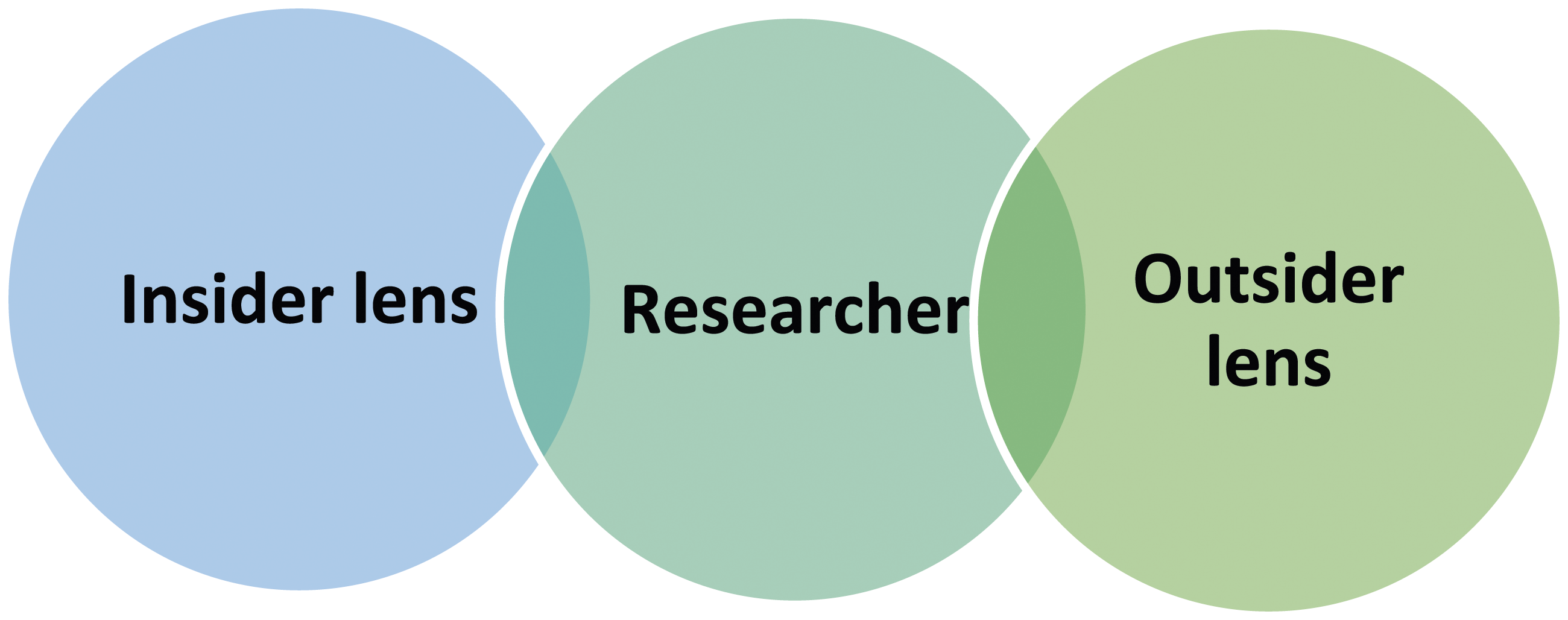
As illustrated in Figure 1, the position of a researcher can be both from an insider or an outsider lens. For example, the researcher can be an insider if they belong to the same community as the participants. However, even though they belong to the same community, there could be an age gap or gender differences (Yip, 2024). In the same way, Figure 1 attempts to show the overlaps, the researcher could have lived experiences with participants because they have the same nationality. On the other hand, there could be linguistic diversity between the researcher and their participants despite belonging to the same country. When reflecting on their study conducted in Hong Kong, Katyal and King (2014) explained that they were “insiders” professionally to the participants in the educational institutions they researched but were “outsiders” due to the cultural and racial differences.
Through the perspectives of individuals and the specifics of their lived experiences, the field of qualitative research aims to provide insight into an issue (Bourke, 2014, p. 2). Therefore, it is pivotal for research in higher education to bring forth my lived experiences when reflecting on my researcher positionality. Another example can be seen when the teacher is conducting research with their own students; this raises flags related to fit their research agenda. According to Bourke (2014) and Holmes (2020) it is critical to explain the underlying assumptions of how the student-teacher relation would provide unbiased findings and conclusions of the study. These assumptions relate to accessibility as a teacher (Bourke, 2014, p. 5).
My study benefited from the insights I brought through my identity as both insider and outsider to the research context. When I joined high school, in the first few weeks, I felt out of place, had culture shock, and I found adapting to English as a mode of communication between teachers and students challenging. There was constant fear of being unaccepted in the English-language mediated learning high school environment. This resonated with the challenges faced by the students who were participants in my study, placing me as a quasi-insider (Goundar, 2023b; 2023d). From an insider’s perspective, I was able to gain access to undergraduate students and understand educational inequalities that persist in different parts of Fiji Islands.
Milligan (2016) argues that a researcher cannot be expected to fully be an insider or an outsider but takes on different positions depending on their situation. According to Yip (2024, p. 223), the two positions at play for the researcher are not clearly delineated but are fluid and situated within a continuum. This also draws on conflicting views that exist between the participants and the researcher. For example, Yip (2024) assumes that she was an insider when conducting a research with Asian immigrant teachers. While interviewing participants for her doctoral research, Yip realised that one of her participants from Bangladesh considered her an outsider as she was not from a Chinese Asian background like her. Factors such as how the researcher perceives to be either an insider or outsider may not necessarily play out the same way in the field. Therefore, Blaikie and Priest (2019) advise researchers to adopt a learner’s stance by suspending preconceived notions, and engage in understanding participants’ contexts.
Benefits of Being an Insider
Researchers need to be conscious of their position in relation to the participants under study (Yip, 2024). Positionality in terms of how the participants can benefit from the researcher being an insider is appropriate to include as it provides clarity in identifying the various factors that are encountered in a qualitative research process. Adding to the study’s robustness was my status as an academic and, therefore, as a quasi-insider among the study participants (Goundar, 2023d). Being a quasi-insider, I had familiarity with the culture and languages as a Fiji Islander. More importantly, my status as a local gave the participants an opportunity to engage freely and voice their views without worrying about criticism (Katyal & King, 2014; Milligan, 2016). Being an academic researching his own students and my privileged position as someone who worked for a reputed institution, Green Lantern University, allowed me to reach out to students from all parts of Fiji Islands. This might not have been possible if I was not in academia. Hence, Yip (2024, p. 228) states there are both positives and negatives of insider and outsider positions.
Katyal and King (2014) highlight that being an insider may prove to be advantageous as familiarity encourages participants to feel less restrained and more willing to speak. On the contrary, Shah (2004) disputes that familiarity might impose a risk where researchers may assume answers and not probe deeper into the response. However, due to my position, I had unique insights into making improvements and recommendations based on findings relating to academic English written proficiency and educational inequalities (Goundar, 2023d). Although this could also be achieved by an outsider, I had the privilege and opportunity to follow through with these recommendations at Green Lantern University. In the above example, cultural acknowledgement is significantly highlighted when discussing the insider lens. I show the relationship between the research objectives and their significance to the institution where the study was conducted. Masters, Doctor of Education, Doctor of Social Work, Doctor of Teaching English to Speakers of Other Languages, and Ph.D. candidates carrying out research in their own institutions can take a similar approach.
Researcher’s Educational Background
Another way to depict the outsider context is by acknowledging the educational background of the researcher. To illustrate, I was both an insider and an outsider in the context of being a Fiji Islander and my cultural background. I belonged to some part(s) of the country, but I am an outsider in others. For instance, my primary and secondary education took place in a semi-urban part of the western region of Fiji Island. This restricted any ontological assumptions I may have made, as I did not have the same background knowledge as the participants in my project (Goundar, 2023d), who came from various urban, rural and island schools. In such a context, I was effectively an outsider in terms of cultural and education background (Goundar, 2023d). I point out the educational background as factors that attribute to the outsider lens. This is pivotal to a study as it goes on to provide insights that would be relatively new for the field (Holmes, 2020). These insights can include findings that the investigator might not have anticipated.
Further, the insights I have provided in this paper may not have been noted in the existing literature as well. Even religious backgrounds can provide insights into where a researcher is considered an outsider (Sanghera & Thapar-Björkert, 2008). An individual’s values and beliefs are shaped by their political allegiance, religious faith, gender, sexuality, historical and geographical location, ethnicity, race, social class, and status (Holmes, 2020; Lowndes et al., 2017). Being an outsider to these factors can be intuitive. For example, I attended multicultural schools where all religions were accorded the same status. However, some of the participants in my study attended religious faith-based education institutions. Hence, insights into the way teaching and learning took place in those settings would be different from my own experience.
Gender Consideration
The other significant factor as an outsider relates to gender (Bourke, 2014) which plays a pivotal role in how the study is informed from various perspectives. For instance, earlier in this paper, it was pointed out that I am a male whereas most of the participants in my study were females. Therefore, in my thesis I provided clarity on positionality in relation to gender using the outsider lens. I am an adult male academic who wanted to investigate issues impacting young people who were not of my generation or age group. This put me in an outsider’s position as I did not have the participants’ lived experiences. Moreover, as a male I lacked insight into the way education is viewed and experienced by female students. I could not assume that the issues faced by males and females in Fiji Islands were the same. Due to my gender, my status was that of an outsider for female participants in the study (Goundar, 2023d). Since I was a male, I lacked the lived experiences of female participants. Therefore, the experiences of female participants gave more insight to my research.
According to Bourke (2014), the research interest of a researcher is the lived experiences of the participants. Like the example on the educational background of the researcher, the gender factor in the preceding example provides clarity on the outsider lens. One of the elements that I did not account for was those participants who did not identify as a male or female including those who would have preferred not to say anything about their gender. Those who did not identify as a male or female would have had a different lived experience with Fiji’s educational system. My study (Goundar, 2023c) could have benefitted from their insights as that would have contributed to the recommendations of language education policies in the study.
Balance of Power
Dhillon and Thomas (2019) sate that a researcher’s positionality is multidimensional and influenced by the power relations between the researchers and their participants. Since the power dynamics are subject to questioning, a researcher should be precise in their positionality when explaining how the balance of power between the researcher and participants play out. Clarifying this in earlier stages of the study will leave less room for any form of dominance between the parties. The following example illustrates how balance of power can be framed in a thesis: During the data collection stages of my project, my status was that of a doctoral researcher from the Howard State University (Goundar, 2023d). I was aware that the students knew me as one of their lecturers and that relationship does not automatically disappear. However, to make the students comfortable with my position as a doctoral candidate, two strategies were used. First, I carried out informal chats and casual talks during the students’ breaks. This helped the participants to be at ease with me and ask questions about the research without hesitation (Yip, 2024). I also explained to them that participation was on a voluntary basis which assured them of no obligations towards me or the research. I positioned myself as an outsider, and the study participants were not students who I directly taught but from the university I worked at.
The relationship between the researcher and the participant is a legitimate factor (Yip, 2024). For example, some participants in the doctoral research conducted by Yip (2024) engaged in her study out of goodwill and personal reasons. One of her participants was a mutual acquaintance while another participant was interested in her workplace which were some of the reasons for participation. The participants in my study were informed that they could leave the study at any point in time. Leaving the study would not subject them to being treated unfairly. However, none of the participants left the longitudinal study during the one year of data collection (Goundar, 2023d). Here, the researcher specified how the balance of power came into place during the data collection phase. This also illustrated the point that a researcher’s position from the commencement of qualitative research until its completion needs to be declared in different stages. For instance, the reflections show the data collection process, signifying how to recruit participants but allowing the individuals full power so that the data is not influenced (Ozano & Khatri, 2018; Wilson et al., 2022). Giving liberty to the participants created an open environment of comfort for involvement (Blaikie & Priest, 2019). They did not feel pressured or obliged to participate in the study just because I was an academic at the same institution they were studying at.
Another point to consider when demonstrating balance of power in the researcher’s positionality is to reflect how one’s environment impacts the study (Dhillon & Thomas, 2019; Wilson et al., 2022). The research should provide the current situation whether it has to do with geographical features or age gaps. For instance, various developments had taken place in Fiji’s education system since I was a primary and secondary school student. Thus, my participants had a better grasp of the contemporary practice and conditions of teaching and learning in the country. The participants had more power as they carried knowledge about education system in rural areas and islands. Significantly, they had age-specific insights since they were from a different generation (Goundar, 2023d). This example identifies how the participants had more power over the research in terms of the rich data. In her reflection Yip (2024, p. 229) also echoes this notion of “balance of power” by claiming that while she possessed the information about the study, her participants owned the knowledge and experience for the study.
Limitations
As I reflect on the study I carried out as a Ph.D. scholar between 2020 to 2023, I realise that perhaps I could have recruited more participants through my network or contacts. These would have been colleagues in other departments or based in other campuses who could have assisted during the recruitment stage. However, that means additional time would have been needed to be put in to do the data analysis, transcribing interviews, and collating the language test results. I also believe that students might have felt that they would get in my good books if they participated in my study under the assumption that they would be in my courses in future. Bourke (2014, p. 7) argues that his positionality as a researcher is not a limitation to the study but meets the positionality of the participants. He points out that the research one engages in is shaped by who the person is. As long as one remains reflective throughout the research process, an individual will be shaped by it and the people they interact with (Bourke, 2014, p. 7; Yip, 2024).
Being a novice researcher the concept of ‘researcher positionality’ was unfamiliar to me prior to undertaking a higher degree by research. Even though I had conducted qualitative research previously, positionality was not considered. Therefore, I am aware that some of the reflections that should have been made regarding the various positions I have might not have been fully acknowledged. These multiple positions can relate to the insider-outsider disclosure, the balance of power or an oversight of a crucial factor as well (Herod, 1999). As Holmes (2020, p. 8) notes, engaging in reflexive practise by articulating ones positionality does not guarantee the research to be of higher quality. It does however indicate that reflexivity should assist in becoming a better researcher (Holmes, 2020, p. 8). I do believe that despite the limitations of my study, through reflections, I will be able to improve on my research designs in future undertakings.
Conclusion
This paper contributes to the ongoing discussion on qualitative research design that explores positionality. The key assertion that Masters, Doctor of Education, Doctor of Social Work, Doctor of Teaching English to Speakers of Other Languages, and Ph.D. candidates ought to frame in a section of their thesis should include a discussion about the researcher’s positionality, the ways in which they are to be seen as an insider or an outsider in the study. There should be a discussion on the power dynamics between the researcher and their participants (Katyal & King, 2014). Researcher positionality is a way to safeguard against any partiality that can be questioned at the conclusion of a study (Wilson et al., 2022). Therefore, researchers ought to have an open mind when conducting a study. They need to account for these factors by maintaining the different positions that provide insights into the research. While recruiting participants, I engaged in informal conversations during breaks at the university with potential participants. This stems as a form of trust building exercise. Yip (2024, p. 230) confirms it is critical to build trust and rapport which allow for interactions to flow naturally rather than being strictly guided by pre-determined questions.
At the beginning of this paper, I clarified that this article provides a practical approach to the concept of researcher positionality rather than a theoretical stand. When my supervisors introduced me to this approach, I was not sure if I could do justice as it was a relatively new concept. However, in qualitative research designs, we need to be specific in clarifying our position in a study (Holmes, 2020). The concepts, as well as how each of these have been depicted in this paper, provide some promising practices to help when novice researchers account for positionality in their own work. There are ways of navigating this task which I have attempted to illustrate in this paper by drawing on examples from my Ph.D. thesis. Future research could investigate how higher degree researchers use ‘researcher positionality' beyond their dissertation and assess their confidence of employing it in the research process.
Footnotes
Acknowledgments
I would like to acknowledge my Ph.D. supervisors; Associate Professor Finex Ndhlovu and Dr. Arvind Iyengar from the School of Humanities, Arts and Social Sciences, at the University of New England, New South Wales, Australia. At the eleventh hour of my thesis submission, they brought the concepts discussed in this paper which allowed me to reflect on how I carried out the research project. I have always credited Finex for taking Ph.D. candidates out of their comfort zone and making them think. Writing the researcher positionality was precisely that. I thank Dr. Iyengar for putting across stimulating questions in making the discussion of positionality meticulous in the introductory chapter of my thesis.
Authors’ Contributions
I am the sole author of this article.
Declaration of Conflicting Interests
The author(s) declared no potential conflicts of interest with respect to the research, authorship, and/or publication of this article.
Funding
The author(s) disclosed receipt of the following financial support for the research, authorship, and/or publication of this article: This research was completed with the University of New England International PhD Scholarship funded by the Australian Government’s Research and Training Program.