




Abstract
Traditional research on Blackness in education often renders Black people nonhuman (Wynter, 1994). In this article, we formulate Black ancestral text analysis, a qualitative research method in which Black thinkers excavate the ancestral knowledges offered in intellectual texts. Our method rejects the white gaze of counting and condemning Black people in education research by reflecting on Black interiority and analyzing the texts that Black intellectuals produce. This article offers a set of research protocol questions to guide an analysis of how Black thinkers re(cover) un/seen, embodied, and alternative knowledges from multigenre historical and literary texts. Through this qualitative approach, we gather information about the texts, including knowledge about the story, the storyteller/storytelling, and the storage (the archival collection). Further, through deep meditation, we come to understand ancestral knowledge, or alternative forms of knowledge when reflecting on the un/seen and the silences in texts. Black ancestral text analysis emerged from a curiosity to explore alternative forms of knowledge and recovery in education research. We present an example of this ancestral knowledge excavation process using Wynter’s critique of the inner eye, school curriculum, student activism outlined in news articles, and Alvin Ailey’s (1960) “Revelations.” We conclude with a discussion of the communal obligations and ethical commitments of abstracting alternative knowledges within Black education research.
Keywords
Education researchers must center Blackness by using a multifaceted/multigenre approach to incorporate the complexity of Black livingness, waymaking (Tolbert, 2020), and praxis (Kershaw, 1992; McKittrick, 2021) into their study of Black lives. Historically, knowledge systems that recover Black historical pasts and Black educational histories use rigid data sources and archival data analysis to understand early Black life (Kershaw, 1992). Yet, the recovery of historical documents from archives is often recovered from those in power (Trouillot, 2015). Specifically, when trying to recover the stories of our enslaved ancestors, many of the surviving sources (e.g., ledgers, bills of sale, and ads for runaway slaves) reflect the words, thoughts, and logic of the enslavers.
Historical memory in archival collections is fragmented and limiting, requiring alternative gazes (Fuentes, 2016; Hartman, 2008) and alternative qualitative methods (Okello & Duran, 2021) to expand the reach and possibilities of our knowledge. We extend these methods of research on archival memory to include historical archival collections, but also to consider textual documents like literature, art, and songs that are not necessarily historical. Archival documents alone limit our understanding of our enslaved ancestors and distances us from the messages they convey through their stories and modes of storytelling. One way we propose to examine early understandings of Black stories and Black humanity is through an analysis of multigenre texts by combining Black studies methodologies with critical content analysis (McDougal, 2017; Short, 2017; Johnson et al., 2017). This kind of methodological merger allows us to formulate a qualitative approach for re(cover)ing ancestral knowledges in Black education research. Our formulation is a refusal of traditional and Westernized research methods (McDougal, 2017) that cannot fully grasp the magnitude, uniqueness, and complexity of studying Black life and livingness in education.
Considering the afterlives of slavery as an entry point (Hartman, 1997; Sharpe, 2016), we are interested in slavery’s impact on education (ross & Givens, 2023). In doing so, the research methods and sources in this article do not necessarily reflect a single point in history. Instead, we draw from material that encompasses the themes of Black freedom struggles in education to understand ancestral knowledge and un/seen messages on Blackness, humanness, and education embedded and embodied within multigenre texts. Therefore, the purpose of this article is to formulate a qualitative method we call Black ancestral text analysis. To do so, we foreground this formulation by meditating on internal nudges, the inner eye, ancestral knowledges, Black studies methodology and embodied knowledges, and critical content analysis. Next, we provide an overview of our analytic protocol (Figure 1), illustrate how we applied it to our own work, and describe the communal obligations and ethical commitments for using this qualitative method. Finally, we reflect on the benefits of Black ancestral text analysis within Black education research. Bookmark Protocol for Black Ancestral Text Analysis.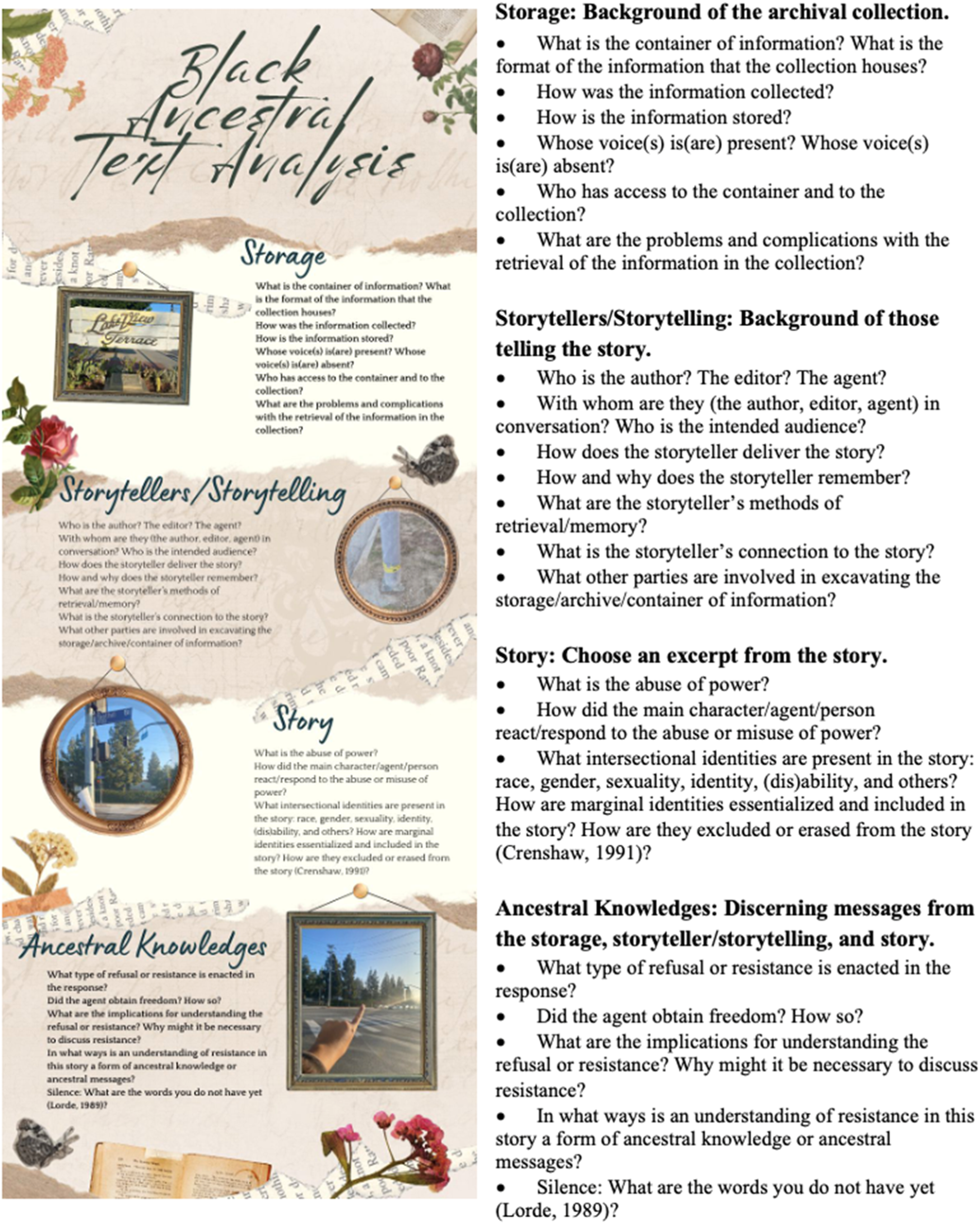
Internal Nudges: The Evidence of Things Un/seen
Two newspaper articles outline instances in which teenage students reclaimed their understandings of their history, and demonstrated agency when someone in authority mishandled their historical legacies. We shift our gazes from the articles themselves to reflect on the students’ enactment of agency due to an internal warning they felt or experienced.
In 2015, Coby Burren sat in a high school geography class in Pearland, Texas, perhaps flipping through the unit on migration in the textbook (Isensee, 2015). Burren’s teacher assigned the class to study the map of migration patterns in America. Perhaps Burren felt uncomfortable reading, “The Atlantic slave trade between the 1500s and 1800s brought millions of workers from Africa to the southern United States to work on agricultural plantations” (np). Burren noticed the error made by McGraw Hill, a major textbook publisher and distributor of K–12 textbooks across the U.S. Instead of using the correct term, “enslaved people,” the textbook described them as “workers.” The implication suggests that African people willingly crossed the Atlantic for paid jobs; the truth is that enslavers trafficked, tortured, raped, beat, forced them to work, and oppressed them. We imagine this caused Burren to question something that he knew was false.
A few years later, another unnamed high school student in Birmingham, Michigan, experienced a different revelation, but one that was similar in message (Pratt, 2019). After receiving the syllabus for an African American studies class, this student noticed that the primary texts used to teach the civil rights period were the film Boyz n the Hood (1991); a documentary about the Bloods and Crips gangs; and Michelle Alexander’s (2012) The New Jim Crow. In the face of backlash for his thoughtless exclusion of stories of Black excellence and accomplishments, the instructor, a white male, attempted to justify his selections (Craig, 2019).
Both of these Black students wrestled with internal tensions after reading the blatant misrepresentation of their histories. As a result of that tension, they showed the texts to their mothers (Fernandez & Hauser, 2015). We believe this internal tension was the result of unseen warnings and a source of wisdom to the students. We contextualize these warnings and wisdoms as ancestral knowledges. This qualitative study also examines the internal nudges that happen when a Black student encounters a misrepresentation of their history in school. The two incidents recounted here made national news. Connecting these examples, we believe the internal nudges are material evidence of ancestral knowledge that warrant interpretation. Sylvia Wynter (1994) conceptualizes the inner eye to discern seen and unseen racial dominance and subjugation. In this paper, we reclaim the internal gaze as our own cultural compass to explore and interpret internal nudges activated by reading and analyzing texts, broadly defined.
The Inner Eye: Internal Gazes and Embodied “Text”
Sylvia Wynter’s (1994) “No Humans Involved: An Open Letter to My Colleagues,” is an eloquent warning to her faculty colleagues not to be so enmeshed in the academy as to contribute to the cultural prescriptions of humanness, especially when academic work invests in the “optimally white, but optimally middle-class” (p. 2) capitalistic gaze. She goes on to express wisdom about subjective understandings of the “inner eye,” to interrogate “our responsibility for the making of those ‘inner eyes’” (p. 2), and to posit that white people use their inner eye to discredit Black humanity.
Wynter (1994) mentions the “inner eye” 18 times in this 15-page letter. She metaphorically describes the body as a text where Western logic uses internal gazes to prescribe humanness in proximity to whiteness and middle-class status. As Asante (2006) affirms, “Western concepts of society and beingness are not naturally occurring but designed and maintained by discourse and symbolic rules” (p. 647). Reading the body as text is common in research studies. However, unfavorable scrutiny accompanies the reading of Black bodies (Mobley, 2014; Nash, 2014; Strings, 2019; Wynter, 1994). Although Wynter (1994) discusses the connections of the inner eyes to North Americanness and humanness, describing the making of a system that classifies one as human using Western logic, we want to interrogate the function of the inner eyes in qualitative research, but more importantly, in Black studies and education studies analyzing texts, as documents. We agree that the inner eye prescribes the body as a text. But what does the inner eye, or inner guidance and ancestral knowledge, offer when the internal gaze critically interrogates power? Using Wynter’s logic, how can the inner eye be used to extract ancestral messages from texts? In this qualitative study, we interrogate power in texts or documents, countering anti-Blackness in education research. By shifting a critical gaze to less visible texts, the subaltern, an analysis of source material, we begin to discern a fragmented, but fuller, picture of Black humanity.
Utilizing Wynter’s conceptualization of the inner eye, we merge the criticality of Black studies methodologies with education studies to excavate warnings and wisdom from texts. Following Wynter’s reading of the body as text, we turn to documents. These texts reflect the lives, intellect, and creativity of Black thinkers. This qualitative research method requires an analysis of various types of texts. We will analyze texts outside the constraints of chronological time, space, and genre.
When defining texts, Short (2017) cites Vasquez (2012): “Texts are never neutral as readers can revise, rewrite, and reconstruct texts to shift and reframe meaning” (p. 1). Texts are also written from a particular perspective to convey certain understandings of the world with the language of the text and the narrative strategies that position readers to receive the authors’ meanings. Because of this positioning of text and reader, their respective perspectives should be questioned. Therefore, this concept of the critical requires a questioning stance when reading the word and the world (Freire & Macedo, 1987).
Combining Short’s definition of text with Wynter’s close analysis of the inner eye and the body as text, we think of text as documented materials, such as songs, memos, emails, research papers, correspondence (Rautio, 2009), footnotes, poems, art pieces, acknowledgment sections, tweets, and reference lists. Our qualitative research method extends a set of protocol questions to aid readers in interrogating messages within texts. These questions offer a starting point for research in the realm of ancestral knowledge. Later in this article, we demonstrate our analytic process by using one text from our larger study to display the qualitative method of mining sources for ancestral knowledges, wisdoms, and warnings.
Ancestral Knowledges: Our Foundation
This qualitative method turns purposefully to ancestral knowledge. Toni Morrison (1984) calls ancestral knowledge an acceptance of our supernatural, discredited knowledge. Because Black people were discredited, humanless, and personless, what we knew has also been discredited. Further, Morrison (1984) defines the ancestors in literature as “sort of timeless people whose relationships to the characters are benevolent, instructive, and protective, and they provide a certain kind of wisdom” (p. 401). In his poem, “Unseen Ancestors,” Animashaum (2009) describes the unseen ancestor as, “quiet spirits, alive in the belly of the wind, whistling their old songs when it is/howling:/At times telling us stories about themselves: Especially, when we’ve forgotten/tales of our birth” (np). We believe our ancestors send warnings and shares wisdom, which a finely tuned ear can hear. Roane (2018) suggests, “These alternative life-worlds are imprinted, for example, in sayings, greetings, songs, novels, and films that afford a different vantage on loss and, ultimately, articulate an alternative grammar of living” (np). This begs the question of how education research, foundational in precision, accounts for alternative and ancestral knowledge. If Blackness is rooted in ancestral knowledge, then education research must turn to this form of knowledge to rupture precision in scientific research.
Because social death (Patterson, 1982) is imminent in Black communities, our speculative imagination, storytelling, and spirituality become the gateway to new futures. Alternative knowledge is essential to Black waymaking in a society that has historically exploited the labor, genius, and knowledge of our ancestors (Gordon, 2011). In early American history, laws were written to exclude the Black phenotype, and deprive proximity to Blackness of the right to personhood (Williams, 2007). Today, the inner eye arbitrarily determines humanness to Black people. This freedom struggle is unfinished, and education research has a responsibility to incorporate all knowledge systems, especially those that researchers have discredited (Morrison, 1984). Because the world ends regularly for Black people, we must “craft otherwise modes of living” (Roane, 2018, np). This is vital for us to thrive, not just to survive. Because alternative knowledge is imperative for recouping, reconciling, and recovering stories of Black life and livingness, we formulate Black ancestral text analysis as a methodological response. This qualitative research method honors ancestral and embodied knowledge (Dei, 2017; McKittrick, 2021; Nagatomo, 1992) as central to the exploration of Blackness unbound by spatial and temporal limitations.
Black Studies Methodology and Embodied Knowledges
Black ancestral text analysis adapted a Black studies methodology to interpret Black life and argue for the use of alternative research approaches to understand Blackness. Black studies, or Africana studies, is the “critical and systematic study of the thought and practice of people of African descent in their past and present unfolding” (McDougal, 2017, p. 4) Black studies methodology, as defined by McKittrick (2021), is the practice of studying Black livingness and Black ways of knowing centering the ways “Black thinkers imagine and practice liberation” (p. 16). She argues that studying Black ways of knowing cannot be quantified with precision as scientific research requires. In describing a Black studies aesthetic, she writes, “I am asking for a mode of recognition that does not itemize-commodify Black liberation, and Black embodied knowledge” (pp. 16-17). She frames Black knowledge, which is sometimes embodied and unmeasurable, as “disruptive work” (p. 16) that Black scholars engage to write critically about the thoughts and practices of the people of the African diaspora. As such, Black studies methods help to reveal embodied knowledge in the texts, per the guiding inquiry questions of the study. Black ancestral text analysis uses a combination of sources to explore and expand the concept of ancestral knowledges and critical analysis. Drawing from historical documents and literary sources allow us to use historical and imaginative documents to understand the fraught Black histories linked to chattel slavery within the African diaspora.
Critical Content Analysis
In focusing on the materialization of embodied knowledges, we formulate our method of Black ancestral text analysis by returning to McKittrick’s (2021) guidance on mining ancestral knowledges and bridging it with Wynter’s (1994) inner eye. This bridge allows us to qualitatively analyze sets of multigenre, Black intellectual texts that cannot be quantified with the precision required by scientific studies (McKittrick, 2021). As described by Short (2017), “in order to challenge the conditions of inequality” the critical content analysis of a text requires reading from a “critical stance” that locates power in “social practices” (p. 1). Black ancestral text analysis also engages critical content analysis to shift the gaze to those less visible (Fuentes, 2016; Kim, 2016). More specifically, we conducted textual analyses by reading from a critical stance to recognize and highlight the embodied knowledge of the texts in this multigenre study.
Black ancestral text analysis adapts critical content analysis (Neuman, 2009; Short, 2017; Utt & Short, 2018) to enact Black studies methodology. Our adaptation guides researchers on analyzing sources that may contain hidden messages within source material. Text-based data sources that can be analyzed through critical content analysis includes, but is not limited to, physical material (i.e. books, letters, newspapers, magazines, articles, and transcribed speeches) or digital material such as films, television sitcoms, websites, emails, and social media threads. Black ancestral text analysis focuses on details, analogies, and metaphors that go beyond the facts to understand “latent, subtextual, or beneath-the-surface meaning in texts” (McDougal, 2017, p. 197). Drawing on ancestral knowledge, Black studies methodology, and critical content analysis, we stand on the shoulders of intellectual ancestors and elders to formulate Black ancestral text analysis as our contribution to qualitative methods for Black education research.
Black Ancestral Text Analysis: A Contribution to Education Research
The American educational system reflects the lives of those in power. Text selection, stories, and curricula perpetuate the master narrative of white and Westernized patriarchy, conceiving Black folks as “other,” deviant, and humanless (Jenkins, 2021). When Black students encounter texts that do not reflect their lives, they learn to internalize anti-Blackness. The disparities are even more complex given the intersectional identities of Blackness (Crenshaw, 1991) in education, including the criminalization of Black girls (Morris, 2016; Nyachae & Ohito, 2019), Black queer youth (Love, 2017), Black boys and disability (Proffitt, 2022) and Blackness and ableism (Boveda & McCray, 2020). Anti-Blackness is “the cultural disregard for and disgust with Blackness” (Dumas & Ross, 2016, p. 12). Love (2023) names frankly in her editorial, “American Education Hurts Black Students”: For millions of Black children in our nation’s public schools, suspensions, police brutality, neglect, zero-tolerance policies, a lack of Black teachers, and educational trauma make up the school day. This is not a secret. American educational reform was never designed with our interests in mind. Instead of creating better learning conditions for Black children, school reforms punish us for being Black.
Black studies emerged to refute Western logic and reimagine the study of Black life, education, and research considering alternative epistemologies (Asante, 2006; Carruthers, 2006; McKittrick, 2021; Myers, 2023). Black studies rejects and critiques the limitations of Western scientific logic and civilization (Mills, 1999; Myers, 2023; Robinson, 2020; Stovall, 2023). Therefore, studying the power structures that create the anti-Black logic and limitation system that diminish Black life is a vital starting point for qualitative research. Black studies education scholars call for a closer look at Black studies and education as a combined field of study. ross and Givens (2023) think at the intersection of the fields of Black studies and education, urging for a field of study that is more accountable to the “past that meets the present and future with renewed conceptual clarity” (p. 150). This intersection foregrounds the ways “slavery and its afterlives continue to mark Black learners” (p. 150). The marks of colonialism and slavery on Black learners is where this article begins its intervention, thinking also of Hartman’s (1997) explanation of the ways in which the afterlife of slavery still haunts the field of education (Gordon, 2011). We use this lingering presence to conceptualize Black ancestral text analysis. Archive construction, Black education studies, and ancestral knowledges collectively ground this research method. This method requires a finely tuned eye to see and discern varied wisdoms and warnings that ancestral knowledges offer to us through Black intellectual texts.
On Reflexivity, Positionality, and Co-Construction
Following Bundy et al. (2023), we begin by situating our positionality within the traditions of Black intellectual thought in education (Grant et al., 2016) and Black archival practice (Sutherland & Collier, 2022) to acknowledge what brings us–Black women, sistah scholars, and educators with connections to Detroit, Michigan–to this moment of formulating Black ancestral text analysis as a method for mining ancestral messages from archival texts on Black living, waymaking, and praxis in education research. We develop a qualitative approach that draws its analytic techniques from critical content analysis (Neuman, 2009; Short, 2017; Utt & Short, 2018). Using this qualitative approach while discussing our positionality and desires for merging Black studies and education makes it possible to co-construct a methodological pathway to re(cover) ancestral messages in all texts. We embarked on this research as educators with professional and scholarly expertise from our work in K-12 and higher education.
Latoya M. Teague studied slave narratives for evidence of her ancestors’ literacies utilizing the oral testimonies of their freedom struggles in the Work Projects Administration narratives of the formerly enslaved. This sparked an interest both in the words they spoke and in the messages behind those words. Mariama N. Nagbe studied how the afterlife of slavery continues to haunt historically white institutions (HWIs) of higher education. By critically examining the ways HWIs narrated their relationship with Black intellectuals over time, she recognized peculiar patterns of selective forgetting. Universities obscured ties between their founding and chattel slavery. Today, those university narratives still flatten their antagonistic relationship with Black people. While working together on separate archival studies, we often returned to ancestral knowledges.
In this article, we formulate Black ancestral text analysis to mine ancestral wisdoms and warnings from multigenre documents that archive broad conceptualizations of Black intellectual texts on our livingness, waymaking, and praxis. Black education archives are an ancestral meeting-place where we locate, learn, and discern ancestral knowledges transmitted from one generation to the next as a continuum from past to present to future. In doing so, we become vessels through which this method threads a genealogy between intellectual ancestors (Carruthers, 2006; Morrison, 1984, 2019), intellectual elders (Carruthers, 2006), intellectual descendants’ (Louis, 2002, p. 652), and back again, making this a praxis of re(cover)ing intergenerational revelations in Black education research.
Guiding Protocol and Methodological Considerations
Understanding the historical origins of an archival collection, its archivist(s), and each storyteller’s background provides critical contexts for mining ancestral knowledges from those texts and silences embedded within its content. Therefore, Black ancestral text analysis is informed by attending to the silences and Wynter’s (1994) critique of the inner eye. To develop this guiding protocol, we began with a preliminary read-through of digital and physical material as archival sources to select the story, storytellers/storytelling, and storage as our initial three content categories. The purpose of this read-through was to familiarize ourselves with the structure and organization of the texts and identify any recurring and significant themes. Through further questioning and returning to the texts, ancestral knowledge emerged as the fourth category that maps the un/seen. The un/seen shows up as lingering curiosities that are best unpacked by listening to the silences of meditating on a source. Lorde (1989) articulates silence as a mode of understanding emphasizing our responsibility to listen for what silence teaches us. She reminds us of the obligation to make silence loud, especially when our silence perpetuates a system of hyper-invisibility. This final part of the protocol is an attempt at listening for the ancestral knowledge we believe emerges from silence.
The protocol offers a four-part set of questions for analyzing all source materials, often referred to as texts. At the heart of Black ancestral text analysis is a list of essential questions that arose while searching for texts: Where is the story housed? What does it contain? Who is telling the story? What is the story? These questions generated several sub-questions, which helped us develop a guiding protocol, later adapted into a bookmark (Figure 1) as an inquiry process to apply Black ancestral text analysis to source material derived from Black education archives.
The four parts of the Black ancestral text analysis protocol consist of the storage, storytellers/storytelling, the story, and ancestral knowledge. Each part is arranged in that order considering that this method for querying sources reveals multiple layers of interpreting the source when reexamining them. First, the storage looks at the collection where individual texts are found. Second, the subsequent section of the protocol uncovers information about the storytellers. This set of questions provokes further interrogation of the actors affiliated with the story’s construction. Third, the story interrogates power by looking at how the storage and the storytellers influence the narration (i.e. “storytelling”). The last and most critical part of the protocol, ancestral knowledge, departs from critical content analysis to pay attention to the silences within texts. The foundation for Black ancestral text analysis returns to Wynter’s (1994) critique of the inner eye as a pathway to understanding the silences that Lorde (1989) uplifts. In Black education research, our protocol addresses McKittrick’s (2021) urge to mine ancestral knowledges.
To ensure trustworthiness, we underwent a process of inter-coder reliability to identify storage, storytellers/storytelling, the story, ancestral knowledge as content categories, and the sub-questions on our guiding protocol. We made the names of our content categories more accessible to multigenerational audiences inside and outside of academic research settings. Unlike traditional research methods, we do not believe language such as units of analysis or coding systems are accessible ways to convey the prescribed steps for applying the techniques of Black ancestral text analysis.
Applying each step of the analytic protocol for Black ancestral text analysis in the order we prescribe is important for approaching the sources more than once. Frequently returning to each source may reveal new parts of re(cover)ing messages nestled within its content, which ultimately informs the ancestral knowledge section of the protocol. Each of the four parts, arranged in the prescribed order, offers a guiding template for researchers in re(cover)ing a more complex understanding of texts, broadly, but Black texts specifically. This formation process outlines the backstory of how the protocol was conceptualized as a guiding framework to apply Black ancestral text analysis. The protocol questions are as follows:
We applied Black ancestral text analysis to every archival source using this protocol. With these analytic questions in mind, the following section offers an example of applying this method.
Re(cover)ing Revelations: an Illustrative Analysis
When Mariama N. Nagbe was an aspiring professional dancer, Alvin Ailey was one of her ancestral heroes. His choreography for Revelations (1960) transformed her understanding of Black arts as a space for activism and healing. As a teenager, she performed his piece at an event for Black History Month at Madonna University in a suburb of Detroit, Michigan. In 2020, while searching for inspiration to complete her dissertation during the height of the COVID-19 pandemic, she took screenshots of a clip from the opening number of Revelations, then transcribed and superimposed the lyrics from the African American spiritual “I’ve Been ‘Buked” while watching a digital version of this performance (Figure 2). During a freedom writing break with Latoya M. Teague, she wrote while meditating on those lyrics. This meditation evolved into a revelation of ancestral wisdoms and warnings, embodied in the performance of Alvin Ailey’s choreography. A Visualization of Mining Ancestral Knowledge from Watching Revelations.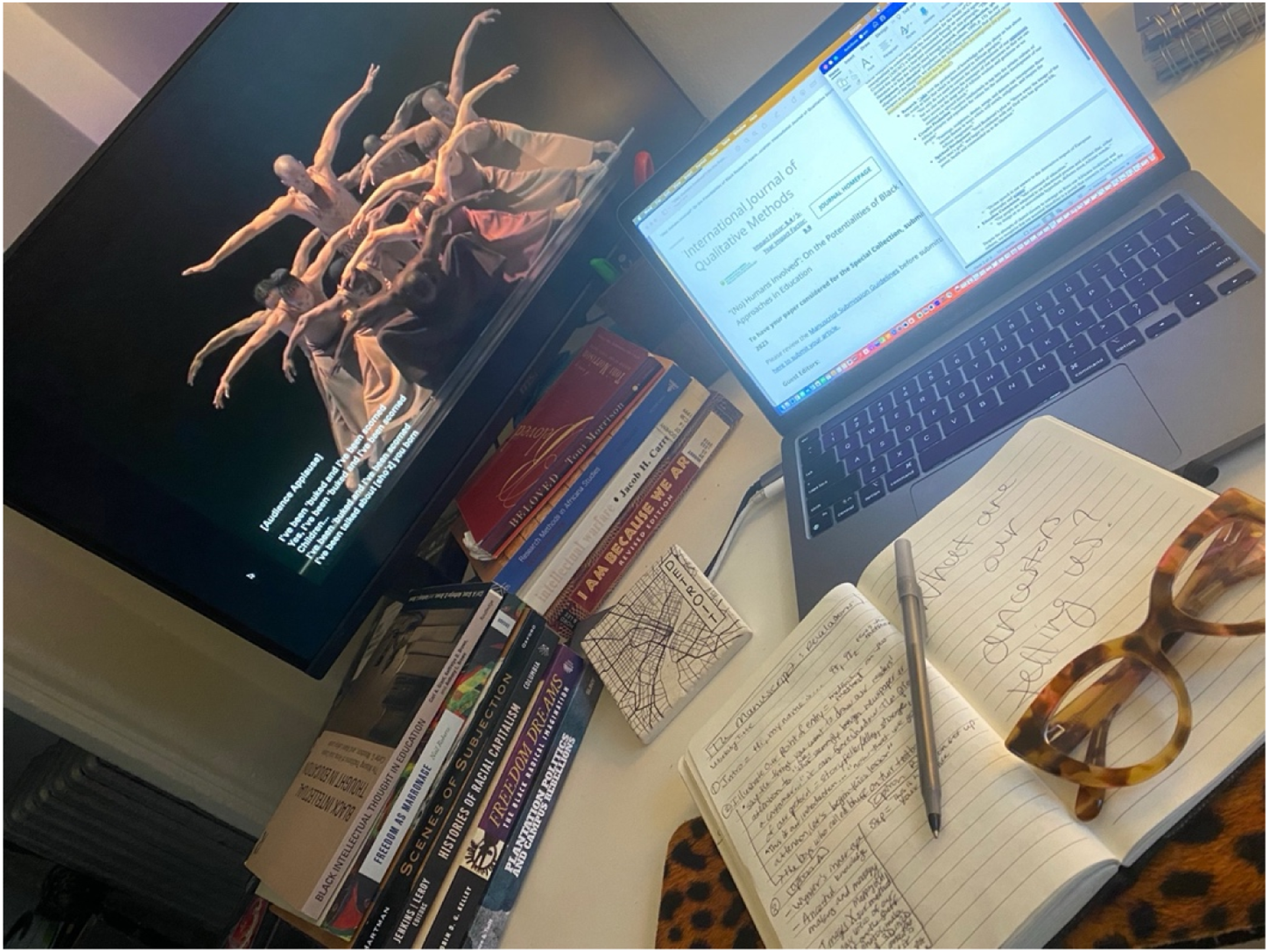
In 2023, we recognize this meditation as re(cover)ing revelations–a double entendre that points to protection and re/memory instead of describing what our ancestors left behind for us as “findings.” This moves us to the set of protocol questions (Figure 1) to analyze key components of the text: storage, storytellers/storytelling, story, and ancestral knowledge. Together, we rewatched the Alvin Ailey American Dance Theater perform Revelations’ opening piece on YouTube (“Revelations-Alvin Ailey,” 2020), and illustrated our process of applying Black ancestral text analysis (Figure 3) juxtaposed with the lyrics to the spiritual “I’ve Been ‘Buked.” I’ve been ‘buked and I’ve been scorned Yes, I’ve been ‘buked and I’ve been scorned Children… I’ve been ‘buked and I’ve been scorned I’ve been talked about [sho’z] you born A Collaborative Table Illustration Analyzing an Excerpt of “I’ve Been ‘Buked.”
Communal Obligations and Ethical Commitments
Qualitative research requires multiple layers of data interpretation, particularly when the data are people. New sources can shape the interpretation of data stories, while the life experiences of researchers have an impact on those interpretations. McKittrick (2021) reminds us that Black studies and qualitative methods are not a science of precision. We further realize that precision, coding, and data render us nonhuman through Western logic. Like Tuck and Yang (2014), we reject settler colonialism in research studies that over-code Black people who are often “hyper surveilled…and made invisible by the state, by police, and by social science research” (p. 811). As such, our method practices care (Hill Collins, 2009) and resists the urge to study people by analyzing documents that do not count or condemn Black people. We find refuge in intellectual or creative renderings of Black brilliance, Black joy (Muhammad, 2023), and Black waymaking (Tolbert, 2020), despite oppressive and anti-Black education systems (ross, 2020) that often code or deem us marginalized, high-risk, or problematic (Brown, 2013; Jenkins, 2021). Tuck and Yang (2014) write, “Refusing the colonizing code of research is an analysis that must come after, before, and beyond coding. It must precede, exceed, and intercede upon settler colonial knowledge production” (p. 812). We believe the analysis of texts guided by the protocol of Black ancestral text analysis offers a qualitative method with Black humanity as a central tenet without the disruptive and inconclusive gaze of settler colonial knowledge production. Our refusal of the colonial gaze (Morrison, 1993, 1998) is a starting place for analyzing texts as an analytical tool rather than as a system for counting, condemning, and often excluding Black people. Our protocol can be used to analyze all forms of text about Black life and Blackness written by Black and non-Black people, giving readers and researchers a tool grounded in Black studies methodologies to ask pointed, defined and intentional questions of archival sources.
We recognize the historical legacies of researchers who laid the foundation for Black ancestral text analysis and all future research. As Robin D.G. Kelley wrote in the foreword for Robinson’s (2020) book, the theorizing of Black Marxism and most theories should be seen as a recognition, not discovery. Black ancestral text analysis lets go of the logic of newness and novelty in Black education studies and embraces our ongoing recovery of what was. Christian (1987) so eloquently reminds us that people of color have always theorized, even when our knowledge production was discredited. As such, recovery is ongoing and results from emancipation as an unfinished project (Sharpe, 2016; Walcott, 2021). We analyze all stories, even those that are anti-Black (ross, 2020), hoping that a systematic interrogation offered in this method alerts readers to ancestral warnings of anti-Blackness in education, curricula, and documents. Interrogating the texts with this set of protocol questions expands our understanding of those texts. However, we believe the stories about and by Black people must unequivocally and unceasingly empower educational research, policy, pedagogies, curriculum design, and practices affecting Black people.
For ancestral wisdom, although we refuse to count Black people, we are intentional about mining the citational practices in education research about Black people and Blackness. We read references and sources as texts and as tools for understanding ancestral and intergenerational Black intellectual thinkers that the text engages. This is not to quantify the number of times that Black thinkers are engaged in the research study but to measure the credibility of a study on Blackness and discern if the researcher does or does not intentionally engage Black thinkers. One way to engage Black thinkers is to cite Black thinkers appropriately. Furthermore, as Black women and thinkers, we are especially keen on looking at citational politics that silence Black women in educational research. As stated earlier, Black archival text analysis is a tool for re(cover)ing both ancestral warnings and wisdoms in qualitative research.
Because westernized notions of scientific knowledge have rendered the ancestral illegible (Morrison, 1988), the questions from our analytic protocol facilitate the mining of textual sources. Answers to these questions are subjective and will vary based on many factors, including the researcher’s lived experiences, knowledge of the source, historical recollection, and other nuanced realities. Despite these variabilities, we believe returning to the ancestral accounts for the un/seen factors and phenomena that traditional education research often obscures. The un/seen, internal gazes are embodied knowledge, which holds space for Black knowing. Therefore, education research must account for alternative forms of knowledge. The looming threat of literal and social death is ever-present; thus, world-building is a necessary factor in our ultimate survival. Those worlds are built in the creative and imaginary realms, and we must turn to the alternative, embodied, and ancestral to know otherwise.
We honor the language in which Black stories are told (Goss & Barnes, 1989; Smitherman, 1996; Toliver, 2022). Black English should never be made to resemble Standard English (Baker-Bell, 2020; Baldwin, 1997; Rickford & Rickford, 2000; Sealey-Ruiz, 2006; Smitherman, 2000). Because oral storytelling, what Giovanni (2023) calls the first Black library, is a precursor to today’s creative, intellectual, and documented Black brilliance, we honor how the story has been passed forward from generation to generation. In this vein, we honor our ancestral lineages of Black intellectuals: those who have passed (intellectual ancestors), those who are present (intellectual elders), and those yet to be born (intellectual descendants) who breathe life and story into vast collections of texts and documents. Through the application of Black ancestral text analysis, meeting these communal obligations and ethical commitments is beneficial in expanding our access to a wider range of knowledge from archival texts.
Final Reflection: What Are the Benefits of Black Ancestral Text Analysis?
This article presents Black ancestral text analysis as a qualitative method for excavating ancestral wisdoms and warnings. An analysis of archival texts, broadly defined, should consider multigenre and intergenerational archival sources in Black education in light of three key components: storage, storytellers/storytelling, and story. Black ancestral text analysis leads to what we imagine as a mining of ancestral knowledge. As such, we offer an explicit bookmark to re(cover) ancestral knowledges, bringing them back to our collective memory and protecting them from harm, erasure, or distortion.
Grounded in methods from Black and Africana Studies, Black ancestral text analysis offers a place for our “inner eye” (Wynter, 1994) to find refuge, fashion our ability to see and discern ancestral wisdom and warnings that fortify our collective selves against the disruption of temporal, spatial, and institutional barriers steeped in anti-Blackness or hegemonic norms of qualitative inquiry. Ancestral knowledge is scientific knowledge. Thus, applying this methodological approach to Black education research is vital in a scholarly climate that allows the devaluing of Black life, knowing, waymaking, and being in and through the P-20 education pipeline.
As researchers, we often bring unanswered questions to our sources. Black ancestral text analysis will equip education researchers with a set of guiding questions to reveal all layers of a source. The protocol’s function as a bookmark benefits Black students and researchers by offering a pathway to locate and discern the ancestral warnings and wisdom within texts. The protocol questions may change depending on whether the archive is physical or digital. This should encourage deeper research into other sources. Overall, this qualitative method requires careful listening to the silences as an entry point for a revelation of ancestral knowledges.
We formulated Black ancestral text analysis from the vantage point of Coby Burren, a Black student attending high school in Pearland, Texas. Another high school student in Birmingham, Michigan, who similarly noted the omission of Black history from an African American studies course that used movies about gang violence as its primary source materials. These students were attentive to the silences of texts that had been assigned and used their inner eyes to interrogate those materials. We commend these young students for having the agency to heed the ancestral warnings and wisdoms whispered to them. What will Black education research methodologies allow us, as researchers, to disrupt if we, like these students, use our understanding to listen to the silences and see the un/seen?
Wynter (1994) criticizes the inner eye for the harm it causes in prescribing humanness on bodies as texts, which often renders Black bodies nonhuman. In this article, we subvert that subjugation and reimagine Black interiority by critically excavating ancestral knowledges in texts. Education researchers who apply Black ancestral text analysis must take Wynter’s (1994) critique of the inner eye seriously and answer the call for qualitative methods to “engender ethical and generative relationality” with Black thinkers (Okello et al., 2023). Black ancestral text analysis offers an entry point to re(cover) the un/seen in education research studies, especially inquiries into Black lives. The lyrics and performance of Alvin Ailey’s choreography to the spiritual “I’ve Been ‘Buked” embodies both ancestral wisdom and warnings. As inheritors of this ancestral genealogy, we have a responsibility to disrupt systems that rebuke, silence, and exploit our genius. Black ancestral text analysis represents the possibilities of education research methods that center and reflect our lives.
Footnotes
Declaration of Conflicting Interests
The author(s) declared no potential conflicts of interest with respect to the research, authorship, and/or publication of this article.
Funding
The author(s) received no financial support for the research, authorship, and/or publication of this article.
