




Abstract
Exercise for people with Prader-Willi syndrome (PWS) is important for their health and wellbeing and can provide opportunities for community participation. However, they may find it difficult to participate in some contexts, such as community gyms because social and environmental barriers in these settings may compound difficulties caused by physical impairments or intellectual disability. This study aims to observe and understand the actions and interactions of people with PWS when they exercise in community gyms. A focussed ethnographic study will be conducted. Field notes will be taken in community gyms where people with PWS are participating in a structured exercise program for six months as part of a randomised control trial called PRESTO. Up to ten participants will be observed, with at least three observations planned per participation during the program. Gym sessions observed will be approximately 1 hour long. Within the framework of interpretive description, reflective thematic analysis will be used to interpret observational data. Our findings will inform how best to support people with PWS to exercise at a community gym. Trial Registration Number: ACTRN12620000416998; Australian and New Zealand Clinical Trial Registry.
Background
Exercise is important for the overall health of people with PWS, particularly for weight management and maintenance of muscle strength (Reus et al., 2012; Shields et al., 2019). PWS is a rare, genetic, developmental disability which affects approximately 1 in 15,000 individuals and is caused by changes on chromosome 15 in the q11-q13 region (Cassidy et al., 2012). PWS affects multiple body systems including the musculoskeletal system resulting in very low lean muscle mass and low muscle tone, and the endocrine system resulting in hypothalamic dysfunction and constant hunger known as hyperphagia (Benarroch et al., 2007; S. Cassidy et al., 2012). People with PWS typically need support in the community because of food-seeking and other behavioural difficulties (Stanley, 2014). Cognitive impairment ranging from mild to moderate intellectual disability and social communication impairments are common among people with PWS, and can make establishing social relationships (Dimitropoulos et al., 2001; Whittington & Holland, 2011) and social interactions difficult. The physical, learning, language, social and behavioural impairments associated with PWS can create barriers to participation (Rubin & Crocker, 1989; Simplican et al., 2015) and make it more difficult to exercise (Shields et al., 2012).
Physical and social environmental barriers may compound the effects of impairments on the ability of people with PWS to exercise (Dykens, 2014). For example, the equipment in gyms is usually designed for adults of average weight and height, and this may mean a person with PWS cannot use the equipment because they are typically shorter and heavier (S. Cassidy et al., 2012). Other examples of potential physical environmental barriers include high noise levels and inaccessibility of bathroom facilities. The social context can also help or hinder a person with PWS to exercise. Social context, as defined by Batorowicz et al. (2016), refers to an individual’s subjective experiences of places, activities, people and objects where the person-environment interaction occurs. Experiences that could make people with PWS feel unwelcome or that they do not belong in the gym include words or actions that aim to exclude or invalidate their being there. For example, people with disability have reported experiencing being stared at and ignored in the gym, resulting in feelings of otherness (Richardson et al., 2017a). It is important to understand the relationships between impairments and social contexts for people with PWS as this knowledge may inform strategies to mitigate participation barriers in gym settings.
Exercising at a gym is likely to be a meaningful activity for people with PWS as it affords the opportunity to increase community participation. Participation is defined by the International Classification of Functioning Health and Disability as ‘involvement in life situations’ (World Health Organization, 2013). Participating in exercise programs in a community gym can encourage a sense of belonging and empowerment (Richardson et al., 2017a) and can improve physical and social wellbeing and provide psychological benefit among people with disability (Richardson et al., 2017b). However, most exercise studies involving people with PWS have been completed either at home or in a clinical setting (Reus et al., 2012). One qualitative study has described the experience of physiotherapists supporting people with PWS to exercise in community gyms (Shields et al., 2020) but it did not focus on the social context or the social interactions that took place. Understanding social interactions that occur in a gym will allow for a deeper understanding of the social context, which in turn may help facilitate a better understanding of how to support people with PWS to exercise in the community. Hence, the aim of this study is to observe the actions and interactions of people with PWS when they exercise in the social context of a community gym.
Methods
Context
This ethnographic study is embedded within a randomised control trial (called PRESTO) that is investigating the effect of exercise in community settings for people with PWS (Shields et al., 2022). The trial will be conducted across Australia with three assessment sites in Victoria, New South Wales and Queensland. Trial participants are randomly allocated to either an experimental or a control group. Participants will exercise at either moderate (experimental group) or low (control group) intensity at a community gym close to where they live, twice a week for 24 weeks under the supervision of an exercise professional (see Figure 1). Trial design edited from Shields et al. (2022).
Qualitative methods are increasingly used in clinical trials. They are important for understanding the experiences of participants and how this may affect implementation and uptake of an intervention (O’Cathain et al., 2013). A systematic review of qualitative methods used within randomised controlled trials found most involved interviews and very few used either participant observation or ethnographic methods (O’Cathain et al., 2013). Qualitive methods such as ethnographies have been used previously to understand the social context of people with intellectual disability (Clement & Bigby, 2009). To address the aim of observing and understanding the actions and interactions of people with PWS when they exercise in the social context of a community gym, a focussed ethnography will be completed (see Figure 2). The process of an ethnographic framework, modified from Crotty (1998).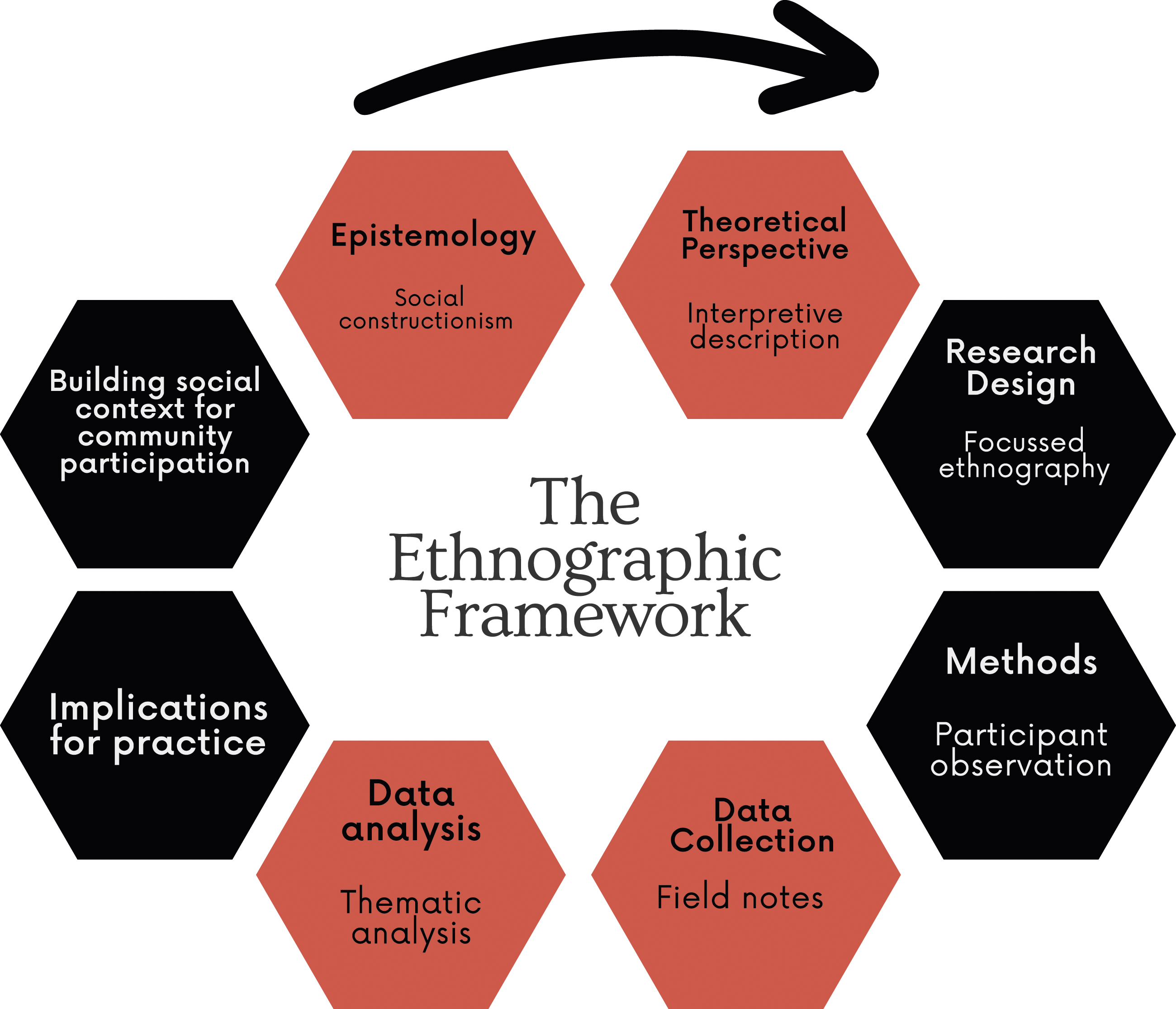
Epistemology
Epistemology describes the theory of knowledge and how we come to know reality (Krauss, 2005). Social constructionism posits all individuals view situations and objects differently and that our reality is constructed around our individual perceived realities through our interactions with our environment (Galbin, 2014). This differs from constructivism which relates to how individuals themselves will create meaning rather than how meaning is created through interactions (Crotty, 1998). Both epistemological theories acknowledge there are many different perceptions of reality. However, they differ in that social constructionists see realities being created through interactions with the environment and constructivists see realities as being created from within the person. This ethnographic study will be conducted through the lens of social constructionism.
Theoretical Perspectives
The theoretical perspective is used to further inform the methods and bring deeper context to the rationale of the epistemology (Crotty, 1998). The foundation of interpretive description is to use data generated from a qualitative enquiry to inform change in practice, rather than to develop theory (Thompson Burdine et al., 2021). Interpretive description aligns with our chosen epistemology in that multiple realities and perspectives can be observed. With this perspective, we acknowledge that we give our own meaning to the observations taken during data collection.
Study Design
The overarching aim of any ethnography is to interpret what is happening in a society or community. Ethnographies typically use a variety of methods to describe a social phenomenon, and often include the researcher being immersed in a setting or culture and observing a large number of people over a long period of time (Bikker et al., 2017; Reeves et al., 2008). Focussed ethnography, however, can be conducted without lengthy immersion in a setting, and in contexts where people do not have a strong or ongoing connections to a community. Thus, it is well suited to this study where participants exercise in a community gym on a short but regular basis and can be observed intermittently during a 6-month trial period. The use of focussed ethnography methodology will enable a deep and intimate understanding of people with PWS in community gym settings (Knoblauch, 2005). Accordingly, this study will record a short-term phenomenon (exercise participation) within a specific setting (a community gym) rather than observing a cultural community over an extended period. Participants will be observed to ascertain what happens when they exercise at a community gym and their interactions with others in that setting. Data will be collected in the form of field notes, providing rich descriptions.
Sampling and Recruitment
The sample will be a subset of all participants with PWS in the clinical trial including up to 10 participants who are enrolled in the trial and who are living in Victoria. Participants may be allocated to either the trial’s experimental or control group as both groups will complete a supervised exercise program at a community gym. The participants will vary in age and gender reflecting the broader inclusion criteria of the trial (13–60 years old). Consent to take part in this embedded ethnography study will be obtained as part of the consenting processes for the trial (see ethical considerations section below). As participants have already been through an extensive screening process, no additional screening questions or consent procedures will be required.
A member of the research team (CS) will contact by telephone the person who gave consent for the trial. This might be the participant with PWS themselves or their parent or caregiver. During the phone call, details of the ethnography such as the amount and duration of the observations will be provided. If they agree, the researcher will call back one to two weeks prior to the first observation of an exercise session. This is to prepare and reassure them about what to expect and that there will be no changes to their usual exercise routine. The community gym where the exercise program will be completed will also be contacted, to provide information about the purpose, aims and activity of the researcher completing the study observations within the setting. The researcher will make the gym staff aware that no identifying information about the gym will be used in reports nor will the researcher be asking or recording any names of gym patrons. The researcher will also contact the exercise professional who is supervising the exercise program and provide information about the purpose and methods of the ethnographic study.
Field Notes
Observations at least three times for each participant are planned. As the duration of the exercise program is 24 weeks for both intervention and control group participants, the observations will take place at sessions during the initial, middle, and final weeks of the program The initial session will be primarily used to describe the setting of the community gyms the participants are attending. Subsequent observations of sessions will focus on actions and interactions of the participant in the setting. Thus, the researcher will be able to observe any changes that may occur during the program. Overt observation will be used where the participant is aware of the observations (Gavin, 2008).
Field notes will be taken by the researcher during the observation in the gym setting using pen and paper. The notes will describe the happenings in the gym including the interactions between the participant with PWS and the exercise professional, other gym staff and other gym patrons. The researcher will take shorthand notes that describe details about the action or interaction and contextual observations. Recording the social context of the action or interaction will include: what happened before or after the action or interaction; what part of the gym the participant was in; and the researcher’s description of the action or interaction. A thick description of the other patrons and the participant with PWS they are interacting with will also be recorded. Interactions between the participant and their social context may include verbal and non-verbal interactions with other patrons and their actions and other interactions while exercising. Immediately after the period of observation has concluded, the researcher will re-read the notes and add additional context or observations to create a detailed account of their interpretations, as close to the observation period as possible (Lofland, 1984). The field notes taken by the researcher aim to tell a story within the context of what the researcher observed happening, acknowledging the documentation of this story will bring only one of the many possible interpretations of the exercise sessions in the community gym.
Data Analysis
Data analysis will be conducted inductively using reflective thematic analysis. Reflective thematic analysis is a non-specific and flexible method for analysing qualitative data. This type of analysis is suitable across a range of epistemologies and theoretical frameworks and has previously been used for focussed ethnographic studies (Bikker et al., 2017; Clarke & Braun, 2017). The analysis will follow the process outlined by Braun and Clarke (2006). Initially, the researcher will immerse themselves in the data by writing and familiarising themselves with the field notes. Next, initial codes will be created through line-by-line coding of the field notes. The relationships, patterns and meaning between the codes will then be discussed by the research team to develop categories and generate themes. These collaborative discussions will help the research team, who have varying levels of expertise and experience from a range of disciplines, to understand and interpret what happened in the gym sessions that were observed. Iterative discussions among the research team will then facilitate lines of enquiry, mapping of codes and themes and naming of themes. The analysis will be constantly compared to the data (Thorne et al., 2004). Memos will be written by a researcher to justify coding decisions made during this process and the lines of enquiry taken while analysing data.
The chosen epistemology (social constructionism) and theoretical perspective (interpretive description) will inform the data analysis. A social constructionist epistemology can support data analysis that has a focus on realities experienced the participant and created during interactions with their environment (community gyms) and other people (other gym patrons, allied health or fitness professionals). Throughout the data collection the researcher will be embedded in the environment where interactions between people with PWS and others take place. As the analysis is the researchers’ interpretation, it is important for the researchers to constantly and reflexively question the data collected during participant observations (Thorne et al., 2004). This practice detailed by Thorne et al. (2004) encourages the analysis of context, a key consideration in social constructionism, so that patterns within the data can be identified and explored via logical thought queries of the data collected. Data collection and data analysis will occur simultaneously so the researchers can make constant comparisons between the data from observations within different community gym contexts and adjust observations to look for new or different things that may be happening. Data analysis will be supported by NVivo software (QSR International Pty Ltd, 2020).
Rigour
Trustworthiness of data will be maintained through multiple methods. Credibility will be strengthened by representing each participant’s experiences in the ethnography in data reporting (Thomas & Magilvy, 2011). Reflexivity of the lead researcher will be ensured by the process of reflexive journaling and peer debriefing with the research team. Reflexive journaling will be used to maintain a record of the decisions made and how the researchers felt about the analysis process. Data will be analysed by expert members of the research team, which will minimise any discrepancies in understanding and coding of the data into themes (Whittemore et al., 2001). Dependability of the data refers to the consistency of the findings and reporting (Thomas & Magilvy, 2011). This study will be reported according to Standards for Reporting Qualitative Research and a rich description of the study processes will be provided (O’Brien et al., 2014). The transferability of the data and findings will be aided through providing a rich description of the study participants, although the geographical limitations are acknowledged with only participants from one state included (Thomas & Magilvy, 2011). However, translatability will be achieved through performing focussed ethnographies on as wide range of participants from different age groups and genders as possible (Guba, 1981).
Ethics
This study has received ethical approval from the Human Research Ethics Committee (HREC/50874/RCHM-2019) of the Royal Children’s Hospital, Melbourne, Australia. A specific ethical consideration for an ethnographic study is whether the participant knows they are being observed. The participants in this study will be made aware that a researcher will observe their exercise sessions. This is important as the participants with PWS may become distressed if they notice someone they do not know observing and making notes about them. The researcher will not interfere with the exercise session and keep some physical distance from the trainer and participant, within the confines of individual gym settings. This creates a low risk of the participant becoming distressed or distracted during the exercise sessions when being observed.
Consent for this embedded focused ethnography will be obtained as part of the consent process for the randomised controlled trial. The process for obtaining consent will begin with a full discussion with a member of the research team about the trial and allowing the person with PWS and their family member to ask any questions. A discussion with the person with PWS will be facilitated by the parents, legal guardians or usual care givers and the person will also receive written information. A decision will be made by the parents, legal guardians, or usual caregivers if the person with PWS is over 18 years old and is able to give written informed consent for themselves. The consent method used follows the ethical requirements for the Australian context for people with disabilities. This is highlighted in the full trial protocol paper published elsewhere (Shields et al., 2022; State Government of Victoria, 2016). This decision will include if the person with PWS would or would not ordinarily give consent for themselves; if they do then they will be invited to provide consent, if they do not then the parent, legal guardian or care giver will provide consent. For all participants 13–17 years old, parents or legal guardians must provide written informed consent.
Strengths and Limitations
A strength of this study is observing and making notes on what happens in a gym session in real time, minimising recall bias. This will provide an observation, which allows for a more robust insights on areas that may need improving or what is working well in the gym session to support the experiences for people with PWS, followed by reflection and team discussion of codes. Data will be collected and analysed in line with recommended analysis frameworks. Trustworthiness will be ensured by addressing reflexivity of the research team during the iterative data analysis process. This study is embedded within a randomised control trial, allowing the research team to better understand the participant experiences while completing the intervention in real time.
A limitation of this study is that only participants in Victoria will take part due to the cost of research team members travelling interstate to observe other participants. This means it may not be possible for the researchers to achieve a maximum variation in participants due to convenience sampling.
Discussion
Little is known about what happens when people with PWS exercise in a community gym. This proposal aims to complete a focused ethnography embedded within a randomised controlled trial being conducted in community gyms. Conducting an ethnographic study will provide insight into the actions and interactions of people with PWS when they exercise in the social context of a community gym. This study will contribute to the limited literature on the experiences of individuals with developmental disability while exercising at community gyms. A deeper understanding of individual barriers and facilitators within a social context will inform targeted approaches to support people with PWS to participate in community exercise.
This ethnography brings multiple frameworks and perspectives, including the International Classification of Functioning Health and Disability, social context and interpretive description, to create a holistic understanding of the participation in exercise of people with PWS at community gyms. The International Classification of Functioning Health and Disability recognises the impact of the environment on the individual (Batorowicz et al., 2016), while a focus on social context aims to create an understanding of why functioning in an environment may be difficult for individuals with disability (Goodley, 2001; Masala & Petretto, 2008). Using both constructionist epistemology and an interpretive description framework will support the researchers to recognise, understand and interpret the participants’ experiences. Further, using social constructionist epistemology will facilitate a deep understanding of individual nuances in the data and highlight the importance of social interaction in settings such as a community gym. These frameworks may allow new perspectives and help create a deeper understanding of the barriers to exercise participation among people with PWS in the community. It also has the potential to identify strategies to mitigate such barriers in the future.
Footnotes
Declaration of Conflicting Interests
The author(s) declared no potential conflicts of interest with respect to the research, authorship, and/or publication of this article.
Funding
The author(s) disclosed receipt of the following financial support for the research, authorship, and/or publication of this article: This work is supported by the Medical Research Futures Fund (grant number 1169989). This work was supported by an Australian Government Research Training Program Scholarship. Additional funding for PhD top-up scholarship was provided by the Prader-Willi Research Foundation of Australia and the Foundation for Prader-Willi Research (US). MRFF has no role in the design, conduct, analysis, or interpretation of the findings of this trial, report writing or decision to this protocol for publication. JD is supported by a Fellowship from the Stan Perron Charitable Foundation.
