




Abstract
The increase in the popularity of field research and its digitization meant that the vast majority is carried out in teams. This means that collecting empirical data in the field requires coordination for the correctness of its effectiveness. The article presents the evaluation meeting as a tool for managing field research carried out on a team. The text presents the current challenges of field research and discusses the range of areas requiring coordination. The paper presented how the field research coordinator should organize and conduct the evaluation meeting. The range of problems that can be solved through the evaluation meeting was also presented, indicating its benefits and limitations.
Introduction
Field research has been evolving in recent years. The development of technology and its dissemination, information and communication technologies, and applications on mobile devices with internet access create new opportunities for field research (Eghbal-Azar & Widlok, 2013; Molnar, 2019; Nordfält & Ahlbom, 2024; Ochoa & Revilla, 2023). As a result, the time required to complete certain stages of field research (Millen, 2000), for example, providing empirical data for further processing (e.g., interview transcript) or analysis, is significantly shortened (Crump, 2020). Moreover, the process of digitizing field research also creates new opportunities to establish contact with the researched environment (Arntson & Yoon, 2023; Rahman et al., 2021). Increasingly, the first contact is made via web applications or social media. The process of digitalizing field research allows for the involvement of more field researchers (also outside the organization) and their dispersal in geographical space for simultaneous data collection (Morse, 2010). Mobile internet applications allow you to coordinate the stage of data collection in the field with a faster-than-before response to errors in the work of field researchers or ongoing control of the implementation of the research sample. This improves the ergonomics of the field researcher’s work and positively affects his efficiency.
The implementation of modern digital technologies for field research is a response to the specificity of modern reality and is also associated with many challenges. While contemporary everyday life is focused on quick results, the cognitive process using field research is a long-term and strenuous effort (Adler & Adler, 1987, p. 82). Detailed data analysis brings results in the form of coherent conclusions only after deeper (longer) reflection (McBride, 2022). The first problem of contemporary field research is the high turnover of interviewers, which is associated with the need for continuous recruitment, a training process, and the distribution of materials and tools for collecting data in the field. Frequent resignations of interviewers from their commitments mean the need to monitor the results of their fieldwork on an ongoing basis. Financial settlements with interviewers should be based only on effectively conducted interviews. The second problem is the management of the empirical data collection phase. It is about coordinating (Burgess, 2002, p. 128; Feldman, 2019) the field research team (interviewers) and the international research team (researchers). Working with a team of interviewers requires control over the implementation of the research sample, the time of the stage of collecting empirical data, and the quality of the empirical data obtained. In turn, working with an international research team consists of developing empirical material concerning the research objectives. The third challenge of field research is the issue of changes in the content presented to respondents. There are expectations related to a greater share of multimedia content (e.g., virtual reality) in social research (Mokas et al., 2021). However, technology is unlikely to cope with the biggest challenge of field research: convincing respondents to participate in the measurement (Mulder & Bruijne, 2019; Wen & Fang, 2012). The amount of research in the field of social sciences (including commercial research) is so large that people are tired of answering more questions. In addition, the prevalence of measurements of low methodological quality (Malsch & Salterio, 2016) makes field researchers an elite species today. Therefore, the issue of soft skills – the ability to establish interpersonal relations with the respondent and convince him to meet and talk – remains a challenge (Harvey, 2021).
The widespread use of digital technologies in field research makes this type of empirical data collection more accessible and popular. The most common problem faced by contemporary field researchers is coordinating the team’s work in carrying out the stage of collecting empirical data. This applies to both quantitative and qualitative research projects. It also causes many difficulties during the measurement, which relate to the interaction with the respondents (Geisen & Bergstrom, 2017). The reality of field research is simply surprising for researchers and cannot be fully predicted (Irgil et al., 2021). Interestingly, these issues cannot be found in the literature on the subject. The answer to the gap in the literature on how to deal with these problems is this article, which presents the idea of evaluation meetings as a team coordination tool at the stage of collecting empirical data in the field. A particular advantage and added value of the text is the indication of the scope of field research problems that can be solved during the evaluation meeting, illustrated with examples from research practice, which ultimately increases the effectiveness of the team’s work.
Coordination of the Team Carrying out the Field Research
The implementation of field research requires the involvement of a team (e.g., a network of interviewers), whose work must be coordinated. Five areas require the coordination of the researcher during the fieldwork, that is, the stage of gathering empirical data.
The first issue is understanding the measurement tool (e.g. interview questionnaire or in-depth interview scenario). How team members and respondents understand individual elements of a research tool affects the quality of the obtained empirical data, and especially its accuracy (McKinnon, 1988). Therefore, the empirical data collection phase should only begin when it is certain that all team members understand the various elements of the research instrument in the same way. Although the implementation of field research is preceded by training the team in the measurement tool, it turns out that the same wording in a questionnaire or interview instructions is understood differently by different people. This also applies to situations where respondents do not understand individual questions or phrases. In practice, this means that even pilot studies may not capture some phrases that cause difficulties for respondents. It is therefore necessary to correct the measurement tool during field research.
The second issue is the attitude of people carrying out field research towards respondents (Glasius et al., 2018). It is about the attitude towards establishing contact with respondents and convincing them to take part in the study. Each of the studied target groups has its specificity (Howe, 2022), which means that different ways of interaction and argumentation influence different social groups. Therefore, it is necessary to exchange knowledge and experience on an ongoing basis in terms of contact strategies and persuading different people to talk and share information.
The third issue is the implementation of the assumptions regarding the research sample. Coordinating this area primarily concerns the exchange of information between team members on the profiles of people who have already been interviewed or scheduled for a meeting. It is about verifying the level of individual weights in the research sample concerning the parameters of the surveyed population, for example, distribution of sex, age, education, profession, etc. In addition, coordination in this area also concerns the exchange of team members’ experiences in reaching a specific profile of respondents, for example, those who are professionally active. Researchers and interviewers share when, where, and how it is best to reach a person with specific characteristics, that is, gender, age, education, profession, etc.
The fourth area of concern is coordination on current issues and difficulties in team interaction with respondents. This applies to any unusual behaviour of respondents during the meeting, for example, aggression, contempt, disregard, or being under the influence of drugs. In this area, the exchange of experience and information also includes any unusual statements made by respondents. It is about free remarks and comments made by the respondents during the meeting, which may be important for the studied reality.
The fifth issue is the team’s reflections and questions (Hartmann, Vinke-de Kruijf and van Weesep 2023) on the study group and the measurement tool. Particularly valuable for the development of scientific descriptions is the exchange of observations by the team characterizing the researched social group. Indications of some specific features or behaviours may contribute to the discovery of cause-and-effect relationships between theoretical categories or the development of interesting threads. This area of coordination also includes the exchange of insights on questions that have been difficult for respondents. These are questions from the questionnaire or instructions for the interview that were incomprehensible, invasive (too personal), or suggested an answer. In addition, the team’s observations on the questions that arose during the meeting with respondents and which were missing in the measurement tool are also of added value.
The coordination of these areas affects the motivation and mental condition of team members. As a result, it is important for the effectiveness of the process of collecting empirical data.
Organization and Conduct of the Evaluation Meeting
The evaluation meeting should emphasize teamwork in the implementation of field research. Individual achievements contribute to the success of the entire team, and this should be made clear to all team members. The purpose of the evaluation meeting is therefore to support, edify and motivate the team, and above all, to share knowledge and solve real problems encountered in field work.
The first evaluation meeting is organized immediately before the start of field research, preferably on the day of the start of meetings with respondents in their environment. No judgment is made here, but it is necessary to properly motivate the team and pay special attention to possible risks associated with working in specific field conditions that are not usually covered by training in the use of measuring tools. The training usually takes place a few days before the start of the field research process and usually focuses on team members mastering the measurement tool and to a lesser extent on motivation. The evaluation meeting serves as a short briefing before going into the field, that is a reminder about the most important issues (measurement tools, establishing contact with respondents, how to react in a threat situation, etc.) and a positive attitude to carry out tasks, as well as learning how to get to a safe place of support.
Each subsequent meeting should take place at the end of the fieldwork day. Evaluation meetings must be systematic and constitute the central point of each research day. This is important from the point of view of team management effectiveness. It allows for continuous exchange of experiences, that is sharing difficulties and unexpected situations with the entire team, not just with the superior. Thanks to this, knowledge about the specificity of the studied community, respondents’ problems with the measurement tool, ways of dealing with unexpected situations, etc. is not forgotten and quickly reaches the most interested team members. This enables discussion and direct exchange of information. Moreover, the daily rhythm of meetings minimizes the risk that some information will be forgotten and therefore not passed on to other team members. We can never be sure that some information that is seemingly irrelevant to us is important to someone else.
The evaluation meeting is scheduled for a set time in the evening, that is when it is so late that further conversation with the respondent could be considered an infringement of his or her privacy and freedom. Experience in organizing evaluation meetings shows that the most convenient time is 8:30 p.m., that is half an hour after meetings with respondents in the field. This is enough time to reach the base premises or move to a place from which you can connect to the online meeting. Field researchers have fresh impressions of their working day, and this should be used to ensure that they do not forget to pass on these experiences to other team members. The evaluation meeting should not last longer than 2 hours, and the most optimal time is 1 hour. Try not to extend evaluation meetings to allow team members to rest.
The meeting place for those carrying out the field research should be fixed as far as possible. The best place for an evaluation meeting is a room in the field where the research is carried out. This optimizes the travel time of individual team members. Any place that requires travelling more than half an hour should be replaced with an alternative solution in the form of an online meeting. Changing the place is allowed only in exceptional situations because the team member’s knowledge of the space favors their greater openness to discussion.
The course of the evaluation meeting should not be schematic but rather casual. The point is that its participants feel free to express their opinions, comments, and problems. This does not mean that the course of the discussion is disordered, but that it is free to take up topics that are important for the implementation of field research. An example is telling first about the impressions of a day of work in the field and then pointing to specific and exceptional situations that can be forgotten later. In practice, this means that the evaluation meeting should be moderated by the field research coordinator, who supervises the discussion of topics relevant to the implementation of the research, that is, problems and difficulties with the measurement tool, the level of implementation of the research sample, problems and difficulties in interactions with respondents and their sourcing for research, reflections on the study group, and measurement tools.
The key to success is the right atmosphere in the evaluation meeting. During the meeting, you should take care of partner relations between the participants, openness to discussions and arguments, and attentiveness to each of the participants. It is important to exclude criticism from others and focus on good practices, i.e., solutions that are helpful and bring results. The evaluation meeting is a space to ask questions and seek support in carrying out tasks in the field. Participants in the meeting are expected to formulate problems and difficulties related to fieldwork as issues to be solved, not only for the fieldwork coordinator but for all participants. The atmosphere of the meeting should be such that all participants feel free to express their opinions and doubts.
Field Research Management through Evaluation Meeting
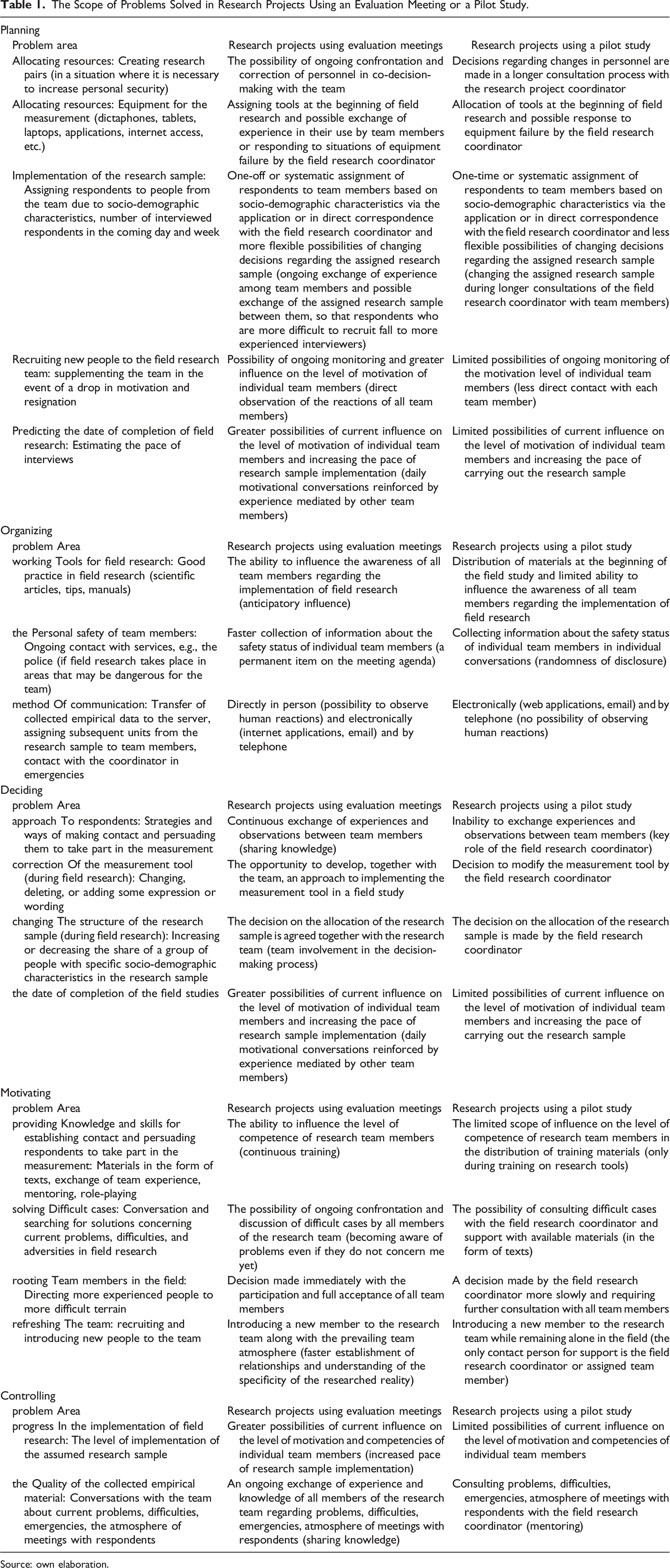
The Scope of Problems Solved in Research Projects Using an Evaluation Meeting or a Pilot Study.
Source: own elaboration.
An evaluation meeting allows you to organize the process of collecting empirical data much more effectively than in the case of measurement corrected only by a pilot study. Including evaluation meetings in the management of a research project enables, above all, immediate response to current problems and unforeseen situations. A good example from research practice is a situation in which research pairs do not cooperate well in the long run due to personality differences and it is necessary to correct the composition of people or difficulties in measuring a specific area require the assignment of another person/pair. Without an evaluation meeting, such an evaluation requires contact with the research project coordinator and then further contact with other team members, which lengthens and reduces the effectiveness of the decision-making process.
During one of the field studies in a rather neglected district (with many abandoned apartments) of one of the large cities, it happened that a team of interviewers (a woman and a man) did not appear at the agreed time for the evaluation meeting. The fieldwork coordinator tried to contact him by phone. After some time, a telephone connection was established, and the interviewers declared that they were on their way to the meeting. It turned out that they ended up in a tenement house where no one opened the door, but after some time they realized that tables were set up in the yard and many residents were taking part in a common feast. The interviewers joined the feast, which allowed them to interview each of the participants, but had difficulty leaving the event (they were enticed to continue drinking alcohol). During the evaluation meeting, the remaining interviewers were made aware of the risk of such a situation. In addition, a common security code was established (a text message or keyword as an alarm for the research coordinator).
Each field study has its specificity (goal, group of respondents, area), so it is difficult to standardize the evaluation meeting more precisely in terms of the scope of problems to be solved. The advantage of evaluation meetings is their flexible approach to achieving the goal of collecting high-quality empirical data. Managing the process of collecting empirical data in the field using this formula allows you to quickly respond to the dynamics of team members’ interactions with respondents and make necessary changes. Unlike a research project using only pilot studies, there is a much greater possibility of influencing the level of competence and motivation of the team. However, the key during the evaluation meeting is to remain vigilant towards the problems and difficulties expressed by team members.
Discussion and Conclusions
Organizing evaluation meetings allows, firstly, to avoid situations in which the original research assumptions do not coincide with reality (Edmondson & McManus, 2007), for example a poorly constructed measurement tool will be implemented until the end of field research and will not be theoretically accurate. This means that you can react quite quickly and make necessary corrections to research assumptions even after the main measurement has started. Unlike research projects using a pilot study, this concerns, among other things, a situation of different interpretations of individual formulations in the measurement tool (e.g. dispositions for in-depth interviews) not only by respondents but also by team members who have not disclosed their perceptions so far. Thanks to this, it is possible to constantly monitor the implementation of the empirical data collection process and the research sample and to ensure a high level of quality of the collected empirical data.
Thanks to meetings with the team, the field research coordinator rationally manages the resources and budget of the research project. The possible selection of pairs for field measurement is much more flexible than in the case of research projects using only a pilot study. The strength of evaluation meetings is the greater ability of the field research coordinator to influence team members, including motivating and solving problems and conflicts. This applies to situations of personality differences and personal conflicts, but also to lack of self-confidence, self-isolation, etc. Meetings with the entire team also save the time of the field research coordinator by minimizing individual meetings with team members. Organizing evaluation meetings builds relationships within the team, a sense of bond and shared responsibility for tasks, positively influencing the motivation and relieving emotions (Wood, 2006) of team members.
The key advantage of evaluation meetings is the possibility of the ongoing exchange of experiences between team members, which allows you to influence their level of competence and commitment and allows the field research coordinator to feel the area and imagine that he or she is there. Above all, organizing evaluation meetings increases the vigilance and reflectivity of the field research coordinator (Reyes, 2020) and inspires the search for more and more effective solutions that will correspond to the current specificity of research (Howe, 2022). In practice, this means sharing the knowledge and experience of team members, which makes people who have not yet encountered them in the field aware of problems and prepares them for possible encounters with them. No research project using only a pilot study can make appropriate corrections in this area so effectively and quickly.
Even if the fieldwork encounters a significant problem that cannot be solved at the evaluation meeting, mere awareness of its existence and discussion about it will certainly bring us closer to finding a solution. A certain limitation of the evaluation meeting is the possible loss of time for considering the research process in a situation where a member of the team signals the need for unjustified changes. However, it is crucial to remember that field research is an art. As in medicine, it requires a precise response to the current situation, which leads to the achievement of the goal while maintaining all applicable methodological, ethical, and cultural principles.
Footnotes
Declaration of Conflicting Interests
The author(s) declared no potential conflicts of interest with respect to the research, authorship, and/or publication of this article.
Funding
The author(s) disclosed receipt of the following financial support for the research, authorship, and/or publication of this article: This work was supported by the Co-financed by the Minister of Science under the “Regional Excellence Initiative” Program.
Ethical Statement

Data Availability Statement
Data sharing not applicable to this article as no datasets were generated or analyzed during the current study.