




Abstract
This article introduces a novel seven-step methodology designed to incorporate podcasts as qualitative data sources in academic research, addressing a notable gap in current literature. The purpose of this methodology is to harness the unique and timely insights offered by podcasts, thereby enriching academic studies with diverse, real-time perspectives. The design of this approach includes a meticulous selection of podcasts based on relevance and credibility, comprehensive ethical considerations, strategic sampling methods, robust data collection and analysis techniques, and recommendations for applying best research practices. Key to this methodology is the use of weighted scoring systems to mitigate biases and the establishment of ethical guidelines specifically tailored for podcast data. The results of this study indicate the high potential of the proposed methodology in employing podcasts as an additional source of data, providing dynamic and current perspectives often absent in traditional research sources. Future studies are encouraged to delve deeper into refining and standardizing the proposed methodology, focusing on enhancing the weight metrics through advanced statistical techniques and exploring new technological tools for more efficient podcast data extraction and analysis.

Keywords
Introduction
The current landscape of academic research heavily relies on traditional sources like academic articles, surveys, and archival research. While invaluable, these sources often suffer from limitations such as long publication cycles, potential for bias and a lack of real-time relevance. The digital age has ushered in a plethora of new media forms, among which podcasts have gained remarkable prominence. Integrating podcasts into academic research offers a valuable complement to traditional data sources, providing real-time, diverse perspectives and rich qualitative insights. This approach enhances research by offering current, nuanced viewpoints and naturalistic data, which can effectively mitigate the limitations of more conventional methods.
A podcast is a digital audio or video file series that can be streamed or downloaded from the internet (Gachago et al., 2016; Kulkarni & Whitworth, 2022). These files are typically episodic, allowing the user to subscribe to a show and receive automatic updates when new episodes are released. Podcasts offer a wide variety of content, from news and interviews to storytelling and educational lectures, making them a versatile medium for information dissemination and public discourse (Quintana & Heathers, 2021). Despite the growing popularity and versatility of podcasts, there is a significant research gap in the academic literature concerning their methodological use. While some studies have employed podcasts as a data source (Kulkov et al., 2023; Thomson, 2022), there is a conspicuous absence of comprehensive guidelines or frameworks that outline how to systematically incorporate this rich medium into academic research.
While podcasts are increasingly recognized for their rich content and accessibility, academic research has yet to establish a standardized approach for their systematic inclusion as a data source (Baelo-Allué, 2019; Kwok, 2019). This omission in research methodology literature forms a gap, as it overlooks a medium that is suited to capturing the nuanced and evolving dynamics of contemporary social, technological, and educational landscapes. The current study aims to address this gap by proposing a structured methodology that enables the integration of podcasts into qualitative research and ensures the rigor and reliability of the data collected through this source. By doing so, this methodology seeks to broaden the qualitative research toolkit, offering researchers a new possibility to gather deep, contextually rich data that is reflective of current trends and public discourse.
Given that podcasts offer unique forms of data, this research gap represents an opportunity to enrich and diversify academic research. To address this gap, we have developed a seven-step methodology designed to guide researchers across various disciplines in using podcasts as a qualitative data source. The methodology will also be of interest to educators, policymakers, and professionals who are looking to understand the evolving landscape of data sources in academic research. This structured and rigorous approach is designed to be replicable, guiding researchers from the initial stages of podcast selection through to data collection, analysis, and validation. The methodology emphasizes selecting podcasts based on criteria like topic relevance, credibility, and audience engagement, and includes the establishment of ethical guidelines tailored to podcasts. It involves a diverse sampling method, multifaceted data collection and analysis techniques.
Literature Review
Traditional Sources for Academic Research
In the realm of academic research, understanding the distinction between qualitative and quantitative methodologies is foundational, as these approaches significantly influence the types of data sources deemed appropriate for various studies. Qualitative research, focused on exploring the nuances of human behavior, thoughts, and experiences, often utilizes textual or audio-visual data. This method is particularly effective for in-depth analyses of complex, context-driven phenomena. In contrast, quantitative research emphasizes numerical data and statistical analysis, catering to studies that require measurable, objective data for hypothesis testing or pattern identification. The choice between these approaches depends on the specific research question, the methodology employed, and the type of data needed to achieve the research objectives (Ahmad et al., 2019; Flick, 2007; Köhler et al., 2022). The distinction between qualitative and quantitative methodologies is pivotal in academic research, shaping the framework within which traditional data sources are employed and understood. Indeed, the foundation of academic research has a long history with traditional data sources, such as interviews, surveys, academic journals, and archival data. However, they come with their own set of limitations.
Interviews and surveys, serving as primary data collection methodologies, are strategically employed to investigate specific research hypotheses. They facilitate the acquisition of direct, contemporaneous insights from subjects involved in the study. Notwithstanding their utility, these methodologies are susceptible to systemic errors such as selection bias, where the sampling method does not adequately represent the target population, and response bias, characterized by a tendency of respondents to answer questions in a manner that deviates from their true thoughts or feelings, often influenced by question phrasing or social desirability factors (Lê & Schmid, 2022; Mwita, 2022).
In turn, academic journals are repositories of secondary data, comprising peer-reviewed studies that offer a reliable reference for existing theories and findings, particularly useful in literature reviews and theoretical analyses. However, it’s important to note that despite their rigorous review process, scientific publications may not always capture the most current or diverse perspectives due to the often-lengthy publication process (Baas et al., 2020).
Archival data, predominantly historical in nature, offers a longitudinal view essential for identifying trends and analyzing long-term changes across various disciplines. This type of data is particularly beneficial for research that requires a deep understanding of historical contexts or seeks to track the evolution of specific phenomena over extended periods (Das et al., 2018). Interpretation of archival data can be challenging due to the context-specific nature of historical documents, requiring careful consideration of the socio-cultural background of the period from which the data originates (Lee & Peterson, 1997).
Ethical considerations are a cornerstone of research methodology involving people or sensitive personal information (Hunter et al., 2018). While ethical guidelines for interviews, surveys, and archival research are well-established, they are not static. The advent of new technologies and data collection methods has led to an evolving landscape of ethical considerations. For example, the use of online surveys raises questions about how to ensure informed consent when the researcher cannot interact directly with the participant (Eysenbach & Wyatt, 2002). Similarly, the use of digital archives brings up issues around data ownership and the ethical use of historical data that may have been collected under different ethical standards (Lee & Peterson, 1997). To tackle the limitations of traditional data sources, a comprehensive approach is needed. This includes cross-checking data with other sources for accuracy, combining qualitative and quantitative research methods, and using detailed analysis methods to ensure the research is both valid and reliable, all while following ethical standards (Allwood, 2012).
Emergence of New Media in Academic Research
The advent of the digital age has ushered in new media forms like social media, blogs, and online forums, now increasingly accepted as legitimate sources of academic data (Bivens, 2008; Fuchs, 2011). These platforms offer insights into public opinion, social dynamics, and trends in real-time. To analyze this content, researchers have modified traditional methodologies, such as grounded theory, enabling a structured examination of online behaviors.
In the landscape of academic research, podcasts already have garnered significant attention across various disciplines, including journalism, sociology, psychology, and political science (Moore, 2022; Quintana & Heathers, 2021). Their rise as a data source is attributed to their ability to facilitate in-depth discussions, providing a level of detail and exploration that traditional media may lack. This depth makes podcasts particularly useful for qualitative research, where nuanced understanding and comprehensive exploration of topics are paramount. However, a critical aspect to consider in podcast-based research is the demographic diversity of the audience. The audience demographics play a vital role in determining the generalizability of the research findings. If the listener base of a podcast is not demographically diverse, the insights and viewpoints expressed may only represent a specific segment of the population, thereby limiting the broader applicability of the research outcomes. Furthermore, the demographic profile of a podcast’s audience can significantly influence the content’s perspective. A podcast that predominantly attracts a certain age group, cultural background, or socioeconomic status might reflect inherent biases or specific viewpoints related to these demographics. On the other hand, the general credibility of online content often presents a concern, as it typically lacks the rigorous peer-review process that traditional academic sources undergo. Additionally, the fluid nature of online materials, prone to edits or deletion, alongside the complexities of intellectual property rights in podcast usage, poses distinct challenges for maintaining consistency and legality for academic research (Kulkarni & Whitworth, 2022; Samuel-Azran et al., 2019).
As digital media have increased, podcasts have emerged as a significant source for content dissemination, characterized by their ease of access and the diversity of topics they cover. In academic contexts, podcasts have been increasingly regarded as valuable sources of qualitative data. Studies have highlighted their utility in fields ranging from social sciences to medical education, where they offer insights into contemporary issues and expert opinions in a dynamically engaging format (Gachago et al., 2016; Quintana & Heathers, 2021). Despite their growing popularity and potential, the academic use of podcasts has faced methodological challenges. These include issues of credibility verification, ethical considerations, and the lack of a standardized approach for data collection and analysis, which are not as frequently encountered in traditional data sources like journals or books (Kulkarni & Whitworth, 2022).
Brumley et al. (2017) noted, the utilization of podcasts in academic research brings specific methodological challenges to the fore. These include the verification of the credibility of content, ethical considerations, and the absence of standardized methods for data collection and analysis. These issues are notably less prevalent in traditional data sources such as journals or books. As podcasts continue to gain traction in academic use, these methodological concerns underscore the need for developing rigorous approaches to integrate podcasts effectively into the research framework, ensuring that their full potential is harnessed while maintaining academic rigor and integrity.
We acknowledge that the flexibility of podcasts—ranging from structured educational formats to more conversational or narrative-driven styles—presents unique opportunities and challenges for qualitative researchers. The rich, real-time nature of podcasts can provide depth and immediacy to academic review, offering a new perspective often lacking in printed materials. However, the informal and sometimes episodic nature of podcasts can complicate systematic analysis and integration into established research standards. Our review of the literature indicates a notable gap in comprehensive methodologies tailored specifically to the utilization of podcasts in research, highlighting the need for our proposed systematic approach to connect their potential effectively.
Examples of Podcasts in Academic Research
In the realm of science communication, the podcast “Science versus” has been employed by researchers to investigate the dissemination of complex scientific concepts to a general audience. This podcast, which critically examines fads, trends, and public opinion, serves as a real-world example of science communication. Its engaging and accessible format presents a distinct advantage over the more traditional mediums like academic journals. However, critiques have emerged regarding its entertainment-focused approach, suggesting a potential oversimplification of intricate scientific topics, which raises concerns about depth and accuracy in conveying scientific information (Carlson, 2020; Opat et al., 2022).
Similarly, “The Daily” produced by The New York Times, is another podcast that has garnered attention from scholars in journalism and political science (Asier & Luis Miguel, 2022). This podcast’s analysis has been instrumental in understanding the framing of current events and issues, offering a timely perspective often more current than peer-reviewed publications. Nevertheless, the challenge with “The Daily” lies in its predominantly U.S.-centric focus, which may not encapsulate global viewpoints or events, thus limiting the scope of generalizability in research findings.
In psychology, “The Psychology Podcast” provides a rich source of data, featuring interviews with experts on a wide range of topics, from creativity to mental health (Wai, 2020). Researchers utilize this podcast for insights into expert opinions and the public’s perception of psychological theories. The advantage here lies in the extensive coverage of topics and the inclusion of leading experts. However, the conversational nature of the podcast, while engaging, may not undergo the rigorous scrutiny typical of academic publications, thereby raising questions about its reliability.
Methodologically, traditional qualitative techniques like grounded theory have been adapted for podcast content analysis. Researchers employ grounded theory to systematically code and categorize themes within podcasts, akin to the analysis of interview data. This adaptation highlights the flexibility and evolving nature of qualitative research methods in accommodating new forms of media. However, the transient nature of podcasts, susceptible to updates or removal, presents a significant challenge in ensuring the replicability and reliability of research findings, as the data source may change over time.
Methodology Overview
This study introduces a structured, seven-step framework to guide the academic use of podcasts as a qualitative data source. The methodology is intended to involve at least two researchers and designed to be rigorous, systematic, and ethically sound, aligning with scholarly standards and research objectives. Each step in the methodology is guided by specific criteria and activities, which are detailed in the accompanying Figure 1. This framework aims to provide a robust and replicable approach for researchers interested in leveraging podcasts for academic inquiry. Seven-step podcast methodology.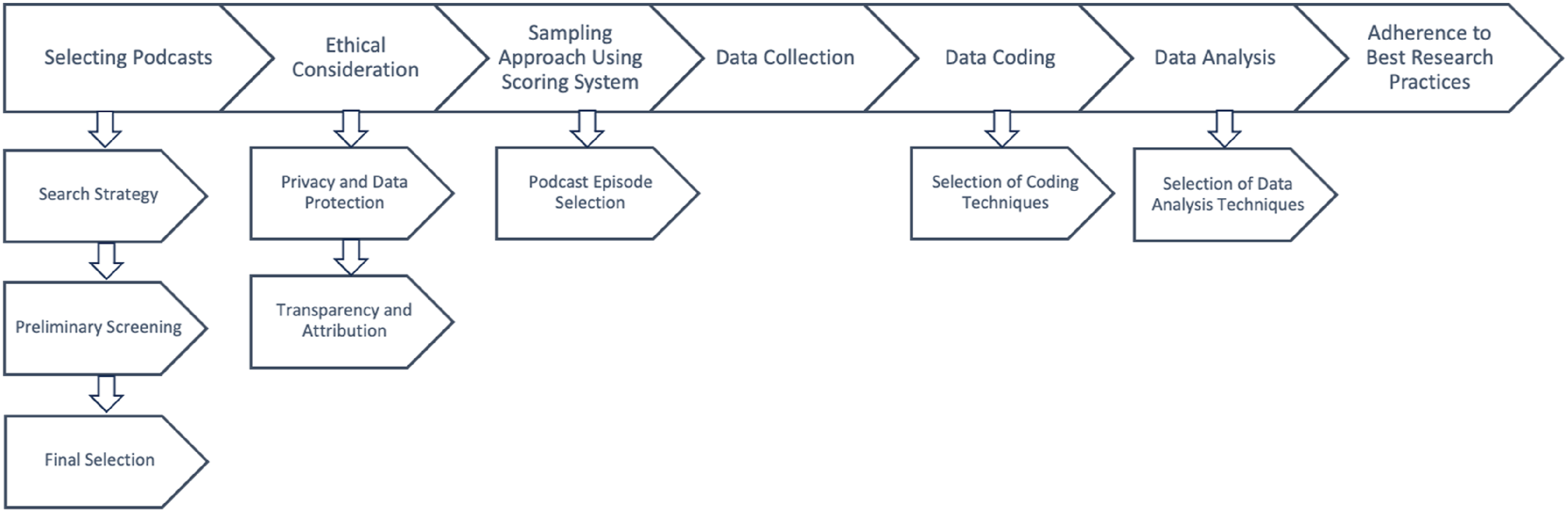
Step 1: Selecting Podcasts for Academic Research
The meticulous selection of podcasts critically determines the validity and applicability of the research findings. Considering the extensive array of available podcasts, implementing a structured selection methodology is imperative for ensuring alignment with specific research objectives.
Search Strategy
A thorough search across platforms, such as Apple Podcasts and Spotify, supplemented with academic podcast directories, is essential. Keywords help streamline the results, and expert recommendations can enhance the quality of selections.
Preliminary Screening. Criteria for Selection with Weighted Scoring System
This step involves a preliminary analysis of potential podcasts to gauge alignment with the criteria. Listening to a minimum of five episodes from each offers a deeper understanding. A double-blinded approach, where two independent reviewers assess the content, ensures unbiased selections.
A weighted scoring system aids in evaluating podcasts based on a set of defined criteria: • • • •
Scores Explanation for the Weighted Scoring System.
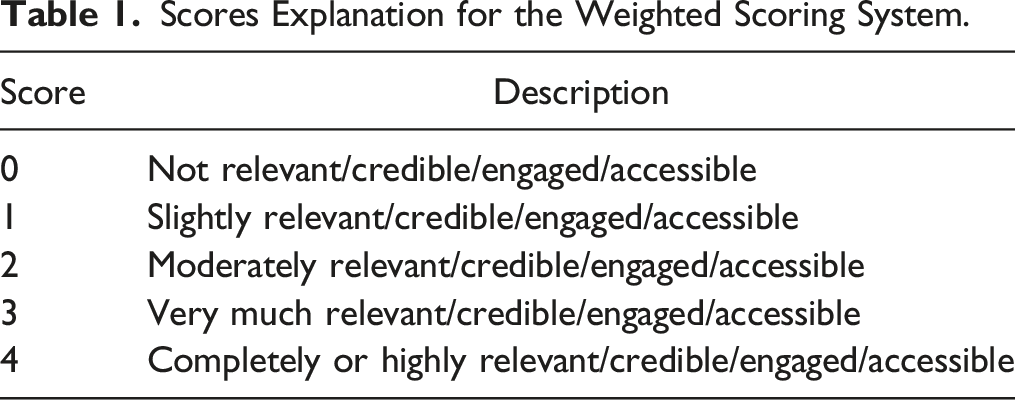
Topic Relevance: 3 × 0.4 = 1.2
Credibility: 4 × 0.3 = 1.2
Audience Engagement: 2 × 0.2 = 0.4
Accessibility: 4 × 0.1 = 0.4
Total Weighted Scoring System Score for the podcast: 1.2 + 1.2+0.4 + 0.4 = 3.2
Podcasts with a total weighted score of 3.0 and higher are included.
Final Selection with Extended Weighted Scoring System
Following preliminary screening, the final podcast selection is determined using an extended weighted scoring system. This system considers additional factors such as the diversity of podcast guests, publication frequency, and alignment with current industry trends, enabling a more comprehensive selection process.
• • • • • • •
Scores Explanation for the Extended Weighted Scoring System.

Diversity of Guests: 3 × 0.15 = 0.45
Frequency of Publication: 2 × 0.10 = 0.20
Depth of Discussion: 3 × 0.25 = 0.75
Technical Production Quality: 4 × 0.05 = 0.20
Alignment with Current Trends: 3 × 0.20 = 0.60
Listener Feedback: 2 × 0.15 = 0.30
Podcast Longevity: 3 × 0.10 = 0.30
Total Extended Weighted Scoring System Score for the podcast: 0.45 + 0.20+0.75 + 0.20 + 0.60 + 0.30+0.30 = 2.80
In the Extended Weighted Scoring System, podcasts with a total weighted score of 3.0 and higher are included.
Step 2: Ethical Consideration
The second step in this methodology focuses on ethical considerations. When using publicly available media like podcasts, ethical considerations take on unique dimensions that require attention. Below, we elaborate on the criteria for them.
Privacy and Data Protection
Informed consent is secured from podcast creators for the use of their material in research. This process entails directly contacting them for consent or complying with the terms and conditions specified by the podcast platform. Measures are taken to safeguard the privacy of podcast creators and participants. This involves anonymizing data during the analysis phase to prevent the disclosure of personal anecdotes, opinions, and potentially sensitive information. • • • • • • Podcast data, including transcriptions, is ensured secure storage and handling, involving the use of encrypted storage solutions and restricting access solely to authorized personnel.
Transparency and Attribution
The research objectives and the intended use of podcast data are clearly stated, involving direct communication with podcast creators to prevent misrepresentation of their content. The source of the podcast data is properly cited, a mandatory practice to ensure creators receive due credit and to enhance the traceability and credibility of the research.
Step 3: Sampling Approach Using Scoring System
In the third step of the methodology, the focus shifts to selecting specific episodes from the chosen podcasts. Given the wide range of available episodes across various podcasts, a scored approach is implemented to ensure that this selection process is systematic and aligned with the study’s objectives.
Podcast Episode Selection Scoring System
Criteria for Determining a Suitable Episode Sampling Approach.

The scoring system then guides the selection of sampling methods: • • • • •
Once the method is selected, at least two researchers should independently undertake the sampling, comparing results to finalize the list. This dual approach minimizes bias and enhances the rigor of the study.
Step 4: Data Collection
The fourth step of this methodology is the structured collection and preparation of podcast data. This step begins with the accurate transcription of selected podcast episodes. Simultaneously, the collection of metadata is undertaken for each episode, encompassing details such as the podcast name, episode title, release date, duration, platform, and URL.
In conjunction with these actions, a detailed audio analysis of the episodes is conducted. This analysis delves into the nuances of tone, pitch, and background sounds, offering insights into the emotional states and emphases within the episodes. Such auditory elements can provide a deeper context to the content, adding a layer of richness to the data.
Furthermore, throughout the listening process, annotations or notes are made to highlight significant segments or themes in the episodes. These annotations act as preliminary codes or markers which help identify key themes and patterns, facilitating a more focused and insightful analysis.
This comprehensive approach to podcast data collection—encompassing transcription, metadata gathering, audio analysis, and annotation—ensures a thorough and nuanced understanding of the content.
Step 5: Data Coding
In this phase, the qualitative podcast data is transformed into structured, analyzable unit using various coding techniques. Each technique is suited to different research objectives, and their applicability can be gauged using a scoring system.
Selection of Coding Techniques
In the data coding phase, the selection of one or more coding techniques is based on the nature of the data and the research objectives. The techniques available include: • • • •
Scores for Each Technique in Coding.

The table below presents criteria for selecting appropriate coding techniques in the analysis of podcast data. Each criterion is assigned a score ranging from 0 to 4, where 0 indicates the lowest relevance or applicability, and 4 indicates the highest.
• Relevance to Themes: 3 • Context Preservation: 2 • Content Summary: 4 • Action/Process Focus: 1 Thematic Coding: Total Score (Thematic) = (Relevance to Themes x 4) + (Context Preservation x 2) + (Content Summary x 2) + (Action/Process Focus × 1) = (3 × 4) + (2 × 2) + (4 × 2) + (1 × 1) = 12 + 4 + 8+ 1 = 25 In Vivo Coding: Total Score (In Vivo) = (Relevance to Themes x 2) + (Context Preservation x 4) + (Content Summary x 1) + (Action/Process Focus × 1) = (3 × 2) + (2 × 4) + (4 × 1) + (1 × 1) = 6 + 8 + 4+ 1 = 19 Descriptive Coding: Total Score (Descriptive) = (Relevance to Themes x 3) + (Context Preservation x 2) + (Content Summary x 4) + (Action/Process Focus × 1) = (3 × 3) + (2 × 2) + (4 × 4) + (1 × 1) = 9 + 4 + 16+ 1 = 30 Process Coding: Total Score (Process) = (Relevance to Themes x 1) + (Context Preservation x 1) + (Content Summary x 1) + (Action/Process Focus × 4) = (3 × 1) + (2 × 1) + (4 × 1) + (1 × 4) = 3 + 2 + 4+ 4 = 13 Result: Based on the hypothetical research focus criteria, the Descriptive Coding technique has the highest total score of 30, making it the most suitable for this study. This process of calculating scores can be replicated for any research criteria by adjusting the focus numbers. The technique with the highest total score will be the most relevant for the specific research needs.
Once a coding technique is selected, it is vital to ensure its consistency and validity through reliability checks. This involves engaging at least two coders to independently review and code a subset of the data, comparing assigned codes to identify inconsistencies, and calculating a reliability coefficient using statistical tools to quantify the agreement level among coders. Discrepancies are addressed through discussion among coders, potentially leading to adjustments in the coding scheme.
Step 6: Data Analysis
The sixth step in the methodology is a systematic examination of coded data to extract insights. To align this process with research objectives, the following criteria are essential in selecting the appropriate data analysis technique.
Selection of Data Analysis Techniques
• • • •
Criteria for Evaluating Coding Techniques.

Criteria for Evaluating Data Analysis Techniques.

The suitability of each analysis technique is quantified by scores, which are assigned based on how well the criteria are met by each technique.
For example, let’s assume the research focuses on the impact of digital transformation in small businesses. The selected podcasts feature discussions with industry experts, entrepreneurs, and technologists. The research aims to understand the narrative around digital transformation, capture the nuanced language of the discussions, and compare views across different business sectors. Here’s how the scoring system from Table 7 would be applied: 1. Dataset Overview: Scoring System for Data Analysis Techniques.

Score 4: The selected podcasts offer a comprehensive overview of digital transformation in various business sectors, providing a rich dataset that covers a wide range of experiences and insights. 2. Story Presentation:
Score 3: The podcasts present detailed narratives of how businesses are adapting to digital changes. The storytelling is engaging and provides a clear understanding of the challenges and opportunities in digital transformation. 3. Language Nuances:
Score 2: While the podcasts offer some depth in language nuances, particularly in terms of industry-specific jargon and expressions, they do not fully delve into the subtleties of language that could reveal underlying attitudes or resistance to digital transformation. 4. Comparative Focus:
Score 4: The podcasts provide an excellent basis for comparative analysis, as they feature a diverse range of businesses from different sectors, allowing for a thorough comparison of digital transformation impacts and strategies.
Based on the scores, Content Analysis emerges as the most suitable technique for this study, offering a comprehensive approach that aligns with the research objectives. This technique will allow the researcher to analyze the dataset thoroughly, focusing on narrative structure, language nuances, and making comparative assessments.
Through this scoring system, researchers can effectively determine the most suitable data analysis technique for their specific dataset, ensuring that the chosen method aligns well with the research objectives and promotes thorough and relevant findings.
Step 7: Adherence to Best Research Practices
At the outset, triangulation is emphasized as a fundamental approach. It is recommended that insights from multiple data sources, methodologies, and investigators be integrated, particularly in podcast content analysis where cross-referencing insights from various mediums is crucial. At the same time, it is also important to follow transparent record of the data. Transparency facilitates the study’s replication but also enhances its comprehensibility, thus upholding accountability throughout the research process. This approach not only enhances the depth of analysis but also serves as a critical safeguard against biases associated with single-source data.
Next, continuous validation is presented as an integral component of the methodology. Regular reassessment of findings is advocated to ensure ongoing accuracy and relevance.
Finally, the practice of engaging with feedback is a crucial final step. The presentation of preliminary findings to a diverse group for feedback is shown to provide invaluable insights. This engagement, involving researchers, industry stakeholders, and target audience representatives, is demonstrated to challenge assumptions and confirm that the research findings are resonant and robust.
Method Justification
In our proposed methodology for incorporating podcasts as qualitative data sources, the weighting system is a pivotal element designed to enhance the validity and reliability of the research findings. This system is not arbitrary but is grounded in established methodological frameworks and empirical evidence.
The weightings draw inspiration from established qualitative analysis techniques, particularly thematic analysis, and grounded theory. Braun and Clarke’s thematic analysis framework emphasizes the importance of weighting themes based on their prevalence and significance in the data (Braun & Clarke, 2012). Similarly, the grounded theory approach by Strauss and Corbin advocates for a systematic and weighted analysis of qualitative data to develop theory (Strauss & Corbin, 1998). Our weighting system mirrors these principles, assigning greater importance to frequently occurring and contextually significant themes within podcast content. A study by Fereday and Muir-Cochrane (2006) highlights the effectiveness of incorporating weighted coding in data analysis to enhance the depth and breadth of thematic exploration. This approach aligns with our methodology, where weightings are employed to ensure comprehensive and nuanced analysis of podcast data. Contrary to the concerns raised, our weighting system is designed to be adaptable to different research contexts and samples. By allowing researchers to adjust weightings based on the specificities of their research question and the nature of the podcast content, our methodology ensures tailored and context-sensitive analysis. This adaptability is supported by the work of Morse (2009), who advocate for flexible coding schemes in qualitative research to account for the unique characteristics of each study. Our weighting system also serves to mitigate potential biases in qualitative research. By providing a clear and justified basis for emphasizing certain aspects of the data, it reduces the likelihood of selective attention or confirmation bias, as discussed by Maxwell (1992). This is particularly relevant in podcast-based research, where the diversity of content and perspectives necessitates a balanced and critical approach to data analysis.
In our manuscript, the detailed weighting system for podcast-based qualitative research is rigorously defined, drawing from qualitative research practices and the distinct nature of podcasts. These weights, based on content authenticity and speaker expertise, are tailored to the dynamic, mixed-content nature of podcasts. The specific weights assigned in our methodology are derived from a comprehensive analysis of existing qualitative research practices and the unique nature of podcasts as a data source. For instance, the higher weight given to content authenticity and speaker expertise is based on the principle that podcasts often feature subject matter experts, whose insights are particularly valuable in qualitative analysis. Our weighting system accounts for the dynamic and unstructured nature of podcasts. Unlike traditional qualitative sources like interviews or surveys, podcasts often contain a mix of formal and informal discussions, personal anecdotes, and expert opinions. Our weights are designed to capture this richness and diversity, ensuring a more nuanced analysis. The selection of specific weights is further justified through examples we offered, which demonstrated the effectiveness of these weights in extracting relevant and significant insights from podcast data. These examples provide empirical evidence supporting our chosen weighting scheme.
Discussion
The presented methodology for employing podcasts as an academic data source represents a novel approach in the research landscape. To our best knowledge, this is the first methodology that rigorously incorporates podcasts into academic data collection and processing. While there are existent propositions from other researchers that focus on emotional scales and relatively ambiguous mechanisms (Moore, 2022; Riggs & Knobloch-Westerwick, 2022), our methodology sets itself apart through the incorporation of weight estimates that were intricately developed by our team. One of the significant advantages of our methodology is the tangible reduction in bias. By relying on a weight-based system and involvement of at least two investigators, our approach ensures that data is not only collected but also analyzed in a structured and consistent manner. This approach can be juxtaposed against other methods that often leave room for subjective interpretations and could potentially introduce unnecessary variances (Denzin & Lincoln, 2011; Flick, 2007). A noteworthy aspect of our methodology is its modernized outlook. While we have taken care to ensure all standard steps typical for research of this kind have been considered, the methodology offers a refreshing perspective on how podcast data should be collected, coded, and analyzed.
One of the intrinsic benefits of using podcasts as a data source is the ability to keep pace with the rapidly evolving design landscape across industries (Gachago et al., 2016). Traditional data collection methods often lag, unable to capture the nuances of swift industry changes (McGloin, 2008; Yin, 1992). In contrast, podcasts, often being a real-time reflection of industry trends and shifts, allow researchers to remain at the forefront of industry developments.
In recent research, podcasts have been shown to offer unique insights into contemporary cultural, social, and technological trends. For instance, Moore (2022) Click or tap here to enter text. Has demonstrated how podcasts can serve as dynamic platforms for public education and engagement, particularly within the realms of planning and policymaking. Additionally, work by Riggs and Knobloch-Westerwick (2024) has explored power of narratives within podcasts, suggesting that the format’s conversational nature can significantly influence public opinion and knowledge retention. These findings support our observations about the potential of podcasts to provide nuanced, in-depth perspectives that are often missing from more traditional academic sources.
Moreover, the challenges associated with podcast data—such as issues of data consistency and representativeness—are highlighted by recent studies, including those by Rime et al. (2024) and Chen and Melon (2018) which have addressed the technical and ethical considerations needed when incorporating such modern media into research. These studies further validate our methodology’s focus on rigorous, structured approaches to podcast integration, ensuring that such issues are effectively addressed, and that the data from podcasts can meet academic standards of reliability and validity.
The use of podcasts as a qualitative data source opens a plethora of opportunities for gaining insights into various academic fields. In social sciences, for example, podcasts can offer real-world perspectives on societal issues, capturing the nuances of public opinion and social behavior (Kazlauskas & Robinson, 2012). In the field of history, podcasts often feature experts who provide in-depth analyses of historical events, offering a dynamic supplement to archival research (Picard & Marsillo, 2018). Similarly, in disciplines like psychology, business, and even the natural sciences, podcasts can serve as platforms where new theories, research findings, or professional practices are discussed and debated by experts in the field (Kulkov et al., 2023; Thomson, 2022). The diversity of podcast topics and the expertise of the hosts and guests make this medium a rich source of data that can complement, and in some cases, even surpass traditional academic sources.
One of the most compelling advantages of using podcasts as a research source is their timeliness. While traditional academic publications often have a long lead time from research to publication, podcasts can respond to current events, scientific discoveries, or societal shifts in real-time. Another advantage is the diversity of perspectives that podcasts offer. Unlike academic journals, which are often restricted by disciplinary boundaries, podcasts frequently feature interdisciplinary discussions, bringing in experts from various fields to offer a more rounded view of a topic. This can be particularly beneficial for research that seeks to address complex issues requiring a multifaceted approach. Furthermore, the conversational nature of podcasts offers a level of engagement and depth that is often lacking in written sources. The tone, inflection, and spontaneity of spoken dialogue can provide additional layers of meaning, making podcasts a rich source for qualitative analysis.
In the discourse on data sourcing, a pivotal question emerges: Can podcasts serve as a standalone data source, or are they better suited as an assistive, supplementary medium? Podcasts, with their rich narratives and real-time reflections on industry trends, undeniably offer valuable insights. However, relying solely on them might present challenges, primarily due to their inherent subjectivity and potential biases of podcast hosts or guests (Rime et al., 2024). As with any single data source, exclusive reliance on podcasts could limit the breadth and depth of analysis. Therefore, while podcasts can provide substantial primary data, especially in areas where real-time discourse is valuable, it’s prudent to consider them as part of a broader data ecosystem. Pairing podcast data with other sources, such as academic journals, interviews, or surveys, can offer a more holistic and balanced view, ensuring comprehensive and robust research outcomes.
The educational value of podcasts is increasingly being recognized, and there is significant potential for their integration into academic curricula (On Tam, 2012; Sutton-Brady et al., 2009). Podcasts can serve as supplementary material that complements traditional textbooks and lectures, offering students a different mode of learning that is both engaging and informative. This not only enriches the educational experience but also introduces students to the concept of podcasts as a legitimate academic resource. By familiarizing students with the academic potential of podcasts, educators can encourage a new generation of researchers to consider this rich medium as a valuable data source for future scholarly work.
Future Research Areas
The utilization of podcasts as an academic data source, while groundbreaking, presents unique methodological challenges. One pressing issue is the consistent coding of informal podcast content, which can vary significantly across different platforms and hosts. Another potential limitation is the inherent subjectivity that podcasts might introduce, given the biases of hosts or guests. It’s crucial for future investigations to delve deeper into these challenges, refining and standardizing the proposed methodology via applying it real research settings to ensure not only consistent but also accurate data extraction across an array of podcast formats.
Our initial foray into weight estimates provides a promising direction for podcast data analysis. However, the current metrics, while foundational, leave room for enhancement. Future research endeavors should concentrate on the continued development and refinement of these weight metrics. This could involve the integration of advanced statistical techniques, machine learning models, or even neural network approaches. The goal would be to enhance the metrics’ precision, robustness, and adaptability, ensuring they remain relevant and accurate across a diverse range of podcast content and topics.
The journey into podcast-based academic research is significantly influenced by the technological tools at researcher`s disposal. While the technology used in this study proved beneficial for transcription and initial analysis, there remains a vast landscape of potential tools yet to be explored. Future research should be dedicated to identifying, testing, and optimizing software and technological advancements that are tailored for podcast data extraction, analysis, and interpretation. This will not only streamline the research process but also ensure a more comprehensive and in-depth analysis of the rich data podcasts offer.
Limitations
While our methodology provides a structured approach to incorporating podcasts into academic research, it is important to acknowledge several limitations that researchers may encounter. First, the representativeness of podcast audiences may not always align with broader demographic criteria, potentially skewing the data and limiting generalizability. Furthermore, the production quality of podcasts can vary significantly, which might affect the audio clarity and the interpretability of the content. This variability positions a challenge for consistent data analysis across different podcast sources. Additionally, the content of podcasts can evolve in response to current events or cultural trends, which may introduce challenges in maintaining the continuity and relevance of data in longitudinal studies. Such dynamism, while a strength in capturing real-time insights, can complicate the replication of studies or the comparison of data over time. Lastly, the informal nature of many podcasts may lead to inconsistencies in the depth and rigor of discussion on given topics, requiring researchers to apply rigorous criteria for episode selection and analysis to ensure data quality.
Addressing these limitations requires ongoing refinement of our methodology and suggests areas for future research, particularly in developing more sophisticated tools for assessing and compensating for these challenges.
Conclusion
This study has ventured into the relatively uncharted territory of harnessing podcasts as a viable source of academic data. Our novel methodology offers a nuanced and modernized approach to data collection and analysis, setting a precedent for future research in this domain. The weight estimates developed by our team present a structured mechanism to reduce biases and ensure consistency in data extraction. While the potential of podcasts as an academic data source is undeniable, it’s also clear that they should ideally be integrated within a broader data ecosystem to ensure holistic research outcomes. As the digital age progresses, and as podcasts continue to rise in prominence, the integration of this medium into academic research signifies a necessary and timely evolution. The challenges and opportunities highlighted in this work pave the way for subsequent studies to refine, expand, and fortify the nexus between podcast content and scholarly research.
Footnotes
Acknowledgements
The authors thank Niko Moritz for developing the graphical abstract. Declaration of generative AI and AI-assisted technologies in the writing process. During the preparation of this work, the authors used ChatGPT 4.0 to enhance the English language proficiency and fluency of the manuscript. After using this service, the authors reviewed and edited the content as needed and take full responsibility for the content of the publication.
Declaration of Conflicting Interests
The author(s) declared no potential conflicts of interest with respect to the research, authorship, and/or publication of this article.
Funding
The author(s) disclosed receipt of the following financial support for the research, authorship, and/or publication of this article: This research was partially sponsored by the Jenny and Antti Wihuri Foundation, Finland. This research was partially sponsored by the research center XPRES (Excellence in Production Research) – a strategic research area in Sweden.
