




Abstract
Research involving people with dementia has highlighted the need to improve engagement in the conduct of interviews and focus groups. Projective and enabling techniques may be useful and avoid some of the drawbacks associated with direct questioning. However, researcher-driven projective techniques have not been extensively tested in research with people with dementia. In 2019, researchers in Australia, Canada, the Netherlands and Poland received training and trialled projective and enabling techniques to collect data about dementia diagnostic and early post-diagnostic experiences. The techniques were used with a total of thirty people with dementia (aged 67–97 years) in online and face-to-face individual and dyadic interviews and a focus group. Word association activities supported brainstorming about the concepts of ‘dementia’ and ‘support’. A researcher-driven photo elicitation technique was utilised to seek responses concerning a hypothetical couple at four time points: during a diagnostic conversation, and at 1, 6 and 12-month post-diagnosis. Discussions were audio recorded and transcribed and interviewers created ‘meta’ mind maps of word associations and made reflective notes regarding participant engagement. Deductive content analysis was used to assess the value of the techniques to support a manageable, comprehensible and meaningful research experience. Word associations supported free-flowing conversations around the key research concepts. Photo elicitation techniques promoted empathy and supported personal reflections on the probable experiences and needs of the hypothetical couple. The techniques were also useful in eliciting reflections on personal experiences, societal responses to dementia, and recommendations for improving the diagnostic conversation and supports for the post-diagnostic period. Overall, the techniques appeared to lessen some of the demands of direct questioning but were not manageable or meaningful for all participants. Further research should explore the vast array of projective techniques and engage in greater co-design and tailoring of research approaches to enhance the toolkit of dementia researchers.
Keywords
Background
Some people with dementia and their care partners have negative experiences of receiving a dementia diagnosis (Craig et al., 2008; Dam et al., 2016). In addition, post-diagnostic information and support are often negative or lacking (Robinson et al., 2015) or, if provided, have been criticised as failing to focus on quality of life (Swaffer, 2015). Being diagnosed with dementia is also associated with experiences of stigma and discrimination (Hermann et al., 2018). Challenges can be even greater for people from culturally diverse backgrounds due to low health literacy (Prince et al., 2016), language barriers and cultural beliefs and practices (Franco & Choi, 2020) and also for older LGBTQI individuals who have often faced a lifetime of discrimination (Movement Advancement Project [MAP], 2017).
Hearing directly from people living with dementia about their diagnostic experiences could help to enhance evidence-based service delivery. Whilst it is now more common to include people with dementia in research, there remains various challenges to meaningfully engaging people with dementia in qualitative research. These include a reliance on direct questioning and recall within interviewing (Abbato, 2015; Beard, 2004; de Boer et al., 2007; Dewing, 2002) which can pose challenges for people with dementia due to memory impairment and communication difficulties (Lazar et al., 2014; Orrell & Woods, 2005). Research approaches must also be careful to avoid distressing assessment processes and questioning of capacity which provide limited insight into people’s diagnostic experiences (Manthorpe et al., 2013).
Phillipson and Hammond (2018) highlighted the potential benefits of methodologies such as case study (e.g. McKeown et al., 2015), photovoice (e.g. Genoe & Dupuis, 2013), and participatory action research (e.g. Capstick & Ludwin, 2015) for promoting the involvement of people with dementia. Other researchers have made recommendations to improve the research process, including: support for researcher training; preparation and reflexivity; adaptations to consent processes; careful preparation; choosing comfortable environments; ensuring positive conclusions (Cridland et al., 2016; Murphy et al., 2014); and the value of co-designing research approaches (Wray et al., 2021). Recommendations to improve data collection activities to maximise responses and assist people with dementia to tell their story have emphasised principles such as building rapport, asking open-ended questions, and avoiding direct questioning (Murphy et al., 2014). However, following these principles can be challenging when relying only on verbal or text-based questionnaires and if researchers lack experience and training in alternative techniques (Phillipson & Hammond, 2018).
The use of case vignettes is one promising alternative to direct questioning, decreasing the reliance on participants recall of their personal experiences of dementia (Day et al., 2011). There is also growing interest in qualitative visual data collection methods which involve more than talking with research participants with dementia (Banks & Zeitlyn, 2015; Mannay, 2016; Phillipson & Hammond, 2018). Visual methods such as photovoice (Genoe & Dupuis, 2013; Guerra et al., 2013; Morgan et al., 2013; Wiersma, 2011) and visual stimuli including prompt cards (Mountain & Craig, 2012), DVDs (Aguirre et al., 2011), and alternative and augmented communication aides (Murphy & Oliver, 2013) have all been reported to promote engagement during data collection by people with dementia.
Projective and enabling techniques are another form of visual approach used in consumer research to enhance discussions and overcome some challenges with responding to direct questioning, especially about sensitive topics (Mesías & Escribano, 2018). Emerging from psychotherapeutic settings, they rely on the idea that ‘someone will project their own (perhaps unacceptable or shameful) feelings or beliefs onto an imaginary person or situation’ enabling them to say more through ‘accessing thoughts, feeling or meanings which are not immediately available’ (Association of Qualitative Research [AQR], 2022a). Techniques utilise visual stimuli and hypothetical or imaginary situations and ask participants to provide thoughts on others in a similar or different circumstance; word associations; completing a task; and constructing or ordering different choices about a given topic or scenario (AQR, 2022a; Mesías & Escribano, 2018; Will et al., 1996). However, these techniques have not been extensively tested in health services research with people with dementia (Phillipson & Hammond, 2018).
This research aimed to develop and test the use of two projective and enabling techniques (word associations and researcher-driven photo elicitation). The aim was to explore researchers’ reflections on whether, and how, the techniques supported the engagement and participation of people with dementia during interviews and focus groups. The study was conducted as part of the international ‘Co-Designing Dementia Diagnosis and Post-Diagnostic Support’ (COGNISANCE) project, which focused on understanding and improving dementia diagnosis and early post-diagnostic support in five countries (Centre fo Healthy Brain Ageing [CHEBA], 2023).
Method
Ethical Approval and Consent Process
All participants were provided with written and verbal information about the project and how and when they could withdraw from the study. All had opportunity to ask questions. In Australia, participants provided written consent confirming their understanding of the study demands, intended use of their data, and risks and benefits of involvement. In Canada, the Netherlands and Poland only verbal consent was required by the ethics committee; (this was audio recorded in the Netherlands and Poland but not in Canada). In each of these countries, verbal consent was seen as adequate and less burdensome than having to print, sign and return a paper form during COVID lockdowns. If necessary, proxy consent was also obtained from caregivers or guardians. Principles of process consent were also followed by researchers in the field who attended to body language and fluctuations in attention to ensuring willingness to participate was evident throughout the engagement (Dewing, 2008). All interviews were designed to be limited to 60 minutes.
It was anticipated that interviews may provoke emotional responses - so stimulus photographs were chosen with care, all interviewers had active listening skills and an ability to debrief with participants. Care was taken to monitor signs of upset and participants were asked if they wanted to continue. Contact information for local dementia supports were also available to participants if needed.
Study Design and Procedure
Study Design
This study used a cross-sectional qualitative design. Projective and enabling research methods, such as photo elicitation have been successfully utilised in a variety of research contexts, including interviews, dyads, and focus groups. In this study, we collected data in each of these contexts including individual and dyadic (person with dementia and their caregiver) interviews via telephone, online, or face-to-face environments. One mini-focus group was also conducted online. See Table 2 for details.
Projective and Enabling Techniques
1. Word Associations - simple, quick activities where research participants suggest words that they think are relevant to the research topic, producing associations that can be the subject of further discussions (Mesías & Escribano, 2018). Word associations have been used succesfully to explore social and cultural representations of dementia in the general population (Calia et al., 2019). We acknowledge that some complex word association techniques may pose difficulties for people with dementia due to language impairment (Bourgeois et al., 2001). However, the simple techniques we utilised were performed without too much analysis or censorship relying on the idea that the brain stores concepts in associative clusters and that brainstorming can therefore be useful in information retrieval (AQR, 2022b).We presented the word ‘dementia’ in the centre of a worksheet and asked participants to discuss, write, and/or draw what thoughts or feelings came to mind. This activity was repeated with the word ‘support’. The word association tasks were the first activity in the interviews and the focus group. In the focus group, the moderators were careful not to lead the discussions in a particular direction, but rather just record the verbal responses of participants. In Australia, the researcher created a visual mind-map on the PowerPoint slide during the conduct of the focus group. Subsequently, researchers from each country then created ‘meta’ mind maps from the interviews and dyads mapping the associations that participants made with the stimulus words. 2. Researcher-driven Photo Elicitation Techniques – involve researchers selecting photographs or other visual stimuli to promote participant responses (Bates et al., 2017). Researchers select the images to use, and how they should be presented to participants. The researcher may also ask specific questions about the photos or guide the discussion in a particular direction. This is distinct from participant-driven photo elicitation where participants themselves select the photographs or visual stimuli (Clark-Ibáñez, 2004). Whilst participant-driven photovoice has been utilised more frequently in dementia research, it has pros and cons (Phillipson & Hammond, 2018). In this study, researcher-driven photo elicitation was chosen to answer the focused research questions and ensure photographs were relevant and informative (Bates et al., 2017; Clark-Ibáñez, 2004; Harper, 2002).
Participants were asked to respond to and provide feedback on a scenario involving a hypothetical couple (‘Thelma and John’ or renamed as culturally appropriate) at four points in time: during a diagnostic conversation with their doctor; a few weeks later; a few months later and at 1-year post ‘Thelma’s diagnosis’. Participant handouts included stock photos of the hypothetical couple with a short description of their situation at each time point (Glaw et al., 2017). Visual ‘thought bubbles’ were used to prompt participants to create a story around the pictures and discuss what they thought the people were thinking and feeling (AQR, 2022c; Mesías & Escribano, 2018). Participants were supported to share their ideas about the hypothetical couple’s feelings in the various situations and to reflect on the similarities or differences of the hypothetical couple to themselves and others. Photo elicitation techniques have proven useful to reveal motivations, emotions, and conflicts (Mesías & Escribano, 2018). In this study, we also used them to avoid some of the issues associated with direct questioning of people with dementia.
Known limitations of researcher-driven photo elicitation methods (Rose, 2010) were overcome as follows: - Interpretation bias: clear instructions provided context for the images and consistent use of follow-up questions to promote understanding of the intended meaning. - Social desirability bias: researchers reassured participants that there are no right or wrong answers and that their honest opinions were valued. - Validity and reliability: use of a standardized protocol for selecting and presenting multiple images to participants, ensured data was consistent across participants and settings.
Resources
Researcher resources included: an audio recorder, a discussion guide, a brief questionnaire, and a template to support researcher reflections. Participant resources included: a research information sheet, participant handouts, paper and pens, and, for online interviews, an explanation sheet for using ZOOM. The participant handout could be used as a visual aid or for notes if desired. The ability to write was not required to take part. The researcher discussion guide and participant handouts are provided in Appendix A and B.
Skills/Training
The interviewers had varying disciplinary backgrounds including allied health, psychiatry, psychology, public health and sociology. All interviewers had experience and skills in interviewing and/or focus group moderation and experience debriefing participants with dementia from research and/or clinical contexts. Researcher training included pre-reading, an explanation of the projective and enabling techniques, and attending a focus group discussion that utilized the researcher guide and participant handout. All researchers attended training (facilitated by LP, LFL and MG).
Researcher Reflections
After the interviews and focus group, researcher(s) in each country reflected and wrote notes on their experiences of using the projective and enabling techniques with people with dementia (see Appendix C for Research Reflections template). This consisted of: 1) General information (e.g., description of the interviewer and any major deviations or modifications made to the interview structure) 2) Analytic questions (i.e., concerns related to participant responses such as emotional disturbances or other topics that emerged) 3) Evaluation of the projective techniques (i.e., manageability, meaningfulness, and comprehensibility; see Table 1 for descriptions of these concepts). Definitions of Three Dimensions of Research Cohesion (Adapted From Phillipson et al., 2019).
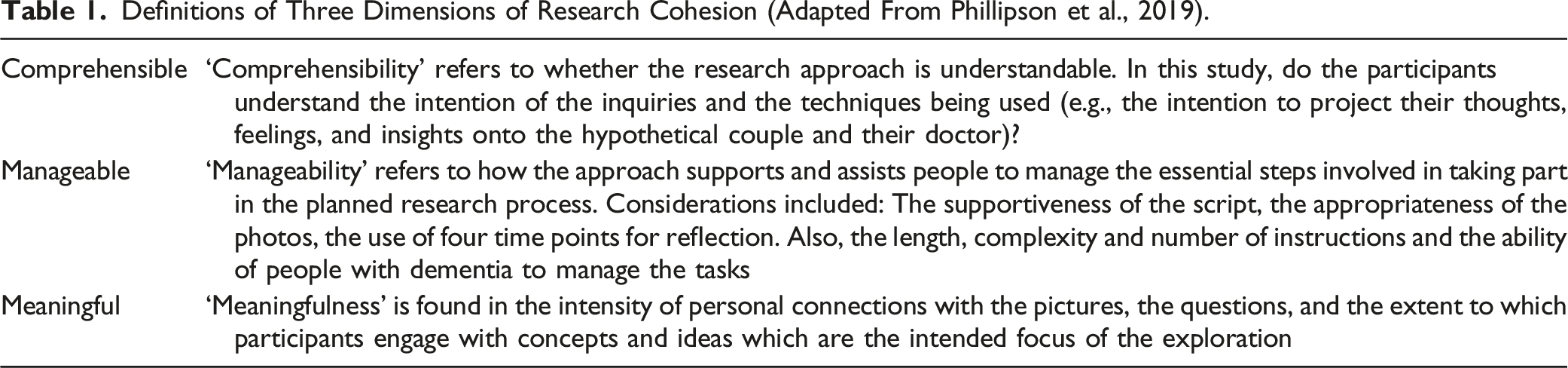
Recruitment
All data collection occurred between November 2019 and February 2021. Recruitment was challenging as, for the most part, it took place during the COVID-19 pandemic. To overcome challenges, each country tailored strategies to maximise reach. Sample strategies included use of social media (Twitter and Facebook) in Australia, recruitment via dementia and community care services in Canada, and a day program in Poland. In the Netherlands and Poland recruitment also took place through hospitals (e.g., memory clinics and psycho-geriatric wards). Finally, some participants indicated willingness to participate in an interview or focus group following completion of a baseline survey conducted as part of the larger study (COGNISANCE). To maximize convenience, participants could choose between individual or dyadic interviews (with a caregiver) or focus groups. Participants were also given the choice of face-to-face (when public health orders permitted), telephone, or online interviews. Online sessions utilized Zoom which is the platform preferred by people with dementia (Gray et al., 2020). All participants were offered instructions and a prior trial session using Zoom.
Eligibility
Persons were eligible if they had self-reported a dementia diagnosis in the previous 24 months and could provide informed (or proxy) consent.
Data Analysis
All interviews, dyads and focus groups were recorded and transcribed verbatim. Data from the transcripts, along with researcher reflection templates were analysed. Combined ‘meta’ mind maps for the words ‘dementia’ and ‘support’ were created by the researchers and analysed for each country. All authors were involved in a multi-step analysis process led by LP and MH: 1. Re-familiarizing themselves with their national data sets and the concepts of research cohesiveness: comprehensibility, manageability, and meaningfulness (Phillipson et al., 2019). 2. Attending an online meeting to agree on definitions to capture the important elements related to the use of projective techniques (See Table 1). 3. Reviewing the three data sets: in-language transcripts, meta-mind maps on the words ‘dementia’ and ‘support’, and researcher reflection templates from their own countries. Content analysis was utilised to deductively identify evidence related to the revised definitions for the three ‘research cohesiveness’ concepts (see Table 1). Evidence from the Netherlands and Poland were translated into English before providing it to the team for their review. Two online meetings were held to discuss and reflect on the deductive analysis. 4. LP and MH wrote a first draft of the results combining input from all authors. LP conducted an iterative analysis of the meta mind maps from each country tabulating key themes or ideas (see Appendix C). All researchers discussed the draft analysis at an online meeting. All authors then returned to their transcripts, mind maps, and researcher reflections one final time and provided further input and evidence. 5. LP and MH incorporated additional input, feedback, and quotes and finalized the analysis and results.
Results and Discussion
Data Overview of Data-Collection Methods.

Participant Demographics.

Impact of Different Data Collection Methods
There is potential for various data collection methods to impact on research experience and data quality – especially the use of dyads – where varying expectations and disagreements between people with dementia and their caregivers have been previously reported (Dai & Moffatt, 2021). In relation to this, one researcher from Australia, reflected that ‘there were very few disagreements within dyadic interviews between the person with dementia and their caregiver – and I have noticed this occurring previously when using standard interview approaches. This causes me to wonder whether the projective techniques may have lessened the power dynamics because there was less time spent on disagreements about the person’s ‘actual’ history due to the focus on the hypothetical situation’. Another researcher from the Netherlands noted that in one dyadic interview, the person with dementia and the informal caregiver disagreed on minor details throughout the interview (names of places, people and dates). The researcher resolved this by acknowledging both opinions and re-iterated that there was no right or wrong and that detailed information (like names of people or nursing homes) were not always important for the purpose of the interview. The researcher felt that these minor disagreements did not have a significant effect on the course of the interview, or the data collected and that the use of the hypothetical scenario was helpful in resolving the disagreement. Other dyadic interviews did not encounter any such power dynamics affecting the interview.
Comprehensibility
To effectively participate, participants needed to be able could comprehend the intention of the projective and enabling techniques. In relation to this, our analysis suggests all participants understood the intent of the word associations and were able to effectively brainstorm to produce a variety of responses. Associations with the word ‘dementia’ flowed freely and included words associated with symptoms, stigma, stereotypes, emotions, family and social issues, and nihilism. With regards to ‘support’, word associations included lists of different types of services including informal care, health and medical, and financial services. Some participants also mentioned the primary importance of the love and support of family and spouses and the importance of taking a positive approach including providing supports for adaptation and agency. These free-flowing discussions contrast with qualitative studies using direct questioning which have reported decreased vocabulary, poor reasoning of verbal information, confused word associations and limited data quality (Crisp, 1995; Haak, 2003; Hubbard et al., 2003; Nygård, 2006).
All participants also understood the intent and purpose of the photo elicitation techniques i.e., that they were being used to prompt them to reflect on the thoughts and feelings of the couple in the hypothetical scenario. One researcher from the Netherlands noted, ‘No additional explanation was needed on the use of projective techniques. Some participants dove straight into the questions they saw written on the handouts’. Comprehensibility of the photo elicitation techniques was also evident in the participants’ engagement with the ‘experiences’ of Thelma and John. Some empathised with the characters, for example one participant noted that Thelma’s situation was very similar to her own and said “…it is hard not to personalize that…” (Canada, Participant 4) whilst others compared and contrasted their own experiences to the scenario. Interviewer: ‘Okay, will you want to add anything else to what [Thelma] thinks about this situation?’ Participant: ‘Well, I think that because she is with a friend or her husband, she feels that she is safe’ Interviewer: ‘What could [Thelma] feel, a few weeks after this diagnosis?’ Participant: ‘Well, I think she feels bad about it, because nobody wants to hear such a diagnosis. But I can handle everything, I can handle everything…’ Poland, Participant 1 Interviewer: ‘So, I’m wondering whether you can put yourself into Thelma’s shoes and imagine what she might be thinking and feeling’. Participant: ‘Two things are happening; I’m looking at them and [also] thinking what happened to me’. Australia, Participant 8
Manageability
To understand how the techniques supported manageability, we examined how easy it was to complete the essential steps in the research process. Word association activities were manageable for most participants and served as ‘icebreakers’, supporting free-flowing conversations, and triggering spontaneous thoughts around the key research concepts of ‘dementia’ and ‘support’. ‘It was a good warm-up… participants felt free to express themselves. In this activity the participants could talk more freely about the first general associations.’ Poland, Researcher Reflection Template
Researchers reflected that the word associations supported clarity around the focus of the research. Using word associations at the start provided an easy and early opportunity for participants to experience success in the interview. This scaffolding of capacity was useful to promote trust with researchers and other group or dyad members, aligning the technique with strength-based approaches which are known to have advantages in dementia care (McGovern, 2015).
Researchers noted the techniques supported collaboration between both group and dyad members, with each able to build on the suggestions of others to delve deeper into the meaning of keywords. When the researcher collated participant responses into ‘mind maps’ they also served as useful rich visual representations summarising collective knowledge and prompting further suggestions from other participants. Mind-mapping has been highlighted previously as a potentially useful tool for people with dementia to use to improve their quality of life (Kellogg & Nogi, 2018). Although only preliminary, our findings suggest that word association techniques could also assist in research to promote the more typical benefits associated with group processes and interactions (Morgan, 1997). ‘The impact of mind maps in [the] small focus group assisted in developing group rapport and a sense of commonality of experience in group members…. They establish rapid rapport…[gave] a sense of direction and allowed the facilitator to use the mind maps’ words and statements as an ‘anchor’ to keep the interview on track…’ Australia, Researcher Reflection Template
The photo elicitation participant handouts included images and a space to write which allowed people with varying capacities to engage differently. While some only used the handouts as a visual aid or prompt, others wrote on them and commented on their usefulness to help them prepare their responses. For example, ‘I wrote on this before, so it’s helping me to look at the notes I’ve got here’ (Australia, Participant 8). However, when others were invited to write down words on their worksheet they declined, ‘I don’t write so well anymore’ (Australia, Participant 9).
At times having multiple pages in the participant handouts posed both physical and cognitive challenges for participants. However, with researcher support, it was possible to re-orientate those who lost their place. Interviewer: ‘You may go to the last page.’ Participant: ‘Huh, huh am I getting nervous.’ Interviewer: ‘Well, there’s no need for that…Uhm you may turn to page uh 5 for now.’ Participant: [Browses to page 5] ‘Aah they are stuck together.’ The Netherlands, Participant 5 Participant: ‘Now even you ask me the questions…my weakness is sometimes I go off on a tangent and forget what you want me to do.’ Interviewer: ‘Yes. Well…hopefully those pictures there will help us to stay focused on the conversation. And I’ll try and help you to stay on topic. That’s one of my jobs as well.’ Australia, Participant 8
Overall, the photo elicitation techniques used in this study were not always manageable for all participants. Similar to other research (Phillipson et al., 2022), we found that the stage of dementia as well as physical co-morbidities (e.g. hearing loss) made discussion of the photos and probing around responses more challenging. Some researchers used supports in the field such as repeating instructions or providing physical assistance with managing the handouts when in face-to-face environments. However, this was more challenging when working in online and telephone environments. Likewise, the length, complexity, and number of instructions in the resources required a level of sustained attention and involvement that was too demanding for some participants. In the Netherlands there was one interview that was relatively short. The participant had just finished an appointment at the memory clinic and explained they were tired. This impacted their ability to extensively answer questions, but they still engaged with the scenario and produced relevant information. The researcher did not want to create additional burden by asking too many in-depth questions.
Whilst improvements to both the research process and research instruments are possible, it is also likely that the type and nature of some people’s dementia and other physical co-morbidities may limit the usefulness of photo elicitation techniques for some participants. This reinforces the need for flexibility in data collection methods based on the needs, preferences and abilities of participants (Bartlett et al., 2018).
Meaningfulness
We also evaluated the projective and enabling techniques in relation to the extent to which they supported a connection with the research topic and engagement with the issues surrounding a diagnosis of dementia and post-diagnostic supports.
Word association activities were useful to prompt a variety of responses including those associated with the social aspects of dementia (e.g., stereotypes, stigma) and specific emotional responses (e.g., fear, sadness). However, the free-flowing nature of the brainstorming was associated with minimal delays between the offering of word associations by different participants, so did not always provoke emotional responses from participants. Interviewer: ‘Okay. [silence] And uh does it also evoke certain emotions in you?’ Participant: ‘No. No.’ Interviewer: ‘Okay. So basically, what you say by the word dementia I think of forgetfulness and how to deal with that and the situation with my mother.’ The Netherlands, Participant 1
In contrast, the photo elicitation techniques frequently prompted both strong empathy for the hypothetical characters and emotional responses and reflections from participants on the personal aspects of being diagnosed. The photos prompted reflections on the deep emotions associated with the diagnostic experience. This included frustration, stress, and horror. Interviewer: ‘A few weeks after the event. [Do] you think she’s been doing anything to try and come to terms with the diagnosis she’s received.’ Participant 4: ‘I repeat my previous comment, horror.’ Participant 5: ‘And probably worse.’ Participant 4: ‘Well, yes, I mean, what else is worse?’ Participant 5: ‘Did you stop sleeping?’ Participant 4: ‘I have had very broken sleep, and I never used to know, used to get troubled with sleep at all’. Australia, Participants 4 and 5
Fears were also expressed regarding the social impact of the diagnosis, including the potential impact on family members. Participant: ‘Exactly, and I mean, at this stage of the game, I reckon that she was probably thinking, OK, those two daughters of mine, how does this affect them, and I can tell you that nobody would have said anything to her about this gene, so she wouldn’t have thought about that’. Australia, Participant 4
The photo elicitation technique also supported participants to reflect on the possibility of more positive and resilient responses to the diagnosis. Interviewer: ‘We move a few weeks later, that is, [Thelma] received the diagnosis a few weeks ago and we wonder what happened during that time from that visit, during those few weeks, what happened? What was she doing then? What could she be thinking? What to feel’? Participant: ‘So, I am already in this state, so I compare my behaviour, remember what I used to be …, but it does not break me down, I know age needs it, otherwise a person would not die, s/he would not die, a person must run out.’ Poland, Participant 10
In addition, they were useful to prompt the importance of the doctor’s approach to supporting acceptance. Interviewer: ‘What could a doctor do? What role could the physician play in the beginning in making a diagnosis?’ Participant: ‘Well, it is not to break down right away when he makes a diagnosis. Just like I can see, after all, like my professor, who very gently, kindly … just like we did diagnostics, checking the mind, efficiency and all … well, I would like to, well, I’m not afraid, I know, I realise, that a person is not so mentally efficient all his life, there are exceptions, there are people who somehow work their brains all the time, they think - well, that’s positive, it’s good.’ Poland, Participant 10
One researcher noted some initial concerns over the intention of the techniques to trigger personal and emotional responses. However, these worries were not realised, and whilst this researcher experienced one participant crying during the interview, they found the response was manageable with support, and the participant expressed a clear desire to continue with the research. Participant: ‘I decided it is what it is, and I might as well go through it the best as I can [crying] I’m sorry.’ Interviewer: ‘Oh, that’s ok.’ Participant: [crying] (5 sec) ‘That’s ok, I cry easily when anything is, anything is going wrong.’ Interviewer:’ Hhmm Did you want to a take a little break or anything?’ Participant: ‘No, I am ok.’ Canada, Participant 3
Finally, the photo elicitation technique supported participants to meaningfully move between their reflections on the experience of the characters in the hypothetical scenario and their own experiences, helping to generate rich data about helpful advice and improving the diagnostic process and supports. Participant: ‘From my perspective, I remember when the doctor told me exactly. Again, I wasn’t fighting for diagnosis, I actually knew I had it, from my perspective. I was lucky that the doctor who, Dr. [Name] was highly professional in the way she delivered the diagnosis and exceptionally supported. But as I think too what the stories I’ve heard, the majority talk about being told in a very impersonal way…. [Yes] The people that I spoke to they were shocked at first, and when I look at Thelma at her age, I’m not sure but she’s probably baffled/confused at the diagnosis but only her carer there would know the magnitude of the devastation of such. [Yes] and one of the things I suppose I look at for older people when often they’re told it’s too late, they’re at that point in time their ability to process a bit too emotionally attached the diagnosis and what it actually means is it’s probably limited. I see her absolute uncertainty; I see her confusion. Not a good grip in reality which is what I would expect with the diagnosis. [Yes] and I think it’s lovely that the bloke is holding her hand at a point of reassurance, you know is support there. Australia, Participant 6
Deep reflections were sometimes also shared about issues such as how a diagnosis might disrupt the character’s identity or role. For example, despite being male, the photo elicitation technique supported on participant to reflect on how a diagnosis of dementia may interrupt Thelma’s identity as a married woman. Interviewer: ‘What about you, [Participant 3]? What do you think a few months later might be making a difference for Thelma about how she’s feeling about life?’ Participant: ‘Well, I think she probably has come to terms… and I think that’s the first step. Yeah. And learning how you can, uh, a - reduce the problem, the progress of the problem, you got… slow it down. I think it depends a lot on the individual, if Thelma is -If she hasn’t been out in the community and she’s spent her life…[as] a servant to the husband, being a housewife and…all of a sudden, it’s gone, or these capabilities are. I can imagine that would be very difficult.’ Australia, Participant 3
Limitations to Meaningful Engagement
Whilst many were very engaged, not all participants found the photo elicitation techniques meaningful. For example, one participant did not feel it was possible to understand what someone else might experience, especially without more information about the person and their unique situation. However, through the process of engaging with the scenario, he was eventually able to see the perspective as if in “Thelma’s shoes”. Participant: ‘Well, this is a problem for me, because I do not know exactly what this dementia is associated with. If so… it could be very serious. Or it is at the beginning, for example, and something else can be done about this dementia through some mental training or some drug treatment, so I just don’t know what this diagnosis entails. And I, if I were in this lady’s shoes, I would like to know, the truth is, what is it, what can be done, can something be done, can something be done, or what they are here, I don’t know … dementia is generally associated with something so serious (…)’ Poland, Participant 2
One participant also limited their engagement with the scenario, providing only brief, and factual responses. Interviewer: ‘If you were the person who received that diagnosis how would you feel? Or how would she be feeling?’ Participant: ‘Well, if the doctor said you had it, the doctors they know their business’. Interviewer: ‘mm-hm’ Participant: ‘I would accept what they said.’ Interviewer: ‘Ok, do you think she would have, that Thelma would have some questions at the time when her physician said that to her?’ Participant: ‘Well, I wouldn’t know. Some people accept these things, and some people don’t, so it all depends [on] whether she accepted the decision.’ Canada, Participant 5
Our analysis suggests that the inclusion of written words within the ‘thought bubbles’ as well as the nature of some of the images selected may have limited participant responses. Researchers felt that they specified a focus for participants on Thelma’s thoughts and feelings, rather than encouraging a more open-ended response to the scenario. Interviewer: ‘Please look at this photo, think about what, after these few weeks, could [Thelma] be feeling?’ Participant: ‘I mean, I can’t think about it, because it says here: “Thoughts, [Thelma] feels.” Oh, “What did she do during this time, could she help her, what might help her” …’ PwD3: ‘Well, I see, I see two smiling people who are satisfied with their life, so it all worked and now there are happy people!!!’ Poland, Participant 3
Some participants also did not find the different time points represented in the photo elicitation techniques meaningful. These interviews tended to be shorter, with participants sharing little additional information about the experience of diagnosis over time. For example, responses to the initial timepoint (Thelma’s diagnostic conversation with her doctor) produced consistently meaningful, engaged and strong responses. Interviewer: ‘What would Thelma be thinking and feeling right now?’ Participant: ‘Well, I’ve been in the chair… So, when I’m in the chair, I’m thinking “oh my god, I’ve got dementia”. So, you start, you know, your brain is going around and around thinking “what symptoms did I show? What made them do this?” And that they hadn’t told me.’ Canada, Participant 1
However, the subsequent time points (‘a few weeks later’ and a ‘few months’ later) lacked the same intensity of meaning for some participants. Some did not perceive much difference between the intervals and had problems distinguishing between the types of supports that may be useful a ‘few weeks’ after diagnosis versus after a ‘few months’. Interviewer: ‘Now let’s move a little forward in this story, a few weeks later from this visit, where the doctor made a diagnosis when he told [Thelma] that she had dementia and again a similar question: what can [Thelma] feel at this time? What could she do?’ Participant: ‘Well, what I said. It’s the same.’ Poland, Participant 3 Interviewer: ‘Has anything changed for her do you think [a few months later]?’ Participant: ‘Uh, you say a few months later? Yes. Uh, I, it might have changed markedly, and it, there may be no change at all. Um… and she might not notice those changes regardless of how advanced they have become. John will know…Yes. I think, uh… at that point, months later, depending on how rapidly her progress is down the road, it might be years before John says, “I have to have help for her, I have to be able to get away.” But it might, and it might be months, it might be years.’ Canada, Participant 1
The final scenario which presented a positive conclusion to the 12 months post-diagnosis for Thelma and John consistently prompted both strong positive and negative reactions. For some, they thought the image highlighted that the shock and horror might not last, and they reflected on the fact that it was possible to come to terms with their diagnosis and take back some control. This shows the potential value of research-driven photo-elicitation to present visual stimulus that causes participants with dementia to reflect on something they may not have otherwise done. Interviewer: ‘I’m wondering what this image brings up for you and what you think of this you know a few months later might be going on for Thelma and you know what she’s thinking and feeling at the moment, what you think she’s been doing and might have helped her?’ Participant: ‘See that was probably reflective of me, that I’m at that point in time where I’ve been able to take control back of my life and the good things, I may not have the mathematical skills etc. but that’s irrelevant. I can have conversations the fact that I can be myself because I have control over the destiny of my life, that’s what that brings to me. Sadly, to say from my experience from the people I’ve met I’d probably be one of few who’d be in that situation. So, I would see this as a goal find their diagnosis, that’s what you wanted to hear, that means you have a purpose in life, still make decisions. That has gone.’ Australia, Participant 6
For others, however, the photo represented a scenario that was unrealistic and did not reflect their own situations. Informal caregiver: ‘That picture [final picture].’ Participant: ‘That one just sitting there on that couch.’ Informal caregiver: ‘And she isn’t that like that.’ Participant: ‘I don’t…’ Informal caregiver: ‘Ok, no’ Participant: ‘No way. Not really no. I would like to but uh, I can’t imagine being like that, that we’re laughing like that.’ The Netherlands, Informal caregiver and Participant 4
Strategies for Developing and Improving the Photo Elicitation Techniques
Previous research with people with dementia has identified two types of visual data collection techniques as useful for promoting engagement in research by people with dementia: those which use researcher-driven and selected photographs, films, or visual tools and those in which participants produce or select their own visual artifacts (Phillipson & Hammond, 2018). In this study, we utilised researcher selected stock photos and a researcher generated hypothetical scenario involving two characters: Thelma (who was recently diagnosed with dementia) and her husband (John). On reflection, a shortcoming may have been that the hypothetical nature of the images and scenarios made them less believable and limited research engagement by some participants. Firstly, the hypothetical scenarios were strongly culturally bound (i.e., our characters had western names, were heterosexual and white and their formal well-dressed appearance in the stock images also suggested they possessed relative wealth). The scenario also concluded with representations of happiness for Thelma and John at 12 months post-diagnosis – which whilst consistent with recommendations for a positive ending in dementia research (Murphy et al., 2014) – provoked both strong positive and negative reactions from some participants.
To build on these insights we suggest future research take advantage of the known benefits of co-designing research activities with people with dementia (Wang et al., 2019). Use of co-design is one way to enhance knowledge exchange between researchers and people with dementia through the incorporation of their ideas and experiences. We recommend that co-designing projective and enabling methods with a diverse group of people with dementia may be helpful to support the selection and design of more varied scenarios, images, and cases. This will be important to improve the approach and stimulate more discussion of cultural and experiential differences. Engaging in co-design with a varied group of people with dementia may also assist with decreasing the reliance on a single scenario and providing opportunities for testing whether different cultural groups engage more with different types of projective techniques (an outcome which we did not address in this study despite this being a multi-country study). Bamford and Bruce (2002) also suggest that exploration of the role of gender within case studies may be worthwhile. This is not only due to the perceived difference between men and women, both also the frequently ignored experiences of those who identify as gender and sexuality diverse (Smith et al., 2022). For example, in our use of photo elicitation techniques, we could have been more inclusive of cases that included men being diagnosed, female caregivers, same-sex couples, and people who express their gender in non-conforming ways. This greater diversity of images and scenarios may have been useful to stimulate a greater range of responses that could promote more inclusive service planning.
We also recognise the potential value of trialling more participant driven photo-elicitation methods such as Photovoice which have also been used to promote inclusive research with people with dementia (Guerra et al., 2013; Wiersma, 2011). Photovoice involves participants independently taking photographs about something they feel is important and can provide insights into their lives (Wang & Burris, 1997). In participant-driven photo elicitation participants are more actively involved in selecting the photographs or visual stimuli to prompt discussion, giving more control over images and the direction of the discussion, as well as greater ownership over the research process (Clark-Ibanez 2006). It is possible that the participant-driven photo elicitation (e.g. Photovoice) may have therefore been useful to promote deeper and more diverse understandings of the dementia diagnostic experience, meaningful time transitions, and post-diagnostic supports for people with dementia during the first 12 months. That said, for older people with dementia, all methods, including photovoice can still pose challenges (Genoe & Dupuis, 2013) so care must still be taken to ensure the manageability, comprehensibility, and meaningfulness of the research process (Phillipson et al., 2019).
Limitations
It was our experience that both word association techniques and photo elicitation techniques may have some utility in overcoming dementia-related memory, perceptual, and communication challenges described in other qualitative research (Cridland et al., 2016; Lloyd et al., 2006; Ready & Ott, 2003). However, these techniques were not manageable or meaningful for all participants, and researchers should consider the need for inclusion criteria which recognise that to take part, participants must have the capability to converse and share ideas with others, as well as the cognitive capacity to respond and discuss the photo stimulus. As such, we do not recommend these methods for use in people with more advanced dementia. Our study also had several limitations. Firstly, our study design was cross-sectional and exploratory, and we did not have a comparative group. So, while we can comment on the feasibility and utility of the techniques to support engagement from the researcher perspective, future research should endeavour to compare the results to those gained by use of an alternative standard interview or discussion guide questioning.
Enabling research methods can be used in a variety of research contexts, including interviews, dyads, and focus groups (Clark-Ibanez 2006; Gill et al., 2008). In interviews, they can enhance recall and discussion of sensitive topics; in dyads, they can support communication and collaboration between the two participants; and in focus groups, they can help to stimulate discussion and generate a rich understanding of experiences and perspectives (Clark-Ibanez 2006; Gill et al., 2008). However, due to the relatively low numbers of participants and the wide variety of contexts in which data was collected we are not confidently able to comment on the value or drawbacks of these different contexts. We therefore recommend exploration of this in future research.
We also faced many challenges associated with recruitment to our study due to it occurring during COVID lockdowns (Sharma et al., 2022). This resulted in a mixed approach using both online, face-to-face, and telephone settings, and a combination of individual, dyadic, and small focus groups discussions. Unfortunately, our relatively small sample size did not allow for examination of whether utility of the techniques differed between these methods, and this should be explored in future research. That said, we did have a positive experience with online interviews, which have been associated with both benefits and challenges in other research with people with dementia (Sharma et al., 2022). It has been reported than women are more likely to volunteer to participate in dementia research studies than men (Jeon et al., 2021). In our study, although the majority of participants were women, we did also attract a high number of males. This may be due to some preference for online interviewing but perhaps also the use of projective techniques. However, further evidence is required to confirm this hypothesis.
Conclusions and Implications for Research, Policy and Practice
Our experiences within this study suggest that word associations and researcher-driven photo elicitation techniques can be useful to support involvement and lessen some of the demands imposed by more direct questioning approaches for people with dementia. They were also useful to promote meaningful engagement with the topic, with photo elicitation especially highlighting the deeply personal aspects of being diagnosed and the complex and strong emotions associated with the diagnostic experience. In response, medical practitioners involved in diagnosing dementia should be mindful to recommend psychological support services that can promote wellbeing and psychosocial adjustment to a diagnosis, whilst dementia policy makers should also ensure psychological supports services are readily available for those recently diagnosed (Bamford et al., 2021). Finally, the study has implications for research training practices, highlighting the need for research students to be exposed to a wider variety of innovative methods which may enhance the voice of people with dementia in health services research and evaluation (Phillipson & Hammond, 2018).
However, despite some utility, the techniques were not a ‘cure all’, and the importance of research support, careful preparation, and co-design of research approaches was highlighted. Our findings reinforced the need to match approaches to the individual circumstances and preferences of people with dementia. Future research should build on this work by exploring the value of other projective and enabling techniques to grow the evidence needed to understand what works for whom and in what context. We also join with other researchers in the call for further research which places a greater emphasis on co-design, co-delivery and co-evaluation strategies to support interpretation of research data (Wray et al., 2021). These efforts will enhance the toolkit of dementia researchers and improve the engagement of people with dementia within an interview and focus group context.
Supplemental Material
Supplemental Material - The Utility of Researcher-Driven Projective and Enabling Techniques to Support Engagement in Research About Dementia Diagnosis and Post-Diagnostic Support
Supplemental Material for The Utility of Researcher-Driven Projective and Enabling Techniques to Support Engagement in Research About Dementia Diagnosis and Post-Diagnostic Support by Phillipson, L., Hevink, M., Conway, E., Gresham, M., McAiney, C., Mackowiak, M., Szczesniak, D., Smith, L., Brodaty, H. and Low, L. F. in International Journal of Qualitative Methods.
Ethical Statement
Ethical Approval
Ethical approval was obtained in each participating country prior to commencement of the research: Australia: University of New South Wales, Sydney. Human Research Ethics Committee #HC190776. Canada, Quebec: Research Ethics Institutional Review Board (IRB), Faculty of Medicine and Health Sciences, McGill University. IRB #A09-B70-20A. Canada, Ontario: University of Waterloo Office of Research Ethics (ORE). ORE #41423. Canada, New Brunswick: Horizon Health Network Research Ethics Board (REB). REB #100560. Vitalité Health Network Research Ethics Board (REB). REB #100858. University of New Brunswick Research Ethics Board (REB). REB #057-2019. The Netherlands: Maastricht University Medical Centre Medical Ethics Committee #2019-1064 -A-10, 2019-1064. Poland: Wroclaw Medical University, Ethics Committee protocol code: KB – 602/2019.
Footnotes
Acknowledgements
We would like to thank all other members of the COGNISANCE consortium for their collaboration on the overall project including: Marta Ciulkowicz, Marta Duda-Sikula, Frans Verhey, Marjolein de Vugt, Claire Wolfs, Lauren King, Alison Luke, Amy E. Reid, Melissa Koch, Shelley Doucet, Isabelle Vedel, Laura Rojas-Rozo, Pamela Jarrett. The authors would also like to extend a thank you to Kate Swaffer from Dementia Alliance International, Katrin Seeher from the World Health Organization, and Wendy Weidner from Alzheimer’s Disease International for their continuous help and support.
Declaration of conflicting interests
The author(s) declared the following potential conflicts of interest with respect to the research, authorship, and/or publication of this article: Henry Brodaty is or has been an advisory board member or consultant to Biogen, Eisai, Eli Lilly, Roche and Skin2Neuron. He is a Medical/Clinical Advisory Board member for Montefiore Homes and Cranbrook Care. No other authors have conflicts of interest to declare.
Funding
The author(s) disclosed receipt of the following financial support for the research, authorship, and/or publication of this article: This work was part of the COGNISANCE project funded by the EU Joint Programme - Neurodegenerative Disease Research (JPND). The project is supported through the following funding organisations under the aegis of JPND -  : Australia, National Health and Medical Research Council (RG181644); Canada, Canada, Canadian Institutes of Health Research (ENG-161464) in partnership with the Public Health Agency of Canada, with additional funding from the Public Health Agency of Canada administered through the Government of New Brunswick (C0049); The Netherlands, ZonMw (JPND733051081); Poland, The National Centre for Research and Development (JPND/05/2020)
Contributorship
LP led the design of the study and research instruments. She also led the training of all researchers in the use of the projective techniques. She was involved in the Australian data collection and led the international data analysis with MH. She also took the primary responsibility, along with MH for drafting the manuscript. MH was involved in data-collection in the Netherlands, coordinating international data-collection, international data analysis and drafting parts of the manuscript. EC was involved in analysis of the Canadian data and editing and approving the final manuscript. MG was involved in data collection in Australia, in analysis of Australian data and editing and approving the final manuscript. CM provided oversight in data collection in Canada, was involved in analysis of the Canadian data and editing and approving the final manuscript. MM was involved in data-collection in Poland, was involved in analysis of the Polish data and editing and approving the final manuscript. DS was involved in data-collection in Poland, was involved in analysis of the Polish data and editing and approving the final manuscript. LS Contributed to the design of research instruments. She was also involved in analysis of the Australian data and editing and approving the final manuscript. HB contributed to the overall design of the study and was involved in editing and approving the final manuscript. L-F L contributed to the design of the study and research instruments. She also supported training of all researchers in the use of the projective techniques. She was involved in the analysis of the Australian data and editing and approving the final manuscript.
Supplemental Material
Supplemental material for this article is available online.
References
Supplementary Material
Please find the following supplemental material available below.
For Open Access articles published under a Creative Commons License, all supplemental material carries the same license as the article it is associated with.
For non-Open Access articles published, all supplemental material carries a non-exclusive license, and permission requests for re-use of supplemental material or any part of supplemental material shall be sent directly to the copyright owner as specified in the copyright notice associated with the article.
