




Abstract
This paper explores the application of Constructivist Grounded Theory (C-GT) methodology for social work research. First, it argues that C-GT methodology is well aligned with social work as the two value the individual in the context of their environmental influences. Both also prioritise the importance of respecting and valuing the participant or individual, seeing their perspective as unique and significant. Finally, this research methodology’s systematic yet flexible guidelines align with social work ethics, which also focus on the importance of professional integrity. The paper then provides an example of a C-GT PhD study in relation to an area of social work practice, that is, stability in statutory kinship care in Queensland, Australia. The paper details the specific recruitment and sampling of participants, data collection and coding analysis examples from the PhD study. The examples evidence the relevance of C-GT methodology and its application for research in the area of social work practice, specifically statutory kinship care.
Introduction
Social work is a practice-based profession that strives to increase the development of human potential and realisation of human needs (AASW, 2020). Social work focuses on service to people, seeing both the dignity and worth of others. The profession sees social worker duties undertaken in a manner that commits to social justice, integrity, competence and respect (BASW, 2021). Social work is the academic discipline founded on theories in social work, humanities and social science (Canadian Association of Social Workers [CASW], 2020). The CASW (2020) states that ‘social work focuses on the person within the environment and recognises the importance of family, community, culture, legal, social, spiritual and economic influences that impact the well-being of individuals, families, groups and communities’ (p. 1). Research in the area of social work is a priority as it builds knowledge, informing both competency and evidence for practice. Within the context of this priority, this paper argues the relevance of C-GT methodology for enquiry in social work. This paper will first detail the alignment between social work values and the C-GT methodology from the paradigm through to the methods. Next, it examines the specific social work research concerning stability in statutory kinship care undertaken using the C-GT methodology in Queensland, Australia. Finally, it details the research findings, highlighting the positive results of applying this methodology to build an understanding of stability in statutory kinship care and inform social work practice in the area.
C-GT methodology is based on the philosophical framework or paradigm of constructivism (Charmaz, 2014). Constructivism denies the existence of an objective reality and instead states that realities are social constructions of the mind, and as many such constructions exist as there are individuals (Guba & Lincoln, 1989). Specifically, social constructivism asserts that an individual reality is created through individual and collective reality. Social constructionist studies maintain a focus on what people at a particular time and place see as real, and they have formulated their views and actions (Charmaz, 2014). Constructivism and social work are aligned in valuing both the individual and the influence of the environment on the individual, including culture, family, community, social and legal (AASW, 2020; CASW, 2020). Constructivism and social work allow for the possibility that many constructions will be shared, and understanding these shared constructions informs practice. For social work and constructivism, understanding the differences also informs practice (AASW, 2020; Guba & Lincoln, 1989). Another critical element of constructionism is the recognition that individuals learn from their actions and interactions and learn through their acceptance of what others tell them (Schwandt, 2007). This element also fits with the focus of social work on the individual and their environment. Constructivism research is not designed to produce fixed and universally valid knowledge but instead opens up an awareness of what is possible within the relevant context (Galbin, 2014). The consideration of context supports research that is relevant to the practice-based profession of social work.
The constructivism paradigm, which applies to C-GT methodology, holds three key assumptions. First, it is a relativist ontology; that is, there are many possible realities. For the study detailed in this paper, the reality is in relation to stable statutory kinship care placements. These realities are subjective and multiple, as seen by the research participants (Creswell, 2014). The relativist ontology is a good fit for social work because it recognises the importance of seeing each individual as unique and in the context of their own environment. This is consistent with social work ethics regarding respecting the inherent dignity and worth of persons (AASW, 2020; BASW, 2021; CASW, 2020). Second, it assumes a subjectivist epistemology in that the researcher and research participants co-construct the understandings (Denzin & Lincoln, 2011). This paradigm positions the researcher as an active participant in the study. The researcher is neither neutral nor required to be. It is through their active engagements during the interview process that ideas are raised and discussed, and knowledge is jointly contrasted (Mills et al., 2006). A C-GT methodology allows the researcher to have existing knowledge of the area being studied, as long as the researcher is aware of their extant theories and remains vigilant not to start from these theories (Charmaz, 2014). It is argued that researchers construct grounded theories through past and present involvements and interactions with people, perspectives and research practices (Charmaz, 2014). The subjectivist epistemology is well aligned with research to inform social work practice because it values the social interaction between the researcher and the participant. Further, for social workers who undertake research, it values their practice-based experience in the profession (AASW, 2020; CASW, 2020). Ethically, social work values integrity in professional practice, which is therefore applied when using this methodology. That is, the professional experience of researching social work is transparently included and reported on in the study.
C-GT methodology incorporates trustworthiness criteria to support research rigour (Charmaz, 2014). These four trustworthiness criteria, namely credibility, dependability, confirmability and transferability, also align with social work ethics that value integrity in professional practice (AASW, 2020; Rodwell, 1998). Credibility is the ability of the data to represent the research participants’ experience of the social phenomenon being investigated (Denzin & Lincoln, 2011). The second trustworthiness criterion is dependability or the degree to which the research procedures adhere to accepted constructivist practices (Denzin & Lincoln, 2011). This criterion includes being able to replicate the research procedure and ensuring a process is in place to balance the participant’s meaning and the researcher’s interpretation (Denzin & Lincoln, 2011). Dependability also includes reflexivity or the strategies to explore and manage subjectivity. In the C-GT methodology, these strategies can include memo writing and participating in formal supervision meetings (Charmaz, 2014). Confirmability is the third criterion and requires that the collected data and the research results are sufficiently linked and that this can be evidenced (Charmaz, 2014). The final trustworthiness criteria is transferability, or the ability to evidence how the findings are pertinent to other settings, circumstances, or situations. The four criteria evidence how the C-GT methodology aligns with social work ethics, particularly the value of professional integrity in social work practice.
The final assumption of the constructivism paradigm, which applies to C-GT methodology, requires the use of naturalistic methodologies, that is, nonexperimental, emergent methods (Denzin & Lincoln, 2011). This assumption supports using semi-structured interviews with research participants in their environment. Specifically, ‘data does not provide a window on reality, but rather the “discovered” reality arises from the interactive process and its temporal, cultural, and structural contexts’ (Charmaz, 2000, p. 524). As noted previously, the inclusion of context within C-GT methodology research aligns with social work practice, which also positions the importance of the individual’s context, including their environmental influences. These influences can include family, culture, social, economic, spiritual and community (AASW, 2020). C-GT methodology is a good fit for research to inform social work practice because it aligns with how social work positions the individual within their environment, values the researcher’s existing knowledge base and acknowledges the uniqueness of individuals.
Within the C-GT methodology, numerous methods fit well with social work practice. The methodology provides systematic yet flexible guidelines for collecting and analysing qualitative data to construct theories ‘grounded’ within the data (Charmaz, 2014). The guidelines support the research process to ensure the research participants’ contribution is valued and forms the construction of the theory. The guidelines support the researcher to competently approach the data collection and analysis. Competency is a social work principle guiding the delivery of services to individuals, groups and communities (BASW, 2021). The joint focus on competency in both social work and C-GT methodology highlights why this methodology is a good fit for social work research.
Many elements used in the C-GT methodology are not unique to this methodology and also fit with other qualitative methodologies. These include semi-structured interviews, focus groups, case studies, purposive sampling, coding and analysis (Creswell, 2014). Theoretical sampling is unique to grounded theory research. In C-GT research, theoretical sampling occurs when tentative theoretical categories have been developed from the initial data. Theoretical sampling then sees the researcher seek events, people or information that will result in the tentative categories either becoming saturated or highlighting further categories (Charmaz, 2014). The theoretical sampling could be from the same participant group as previously sampled, but it may also include the sampling of other sources of information, data or participants in an effort to saturate the categories (Charmaz, 2014). This type of sampling complements the social work ethical standards in relation to prioritising the interests of the service user while meeting the social work principle of practising in a manner that shows respect for persons (AASW, 2020). Because the sampling allows the flexibility of the researcher to determine the most appropriate source of new data to be considered with the tentative categories, the interest of research participants is given priority. This could include going back to the existing research participants with specific questions to gather additional data or going to the existing literature in the subject area to incorporate additional data in an attempt to saturate the categories (Charmaz, 2014). These strategies of theoretical sampling see the researcher act in line with the ethical principle of respect for persons, as they value the data already shared by research participants or value the research findings already developed in the field through the involvement of previous research participants. In addition, theoretical sampling ensures the research applies informed decision-making to seek the necessary data required (Charmaz, 2014). This is aligned with the social work ethical principle of prioritising the interest of the service user (AASW, 2020). It is not in the service user’s or research participant’s interest to share information that is not relevant to the research. Theoretical sampling sees the researcher make an informed decision about what data would best fit the gap that is needed to saturate or fully form the substantive theory (Charmaz, 2014). This means participants are not interviewed unnecessarily, that existing data is valued and existing literature is valued. Again, this sees the methodology respecting the individuals, families, groups and communities.
The other area of C-GT methodology that aligns well with social work principles is the coding or the process of labelling the data segments to allow for the distillation, sorting and comparison with other data segments (Charmaz, 2014). These distinct phases include the initial, focused, and theoretical coding process. The coding process is iterative; that is, the researcher interacts with the data in a consistent and comparative way with new and existing data (Charmaz, 2014). Initial coding, sometimes referred to as open coding, is comprised of identifying concepts deemed pertinent to representing the collected data (Khan, 2014). Two key questions—‘What is the participant’s primary point?’ and ‘How do they interact with it?‘—provide invaluable insight into the data collected. Coding includes looking for actions and potential theoretical cues (Kenny & Fourie, 2015). Once initial coding is completed, the identification of categories commences; this is referred to as focused coding. This type of coding enables the identification of emerging core categories and facilitates the organisation of codes and categories. The codes emerge from the data rather than being imposed on it (Kenny & Fourie, 2015). Finally, the theoretical coding, or the integration of core categories, is completed. This final stage of coding allows for core category saturation, which means the core and non-core categories are saturated, and no new data emerges from the theoretical coding process (Charmaz, 2014). The saturated categories are then sorted into a theoretical statement in relation to the research topic. This coding process mirrors how social workers practice in the field in that they may be working with an individual. The social worker will consider the individual and what the individual means when sharing information, the same way initial coding does. The practice of social work also requires the practitioner to consider the individual in their context, the other influencing individuals, groups and systems, and also what cues, actions and interactions exist from the information shared by the individual, again aligned with the focused and theoretical coding (AASW, 2020). The C-GT coding process aligns with the social work ethical practice, namely, with respect for persons.
In summary, the C-GT methodology is a good fit for social work research because both have a foundational positioning of valuing the research participant, ensuring research findings are grounded in the participant’s data and finally considers the individual participant in their context, which values the place of family, community and social systems. The alignment between C-GT methodology for social work research will be detailed in the next section. Through the case study example of research in relation to stability of statutory kinship care, the methodology is highlighted as valuing key social work principles and ethics.
Methodology for This Study
The C-GT paradigm provided the framework for the enquiry into stability in statutory kinship care placements. The social construct for this study was ‘stable kinship care placement’, as constructed by the individual adults providing the stable kinship placements, the kinship carer.
The framework established the research design logic; that is, the individual people who experienced a stable kinship placement, formed the key participants for the initial data collection. This allowed the researcher to hear the participants’ understanding of stable kinship care placements. In addition, it assumed a subjectivist epistemology, thereby allowing for the researcher’s existing knowledge and practice experience in the kinship care field (Charmaz, 2014). The lead researcher was a social worker with over 20 years of practical experience working directly in statutory child protection, foster care and kinship care services. The role of the researcher in this C-GT methodology supported the co-construction of data (Clarke, 2019). In this study, co-construction occurred because the researcher was an active participant in all of the interview processes, allowing ideas to be discussed and knowledge to be contrasted jointly (Mills et al., 2006; Charmaz, 2014). It was essential for the researcher to be aware of their own extant theories or pre-existing knowledge and ensure that the research did not start from these (Charmaz, 2014). C-GT methodology requires the researcher to acknowledge their biases and experiences; and manage these during the analytical process (Corbin & Strauss, 2008). For example, the researcher’s procedural knowledge and experience in relation to the Queensland statutory agency had to be managed during data collection and coding. The researcher was required to balance their knowledge of the procedures with the participants’ stories, ensuring that they were listening on all levels to the participant and asked clarifying questions so as not to make assumptions about any statutory procedures that were mentioned. Another strategy implemented to support the effective co-construction of data while managing the researcher’s pre-existing knowledge and experience included the practice of journalling to support written reflection throughout the study.
This research paradigm supported the use of purposive sampling for the initial data collection, followed by theoretical sampling until theoretical saturation was secured. Naturalistic methodologies were applied, including the use of semi-structured interviews with research participants in their environment and memo writing completed by the lead researcher. Inductive reasoning was used to analyse the data with a three-phase coding technique. The coding phases applied were the initial coding, focused coding and theoretical coding to ensure the results were directly grounded in the data. C-GT provided the paradigm to guide the emergent research design, support the methodology and ensure rigour throughout the research.
C-GT Rigor and Trustworthiness
Credibility, dependability, confirmability and transferability formed the trustworthiness criteria for this study (Rodwell, 1998). Several strategies were applied to ensure creditability. Firstly the purposive sampling of familial and non-familial kinship carers who had experienced stable statutory kinship care placement meant the adults who have the authority to comment on this phenomenon were included. The second strategy was the researcher’s review of the current literature and subsequent application to the research design and interview process (Clarke, 2019). Finally, the inclusion of in-depth interviews whereby participants are invited to speak freely supports the construction of meaningful data about statutory kinship care (Charmaz, 2014). Dependability or replicability was achieved by the study having a detailed research design and methodology documents in a published Thesis. In addition, two reflexivity strategies were included to support the dependability. These included memo writing throughout the data collection and coding phases of the research to manage subjectivity and the researcher’s involvement in external supervision with three experienced social work researchers. This supervision included both reflective meetings to discuss any elements of the research and also the joint coding of some interview data. Dependability strategies supported the research to manage subjectivity (Charmaz, 2014).
C-GT coding methodology supported the third trustworthiness criterion of confirmability (Charmaz, 2014). This study evidence confirmability in the data collection process of transcribing the participant interviews, applying the initial, focused and theoretical coding process to all interviews, utilising Nvivo 11 to demonstrate the coding and using the participant’s words in the theory generated from the study. The supervision process previously mentioned also safeguarded confirmability. The final criterion was transferability. This study’s findings in relation to stability in statutory kinship care could be applicable to others who experience this type of Out-of-Home care placement. This placement type has increased in Western countries across the world (Kiraly et al., 2020). Research has linked stability to improved well-being outcomes for children in Out-of-Home care; therefore, the production of new knowledge in this area may be transferability and applicable to policymakers, practitioners, and stakeholders (Chang & Liles, 2007; Galbin, 2014; Winokur et al., 2015). These four criteria assist in evidencing this study’s trustworthiness.
Scope of the Study
This study took place in Southeast Queensland, Australia, with statutory kinship carers who defined themselves as providing a stable kinship placement. Kinship care is a statutory or informal arrangement where an adult or adult couple with either a familial connection or a connection that is deemed significant, cares for a child when they can not be cared for by their parent (McHugh, 2013). Statutory kinship care was defined as a type of placement in which either the statutory child protection agency holds custody of a child or custody and guardianship of a child (Department of Communities, 2011). This study included both familial and non-familial kinship carers. A familial kinship carer is related to the child and includes a grandparent, uncle or cousin. A non-familial kinship carer is an adult considered by the child to be significant to them and is a member of the child’s community. This could include a godparent, neighbour or former teacher (McHugh, 2013). This study was purposeful in considering the similarities and differences between familial kinship carers and non-familial kinship carers because there is limited research in relation to non-familial kinship care internationally.
The rationale for this study related to the continued growth of statutory kinship care as an out-of-home care placement type in Western countries across the world (Kiraly et al., 2020). Given the growth of this placement type, building knowledge to inform the social work practice in relation to statutory kinship care positively impacts children, young people and families living in this placement type.
This research was conducted in accordance with the ethical standards detailed in the National Statement on Ethical Conduct in Human Research 2007(updated May 2015) (National Health and Medical Research Council Australian Vice-Chancellors' Committee, 2015).
Sampling, Data Collection and Data Analysis
This study utilised both purposive sampling in the initial phase and theoretical sampling in the second phase to secure theoretical saturation. The sampling phase was conducted between May 2018 and July 2019. The initial purposive sample recruited eight familial statutory kinship carers and eight non-familial statutory kinship carers who described their kinship placement as being stable. The theoretical sampling phase recruited an additional two familial statutory kinship carers and two non-familial statutory kinship carers who described their kinship placement as being stable. This meant a total of 20 kinship carers participated in the study. Both cohorts were recruited by advertising the research in key kinship forums, including through the Kinship Carer state-wide peak body and kinship support agencies, to ensure participants were information-rich and representative of the characteristics under analysis in this research (Glaser & Strauss, 1967; Patton, 1990). Figure 1 provides a diagrammatical representation of the research detailing the two phases of sampling, data collection and coding, and the emergence of the substantive theory. Sampling and coding diagram.
(Clarke, 2022, p.66)
The researcher and research participants had one-on-one semi-structured interviews for up to an hour with key open-ended questions. This allowed a focus on the topic of stable statutory kinship care placements and also gave research participants time to tell their stories (Charmaz, 2014). Data included the collection of demographic information, followed by open-ended questions in relation to the stable statutory kinship placement, the child and kinship carers’ pre-placement relationship, factors related to the child, kinship carer and statutory agency that contributed to or challenged the stability within the placement, and their definition of stability in a statutory kinship placement. During the interviews, memo writing was completed by the lead researcher. Memo writing is categorised into two types, descriptive and conceptual. The descriptive memos see the researcher summarising the information and identifying key properties, dimensions, similarities and differences (Khan, 2014). The conceptual memos are abstract and informed by both the interview data and the descriptive memos (Charmaz, 2014). The interview data were transcribed by the lead researcher, allowing for further data collection through the researcher’s ongoing memo writing. Once transcribed, the data were analysed, which incorporated the researcher reading the data at a literal level, an interpretive level and a reflexive level (Mason, 2010). Again, this resulted in more memo data. During the three phases of data analysis—that is, the initial, focused and theoretical coding—both inductive and abductive reasoning was applied. Inductive reasoning was applied in that the individual participants’ data and stories were analysed with a focus on identifying conceptual categories (Charmaz, 2014). This type of reasoning ensures the categories are grounded in the participants’ data. Abductive reasoning was then applied to the conceptual categories generated, which moved them from the individual cases and supported generating credible theoretical explanations in relation to stability in a statutory kinship care placement (Charmaz, 2014).
Transcript and Initial Coding Example.

Note. (FKC = Familial Kinship Carer, NFKC = Non-Familial Kinship Carer, I = Indigenous, NI = Non-Indigenous, PPR = Pre-placement Relationship, NPPR = No Pre-placement Relationship). (Clarke, 2022, p. 94).
At the conclusion of the first four interviews, the initial coding and focused coding commenced, which resulted in the identification and refinement of categories. Both initial and focused coding continued iteratively from the fourth interview onwards. In completing the focused coding, the researcher extracted reports from NVivo 11 on the initial coded categories and the specific interview data coded to each category and the initial coding memo data. The research applied the following questions to the data in the reports to support the movement from initial coding categories to the focused coding categories. • What stands out when comparing the initial codes with data? • What patterns are revealed from the initial codes? • In considering the data, which codes best account for it? • What does the comparison between codes indicate? • What gaps in the data do the focused codes reveal? (Charmaz, 2014).
Interview Transcript, Initial Coding and Focused Coding Example.

Note. (FKC = Familial Kinship Carer, NFKC = Non-Familial Kinship Carer, I = Indigenous, NI = Non-Indigenous, PPR = Pre-placement Relationship, NPPR = No Pre-placement Relationship). (Clarke, 2022, p.97).
Interview Transcript, Initial, Focused and Theoretical Coding Example.

Note. (FKC = Familial Kinship Carer, NFKC = Non-Familial Kinship Carer, I = Indigenous, NI = Non-Indigenous, PPR = Pre-placement Relationship, NPPR = No Pre-placement Relationship). (Clarke, 2022, p.101).
Theoretical Sampling—Initial, Focused and Theoretical Coding Example.
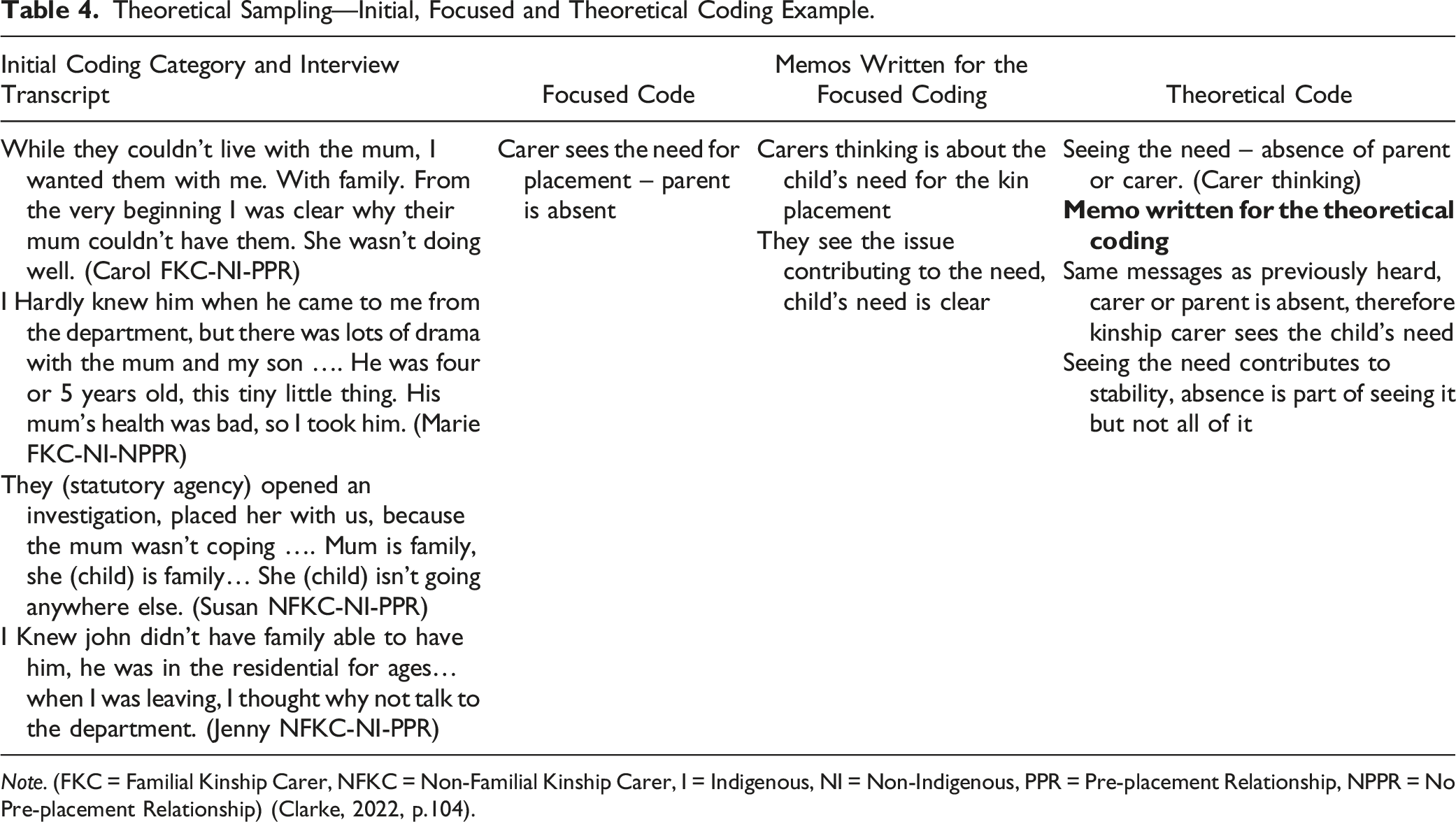
Note. (FKC = Familial Kinship Carer, NFKC = Non-Familial Kinship Carer, I = Indigenous, NI = Non-Indigenous, PPR = Pre-placement Relationship, NPPR = No Pre-placement Relationship) (Clarke, 2022, p.104).
The C-GT methodology resulted in the development of the substantive theory with a core category and five non-core categories, inter-relationships between the categories and two influencing factors. This final stage of theoretical coding resulted in the substantive theory for stability in statutory kinship care. The substantive theory included the core category of feeling connected and the five non-core categories of seeing the need, being constant, empathising with, championing for, and being aware and accepting of the kinship context (Clarke, 2022). The influencing factors of preplacement relationship and identifying as Australian Aboriginal existed for the core and non-core categories. The substantive theory was found to be applicable to social work practice improvements in the recruitment, assessment, training, support and monitoring of kinship carers (Clarke, 2022).
Conclusion
This paper explored the relevance of C-GT as a research methodology for social work practice. First, it argued the alignment between social work and constructivist ground theory in relation to valuing the individual in their context, including their culture, family, community, society and legal context. It then detailed how both social work and C-GT place a foundational value on respecting the person or research participant. The paper then highlighted how elements of C-GT participant sampling and data collection evidence the social work focus on practising with professional integrity. Finally, the paper provides an example of constructivist ground theory methodology in a specific social work study related to stability in statutory kinship care. It presented the methodology in the context of the specific study highlighting the examples of participant recruitment and sampling, data collection and coding and the formation of the study’s findings. It is important when building knowledge to inform social work practice that the methodology used respects the individual and their views. This supports the knowledge developed by research to benefit the individuals the research concerns. C-GT methodology considers the context that the individual exists in, and professional integrity is maintained. This paper has highlighted the good fit the C-GT methodology has when applied to researching areas of social work practice.
Footnotes
Declaration of Conflicting Interests
The author(s) declared no potential conflicts of interest with respect to the research, authorship, and/or publication of this article.
Funding
The author(s) received no financial support for the research, authorship, and/or publication of this article.
Ethical Approval
This research was conducted in accordance with the ethical standards detailed in the National Statement on Ethical Conduct in Human Research 2007 (updated May 2015) (National Health and Medical Research Council Australian Research Council Australian Vice-Chancellors’ Committee, 2015). The University of Queensland Human Research Ethics Committee approved this research project (A – 201700610, date: 6/4/2018).
