




Abstract
The ubiquity of remote research practices and the increased adoption of videoconferencing tools are forcing researchers to pay attention to the features of these technologies and how they shape the research encounter. This article draws on experience from a Norwegian research project about digital vulnerabilities and living with smart home technologies. Participants were invited to draw floor plans of their homes, enact everyday routines, and perform a house tour on camera. By enacting collective memory work, reviewing, and discussing fieldnotes and other materials from the interviews, the authors have reflected upon experiences and identified lessons and implications for further research. Drawing on a socio-material approach that views digital technologies as active participants in enacting the research event, the article highlights how the presence of videoconferencing technology shapes the research situation and how data is generated. We show how videoconferencing tools can provide both access to and constraints on what can be done and who can participate and underline the importance of skills for both researchers and participants. We demonstrate how the handholding of the camera and the frame of the lens direct what is seen during a video interview, and how power dynamics between participants and researchers are shaped. We conclude that researchers need to be mindful of how agency is negotiated between technology and humans during remote fieldwork.
Keywords
Introduction
We are in an era where videoconferencing tools such as Zoom and Microsoft Teams are normalized as media for conducting research. As videoconferencing technologies become increasingly ubiquitous, there is a heightening interest and need to examine methodological questions regarding their use in research practices. In this article, we reflect on experiences of using Zoom to perform remote talk and visual activity-based methods with participants in their homes. This article builds on previous arguments about the centrality of instruments in social research. It invites consideration of the Zoom videoconferencing application’s role as an instrument within “a complex and constantly changing constellation of things, procedures, abstractions, mediations, sensitivities, and sociabilities in the apparatuses, configurations and assemblages” (Lury & Wakeford, 2012, p. 9) for enacting visual interactive methods. Although digital communications platforms have enabled many researchers to continue their studies remotely, we realise that not all types of research activities easily mediate themselves through these technologies.
In this article, we draw on experiences from a research project that involved qualitative activity-based research remotely in the context of COVID-19 restrictions in Norway. The original research design relied on face-to-face interviews and visual elicitation activities involving continued dialogue between participants and researchers. Therefore, we had to rethink our project design and envision how to recreate appropriate interview contexts digitally and re-enact creative research activities (Paupini et al., 2022). A series of publications have examined the experiences of doing research through digital communication platforms (see for instance Howlett, 2021; Watson & Lupton, 2022). This article builds on and contributes to this growing body of remote research literature by focusing on qualitative activity-based research in remote settings employing a socio-material approach (Fenwick, 2015). As such, we view technology as an active agent in enabling the remote research process which allows us to explore in depth how technology, humans, and the surroundings interact, providing new insights into researching with videoconferencing tools.
Researching with Videoconferencing Technologies
Remote qualitative research has become ubiquitous during the Covid-19 pandemic, partly afforded by the availability of various videoconferencing technologies such as Microsoft Teams, Skype, Google Hangout, and Zoom. This has led to the resurgence of old methodological questions about how researchers can generate rich contextual insights about people’s everyday lives, feelings, and spaces without being physically present to observe and record (Watson & Lupton, 2022). This is partly prompted by the recent surge in the number and types of communication technologies available for conducting interviews, focus groups, workshops, and other collaborative research activities. Videoconferencing services offer features such as online meetings, group messaging and the ability to securely record sessions. They offer access to an impressive volume and variety of personal and biometric data – such as faces, voices, gestures, chat scripts, and home backgrounds. However, access to personal and biometric data raises concerns about “the opaque processes through which this data could be processed, analysed and ultimately monetised via the logics of contemporary surveillance capitalism” (Elsden et al., 2022, p.1).
Methodological literature on videoconferencing in a qualitative research context focuses on benefits and challenges. Among the challenges are the notions of difficulty in building rapport, trust, and empathy (Moran & Caetano, 2021). Góralska (2020) further argues that the restricted access to participants’ environment and the non-verbal communication are the main limitations of videoconferencing research. Adams-Hutcheson and Longhurst (2017) further found that people are less comfortable in front of cameras on videoconferencing tools than when meeting researchers in person. Moreover, people may be distracted from the video meeting by various surrounding factors (Lee et al., 2022). The materials are also important as it is critical that both participants and researchers have access to technical equipment and online platforms, as well as possess the necessary competencies to manage them (Gray et al., 2020). The data collected may also be affected by inadequate equipment or poor internet connection (Irani, 2019). Moreover, researchers point to concerns with the digital platforms’ security and other ethical questions arising from the use of digital internet tools (Lobe et al., 2020; Newman et al., 2021).
On the other hand, videoconferencing platforms are considered viable for collecting research data (Sedgewick & Spiers, 2009; Glassmeyer & Dibbs, 2012; Kahn & MacEachen, 2022). They may reduce time and expenses related to travelling, as well as overcome geographical constraints to reach participants (Irani, 2019). Within the context of remote research, videoconferencing technologies have the advantage of facilitating access and participation by people living in hard-to-reach locations (Hall et al., 2021). Videoconferencing tools may also create an informal, relaxed interview atmosphere, making participants more comfortable sharing intimacies with the researchers (Moran & Caetano, 2021). Participants in online videoconferencing focus groups for instance report being more comfortable taking part in their surroundings (Dodds & Hess, 2020). Videoconferencing platforms constitute dynamic environments that prevent participants from overthinking their answers and allow researchers access to visual and non-verbal cues, providing equally authentic experiences like in-person interviews (Howlett, 2021; Sullivan, 2012). Howlett (2021) further experienced that she was able to embed herself in her participants’ lives remotely and found that participants would disclose the domestic and local surroundings, as well as local-level dynamics, such as introducing her to family members or pets. The use of a videoconferencing tool for interviewing further contributed to developing a more symmetrical relationship between researcher and participant, as they both exposed some of the privacy of their living spaces (Howlett, 2021). Archibald et al. (2019) also found that both researchers and participants were satisfied with using Zoom for collecting qualitative data – despite many experiencing difficulties in initially establishing the call. Moreover, Comeforo (2022) argues that the basic features of Zoom - screen sharing, chat, and reaction buttons - mirror a feminist pedagogy, by enabling articulation of a variety of voices, distributing control over group interactions, and delivering interactive community learning experiences. The Breakout Room function might enable the shifting of authority from being singularly held by facilitators to collectively shared by participants, giving them autonomy to work together to privilege their perspectives and lived experiences.
A Socio-Material Approach
Our understanding of the experience of conducting remote research using video conferencing technologies is built on the idea that digital technologies are not only tools but also active participants in enacting the research event. We draw on a socio-material approach (Fenwick, 2015) that views technology as performative in research practices, meaning that they act together with other things and forces, shaping distinct forms of participation in the enactment of qualitative inquiry. There are three concepts that build on a socio-material approach that we find useful in making sense of the methodological possibilities and constraints of remote research mediated by videoconferencing technologies. The first is the notion of socio-material assemblage (Fenwick et al., 2011). The socio-material approach “insists upon attending to the material that is enmeshed with the social, technical and human” (Fenwick et al., 2011, p. 3), and these enmeshments are socio-material assemblages. They can further be described as momentary connections and relations between the elements that constitute an activity, and we can draw on the concept to conceive of mediated research practices through videoconferencing technologies as constitutive entanglements of social and material agencies.
The second is the concept of affordances (Gibson, 1977), referring to how elements of the environment act not as neutral objects, but rather encourage us to perform certain actions. Affordances can help explore the design and uses of technology considering the needs of users and their responses to changes in affordances (McKenna, 2020; Cai et al., 2020). Social affordances might come into being through technologies’ material features that initiate, encourage, and sustain, social interaction and collective action (Waizenegger et al., 2020). The concept of affordances can help explain how the different modes and media of videoconferencing contribute to communication and meaning-making.
The third is Barad’s concept of intra-activity (Barad, 2003; 2007), which draws on Butler’s (1993) concept of performativity. It stresses that meaning is produced when human and non-human organisms and matter intra-act as performative agents. This view does not see all agents as being equal, but rather as acting asymmetrically, such that human and non-human agents exert more or sometimes less agency depending on the context. Digital technologies employed in remote research interactions can thus intra-act with researchers and research subjects to permit some actions and limit others. The concept of intra-activity takes the notion of affordances one step further as it “turns our attention to the agency of the environments, things, materials and places in the ongoing interrelations and mutual processes of transformation taking place between human organisms and matter” (Palmer, 2010, p.8).
What these concepts have in common within a socio-material approach is that they help to uncover the micro-processes of what things do and how they materialise actions in a ‘choreography’ of human and non-human relations (Taylor, 2016). They enable us to see digital technologies not merely as infrastructure, but as part of complex and cross-cutting configurations of relationships (Braidotti, 2016), negotiations, interfaces, and situations integral to the shaping of research practice (Pischetola et al., 2021).
The Project: Smart Homes, Digital Risk, and Everyday Life
In this article, we draw upon a 5-year Norwegian Research Council-sponsored project focusing on understanding and addressing digital risks in households using internet-connected smart home technologies such as smart lights, door locks, heaters, speakers, vacuum cleaners, digital assistants, and sensors. The project, which for the remainder of this article we will call the smart home project, involved 12 participants with three or more internet-connected smart devices or a digital assistant in their home. The participants made up nine different households and included three couples who were interviewed separately. The ages of participants ranged between 24 and 81, and there were five women and eight men. The level of confidence and interest in smart home devices varied among participants. Some were self-proclaimed enthusiasts with high confidence in their technological skills while others were more neutral to the technology and claimed low confidence in their skills.
The methodological design consisted of semi-structured qualitative interviews with visual and mobile activities. The interviews were conducted through videoconferencing tools and were divided in two to avoid tiring out the participants. During the first video call, participants were asked to draw a floor plan of their home (Chetty et al., 2010; Mitchell et al., 2015) indicating where their smart home products are located. They were also asked to guide the researchers through a video home tour showing all their internet-connected devices as they are placed in the home, a method inspired by researchers such as Pink (2007) and Kusenbach (2003). In the second interview, the focus was on everyday practices with the devices, and participants would do an adjusted re-enactment of daily routines and practices. Most participants were at home during these video calls, sitting in their home office space, in a living room, or kitchen. Some did a walk-and-talk, while others just narrated while staying seated.
The participants received information about the project and what their participation would entail for them before the interviews. A summary was also repeated verbally at the beginning of the interviews. Informed consent was obtained both verbally at the beginning of the interviews and by email. The data was anonymized through the transcription process, and participants were given new names to protect their identities.
Method
To generate the reflections presented in this article we have drawn on observations and experiences from facilitating interactive interviews and revisiting materials generated from these. The three authors of this article represent a mix of experience and training, as two are Ph.D. students with just a few years of research practice, while the third one is a senior researcher. The authors have met several times before and during the process of writing this article to discuss and exchange experiences, observations, and ideas. We have enacted a form of memory work (Haug, 1992), a methodological approach based on the active practice of remembering that involves looking and inquiring critically at our past research experiences with videoconferencing, and how we (re)construct these in the present. To facilitate this, we have reviewed and discussed fieldnotes and other materials generated from the interviews, such as participant-drawn maps, verbatim interview transcripts, and video recordings of the interviews. We identified interesting situations and lessons through reviewing the fieldwork material together and discussed their implications for the research process. As we are employing a socio-material approach, a recurring question was ‘what is the role of technology in this situation?’ and ‘how are the human and non-human agencies enacted and distributed in this setting?’. Our process of reflection draws on elements of collaborative ethnography manifested through “co-producing a critical consciousness, imagining new politics of possibility” (Denzin, 2014, p. 27), and generated through “technologies of telling, listening, and writing” (Gonick et al., 2011, p. 742).
The following analysis is divided into four sections focusing on different, albeit entangled and interrelated, aspects of how doing remote research affected the data collection process in the smart home project. These sections are the technology’s agency in an interview situation, controlling the eye of the camera, performing identity and participants’ comfort on camera, and collaboration in addressing technology’s logistic challenges.
Logistics of a Video
Doing remote interviews require specific equipment, such as a communication device with a camera (smartphone, tablet, or computer), internet access, and communication-facilitating software (videoconferencing platforms). The modes of all these devices plays an important role in an interview situation. For instance, one noticeable material characteristic was battery life and cables. These devices run on battery and must be charged from time to time. A fieldnote excerpt from the second interview with Anders, a 42-year-old male, exemplifies how these material affordances became visible during the remote research situation: He was not able to show us his routines while talking as he was talking to us on his iPad and it was almost out of battery, plugged into the charger while we spoke. He tried opening the meeting on his phone but had to download the Zoom app again and dismissed the idea. Instead, he talked through his last weekday (Friday). I think it worked fine. (Fieldnote, “Anders”, second interview)
The low battery state of the iPad prohibited Anders from physically getting up and move about his home, forcing the researchers to respond to this by spontaneously reconceptualizing the activity as a talk-through rather than a walk-and-talk re-enactment of everyday routines. This example highlights how both humans and non-humans work together in a socio-material assemblage to realize the research situation. It also illustrates how these assemblages are not fixed, but rather a momentary set of relations and connections that may change and reassemble into other constitutions. For instance, in this setting, Anders’ iPad charger was a material element of the assemblage but at another point in time, his iPad would have been charged and the charger cable and need for an outlet would not have been part of the research situation anymore.
The second aspect of the technical equipment is related to how they are used. Doing remote research requires competencies and skills to use the equipment and knowledge about their functions to resolve emerging challenges. In another situation a participant faced a problem connecting to the video conferencing platform, illustrated by this fieldnote excerpt from Kristin’s (71 years) first interview. We scheduled to meet her on Friday 6th November 2020 at 12:00. She calls me on my phone 2 minutes past 12, saying she has difficulties logging into the Zoom room. We manage to sort it out (join through browser) and seconds later she appears on the screen. (Field note, “Kristin”, first interview)
Kristin was familiar with digital technology and used tools such as a smartphone, tablet, and computer regularly. However, she had not used Zoom before, and thus found it difficult to understand how to log into it. Research on elderly and ICT use in Norway shows that most people between 60 and 100 years use smartphones and internet-connected tools but at the same time, one out of four need guidance and help related to these technologies (Slettemeås et al., 2018). An important lesson for future research is thus that although people are familiar with digital technology, research tools and activities may require additional skills that are less widespread. This is especially something to keep in mind when involving participants who are not familiar with the technology in use. It also indicates that although digital technology can enable access to otherwise unavailable participants, they may also exclude potential participants lacking such competencies.
Another important element of the socio-material assemblages of remote research is a stable internet connection. Walking through a home during a remote interview further requires a stable internet connection in all rooms (Watson & Lupton, 2022). When doing videoconferencing research, one should expect technical glitches and hiccups, such as faulty internet connection. The extract below from the first interview with Erik, a 24-year-old male, illustrates how obstructive connection failure can be during a videoconferencing interview: Interviewer 2 : You mentioned that you have [unclear]. Can you tell us a little bit more about how you [unclear] Erik: I’m not sure I got that. The audio is still really bad. I don’t know if it’s you guys but there is a red signal thingy at the bottom of the left corner Interviewer 1 : Maybe we can try to call you back and see if that may help Erik: Yeah we can do that. I can also try to disable my video and see if that- Interviewer 1 : yes, try that first and then we’ll… (…) I think we should try to...It seems to be a problem with the-[unclear] I think we should try to reconnect. Erik: Yeah, let’s try that. (Interview transcription, “Erik”, first interview)
The glitches and lagging in both audio and video made it impossible to hold a conversation as words were lost and images froze, obstructing the interview and data collection process. Moreover, this dialogue also illustrates how the requirements for videoconferencing materials such as a stable connection, functioning equipment, and competencies apply to both participant and researcher for the videoconferencing interview to work. Thirdly, and related to the previous point, the dialogue above illustrates how the experience of technical clutter invites collaboration between researchers and participants to solve the issue. As we did not know where the fault was located, both parties – researchers and participant – came up with suggestions for solutions. Recent literature points out how gaining trust can be a challenge with remote research (Lawrence, 2020). Our experience is that this worked well as an icebreaker and set an informal tone for the remaining interview.
Controlling the Eye of the Camera
The affordances of video equipment shape the type of view that the researchers can have of the research site. The videoconferencing camera offers the viewer a view of the scene through a small rectangular window. This is not a 360-degree angle view. In addition, the researcher can only see what the participants manage or decides to show. This can have a dual effect on the researchers’ perspective. On one hand, the camera can provide new light on familiar environments, such as the home, but on the other hand, it can severely limit access to the said environment as well as relevant participants (Änggård, 2015). One of the participants, 74-year-old Harold, had a smart vacuum cleaner that he wanted to show during the house tour that was located under the sofa in the living room. He tried to show the device by lowering the laptop’s camera to the floor without having a clear view of the researchers’ perspective. The shape of the camera and the nature of the space being filmed guide the movements and positioning of the person behind the camera, again highlighting how the material non-human and human act together in an assemblage.
The type of view that the researchers had of the home environment changed depending on the participants’ handling of the camera. During the remote house tours, some participants flipped their cameras to face away from them by pressing an icon on their screen. This allowed participants to see what the researchers saw on their screen while filming, making it easier for them to angle the camera to provide researchers with as much or as good a view of the devices as possible. Those who could not flip their screens had to make sure that they were not blocking the camera view. Some participants had difficulties aiming the camera at devices without seeing the researchers’ camera window. During interviews, some participants were seated in their living room or their kitchen, providing the researchers with a view of the background. We could see other members of the household walk by, the lights, and other things lying around. Others chose to take the interview from their bedroom, and their camera was often pointing at a white wall behind them. When that happened, it almost created the illusion of a void, a space outside of space from which they decided to connect with the researchers. Some of the participants decided not to turn on the webcam at all, meaning the researchers could neither observe the participants’ reactions and bodily cues, nor their home environment. Similarly, researchers’ webcam backgrounds varied from the white walls in the office to bedroom home offices with messy backgrounds and flowery tapestry. Although the eye of the camera in some ways restricted the researchers’ gaze, it can in other situations be enabling. In another focus group study on youth and gaming, the authors described how participants often logged on from their bedrooms, the space where they often played video games (Mainsah & Steinnes, 2020). This offered researchers a direct view of their gaming environment and made it possible for participants to show and demonstrate things in the interview.
If on one hand, what the researchers see is controlled by the participants through the lens of the device they are physically holding, it does not, however, prevent unintended details from being shown to the camera, especially in the case of digital home tours. When moving around the house, some participants were openly deliberate in their choices of what and what not to show during the tour. One participant felt “ashamed” of how messy their bathroom was and therefore decided not to show it to us. In other situations, the participants were more carefree about their surroundings and ended up including details that were unexpected to the researchers. For example, when Anders (42 years old) was going up the stairs to show the devices in his children’s bedroom, his camera showed in passing a bright red Make America Great Again hat, merchandise from former American president Donald Trump’s election campaign in 2016, that was hanging on the wall. While rewatching the video recording from the interview, we noticed the surprised reaction of the researchers from their camera window upon seeing the hat, making us wonder what Anders would have made of the reaction if he saw it. This highlights how the camera is acting as a tool for the researchers and on them. Looking at the recording from the video can function as an elicitation tool to reflect upon the researchers’ performance during interviews, this material affordance also made us more aware of how we act and respond to what the participants show and tell us.
The windowed gaze further affects what data researchers can generate. One of the activities in the smart home project was a re-enactment of everyday routines which involved the participants moving around their homes with a camera in their hands, performing their routines as they usually do them. However, most of the informants struggled with holding the camera while performing the re-enactment. Because they need to hold the camera, at least one hand is incapacitated, perhaps both if they were holding a large device like a large iPad or laptop. This makes it difficult to perform the routines as they normally would. At the same time, they struggled with angling the camera to show what they were talking about while performing the actions – such as angling the camera down on their hands while explaining how they use an app for controlling the smart lights. The participants ended up preferring a narrative recollection of their average day, either remaining seated or walking a route through their home while describing what they did in those rooms. On the researchers’ side, it was not possible to gain a view of the re-enactment that would include the whole body of the participants, the devices they were interacting with, and the environment in which the action was taking place. This highlights how the filming equipment’s material affordances can impose restrictions on movement and the ability to show. Furthermore, it exemplifies how the participants need to be mindful of the eye of the camera to provide researchers with a sufficient gaze. However, we would still emphasize that although videoconferencing interviews are different from in-person research, we do not consider the digital video alternative as a loss but rather as an opportunity to discover new insights – as we explore further in the next section.
Performing Identity and Participant’s Comfort - How People Behave on Camera
The camera lens does not only affect the accessible gaze but also how people act in front of it. As Pink experienced; “[k]nowing that they were being video-recorded, they [the participants] performed ‘for the camera’” (2005, p. 277). As the video camera captures the audio-visual manifestations of the participants’ experiences through their verbal descriptions and embodied performances such as facial expressions and gestures, the video format encourages participants to construct identities and perform narratives. In the construction of identity through the camera lens, people perform narratives that serve as frames where participants sort their experiences and choose what to reveal and what to conceal from the researchers (Pink, 2004).
The home tours were performed quite differently by the participants. During the tour of 24-year-old Erik’s home, he took his time, pausing at the various devices, verbally explaining their functions, the thought behind them, and how they came to be. While he talked about his smart door lock and sensor setup, he angled the eye of the camera toward details at the door, shifting the eye from the sensors to the lock mechanism as he describes each of their function. He described himself as a tech enthusiast, considering smart home technology his hobby and a way for him to practice his programming and other technical skills. During the video home tour, he used the zoom function of the camera to adjust the image, tilted the camera to point it at the right details, and checked his screen several times to see if the researchers’ visuals were what he wanted to show – making his face appear in front of the camera a few times. He went into detail about the smart home devices such as when he was demonstrating the different automation mechanisms of his door lock.
In contrast, 30-year-old Daniel did not spend a lot of time on the house tour and his movements were swift and somewhat inaccurate, not always providing the researchers with a clear view of the devices. He panned and tilted the camera but rarely paused, zoomed, or walked closer to the devices to give researchers a better look. He described his relationship with smart home technology as quite pragmatic. He perceived such devices as fun and novel objects but emphasized that they also had to serve a practical purpose. He is not interested in the details and thus is not inclined to convey them to the researchers either – verbally or physically – as Erik did.
These two house tours provide insight into how the participants relate differently to the camera and its technical features. While both participants acknowledged the presence of the camera by steering it toward the smart home devices, they managed it in different ways. Erik had the camera facing himself, making him visible a lot of the time, only disappearing when he directed the attention to specific devices and details. He demonstrated an awareness of the researchers’ gaze and how the filming equipment affected this. He used body language a lot, pointing with his hand to aid the researchers’ gaze, and when showing a device on camera, his head would sometimes pop up in front of the lens as he was checking if the researchers could see what he wanted to show. Daniel, on the other hand, had the camera facing away from him the whole time. He was thus able to see what the researchers saw on his screen without turning the device around, however, did not seem particularly aware of the researchers’ gaze. He steered the camera at the devices as he listed them but would sometimes group them, such as mentioning the “light panels” and quickly showing three different smart lights in one camera sweep. He did for the most part keep a distance from the devices, turning his body around to show them but often not moving closer to or zooming in on them, sometimes making it difficult for researchers to immediately spot them. At the end of the tour, he was asked a question and stopped moving while he responded but kept the camera facing the kitchen without focusing on anything, making it seem like he forgot the camera for a second.
While Daniel appeared somewhat disinterested and a bit rushed to get the assignment over with, invoking a sense of discomfort, Erik in comparison seemed more comfortable with the tour. His presentation style invokes association with the social media genre of “vlogs” (short for video blogs). These are a “user-generated form of online communication that serve as media for social commentary, creative outlets or personal diaries” where users “share their daily routines, give tutorials or play games” (Folkvord et al., 2019, p. 78). Erik draws on the characteristics of these videos by filming himself talking to the camera while moving around his home. In this social media context, it is also interesting to note that among the four elderly participants over the age of 70, only one did the home tour.
These examples illustrate how some are more comfortable in front of a camera than others, revealed by their performance and how they manage the material affordances of the camera. This may be something to be mindful of when planning for videoconferencing research. It further demonstrates how this type of research allows the participants to perform their identity and their relation to technology, adding to – or perhaps constituting a methodological alternative-to the verbatim data collected through interviews.
Collaboration in Addressing Technology’s Logistic Challenges
Drawing a floor plan was another method employed in the project. Visual artefact diagrams such as floor plans act as a map of the participant’s perception and experiences, enrich the dialogue, and offer prompts that the researcher can take up to probe them (Bravington & King, 2019). Successfully performing research activities remotely is contingent on a series of material and logistic conditions. Harold’s hand-drawn map.
The participants were asked to draw a floor plan of their home, and then to indicate on the floor plan where in the home their smart home technologies were placed. As they were interviewed separately, this was intended as an individual task. However, the researchers could observe and interact with the participant along the way. The participants solved the task of drawing while on video in different ways. Some simply had a sheet of paper and a pen (Figure 1), some shared their iPad or tablet screen with the researchers and used a drawing program to sketch (Figure 2). Others used pre-made floor plans or drawing programs, in which they added the technology (Figure 3). Erik’s digital map.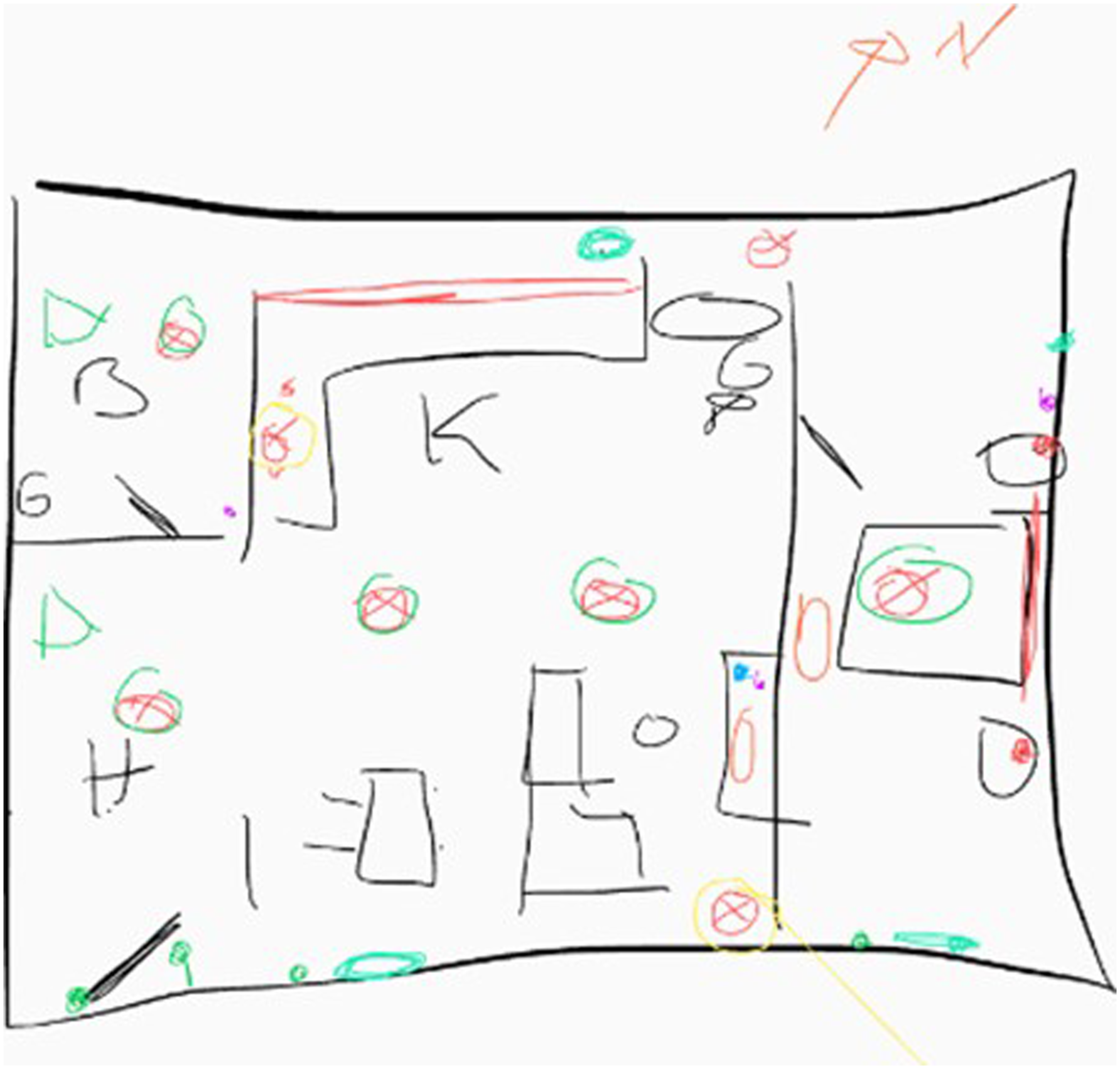
For those who drew digitally the screen worked as a shared canvas, where the researchers could watch the drawing as it happened in real time. This worked well as a collaborative activity between the researcher and the participant. The researchers could ask for details and clarifications as the participant drew, and participants could alter their drawing underway according to the researchers’ prompts and questions. Some participants also asked for the researchers’ input on for instance the choice of colour for the various devices. This made the activity dynamic, and it worked well to spur conversations about smart home technologies and their infrastructures. Ivar’s pre-made floor plan with hand-drawn devices.
When participants drew with a pen and paper, the screen and camera often worked more like a shield between the participant and researcher, preventing the researcher from seeing. Cameras could often not be tilted to face the hands drawing and lingered on the participants’ faces instead. It was more difficult for the researchers to take part and ask questions to the participants who drew off-screen so they tended to let them finish their drawing before discussing it and asking questions after. Watson and Lupton (2022) experienced the same challenge of not seeing the map drawing process as it unfolded because the camera faced the participants’ faces. Their solution was to ask the participants to talk them through the drawing process, which seems like a good solution to the shielding effect. In our case, participants held up their drawings to the camera once they were done and explained while pointing at the different elements. During this phase, researchers would ask questions and the participants would alter their drawings if needed, maintaining some collaborative aspects although the drawing was an isolated process. This example highlights both the various impacts of different materials and their affordances used for drawing and the need for competencies and knowledge to use them. For instance, the researchers were not aware of the shared screen drawing function until some of the participants showed them, and it turned out to give the best results in terms of providing richer data as the participants would comment on the drawing while making it. This was perhaps because they were aware that the researchers could see their process and provided more data on the participants’ experiences and perceptions than those who finished their drawing before showing it to the camera. It enabled a greater level of participant–researcher collaboration by keeping the dialogue going throughout the activity.
These experiences as such emphasize the importance of the gaze and the temporal aspect of seeing the process as it unfolds, for such an activity to be successfully engaging and collaborative. Although alternative ways of conducting this can achieve many of the same goals, the collaborative aspect was best maintained when participants and researchers had a shared view of the activity and could thus respond to it simultaneously.
Discussion
In this article, we have drawn theoretically on a socio-material approach, by borrowing from concepts such as intra-activity (Barad, 2003; 2007), affordances (Gibson, 1977), and assemblage (Fenwick et al., 2011) to understand the methodological implications of conducting research with videoconferencing technologies. These concepts have helped us to map and highlight the different agents involved in the remote video-mediated fieldwork event we presented. These agents included the participants, the researchers, webcams, power batteries, Wi-Fi connections, and the material and spatial configuration of interview locations. Technical skills and identities also emerged as performative agents.
We have seen how the digital tools continuously worked as active agents within the socio-material assemblages during the interviews with changing material affordances that both participants and researchers had to respond to. The examples also illustrate how the various agents asymmetrically exert agency throughout their intra-action in these assemblages. We have seen how technology at times exerts more agency than the humans involved had counted on. This can provide challenges that should be planned better for future projects but can also invite collaboration and a sense of community through facing a shared problem, levelling out the traditional power balance between researcher and participant in an interview situation. It is also evident that in a remote videoconferencing setting, researchers lose some control compared to an in-face interview, as they are dependent on the participants having the required materials and infrastructure and rely on them making sure that everything is in order, such as devices being charged and ready for use. Moreover, there are likely to occur technical glitches that may affect the interaction process underway, and one should thus expect some troubleshooting as part of the process, as detailed by Duque and colleagues (2022).
Discourses on photography underline how cameras help us see familiar environments with new eyes, and how they can affect the gaze by either freeing it or restricting what you see (Benjamin, 1991; Luttrell, 2010). We have highlighted the affordances of the camera in the remote research encounter, showing its role as an agent in directing the gaze of the participants and the researchers.
Doing activity-based remote research using videoconferencing tools requires continuous negotiation between humans and non-humans. This negotiation has several important implications. These are access and opportunity for participation, competencies, and the social dynamics between participant and researcher.
Literature on remote research refers to the technology enabling researchers to reach participants in geographical places that they otherwise would not (Irani, 2019; Gray et al., 2020). However, reflections from the project presented here reveal that digital tools can also act as barriers to access and participation. Firstly, there is a need for certain materials to conduct such research. This applies to both researchers doing the required research and for the participants to partake.
These materials are for instance communication devices, such as smartphones, computers or tablets, and the materials needed to make them work – like chargers. There are digital materials such as apps for communicating and drawing programs. And then there are infrastructural materials such as internet access, including a stable connection in all rooms of a home if activities such as house tours are included (Watson & Lupton, 2022). The prevalence of such materials may differ between countries, between rural and urban areas, and between age groups or other social categories. This is something to be mindful of when planning for videoconferencing activity-based interviews as it affects what participants we reach and who can partake. The Norwegian context is well suited for remote research due to the widespread use of internet-connected devices such as smartphones, tablets, and computers. However, the frequency and type of use vary (Slettemeås et al., 2018), and those less confident or competent with technology are more difficult to reach and recruit as participants. Thus, we risk a skewed sample that overlooks the nuances and challenges of those who are digitally vulnerable.
Secondly, walking around while filming such as during the house tour requires some physical abilities of the participants. They had to be able to move around their home, bending and stretching their bodies to reach the devices that were placed low on the ground, beneath sofas, high up on shelves or in ceilings, and so on. And at the same time navigating a camera device, making at least one hand incapacitated. As illustrated by the example of the smart vacuum under the sofa, this activity demands some physical abilities not available to all, risking excluding some societal groups as potential participants.
Thirdly, remote activity-based methods require certain skills and competencies from both researchers and participants. They must navigate the materials – both physical and digital to participate in the interview. There are many technical issues to manage, such as devices, buttons, wires, and icons, knowledge about functions, and how to activate them. The required materials, physical abilities, and competencies highlight the socio-material assemblages that make out the videoconferencing research setting and how the material affordances of the technology provide both opportunities and restrictions on human agency. This has implications for access and participation which may exclude potential participants or may impede the research in attempts to work around it.
In addition to the technical and digital competencies, doing videoconferencing research highlights the need for skills such as collaboration and problem-solving. For instance, all the technical malfunction and issues faced in the smart home project was solved in collaboration between researchers and participants. Partly because it was difficult to know whether the fault was located on the researchers’ or participants’ side, and partly because these kinds of issues, although situated at one party, affected the whole interview situation, and had to be resolved for it to continue. As such, the technology, its affordances, and the required competencies bring the need for collaboration between researcher and participant, which also opens new ways of building rapport and gaining trust, as well as conducting remote activity-based research.
The notion of collaborating brings us over to the third implication we can extract from the analysis of videoconferencing research. This is the social dynamics between researcher and participant. It is traditionally thought in interview situations that the researcher holds a position of power over the participant(s). However, several scholars have pointed out how digital ethnography gives participants agency because they have control in terms of deciding what to show the researchers and not (Watson & Lupton, 2022; Paupini et al., 2022). Experiences from the project presented here further illustrate how the technology worked to rebalance the social dynamics between researcher and participant. The researchers were not necessarily more competent with the digital tools than the participants, and as such could learn from them. This was especially true regarding technical glitches, but also in how the various activities were performed – such as sharing a screen while drawing a floorplan. In this way, the presence of digital technology rebalanced the power relations between researcher and participant, treating them equally. Employing the socio-material perspective, it can rather be seen as the technology was the one in a powerful position, in some situations exerting more agency than humans. However, despite at times being frustrating for both researcher and participant, this provided an informal atmosphere where the participants and researchers could bond over a shared experience and a mutual problem.
Conclusion
This article has explored the affordances of digital technology and the implications of their use in remotely set activity-based videoconferencing research. Through reviewing and reflecting upon experiences from a research project with videoconference interviews including participant activities, we have analysed the role of these non-human agents and how they exert more or less agency during a remotely set interview situation, impacting the research.
Three important implications can be extracted from the analysis. Firstly, how the technology provides both access and constraints on what can be conducted and who can participate, in terms of material tools and access to the technology itself. Secondly, the competencies that are necessary for conducting and participating in the research, both regarding the use of the technologies and the physical ability necessary to complete the required tasks. And thirdly, how technology as an agent can work to rebalance the social dynamics between participants and researchers, altering the power dynamics that were so far established.
From the discussion of these implications, we recommend future research explore the potential benefits of remote videoconferencing methods when it comes to what interesting data they can provide and the innovative reframing of the power dynamics between researchers and informants that they offer. At the same time, researchers should be mindful of the possible downsides of these methods, particularly considering access to technology, lack of physical ability on the participants’ side, and the role technology itself plays in the interaction with intentional research design and compensatory measures.
Footnotes
Acknowledgments
We would like to thank Niamh Ni Bhroin and Clara Julia Reich for their valuable and constructive comments on this article.
Declaration of Conflicting Interests
The author(s) declared no potential conflicts of interest with respect to the research, authorship, and/or publication of this article.
Funding
The author(s) disclosed receipt of the following financial support for the research, authorship, and/or publication of this article: This research was supported by the Norwegian Research Council under project number 288663.
