




Abstract
The use of online focus groups is becoming popular as a qualitative research method and the literature available for evaluating this data collection method is useful. However, to the best of our knowledge almost no methodological information is available on synchronous, online video-based focus groups with children of 10–12 years of age. In this article we describe our experiences with a study in which we conducted a total of 13 online synchronous video-based focus groups with children of this age. Our study generated rich and useful data, however, during our research we also encountered several challenges. In this paper we discuss these challenges concerning a) the technical tools used, b) the interaction between children, and c) ethical issues. We evaluate possible solutions and in doing so, also discuss standard procedures that are used in real-life focus groups, such as the optimum number of children, the duration of the focus groups, and the relation between the moderator and the children. We conclude that, when conducting online focus groups with children, researchers need to consider several aspects beforehand such as using a platform that is well-known to the children, developing a technical step-by-step guide, and recruiting a flexible moderator that is familiar with child development. We propose a flexible framework that includes questions and offers suggestions for conducting online focus groups with children aged 10–12 years. This framework can inform researchers wanting to conduct online focus groups with children in the future.
Keywords
Introduction
In the last decades, digital technologies have created new possibilities for researchers such as collecting data through online questionnaires and mobile phone apps. Computer mediated communication has become an important source for data collection in qualitative research as well (Lobe & Morgan, 2021). Several researchers have used online diaries (e.g. Seguin et al., 2022), interviewing with the use of video conferencing (e.g. Oliffe et al., 2021), or synchronous and asynchronous online focus groups (Stewart & Williams, 2005). Recently, the global pandemic of COVID-19 led to an increase in online data collection (e.g. Dos Santos Marques et al., 2021; Lobe et al., 2022). Despite the practical usefulness and the positive experiences that researchers have had with this form of data collection, these relatively new approaches need to be evaluated more (Lobe & Morgan, 2021; Lobe et al., 2022). This is especially the case for online data collection with children because very limited information is available on this topic. In this paper, we will share our experiences with video-based online focus groups with children aged 10–12 years and evaluate this method in a systematic manner.
Focus Groups
Face-To-Face Focus Groups
Conducting focus groups can be an appropriate way to collect data when interested in people’s opinions and experiences. Participants come together and join a group discussion that is facilitated by a moderator (e.g. Stewart & Shamdasani, 2014). A key characteristic of a face-to-face focus group is that participants interact with one another. This interaction challenges people to critically evaluate their own point of view and can therefore elicit co-constructed opinions and deeper insight in the subject under study (Kitzinger, 1994). Many methodological articles explain in detail how focus groups can be organized and what advantages and disadvantages of this method should be considered (e.g. Cyr, 2019; Krueger & Casey, 2015; Sim & Waterfield, 2019).
Focus groups can also be used in youth research as children are found to be well able to express their thoughts in a group setting. A focus group facilitates communication between children and can stimulate the construction of opinions in their own words and within their own shared culture (Raby, 2010) and can elicit their perspective (Adler et al., 2019). Children can join focus groups from a young age, and when there is both a relatively safe peer environment, and a minimalized power relationship between researcher and participants, the children will possibly speak freely (Adler et al., 2019; Kirk, 2007; Shaw et al., 2011).
Online Focus Groups
Nowadays, focus groups are also conducted using computer mediated communication. Two commonly used strategies are synchronous and asynchronous online focus groups in which no cameras are used (Stewart & Williams, 2005). In asynchronous focus groups, participants react to one another in discussion boards or other fora. Their interaction does not have to take place at the same moment in time. Especially stigmatized groups and people that are rather inhibited feel at ease participating in such a design as it allows for complete anonymity (e.g. Thomas et al., 2013; Turney & Pocknee, 2005; Ybarra et al., 2014). This kind of focus group however does not elicit spontaneous reactions to other people’s opinions that can be of great interest. In a synchronous online focus group, participants can interact through chat or discussion boards simultaneously (Stewart & Williams, 2005). With this method, spontaneous reactions to opinions of others are in fact detectable. However, the data collected using this method is limited by the respondents’ typing speed (Clark et al., 2021; O’Connor & Madge, 2003).
Videoconferencing created new possibilities for conducting synchronous online focus groups (Lobe & Morgan, 2021). In video-based online focus groups, people meet each other online, in real time, with the help of online videoconferencing platforms. Obviously, this method resembles face-to-face focus groups more closely than the previously mentioned asynchronous or synchronous focus groups via chat or discussion board (Kite & Phongsavan, 2017; Lobe & Morgan, 2021).
Previously, videoconferencing tools in online focus groups seemed to be under-used by qualitative researchers. Some positive experiences were shared, but inadequate platforms and limited bandwidth caused technical difficulties (Kite & Phongsavan, 2017). However, when the COVID-19 pandemic occurred, researchers were forced to push their boundaries, and online methods of data collection, including online, video based synchronous focus groups, were implemented more and more (e.g. Lobe & Morgan, 2021; Lobe et al., 2022). Along with this increased implementation, positive experiences with conducting online video-based focus groups were reported (e.g. Dos Santos Marques et al., 2021; Lobe & Morgan, 2021). Core issues of online focus groups with adults that have received attention in the literature are related to the use of technology (e.g. Dos Santos Marques et al., 2021; Halliday et al., 2021; Lobe & Morgan, 2021), the interaction between participants (e.g. Dos Santos Marques et al., 2021; Halliday et al., 2021; Lobe & Morgan, 2021), and the ethical challenges that come with these online focus groups (e.g. Lobe et al., 2022; Willis et al., 2021). The question is to what extent these core issues are different for studies with children. Recently, Woodrow et al. (2022) shared some first experiences with conducting online focus groups with adolescents aged 12–17 years. They concluded that it was more difficult to establish rapport with their participants compared to a real-life focus group, and that supporting participants when discussing sensitive topics was more difficult. They overcame these issues by for example using informal introductions and small breakout rooms. However, to the best of our knowledge, no scientific information is available on the methodological challenges of conducting online video-based focus groups with children aged 10–12 years. Now that online data collection is becoming a more commonly used method, there is an urgent need for evaluating this method. Knowledge on this issue will help researchers to make well informed decisions about their data collection with children and will enhance the scientific quality of these methods.
Challenges of Online Focus Groups
Technology Used
There are several platforms that can be used for online focus groups such as Teams (Microsoft, 2023), Kaltura (Kaltura, 2023), Zoom (Zoom, 2023), and Webex (Webex, 2023). The choice of these platforms depends on the specific benefits that researchers associate with them. It is important to think about the participants’ familiarity with the program, because they need to be able to use the program with ease. Halliday et al. (2021) for example made a “How-to-use-Zoom” guide for their adult participants to get familiar with the most basic functions of the platform.
Other technical challenges that should be considered are bad internet connections and background noise which may interfere with the natural flow of a group conversation. Halliday et al. (2021) for example experienced unintended background noise of young children and pets when conducting online focus groups with adults. They asked people to mute their sound, and if they were not able to do so themselves, the researchers took care of this. When conducting online focus groups with children, researchers can expect similar technical challenges to occur.
Interaction Between Participants
The social interaction between the participants of a focus group is of the greatest importance and the major concern for researchers conducting this kind of study (Morgan, 2012). There is evidence that the data gathered through online focus groups can be as rich as the data gathered through live focus groups (Abrams et al., 2015; Halliday et al., 2021; Turney & Pocknee, 2005). Most people feel comfortable in an online meeting (Lobe & Morgan, 2021), and maybe even more than in a face-to-face meeting.
In online as well as face-to-face focus group studies, the moderator is the one who facilitates a fruitful discussion by getting all participants involved, creating a comfortable and safe atmosphere, and steering the conversation if needed (Dos Santos Marques et al., 2021). Conducting focus groups with children is even more challenging because children can become inattentive or even anxious during a focus group. Wyatt et al. (2008) stated that “conducting a focus group with children requires a skilled moderator who is able to effectively elicit individual and group responses and gently direct dialogue to keep it focused on the desired subject matter” (p. 73). A good moderator pays attention to all details, has a child-friendly demeanor, and is willing to relinquish control in order to promote sharing insights (Adler et al., 2019). In an online environment the moderator must deal with additional challenges such as the inability to observe all non-verbal cues of children and the lack of non-verbal facilitating behavior (Lobe et al., 2022). Conducting online focus groups with children may therefore require additional and different moderator skills.
The interaction in a focus group is also dependent on the number of participants. In many studies that have used physical focus groups, the goal is to recruit six to eight participants per group. Then, all participants can be heard and at the same time, there are enough participants to facilitate a good discussion (e.g. Cyr, 2019). This optimum number of people in an online focus group is under debate. Dos Santos Marques et al. (2021) used smaller groups of three to four people when going online, because they anticipated that in this way they could deal with novel – mostly technological – issues and uncertainty about the level of interaction between people in an online environment. Other researchers had good experiences using larger groups when conducting online focus groups (e.g. Abrams et al., 2015). The ideal number of participants for online focus groups with children is not yet known. Even in real-life focus groups with children there are different strategies (Adler et al., 2019). Some suggest small groups of four to six children (e.g. Hoppe et al., 1995; Wyatt et al., 2008), others indicate that larger groups can also elicit rich conversations (Raby, 2010). Obviously, the age of the children and the subject of the discussion is associated with the optimal number of participants.
It is important to have a meeting of sufficient duration that allows for adequate interaction between participants. At the same time, a meeting that is too long can end up in less interaction and disinterest of participants. In general, a real-life focus group with adults takes between 60 and 120 minutes (Hollis et al., 2002; Morgan, 1996). In online focus groups with adults comparable durations have been tested (e.g. Williams et al., 2020). The most appropriate duration for focus groups with children is not decided on. Different lengths in time suitable for the attention span of children have been suggested, which took into account the topic under discussion, the time of day and the age of the children (Adler et al., 2019; Heary & Hennessy, 2002). Most researchers indicate that the length of a focus group with school-aged children should not exceed 1 hour (Hoppe et al., 1995; Peterson-Sweeney, 2005) and for children under the age of 10 this might even be a bit too long (Peterson-Sweeney, 2005). It will be interesting to see whether online meetings with children require similar or different recommendations.
Ethics
It is without doubt that when conducting research online, specific ethical issues need to be considered. The online environment brings new dilemmas which primarily concern confidentiality and privacy issues. For example, platforms may display the full name of participants (Willis et al., 2021), participants may be able to see the private environment of other participants and the online environment might not be secure enough (Lobe et al., 2022). The platforms that are used for conducting video-based focus groups often offer possibilities for recording, and even transcribing meetings. Obviously, this is a major advantage for qualitative researchers who were accustomed to the painstaking work of transcribing audio-recordings manually, however, there is a need to check the privacy adherence of these programs. Online focus groups with children come with additional ethical challenges and place extra demands on researchers to ensure confidentiality and privacy, and to explain the ethical etiquette in an understandable way.
Another ethical challenge is to make sure that the mental burden of participants during the research is as low as possible. During an online conversation, participants should feel at ease and experience the least possible distress. Lobe et al. (2022) advise to pay close attention to possible signs of distress that participants give in an online meeting. Based on these signs, moderators can choose to offer comforting words, or for example give participants the time to express their emotions. Some research suggests that online interaction with other people is not more stressful than a face-to-face interaction (Lobe & Morgan, 2021). Little is known however about the burden that children may feel during an online meeting. How researchers can design an online focus group with children in a way that they feel at ease and are not hindered by power-imbalances is a question yet to be answered.
The Study
The aim of this study was to investigate children’s perceptions of health, their experiences with physical and mental health challenges and their solutions to these challenges. The topic guides were based on a specific health tool: the “My Positive Health dialogue tool for children” (Huber et al., 2011; 2016) and the goal of the conversations was to receive concrete advice from children, for children, to improve their health. First, we planned a study in which children would participate in a live group session at school. Due to the COVID-19 pandemic however, visiting schools for data-collection was impossible. We therefore switched to online video-based synchronous focus groups.
Characteristics of Participating General Primary Schools and Composition of Focus Groups.
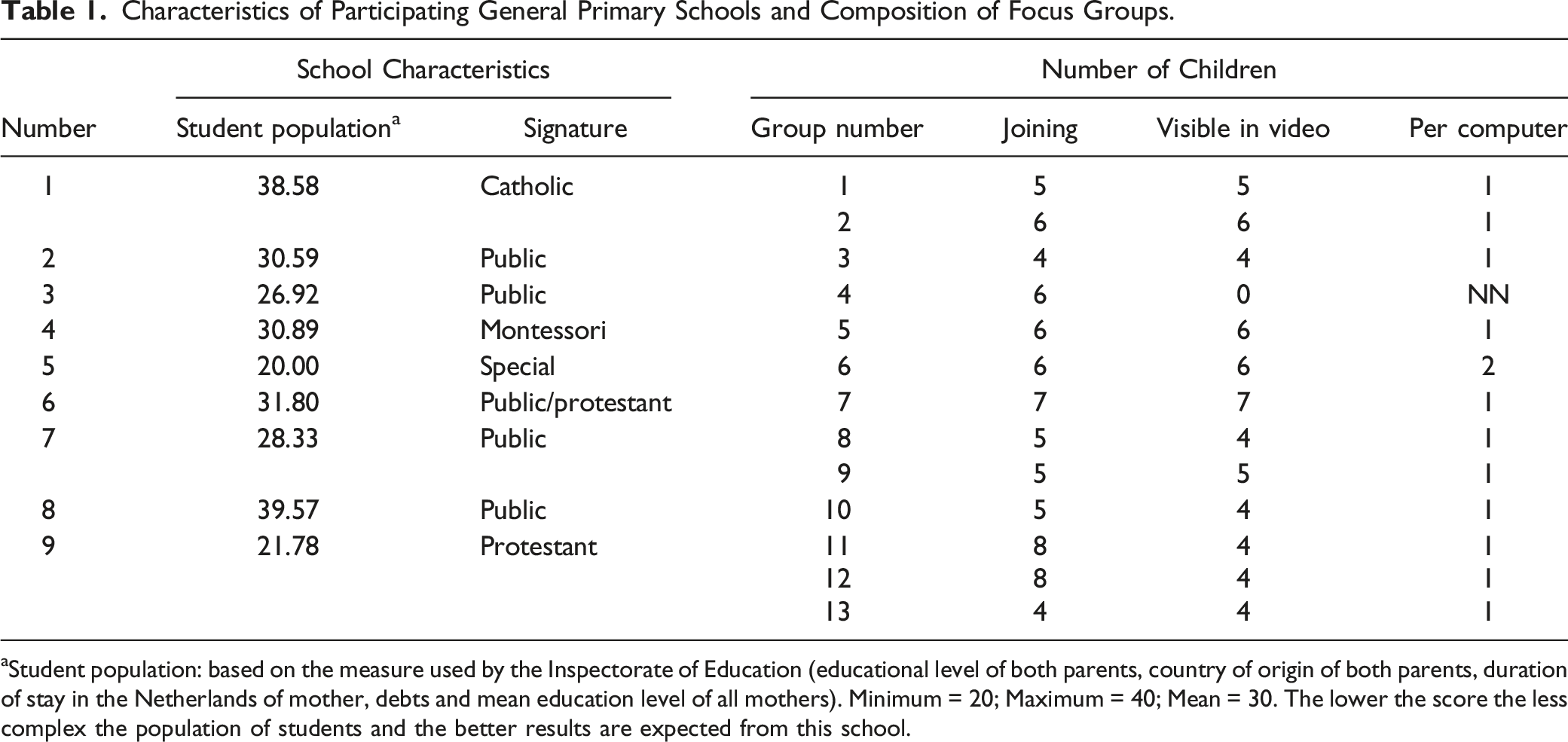
aStudent population: based on the measure used by the Inspectorate of Education (educational level of both parents, country of origin of both parents, duration of stay in the Netherlands of mother, debts and mean education level of all mothers). Minimum = 20; Maximum = 40; Mean = 30. The lower the score the less complex the population of students and the better results are expected from this school.
In all 13 focus groups we worked with the same two researchers. Both researchers were experts in (methodology of) education and child studies and therefore able to understand children’s reactions, their way of talking and their point of view. The first researcher (first author) was the moderator of the focus group. The second researcher (second author) was available for (technical) support. She started the recording and read the chat if the moderator missed this. She introduced herself to the children at the beginning of the session, but after this, she turned off her camera and sound and did not participate actively anymore so as to not overwhelm the children with another adult presence.
The duration of the focus groups varied from 45 minutes to 1 hour and all sessions were held during school hours. One group joined from home, because at that time, the schools were closed due to COVID-19 regulations. All other groups joined online from school. The setting of the online meetings differed. All groups, except for one, were conducted with individual children behind a computer (see Table 1). In some groups the children were visibly close together, and in other groups the children were not that close, or maybe even in different spaces. All focus groups were video recorded. Due to technical issues, one meeting was only recorded in sound and in five recordings, not all children were visible (see Table 1). Ethical approval for the study was given by an ethical reviewing board: the Ethical Committee of the Institute of Education and Child Studies (dossier number ECPW-2020/262).
Challenges and Solutions
Technical Issues
Platform Used
We first thought to use Microsoft Teams (Microsoft, 2022) because it met our criteria. We were acquainted with this program, it was able to host a group up to 12 people and to show all people on screen at once, and it had a good quality of sound and enough stability and chat-options. On top of that, the privacy of the program was considered to be good enough by the Ethical Review Board. However, during the first pilot session, it became clear that this platform did not work well for children. Most children were not acquainted with the program and had to take several steps before being able to enter the room. This made the login procedure very time-consuming. Therefore, we decided to use another platform (Kaltura, 2023) that also met all our criteria, but made it easier for children to log in. The children did not need to create an account, register, or download anything at all. When using the Google Chrome browser they could easily access the room using a link we shared beforehand. Despite the use of this platform, we still considered the fact that some children, and perhaps some teachers, might find it difficult to enter the Kaltura Room. We therefore made a short videoclip in which the moderator explained how participants could get access to the platform. Children and their teachers could watch this clip beforehand if they wanted to.
Unfortunately we did encounter some technical problems with the recording of the Kaltura meetings. Sometimes not all children were visible in the final recording while we as researchers had all children within our view. In one instance, the recording function did not work at all, and only an audio-recording was made.
Internet Connection
Number of Occurrences of Specific Incidents in Video Recorded Focus Groups (n = 12).
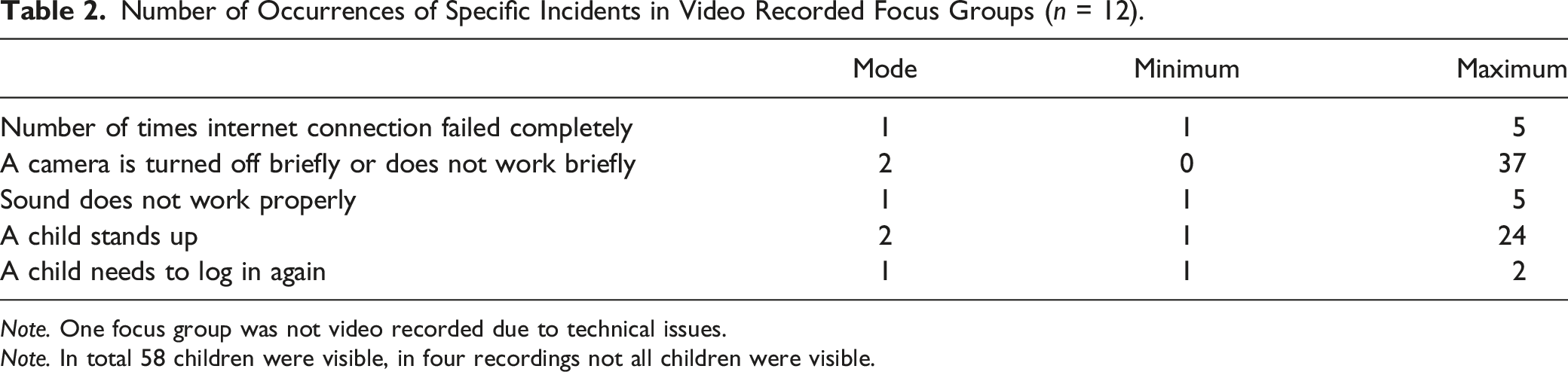
Note. One focus group was not video recorded due to technical issues.
Note. In total 58 children were visible, in four recordings not all children were visible.
In one instance the connection of the moderator failed despite the wired internet connection. The second researcher could explain the children what was happening. Reconnection was done very quickly and easily, and all children present in the online room waited for the return of the moderator. The conversation could continue without any problems.
Background Noise
Contrary to some other researchers we decided to ask the children to keep their microphones on. To minimize possible background noise, we asked teachers to give the children a quiet place to sit. Despite all efforts made however, not all background noises could be eliminated. In some instances the moderator turned off the microphone of a particular child if there was too much noise, or a child moved to a quieter place.
Another issue was the fact that if children were together in a small room, we could possibly encounter issues with echoing of sound. Therefore we asked teachers if children could be placed more isolated if possible. This however did not work all the time. Some groups were (partly) together in one room (see Table 1). Echoing issues however were negligible and general sound problems were not encountered much (see Table 2). We were not exactly sure how these echoing issues were resolved, but perhaps the use of a headset by some (groups) of children added to the quality of the sound.
Interaction
Practical Tools
We anticipated that the online environment may not stimulate children to interact with one another. Especially when children must turn on their microphone every time they want to speak, a group conversation may become a staccato process. This was confirmed in our pilot groups; using the mute buttons with children sometimes was counterproductive. Children unmuted themselves briefly, gave a short statement, and then immediately muted themselves again. Possibly, they were used to this approach when having their regular online school meetings. For a focus group this approach is less suited because it hinders the flow of an ongoing conversation. We therefore decided to ask children to unmute their microphones during the entire conversation, and to only mute themselves when there was a lot of background noise or when we had issues with echoing. This approach worked very well. Most children engaged in the conversation and children regularly started talking without any specific verbal cue.
Probes
To stimulate an ongoing and open interaction we drafted several probes at the beginning of the study. First, we planned to use some pictures that we could show during the conversation. These were pictures about e.g. physical activities, family, and feeling good. In the pilot study, it became clear that these pictures did not have any added value. Children were very capable of talking about their health without these additional probes. Second, we planned to start the focus group with a positive, general question about health: “what makes you happy?” Children could enter their answer in the chat and those answers were used as leverage for the further conversation. This approach worked very well; children entered many answers in the chat and reacted to the answers of others. In some instances children were a bit quieter, depending for example on the character of the child or the topic discussed. In real life focus groups, just looking at somebody often invites a person to start talking. In the online environment, such eye contact is almost impossible. We noticed that we often made use of two verbal probes: How is that for you [name]? or: How is that for the others? This way of probing elicited reactions, without disturbing the natural flow of the conversation too much.
Moderator Role
Despite the measures that were taken to stimulate interaction, such as keeping the microphones turned on, and having a list of good probes, it became clear that online moderating asks for different competences than teaching online or conducting real life focus groups with children. First, the moderator needed to be able to react to several digital problems in a flexible way. Due to the online component, unexpected (technical) issues occurred (such as the fact that in the first group many children had a bad internet connection). In our case the moderator was one of the senior researchers of this project, which made it possible for her to make decisions on the spot. This meant that we were able to collect valuable data even if things went differently than expected. Second, the moderator had to deal with the fact that children were visually in proximity, but physically far away. This affected the manner in which she had to conduct the meeting. The children possibly felt a certain amount of freedom because no adult was physically present at that moment. For instance, some children stood up a couple of times (see Table 2), two girls were braiding each other’s hair during the conversation, and a boy asked for permission to run around for a minute. The moderator decided to allow these behaviors because they were not interfering too much with the conversation. In sum, moderating online focus groups with children required a fair amount of flexibility.
Duration of the Meeting
The meeting with the children lasted between 45 minutes and 1 hour. This is comparable with the duration suggested for face-to-face focus groups with children. Some children became restless during the online meeting but were able to complete the focus group because we allowed them to release some tension. Also, we noticed that at the end of the meeting a few children became less interested and became more distracted. While this may also be the case in face-to-face focus groups, the online environment brought different challenges. For instance, some children stood up several times and moved out of sight of the moderator. Some other children turned off the camera more frequently (see Table 2). When the moderator noticed these behaviors/cues, she decided to wrap the meeting up in a short period of time.
Number of Participants
In our study, four to eight children participated in the focus groups. The most ideal number of children seemed to be five to seven. In groups with five to seven children there was enough interaction to have a good conversation. When eight children participated, it became more challenging for the moderator as she needed to structure the conversation more, had to make sure all children were heard and make sure that they did not have to wait too long before they could add to the conversation. These challenges seem to be similar to the physical environments, and despite this more complex moderating job, we did not encounter any other downsides to this number of participants. Children were still able to give each other time to talk. In two focus groups, only four children were present (see Table 1). This composition of the group made it a bit more difficult to elicit lively conversations, but it still yielded sufficient information.
Ethics
Privacy
Besides all ethical issues concerning privacy that we as researchers encounter when studying children in general, our online method created some additional ethical challenges. First, the platform that was used for the online meetings did not only have to be suitable for children, but also required a solid privacy system to be ethically approved. This combination of criteria may not always be easy to find. In our study, Kaltura seemed to be the most appropriate choice. Second, we wanted to make sure that if children talked about sensitive issues, these were kept private as much as possible. Just as in a face-to-face focus group, we cannot assure this completely, because we cannot control what children talk about after they participated. In case children don’t know each other, using fake names in an online room can be helpful, but in our case, all children knew each other well.
To make sure that all children understood the sensitivity of the situation as well as possible, we asked children not to share detailed personal information with others outside the group. We gave an example of what they could say, e.g.: “I have joined an online meeting about health, it was really nice,” or “it was really boring,” and then reminded them that we didn’t want to share personal experiences with others outside the group. At the end of the meeting we reminded them again.
As researchers we were also obligated to not share personal information with others. Just as with face-to-face focus groups, we told children that we would make sure that if we would use any of their quotes, their names would not be used, and we promised that we would not share non-anonymous personal information with others. The aim of our study was to elicit tips about positive health and therefore, we did not expect very emotional or sensitive topics to be introduced by the children. However, we had to anticipate such a situation and the online environment would make this challenging. Because the children were not physically present, the moderator could not choose to take a natural break and talk with a child if necessary. Therefore, the moderator decided to not go into depth about very emotional issues more than necessary during the conversation. Halfway through our study, we encountered a sensitive situation in which one child talked about suicidal thoughts he had in the past. In a face-to-face focus group we would have arranged a short break to talk with the particular child. In the online situation, the moderator let the child know that the story was heard and confirmed the sadness of the situation. After that she asked the child if he was doing better now, and if he received support from adults. The child confirmed that he was doing better and that he received support. The moderator then emphasized to all children, that adults around you can help you with these kind of difficult situations. Another child than reacted: “Yes, and your friends could also be of help in this situation.” The conversation then continued about receiving help from other adults and children in general. After the focus group, the primary investigator was informed about this situation. She contacted the school principal so that appropriate care for the child and or others could be offered. After this experience, we explicitly told all children at the beginning of a focus group that we needed to inform a counselor in case a child was in danger. We encountered one more worrying situation that required action afterwards. A child explicitly mentioned using aggression towards peers. We felt obligated to share this information with the primary researcher who again contacted the school principal so that appropriate care could be offered to the child and his peers. In a face-to-face focus group we would probably have been able to talk a bit more with this child.
Physical Supervision
Having a teacher physically present in the room with the children may limit feelings of privacy for children and keep them from sharing everything they would otherwise want to. Therefore, and because the children in our study were relatively independent (age 10–12 years), we decided to ask teachers to leave the room after all the children had logged in. We could send teachers a WhatsApp message if more supervision was needed. However, some teachers wanted to assist the children during the entire meeting. They were not present in the online room but were present in the physical environment of the children. Because the teacher is responsible for the children and decides whether supervision is needed, we did not intervene in these cases. Overall, we recommend conducting online focus groups with as little supervision as possible so children can speak freely. Having a second communication line with an adult that is physically close to the children (through WhatsApp e.g.) is advised. This way, intervention is possible when needed.
Mental Burden
A final ethical issue concerned the mental burden children might feel during the conversations. We as researchers found it critical that children enjoyed being in the online environment and that the conversation did not feel like a school test or an obligation. Therefore, we told all children explicitly that the conversation was not a test and that answers could not be “right” or “wrong.” On top of that we decided to balance the power in the conversations as much as possible. This meant that we did not intervene too much when children were not adhering to the adult etiquette of online meetings. On one occasion for example, children started throwing small paper balls at each other. If the children still participated in the conversation, we allowed this playful behavior.
Allowing children to be themselves and to be playful worked rather well, many children visibly enjoyed joining the focus group. At the end of the meeting, some children spontaneously told us that they liked the focus group. One child gave a thumbs up afterwards, one group concluded that they as a group would be able to help other children, and another child said: “No tips but “top” [ “Top” is a Dutch word for “great”], it was really nice.” Also, some children indicated that they really felt free to share their ideas. A girl said, “We can talk about anything with you” and she indicated that this was nice. A classmate agreed with her. In another group a boy spontaneously reacted: “One more thing, it was nice today.” All in all, most children seemed to have enjoyed the conversations.
Framework of Recommendations
Based on our experiences we can make several recommendations. The framework in Figure 1 brings together all important questions and suggestions for conducting online focus groups with children. The information is structured around the three discussed issues: 1) the technical choices, 2) the interaction between children, and 3) the ethical issues. Framework Including Questions and Suggestions for Conducting Online Focus Groups with Children.
In short, we recommend researchers to choose technical tools that assure privacy and a good video and audio quality. The moderator should be familiar with the program and children should have easy access to it. Supporting children with a login manual, and the availability of a second researcher in the online room is highly recommended. To reduce noise problems, children are preferably sitting in a quiet room individually, or in a small group. Having children sit in noisy environments does not work well, as children should be able to unmute their microphone during most of the conversation. The moderator should be knowledgeable in child development and experienced in facilitating group conversations. Using age-appropriate, simple probes such as “How is that for you [name]” works well. Because unexpected things can happen during the meeting, the moderator should have permission to make decisions on the spot if necessary.
We recommend including five to seven children for a focus group, and depending on the expected drop-out, to sample some more. To keep children engaged, the meetings should not exceed 1 hour. If physical supervision of the children is not necessary, the moderator as well as the second researcher need to be able to contact an adult who is close to the children and can react fast. Also, it is advised to talk with the children about the privacy issues that are associated with an online conversation. Having a protocol available for situations in which a child seems to be in danger is important, epecially because the researchers are not physically present. Finally, it is necessary to create an enjoyable meeting with little hierarchy in which intervention is kept to a minimum.
Conclusion and Discussion
In this paper, we discussed our experiences with conducting 13 online focus groups and three online pilot sessions with children aged 10–12 years. We conclude that video-based focus groups are a promising alternative for face-to-face focus groups with children. The observed interaction was good enough to elicit rich data and children seemed to be enthusiastic to participate.
To maximize the interaction and data gathered during the meeting, we suggest using a platform that is easy to use. Also, we advise to make a login instruction for children and having a second researcher available during the meeting for assistance. This may be surprising because nowadays most children seem to be very digitally competent, however, there are many different levels of digital competency among children (Iivari et al., 2020). Their understanding of the platform used in a focus group, and their capability of using it with ease, not only strongly depends on their age, but also on their previous experiences at home or at school.
Having an experienced moderator with knowledge in child development is essential when conducting focus groups with children (Adler et al., 2019), however, in online focus groups this may become even more important. During the online meeting the moderator must be able to focus on many things, such as making sure all children can share their thoughts regardless of the technical issues that are encountered, picking up signs of distress of the children while not physically sitting next to them, and making sure that all subjects are being discussed. This means that a moderator should be able to consider the developmental stage of children. Being able to empathize with the age group, having knowledge of their world and understanding their vocabulary for example are essential to conduct successful online focus groups with children.
Of course, using age-appropriate cues smoothens the conversation and elicits more and higher quality interactions in focus groups with children. In the online environment with children, we often used general probes such as “How is this for everyone else?,” and more specific probes such as: “How is this for you [name]?” These probes worked very well and are comparable to the probes previously suggested for face-to-face focus groups with children (Adler et al., 2019). In our study, we considered using additional non-verbal probes just as other researchers have done in face-to-face focus groups with children. Ronen et al. (2001) for example planned the use of playdough, when conducting small face-to-face focus groups with children with active epilepsy, so they did not have to verbalize all the time. To date, in our study, the use of non-verbal, online probes in the form of pictures did not seem to have any added value for the quality of the online conversation. However, it might be an idea to use age-appropriate (interactive) online tools such as pictures, whiteboards, and videos when working online with groups of children who need extra support in any area.
In an online focus group with children, the moderator does not have complete control over the situation and unexpected things can happen. We therefore advise the moderator to be prepared to make decisions on the spot. Of course, in most qualitative studies, researchers need to be flexible in order to capture the perspective of the participants (Clark et al., 2021). In our experience, however, (online) focus groups are often moderated by other people than the primary researcher, and this makes discussing the boundaries of this flexibility necessary.
The ideal number of participants in an online focus group with children seems to be between five and seven. With four participants, it is more difficult to keep the conversation going, and with eight participants the challenges for the moderator become more complex. However, even with this number, the conversations were fruitful and pleasant in our experience. It may have helped that the children had learned to deal with the basic etiquette of online meetings because during the COVID-19 pandemic they had experienced online schooling (Iivari et al., 2020). We recommend to sample groups of six to eight children for an online focus group with children aged 10–12 years. In an extreme situation in which you have a group of six, and a third does not show up, you can still have a good conversation. Obviously, if a different age group is being studied, or a more sensitive topic is discussed, other choices for group sizes can be made.
When conducting online focus groups with children, there are some ethical points of attention. Firstly, depending on the age and (in)dependency of the children, supervision during the conversation may be needed. However, deciding on this issue is difficult, because the presence of an adult in the same room can negatively affect the privacy of children. Children even may feel they cannot be completely honest and share critical comments (Shaw et al., 2011). Negotiating when supervision is necessary and when not seems to be important. Secondly, the moderator should try to avoid imbalance of power as much as possible. In our online research we tried to establish a more informal atmosphere by using our first names, by not intervening too quickly, by using humor (Adler et al., 2019), and not infantilizing the children. It is however debatable to what extent these measures will really diminish power balance issues. We advocate taking as many measures as possible to create an online environment in which children feel free to communicate.
The framework we propose is a first step in structuring the information needed when conducting online focus groups with children. It is meant to help researchers to make knowledgeable decisions, while maintaining the flexibility that is needed when studying children online through qualitative research. Despite the usefulness of our framework, some limitations need to be discussed. First, our study was done with children aged 10–12 years that all were attending general primary schools. This means that no children from general-special education were included in our sample. Our framework is therefore not readily suitable for studying children with intellectual disabilities. Future research may shed light on how to conduct online research with children who attend general-special education.
Second, in our study we aimed to hear children’s voices. We wanted them to speak as freely as possible, within a safe and comfortable environment. Spencer et al. (2020) however question if children’s voices can be really heard in qualitative research. We agree that children, just as adults, share their view within a common discourse. They will probably realize what can be said and is not to be said in such discussions and it may be difficult for adult researchers to interpret children’s quotations. Indeed we noticed that children sometimes mentioned suggestions that echoed adult advises such as: “You must have faith in yourself.” However, we tried to go beyond these general statements by probing children a bit more and we found that many children felt free enough to share suggestions and/or personal experiences that are deemed socially undesirable, such as using aggression to solve a problem or having depressed feelings, or to share imaginative future thoughts such as: “I want to have my own peanut factory.” In an online environment, children may feel more comfortable sharing these experiences, feelings or original ideas because the researcher is not physically present.
Third, this framework is based on an intensive study with online focus groups with children, but it is not a direct comparison between face-to-face focus groups and online focus groups. In order to test if the voices of children and the co-construction of their opinion (e.g. Halliday et al., 2021) is as good in an online meeting as in a face-to-face focus group, both methods should be thoroughly compared within the same age group, keeping all possible other important variables constant (such as the moderator, the topic guide, the mixture of gender et cetera).
Despite these limitations we think that this paper proposes a useful framework for conducting online focus groups with children in a scientific manner. In our experience, online focus groups with children can elicit valuable information if researchers take time to thoroughly consider all aspects that are associated with this form of data collection. Technical and ethical issues should be considered as well as issues concerning the optimum level of interaction.
Footnotes
Acknowledgments
We thank students Rozemarijn van der Kooij and Iris de Pater for their help with transcribing and coding the conversations. We thank the Institute for Positive Health for their contribution and the Triodos Foundation for their financial support.
Declaration of Conflicting Interests
The author(s) declared no potential conflicts of interest with respect to the research, authorship, and/or publication of this article.
Funding
The focus group study that forms the base for this methodological paper is funded by the Triodos Foundation and the Institute for Positive Health.
