




Abstract
The aim of this paper is to describe an approach to the study of the educational trajectories of students at risk of exclusion and to discuss the suitability of this methodological procedure for a narrative approach. In this research, the theory of the life course by reconstructing life stories has been used to observe how the different experiences in the educational trajectory of these students develop and how these affect their involvement with their studies and school. Through this paper, the research process will be exposed, from the epistemological foundation of research to the method employed for the analysis and discussion of results. A way to delve into an insufficiently explored form of research will be proposed. The application of Barton and Lazarsfeld’s qualitative analysis procedures is novel in the paper; not only for the depth achieved in the analysis of the trajectories of the subjects, but also for the possibility of its integral application in the data analysis software ATLAS.ti. The main conclusions reached in this text are: (1) the full validity of the analysis procedures established by Barton and Lazarsfeld; (2) the progress that supposes its application with the support of the software ATLAS.ti; (3) Semantic exploration through the tools available facilitates the deepening of the development of biographical-narrative research.
Introduction
The research method developed in this text has its origin in a doctoral thesis whose purpose was to explore, understand and compare the different events that occur in the educational trajectory of students at risk of educational exclusion. The thesis was entitled: Trajectories of students at risk of exclusion, study with life stories about their walking away and reinstatement in the school. Research on educational problems such as school dropout, the factors of situations of risk of exclusion and the reincorporation of students to their training have been widely studied throughout the previous research (Nieto Cano et al., 2018; Portela Pruaño et al., 2019; Santos et al., 2020; Van Praag et al., 2018). However, a novel perspective of addressing issues such as those mentioned is that which refers to the school trajectories of students and how they are configured throughout their life course (Crosnoe & Benner, 2016; Hutchison, 2019).
We can use the theory of the life course to respond to the educational trajectories of students who are in situations of vulnerability in their transit through the training offered by the school (Bernárdez-Gómez, 2022; Gebel & Heineck, 2019; Vandekinderen, Roets, Van Keer & Roose, 2018). This paradigm of Life Course Theory understands that, throughout the course of life of students, and specifically in their educational trajectories, different events occur that are shaping this trajectory (Hutchison, 2019). These events that occur can have greater or lesser intensity, affecting the involvement of students in the school and their training (Bernárdez-Gómez, 2022; Santos et al., 2020; Zabalza & Zabalza, 2022).
The resolution of problems such as those addressed in this research maintains a constant urgency for educational administrations through the research and/or society improvement plans established so far. The EU Framework Program for 2021–2027 has present within its clusters the search for a more inclusive society (European Comission, 2019), so inclusion in education itself is fundamental. The need for education aimed at reducing social inequality is strongly advocated by the SDG’s (UNESCO, 2016), both in its fourth and 10th goals, which aim for quality education and the reduction of inequalities. Likewise, organizations such as the OECD have pointed out social inequality as one of the barriers to break through equitable education (OECD, 2018).
To develop this research, we will continue the line of texts with a similar methodological perspective that understand narrative research as a means by which to enhance qualitative analysis in a profound way (Frost et al., 2020; Kahveci, 2021). It is, therefore, an ethnographic research that seeks to interpret the history of different subjects belonging to the same group (Smyth et al., 2008). We can observe how through narrative research, “life stories make it possible to track down how the narrators reassemble the bits and pieces of their past life and weave them into meaningful trajectories” (Törrönen, 2022, p. 3). Narrative inquiry becomes a space of deepening the different experiences that shape these trajectories of the students (Karnieli-Miller et al., 2018; Pilbeam et al., 2022).
In this paper, you will find an approximation of the research approach used and, what is newer, the data analysis carried out using the ATLAS.ti software applying the Barton and Lazarsfeld analysis procedures (1961). Barton and Lazarsfeld carried out a review of more than one hundred qualitative works in order to establish an order of the most characteristic types of analysis within this paradigm. Glasser and Strauss (1967) pointed to this work as a complete route to follow in the analysis of data from lower to higher complexity. Although the authors did not intend to establish a systematic presentation of how to perform a qualitative analysis (Valles, 2003), its usefulness has been seen in previous research in which it has been applied with the ATLAS.ti software (Belmonte Almargro & Bernárdez-Gómez, 2021), allowing a complete analysis from the elicitations of fundamental codes to the matrix analysis. To this end, the procedure presented and applied in this text represents a methodological advance to consider.
Background
The biographical-narrative method has grown in popularity within qualitative research methods. This is indicated by authors such as (Flick, 2014) or (Denzin & Lincoln, 2012) for whom, despite not having a clear definition in its beginnings, this method has had the possibility of materializing over the years, highlighting a common element, the inclination for the life of the subjects or a fragment of it (Clandinin, 2018; Ford, 2020).
This type of research is framed within an ethnographic perspective of the research (Ahmadi, 2021). This is not intended to create generalizations or rules in the reality of individuals (Maciá et al., 2014), since the focus of this approach is based on the unpredictable, experiences and daily work. However, as warned by Bisquerra (2016), there is a certain objectivism in the work of reconstructing the reality that people have lived and how their role in society has developed, being investigations that can be transferred to other situations that have a similar framework or characteristics. Hence the impact on, on the one hand, knowing the links between the lives of individuals and the constituent elements of the centers where they have been and continue to develop, to have a holistic view of the facts and, in another sense, to establish possible similarities in how different people face the same situation. That is why this research method has acquired the afore mentioned popularity.
However, we must consider the types of models that can be found within biographical-narrative research. These, according to Andersen et al. (2020), (Bolívar et al., 2001) or McClish-Boyd and Bhattacharya (2021), would be: • the archaeological model, focusing on an event from which others follow; • the structural model, based on a foundation of facts directly related to its factors and the stage at which they occur; • the trajectory model, which focuses on the globality of the process and how different events occur along the trajectory of the subjects.
When selecting among the different models the most suitable one, we took into account the objectives set for the research. The aim was to explore and understand, contextually, the different events along the educational trajectory of at-risk youth. Therefore, the first two models of narrative biographical study, focused on specific moments or events, would not be sufficient to achieve the stated objective. The latter, the trajectory model, will be the one developed in the research, since it will investigate specific trajectories, a complete tour focused on how the constituent elements of the centers affected students who abandoned and were immersed in a situation of failure to, finally, return their studies. In addition, it should be noted that it is the model with the longest travel and the one that has been used the most in biographical-narrative research. This is due, to a large extent, to the fact that it is the ideal model to point out these relationships with the different events in the trajectory of the subjects from a holistic perspective (Huchim & Reyes, 2013). That is why it is a very accurate way, to the humble judgment of the one who subscribes. Bolívar et al. (2001) characterize this type of research in the following way: Narrative knowledge is based on a constructivist and interpretive epistemology. Language mediates experience and action. Narrative is a central structure in the way humans construct meaning. The course of life and personal identity are lived as narration. The plot sets up the narrative story. Temporality and narration form a whole: time is a constituent of meaning. Individual and cultural narratives are interrelated. (Bolívar et al., 2001, p. 22)
Accordingly, Bass et al. (2020), Ferrarotti (1983), and Ford (2020) point out the polysemic nature of biographical-narrative research, highlighting the need to make a differentiation of terms, since in recent decades there has been a considerably marked methodological evolution. The development indicated corresponds to a first differentiation between the two terms that gave rise to this characteristic method (Taylor & Bogdan, 1984), biography and autobiography. This differentiation would be based on the agent who tells the story or the story of the person being, the autobiography, narrated in the first person and, on the contrary, the biography would be made by a person who performs the task of research on the biography. However, they have been expressions that have needed to be refined over time. What is indicated here has its extension at present with a certain etymological ambiguity, so most of the authors such as Bisquerra (2016), Flick (2014) or Caine et al. (2018) who have expressed their position in this aspect, affect us to move to the English language to make a terminological clarification.
Also, many times no difference has been found between the terms, being used in a confusing way, because the story once told becomes a fragment of history. This is reinforced by the discourse of Cardinal et al. (2021) or Yung (2020), ensuring that both forms were used to refer to various approaches interchangeably until Denzin and Bertaux made the clarification of terms indicated by Bolívar et al. (2001): Life-story (autobiography): narration (retrospective) by the protagonist of their life or of certain fragments/aspects of it, on his/her own initiative or at the request of one or more interlocutors. In this case, the life story is as told by the person who has lived it. Life-history: elaboration (by biographers or researchers) as a case study of the life of a person(s) or institution, which can present various forms of elaboration and analysis. Normally, in addition to the life story itself, other documents are used, to pretend a character objectively, to approach the real story by multiple biographical materials. (p. 28–29)
The afore mentioned confusion that may appear in the use of such concepts is due, again, to the multifaceted and polysemic nature of this method.
According to Denzin & Lincoln (2012), the life story stands out for two key issues. In the first place, the diachronism, since the stories are structured around a linearity in life, the events develop in chronological order and are associated with a globality, linking the events to the institutions; and the people with whom the subject interacts. Hence, the second issue to consider is the holistic perspective (Bisquerra, 2016; Maciá et al., 2014; Pikkarainen et al., 2021), with the intention of bringing together and understanding the different relationships that have developed during his/her life trajectory. With this, the life story describes the story in the same way and sequence that is present in the person and, the life story affects to develop the narrative with additional data, facilitating the reconstruction of the biographical narrative of the subject in a more integral way.
Narrative Study of Educational Trajectories
When one delves into life histories, as a method belonging to the qualitative approach, a series of particularities can be discerned within it that make it characteristic in the range of research methods (Ahmadi, 2021; Nada & Araújo, 2018; Ritacco Real & Bolívar Botía, 2018; Sosa-Díaz & Valverde-Berrocoso, 2022). As has been pointed out, and this is highlighted by Bolívar et al. (2001), this methodology tries to give meaning and construct meaning to isolated facts that, through the researcher, are evoked in the individual. This, inherently, involves a reflective and introspection process at the behest of a person that contrasts the different events in the life of another individual or in an aspect of it. The so-called by Flick (2014), cartography of these events, although it refers to the personal situation of the individual, serves to refer to the collective in which it is circumscribed, so it loses, in a certain way, that individual character. In addition, the author adds that a certain social plurality is acquired because it is, in this story, the interaction of the subject with different elements and social agents. Being the fruit of this construction of the course of a life of a person, the creation of a universe with full meaning for the researcher.
Other authors approach the narrative technique of life histories from what they call narrative portraits (Brandenburg, 2021; Rodríguez-Dorans & Jacobs, 2020; Smyth & McInerney, 2013 of the subjects. As with life stories, the portraits referred to facilitate the deepening of an experience of the subject and make it visible to the reader and the researcher. The similarity between the two techniques is such that there are authors who point out the identicality of them (Rodríguez-Dorans & Jacobs, 2020), since they are carried out through in-depth case studies, establish the profiles of the subjects, and acquire a narrative structure in their analysis (Andersen et al., 2020; Clandinin, 2018; Hernández, 2021; Dhungana, 2022). Thus, using the pictorial simile, the portrait is a written drawing that reveals and exposes a subject (Brandenburg, 2021) that has normally been silenced and that, like the technique of life stories, delves into the different experiences in which students are involved, as well as their feelings (Smyth & McInerney, 2013).
The Narrative Inquiry for Rebuild of Student´s Life History
As Taylor et al. (2015) point out, life history results from a search by the researcher through an interactive context, usually oral. As a result, s/he obtains a series of isolated representations that s/he forms with the help of the person who makes the story about the totality of it or some specific issue (Flick, 2014). With this, the words of Huchim and Reyes (2013) should be evidenced when they indicate that interference in the different events developed throughout a life, enhanced by the process of self-reflection, can produce different effects on the person’s situation, from the joy of being rewarding facts to painful emotions because they are unpleasant incidents.
With the formation of life histories, the researcher is provided with a way to delve into the most intimate part of the people he wants to analyze. Thus, going through it together with the subject of the research, they becomes a researcher of them own life (Clandinin, 2018; Cotán, 2015; Foste, 2018; Jack-Malik, 2018), arousing greater interest, if possible, for him/her. In this way, Ford’s speech (2020) is valid when he points out that the self-analysis of the events and actions that have been developed throughout his/her career serves the researcher as the first interpretation of it. This way of exploring the facts supposes an organization that is endowed with meaning as a whole, highlighting the global vision and the relationship between events as the main element of meaning. Thus, “life stories do not preexist the narration process itself, they occur in it as research progresses, which contributes to guiding the life and action of those who narrate it” (Bolívar et al., 2001, p.37).
With all this, the words of Cotán (2015) fit when pointing out very specific methodological aspects as objectives of life histories. (a) To cover the greatest possible bibliographic experience of individuals from their youth until the moment that the research aims to investigate. (b) Distinguish the changes and ambiguities among all the events in order to clarify them without any doubt about the development of the story. (c) Understand the subjectivity in the discourse, in order to reveal the attributions that the subject makes about his environment and it. (d) Decipher the essence of interpretation, developing the history of individuals from their discourse, leaving aside any subjectivism.
Through these objectives it can be inferred that the process of research through life stories is cyclical, being linked to each other to enrich the narrative that is generated. With this we can insist on the idea already exposed in the point on biographical-narrative research. Life stories, when establishing a narrative about the life or part of it, of a person, must be elaborated with a depth that is only allowed by the reflection of the discourse and the experience that the individual narrates. That is why, authors such as Bisquerra (2016) and Pikkarainen et al. (2021), point out that the life story begins at the moment that the subject speaks to another individual of a specific event in his life, being the word a fundamental tool for the construction of the narrative and the identity of individuals. However, from a somewhat divergent point of view, or so it seems to us, Ferrarotti (1983), Flick (2014) and Cotán (2015), point to a certain disorientation before the history of life, affirming that they are not presented as a method or a technique, but as a perspective of own study through which a product of interactions between the subject and his environment is observed.
Thus, maintaining this view of the individual and his/her relationships, the perceptions of those who have maintained their silenced discourse before society are discovered (Caine et al., 2018; Vera, 2010). A point of view where perceptions are shown as a way to achieve the intended purpose, locate in the discourse the contextualized experiences and, as a result of them, their influence, reflect on the behavior and trajectory of the subjects throughout their experiences. For Denzin and Lincoln (2012), through life stories the person is exposed to another, revealing their values, their ethics and their actions. Some very personal aspects within a totally exposed context, such as your family, your center or social groups.
Other Methodological Aspects Present in the Research
Although the general framework of the research developed has been explained and the most relevant methodological aspects of the design have been explained in detail, we believe it is necessary to specify a number of aspects that will help establish the context of research and how the process has developed. That is why, in this section, the following will be briefly discussed: (1) the objective of the main research, not of this paper; (2) the manner in which the research data have been collected and a few brief explanations of the parts of the interview; (3) the established considerations for selecting the sample and the final selection of subjects.
Objectives
The aim of the main investigation has been to explore, to understand and to compare the different events that occur in the educational trajectory of students at risk of educational exclusion. That is why the objective itself leads us to investigate a process and the multitude of factors or experiences that may appear in it. As pointed out at the beginning of this paper, complex and multifactorial theoretical constructs have been taken into account, for the study of the educational trajectories and life stories of these young people who moved away and re-joined their training. This added complexity to the proposed research, both in its approach and in its development.
Data Collection
For the collection of data, it has begun by requesting permission from the ethical research commission of the university, to which the protocol of access to the field, the interview carried out, as well as the different documents for which the informants will give their consent for the research have been sent.
The interview, the main data collection tool, considered all the ethical considerations necessary to safeguard the anonymity of the participants and the confidentiality of the study. Therefore, in the three main parts that we can find in the interview, no reference is made to any particular aspect that could lead to their identification, even more so being interviews of an intimate and personal nature.
As noted, the interview consisted of three distinct parts: (1) the initial one, referring to the sociodemographic aspects of the subject, such as the environment where they resides or the type of family; (2) a second part dedicated to reconstructing each of the stages of the student’s educational trajectory that would allow sufficient information to be collected to recreate the life story of that student; (3) a final part about the trajectory retrospective, in which the subject was invited to assess his/her career and served the researcher to investigate a specific aspect in greater depth.
Sample and its Population
In order to select the sample, three issues relevant to the research were taken into account: (1) the difficulty involved in searching for subjects with characteristics as defined as those of this study, who have gone through a situation that led them to leave school and, subsequently, to return to their studies; (2) that the subjects have studied or are currently studying any of the measures considered as a second chance or reincorporation into the education system; (3) the size of the sample. Taking into account the aforementioned aspects, the sample was selected in a non-probabilistic manner, based on causal criteria, seeking, on the one hand, theoretical saturation (Bisquerra, 2016) and a minimum of three to five subjects, a reference sample for biographical-narrative studies (Hernández-Sampieri & Mendoza, 2018). Finally, the sample consisted of 10 subjects from different types of reintegration programs. The characteristic of this type of reintegration programs is that they are dedicated to “students at risk of educational exclusion and/or who present personal or schooling characteristics that negatively value the school framework” (Bernárdez-Gomez et al., 2021, p. 257). The group of subjects comprising the sample were four men and six women between 17 and 29 years of age. All of them met the characteristics previously established. In addition, they came from vulnerable or at-risk backgrounds.
Data analysis, semantic exploration using Barton and Lazarsfeld’s method applied by ATLAS.ti software
The method of analysis of qualitative materials established by Barton and Lazarsfeld has a long history in qualitative research and, at present, with the development of the different data analysis software, the validity is maximum. This method has a series of procedures that increase the complexity of the analysis carried out (Barton & Lazarsfeld, 1961) and that will be the one expressed in the following pages and the one that has been followed in the research. Through the following lines it will be shown how the procedure established by Barton and Lazarsfeld has been applied in five different steps that present their reflection in the tools provided by the ATLAS.ti data analysis software.
This procedure begins with the simple analysis in which the researcher begins to detect in the text the possible dimensions of meaning, patterns or premature relationships between the analyzed content (Miles et al., 2019; Saldaña, 2021). For this first step of the analysis, express codification by categories is not necessary, but it could begin to point out relevant citations and the link of these with others. In it a simple analysis is carried out by observing the data. We could refer to this step as the arrangement of the data, in which a first reading of them is made and organized for the next steps (Paulus et al., 2019; Paulus et al., 2017). Such an initial arrangement can facilitate the reader’s first elicitations of categories that may appear in the analysis. It also helps to identify the first relationships between the different categories that help in the next step of the analysis procedure.
Categories used in coding.

Its presentation in the qualitative data analysis software ATLAS.ti is shown as follows in Figure 1. We can observe the different dimensions used in the groups of codes and the categories belonging to these dimensions within each of these groups. This type of initial analysis is performed to develop a preliminary classification that can be used to substantiate the basis of the following levels of deepening. Sample of the presentation of categories as codes in its manager.
The third step in the working procedure would be the qualitative data analysis establishing different relationships in an initial way. In our case, two different pathways are proposed, qualitative suggestions as quasi-statistics and comparative analysis of few cases (Taylor et al., 2015). First, through Figure 2, we can observe the presence of events of each of the subjects at different stages of the trajectory they have gone through. This allows us to carry out a comparative study of the differences that can be established between the subjects and the different stages they go through. It has been carried out through the code-document analysis tool present in the ATLAS.ti software (Friese, 2019; 2020). It will be a good tool for when we want to make these comparisons between subjects or groups of them, since it allows us to establish different groupings of documents. Code-document frequencies table.
This function will allow us to make these qualitative suggestions as quasi-statistics through the simple frequency distributions that we have seen (Friese, 2020). They can also be performed through correlations between codes, but it will be explained in the next step of the analysis. The set will allow us to reach some first results and conclusions of the research, pointing out, for example, which stages are most relevant for students.
Likewise, in the same tool of the program we can make this comparison in the codes of each case. For example, through the Sankey diagrams found when performing this type of analysis (Figure 3), the total count of events in each of the stages selected to make the comparison is displayed. This allows the careful study of few cases in a specific aspect or several (Miles et al., 2019). Its suitability lies in the possibility it offers to analyze phenomena of great complexity and we want to analyze in a meticulous way the interactions that emerge (Bruun et al., 2019). The main results that are extracted from analyses of this type are explanatory factors and offer evidence of this. Sankey diagram of the relationship between subjects and events present at certain stages.
Example of Matrix Formulations extracted using the co-occurrence analysis tool.

As in the previous step, the analysis of code co-occurrences can also be expressed or illustrated using Sankey diagrams (Figure 4). Through the diagram and the table of co-occurrences we can face this mass of particular facts (Friese, 2020). At the individual level it would be impossible to treat them in terms of interrelationships or as descriptive attributes of a situation (Bruun et al., 2019; Paulus et al., 2019). However, through this way of analysis this purpose can be achieved. Sankey diagram of relationship between codes referring to events and codes referring to the stages of the trajectory.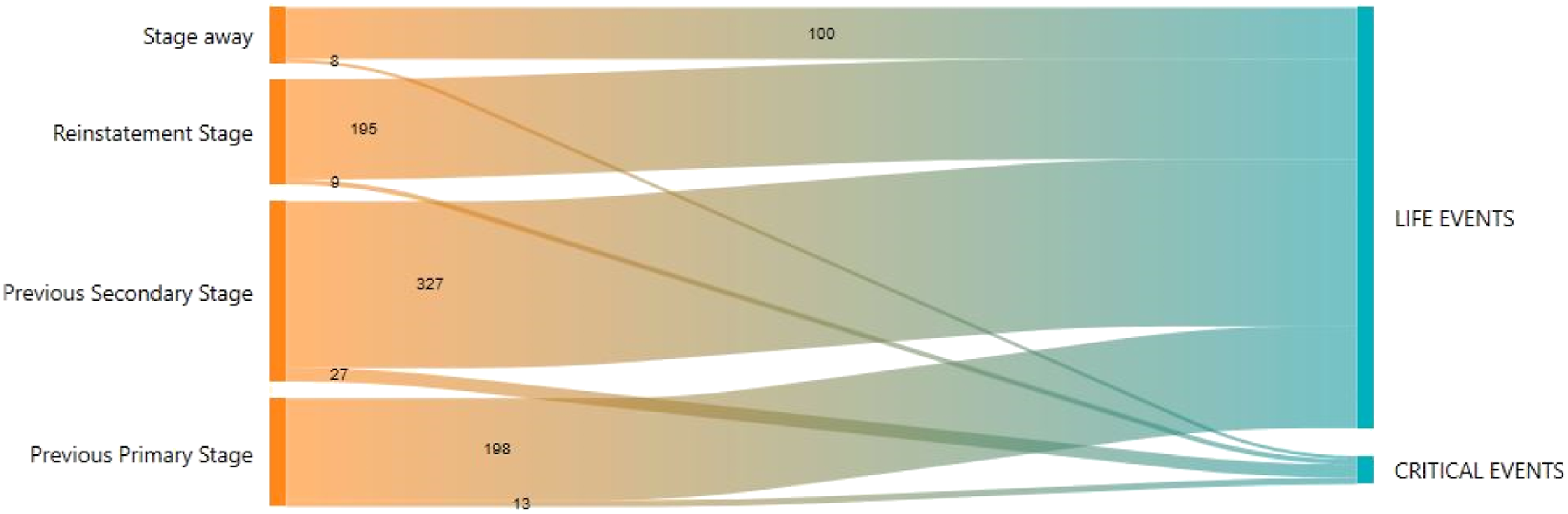
The Fifth Step, Qualitative Analysis Supporting the Theory
Co-occurrence between the different factors that affect the trajectories and stages in which they occur.

However, here we have taken two ways by which we can show that relationship that is intended to be shown in the fifth step of the Barton and Lazarsfeld analysis procedures. On the one hand, an analysis of the educational trajectory of a student will be shown through the use of a biogram created for each of the life stories. In them it was possible to observe how the different events affected the involvement and how its trajectory was modulated throughout the different stages. Reflecting those precise propositions about how different events occur and what effect they have on each of the trajectories. This has allowed us to make a comparison with the different models of educational trajectories that were used as models in the development of the thesis.
On the other hand, as general orientations, we would use the semantic networks made using the ATLAS.ti software to indicate which factors are most often reflected in each of the stages. Through this network of meaning, the so-called semantic networks, we will be able to represent the main results that are shown and based on them, be able to reflect the different supports to the theory necessary at this stage of the analysis.
Biograms, First Way to Qualitative Analysis Supporting the Theory
Biograms are a way to initiate or contrast the exploration and analysis within the biographical-narrative approach. This can be through the preparation of “a map of personal and professional history, from the establishment of a chronology, and of the events that had occurred in the life of the interviewee” (Vera, 2010, p.427), a biogram. This will allow the researcher to represent the trajectory of the subject being studied. In the words of Nieto et al. (2018), consists of constructing a textual and visual summary representation of the most relevant events that occurred in the life of a person, combined and ordered chronologically, in which the description made by the person of the events themselves and the appraisals or evaluations that are the object of them are reflected (Nieto et al., 2018, p.101)
In this way, a graphic and orderly structure of the different relevant facts that have meant moments of inflection in the student’s life is presented. Thus, it is a question of outlining the history of life, taking into account the chronology of the events, the events of the phases that are reflected in that route, and the assessment that the person makes of them.
This technique of information analysis has been used recurrently and has been considerably contrasted (Domingo et al., 2017) over the years, both in research in the educational field and in the social sciences as a whole. Following the aforementioned authors, the biogram is understood as a tool that operationalizes the biographical-narrative approach by focusing the focus of attention of the interviewee and interviewer on reflection based on the person’s life experience. A question carried out through the appearance of new stories that contrast or refine the facts present in the biogram, helping its understanding and reflection on the experiences lived throughout its trajectory.
This type of instrument within the investigation, suppose a first structuring of the data through a cartography of the trajectory of the interviewee (Flick, 2014) and of the facts of relevance or critical incidents (Bolívar et al., 2001; Hutchison, 2019). In this way, it will be possible to concretize this diachronic scenario mentioned above and necessary in research raised through this approach.
The advantages of using the biogram as a tool in life stories seem inevitable, taking a prudent attitude and the words of Domingo et al. (2017). First, it presents the subject himself/herself on a map where his/her trajectory is shown, an aid in making the life story when it is addressed. Derived from this, in the second place, we find that, through the biograms, the most outstanding facts of the trajectory, the critical incidents are shown, being able to be perceived with clarity, possible moments of inflection, their triggers or the consequences of this, showing themselves as elements that give meaning to life. In addition to the different events and categories of analysis that are intrinsic to this tool, through the plot reflected in the biograms, transversal elements can be extracted that provide meaning and help build the life story.
With what is indicated throughout this section, and relying on research that has used this tool (Bolívar et al., 2001; Domingo et al., 2017; Portela Pruaño et al., 2019), has proceeded to elaborate biograms of each subject as the model that follows (Figure 5): Example of elaborate biogram.
In our case, we made a biogram in which we were signaling the different events that took place in each of the stages of the students' school career. In addition, the involvement in the trajectory has also been modulated according to how the events present in it affected. We have achieved, in each of the life stories of the subjects, a representation of their educational trajectory (Domingo et al., 2017; Portela Pruaño et al., 2019). In this representation you can see how the process of distancing and reincorporation from their training has occurred. Methodologically it is extremely relevant, since the development of the life story can be observed in an image that represents the elements of the theory of the life course established by Hutchison (2019).
Second way of Analysis, Building Semantic Relationships to Build Networks
Finally, a tool de ATLAS.ti that allows us to explore the results visually and show the different connections that appear is the semantic network. It is another way to make an approach to the theory from the data, since the different categories of coding used to show the relationship emerged between them are organized. Likewise, it is also a relevant tool to show the different research findings emerged from the co-occurrence tables or document code such as those shown above. In the following image (Figure 6), we can find an example of this. It corresponds to the previous research and points out the link between the stages of the educational trajectory of the subjects and the involvement manifested by the different authors. Semantic network on the factors presents in the trajectory of the students and the type of involvement to which they are associated.
The construction of semantic networks resembles the elaboration of a conceptual map in which we can observe the relevant information extracted from the analysis of organized data. In this case, the networks are used to perform a conceptual analysis of the emerged data and to be able to discuss them with the theory (Friese, 2019) as indicated in the stage of the Barton and Lazarsfeld data analysis model. Different networks created can have different bases. We may create networks by relating codes to informants or other elements within the program. In our case we have created a network based on the relationships emerged between categories, so only codes will appear. This final stage in the work with the analysis of the coding seeks to establish relationships that demonstrate the understanding of the phenomenon through the data. This relationship between concepts allows to fit the pieces that give meaning to the later theoretical construction. As we can see, it is done through central categories that are the ones that articulate the others in the network and in the conceptual development of the discussion.
Conclusions
This paper had a very specific purpose, to describe an approach to the study of the educational trajectories of students at risk of exclusion and to discuss the suitability of this methodological procedure for a narrative approach to such an ecological problem.
These two objectives lead us to think about the previous methodological tradition and the different research approaches used to carry out narrative research where the researcher’s focus was to explore in depth the trajectory of subjects. These questions were considered by the authors as challenges that led us to carefully select each of the steps to be developed in the methodological process of the research. To do this, we should take into account similar research that had been done previously by other authors and the suitability of the various research approaches that we can find today. Törrönen (2022) and Kahveci (2021) reminded us how life stories reconstruct through pieces or small pieces a complex puzzle. Through this research we have seen that these pieces acquire meaning in context beyond the individual one.
The problem to be addressed, being understood as an ecological issue, had to be worked through a methodology that delved into all the issues necessary to understand it exhaustively. After investigating different research approaches used by previous research, we decided to develop the one that was shown. However, at the beginning of the research we realized the need to approach data analysis with a complexity commensurate with that of the problem studied. The issue that required further development on the part of the researchers was the selection of a data analysis strategy according to the complexity and characteristics of the study. The narrative research approached from a perspective similar to the one presented here goes deeper than those reviewed in order to carry out the analysis. One of the aims of narrative research is to delve deeper into the experiences of the subjects (Pilbeam et al., 2022). This is achieved with greater success if the analysis is carried out systematically and with the support of tools with these characteristics. Access at any time to any phase of the analysis process is useful for the revision and improvement of the research. Moreover, due to the need to go deeper into the data to achieve a quality narrative reconstruction (Ford, 2020), an analysis method such as the one presented allows navigating between the different experiences presented in narrative research.
After conducting a survey of the methods of recurrent analysis in these investigations we noticed a stagnation in similar investigations with respect to the analysis and presentation of the results. Previous research focuses, for example, on improving research design or data collection procedures (Dhungana, 2022; Sosa-Díaz & Valverde-Berrocoso, 2022), but the process of inquiry into the data focuses on basic analysis models. To carry out this methodological evolution in the study of narration, life stories and their trajectories it was necessary to carry out a data analysis based on the method of Barton and Lazasfeld. That was going to make it easier for us to use two fundamental tools in research, biograms and ATLAS.ti for semantic exploration. This shows that many traditional ways of research analysis are still valid because of their applicability to current tools (Friese, 2019). Moreover, it produces an improvement in the quality of the analysis performed which, as Glasser and Strauss (1967) point out, increases in complexity as one progresses.
After taking the research to the board, it has been concluded that, using a method such as the one described here, the data is deepened in a greater way than the analysis of traditional content or other strategies explored previously. In addition, the use of biograms for the study of trajectories are inseparable to represent them in an efficient and clear way.
We consider that this protocol or way of analyzing the data fills a gap that was constant in qualitative research, the semantic exploration of the data in a contrasted way with the quasi-statistical data that emerge after coding and that is only accessible if a tool such as the one shown in this text is used.
Footnotes
Declaration of conflicting interests
The author(s) declared no potential conflicts of interest with respect to the research, authorship, and/or publication of this article.
Funding
This work was supported by the Ministry of Economy, Industry and Competitiveness of the Government of Spain under Grant [BES-2017-081040].
