




Abstract
Collective action is needed to conceive and implement sustainability transitions within our society. Yet, it requires the coordination of a diversity of actors, each possessing their own reasoning. Integrating diversity, characterized by variety, disparity and balance, is thus a crucial methodological challenge to address, notably in order to enhance the quality of policy decisions concerning sustainability issues. Here we show how to tailor the way of collecting, analyzing and using actor reasoning diversity to the management style of collective action, characterized by the role the actors are allowed to play in defining collective action. To this purpose, we compare three design experiments using actor reasoning in the context of collective action aiming at developing sustainable food production: (1) considering actor reasoning in top-down decision-making (scallop fishery in Integrated Coastal Zone Management); (2) building consensus for a common strategy (quality in a sheep milk cooperative); and (3) fostering collective intelligence for individual and collective paths for action (agroecological transition of an agricultural territory). The diversity of actor reasoning in each of the design experiments was collected through cognitive mapping, a systemic representation tool adapted to represent actor reasoning. We propose a framework to adapt cognitive mapping methods to different management styles of collective action. In practice, adjusting the level and nature of the reasoning diversity considered at each step of a participatory process, through the way cognitive maps are collected and analyzed, is key to the tailoring of a cognitive mapping method to a management style of collective action. Overall, we show that the level of reasoning diversity considered in collective action should increase with actor involvement in analyses and decision-making.
Keywords
Introduction
Sustainability transitions within society translate into specific and context-dependent actions at a local scale (Hansen et al., 2018). Involving or empowering local actors in collective action to conceive and implement such transitions is necessary. These actors are experts of their local contexts (Cuppen, 2012), and they are the ones implementing transformations in the field. Considering and articulating their reasoning in the design of action strategies thus seems essential to the success of implemented actions. Their reasoning takes place in action, taking the form of a “practical means-end reasoning”, which “seeks means for securing desirable consequence in a given context”, and comprises different aspects related to the preparation of action (Goldkuhl, 2011). Actor reasoning also comprise different components, such as in “socio-scientific reasoning” (Morin et al., 2014): different types and areas of knowledge (technical, human and social, economic, environmental and political), personal values, and perception of uncertainty. Each actor develops his/her own reasoning, each with its own overall coherence, which entails the necessity to integrate a diversity of reasoning in the management of collective action.
Diversity integration is a methodological challenge, but is perceived as crucial, notably to enhance the quality of policy decisions concerning sustainability issues (Cuppen, 2012). Diversity can be characterized through variety as the number of categories describing a system’s elements, disparity as the explanation on the nature and extent of the difference between categories and balance as the elements’ distribution among categories (Stirling, 2007). When studying reasoning diversity, we study elements of reasoning, or ideas, concerning a particular issue. Reasoning diversity can be perceived and integrated in the definition of actions in various ways: (1) as a constraint for progress towards sustainability (Levy et al., 2018), notably in top-down strategies to design socially acceptable policies (Vuillot et al., 2016), (2) as a resource for top-down strategies benefiting from knowledge co-production and emergent knowledge (Olazabal et al., 2018), or (3) as a resource to foster social learning in more empowering approaches (Blackmore, 2007; Cuppen, 2012; Ison et al., 2007; Steyaert & Jiggins, 2007). These different diversity management strategies, linked to different collective action types, also condition the way actors are involved in the production and analysis of representations of their reasoning.
Several frameworks have been developed to guide actor involvement in decision-making processes (see Table 2 in the Supplementary Information). Some particularly reflect on when and how to involve actors (Gray et al., 2012; Kelly et al., 2013; Schäfer et al., 2020; Voinov et al., 2018; Wiek et al., 2012). A few other frameworks were developed to guide or evaluate the actionability of knowledge produced by participatory processes (Mermet, 2018; Schäfer et al., 2020; Wiek et al., 2012), that is the possibility for the people implementing actions in the field to use knowledge produced by experimental research (Argyris, 1996). Mermet (2018) details different collective action types linked to different types of actor involvement. Cuppen analyzed actor reasoning diversity in the context of organizing participatory workshops (Cuppen, 2012). Participatory modeling, notably via cognitive mapping, is a key tool to take into account actors’ reasoning in many approaches (Kelly et al., 2013; Moon et al., 2019; Voinov et al., 2018).
Cognitive mapping is a visual tool used to apprehend actor reasoning. It is a conceptual graph, linking words with arrows, enabling a systemic representation of an individual’s reasoning on a subject. Cognitive mapping can be used in different ways, from purely qualitative to semi-quantitative combined with artificial intelligence. Cognitive mapping can be used solely for reflection and discussion or as a basis for simulation modelling. Several names exist to refer to different types of cognitive maps and similar visual tools depending on these differences: semantic maps or mind maps (a purely qualitative map which can include drawings), idea maps, heuristic maps, mental maps, mental models, cognitive maps (Axelrod, 1976; Eden, 1992; Tolman, 1948), causal maps (a type of cognitive map with causal links only), fuzzy cognitive maps (FCMs, a semi-quantitative type of cognitive map combined with fuzzy logic (Henly-Shepard et al., 2015; Kosko, 1986; Papageorgiou, 2013)), learning FCMs (FCMs combined with learning algorithms (Felix et al., 2017)), diagramming of multiple perspectives and systems of interest (Ison, 2008), etc. A large number of studies and several reviews exist in the literature about different cognitive map types, uses, advantages and limits, which go beyond the scope of this paper and which we will not all detail here. See for instance Eden (1992) on the nature of cognitive maps, Papageorgiou (2013) about FCMs in a broad range of applications, Felix et al. (2017) about learning FCMs and Moon et al. (2019) about different types of cognitive maps in conservation research. All types of cognitive mapping share some common characteristics. One main shared characteristic is that this tool enables the researcher to work with more or less defined elements and without a precise understanding of the links between them, but with a vague description (Kosko, 1986). Moreover, the fact that cognitive maps enable a systemic representation is essential to adapt to actors’ systemic reasoning (Toffolini et al., 2016). Therefore, cognitive maps are well adapted to collect local actors’ reasoning. Cognitive maps also reveal the extent of actor reasoning diversity (Olazabal et al., 2018) and constitute a valuable communication and analysis tool in a consultation framework, where actors must confront different perceptions (Eden, 1992). Moon et al. (2019) propose a framework linking the choice of cognitive map type to “the role” cognitive maps play in the research study (i.e. the way the cognitive map results will be used).
Overall, each of the above-mentioned frameworks considers a subset of the following aspects: actor reasoning diversity, participatory modeling including cognitive mapping, link between cognitive map type and use of results, collective action types, and knowledge actionability.
Here we present a framework encompassing all of these aspects, and specifically highlighting the links between collective action management styles and cognitive mapping analysis types. We emphasize how different styles of collective action management call for different uses of actor reasoning diversity, and reciprocally how the way we collect and analyze reasoning diversity has implications on the ways we can manage collective action. In analyzing the actors’ reasoning diversity, we focused on the diversity of the levers for action they mentioned, as we consider them as particularly useful for action. We produced our framework from the analysis of three design experiments using actor reasoning in the context of collective action. We refer to a design experiment as a research intervention aiming at generating solutions to an existing problem in order to help local actors (Ansell & Bartenberger, 2016; Stoker & John, 2009). Using our framework matching collective action management styles to cognitive maps analysis types, we present the analysis of three design experiments, which differ in terms of management style: (1) considering actor reasoning in top-down decision-making, (2) building actor consensus for a common strategy and (3) fostering collective intelligence for individual and collective paths for action. For each design experiment, we then present quantitative and qualitative analyses of reasoning diversity collected with cognitive mapping, and an analysis of the management of actor reasoning diversity. Last, we discuss the advantages and disadvantages of using reasoning diversity for optimization and for social learning.
Materials and Methods: Actor Reasoning Diversity Collection and Analysis in the Context of Different Management Styles
In order to characterize the actors’ reasoning diversity, we used cognitive mapping in three design experiments with different management styles, which led us to analyze and use this reasoning diversity in different ways. In order to analyze the links between (i) reasoning diversity collection and analysis with cognitive maps and (ii) management styles, we produced a dedicated analytical framework.
Three design experiments with different management styles
In this section, we present the context, operational goal and management style of each design experiment.
Design Experiment 1: Considering actor reasoning in top-down decision-making
In design experiment 1, the operational goal was to enable top-down actor representatives to consider scallop fishers’ main reasoning within an Integrated Coastal Zone Management (ICZM) project. ICZM aims at coordinating different activities sharing the same coastal area, notably by integrating actor reasoning from different activities in order to develop locally adapted management strategies (Cicin-Sain & Knecht, 2013). This project was managed by several researchers, and occurred in the bay of Brest, Northwest France, from December 2009 to February 2013. As an emblematic activity of this area, scallop fishing was studied in particular detail within this ICZM project. There were 50 scallop fishers in the bay of Brest at the time. The researchers defined the question guiding the cognitive map drawing: “Which elements play a role in the scallop fishing activity in the bay of Brest, and how are they linked?”. The first author conducted 17 cognitive mapping interviews with scallop fishers in the spring of 2011. In this design experiment, cognitive mapping was used to fuel an optimized model to generate a summary of the reasoning of this category of actors.
Design Experiment 2: Building consensus for a common strategy
In design experiment 2, the operational goal was to reach a consensus for a common action strategy about quality management within a sheep milk cooperative. The second design experiment took place in the context of a sheep milk cooperative in the Roquefort area in southern France, between November 2015 and December 2016. This cooperative was composed of 30 member-farms, uniting around 60 farmers and 34 employees, including four cheesemakers. The cooperative collected the farms’ milk production and transformed it into cheese. Its director, a historic co-founder and leader of the cooperative, was its main manager. All the members of the cooperative (farmers) met every 6 weeks in a managing board meeting to discuss the results, evolution and management strategy of the cooperative. The researchers participated in two managing board meetings to define with them the subject studied together: cheese quality in the cooperative. The researchers formulated the question guiding the cognitive map drawing: “What are the links between the farmers’ practices and the cooperative’s cheeses?”. After approval of this question by the cooperative director, the first author conducted 13 cognitive mapping interviews with sheep dairy farmers in the spring of 2016. In this design experiment, cognitive mapping was used to develop a diagnosis and discussion tool supporting consensus-building among the cooperative members.
Design Experiment 3: Fostering collective intelligence for individual and collective paths for action
In design experiment 3, the operational goal was to build individual and collective paths for action, in order to operate a transition to agroecology at a regional scale, in the same area as design experiment 2 (Roquefort area in southern France). Several farming actors in this area, such as farmers, farm advisors, and natural park managers were operating a transition to agroecology. In order to coordinate their actions, they created an “Operational Group for European Innovation Partnership” entitled “Initiative for Local Agroecological Innovations” with three researchers, including the first and last author of this paper. This European-funded project took place from February 2016 to November 2018. Within this project, the researchers organized a participatory strategic futures study (Godet & Roubelat, 1996; Masini, 2006), in order to facilitate actor coordination in their transition to agroecology. During this futures study, actors shared their understanding of the current situation, discussed possible evolutions, defined a desired state and identified means to reach it. The actors defined the question guiding the futures study with the researchers, during two steering committee meetings of the project: “How to create the conditions to increase employment in sustainable farming, respecting agroecology principles, in the Grand Causses Regional Natural Park by 2035?”. The first author conducted 30 cognitive mapping interviews using this guiding question in spring and summer 2017, as a first step of the futures study (see Supporting Information). In this design experiment, cognitive mapping was used to fuel social learning and collective intelligence within the futures study.
Cognitive mapping interviews in our design experiments
Cognitive mapping was used as a visual aid for data collection, reflection, and dialogue within interviews, as a basis for discussion and facilitation during collective meetings in design experiment 2 and during workshops in design experiment 3, and as a basis for simulation modelling in design experiment 1. In each design experiment, we used a slightly different type of cognitive mapping, as we adapted the cognitive mapping process to the operational goal of the study. In design experiment 1, we used Fuzzy Cognitive Mapping (FCM) (Kosko, 1986). In design experiment 2, we used a mixture of FCMs and mind maps. In design experiment 3, we used cognitive mapping resembling mind mapping, but without its typically centralized organization.
In each design experiment, one main question guided the cognitive map drawing during the interviews (presented in sections 2.1.1., 2.1.2, and 2.1.3). The interviewer used an interview guide, which was mainly comprised of sub-questions emanating from the main guiding question. During each interview, the interviewee was asked to represent his/her thoughts concerning the guiding question on a blank sheet of paper. Each interview led to the construction of a cognitive map, either by the interviewees themselves (in most cases: two out of three in design experiment 1, all but one in design experiment 2 and one out of two in design experiment 3) or by the interviewer, taking dictation from the interviewee. When an interviewee showed difficulty in completing his/her cognitive map, the interviewer stimulated him/her with the following question: “Are there other elements concerning… [the guiding question]?”, or by a reminder of certain elements and exact words which he/she had mentioned during the interview, in the same order.
Once the interviewee had written the elements that he/she deemed relevant to the question, the interviewer asked him/her to draw the links between these elements, in the form of arrows. The arrows represented links of causality (with a positive or negative influence), functionality (governs, inhabits, uses, eats…), or details concerning the element at the beginning of the arrow. Depending on the design experiment, the interviewer asked for a specific codification of the links or not. In all cases, the interviewer asked the interviewee to explain the signification of each element and arrow represented. This was essential in order to manage the semantic diversity of the actors’ vocabulary: one word could have different meanings, and several words could refer to the same meaning.
To finish, the interviewee would circle, with different colors, elements of particular interest, according to categories predefined by the researchers. In all case studies, these categories included: “most important”, “obstacles/limits” and “levers for action”. Other categories were added for each design experiment.
Although it is easy and quick to explain the principle of a cognitive map, not all actors feel comfortable with its formalism. Indeed, drawing cognitive maps requires certain visualization and information coding capacities which are not necessarily intuitive processes (Bonneau de Beaufort et al., 2015). Moreover, the information collected by the interviewer can be biased by his presence. In order to reduce this bias, as recommended by Özesmi and Özesmi (2004), the interviewer created her own cognitive map before starting each survey, answering the same question that she would ask the interviewees. As this process brings more awareness of one’s own mental representation of the object of study, one is less likely to be unconsciously influenced by it during the survey (Özesmi & Özesmi, 2004). This also enables the interviewer to further understand the exercise and be all the more able to explain it.
Depending on how comfortable they felt with this representation tool, the interviewees would either draw it right away to represent their thoughts on the question, and would then be asked to explain what they drew, or the interviewer would first carry out the interview and the interviewee would draw a cognitive map at the end. In design experiment 1, all the maps were drawn at the end of the interview. In design experiments 2 and 3, almost all of the interviewees started drawing their map at the beginning or in the middle of the interview.
At any given moment during the creation of the cognitive map, the interviewee could modify it. Once finished, the interviewer asked him/her to review his/her map and to validate it. After the interviews, the interviewer sent each interviewee a copy of their cognitive map, so that they could suggest any modification and validate it again.
Analysis framework of the links between collective action management styles and cognitive map analyses
Framework guiding the choice of cognitive mapping methods and analyses of reasoning diversity depending on the management style of collective action in the context of sustainable food production: summary of the results in three design experiments.

In our framework, we suggest to consider the following elements concerning collective action management styles (column headings in Table 1(a)): actor coordination type, operational goals, diversity perception and management, production of the study, actor involvement, and contribution of results to problem-solving. The production of the study can be of different natures (production type and reasoning components collected), it can be meant for different users, and produced by different people. We characterize actor involvement according to (1) their reasoning components used, (2) the level and nature of their participation in the problem finding, framing or solving (Heiman et al., 2009), and (3) the opportunity for social learning during their participation in the study. Here we define social learning as individual and/or collective learning in the context of social interactions (Blackmore, 2007).
In our framework, we also distinguish four main types of elements to consider when adapting the cognitive mapping method to a design experiment (column headings in Table 1(b)): cognitive mapping results use, cognitive map drawing, cognitive map analyses, and their validation process. We present three main parameters that can vary in cognitive map drawing: who chooses the question guiding the cognitive map drawing, constraints imposed on cognitive map drawing, and possibility of modifying cognitive maps over time. We also consider key elements concerning cognitive map analyses: producers, methods, result type, and the main diversity property(/ies) addressed, such as defined by Stirling (2007): variety as the number of categories describing elements of reasoning, disparity as the explanation on the nature and extent of the difference between categories and balance as the elements’ distribution among categories. In our analysis of reasoning diversity in the three design experiments (detailed in section 3.2), we focused on the elements the actors perceived as levers for action, falling into different categories corresponding to sustainability domains: ecology, economy, policy, technical and human and social aspects. In section 3.2, we also use Mermet’s (2018) description of underlying models of organized action to compare the consistency of the categories of levers for action put forward by the actors in each design experiment with its management style, and in relation to the place given to reasoning diversity. Last but not least, in our general analysis framework we also consider in which way actors are involved in the validation of cognitive maps and analyses (validation of individual cognitive maps, summaries or models generated by the researchers, analysis of the results and choices influenced by the consideration of the results).
Results
In this section, we first present (3.1) the application of our analysis framework to each of the three design experiments, then (3.2) a more in-depth qualitative and quantitative analysis of reasoning diversity in the three design experiments and then (3.3) a focus on the managing of actor reasoning diversity in the three different operational settings.
Three design experiments dealing with reasoning diversity
In this section, we analyze each design experiment using the framework presented in the previous section, linking the collective action management style to the type of cognitive mapping method and analysis.
Design experiment 1: Considering actor reasoning in top-down decision-making
In the first design experiment, the operational goal was to enable top-down actor representatives to consider scallop fishers’ main reasoning within the ICZM project (Table 1.a). Cognitive mapping was used to fuel an optimized model to generate a summary of the reasoning of this category of actors. Bonneau de Beaufort et al. (2015), a researcher associated to the project, developed a decision-making tool to explore scenarios with a simulation model. The researchers defined and framed the problem to address. The actors were only involved to extract their contextual and expert knowledge, in order to contribute to the representatives’ understanding of the problem and problem-solving.
In order to be able to build a simulation model, the interviewer imposed several constraints to the cognitive map drawing, which corresponded to Fuzzy Cognitive Mapping (Kosko, 1986; Papageorgiou, 2013) (Table 1.b). Firstly, each cognitive map had one concept imposed in its middle (“scallop”) to facilitate the automatic generation of summaries. Secondly, all the links had to be characterized with an influence type (“+” or “–”) and an influence weight (1: low, 2: medium or 3: high). The “+” symbol signified that the element at the end of the arrow varied in the same direction as the element at the beginning of the arrow (i.e. both increased or decreased). The “−” symbol indicated that the element at the end of the arrow varied in the opposite direction as the element at the beginning of the arrow (i.e. if the first increased, the second decreased, and vice versa).
Cognitive maps were automatically compared and aggregated, generating cognitive map summaries, with a process detailed in Bonneau de Beaufort et al. (2015), who used the same data (for more detail on this aggregation process, see Supporting Information). Only one majority cognitive map summary was used within the ICZM project (Figure 1): it showed elements that had been cited by at least seven fishers, including the main diverging opinions among fishers (dissensus, indicated in red). Arrow thickness gave an indication of the number of fishers citing the links, and an average weight was attributed to each link. This majority summary was used as a base for a simulation model generating inference reasoning to estimate how the fishers would perceive the evolution of their activity in the face of certain changes (environmental, policy, etc.) (in Bonneau de Beaufort et al., 2015). The cognitive map summary was used in the ICZM process, as a way to include the main considerations of the fishers’ group in the multi-actor dialogue. Cognitive mapping method and analysis for design experiment 1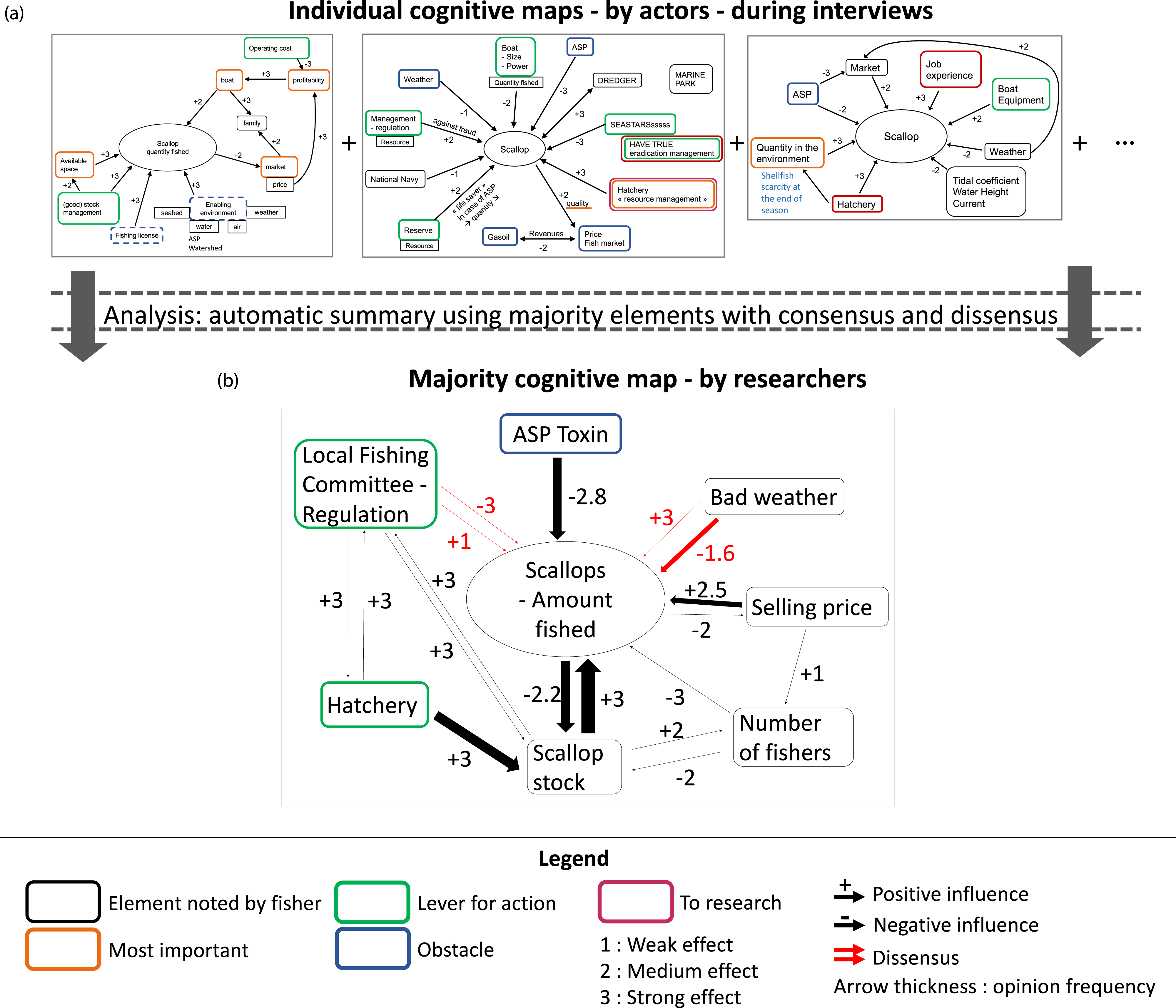
The fishers had the possibility to change elements from their cognitive maps during an individual cognitive map validation step, after they were digitized. After the researchers produced analyses, there was no opportunity for the actors to modify their cognitive maps or the analyses. In this case, researchers produced the results and gave their final validation (Table 1(b)).
For more detail about data collection and analysis methods, see Supporting Information.
All the elements of this figure are present in full size in the Supporting Information.
Design experiment 2: Building consensus for a common strategy
In the second design experiment, the operational goal was to reach a consensus for a common action strategy about quality management within the cooperative (Table 1.a). The results of the study, obtained with cognitive mapping analysis, were used as a diagnosis and discussion tool among the actor group, in order to help understand dissensus and build consensus. In this case, the actors contributed to problem-finding, validation of the problem-framing, modification and validation of the results of the study, and they undertook problem-solving.
Once the cognitive maps were collected, we classified all their concepts in a taxonomy, grouping synonyms under one formulation which included the most diversity (for details, see Supporting Information). We counted the occurrence of the different concepts and links in order to be able to give an indication of their weight. We then generated one general summary indicating the most frequently mentioned elements, and three thematic summaries showing both frequently mentioned elements and rare elements concerning themes that were noted as particularly important by the farmers: “forage quality versus autonomy seeking”, “elements influencing cheese quality” and “social elements”. These summaries gave an indication of the elements’ frequency, proportional to word size and arrow thickness, and highlighted diverging opinions (in red) (Figure 2). We presented and discussed these results in a managing board meeting with the actors. We detailed certain causes and extent of dissensus, to entail a better understanding of the diverging opinions among the cooperative. We also presented the “rare” elements in order to see if they would generate consensus or dissensus. This led to discussions within the managing board. Cognitive mapping method and analysis for design experiment 2 "Building consensus for a common strategy (sheep milk cooperative)". (a): 13 individual cognitive maps were collected from sheep dairy farmers during cognitive mapping interviews. No element was imposed. The computerized version is an exact copy of the paper one. The colors in the cognitive maps highlight certain elements of interest: most important elements, levers for action, obstacles, and elements to promote or to enhance. These individual cognitive maps were manually analyzed using a summarizing method based on the aggregation of common elements, highlighting consensus, dissensus and original elements. (b): one majority summary map obtained through analysis by researchers, which contains elements most noted by sheep dairy farmers, including dissensus, and shows the frequency of the elements and links noted by the fishers. The elements present in this cognitive map were cited by at least five farmers. (c): three thematic summary maps obtained through analysis by researchers, which contain elements of consensus, dissensus and original elements, and show the frequency of the concepts and links noted by the farmers. The themes were chosen by the researchers according to their analysis of what was most important to the farmers. These summaries were used by the members of the cooperative, especially by the directors.
The interviewer did not impose any concept or link quantification on the cognitive map drawing, in order to enable representation diversity and to use the time allocated for each interview to understand the actor’s reasoning rather than to quantify it (Table 1.b). The farmers had the possibility to change elements from their cognitive maps after the interview, when the interviewer sent their cognitive map via e-mail. They also had the possibility to add modifications to the summaries, during the collective discussion of the results (Table 1.b). The director of the cooperative gave the final validation of the results.
For more detail about data collection and analysis methods, see Supporting Information.
All the elements of this figure are present in full size in the Supporting Information.
Design experiment 3: Fostering collective intelligence for individual and collective paths for action
In the third design experiment, the operational goal was to build individual and collective paths for action, in order to operate a transition to agroecology at a regional scale (Table 1(a)). We used the results of individual cognitive map analysis as facilitation material among diverse farming actors during a collective workshop, in order to foster social learning and collective intelligence within the futures study. The actors defined and framed the problem with the researchers as facilitators. The diverse actors participating in the process could redefine the problem at any time. Actors also undertook problem-solving.
We identified themes to discuss with the actors based on what they had circled as most important to them in their cognitive maps. We identified nine themes of particular interest, including “farmer’s job attractiveness” (Figure 3(b) and (c), in full size in Supporting Information). In order to analyze the cognitive maps, the interviewer grouped all the concepts and links described by the actors in nine taxonomy-structured mind maps, one for each theme of interest (Figure 3(b), left). These mind maps included all the elements referring to the theme, grouped synonyms and indicated inclusion links (see Supporting Information). They did not indicate the weight of the different elements, but included all the consensus, dissensus and rare elements. From these nine summaries, the interviewer produced nine tables (Figure 3(b), right) prioritizing these elements according to their importance indicated in the actors’ cognitive maps. The facilitators used these tables during the first collective workshop of the futures study where collective cognitive mapping was used to trace ongoing discussions. 12 collective cognitive maps were produced during the first workshop (Figure 3(c)), which were used to prepare for the next workshops. Throughout the workshops facilitated by the researchers, the actors ultimately generated the final results of the study, namely a collective diagnosis of the situation, shared objectives for the future and diverse ideas for action, both individual and collective (Table 1(b)). These results were presented in a collectively made brochure (see Supporting Information). In this paper, we only analyze the results of the interviews and the first workshop. Cognitive mapping method and analysis for design experiment 3 "Fostering collective intelligence for individual and collective paths for action (diverse agroecology actors)". (a): 30 individual cognitive maps were collected from diverse agroecology actors (farmers, farm advisors, natural park managers, etc.) during cognitive mapping interviews. No element was imposed. The computerized version is an exact copy of the paper one. The colors in the cognitive maps highlight certain elements of interest: most important elements, levers for action, obstacles, elements to develop, elements to change, strong trends (i.e. elements which the actors think have a predictable evolution in the future) and uncertainties (i.e. elements which the actors think have an unpredictable evolution in the future). These individual cognitive maps were manually analyzed using a summarizing method based on the aggregation of common elements, highlighting consensus, dissensus and rare elements, according to nine themes. The themes were identified by the researchers, from their analysis of what was noted as most important by the actors. (b): nine Thematic summary maps and nine thematic tables (1 of each per theme) obtained through analysis by researchers, which contain elements of consensus, dissensus and rare elements. These were used by facilitators during the workshop. The example displayed corresponds to the thematic summary and table elaborated for the theme “Farmer’s job attractiveness”. (c): 12 Collective thematic cognitive maps, drawn by the facilitators with the actors during a workshop. The example displayed corresponds to the theme “Farmer’s job attractiveness”. These summaries contain elements of consensus, dissensus and rare elements. They were used to prepare the next steps of the futures study.
As in experiment 2, the interviewer did not impose any concept or link quantification on the cognitive map drawing (Table 1(b)). The actors had the possibility of influencing the results of the study throughout the entire process. Indeed, they could (1) change elements from their cognitive maps during an individual cognitive map validation step after the interview, as well as throughout the entire futures study, (2) modify the summaries built by the interviewer at the beginning of each workshop, (3) modify the collective cognitive maps drawn by the facilitators at any time during the workshops, which were drawn using their words. Diverse farming actors thus gave the final validation of the results.
For more detail about the data collection and analysis methods, see Supporting Information.
All the elements of this figure are present in full size in the Supporting Information.
Reasoning diversity in the design experiments
In each design experiment, we analyzed the number of different levers for action mentioned by the actors (variety), their associated domains of sustainable food production (disparity), i.e. ecology, economy, policy, technical and human and social aspects, and their frequency (balance). We also explored the evolution of this diversity from the individual maps collected to the final results.
The diversity of levers for action was reduced in each design experiment from the individual maps to the summary or collective maps (Figure 4). Variety – here the number of different levers - was most reduced in experiment 1, where only two levers remained in the summary map representing the actors’ majority reasoning. Disparity – here the number of different lever domains – was conserved in experiments 2 and 3, but largely reduced in experiment 1, where only 2 out of five domains represented in the individual cognitive maps were present after analysis, in the summary. Balance among the different lever domains was more and more conserved from experiments 1 to 3. This can be linked to the representation of rare elements in experiments 2 and 3, to the fact that the results were discussed with the actors in experiment 2 and to the fact that actors directed the drawing of the collective maps in experiment 3. In all three design experiments, over half of the levers were indicated only once. This illustrates the fact that keeping only majority elements drastically reduces diversity and that encouraging individual contributions throughout the process enables more diversity. In a nutshell, variety, disparity and balance were drastically reduced in the context of top-down management (design experiment 1), whereas maintaining more actor participation throughout the process in the context of coordination or actor empowerment (respectively design experiments 2 and 3) led to maintaining and/or developing more diversity. Evolution of the number, frequency and sustainability domains of levers for action throughout the three design experiments. “Unique” levers are rare levers which were mentioned by only one actor in his/her cognitive map.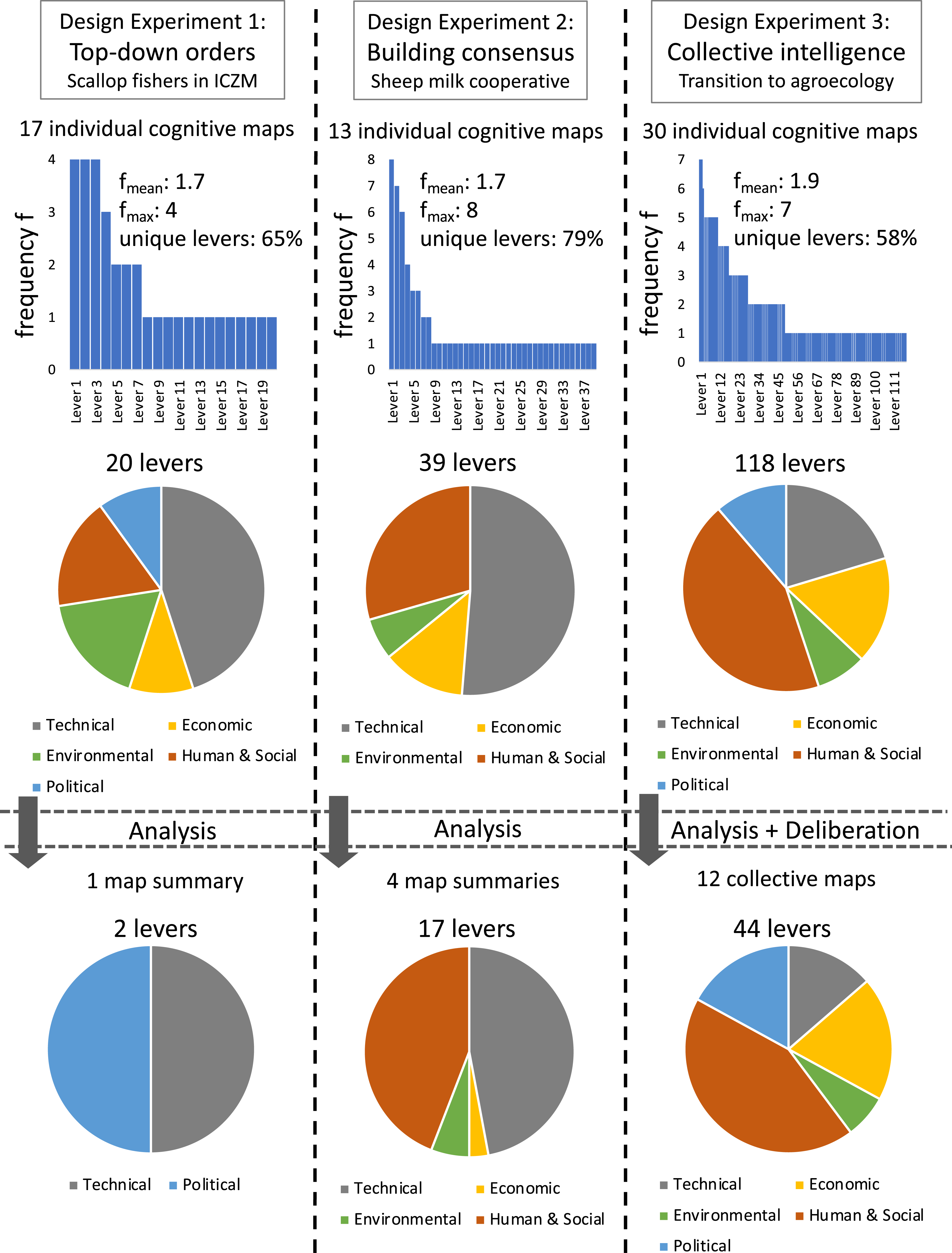
Moreover, the nature of the levers for action represented in each design experiment informs us on their underlying conceptual models of collective action such as defined by Mermet (2018). In design experiment 1, the fact that only a technical and a political lever for action are transferred to decision-makers illustrates the “government-as-operator” model. This is consistent with the top-down management style conducted in this experiment. In design experiment 2, all domains, except the political one, are present. In this case, levers are mainly technical and human and social. This illustrates the actor « coordination » model, which is consistent with the cooperative management style conducted in this experiment. In design experiment 3, levers for action are mainly human and social, followed by political and economic. This corresponds to a “governance-process” model (“a complex set of government and stakeholders” as main operators (Mermet, 2018)), and is fairly consistent with the multi-actor management style in this experiment, even though at the stage of the study it was focused on actor empowerment. “Governance-process” and “coordination” models are the two (out of six) models described by (Mermet, 2018) which most enable pluralism, and thus most use reasoning diversity in collective action.
Managing actor reasoning diversity in different operational settings
In design experiment 1, diversity is seen as a constraint for decision-making. Diversity is hugely reduced (e.g. levers in section 3.2 and in Figure 4) and little discussed at the level of the studied actor group (scallop fishers). In order to build a majority reasoning summary, we especially focused on the frequency of the elements present in the actors’ reasoning. We thus mainly explored the balance aspect of diversity (Table 1(b)), but only to keep the predominant reasoning elements, thus diminishing reasoning variety. We kept both consensus and dissensus, as long as they were predominant, in order to avoid representing a false consensus (Curseu & Schruijer, 2017) on some main elements. Our working hypothesis was that the more actors mentioned an element, the more that element was important to consider for other actors. The main advantage of building a “majority” map is that it enables to present a very condensed view of the actors’ reasoning to top-down decision-makers or to another actor group in the context of a concertation process (e.g. ICZM), enabling them to at least consider part of their reasoning rather than none. The main drawback of this method is that the majority view is impoverished and can lead to lesser quality policy solutions than one taking into account more diversity (Cuppen, 2012; Stirling, 2010).
In design experiment 2, diversity is seen as a constraint for common strategy definition. Diversity is reduced (e.g. levers in Figure 4) but discussed. We explored the variety of reasoning concerning the links between farming practices and production quality and we showed the balance of the different reasoning elements. This informed the cooperative managers on the distribution of reasoning and practice diversity among their cooperative. We then strove to understand their disparity in order to diminish the variety of farming practices among the cooperative. In this case, we especially focused on understanding the dissensus: What makes their opinions differ? What could make them converge? We thus mainly explored reasoning disparity. The fact of building cognitive map summaries considering rare elements and highlighting dissensus enables to work on the origins of disparity within actor reasoning, which appears as a necessary step to build true consensus.
In design experiment 3, diversity is seen as a resource for social learning and collective intelligence. Diversity is discussed and fostered. In this case, we especially strove to keep as much reasoning variety as possible throughout the whole process (four workshops with group discussions). The fact of putting into discussion consensus, dissensus and rare elements without presenting a previous summary, but instead with the building of a collective map with the actors (Figure 3), enables them to learn from each other and add new elements to the summary which were not present in the individual cognitive maps. This expression of collective intelligence generates new diversity (article in prep.). In the workshops, participants were divided into small subgroups, where discussions were facilitated by an external researcher. The researchers were careful to regularly put back into discussion “rare” reasoning elements, in order to maintain a minimum of reasoning balance. Nevertheless, the participant group itself was imbalanced in terms of reasoning diversity, due to who felt concerned by the guiding question of the study (how to increase jobs in agroecology), which hindered true reasoning balance (Cuppen, 2012). The process in this case nonetheless enables to maintain and develop reasoning variety, and enables to build collective intelligence, which can help find new courses of action, both individually and collectively.
Discussion: Diversity, From a Constraint for Optimization to a Resource for Social Learning
Different collective action management types call for different uses of actor reasoning. At both ends of a range of practices, we identified two contrasted approaches: (1) optimization with top-down orders where reasoning diversity is seen as a constraint to be reduced and (2) fostering social learning with concerted action using reasoning diversity as a resource. The relevance of the approach depends on the context and goals.
When seeking actor coordination through optimization (as in design experiment 1), researchers strive to describe the problem as accurately as possible according to their own scientific standards, in order to find the best possible outcomes. In this most common approach, researchers mainly extract actor reasoning to represent them in their model (Table 1.a). The purpose is then to find the optimal outcomes integrating actor knowledge, or to assess the acceptability of proposed policies (as in Vuillot et al., 2016). The main limitation of this optimization approach is the impossibility to find optimal solutions when facing wicked problems (Churchman, 1967; Rittel & Webber, 1973), i.e., problems that are “ill-formulated, where the information is confusing, where there are many […] decision makers with conflicting values, and where the ramifications in the whole system are thoroughly confusing” (Churchman, 1967). Actor reasoning diversity impedes the possibility of developing a consensual model of the situation (Gouttenoire et al., 2013; Halbrendt et al., 2014). Moreover, this type of simulation modeling misses the opportunity to take advantage of actors learning from experience to design and manage adaptive collective action that matches the volatility and complexity of most situations of action.
When seeking actor coordination through social learning (as in design experiments 2 and 3), researchers strive to help actors increase their understanding of their situation and address its complexity to build their own action strategies (Blackmore, 2007; Cuppen, 2012; Ison et al., 2007; Steyaert & Jiggins, 2007). In this type of approach, researchers collect a diversity of actor reasoning about a problematic situation, and they share this diversity with the actors to promote social learning. Discussing dissensus (or constructive conflict - Amason et al., 1995; Cuppen, 2012) among actors is especially useful when addressing wicked problems, as it especially fosters social learning. Nonetheless, sharing reasoning diversity does not ensure learning, as groups can tend to favor consensus in order to avoid conflict (Cuppen, 2012; Joldersma, 1997; Stasser & Titus, 1985). In design experiment 2, a collective discussion about the final results was engaged within the group in order to help understand the reasons for dissensus and the sources of consensus among them. This helped them develop a common strategy to manage quality in their cooperative. In design experiment 3, the collective discussions helped actors better understand the complexity of their situations and form temporary groups for specific collective actions. The dynamic aspect of the results makes the approach adaptive and the simple format of the results enables actors to amend them directly and integrate rapid changes. In design experiments 2 and 3, result validation is primarily done through a deliberation process with the actors making them operational (or actionable - Argyris, 1996). Seeking social relevance rather than optimization leads to several challenges. In the short term, it takes more time to work with actors to co-develop a shared analysis of the situation and action strategies (Gray et al., 2012; Steyaert & Jiggins, 2007). Moreover, the increase in genericity of these contextual results becomes more a problem of information triangulation from different sources, case studies and design experiments than of statistical significance (Wiek et al., 2012).
Conclusion
When managing collective action, diversity is a constraint for optimization but a resource for collective intelligence and social learning. We found that the use of cognitive maps helps to manage reasoning diversity among actors, as it can capture a high diversity of reasoning, and one can adapt the type of cognitive map analysis to the management style of collective action. Adjusting the level and nature of the reasoning diversity considered at each step of a participatory process is key to the tailoring of a cognitive mapping method to a management style of collective action. In a top-down management configuration (such as in a state government), one can use cognitive map summaries of different actor groups to apprehend different potential impacts of considered policy measures. In cooperative management, one can explicit common points and differences between individual cognitive maps in order to help understand dissensus and to build more consensus among the members. In actor empowerment, using individual cognitive maps’ content as a basis of discussion for workshops helps value the individuals’ original ideas and can foster collective intelligence and social learning, which in turns leads to more ideas relevant for action. The level of reasoning diversity considered in collective action increases with actor involvement in analyses and decision-making. We highlight the importance of tailoring cognitive mapping methods and analyses to the collective action management type, considering who will use the results and how they will operate actor coordination. This entails constraints on the guiding question choice, cognitive map drawing, analyses and validation of the results.
Supplemental Material
Supplemental Material - Tailoring Cognitive Mapping Analysis Methods to Different Management Styles of Collective Action by Handling Actor Reasoning Diversity
Supplemental Material for Tailoring Cognitive Mapping Analysis Methods to Different Management Styles of Collective Action by Handling Actor Reasoning Diversity by Gwen Christiansen, Jean Simonneaux and Laurent Hazard in International Journal of Qualitative Methods
Footnotes
Acknowledgments
First of all, we thank all the actors who participated in the interviews and workshops. We also warmly thank the other researchers involved in the three design experiments. Concerning design experiment 1, we especially thank Louis Bonneau de Beaufort (Département Statistique et informatique, Agrocampus Ouest, France), for introducing the main author to cognitive mapping, for the developing the automatic cognitive map aggregation platform used in this design experiment, and for the many discussions. We also thank Guy Fontenelle (Département halieutique, Agrocampus Ouest, France) for the discussions and Françoise Gourmelon (UMR LETG, CNRS, France) for the discussions and the inclusion in the ICZM project. Concerning design experiment 2, we are especially grateful to Nathalie Couix (UMR AGIR, INRAE, France) for her role in the choice facilitation and the formulation of the question studied with the actors, as well as the many discussions. In design experiment 3, we especially thank Vincent Thenard for his participation in the facilitation of the workshops and his support in summarizing the themes of interest to the actors (UMR AGIR, INRAE, France).
Authors’ Contributions
Conceptualization, G.C., L.H., J.S.; Methodology, G.C.; Investigation, G.C.; Writing, G.C.; Review and editing, G.C., L.H., J.S.; Funding acquisition, G.C., L.H.
Declaration of conflicting interests
The author(s) declared no potential conflicts of interest with respect to the research, authorship, and/or publication of this article.
Funding
This study was funded by ADEME and INRAE, as well as the French Region of Occitanie as part of the PSDR4 ATA-RI project.
Informed Consent
The participants to the study were informed about the conditions and purpose of the research. Verbal informed consent was obtained prior to the interviews.
Data Availability
Cognitive maps are available on request.

Supplemental Material
Supplement material for this article is available in online.
References
Supplementary Material
Please find the following supplemental material available below.
For Open Access articles published under a Creative Commons License, all supplemental material carries the same license as the article it is associated with.
For non-Open Access articles published, all supplemental material carries a non-exclusive license, and permission requests for re-use of supplemental material or any part of supplemental material shall be sent directly to the copyright owner as specified in the copyright notice associated with the article.
