




Abstract
Background
The UN Convention on the Elimination of all Forms of Discrimination Against Women (CEDAW) represents an international commitment to equality in the enjoyment of human rights. International human rights scholars posit that, in facilitating constructive dialogues between states and human rights experts, the near-universally ratified Convention is a powerful tool for achieving global health goals, such as the Sustainable Development Goals (SDGs). Yet, the performance of such rights-based approaches in achieving gender equality, and empowering all women, has not been systematically measured and evaluated on a global scale. This study seeks to address the urgent need to support data-driven analyses to hold governments to account through the development of a global dataset measuring state action on women’s health and human rights.
Methods
Standard systematic review methods will be used to review CEDAW periodic review reports produced by United Nations (UN) Member States, civil society organisations and the CEDAW Committee. Global participation with the review mechanism, the scope of health inequities covered by Committee recommendations, the nature of reported government action and the extent of implementation of each program will be extracted from each report. Only data from the two most recent reporting cycles will be analysed. Descriptive statistics will be used to analyse quantitative data, and all qualitative data will be analysed using policy mapping techniques.
Discussion
Using these data, the study will navigate the nature and the extent of state action to address these issues including by increasing women’s leadership and participation, data collection, strengthening health systems, governance and coordination and establishing new human rights infrastructure. It will use the diversity of health and human rights issues affecting women to reframe traditional conceptualisations of global women’s health which have largely focussed on sexual and reproductive health, to the exclusion of other aspects of women’s lives through the life course. In addition, the study will aid the development of authoritative guidance on how each of these areas of state action and inaction contribute to health inequities, and a framework for designing interventions to address discrimination against women as it relates to health.
Background
Human rights scholars have long held that rights-based approaches are a powerful tool for achieving global health goals, such as the Sustainable Development Goals (SDGs). Until now, the performance of rights-based approaches in achieving gender equality, and empowering all women, has not been systematically measured and evaluated on a global scale.
Gender inequality damages the physical and mental health of millions of girls and women across the globe. Taking action to improve gender equity in health, and to address women’s rights to health, is one of the most potent ways to reduce health inequities.(Chapman, 2010) The interconnectedness of gender and health are well-established.(Manandhar et al., 2018; Shannon et al.,2019) Women’s access to health services is influenced by the extent to which they enjoy social independence and experience gender differences in income earned. In addition, it is often associated with poorer health outcomes.(WHO, 2019) When it comes to nutrition, gendered norms and practices about food distribution often disadvantage girls and women.(UN Women, 2018) In relation to communicable diseases, there can be gendered patterns in exposure which make women more vulnerable. Gender norms can affect the uptake of services by women, and health systems may not take account of how unequal gender norms, roles and relations affect health.(UN Women, 2019; Theobald et al.,2017) Further, discrimination in health-care settings can lead to gaps in coverage.(WHO, 2017)
Strengthening, and consistently implementing, human rights mechanisms presents an opportunity for mobilising government action to address health inequities and their complex determinants. Such mechanisms, convened by intergovernmental organisations such as the United Nations (UN), work by bringing together Member States to confront common challenges. The UN, human rights specialists and civil society organisations agitate for governments to enact and strengthen effective, acceptable law, policies and programmes. UN Member States have important obligations to use the law to protect the health of vulnerable populations due to their voluntary and long-standing ratification of human rights instruments. Treaty bodies are custodians of the legal norms established by these instruments, and their work faces many challenges: shortages in human and financial resources, a high rate of non-compliance with reporting obligations resulting in persistent delays, and a large volume of documentation. The efficiency and effectiveness of these mechanisms are also complicated by States’ capacity and willingness to comply with recommendations, tensions and controversies surrounding what it means for UN Member States to dedicate ‘maximum available resources’ and what is considered to be progressive realisation.(Skogly, 2012)
The UN Convention on the Elimination of all Forms of Discrimination Against Women (CEDAW), adopted in 1979 by the UN General Assembly, is a near-universally ratified human rights instrument. It brings to light all areas in which women are denied equality with men, including health. The thirty Articles of the Convention offer protections against discrimination, understood as “any distinction, exclusion or restriction made on the basis of sex in the political, economic, social, cultural, civil or any other field.”(UN OHCHR, 2020) CEDAW is particularly powerful because it obliges states to enact or modify domestic legislation and constitutions to ensure the full development and advancement of women.
The Committee on the Elimination of all Forms of Discrimination against Women (CEDAW Committee) is the body of independent experts charged with monitoring the implementation of CEDAW. The Committee meets three times every year, for three weeks at a time, to review the human rights situation in each UN Member State. States report to the Committee every four years. The CEDAW Committee provides states with recommendations for concrete actions to improve women’s health. However, despite more than 40 years of CEDAW reviews, there has been limited research undertaken into the effectiveness of the review system in motivating state action to implement health-related human rights recommendations. This is in part due to the challenges involved in developing a sound method to assess effectiveness of CEDAW in advancing women’s health. To accelerate progress towards achieving the SDGs, there is an urgent need to address these methodological challenges, in order to understand the extent to which countries are acting to realise women’s health rights, and the role treaty bodies play in influencing such action. This reflects calls by leading human rights experts that have highlighted that while human rights research and advocacy has traditionally relied on testimonial evidence, a methodology that arises from practices of both law and journalism, data-driven approaches are needed to move the field forward. (New York University, 2015)
Currently however, the literature exploring the impact of the CEDAW mechanism remains largely non-empirical. For example, existing socio-legal scholarship offers rich theoretical perspectives on how, and why, the ratification of CEDAW should be expected to improve women’s health, and how it has led to global norm creation and enforcement. (Bond, 2014; Farhoumand-Sims, 2009; Moss, 2002; Raday, 2012; Zwingel, 2005) The limited empirical work evaluating and measuring CEDAW’s impact has investigated the effect of ratifying CEDAW on health outcomes, on the broader human rights situation for women, and on female political empowerment.(Englehart & Miller, 2014; Simmons & Creamer, 2018; Tait et al., 2019) These studies see ratification as the intervention and catalyst for change, rather than the ongoing engagement with CEDAW reviews, and interventions implemented in response to Committee recommendations over time. Two country-specific studies in Japan and New Zealand take a more granular approach, utilising CEDAW State Reports, government actions and the Committee’s Concluding Observations to assess the impact that engaging with the CEDAW process has on workplace rights, litigation and law reform.(Krommendijk, 2013; Shinohara, 2008) However, as the authors highlight the resulting insights are highly context-specific, and subsequently lack generalisability to other countries. One study provides an overview of recommendations provided during Universal Periodic Reviews (UPR), a mechanism scrutinizing the human rights record of UN Member States and where recommendations are State-led. (de Mesquita, 2018) The study does not extend to CEDAW reviews.
This study aims to address the gap in knowledge of CEDAW’s impact by measuring the effectiveness of the CEDAW review mechanism in mobilising government action to address gender inequality in health. The research team seeks to achieve this by developing a global dataset of government actions derived from the CEDAW reporting process to facilitate the monitoring and measurement of state action on women’s health and human rights across all regions of the world.
Explanation and Justification of Method
Study Aim
This study seeks to assess the extent to which UN Member States are acting to realise human rights affecting the health of women. It does this by assessing the global reach of the CEDAW mechanism, examining the scope of issues covered by the CEDAW Committee’s recommendations, investigating the categories of government action recommended by the CEDAW Committee, and determining the extent to which the recommendations are being implemented and how.
Study Design
Summary of Study Objectives.
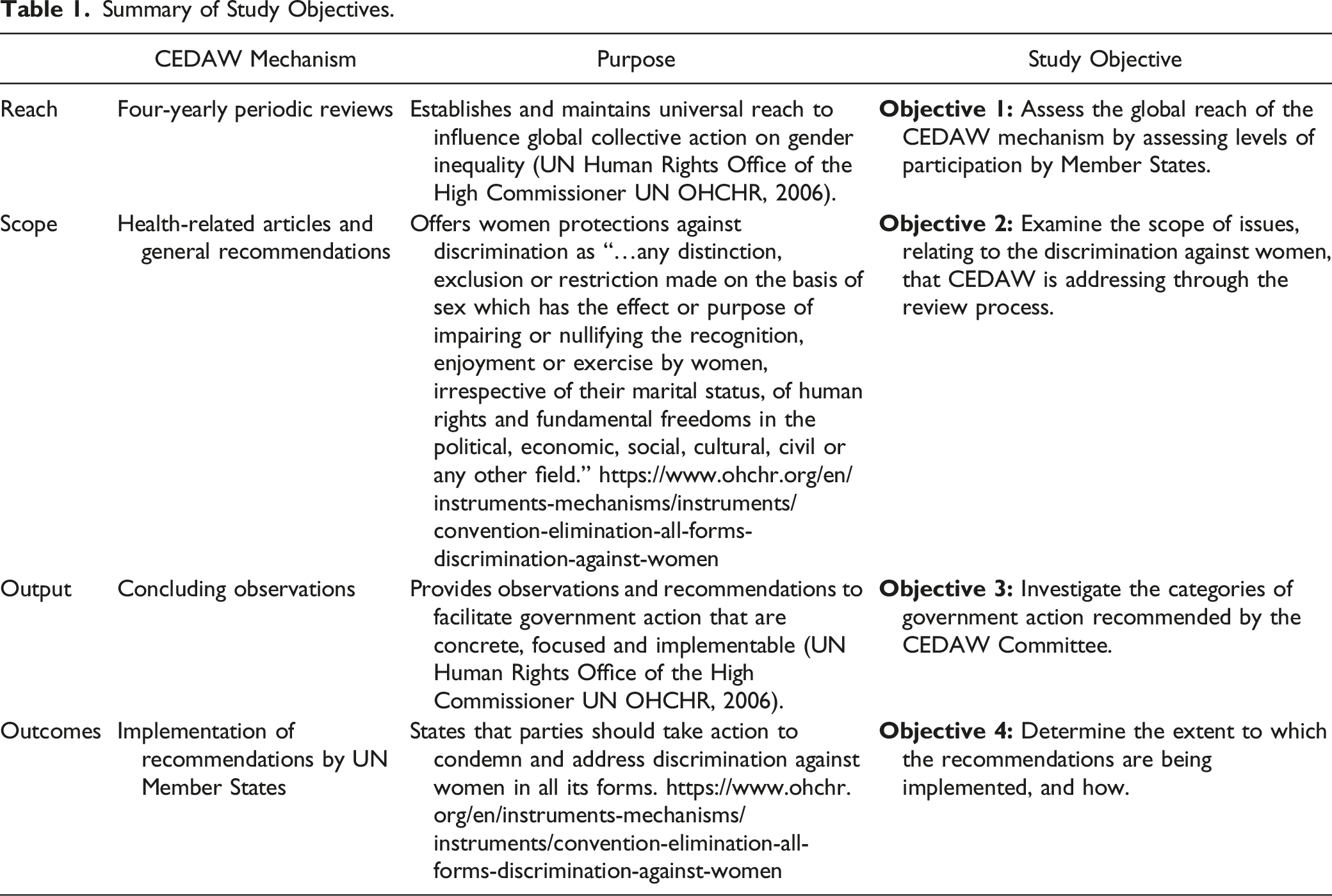
(1) Reach refers to the level of global participation with CEDAW Committee reviews by subregion, income level, and humanitarian crises. We define participation as having reported to the CEDAW Committee at least once. Objective 1 will measure reach by assessing levels of participation by Member States. This analysis will enable us to broadly identify the characteristics of UN Member States in which CEDAW is influencing global action on women’s health inequities, and those in which the CEDAW Committee’s reach is limited.
(2) Scope refers to the five domains of health inequities in which the CEDAW Committee directs government action using the CEDAW framework: (i) On the ground experience of health care, including access to adequate health care facilities, health information, counselling and social support services; (ii) Legal protection of women’s equal rights to health, which requires that no laws, policies or practices discriminate in access to health services; (iii) Equal rights to seek, receive and impart information; (iv) Equal rights to education; and (v) Equality in marriage and in family. These domains are modelled on the World Health Organization’s CEDAW Provisions Related to Health.(WHO, 2015) Objective 2 will examine the scope of issues that CEDAW is addressing through the review process. Our analysis will enable us to pinpoint the areas in which the system is directing government action and enable us to identify areas that may be neglected.
(3) Output refers to the types of government action the CEDAW Committee is requesting, contained in the Concluding Observations issued to countries. Concluding Observations are the recommendations issued by the CEDAW Committee after consideration of a Member State’s four-yearly progress report (State Report). Concluding Observations should be concrete, focused and implementable and provide a new ‘baseline’ against which future progress by states can be measured. Objective 3 will investigate the categories of government action recommended by the CEDAW Committee. Through this analysis we will be able to better understand how the CEDAW Committee conceptualises, designs and communicates their recommendations to states in order to address health inequities faced by women.
(4) Outcomes refer to the extent to which states have implemented the Committee’s recommendations and how they have been implemented (e.g. the introduction of new legislation). Given that strengthening legal frameworks supporting women’s health is a core focus of CEDAW, we will specifically investigate the core objectives of legislation, who it affects, how it works to support women’s health, as well as any potential weaknesses or deficiencies. Objective 4 will determine the extent to which the recommendations are being implemented, and how. These analyses will provide a measure of CEDAW’s effectiveness in motivating government action, and a comprehensive understanding of the areas in which governments are willing to act to address health inequities faced by women.
Sampling
Data Sources
The primary data sources will be those reports submitted or produced by Member States, civil society organisations or the CEDAW Committee as part of the periodic CEDAW review process, i.e. State (country) Reports, Civil Society Organisation Reports and Concluding Observations. These reports will be accessed from a publicly available central repository for UN reports called the UN Treaty Body Database which is hosted by the UN Human Rights Office of the High Commissioner UN OHCHR, 2006 at https://tbinternet.ohchr.org. Reports are accessed by selecting the mechanism (CEDAW) and UN Member State.
Only full periodic State Reports will be reviewed (i.e. the progress reports produced by member states at least once every four years). Lists of issues, responses to lists of issues and follow-up State Reports will be excluded. A list of issues document includes themes or topics that guide and focus the dialogue between a UN Member State’s delegation and the CEDAW Committee during the consideration of a State Report.
To ensure the data collected are current, only data from the two most recent reporting cycles will be reviewed: Cycle 2 is the year in which a country submits their most recent periodic State Report; and Cycle 1 is the year in which the previous Concluding Observations were published by the CEDAW Committee.
Characteristics of Participating Countries and Setting
UN Member States will be included in the study if they: 1. Are a UN Member State within the World Bank geographic regions of East Asia and the Pacific, South Asia, Sub-Saharan Africa, the Middle East and North Africa, Europe and North America and Latin America and the Caribbean; and 2. Have completed at least 1 periodic review cycle (deemed Cycle 2) and received Concluding Observations from the CEDAW Committee during Cycle 1.
UN Member States will be excluded from the study if they meet any of the following criteria: 1. Has not ratified CEDAW (at the time of writing the US and Palau had signed, but not ratified, CEDAW, while Somalia, Sudan, Tonga, Iran and the Holy See had not signed or ratified CEDAW Commissioner) (UN OHCHR, 2020); or 2. Has ratified CEDAW but has not:
(a) Received at least 1 Concluding Observations report from the CEDAW Committee; and
(b) Submitted a State Report after receiving a Concluding Observations report from the CEDAW Committee (i.e. the member state must have submitted at least 2 State Reports: 1 before receiving Concluding Observations and 1 after).
Where countries are excluded, the reason for exclusion will be documented in an ‘Exclusion Table’ for reporting purposes.
Data Extraction
All data will be extracted separately into a purpose-built data extraction form by members of the research team, and independently reviewed by JS.
Research Team
Data extraction will be undertaken by a team of qualitative researchers, law students and legal trainees based at three institutions: The George Institute for Global Health, the Australian Human Rights Institute and Ashurst International respectively. The extraction team will be trained using a methodology handbook based on this protocol. To ensure consistency in the extraction, all data will be independently reviewed by JS. Data analysts will include a multidisciplinary team of researchers with legal, human rights, health systems and statistical expertise (JS, KM, AP, RV and MW). We anticipate that our multiple perspectives, and the diverse disciplinary background of the analysts, will allow comprehensive understanding of, and inter-relationships within, the data and increase the scope and reliability of results.
Objective 1: Assessing the Global Reach of the CEDAW Mechanism
The UN Treaty Body Database will be searched for all CEDAW-related documents for each country of each World Bank geographic region. Where available, the most recent State Report and all associated Civil Society Organisation reports (Cycle 2), and the Concluding Observation report received in the review cycle immediately prior (Cycle 1) will be identified. Based on the number of CEDAW review cycles completed, each country will be allocated to one of three categories: 1. “No review cycles” (no State Reports have ever been submitted by the Member State) 2. “1 review cycle” (a Member State has received Concluding Observations but has not submitted a State Report addressing the CEDAW Committee’s recommendations); or 3. “At least 2 review cycles” (a Member State has received Concluding Observations and has submitted a State Report addressing the CEDAW Committee’s recommendations).
Member States will be categorised into their World Bank regions, World Bank economic group (based on the World Bank 2020 fiscal year, published in July 2019), and whether the country was experiencing a humanitarian crisis as of August 2019 (as defined by INFORM for Risk Management).(ECJR, 2020)
Objective 2: Examine the Scope of Issues Covered by the CEDAW Committee’s Recommendations
Health-related Articles and General Recommendations from CEDAW. 1
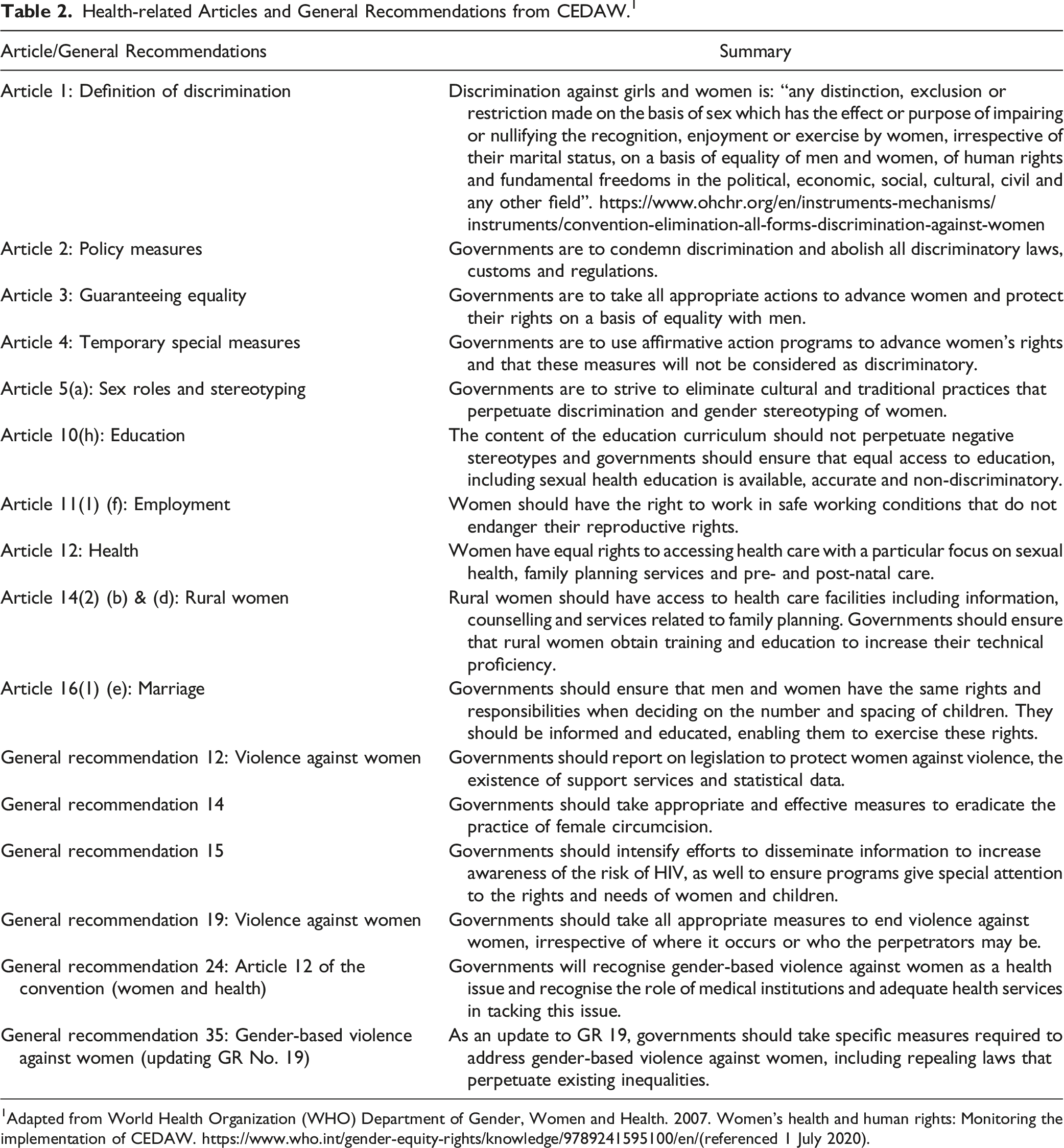
1Adapted from World Health Organization (WHO) Department of Gender, Women and Health. 2007. Women’s health and human rights: Monitoring the implementation of CEDAW. https://www.who.int/gender-equity-rights/knowledge/9789241595100/en/(referenced 1 July 2020).
Objective 3: Investigating the Categories of Government Action Recommended by the CEDAW Committee
Categories of recommended state action.

Objective 4: Determine the Extent to Which the Recommendations are Being Implemented and How
State Reports submitted to the CEDAW Committee in Cycle 2 will be used to evaluate states' implementation of the recommendations provided by CEDAW in their Concluding Observations in Cycle 1.
The review of Cycle 2 State Reports will involve: (a) Identifying state actions and the Cycle 1 CEDAW Committee recommendations they relate to; (b) Assessing the extent to which the state has implemented each of the CEDAW Committee’s recommended State actions (implementation status).
The implementation status of CEDAW recommendations will be classified as follows: (a) Fully implemented (i.e. state responses that adequately address every aspect of the CEDAW Committee’s recommendation) (b) Partially implemented (i.e. where state actions address only part of a multi-faceted recommendation) (c) Inadequate response (i.e. where states have taken action on an issue but not the action prescribed by the CEDAW Committee’s recommendation) (d) Unacknowledged (i.e. recommendations that are not addressed in the State Report at all)
Civil Society Organisation Reports submitted to the CEDAW Committee may also contain information on how states implemented the CEDAW Committee’s Recommendations in Cycle 1, from a civil society perspective (generally service providers, advocacy organisations or peak bodies). These reports will be reviewed to identify any content relevant to the health-related CEDAW articles and General Recommendations set out in Table 3. Relevant information will be extracted.
Linking Government Action to the Sustainable Development Goals
Reviewers will identify whether CEDAW recommendations in Cycle 1 relate to the 2030 Agenda Sustainable Development Goals. This will be done using the Danish Human Rights Institute’s SDG Human Rights Data Explorer (DIHR, 2020) by: 1. Selecting the country and “CEDAW” under the ‘Treaty body’ heading in the Advanced options. 2. Identifying whether the health-related CEDAW recommendations in Cycle 1 identified in Step 1 are listed. If so, the SDG goals they relate to will be populated in the extraction form in the “SDG Classification” column of the Summary Table.
Assessing the Use of Legal Interventions
One reviewer with legal training will identify, and exhaustively extract, any legal interventions that states have implemented (as contained in the State Reports) in response to the CEDAW recommendations. For each of the extracted legal interventions, the reviewer will:
1. Ascertain whether the legal interventions (e.g. India’s Food Security Bill) have been implemented and are in force (yes/no);
2. Conduct research into these measures and summarise:
(a) The core objective/s of the legislation
(b) Which population groups the legal intervention affects
(c) How the legal intervention is operationalised, monitored or enforced
(d) Potential weaknesses or deficiencies
Where a state has mentioned that a legal intervention is ‘in progress' (as opposed to fully implemented), this will be noted.
Data Analysis
The six main study outcomes include: (1) the participation of UN Member States in CEDAW reviews (Objective 1), (2) the nature, scope and distribution of recommendations across CEDAW Articles and General Recommendations (Objective 2), (3) the nature, scope and distribution of government actions in response to recommendations, across the categories provided in Table 3 (Objective 3), (4) the extent of implementation and non-implementation of recommendations, from the perspectives of UN Member States and Civil Society Organisations (Objective 4), (5) the nature, scope and distribution of Committee recommendations and government actions across each of the Sustainable Development Goals (Objective 4) and (6) the nature and scope of legal interventions implemented by UN Member States (Objective 4). Objective 1 aims to encourage the CEDAW Committee and Member States to work together to identify and address the barriers faced by countries (if any) not participating in the CEDAW review process after ratifying CEDAW. Similarly, Objective 2 and 3 aim to inform the CEDAW Committee and civil society organisations of the extent to which recommendations comprehensively cover all aspects of health-related rights and adequately facilitate government accountability and action during subsequent reviews. Objective 4 will enable the Committee, UN Member States and civil society organisations to, through effective processes of follow-up, address recommendations that remain unacknowledged or not implemented. This research will assist the Committee and civil society organisations involved in the CEDAW process in ensuring that CEDAW reviews remain legitimate and valuable in ensuring government accountability. By systematically assessing implementation, it also seeks to investigate the extent to which governments observe the international human rights system in an essentially perfunctory way by routinising inaction and non-cooperation.
Descriptive statistics will be used to summarise states’ participation in CEDAW reviews, the nature of CEDAW Committee recommendations, their implementation status, and to determine any variation in study outcomes by country characteristics (global region/sub-region, economic group, humanitarian crisis status). Descriptive statistics in the form of summary statistics (measures of central tendency and variation) and graphical presentations (such as piecharts, dotplots, box-and-whisker plots and barcharts), will be generated from the qualitative data, with primary analyses being comparisons between regions, economic groups and by humanitarian crisis status. Chi-square or t-tests may be used, if considered meaningful. Associations between variables will be explored using cross-tabulations and scatter plots. Where appropriate, correlation and regression analyses will be used to quantify relationships, including accounting for confounding and mediation effects where possible.
Qualitative data (i.e. extracted Committee recommendations and State actions) will be analysed using policy mapping techniques.(Boyatzis, 1998) These thematic analyses will be used to determine the nature and scope of recommendations and actions, understand phenomena within the State context, and uncovering links among concepts and State’s behaviours. Qualitative outcomes will be applied by the research team to generate and refine theory (modifiable propositions) to help explain, predict, and interpret state actions and the phenomena of interest, that is, the complex interaction of the UN with Member States, powered by often diverging interests, ideas and institutions.(Dubin, 1969; Patton, 2002)
Discussion
We anticipate that this study will have a number of potential benefits for a variety of stakeholders including the CEDAW Committee, governments, human rights advocates and global health researchers. These data will provide stakeholders with a bank of laws, policies and programs that offer good practice examples and act as a guide for the enactment or reform of legislation in other jurisdictions. States commonly suffer from weak institutional memory due to some or most of the drafters of their reports no longer being available when reviews are held (often years after the submission of reports). Our analyses will address this by providing states with an up-to-date analysis of the strengths, weaknesses, and implementation gaps. Ideally, the dataset will be updated longitudinally which will allow for trend analyses and an assessment of global progress over time. These data also complement existing human rights tools. For example, the Gender Legislative Index (GLI) developed and led by RV, is a tool to rank and score legislation against global standards for women’s rights. This study will provide a bank of legislation implemented globally that can be measured for gender responsiveness using the GLI.(Vijeyarasa, 2019)
In addition, these data will help to facilitate a constructive dialogue outside of CEDAW’s four-yearly reviews. This will support the voluntary contributions of CEDAW Committee members, and the under-resourced OHCHR in their mission to strengthen the United Nations machinery to improve its efficiency and effectiveness. The study will also encourage multidisciplinary global health researchers to engage in this constructive dialogue and develop human rights solutions capable of addressing health inequities faced by women.
This novel, data-driven human rights research protocol seeks to keep human rights practitioners, global health researchers and policy makers up-to-date by presenting authoritative guidance on how areas of action and inaction related to the CEDAW review mechanism contribute to health inequities and influence progress towards achieving the SDGs. The study will contribute to the development of a framework for designing interventions to promote equality, inclusion and equal access to health. By giving exposure to our research activities, we aim to facilitate collaboration in the research and advocacy communities working to enhance gender equality and the empowerment of women.
Footnotes
Acknowledgments
The authors would like to thank Emma Feeny, Director of Global Advocacy and Policy Engagement and Dr Kelly Thompson, Global Program Manager of the Women’s Health Program at The George Institute for their guidance in positioning this work to maximise impact globally, and to complement ongoing women’s health and rights movements. We would also like to thank Professor Louise Chappell and Glen Wolter at the Australian Human Rights Institute, Professors Andrea Durbach and Andrew Byrnes at the University of New South Wales Law School, and Professor David Peiris, Stephen Jan and Associate Professors Kris Rogers and Rohina Joshi at the George Institute for Global Health for contributing to early discussions on the direction of this project.
Authors’ Contributions
JS led the writing of this manuscript. JS, AP and KM conceptualised the study. RV and MW contributed to the refinement of the methods. All authors contributed to the writing of the manuscript over several iterations and have read and approved the final manuscript.
Declaration of Conflicting Interests
The author(s) declared no potential conflicts of interest with respect to the research, authorship, and/or publication of this article.
Funding
The author(s) received no financial support for the research, authorship, and/or publication of this article.
Ethical Approval
As this manuscript does not report on a study involving human participants, human data or human tissue, and involves the analysis of secondary data, ethics approval and consent to participate is not deemed necessary by the authors or their affiliate universities.
