




Abstract
The past 40 years have formed a transitional period in Sweden’s education and political history. The social democratic reforms from the 1940s that aimed to create a centralised, expanded and integrated comprehensive education system came to an end. Decentralisation, neoliberal governance and the introduction of new public management with the creation of private schools and competition have shaped the policy regime since then. Ethnography emerged in Swedish educational research as a significant research methodology during this transitional period. Using a qualitative and quantitative investigation of research dissertations that classified and counted the use of ethnography as either classical (using core references and long-term participation research at one or a limited number of sites), or adapted (used within adaptations to other research methods), the present article explores these developments at two universities. It suggests that Swedish education ethnography has developed along similar kinds of historical trajectories to ethnography in other places, with roots similar to those in other European countries, though also with some variations. For instance, as elsewhere, ethnography needed a breakthrough point in Swedish education research. It got this in the 1980s. However, it quickly became an important part of educational research from the 1990s onwards and a strong quantitative take off early in the new millennium followed. Presently more than half of all PhD dissertations in Education at the two universities have some kind of participant observation, over half of which are also classically ethnographic. This leads us to conclude that education ethnography in Sweden has changed across its period of growth and that though configured in contemporary social science as having originated in anthropology as a methodology that employed long-term embedded participant observation, this does not limit the variations of ethnography’s development or its application.
Introduction
The past 40 years has been a transitional period in Sweden’s education and political history. The social democratic reform period that had dominated the political landscape from the 1940s through the 1970s, with an aim to expand the length of education for the majority of the population based on common education experiences in a unitary comprehensive school system (Ball & Larsson, 1989) came to an end. Decentralisation and privatisation reforms formed the new policy regime in the 1990s (Beach, 2010a, 2021), along with the promotion of a neoliberal governance agenda, a new public management bureaucracy (Arnesen & Lundhl, 2006), and the creation of possibilities for global corporations to run schools for profit using public funding (Beach, 2010a, 2021). The present article addresses ethnographic research methodology and its development in Swedish educational research across this period. It identifies some key details in this development and constructs an analytical narrative regarding key turns.
One important aspect of development concerns the significant historical changes to the Swedish higher education field, its institutions, and working conditions. In line with Hammersley (2018) and Larsson (2006), changes in the academic field should have knock-on effects with consequences for the types of research that predominate (also Kuper, 1996), and the viability of long-term fieldwork approaches (Beach, Bagley & da Silva, 2018; Jeffrey & Troman, 2004). However, though patterned changes do emerge regarding the production of ethnographic research, and although alterations in the political control of research funding may have played a role in them (Larsson, 2006), it is difficult to attribute the significant changes we will identify to any single political reform of the higher education sector.
The changing patterns of research finance reform are still interesting however. During the social democratic reform era from the 1940s, a direct state-patronage system of research funding to support school reform predominated. It operated through to the 1990s, but in 2001, the Swedish Government created a competitive funding structure coordinated by a new authority (The Swedish Research Council) to replace the earlier system.
The expressed aim of the research funding reform was to improve practical outcomes and external relevance without entirely removing basic and critical research. Whether this occurred or not is another matter. There is no clear evidence either way, but the reform did have some effects on doctoral studies, as these were now possible to finance using external competitive grant allocations as well as through direct faculty funding. The effects were small according to the present article. In the main doctoral funding remained within the direct control of faculty boards and any changes in the direction of PhD funding lie mainly in relation to local decisions rather than those of external research finance.
Contribution to Research
In the present article we hope to contribute further to the descriptions Larsson (2006) provided of the emergence of ethnographic research in Education in Sweden up to the late 1990s, and hopefully in a way that is useful to colleagues in our own and other fields, in Sweden and in other nations and regions. We see knowledge about the growth of an established research tradition in education research, like ethnography is today, as important, and as adding to understandings in relation to other similar emerging global narratives about research patterns and what may have influenced and been crucial to them (Beach, 2010b). Recent examples include chapters by Casimiro Lopes and de Lourdes Rangel Tura (2018), Eisenhart (2018), Hammersley (2018), Millstein and Clemente (2018), Modiba and Stewart (2018) and Sieber Egger and Unterweger (2018) in the Wiley Handbook of Education.
These handbook chapters describe some common aspects, such as the emergence of a strong turn towards qualitative investigation methods, usually subsequent to a hegemonic struggle against a dominant quantitative methodology (Blumer, 1969). The turn was then generally followed by an initialising period of consolidation, a period of quantitative take off and later some diversification (Beach, 2010b; Beach et al., 2018; Casimiro Lopes & de Lourdes Rangel Tura, 2018; Eisenhart, 2018; Hammersley, 2018). Growth and diversification can threaten existing research identities and hegemony in a field of course, which some members of the research community may experience as rather challenging and may resist (Sieber Egger & Unterweger, 2018; Tummons & Beach, 2020).
In earlier texts on the establishment of ethnography in Swedish educational research (Larsson, 2006) and the Nordic countries (Beach, 2010b), the focus was on a historical description of the actions that had been taken to introduce and develop ethnographic methodology. Like other works that have explored the establishment and growth of different methodologies in a place or region, such as Maeder (2018), or specific methodologies in particular places, such as Millstein and Clemente (2018), Modiba and Stewart (2018) and Sieber Egger and Unterweger (2018), they attempt to contribute to critical reflections concerning what has conceptually and empirically characterised current and past thinking about good ethnographic research practices (Beach et al., 2018). We anticipate being able to add new knowledge in these respects.
Collectively these earlier works can be exposed to qualitative research synthesis to explore and possibly integrate findings into a new whole that may express common elements and ideas about the methodology analysed. Articles in the present journal by Ebneyamini and Sadeghi Moghadam (2018) on case-study methodology and Rashid et al. (2015) on ethnography in health research provide examples, as does an article on meta-ethnography in education and health science research by Uny et al. (2017). These works have been useful for us in structuring the main research question regarding the pattern of uptake and later use of ethnography in this article. Specifically: • What has characterised the development of ethnographic methodology in education research in Sweden in recent decades leading to its grounding in the 1990s and subsequent take off in the early 2000s?
We have analysed this question both qualitatively and quantitatively in relation to the publication of doctoral dissertations. Doctoral dissertations work very well as indicators of the acceptance of a methodology in a field (Mody & Kaiser, 2008). This is because when supervisors and doctoral students choose a methodology, they do so believing that it has the ability to generate trustworthy knowledge that will not risk a dissertation being rejected by an examination committee. We have made the analysis at two universities and have initially included all PhD theses published there in education in three doctoral dissertation series. However, our aim in this article has not only been to gain insight into how many theses have chosen an ethnographic methodology, but also to present Swedish educational ethnographic research in relation to the history of ethnography there and internationally.
An Overview of the International History of Ethnography
Different labels are used for the practice of ethnography. As well as ethnography itself, examples include field- or case studies (Beach et al., 2018). Herodotos’ texts about people he met during travels outside of Greece in the fourth century BC have been described as a methodological precursor to ethnography by Eriksen and Nielsen (2004). However, whilst Herodotos had a curiosity about foreign places his interest was in reporting rather than developing a more systematic scientific research interest.
Exhibitions in ethnographic museums from the middle of 19th century formed expressions for such interests, with both exoticism and nationalism as driving forces according to Vermeulen (2008), along with the celebration of local habits, stories, songs and artefacts related to romantic philosophy, and as motifs for museum exhibitions of domestic culture (Eriksen & Nielsen, 2004). German and Austrian museums were pioneers (Vermeulen, 2008). They provided a base for academic posts for studying cultures and societies, and subsequently for establishing national museums that exhibited collections of artefacts of other cultures spread rapidly during the 19th century.
The growth of museums made it possible to disseminate information and knowledge about objects. However they also supported valuable and systematic kinds of documentation and classification upon which to found scientific research as well (Eriksen & Nielsen, 2004) and there was an obvious value here for ethnography, even though these early developments faced serious criticism later, for the role they played when constructing the ethnographic object in the professionalisation of anthropology, and helping imperialist nations to expand their borders (Vermeulen, 2008). Museums and their ethnographers became harmful for Indigenous communities when setting a template for standardising ethnographic methodologies from this critical perspective (Bennet, 2004; Millstein & Clemente, 2018).
Some examples may help to illustrate what these harmful aspects were. The population of the parts of the world where ethnographic museums and methodology developed generally oppressed other nations and cultures through European colonial expansion and occupation (Vermeulen, 2008). This lasted centuries, not decades, and contributed to a strong concept of Northern and Western global hegemony, and that continued in a more indirect way even after formal independence (Millstein & Clemente, 2018). Populations in colonies were dispossessed of their lands and rights and the officials and industrialists in French, British, Japanese, Belgian, Dutch, German, Spanish and other ‘empires’ used academically generated knowledge to effectivise their exploitation of these populations. Academic researchers objectified exotic people, who then became objects for cultural hierchisation and even eradication (Bennet, 2004; Murray, 2010).
Reflective methodological interests developed later, in the crossover from the 19th to the 20th century. Tied however still to a dark colonial history, evolutionist Darwinian thinking led to a focus on comparisons of different societies based on missionaries’ reports and similar sources (Clair, 2003). Malinowski’s (1961) monography ‘Argonauts in Western Pacific’ began a new era. First published in 1922, it fundamentally changed the understanding of what it meant to research societies from an anthropological perspective (Eriksen & Nielsen, 2004).
Malinowski focussed on understanding a single culture by using what later became very familiar activities: specifically long-term presence and attempts at understanding practices based on a deep contextual familiarity and interpretations based on interviews, artefact collection, photography and participant observation (Tummons & Beach, 2020). Another development, at about the same time as the publication of Malinowski’s work in 1922, was the introduction of ethnographic methodology into the emerging sociology discipline at the University of Chicago, based on pragmatic philosophy and symbolic interactionism (Blumer, 1969; Bulmer, 1986).
A similar link between anthropology and sociology was provided by Mauss research in France (Clair, 2003). Mauss published a book on methodology – Manuel d’ethnographie (Mauss, 1947). He was a strong proponent of the collective ownership of the French cooperative movement with an open dislike for wage slavery. He described how 19th century anthropologists took the dominant class in their own societies as superior to and distinct from others, and how they constructed evolutionary schemes and dualistic concepts (such as civilised vs. primitive) that objectified and marginalised exotic groups (Clair, 2003). Peasants (and later the working class) in national investigations were considered by the elite classes to be less civilised than the dominant class and ethnographic work was very much marked by this societal context (Mauss, 1947; Millstein & Clemente, 2018).
Mauss work thus also had a distinctly critical element that had largely been lacking earlier. It pointed to how the homogeneity of the researchers as part of the ‘we’ of the dominant class was problematically different from the identity of most of those whom they investigated, and was an obvious problem. Veblen (1899) had argued along these lines too. More recently Bennet (2004) has done so as well by discussing the relationship of ethnography to political power elites and colonialism in more recent (post-)colonial contexts, whilst also indicating similar relationships might even exist in domestic circumstances, including in Sweden (also Ericsson, 2015; Millstein & Clemente, 2018; Murray Li, 2010).
An example of this was visible in the history of the interplay between academia and political authorities toward traveller communities. Race-biologists, ethnologists and sociologists defined ‘travellers’ empirically, while the political authorities discussed and devised measures to be taken against the group: for example, in Sweden through sterilisation or putting Roma children into care (Ericsson, 2015). The government was interested in using the national authorities for controlling and assimilating the roma and traveller population in other words, not for understanding the historical evolution of their vulnerability or the degree to which national political decisions affected them and their culture. Research on threats to the group and its culture from the dominant political class had remained absent (Trankell, 1973). Sweden’s anthropologists and sociologists benefitted from researching cultures that came under threat through national politics. They risked thus both exploiting and contributing to dominant class ambitions and cultural hegemony.
Establishing Ethnographic Methodologies in Swedish Educational Research
The establishment of ethnography in Swedish educational research is part of, rather than distinct from the broader historical developments sketched in the previous section. For instance, although developing much later, there were strong shaping influences from the Chicago-tradition in the 1980s, through cooperation with British researchers such as Stephen Ball and Andy Hargreaves (Larsson, 2006). These researchers carried legacies from the Manchester School of Sociology that had copied elements of the Chicago school experiment, and this mediated an influence from Anglo-American research history in what began to become an outpost of British-American sociological views of interactionist ethnography (Beach, 2010b; Larsson, 2006; Tummons & Beach, 2020).
Yet this is only part of the story of course. Another part comes from internal disciplinary struggles for hegemony and attempts to challenge and break the dominance of quantitative methodology over research in the Education discipline (Larsson, 2006). Books like ‘The Sociology of Teaching’ (Waller, 1932) played a part. These investigations had developed under influences from pragmatic philosophy and symbolic interactionism as described by Blumer (1969) in his article entitled (and on) ‘The Methodological position of Symbolic Interactionism’, which formed the key theory for the methodological position of the Chicago school in the 1950s. Blumer criticised the reduction of sociology to a quantitative analysis of variables and changed the landscape of sociological analysis in the USA (Bulmer, 1986), but the domination of social science research by quantitative variable analysis remained in Sweden in sociology and education research until the 1970s (Larsson, 1998).
The pioneering challenge toward the hegemony of quantitative methods materialised in Education at the Department of Education Research at Stockholm University, through a project initiated in 1965 for enhancing the school attendance of Roma children (Trankell, 1973). It adopted a hermeneutic perspective to loosen the straightjacket of variable analysis, but it met with strong protests from many in the research community. The scientific community of education research considered quantitative methodologies as reliable at that time and conclusions from this research had the confidence of decision-makers (Beach, 1995; Larsson, 2006). Quasi-experimental research with large samples and longitudinal design had been very successful, and classroom interaction was still studied mainly through systematic observation (Larsson, 1998).
Trankell and his co-workers were very particular in their choice of wording for denoting what they were doing. Rather than calling their work ethnography, they used the label ‘Action-cum-research’ and referred to a cybernetic perspective. Later they linked to hermeneutics and became advocates for a hermeneutic approach to interpretation (Trankell, 1973). Developments in Sweden were driven philosophically during the early 1970s through hermeneutics against positivism, with the latter equated with quantitative methods whilst hermeneutics and phenomenology became associated with qualitative (Åsberg, 2001).
Shortly after the publication of Trankell’s results, a research group at Lund University made a pioneering step that brought fruit to educational ethnography first some two decades later. This was the introduction of French sociology of education that integrated theories and methods from Bourdieuian sociological analysis, Marxism, and the anthropological research of Godelier (Berner et al., 1977; Friberg, 2016). Part of the delayed pick up of the fruits might be that the Lund research group did not write extensively about methodological matters and that, like Trankell’s group in Stockholm, they also chose not to use ethnography as a nodal concept in the senses described by Larsson (2006). As suggested in an analysis of case study research by Ebneyamini and Sadeghi Moghadam (2018), authors who have used a specific methodology do not always position themselves specifically, and this was something that characterised the Lund research (Friberg, 2016).
One example of research where ethnographic methodology was made explicit was in Uppsala University, around education research connected to the analysis of therapeutic communities. The main supervisor was Gösta Berglund. He published quite extensively on methodology in publications from 1983 and 1985, firstly using the label naturalistic research (Berglund, 1983) and then ethnography (Berglund, 1985). His intention was to transcend local boundaries and invite others to take an interest in ethnographic research (Larsson, 2006).
Berglund’s publications came around the time that another step took place, this time at the Department of Education and Educational Research at Gothenburg University, through a doctoral course on ethnography with Stephen Ball and Staffan Larsson as course leaders. Ball was a key person in the network of educational ethnographers in the UK at that time, following what became a seminal investigation in the early emergence of the tradition of policy ethnography: ‘Beachside Comprehensive: A Case Study of Secondary Schooling’ (Ball, 1989). The course proved important (Larsson, 1998, 2006). A doctoral course is a place for recruitment and several participants switched allegiances from the department’s dominant methodological tradition, namely phenomenography, and subsequently produced ethnographic dissertations, often supervised by Larsson. Several of them then went on to supervise further ethnographic studies. Larsson gave similar courses later on at Linköping and Uppsala Universities (together with Gösta Berglund).
Following the publication of the first generation of ethnographic theses in education research in the first half of the 1990s, the next important step was a successful application to the Nordic Council of Ministers for network funding for ethnographic research (Larsson, 2006). The application (with the acronym ETNOPED) was written by researchers from education research departments in Copenhagen (Karen Borgnakke), Gothenburg (Dennis Beach), Linköping (Staffan Larsson), Helsinki (Tuula Gordon and Elina Lahelma), Trondheim (Sigrun Gudmundsdottir) and Uppsala (Sverker Lindblad, who was the main coordinator). The application was successful and it financed collaboration between the research teams in the four countries and their international partners in the UK, the USA, Italy and the Baltic States. A preconference to the yearly congresses for the Nordic Education Research Association (NERA) was the chosen site for the network kick-off in 1998. Further pre-conferences at the NERA Congress took place afterwards, until 2004, as did various courses and workshops between the yearly conferences, sometimes with guest presenters. They included Staf Callewaert, Amanda Coffey, Beverly Skeggs, Bob Jeffrey, Geoff Troman, Mairtin Mac An Ghail, Matts Trondman and Paul Willis.
The network sponsorship proved important. It supported PhD student participation in the annual St Hilda’s conference of educational ethnography, then organised by Geoffrey Walford at Oxford University School of Education Studies: and one of the most heavily cited texts in education ethnography developed from network collaboration at a workshop in Tallinn in 2002 (Jeffrey & Troman, 2004). Mody and Kaiser (2008) describe how doctoral courses can play an important role in the development of research identities. This was certainly the case with the courses and workshops within the Nordic network (Beach, 2010b). Qualitative methods stepped out from under the shadow of quantitative studies as a standard methodology in the 1970s, but during the first two decades, until courses emerged and sponsorship secured broadened involvement, interview based investigations dominated and ethnography remained quite rare (Larsson, 1998, 2006).
New Developments: The Empirical Analysis and Results
The empirical analysis of ethnographic publications takes its starting point in relation to the question of how many doctoral dissertations have used ethnography and participant observation. The logic (idea or theory) we have applied here is that dissertations constitute publications where methodology is a choice and a mirror among a wide spectrum of research practices and that, if a methodology is used, it indicates acceptance in a space where quality is at stake. The next question concerns how ethnography or participant observation becomes manifest in the theses, and we have also made a qualitative bibliographic analysis of co-referencing of some of these theses, which we will develop in later publications.
Three dissertation series from two universities (Gothenburg and Linköping), constitute the empirical base: Gothenburg studies in Educational sciences and Linköping studies in (a) Education and Psychology and (b) Pedagogic Practices. Doctoral dissertations from the two universities have been the focus firstly because of needing to limit the scope of the investigation, but also because we wanted to produce a rich sample. Gothenburg and Linköping are highly ranked universities in Sweden with over 50 and 30 thousand students on role, respectively, and they also have a long history of success in obtaining national and European competitive research grants for education. Their publications have good citation levels and levels of international collaboration.
The research sample initially included all dissertations in Education (altogether 591) in the three series and published between 1966 and 2019. All dissertations were available either physically or on-line through libraries and departments. During the last two decades they were mostly available online. Methodology chapters were read and all dissertations that could be considered as in some way ethnographic were identified and scrutinised in more detail. Types of data, time spent in the field, and references concerning methodology formed initial indicators for whether a dissertation could be considered as ethnographic or not.
Classifying Methods and Practices
The intention to distinguish what could be considered as ethnographic research turned out to be rather complicated. Our intention was to refer to examples where authors either defined their approach as ethnographic or used similarly connotative labelling and employed long-term participation in the field, leading to the production and integration of field-notes and other methodologies. However, the dissertations used different labels and combined different methods in different ways, and there were significant variations in terms of the number of researched sites and the duration of fieldwork in each, even amongst the works that used the signalling label of ethnography to describe the chosen methodology. So even if the analysis here ultimately is based on quantitative data, the first challenge became a qualitative analysis.
Integrated Methods and Practices in ‘Classical’ Ethnography.

The use of these methods and practices as indicators of the presence of ethnographic intent showed clearly that long-term participant observation did not empty the definitions of what ethnography might involve, how it might be defined, and what substantive issues might be analysed, where, or in what kind of media (Tummons & Beach, 2020). Instead, it indicated that ethnography of education has been debated for decades across different geographic reaches, disciplines and times, and in relation to different subjects and interests, such that differences in practice and reasoning existed in abundance (Walford, 2018). So whilst certain ‘standards’, hopes or anticipations may have rightly or wrongly been stressed by authors and recycled as standards in methods books, these standards have been challenged and transcended (Beach et al., 2018).
As Rashid et al. (2015) suggest, ethnography is an intricate methodology that has become multifaceted and varied not the least in terms of an appreciation of the value of long term fieldwork. Walford (2018) and Jeffrey and Troman (2004) used the series of works by Hargreaves (1967), Lacey (1970) and Ball (1989) to identify examples of classical educational ethnographies, due to their use of long term participant observation field work and combination of quantitative and qualitative data to support their arguments. These are all English sociological ethnographies based on symbolic interactionist theory (Hammersley, 2018). Jackson’s Life in Classrooms (1968) represents an early American anthropological ethnographic example and Shirley Brice Heath’s (1983) classic, Ways with Words, is another.
These sources identify participant oriented methodologies as involving the first hand engagement of researchers in particular settings, watching what is happening and intentionally listening to others’ accounts of what is going on; often at consciously selected times (Jeffrey & Troman, 2004). They describe the research as involving detailed description and contextually grounded analysis of everyday institutional/cultural life and examining relationships between micro- and macro-perspectives to open readers toward ways of thinking differently about people’s actions and experiences when analysing and theorising about them (Eisenhart, 2018). Citing Yin (2009), Ebneyamini and Sadeghi Moghadam (2018) describe such approaches as empirical inquiries that investigate contemporary phenomena in depth within real-life contexts, where the boundaries between phenomenon and context are not clearly evident and the investigator has little control over events (p 2). We turned to this kind of substantial argument about the meaning of ethnography to identify if a work was more classically ethnographic or not, even if this is a rather complex matter.
An interesting finding from our analysis was the widespread use of participant observation in theses generally, often within a framework claimed not to be ethnographic, but rather action research or ethnomethodology, which clarified very strongly for us that any idea about identifying only ‘full ethnographies’ as ones that involved long-term fieldwork would exclude a lot of dissertations, particularly recent ones, and ones that took a more unconventional approach such as online ethnography (Tummons & Beach, 2020). So in the end we chose one broad category of dissertations that had used some kind of qualitative interpretation of observations as a minimum requirement, that is, without preconceived categories, and within this broad category we then also identified dissertations, that followed established ethnographic traditions. The broad category provided an indication of an acceptance of participant observation outside the group of dedicated ethnographers and beyond what Walford (2018) calls classical ethnography.
Ethnography in Numbers
We present the number of dissertations in 5-year-periods below in two kinds of staple-graph and in relation to the two elected categories. The staple graphs refer to frequencies and proportions of research determined as ethnographic in the initial analyses. The total number of dissertations in educational research is in grey. Blue refers to all dissertations that use some kind of participant observation, while Orange represents the group of full ethnographies within the blue group, discerning thus the developments of complete ethnographic dissertations and the use of qualitatively interpreted observation proportionally and in relation to other approaches according to period (horizontal axis) and number of theses (vertical axis).
The patterns in Figures 1 and 2 are similar, though the dimensions differ. The total number of dissertations is relatively low until the mid-1990s, before reaching a peak in 2000–2004. Differences include a drop 1985–89 and a downward trend in the last decade at Linköping. Qualitatively theses (blue), of which some are full ethnographies (orange), emerge from the 1990s. The lack of any before this decade is striking for a methodology with a very long history, and whilst we can only speculate on the reasons, one interpretation is that other qualitative approaches were dominating in the early phase of the qualitative turn (Larsson, 1998, 2006). This is certainly the case in Gothenburg, where interview studies and phenomenographic studies were predominant (Åsberg, 2001). One might interpret from this that ethnographies before the 1990s involved a degree of risk-taking (Figures 3 and 4) Number of dissertations in education at Linköping per period. Grey (right): all dissertations. Blue (left): dissertations with qualitatively interpreted observation. Orange (middle): ethnographic. Number of dissertations in education at Gothenburg. Grey (right): all dissertations. Blue (left): dissertations with qualitatively interpreted observation. Orange (middle): ethnographic dissertations. Number of dissertations in Education at Linköping University per period. Blue (left): dissertations with qualitatively interpreted observation. Orange (right): ethnographic dissertations. Shares of dissertations in Education at Gothenburg University. Blue (left): dissertations with qualitatively interpreted observation. Orange (right): ethnographic dissertations.


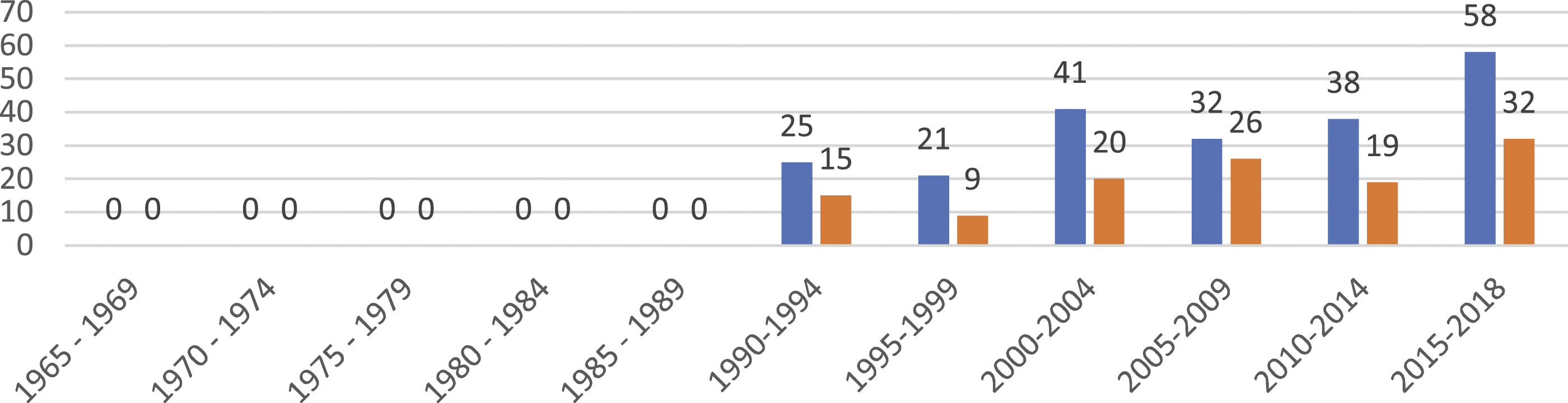
The proportion of qualitatively interpreted observation grows over the decades. In the last period 2015–2019, more than half of all dissertations in education research in Linköping and Gothenburg use qualitatively interpreted observation and most are full ethnographies.
Discussion
In the past 30 years, ethnography has grown from an emerging tradition in education research in Sweden and internationally to become a highly prolific and productive research method (Beach et al., 2018). Impulses have come from different national directions and disciplines, but predominant amongst them have been influences from the UK and the USA and the disciplines of sociology and anthropology. German influences predominated before the Second World War in the education field but not afterwards. Anglo-Saxon influences developed then. They began following a shift from a hegemonic quantitative and positivistic methodology using variable analysis and experimental or quasiexperimental design (Larsson, 1998; Åsberg, 2001). This tradition survived in Swedish social science long after it had been questioned within philosophy and the shift opened the door for methodological experimentation and new methods with specific international influences (Larsson, 2006).
An anti-positivistic wave emerged in the late sixties in Sweden. It grew into a methodological commitment toward qualitative methods in the 1970s, which then became the new methodological hegemony. Theoretical challenges to positivism helped legitimate this new hegemony. They came from Marxist, feminist, phenomenological and hermeneutic philosophical directions (Åsberg, 2001). However, although the new ‘soft’ approaches took less than 10 years to become dominant and enabled vital access to the doctoral curriculum, openings toward ethnography were slow to come about in the two investigated universities. Exactly why is not possible to speculate on from the data available to us, but indications are that perspectives connected to transcendental phenomenology and phenomenography are involved. More than half on the theses in the sample at Gothenburg in the 1980s were phenomenographic and Gothenburg was considered at the time, rightly or wrongly, as the home of educational phenomenography.
Another influential approach in the landscape of Swedish educational research relied on systematic observation – frame-factor theory, which also survived the anti-positivist shift. These research agendas were dominant in the 1970s and 1980s. This possibly reflects a general restraint on the growth of specific methodologies, as they should be expected to be very sensitive to the interests of research professors. Kuper (1996) noted some time ago how the choice of methodology appears to be scientifically arbitrary, but will generally reflect the interests of professors and other key actants in local contexts. So if there are ‘local’ pro- or proto-ethnographic professors local developments might reflect this (Larsson, 2006) whilst if the local professoriate took a methodologically anti-ethnographic stance, we might expect to see effects from this instead. Rashid et al. (2015) describe in their analysis of the development of ethnography in health research, how a kind of classic ethnographic work became increasingly taken up over time in this field, but also how this ‘take up’ was one that embraced temporal and spatial differences.
The effects of potentially proto-ethnographic influences began to appear after the first generation of PhD theses and expanded following the successful grant application for a Nordic research network in ethnography (ETNOPED). The growth was visible both in terms of volume and variety, which suggests that experimentation with variations of methodology entered the field (Beach, 2010b). Rashid et al. (2015) suggest that some key elements of ethnographic research may be lost in this expansion. Walford (2018) issues a similar warning. Mody and Kaiser (2008; p 378) identify the development of courses as significant for encouraging questions like what counts as knowledge, what is an acceptable or unacceptable way of gaining knowledge, what is unacceptable behaviour in research.
The growth of new courses was a characteristic of network activities shown in relation to the growth in both the orange and the blue columns in the periods after the formation of the Nordic ethnography network (Beach, 2010b; Larsson, 2006). Tentatively put, networks gave new potential contacts and acted as a legitimation of the methodology at universities where ethnography had not yet existed. At the same time, they provided fresh input and new directions for novel methodological combinations where it did (Tummons & Beach, 2020). One can also note that ethnography as a methodology has spread from being mainly an application in educational sociology to being also, if not in fact mainly, an approach to research on learning. This becomes another example of the diffusion of the ethnographic practice, which we could follow from anthropology to sociology a century ago, and which also presents itself in ethnographies in management and health studies, etc. (Uny et al., 2017).
Conclusions
The discussion of the results we have obtained reflects and also adds to our earlier discussion of the history of ethnography in the early parts of the article and in earlier articles (Beach, 2010b; Larsson, 2006; Tummons & Beach, 2020). This history suggested that both ‘globally’ and nationally ethnography in education research is a methodology that is generally in constant flux, but that also exhibits relatively short periods of local stability in terms of the common markers of method, which may then become future suturing criteria for the identity of ethnographic work.
Casimiro Lopes and de Lourdes Rangel Tura (2018), Eisenhart (2018), Hammersley (2018), Millstein and Clemente (2018), Modiba and Stewart (2018) and Sieber Egger and Unterweger (2018) have all made similar suggestions to this in different national and regional contexts. Rashid et al. (2015) did so too, for ethnography in health research, whilst Ebneyamini and Sadeghi Moghadam (2018) did so concerning case study methodology. As we do, they identified phases of establishment and initial lift off in different places to imply that although ethnography is broadly configured as having originated in social and/or cultural anthropology and ethnology (and as usually involving long-term embedded participant observation), this does not limit the origins and variations of the development and applications of the methodology in education research. Emerging technologies, new research questions and trends, interactions with traditions in other disciplines and professorial and political interests can feature in the motors of change (Kuper, 1996). Risks of reification are always pending, but even the strongest hegemonies, such as that of quantitative methods in Sweden prior to the 1970s, can be (and have been) overcome.
Although limited in scope, the present investigation suggests that ethnographic methodology has remained vibrant in education research in the sense described above, and also by Hammersley (2018). Ethnography changes in line with changes in science, society and culture (Vermeulen, 2008), including also changes within the disciplines that may temporarily employ and develop them (Tummons & Beach, 2020). It has to do in order to remain a vital methodology (Larsson, 2006), but ethnographic forms of socio-cultural inquiry predate the disciplines that many researchers have described as having given birth to ethnography, which is fortunately not steered only by developments within these disciplines.
Footnotes
Declaration of Conflicting Interests
The author(s) declared no potential conflicts of interest with respect to the research, authorship, and/or publication of this article.
Funding
The author(s) received no financial support for the research, authorship, and/or publication of this article.
