




Abstract
Most of the qualitative research aimed at diagnosing the educational performance of children of immigrant families in disadvantaged contexts does not address how such research can contribute to social impact. However, some research oriented to social impact has collected evidence of achieving improvement in schools implementing actions to promote educational success. This study is a qualitative meta-analysis of a line of research aimed at social impact to contribute to enhancing the educational success of children of immigrant families. Within the framework of this research line, the analysis focuses on three research projects, from the Spanish Research, Development and Innovation plans. These three research projects have analysed 23 case studies of schools in different disadvantaged contexts of Spain from 2009 to 2017. The main findings show that these research focused on social impact and included in their methodologies a category related to the improvement of educational achievement. Including the category of improvement of educational achievement allows qualitative research to obtain evidence of whether the educational actions implemented in those schools contribute to the educational success of children of immigrant families.
Keywords
Introduction
This article starts from the general acknowledgement that most of the qualitative research that addresses the school performance of children of immigrant families does not handle how to contribute to improving it, that is, to create social impact. Most of this research aims at diagnosing their educational performance in disadvantaged contexts and what factors keep them behind that of native children, which is necessary to understand what barriers exist, but not enough to address how such research can improve these children’s educational success. We can conduct an easy fact-checking. If we search for articles published in peer review journals indexed in Web of Science in the last 10 years (2010–2020), combining the keywords immigrants (topic), school (topic) and qualitative (title), we obtain 51 articles. If we review them, 13 are related to the educational or school success of immigrants. If we search this time, putting the keywords immigrants, school and success in the title, we get 13 articles. Once we discard the repeated articles, literature review articles, and articles that are not qualitative or mixed methods among the two searches, we get 17 articles from qualitative research directly related to the educational success of children of immigrant families. Out of these articles, 11 focus on identifying barriers to educational success, and five offer some evidence of what factors contribute to overcoming those barriers. These two searches were obtained with the mentioned concrete keywords, but the results are very similar if we carried out other equivalent searches.
This study is a qualitative meta-analysis that contributes to creating knowledge about the qualitative methodologies used in a line of research aimed at social impact to contribute to enhancing the educational success of children of immigrant families. To this end, it first presents a brief state of the art that shows some examples of qualitative research that only have contributed to creating knowledge in identifying the barriers to the educational success of children of immigrant families, and some others that in addition also provided evidence about factors that contribute to overcoming them. Secondly, the methodology section contextualises the meta-analysis of the qualitative methodologies of three research projects within the referenced line of research. Finally, the results identify which elements these three projects have included in their qualitative methodologies that allow them to collect evidence of social impact on improving educational achievement in schools that implement actions to promote the educational success of children of immigrant families in disadvantaged contexts.
Qualitative Research Diagnosing the Educational Performance of Children of Immigrant Families in Disadvantaged Contexts
There is a large body of qualitative research related to the educational achievement of children of immigrant families that focuses on the impact of the school context, such as teachers’ attitudes and behaviours, teachers’ expectations, parents’ involvement and expectations, acculturation processes and the children psychological adjustment, strategies of schools and minorities’ youth to face challenges. But, inconsistency has been identified regarding the effectiveness of programmes for the adaptation of minority children, analysed from qualitative methodologies, given that these programmes are limited to a particular context (Makarova & Birman, 2015).
A qualitative study analysed 30 interviews with school personnel from two regions of France, mostly teachers, about their experiences and opinions on students presenting school refusal in general and, specifically, on migrant children or children of migrants (Martin et al., 2020). Many school personnel reported experiencing difficulties, ambivalence and destabilising feelings in situations involving immigrant families whose school culture was different from their own. They were challenged to devise new strategies for dealing with these youth and their families. According to this study, although some staff members were at risk of developing exclusionary attitudes, others faced school refusal with commitment and creativity. Despite the study revealing the tensions experienced by these teachers due to the contradictions between their school culture and the reality of an increasingly multicultural school, it has not been investigated which teacher attitudes are overcoming the school refusal of children of immigrant families, or to what extent these attitudes have contributed to the improvement of the academic achievement of these children.
While a growing body of quantitative research has examined non-cognitive factors affecting adolescent school performance across cultures, there is relatively limited qualitative research investigating adolescent perceptions of factors influencing their achievement at school. A study conducted eight focus groups with 32 Indian adolescents living in India and 20 Indian immigrants in Canada to explore their perceptions about the factors affecting their school engagement and performance (Areepattamannil et al., 2018). Focus groups were guided by the topics of academic self-concept, academic motivation, academic achievement, and classroom learning environments. The analysis of the focus groups suggested that Indian adolescents both living in India and living in Canada were motivated toward school and academics. However, both groups perceived their classroom teachers as controllers rather than autonomy-supportive. Nevertheless, no variable in this qualitative research identified the impact that this finding has on improving the school performance.
Another important group of qualitative research focuses on the influence of family context and parent involvement on children’s school adjustment. Teachers' narratives have also been used in the case analysis of children with special educational needs from immigrant families in Catalonia. These case studies have included both tutors and special education teachers. They have expressed the importance of parents' involvement in being informed, in taking action and in making their voices heard in order to contribute to their children’s learning process; but in contrast, the study points out that the opportunities that these schools have given parents to do so have been very scarce (Paniagua, 2015). However, this study did not provide to teachers and families the available evidence of what kind of family involvement contributes to improving the achievement of immigrant children with special educational needs.
Based on interviews with native and immigrant parents at a primary school in an urban context in Greece, Koustourakis et al. (2016) analyse how Pierre Bourdieu’s ‘cultural capital’ correlates with expectations for the educational future of their children. One of the main findings was that the educational expectations of parents, regardless of their national origin and educational background, appear to be very high. In particular, all parents, native and immigrant, want their children to complete high school and then go to university. However, native families with socio-cultural advantages expected their children to have prestigious scientific occupations, while Greek families with socio-cultural disadvantages and immigrant families wanted their children to choose occupations that ensure immediate job stability such as the armed forces or the police (Koustourakis et al., 2016). However, neither state of the art, nor the topics that guide the interviews, mention any available evidence of educational actions that contribute to the expectations of both immigrant families and native families from disadvantaged contexts that their children can reach the most prestigious scientific careers, overcoming thus the determinism of some Bourdieu’s concepts.
We review next the research on mothering strategies of Iraqi immigrant women in Sweden to promote their children’s educational success. A total of 16 mothers participated in five focus groups. For all of them, migrating to Sweden meant a significant decline in their socio-economic status and they had to rely on social welfare for many years. A prevailing argument that these women gave in the focus groups is that fostering discipline is part of their mothering strategies to encourage their children to focus on school to achieve educational success, as an imperative for their chances to obtain employment, preventing the risk of school failure, criminal behaviour and dependence on social welfare (Bergnehr, 2016). However, this study does not provide knowledge of whether or not these mothers have the option of carrying out educational or decisive participation in their children’s schools, as elements that have previously been shown in the literature to have an impact on the improvement of their children’s academic outcomes (Flecha, 2012; Girbés-Peco et al., 2019; Khalfaoui et al., 2020).
Interviews with immigrant parents have also been collected, asking them how schools can support the emotional, social, cultural and educational needs of their children. In a study focussing on six Salvadoran parents recently arrived in the United States, it was identified that if schools improved communication with parents and reconsidered their views on participation, families would be seen as assets to their children’s education rather than obstacles to increasing their future aspirations and educational efforts (Colón et al., 2020). But this is not a study that has analysed the impact on improving the educational achievement of children of immigrant families in those schools that are already implementing such improvements in family communication and participation. In this sense, Bal and Mete in the study on cultural learning and literacy identify the impact that the Research-Action method has had on this learning (Bal & Mete, 2019).
Mixed method research has been carried out to analyse the impact of the separation of Latin American parents during migration in their children’s problems at school after reunification (Gindling & Poggio, 2012). In the quantitative analysis, they found that children separated from their parents during the migration are more likely to be behind others of the same age in school compared to children who migrated with their parents, but it could not determine why this is so. In the qualitative analysis, teachers and parents were asked their impressions of why this would be the case. It developed in-depth, non-structured interviews with school counsellors and psychologists and focus groups with Latin American parents of children from whom they had been separated during migration. The qualitative fieldwork identified that children separated from their parents during migration may be less successful in the host school not only because of the negative psychological effects of separation, but also because of the impact of assigning them to a lower grade than their age when they arrive in the United States, probably due to their lack of English language skills (Gindling & Poggio, 2012). This study identifies an important factor that can contribute to a better understanding of why children who have been separated from their parents during migration remain behind their peers in educational achievement. However, no success story is analysed in which a child who is separated and then reunified has had educational success.
Qualitative research has also been developed on how language brokering developed by children from Latino American families affects their academic and linguistic skills (Villanueva & Buriel, 2010). Most Latino parents arrive in the United States speaking only Spanish. It is their children who learn English first through their schooling, delegating to them the responsibility of interpreting and translating for the rest of the family. Nine first and second-generation Latina adolescents between 13 and 15 years old were asked about their experiences as language brokers. These girls reported that their mothers were the people they translated for the most, and school-related issues were the most frequently reported reason for brokering activities as well as the most stressful. One of the main findings of the study is that participants who were the sole language broker in the family also reported more fluency in both English and Spanish than those who shared a language brokering with a sibling. Language facilitators who do not share that responsibility with others are likely to develop better bilingual skills than those who share that translation role with their siblings. The study identifies the stress these adolescents face in having this important responsibility in their family. But it says nothing about how improving language skills because of their language brokering can have an impact on improving academic performance at school, and whether there have been any non-stressful cases and why.
Qualitative research has been developed to analyse experiences of discrimination in children of immigrants and the responses given by the children and their parents (Romero et al., 2014). The study qualitatively investigates experiences of discrimination in 20 teenagers (11–15 years), and the responses of these and their parents who participated in separate focus groups for teens and parents. Although the school is identified as one of the settings where most situations of discrimination occur, no variables are included to identify how these discriminatory situations affect children’s educational performance, neither to identify which responses have a positive effect on educational achievement. In this sense, another study indicates how solidarity is key to fostering educational inclusion (Hernández Arteaga et al., 2020)
In the United States, there is a long tradition of qualitative research that focuses on the educational expectations that parents from cultural groups have of their children, particularly from Latino, Afro-Caribbean and Asian populations. There is much less research on West African immigrants, a fast-growing immigrant group in the United States. But in recent years some qualitative work has been developed (Chen Lee, 2018; Kumi-Yeboah, 2018; Kumi-Yeboah et al., 2020; Roubeni et al., 2015). Roubeni and colleagues (2015) analysed the migration narratives of 12 West African immigrant families in New York City for the connections between experiences of loss and educational aspirations for their children. Although narratives often refer to losses of material assets, status, culture and family and community networks, parents value the importance of education to the socialisation of children in the United States and the importance of their children’s educational success in alleviating their families' difficulties. The family narratives also report their efforts to negotiate with their children the demands of the new host culture with the traditional values of the heritage culture (Roubeni et al., 2015). What is missing in this study is how researchers could share with these families the available evidence about the experiences of schools where the heritage culture is valued as an asset contributing to the educational success of their children, succeeding in the public education system of the host country without giving up their cultural heritage.
Qualitative Research Addressing Evidence of the Educational Success of Children of Immigrant Families
However, there is fewer qualitative research-oriented to social impact that has collected evidence of success stories to explore the factors that are contributing to achieving school success of children and youth from immigrant families. A qualitative study of 11 urban Hispanic youth in an after-school program was carried out to explore how they constructed the meaning of career, educational and cultural domains of development adjustment through their participation experiences in the program (Perry & Calhoun-Butts, 2012). This qualitative research was social impact-oriented to gain a better understanding of how to improve student attendance in the program. This after school program programme is one of a number of programmes developed by a non-profit organisation aimed at community-based education and social services to K-12 students, families and adult learners, the vast majority of which are of Latin American origin belong to low-income families with limited English proficiency. Some of the researchers were directly involved in the educational activities of this non-profit organisation. They were able to learn more about the reality being studied. In order to collect evidence of how the programme works and what the participants’ perceptions were, the researchers with the staff selected ‘success stories’ to be able to analyse their narratives in depth. Among the questions asked to the 11 youths were ‘How important has [the agency] been for you?’, ‘And in what ways?’, ‘How has [the agency] helped your family?’, ‘What is the most important thing about [the agency]?’ Their answers largely identify how the after-school program contributed to better academic performance, the achievement of the high school diploma and the development of college aspirations.
Another qualitative study was aimed at collecting evidence on factors related to motivation, action and culture, from 11 Mexican immigrant parents from a low-income background, which had influenced their children’s educational success and their admission in a selective college preparatory high school (Goldsmith & Kurpius, 2018). This study also starts from the analysis of success stories to explore the factors, in this case, related to parent involvement, that contributes to the educational success of their children. One of the findings of the study contributes to overcoming the deterministic theories that correlate the socio-educational status of parents with the educational aspirations towards their children. The study found that a parents’ effort to help their children succeed is not dependent on high levels of parent education or income, rather on the home-based strategies and to the extent that the educators promoted outreach to parents for their participation in school. Part of the topics selected for the elaboration of the parent interview questions were from a previous review of the literature regarding Latino parent involvement strategies to help their children succeed in school.
Based on the educational experiences of fifty-four undocumented immigrant college students in the United States, it explored the concrete ways in which social capital is used to succeed in K-12 institutions and access higher education (Enriquez, 2011). The study found that undocumented students receive emotional and financial support from different actors including family, peers and teachers. Given their situation as undocumented students, informational resources specific to their legal status were usually provided by other undocumented students rather than by traditional institutional agents. This study highlights the importance of empowerment as a collective, extending the concept of social network including other agents beyond the traditional institutions and the family as peers and teachers. Another qualitative research based on monitoring 94 students from 19 nationalities from immigrant families in Spain, in their fourth year of the secondary compulsory education, found that students who continue to post-compulsory education have a wide relational dimension of ‘social capital’ that includes peers as models of school success (Sandin-Esteban & Sanchez-Marti, 2015).
Previous qualitative research has linked the multiple worlds of children of immigrant families such as school, teachers, family and peers to academic success, but there is very little research that has done so on how African-born immigrants integrate these multiple worlds into US schools. A qualitative study conducted focus groups with 40 Ghanaian-born immigrant students in 10th, 11th and 12th grades and open-ended semi-structured interviews with 10 teachers, from Atlanta metropolitan area, to explore the factors related to the strategies that students use to combine their multiple worlds in the context of school and classroom situations (Kumi-Yeboah, 2018). The findings suggest that students develop strategies for managing two worlds at school, in their interactions with teachers, their peers and their families, shaping their perspectives and helping them cross borders to achieve success in school in the United States. As a conclusion, it is suggested that teachers, educators and school administrators need to know more about the background of these students and their strategies since very little has been written about this collective of immigrant students.
A similar qualitative study was carried out with 20 immigrant youth from Ghana and Nigeria in the metropolitan area of New York City to explore how do they describe the factors that helped them to adapt, acculturate and integrate to achieve better academic success in US urban schools (Kumi-Yeboah et al., 2020). Semi-structured interviews were conducted with students. The categories for the interview analysis and the results were checked together with the youth participants, authenticating the credibility of the researchers' interpretations. The findings suggest that teacher, parent, and peer support, social and electronic media, and extracurricular activities emerged as the factors that helped acculturation strategies and academic success.
This qualitative meta-analysis study will bring to the state of the art innovative elements that qualitative research includes in order to guide it towards the evidence collection of the social impact from those actions that are improving the educational achievement of children of immigrant families in disadvantaged contexts.
Method
This study is a qualitative meta-analysis (Brown et al., 2020; Erro-Garcés & Alfaro-Tanco, 2020) of a line of research aimed at social impact of educational actions to contribute to enhancing the academic success of children of immigrant families. In this section, we will contextualise the emergence of this line of research, the criteria of selection of the projects analysed and the delimitation and characterisation of the objects of analysis.
The line of research stems from the research project INCLUD-ED. Strategies for inclusion and social cohesion in Europe from education (Flecha, 2006–2011), funded by the EU Sixth Framework Programme, which was coordinated by the University of Barcelona, and involved 15 universities and organisations from 14 EU countries. The social impact generated led the European Commission to select it as one of the 10 successful stories from the Framework Programmes of Research, the only one in Social Science and Humanities (European Commission, 2011). Furthermore, the project findings were the basis for several policy recommendations in the European Union, for instance, the European Parliament resolution of 2 April 2009 on educating the children of migrants (European Parliament, 2009). INCLUD-ED aimed to achieve academic success and social cohesion for all children and communities in Europe, regardless of their socio-economic status and/or ethnic background.
The project analysed the educational actions that lead to social inequality, with a particular focus on the actions that contribute to reducing such inequalities and present evidence of educational success (Flecha & INCLUD-ED Consortium, 2015). One of its specific objectives was to investigate how the educational exclusion affects diverse sectors of society, particularly the more vulnerable groups – migrants and their children among them – and what kind of educational provision contributes to overcoming their respective discrimination. This research project identified educational actions that obtain successful results in very diverse contexts (Flecha & INCLUD-ED Consortium, 2015). The social impact of these educational actions has been published in several indexed journals: on interactive groups (Aubert et al., 2017; Díez-Palomar & Cabré, 2015; García-Carrión & Díez-Palomar, 2015; García-Carrión et al., 2018a; Valero et al., 2018; Valls & Kyriakides, 2013; Villardón-Gallego et al., 2018; Zubiri-Esnaola et al., 2020), extending learning time (Morlà-Folch et al., 2020), dialogic reading (García-Carrión et al., 2020; López de Aguileta et al., 2020; Serradell, 2015; Soler, 2015), family involvement in learning activities (García-Carrión et al., 2018b; Girbés-Peco et al., 2019; Khalfaoui et al., 2020), family education, as dialogic literary gatherings (de Botton et al., 2014; Flecha, 2012; Garcia Yeste et al., 2018), and participation in school evaluations and decision-making (Díez et al., 2011; Flecha & Soler, 2013).
After the INCLUD-ED project, dozens of research projects, both at European and national level, followed this research line and were developed from different universities to analyse the social impact that successful educational actions were having on schools in very different contexts. Among them, we selected three research projects from the Spanish Research, Development and Innovation plans. The selection criteria for choosing projects with which to conduct the qualitative meta-analysis were: having qualitative fieldwork as the principal part of the empirical design, focussing on obtaining social impact evidence of educational actions implemented in schools from disadvantaged context, and having children of immigrant families as one of their targeted groups. As a result, the following research projects were chosen: - Project 1: The improvement of coexistence and learning in primary and secondary schools with immigrant students (2009–2011). National R&D&I Plan. Secretary of State for Universities and Research. Ministry of Education and Science. Government of Spain. - Project 2: Forms of student grouping and their relationship with school success: ‘Mixture’, ‘Streaming’ and Inclusion (2009–2011). National R&D&I Plan. Secretary of State for Universities and Research. Ministry of Education and Science. Government of Spain. - Project 3: Improvement of the education system through the family education of vulnerable groups (2014–2017). Scientific and Technical Research and Innovation State Plan. Government of Spain.
We have developed a meta-analysis of the qualitative analysis reports and final reports from each research project. Even though Projects 2 and 3 are mixed methods, we have only analysed their qualitative part. Overall, we have analysed reports of 23 case studies of schools in different disadvantaged contexts of Spain from 2009 to 2017. And we have focused on the analysis of the aims, specific objectives, techniques of data collection, composition of the research teams, environment of trust between researchers and studied communites and categories of analysis.
The study has been approved by the ethics committee of the Community of Research on Excellence for All with the number 20210108.
Findings
In this section, we present the meta-analysis results of the qualitative methodologies of the three research projects. Briefly, on the one hand, according to the aim, objectives, methodology, techniques for data collection, team composition and orientation towards the community, the principal findings have identified that all projects were focused on obtaining evidence of educational actions’ social impact. And on the other hand, all of them included in their qualitative methodologies the improvement of educational achievement as one of their categories of analysis.
Aim, Specific Objectives and Techniques for Qualitative Data Collection Focused on Obtaining Evidence of Social Impact in Schools from Disadvantaged Contexts
Next, we summarise the aim, objectives, methodology and techniques for data collection of these research projects. The three of them were designed to obtain social impact evidence of educational actions implemented in schools from disadvantaged contexts with a high rate of immigrant families. The social impact approach can be identified in the aim, specific objectives, and the qualitative techniques for data collection of each project.
Regarding the aim, Project 1 analyses educational practices related to improving coexistence and students’ academic success from immigrant families to find those common elements that can contribute to the development of programs or educational actions for primary and secondary schools. Project 2 explores the distribution of human resources and student grouping in schools and its impact on classroom diversity (in terms of cultural and social background and achievement level) and school success. Project 3 studies family education benefits on families themselves, their children, the school and the community. Concerning the specific objectives, Projects 1 and 2 were designed to identify those factors that promote educational success and those that hinder it. Project 3, on the other hand, opted for a more in-depth analysis of success stories.
In Project 1, the schools were selected because they were implementing specific projects aimed at academic success in disadvantaged contexts with an equal or higher proportion of immigrants than the mean of their territory. The families in these schools come from Latin American countries (Bolivia, Brazil, Chile, Colombia, Dominican Republic, Ecuador and Honduras), North Africa (Morocco and Tunisia), West Africa (Gambia, Equatorial Guinea and Senegal), Middle East (Syria) and Europe (Bulgaria, Lithuania, Portugal, Romania and Ukraine). One primary and one secondary school were selected in each of the five Spanish autonomous regions selected (Aragon, Catalonia, Galicia, Basque Country and Madrid).
Description of Project 1.

Project 2 has a specific objective for the qualitative phase, to carry out a qualitative study of schools that are carrying out diverse student grouping models and its impact on the educational performance. Schools selected were implementing the two most usual student grouping models in Spain, streaming and inclusion. Streaming here refers to a group of practices involving tailoring the curriculum to different groups of children based on ability within one school (Commission of the European Communities, 2006; Valls & Kyriakides, 2013), and the inclusion concept is used to refer here the school organisations responding the needs of a diverse student body in a shared learning environment in order to acquire the mainstream curriculum (Ainscow, 1999; Valls & Kyriakides, 2013). In particular, the factors hampering educational success in the streaming model and the factors promoting educational success in the inclusion model were analysed. A total of five schools were selected for the case studies (one primary and one secondary schools that were implementing the streaming model and one primary and two secondary schools for the inclusion model).
These schools were public, located in both urban and rural context, distributed in four autonomous regions of Spain (Andalusia, Castile and Leon, Castile-La Mancha, Galicia and the Basque Country). In all of them, there was an equal or greater percentage of children of immigrant families than in the mean of their territory. Other selection criteria were that schools should have standardised tests’ results on basic skills in language, mathematics and science that the education departments of the different autonomous governments perform. These criteria made it possible to have objective data on student achievement, beyond the perceptions of teachers, students and families.
Description of Project 2.

The qualitative phase of Project 3 has three specific objectives: First, to analyse the main characteristics of family education in disadvantaged contexts with a high proportion of immigrant families; second, to analyse the benefits of family education for families and their children and finally, the third, to deepen the impact of family education over time. Eight primary schools that had been implementing family education for more than 2 years were selected for this purpose. These schools were all public, located in urban disadvantaged contexts with a high rate of immigrant population in five autonomous communities of Spain (Andalusia, Castile-Leon, Catalonia, the Basque Country and Valencia). The immigrant families in these schools came from areas around the world such as Latin America, North and West Africa, the Middle East, Asia and Eastern Europe.
Description of Project 3.

The composition of the research teams and the existing environment between researchers and studied communities seem relevant for the research to generate social impact. Around 40 researchers from 16 universities took part in one or more of the three research projects. The research teams were interdisciplinary including backgrounds from educational theories, teaching and school organisation, educational and social research methods, social anthropology, educational psychology, and sociology. Some of these researchers had been for many years involved within the studied schools. They contributed to these schools, from their academic background, by providing evidence on the social impact from educational actions aimed at the success for all, as well as by participating as volunteers in the different educational actions implemented there. Their commitment with these schools made it easier for them to research them, as well as to gain a deeper understanding of its social and educational reality. Students and families considered these researchers as school staff, even though they were university professors and researchers and contributed as volunteers in their free time without any economic benefit. Therefore, there was a high degree of trust between schools and research teams before the development of the studies.
Categories’ Focus on Collect Evidence of Improvement Educational Achievement
In the following, we show the categories of analysis used in each project and examples of evidence for categories related to improving educational achievement. In the meta-analysis of the three research projects, it has been identified that all of them have included the improvement of educational achievement as one of their analysis categories.
Project 1 Categories.
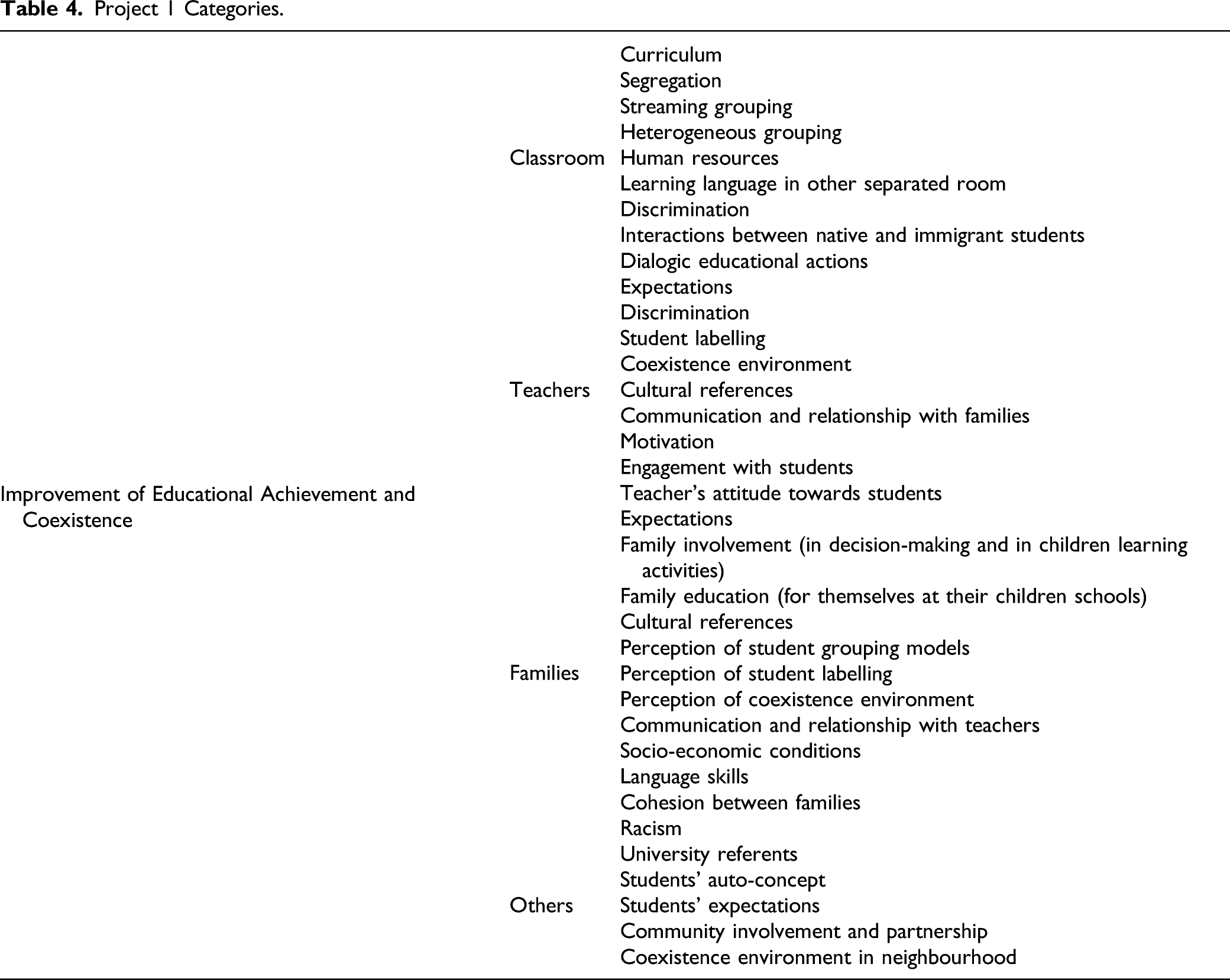
A teacher that is responsible for the immigrant children’s classroom provides an example of impact on improving educational achievement for the subcategory ‘Classroom’ and the subcategory ‘Human resources’. This primary school was first implementing streaming actions, and thus, immigrant children, mainly arrived from North Africa, were placed in a reception classroom with other immigrant students to learn the host country languages, that are Catalan and Spanish. The newcomers were not led to an ordinary classroom with the other native children of their age. This school later changed its organisation towards an inclusive model, by virtue of which immigrant children started to learn the host country languages in the ordinary classroom with the native children. The teacher who was previously in the reception classroom is now in the class with all the migrant and native children, where there is also another teacher. In addition, the school started to organise its classes in interactive groups, and the teacher explains that since then the performance on the basic skills tests in language, mathematics and science carried out by the Department of Education of the Autonomous Community improved for both immigrant and native children within the sixth grade of primary school (11–12 years old). Interactive groups (IGs) are a form of classroom organisation based on heterogeneous groupings with reallocated human resources. IGs are characterised by the participation within the classroom of diverse adults who do not necessarily have professional teaching experience. Participants may be students' relatives or other community volunteers who may have little educational background (Valls & Kyriakides, 2013). This teacher adds in her interview that organising the classroom in IGs has helped immigrant children to greatly improve their oral skills because all the teaching hours are spent interacting with other native children in Catalan and not speaking Arabic among them, as it was the case in the reception classroom. I think the IGs are better. Right now we have just distributed the tests marked by the Department and all the children have passed. I think it is very positive for speaking skills, because of course it is not the same to put all the children who do not know Catalan in a classroom because they will relate to their language among themselves. If there are two Arabs they will probably speak Arabic between them and Catalan will be heard less. So if they are in the classroom (with the other native students) and you go in and help them ... If you are inside the classrooms I think you have Catalan language models all day long. Personally I think it's better, the tests give us the results. (PEM2EC2, 1, 12) [Quote from a teacher taken from the final report of the Project 1)
The subcategory ‘Heterogeneous grouping’ within the category ‘Classroom’ allowed to get the following finding, that interactions among heterogeneous students produces higher learning outputs. Teachers, students and families hold a positive evaluation of heterogeneous grouping under interactive groups. As a sample this quotation from a teacher: I think it is better, [because] if you split by [habilities] groups, those less advantaged will always perform less. Whereas if you make heterogeneous groups, the most advantaged can help the less one. When an advantaged student helps a disadvantaged student, both of them are improving their learning. (...) I think that classifying children by level does not help them because the disadvantaged ones will always remain at a low level because all the students in that group at a low level (PEM2EC2, 1, 162) [Quote from a teacher taken from the final report of the Project 1)
Another example of the impact on improving students’ performance was gathered due to the subcategory ‘Family involvement’ within the category ‘Families’. Drawing upon the storytelling of a 15-year-old immigrant girl from Romania at third year of Compulsory Secondary Education, this subcategory allowed to realise that since her school started organising classes in IGs and involving parents as volunteers, the whole class started getting better marks. I remember that last year in Social Sciences we were doing badly and parents came to help us. The whole class has improved since then. All the class got better marks. (AGIM, 1, 90–92) [Quote from a student from the final report of Project 1)
Project 2 Categories.

Regarding the category ‘Inclusion impact on academic achievement’ and the subcategory ‘Heterogeneous groups with a reorganisation of human resources inside the classroom’, it allowed to collect social impact evidence both from the story of a secondary school girl and from the focus group held later with students of her class. This school includes pre-school, primary and secondary education and has a high concentration of immigrant families. In 2010, it began to implement educational actions based on the inclusion model. Among them, classrooms organised into heterogeneous groups in terms of performance level, gender, culture and mother tongue. Other education professionals, family members and volunteers are involved within classrooms. This secondary school student explains how a parent from a primary education child from Pakistan is volunteering in her English class (English as a second language). The student values him because she and her classmates have improved their English pronunciation as this parent has excellent English speaking. The researcher asks the student how volunteers that come as a support to class help them. She answers the following: Most of all there is one who knows a lot of English that helps us to pronounce. He is teaching us how to pronounce English. He is a primary school father. Is he Spanish? No, he is a foreigner. I think he is a Muslim (RAI_SM1_74-83_12c) [extract from the report of the qualitative case studies of Project 2].
Shortly after collecting this student girl’s story, a focus group discussion was held with other students from her class. They also appreciated the involvement of this immigrant parent as a volunteer because it has helped them improve their English skills. To the same question from the researcher about how they value the participation of volunteers in the classes and whether they help them to learn, the students responded:
In Project 2, we also find the subcategory ‘Extension of learning time’ within the category ‘Inclusion impact on the academic achievement’ allowed to get the following finding in a disadvantaged social context where the students had lower levels of achievement than the mean of that region. In this context, the school performed an extension of the learning time by means of a tutorised library, dialogical literary gathering and helping students to do their homework. In the first case, the dialogical literary gathering provides the students an improvement in the reading and comprehension competences, as this teacher explains: The level of my students was so low that I realised that we must begin with a six year old level for a 3rd or 4th degree children. Then, off course, from that point of departure children only improved, even though it took a lot of time. (...) I got to took them to other neighboorhoods libraries [after the school’s time], and working the instrumental dimension. (EPI_PM1_172-173_16) [Quote from a teacher taken from the qualitative report of the Project 2)
In the second case, students get a better understanding of the subjects and improve their learning easier than in ordinary classes because of the closer and more individualised attention from adult volunteers, as this student’s quotation shows: It is not like in the ordindary classroom where a teacher has to pay attention to 18 children; here sometimes we are six or five students and [the volunteers] explain me better the matter (RAI_PMI_96_16c) [Quote from a teacher taken from the qualitative report of the Project 2)
Project 3 Categories for Family Education Characteristics.

Project 3 Categories for Benefits of Family Education.

Under the category ‘Student’ and the subcategory ‘Improvement of educational achievement’, Project 3 has collected evidence of how families participating in family education improved their children behaviour and academic achievement. A primary school teacher from one of the schools that has been part of the case studies stated in the interview: It is observed that they are children who are doing better because they are taking more interest. Simply because my mother comes to school. In many cases they are not bright children, but they improve in terms of attitude and performance (C.AVE.P-D) [Quote extracted from Project 3 final report]. She was teaching in a public school in one of the suburbs of a city in Andalusia. Twenty-five percent of the families in this school are immigrants of low socio-economic status from Romania, Morocco, Algeria, the Sahara, Nigeria, Senegal and Ecuador. This school has several family education programmes such as Dialogic Literary Gatherings (de Botton et al., 2014), mathematics and other topics depending on the families' demand.
The subcategory ‘Increased involvement’ within the category ‘Families’, helped realising the impact that the participation of one of the immigrant mothers in this school has on improving her children’s motivation and academic performance. She explained that since her increased involvement in Dialogic Literary Gatherings she had more learning interactions with her children, her dialogues have been academically enhanced, and they now do their homework and read together: Our dialogue is different, we can talk about things that I could not talk about before. We can work together on some project that they bring in, that I couldn't before. The book we are reading in the literary gathering, we can read it together at home. We can talk about the book, I can explain to them about it. There are things that I couldn't explain before and now I can (C.AV-E.F-P) [Quote extracted from Project 3 final report].
The subcategory ‘Increased expectations’ within ‘Families’’ category allowed to find out how a teacher realised that her low expectations regarding participants learning capacities make her to teach lesser than she could have done, make her teaching less than other teachers were achieving with families with similar education level. The problem was me. I spent a year training mothers of school students, and I planned some things to work on, but never, for example, I dared to take an exam on them. I thought, ‘no, no, no, we will do things little by little.’ […] And then, the next year I saw other students that had taken exams, that were projecting Power Point presentations. […] I had set expectations that were..., I don't think they were inadequate, but they were very basic, and actually I could have tried to do more things, and the people who were coming would have responded. It has been me who had set lower expectations. They could do a lot more than I had anticipated, it was just a matter of trying it (C.M-G.D.V2-M1) [Quote extracted from Project 3 final report].
Discussion and Concluding Remarks
The qualitative meta-analysis of the three research projects provides knowledge about how qualitative methodologies that have been oriented towards social impact have introduced the improvement of educational achievement as one of their categories. The three projects were explicitly oriented towards social impact, as it has been seen in their aims and goals sections. The fact that the three projects analysed have been oriented towards collecting evidence of social impact, has led them to developing qualitative methodologies that provide a better understanding of the factors that hinder the educational success of the children of immigrant families, but also that unveils what factors contribute to overcoming those obstacles. In all three projects, the categories of analysis have been defined both from previous literature that has reported evidence of actions that are contributing to the educational success of children of immigrant families and from the dialogue with families, students, teachers, volunteers and other staff.
This meta-analysis allows identifying three innovative ways in qualitative methodologies of including evidence collection of the social impact of educational actions implemented by schools that pursue the academic success of children of immigrant families. This knowledge provides a breakthrough in the state of the art in which there is very little qualitative research whose main objective is to gather social impact evidence of educational actions including as a category the improvement of educational achievement. As we documented in the literature review, some qualitative research has provided evidence of the improvement in educational success of children of immigrant families through their participation in after-school programs (Perry & Calhoun-Butts, 2012), by identifying parent involvement strategies to help their children succeed in school (Goldsmith & Kurpius, 2018), or analysing the influence of social network, community, teacher and peer group support (Kumi-Yeboah et al., 2020). However, improvement of educational achievement was not listed as a previous category in any of these studies. Listing it for the very beginning would increase the odds of finding, reporting and documenting the social impact of educative actions. Some methodologies point this direction, including studied subjects in all research phases, from the beginning until its finalisation (Redondo-Sama et al., 2020).
The meta-analysis has allowed to recognise that Project 1 has included the category ‘Improvement of educational achievement’, identifying which elements, actions and practices of the classroom, teachers, families, and other actors favour or hinder educational success, that Project 2 has incorporated this category by analysing how the inclusion model of grouping students improves their academic performance, and finally, that Project 3 focused exclusively on deepening the benefits of family education as a successful educational action, defined as one of its categories the improvement of the children’s educational performance in immigrant families participating in this action.
As a concluding remark, one of the ways to address qualitative research on the social impact to foster the educational success of children of immigrant families could be to incorporate the category of improvement of educational achievement, allowing to obtain qualitative evidence of whether or not the educational actions implemented in those schools are leading to educational success.
Some of the limitations of this meta-analysis is the scarce number of research projects worldwide devoted to gather social impact evidence of educational actions. If we add a focus on children of immigrant families, and a geographic delimitation, there are, to date, few research projects to analyse. However, there is an increasing demand from society and from government institutions to the scientific community to conduct research with social impact (Aiello et al., 2020), and the qualitative inquiry is key to achieving such goal (Sordé Marti et al. 2020). So, in the next future, we would probably witness an increase of this kind of research. A further research, replicating the meta-analysis of categories used in qualitative fieldworks, could also be conducted in some other educational or social areas or populations (as students with special needs, housing, unemployment, etc.), so checking whether the results presented in this article are applicable to other contexts.
Footnotes
Declaration of Conflicting Interests
The author(s) declared no potential conflicts of interest with respect to the research, authorship, and/or publication of this article.
Funding
The author(s) received no financial support for the research, authorship, and/or publication of this article: Research Grants Agency of the Government of Catalonia for the Research Group on Education Overcoming Inequalities (2017 SGR 1560).
