




Abstract
Using a critical discourse analysis approach in analyzing data is useful in exploring meanings and the wider social, political, and historical context of the meanings. However, analyzing data using a critical discourse analysis approach can be difficult and complex. Hence there is a need for well-defined explicit approaches for discourse analysts to follow. The aim of this paper was to explore a clearly explained framework as a method for data analysis in a study investigating spirituality in nursing. Schneider’s method provided the researcher with such a clearly structured framework underpinned by critical discourse analysis that was used in the analysis of a series of interviews conducted with Australian registered nurses involved in the development of practice standards and those applying them in clinical practice. Schneider’s work steps provided a means of applying Fairclough’s and Chilton’s approaches to critical discourse analysis in a systematic and efficient manner to the analysis of the interview texts. The application of this method enabled the generation of findings that revealed the participants’ discursive constructions of spirituality.
Literature Review
Critical discourse analysis is an interdisciplinary methodological approach that centers on “discourse as social practice” (Strauss & Feiz, 2014, p. 312). Strauss & Feiz (2014) define discourse as a cognitive and social process where perceptions, emotions, experiences, desires, and understandings are channeled into a medium for communication and expression. Jaworski & Coupland (2006, p. 6) suggest that discourse “reaches out further than language itself in the forms as well as meanings.” It is linked to context and bounded by discursive structures such as genre (culturally shaped sets of conventions that create wide boundaries for composition of types of discourse) and modality (the channel through which the discourse is produced) (Strauss & Feiz, 2014).
Critical discourse analysis has gained acceptance as a methodological approach in nursing and health (Crowe, 2005, Yazdannik et al., 2017). This theoretical approach has the potential to reveal valuable insights into the political and social contexts in which discourses about nursing and health occur (Yazdannik et al., 2017). Several nursing studies have used a critical discourse analysis approach to guide their investigations (Dixon, 2013; Nelson, 2017; Schofield et al., 2012). In keeping with the critical constructionist tradition, the critical discourse analysis approach assumes that there are powerful interests within the context of health care that influence how nurses practice (Strauss & Feiz, 2014). Crowe (2005) critiques traditional qualitative approaches suggesting that assumptions that underpin qualitative approaches to research show an ideological position that suggests that reality is apprehended when a person’s point of view is captured. Critical discourse analysis on the other hand focuses on how a person’s individual experience is historically and socially constructed by language (Strauss & Feiz, 2014). Critical discourse analysis seeks to expose aspects of nursing practice that have been previously accepted without question (Latimer, 2008; Schofield et al., 2012).
A range of critical discourse analysis research traditions have been established over the years (Krzyżanowski & Forchtner, 2016). These traditions range from Fairclough’s (2014) post-Foucauldian dialectical-relational approach, Wodak and Meyer (2001) discourse-historical approach and van Dijk’s (2008) cross-disciplinary socio-cognitive critical discourse analysis traditions to Marx and Foucault’s social theoretical traditions that link knowledge and intellectual formations to social relations and power (Olssen, 2004). Arising from these critical discourse analysis traditions, there are a range of analytical approaches which have their own epistemological position, concepts, and procedures (Mogashoa, 2014). Morgan (2010) suggests that the diversity of these traditions coupled with each approach being either too narrow, too broad, or lacking explicit methods for analysis can leave the novice critical discourse analyst confused as to how to apply a critical discourse analysis approach to analyze data. Goodman (2017) suggests that among all qualitative approaches to analyze data, critical discourse analysis is possibly one of the most difficult to learn and apply. This is suggested to be related to newer researchers finding the literature discussing critical discourse analysis confusing and there being a general lack of discussion in textbooks and other literature on how critical discourse analysts actually analyze their data (Goodman, 2017).
Some researchers have discussed their analytical approaches in the context of their studies. For instance, Jorgensen, Docent, and Holen (2020) described the application of Fairclough’s three dimensional framework to analyze interview data. In their study, they found this approach useful in generating “insightful knowledge” of the discourses revealed in their study. However, they critiqued this approach as lacking guidelines on how much social analysis is sufficient (Jorgensen et al., 2020). It was unclear what they meant by this though, and why it was considered a limitation for their study. Kunyk, Milner, and Overend (2016) described the use of Tonkiss’s approach to discourse analysis, however, they did not critique this approach. Other nursing studies that have used a critical discourse analysis approach such as Dixon (2013) or Schofield et al., (2012) have explained their methods of data analysis from a more theoretical standpoint, rather than outlining a practical framework. Even though discourse theory has been well examined by various theorists (Krzyżanowski & Forchtner, 2016), there are a lack of practical frameworks using a critical discourse analysis approach. Therefore, the aim of this study was to explore a clearly explained framework as a method for data analysis in a study investigating spirituality in nursing.
Methods
Fairclough’s (1995) discourse analysis approach and to a lesser extent, Chilton’s (2004) approach underpinned this study. This is because Fairclough’s (2003) approach to discourse analysis has a particular focus on the social structure of language as well as on how language is used in specific texts. Chilton (2004) likewise focuses on how language is used and proposes that there is a strong connection between language and politics. In relation to this study, the use of language was believed to be critical to how registered nurses constructed spirituality and practiced spiritual care. Fairclough proposes that there is a link between power and discourse in relation to social change (Fairclough, 1995). In this study, the participants’ interview texts were examined for their use of language in relation to spirituality and for power mechanisms that influenced the ways the participants perceived spirituality.
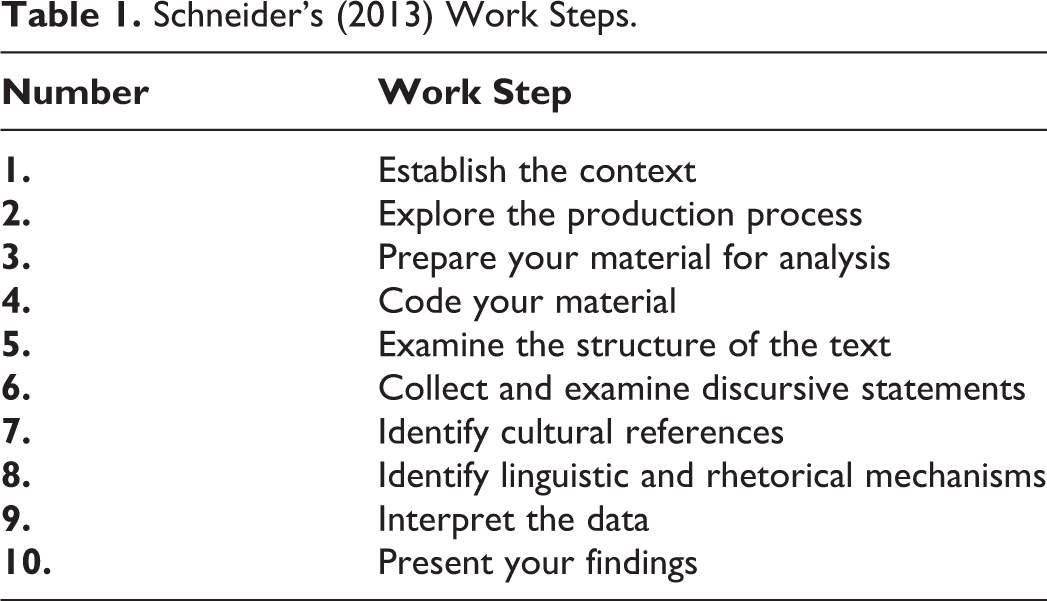
Schneider’s (2013) 10 work steps consist of an explicit step by step approach that have been developed to provide a specific framework to follow when analyzing data using a critical discourse analysis approach. The development of the 10 work steps was underpinned by the works of key critical discourse analysis traditions (Chilton, 2004; Fairclough, 1995). Schneider based the idea of work steps on Jager’s (2004) steps to analyzing data. Even though Schneider’s step approach was originally developed to analyze political texts, these are written in a generic manner that can be readily used to analyze other texts, such as in Cooper et al.’s (2020) study on spirituality in nursing.
Considering the general lack of description or critique of the approaches used to analyze data using a critical discourse analysis approach, using a step by step approach in analyzing the interview texts assisted with ensuring that various aspects of conducting a critical discourse analysis were addressed. These included establishing the context, exploring the production process, examining the structure of the text, collecting and examining discursive statements, identifying cultural references, and looking for linguistic and rhetorical mechanisms within the data. In addition to these aspects, Schneider’s 10 work steps also assisted with addressing more generic features of qualitative analysis such as coding the data, interpreting data and presenting findings. These are also important to address when using a critical discourse analysis approach.
Participants
There were two groups of participants in this study. The first participant group comprised of three members of the Registered nurse standards for practice research and development team who participated in the development of the 2016 Australian Registered nurse standards for practice (standards development participants). The second participant group consisted of 20 registered nurses; 14 registered nurses working in a faith based private hospital and six registered nurses working in a non-denominational public hospital (hospital registered nurse participants). The standards development participants were interviewed to find out how they constructed spirituality in the Registered nurse standards for practice. The Registered nurse standards for practice are used as a guide to inform the practice of nurses in all clinical settings across Australia. The hospital registered nurse participants were interviewed to discover how they construct spirituality and practice spiritual care in nursing.
Applying Schneider’s 10 Work Steps
For this study, data analysis was conducted manually by reading and rereading the texts to gain a sense of what was being expressed. Schneider’s (2013) 10 work steps and their relationship to this study are discussed below.
Schneider’s (2013) Work Steps.
Establish the Context
For the first step of analysis, Schneider (2013) suggested the researcher note down the social and historical context of each source of text, which were interview texts in this study. During this step, the language of the source, the country and place it is from, who wrote it and when it was written, and who published it was to be noted. Also, whether the sources were responses to any significant major incident and whether they tie into a larger debate needed to be considered. Establishing the social and historical context of the sources of the text was necessary to understand the broader context surrounding the text and the influences these contextual factors had on the text (Fairclough, 2003).
Applying Schneider’s approach to CDA in this study meant questions were asked regarding the social and historical context of both groups of participants. Such information included the language of the interview text (English), the country from which the data were obtained (Australia), who spoke the text (both groups of participants) and when it was spoken. This was done to establish any social or historical power relations which could have influenced what the participants spoke about. In relation to this study, the influence of the professionalization of nursing on the development of the Registered nurse standards for practice to clearly articulate professional expectations of registered nurses was considered.
Explore the Production Process
For step two, Schneider (2013) suggested doing a deeper check of the background of the sources of information. Doing this helped to assess the genre-specific mechanism (type and structure of language in a particular context) (Strauss & Feiz, 2014) and the sources used to convey their message (Schneider, 2013).
In this study a further exploration was undertaken of the personal and institutional backgrounds of both groups of participants. In particular, the institutions with which the standards development participants were affiliated with, what positions they held, the working groups and other committees that had informed their deliberations were noted. Furthermore, the general target audience of the Registered nurse standards for practice was considered and how that might have influenced the perspectives of the standards development participants when speaking about spirituality’s representation within these standards. For the hospital registered nurse participants, the institutions they received their undergraduate education and their present place and clinical area of employment were considered. This was done to gain a deeper insight into why they spoke about their understanding of spirituality and spiritual care in the ways they did during their interviews, and to uncover any underlying power relations from their particular social contexts. For this study, the influence of the ideological underpinnings of the hospitals on the hospital registered nurse participants’ practice of spiritual care was considered.
Prepare Your Material for Analysis
Schneider (2013) provided some practical guidance for the next two steps in preparing the data for analysis. For step three, he recommended that the data are entered onto a computer. In relation to this study, this was done for the transcriptions of the interview texts.
Code Your Material
Schneider’s (2013) fourth work step suggested considering themes that have been found during the literature review. Schneider used the word “theme” interchangeably with coding categories or discourse strands. The interview texts were to be examined to see if any of the themes identified in the literature review were contained within these texts. Any broad themes could have been broken down into subthemes. Any additional themes contained in the text that the researcher did not expect to find, could have been added. Finally, the researcher was advised to revise the list of themes to reflect the findings. This was to be repeated for each document or interview being analyzed to develop in order a final list of themes.
The coding of the data was then to take place. Schneider (2013) recommended highlighting text sections in different colors. However, he cautioned to be careful with color coding as some statements may represent multiple themes. The text could then be copied into a table with the text in one column and the themes in the next column.
For the part of this study that investigated the registered nurse participants’ constructions of spirituality and practice of spiritual care in nursing, the themes that were found in other studies were education, religious beliefs, and workplace environment. These themes were written down prior to analysis. The interview text was then read to see if it contained any references to these themes. Following this, the interview data were coded according to the identified themes. Where the text related to more than one theme, it was coded within all relevant themes.
Examine the Structure of the Text, Collect and Examine Discursive Statements, and Identify Cultural References
The next three steps were conducted simultaneously and iteratively due to them being closely interrelated. Schneider (2013) recommended in work step 5 to look for sections of text that predominantly relate to one theme, as well as texts that contain more than one theme. For work step six, Schneider (2013) suggested examining all statements for their meaning in relation to the respective themes. Schneider (2013) recommended in work step seven to think about how the texts are informed by the context. To do this, the analyst was guided to examine the text for references to any social, political or historical influences.
In relation to this study, the interview texts of the standards development participants were grouped together and examined for their meanings in relation to spirituality and the theme “professionalization of nursing.” During this step, any power mechanisms and other contextual factors were considered. For instance, the interview texts were examined closely for social, political or historical influences that may have exerted power over the way spirituality was constructed in the standards.
Identify Linguistic and Rhetorical Mechanisms
In work step eight, Schneider (2013) directed the analyst to identify how the different statements function at a language level. To assist the analyst in understanding how to implement this step, Schneider provided multiple descriptions and examples of linguistic and rhetorical mechanisms to look for in the text. These linguistic mechanisms aided the discovery of how discursive processes function linguistically (Fairclough, 2003). To further assist with understanding how to implement this step in the present study, the researcher also read several nursing and health critical discourse analysis studies and observed the linguistic mechanisms identified.
In applying Schneider’s work step eight to this study, the linguistic features of the texts were examined through a detailed and thorough reading of the text. The interview statements were analyzed for various features such as word groups (words that have common contextual background), grammatical aspects (frequently used pronouns, active versus passive phrases), rhetorical versus literary figures (metaphors, similes, idioms, allegories, and proverbs), modalities (words such as “should” that could imply urgency or call to action) and evidentialities (the kinds of facts presented in the text). Color coding was used to identify various word features within the interview text. This was done to form a picture of how discursive processes operate in relation to spirituality representations in the nursing practice standards. While analyzing the text, the researcher searched for words, statements, and assumptions that described spirituality and spiritual care in relation to the Registered nurse standards of practice and the understanding and experiences of registered nurses. The data were interrogated for words used when describing spirituality and spiritual care. Statements, modalities, and assumptions used when describing these terms in relation to the practice standards and understanding and experiences of registered nurses were examined.
For instance, in the following interview text from one of the registered nurse participants, the modality “should” as in “should be” was noted as a call to action that nurses should include spirituality in a full assessment of their patients. The grammatical pronoun “you” suggested that the participant felt that all nurses should be doing this.
I guess holistic incorporates everything, so spirituality must be a part of that. If you are not addressing that, then you are missing for some people a huge part of their life. For other people, it is still there whether they want to do it or not. And it should be part of a full assessment.
People understand what holism is and if they can’t, they can look it up…spiritual is a component.
Interpret the Data
For work step nine, Schneider (2013) guided the analyst to bring all the results together so that what the discourse was about and how it worked could be explained. This required exploring the individual statements and structural features (Steps 4–8) and placing these findings in the broader context established at the beginning of the analysis (Steps 1 & 2). During this process, questions were to be asked such as who created the material that is being analyzed? What was their position on the topic? Who might benefit from the discourse that is constructed? This was done to examine any power mechanisms and underlying assumptions that may have influenced the findings.
In relation to this study, thought was given to the individual participants and how their respective backgrounds may have influenced their perspectives on the way spirituality and spiritual care were understood. For instance, with the hospital registered nurse participants, three discourses emerged. These discourses were personal religious beliefs, holistic care and empathetic care (Cooper et al., 2020). Consideration was given to the influence of the participant’s religious background, their pre-registration education and institution, and the clinical area they were working in at the time they were interviewed on their constructions of spirituality.
Present Your Findings
For the final stage of analysis, Schneider (2013) suggested that the findings be used to answer the research questions. Once the research questions have been answered, he recommended that the findings be used in the development of a presentation, article, or thesis using examples from the text to illustrate the findings. In relation to this study, the findings have been and will be used in the development of articles, presentations, and the researcher’s PhD thesis.
Discussion
Applying Schneider’s (2013) 10 work steps was useful in examining the social and political context of the study participants and revealing underlying power relations and concealed assumptions relating to spirituality within the interview texts (Gee, 2014; Nelson, 2017). Furthermore, it enabled the examination of the structure of language used by the participants and how this language was used to create contextualized meanings (Gee, 2014; Mogashoa, 2014) relating to spirituality. Investigating the construction of spirituality in nursing is significant in regard to the provision of quality spiritual care in practice, especially in the context of an increasingly global and diverse society.
The advantages of using Schneider’s 10 work steps as a method of analysis for this study were that it provided a clearly structured framework to follow when conducting the analysis of the interview texts. These work steps provided a means of applying Fairclough’s (1995) and Chilton’s (2004) approaches to critical discourse analysis to the interview texts in this study in a systematic and efficient manner. Applying a framework such as Schneider’s 10 work steps helped to overcome the limitation of using a critical discourse analysis approach, which has been criticized for lacking clearly outlined analytical approaches (Morgan, 2010; Mogashoa, 2014), and enabled the generation of findings in Cooper et al.’s (2020) spirituality in nursing study.
The limitation of using Schneider’s (2013) 10 work steps to conduct a critical discourse analysis found in analyzing the data in this study, was that some of the steps provided a limited overview of what was required at that particular stage of analysis. This led to the need to draw on the work of other authors such as Strauss and Feiz (2014), Gee (2014), Nelson (2017), and Schofield et al. (2012) to augment understanding of these steps. These additional references helped to explain the concepts and processes required to conduct a critical discourse analysis, and the studies assisted in illustrating the application of these concepts and processes. Regardless of this limitation, Schneider’s 10 work steps provided a suitable structured critical discourse approach that was readily used in the analysis of the interview data from those involved in developing the Australian Registered nurse standards for practice and the registered nurses expected to follow these standards when providing spiritual and other forms of care in practice.
Conclusion
Critical discourse analysis is an analytical approach that explores relationships between practice, texts, and events, and social and cultural structures to see how these are influenced by power relations, according to Fairclough’s theoretical approach. Critical discourse analysis is increasingly being used by nursing researchers in a variety of studies. It was used in this study to investigate both groups of participants’ constructions of spirituality.
Schneider’s 10 work steps provided a clearly structured method for the analysis of interview texts in this study using Fairclough’s (1995) and Chilton’s (2004) approaches to critical discourse analysis. It could also be useful for other researchers using this methodological approach in their studies. The 10 work steps provided a clearly outlined method that was useful in analyzing data for exploring social and political contexts of the study participants, their use of language, as well as the power mechanisms and underlying assumptions in interview texts. Using this approach was found to be beneficial to overcome any confusion associated with how to analyze data when using a critical discourse analysis approach. Ultimately, in the context of this study, following the work steps enabled the generation of findings that revealed the discursive constructions of spirituality from both groups of participants.
Footnotes
Declaration of Conflicting Interests
The author(s) declared no potential conflicts of interest with respect to the research, authorship, and/or publication of this article.
Funding
The author(s) received no financial support for the research, authorship, and/or publication of this article.
