




Abstract
Phenomenology is an umbrella term that refers to both a philosophical movement and a variety of research approaches. Hermeneutic phenomenology is a methodology, which is not rigidly set or prescribed. Hence, students and researchers using a hermeneutic phenomenology approach underpinned by Gadamer’s philosophy may struggle to apply his concepts while analysing data. This article describes a new framework that provides guidance on how to analyse data in a research study while remaining faithful to the major tenets of Gadamer’s work (pre-understandings, hermeneutic circle and fusion of horizons) and closely adhering to the central tenets. The framework provides a step-by-step strategy to ensure rigour while maintaining trustworthiness. This may serve as a useful guide for neophyte students and researchers using or considering Gadamer’s version of hermeneutic phenomenology in their studies.
Introduction
Phenomenology is one of the main philosophies that guide knowledge generation in nursing (Moi & Gjengedal, 2008). However, implementing phenomenology as a framework for conducting nursing research can be difficult as hermeneutic phenomenology is a philosophical approach not bound by structured stages of a method (Norlyk & Harder, 2010). Some of the challenges are linked to understanding the intricate philosophy and deciding how to undertake a phenomenological study (Caelli, 2000, 2001; Giorgi, 2008). The lack of articulated methods for achieving phenomenological research has been noted before (Caelli, 2000). There are remarkably few sources of information that address the practical aspects of how to carry out a phenomenological study and a lack of description of the methods used to facilitate the research process (Caelli, 2001). This dearth of discussion about methods may leave novice researchers struggling with understanding how a phenomenological research project might be achieved. With the continuous development in qualitative research traditions, guidelines and tools to direct researchers in conducting trustworthy qualitative research are desirable (Nowell et al., 2017). According to Caelli (2000), phenomenological research needs to be made more explicit, more ‘user friendly’, and less daunting for researchers who wish to engage in it. Researchers using Gadamerian hermeneutics need to analyse their research data while complying with its philosophical underpinnings, hence more explicit guidelines of how to carry out phenomenological research could be of benefit to phenomenological researchers. In this article, we describe a framework which assisted adherence to the tenets of Gadamer’s hermeneutics using examples from my doctoral study which explored mothers’ experiences of caring for children receiving growth hormone treatment (GHT).
Background
Knowing how to ‘be and stay open’ as a hermeneutic researcher can be challenging (Suddick et al. 2020). Students usually feel more comfortable using methods that are sequential, well-defined and deemed as rigorous. In the words of a student, ‘It is difficult. There are less rules to follow. It’s scary’. (Spence, 2017). As Crowther et al. (2017) points out, phenomenology is a methodological approach not compelled by structured stages of a method; it is how one accommodates, questions, and thinks in and throughout evolving methods. Since hermeneutic phenomenology is not a fixed methodology and the risk of doing it poorly is a possibility, this makes its use in nursing research challenging particularly for novice researchers (Crowther et al. 2017; McCaffrey et al. 2012).
Gadamer’s Hermeneutics
Hermeneutics is the art of understanding and the theory of interpretation. It focuses on the human experience as it is lived. It reveals details and apparently marginal aspects within an experience that may be taken for granted, with a purpose of generating meaning and attaining a sense of understanding (Kafle, 2013). It is a research methodology designed to produce rich textual descriptions of the experiencing of a phenomena where a deeper understanding of the meaning are sought, through progressively layered reflection while using rich descriptive language (Kafle, 2013). The interpretivist approach seeks culturally derived and historically driven interpretations of the social life world; therefore, an interpretivist can be seen as someone who tries to clarify the meaning of a phenomenon (Crotty, 2000).
Gadamer’s version of hermeneutics is that, firstly, our own preconceptions are fragments of our individual linguistic experience which makes understanding likely, and secondly, people who express themselves, and those that understand them are connected by human consciousness – ‘universality’ and a ‘fusion of horizons’ – which makes understanding conceivable (Morse, 1994). Gadamer viewed hermeneutics not as developing a way of understanding, but as a means to illuminate the conditions in which understanding, perception, experience and knowing itself takes place (Gadamer, 1976). Gadamer’s ontological view was that researchers are deeply influenced by the traditions of their culture and therefore act on that way of being in the world (Converse, 2012). He emphasises that understanding is a state of ‘being in the world’ and that tradition plays a significant role in interpretation. Gadamer believed that there is always more than one worldview for us to respect and at the same time we should be true to our own perspectives and experiences (Gadamer, 1976). With his major concept of pre-understanding, one may have the advantage of acknowledging and using one’s pre-understandings to understand and interpret more deeply. In my doctoral study that explored mothers’ experiences of caring for children receiving GHT (Alsaigh & Coyne, 2019), ‘I’ (the first author) could empathise more with them, having a clearer understanding of their experience because of the commonalities that may emerge. As a mother of a child receiving GHT, I also could share the historicity and language of mothers with children receiving GHT that would facilitate the interpretation, analysis and co-construction of the findings.
The fusion of horizons and the hermeneutic circle consequently play a vital role in hermeneutic philosophy, and Gadamer considers interpretation as a fusion of horizons, a dialectical interaction between the pre-understandings of the interpreter and the meaning of the text (Moules et al. 2015). This concept will not only assist in acquiring the commonalities between each story told, but also the contradictions that may arise as they also need to be highlighted. This helped to broaden ‘my’ (the first author) horizon, as I entered the study with my mind not set on only what I know and had experienced, but open to other experiences and even surprised by the outcomes (Webber, 2020). Gadamer viewed the hermeneutic circle as a process of movement between the aspects of the text and the interpreter of the text, in this movement; the preconceptions of the interpreter are fused into the process and transferred from preconceptions to new understandings as the interpretive process progresses onwards (Suddick et al. 2020). This is done by understanding parts of the text and relating them to the whole (context) and vice versa initiating a dialectical analysis of parts of the data to understand better the whole (Cohen et al. 2000). Gadamer believed that this process of coming to an understanding is a vital component in hermeneutics, and that this plays a vital role in data analysis.
Gadamer implied that to understand is to understand differently and that a fusion of horizons does not mean reaching consensus (Gadamer, 1976). He also claimed that it is essential to be surprised by your research and that perspectives are dependent on historicity and context. In addition, understanding and interpretation are compelled together, and interpretation is always a growing process; thus, a conclusive interpretation is likely never possible (Moules, 2019). Gadamerian hermeneutics has been utilised in numerous nursing research studies as nursing is an interpretive practice and the fit of Gadamer’s philosophical hermeneutics with nursing is evidenced (McCloud et al. 2012; Moules, 2019; Webber, 2020). The hermeneutic interpretive phenomenology informed by Gadamer’s hermeneutics fitted with the aims of my doctoral study and provided a framework for exploring the experiences of mothers’ while enabling a deeper understanding of the phenomena of caring for children receiving GHT. The findings revealed that mothers’ experiences of caring for their child receiving GHT were framed by three concepts that were as follows: uncertainty, normalisation and stigma. These concepts were used to elaborate on the four major meanings encapsulating their experience of caring for their children receiving GHT. The four major meanings of their lived experiences were as follows: (1) ‘It’s the right thing to do’ Striving for the security and the wellbeing of the child, (2) ‘Doubting yourself constantly’ Constant uncertainty, (3) ‘But then you just get used to it I suppose’ Adhering to GHT and lifestyle changes – the new normal and (4) ‘I hadn’t been told anything about it’ Information behaviour; looking for normality and certainty (Alsaigh & Coyne, 2019).
Data Analysis
Choosing an Analytical Framework
Interpretive work has been known for its intriguing feature of lacking a prescribed method for analysing data (Fleming et al. 2003). Instead of strictly adhering to a specific method, hermeneutic phenomenological approaches are based on a body of knowledge and understandings, a history of the lives of philosophers and authors, which, taken as an example, symbolises both a basis and a methodological ground for current human science research practice (Van Manen, 2016). Although Gadamer (1975) proposed valued insights into how one may acquire a deep understanding of texts, he did not suggest either a methodology or a method for doing so. Nevertheless, it is within Gadamer’s view that in order to understand, a systematic approach is needed. Gadamer (1975) clarified that hermeneutics is not a simple matter of endorsing a method; however this poses a struggle for the hermeneutic researcher, who needs structure to begin the research process. Although Moules et al. (2015) believe that developing a formula for analysis in interpretive work would be antithetical to hermeneutics, other authors have offered procedural steps to data analysis (Colaizzi, 1978; Fleming et al. 2003; Van Manen, 1984).
I found it difficult to find a proposed method that covered the main concepts of Gadamer’s philosophy (pre-understandings, fusion of horizons and the hermeneutic circle). Analytical frameworks that reflected the main concepts of Gadamer’s philosophy (pre-understandings, fusion of horizons and the hermeneutic circle) in a similar way were found to be too vague to follow (De Sales, 2003; Koch, 1993).
Accordingly the analytical framework by Fleming et al. (2003) appeared useful as it offered a template containing five clear steps for analysing Gadamerian-underpinned research. Fleming et al.’s (2003) five steps are a translation of Gadamer’s hermeneutic philosophy from his seminal text (Gadamer, 1960); which was then translated from German to English (Gadamer, 1975) and revised (Gadamer et al., 2004, 2013); thus, they closely adhere to his philosophical tenets. This analytical framework was chosen because it provided the clearest guide to how to use the major concepts of Gadamer’s work (pre-understandings, hermeneutic circle and fusion of horizons) and how to integrate them into the research study. The process starts from as early as choosing a research question to maintaining the trustworthiness of the findings, which seemed structured in a sense. So for this reason, Fleming et al.’s (2003) analytical framework was chosen over other frameworks that were used in Gadamer’s research studies such as (Austgard, 2012; De Sales, 2003; Koch, 1993). Although Fleming et al.’s (2003) framework was the clearest guide and widely used in research studies from different disciplines (Marynowski, 2014; Söderhamn et al. 2013; Thorkildsen et al. 2015), I was still unclear in how I would gain understanding through dialogue with the text which is the fourth step of the framework.
Gadamerian Hermeneutic Phenomenology Analytical Framework Based on Gadamer (1960) Explicated by Fleming et al. (2003) and Ajjawi & Higgs (2007).

First step: Deciding Upon a Research Question
In this first step, it is essential to examine the appropriateness of the research question with the methodological assumptions. Research conducted through a Gadamerian tradition is established from an aim to attain deep understanding of a phenomenon. So according to Gadamer (1990) the essence of the question contributes to the opening up of possibilities for deep understanding. He highlighted the significance of choosing the correct questions for elaboration of the hermeneutic situation. Thus, the original or opening research question impacts the whole research process. He additionally stated that there is no understanding without the activity of questioning and that there is a very narrow relationship between the two that gives sense to hermeneutic research (Gadamer, 1990).
When I met with the mothers for interview purposes, I explained that I did not have a set of questions to ask and they were invited to reflect openly and deeply on their experiences through asking them open-ended question (Laverty, 2003)). The interviews were in the form of conversations and to deepen the understanding, the opening question was followed with clarifying questions (Fleming et al. 2003). I usually started the interview with this opening question ‘Tell me about your experience of caring for your child receiving GHT?’ and then used probing questions like ‘Tell me more about this?’ or ‘What is this like for you?’ Consistency on using this main question throughout the interviews was generally maintained to keep the mothers and I oriented to the subject being researched and to continue asking relevant questions throughout the study to reach a deep understanding (Geanellos, 1999).
Second step: Identification of Pre-understandings (Before Data Collection)
Researchers using the Gadamer’s philosophy need to identify their pre-understandings or prejudices on the topic of interest (Fleming et al. 2003). It is recommended remaining open to hidden prejudices and that unexamined prejudices may impact or limit the horizon of understanding so one’s prejudices need to be provoked (Fleming et al. 2003). Prejudice can limit the individual’s horizon which consequences in not seeing far enough, underestimating the familiar, which results in not seeing or closing off further understandings by assuming it is already known (Geanellos, 1999). With my personal experience (providing GHT to my son) and professional experience (registered nurse and lecturer) and underpinning my study with the philosophy of Gadamer, I knew I had to bring my pre-understandings and prejudices of the topic into consciousness. Reflecting upon my prejudices would enable me to move past my pre-understandings and transcend my horizons to better understand the phenomena, which will influence the research findings (Fleming et al. 2003). I found this process not as easy as it might seem. In order to provoke my pre-understandings, I needed to bring out hidden prejudices and ones that I might underestimate myself. An appropriate approach I found to help bring my pre-understandings to the surface was having conversations with my supervisor, colleagues and family members. Then the pre-understandings that became visible within the discussions was described and analysed in the research report (Fleming et al. 2003). During the research process my pre-understandings changed from the point of data collection until the write-up stage and in order to actively focus on this transformation, I consistently documented my thoughts and reflections in a diary. I also re-read and reflected on my accounts in my reflective diary to help remain oriented to the phenomena and to enable me to enter the hermeneutic circle (Geanellos, 2000; Mortari, 2015).
Third step: Gaining Understanding Through Dialogue with Participants (Interview and Diary)
Gadamer disliked the expression ‘collecting data’ or ‘gaining information’ and preferred to use the term ‘gaining understanding’ (Fleming et al. 2003). He remarked that understanding may only be potential through dialogue, one being open to the opinion of the other (Gadamer et al. 2004). Dialogue means not only a conversation between two people, but also a dialogue between reader and text. In both cases, language is considered the mean and it is through language that understanding becomes potential (Gadamer et al. 2004; McCaffrey et al. 2012). In order for the text to be co-created by the researcher and participants, I sought to capture the temporality of every remark within a conversation and so I acted as an active research instrument. Understanding would come into view when my horizon infuses with the horizon of the participant (Morse, 1994).
A ‘horizon’ is a series of vision that incorporates everything seen from a specific vantage point (Gadamer et al. 2004). A person with no horizon, in Gadamer’s opinion, does not see far enough and overestimates what is nearest at hand, while to have a horizon means being able to see past what is familiar at hand. This is where questioning becomes practical, as it helps the person create new horizons and understandings possible which is a critical aspect of the interpretive process (Laverty, 2003). Gadamer emphasised that we are all part of history and consciousness and he recognised the merging of individual’s horizon within the prejudices of history, including those offered by people and text in the development of knowledge and understating (Gadamer et al. 2004). Therefore, in my doctoral study, it was important for me to try to understand how my personal feelings and experiences could influence the research and then incorporate this understanding into the study and this was encouraged by maintaining a reflective diary throughout the entire process of data collection, analysis and write-up.
Fourth step: Gaining Understanding through Dialogue with Text (Transcribing and Analysing)
Gadamer emphasised the necessity of writing down the interviews (transcribing) even though he supports the power of spoken words over the written. However the researcher should not totally rely on the written words (transcripts and diaries) but should also listen to the spoken words (audio-tapes) (Gadamer et al. 2004). ‘Text’ not only signifies to the written transcript, but also to recordings, comments made by the researcher about the interview situation and observations. Field notes describing the context and emotions not captured by the recordings were written next to the interview text.
Stage 1: Immersion
This is where interviews were transcribed verbatim and repeatedly read to get a good understanding of the whole text. Gaining understanding of the whole text was the starting point of the analysis because the meaning of the whole text will impact the understanding of every other part of the text. Already my pre-understandings could have caused the build-up of a sense of anticipation that influenced the first encounter with the text. However, I was fully aware of trying to keep an open mind and reflecting on my influences. This step (immersion) was implemented by reading through the transcripts while hearing the recordings several times before exploring the parts. This step correlates with the ‘Preliminary interpretation of texts to facilitate coding’ (Ajjawi & Higgs, 2007).
Transcripts were considerably annotated with identification of features of significance, as well as narratives of my feedback to what mothers said and what I said. I carefully examined each transcript for ideas, which seemed to add voices to the meaning of the phenomena. Also, I attentively reviewed the transcripts for clues of my own transformation. When articulating the meaning units, the question put to the text concerned meanings of caring for a child receiving GHT. Across this dialogue with the text, main meanings were sought. Both my horizon and the participants’ horizons were fused into a tentative interpretation.
Stage 2: Understanding
This is where rich and more detailed understanding was achieved. It involved investigating every single section or sentence (the part) to expose its meanings to understand the subject matter. This was initially done by identifying first order ‘participant constructs’ (open codes). These constructs represented participant’s horizon referring to participants’ ideas expressed in their own words or phrases, which captured the precise detail of what the person was saying. This step was followed by the abstraction phase.
Stage 3: Abstraction
This is where second order ‘researcher constructs’ (categories) were identified. Due to the large number of open codes, the computer programme NVivo 11(QSR) was used to assist in the organisation of open codes and form categories. Then, subcategories under those categories were generated manually. Subsequently, core categories and subcategories were grouped manually into sub-themes. These sub-themes represented my horizon, which were generated using my theoretical and personal knowledge; these were abstractions of the first order constructs (Integration). Thematic analysis offers a way of uncovering the underlying themes in a given data set (Braun & Clarke, 2006). The main steps followed with regard to the process of thematic analysis (Braun & Clarke, 2006), namely, were the transcription of the data and the coding.
Stage 4: Synthesis and theme development
Then the synthesis and theme development phase was initiated (meshing the horizons) where grouping of sub-themes into themes are made. Afterwards, further elaboration of themes and relating them to the whole meaning of the whole text to try in turn expand the meaning of the whole. This movement from the parts back to the whole text is the core of the hermeneutic circle (Aggregation). It was expected then with the deepened understanding of the whole text, meaning of the parts would expand. Themes were constantly being challenged and in turn challenged by my pre-understandings. An illustration of how initial themes evolved to final themes as they were challenges by the literature is visualised in (Figure 1). Next, the illumination and illustration of phenomena phase follows. Initial themes evolving to final themes as they were challenged by the literature.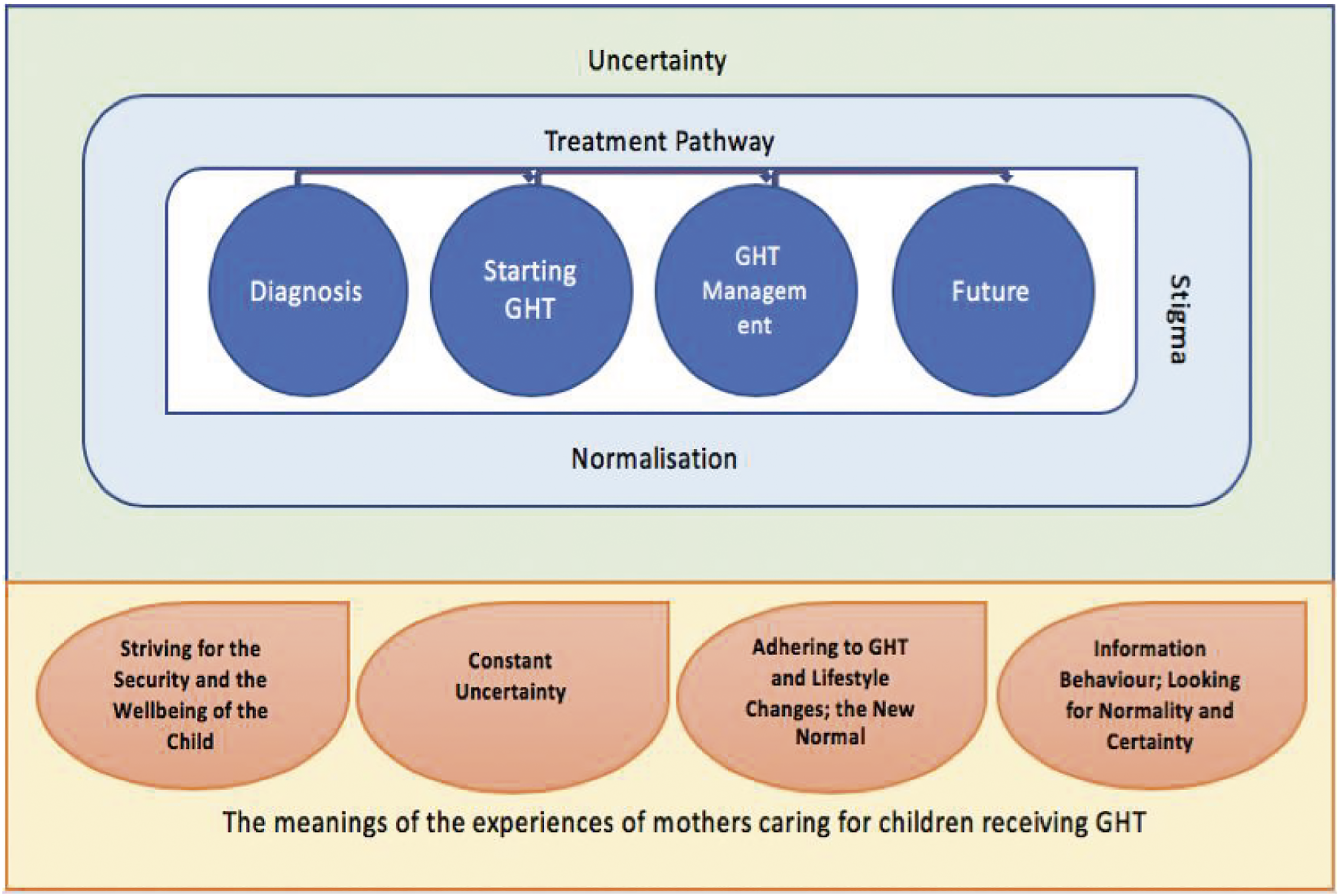
Stage 5: Illumination and illustration of phenomena
This is where I started linking the literature to the themes and sub-themes identified from the entire data. Using the themes, sub-themes and their interrelationships as a basis, I reconstructed the mothers’ experiences into stories using their own words (or first order constructs) in order to illuminate the phenomena and highlight key findings from the data (Ajjawi & Higges, 2007). The second author provided feedback on the quality of the stories. This stage was clarified in the findings chapter of my doctoral thesis as displayed in (Figure 2) which visualises the completion of the Hermeneutic Circle (the final interpretation of the research findings at this point in time). Completing the Gadamerian hermeneutic circle (the final interpretation of the research findings at this point in time).
Stage 6: Integration and critique
The final phase is integration and critique. This is where I critique the themes and report my final interpretation of the research findings at this point in time (fusion of horizons) as displayed in (Figure 2). The findings of my study are not presented here as they are not the focus of this article. This stage was illuminated in the discussion chapter of my doctoral thesis.
Fifth step: Establishing Trustworthiness
Hermeneutic phenomenological research aims to highlight the experience under exploration as close as possible to how it was lived by the participant, while noting the interactions and overlapping horizons between researcher and participant (Cohen et al. 2000). Lincoln and Guba’s (1985) criteria of credibility, dependability, conformability and transferability were used to establish trustworthiness.
Credibility indicates the confidence to the truth of the data and its interpretation (Lincoln & Guba, 1985). In this study, methodological coherence and researcher’s responsiveness were strategies for achieving this. Methodological coherence is reflected throughout the process of the study in a non-linear way as the researcher moves back and forth between framework and application to guarantee congruence amongst deciding on a research question, literature, recruitment, data collection and analysis (Laverty, 2003). My responsiveness was achieved by sustaining truthfulness, staying open and being sensitive while listening to each participant’s story to ensure their perspective was clearly noted and represented as clearly as possible. And then the use of direct quotes upheld from the used text allows the reader to partake in the validation of the data. Dependability is the stability of data over time and conditions (Lincoln & Guba, 1985). It is however uncertain whether dependability can be indorsed to a study that is underpinned by Gadamer’s philosophy as the researcher’s horizon and those of the participants will change; therefore, a final interpretation will not be achievable, and interpretation of data will change over time.
Conformability is the objectivity of the data (Lincoln & Guba, 1985). Coherent with hermeneutic phenomenology, I did not hold an objective position, but included my pre-understandings as part of the data. Objectivity in hermeneutic research can be comprehended as being open to the study text. Transferability according to Lincoln and Guba (1985) is generalisability of the data. To what extent can findings be transferred to other settings or a group? As my study was a hermeneutic one, the aim of the study was not to generalise the findings; but to provide deep description of the phenomenon of caring for a child receiving GHT from mothers’ perspective.
Understanding according to Gadamer can only be achieved by creating harmony between the whole and the parts of the text (Gadamer, 1990). This proposes a standard for trustworthiness in relation to the development of understanding rather than simply to the end result of the study. My responsibility as a Gadamerian researcher was thus to deliver adequate detail of the processes and the findings in the research report. It is suggested by Denzin and Lincoln (1998) that reflexivity plays an essential part in amplifying the integrity, credibility and trustworthiness of a qualitative research study. This involves ways of questioning own thoughts, attitudes, reactions and habitual actions in an attempt to understand our role in relation to others (Bolton, 2018). Being self-aware involves thinking about positionality such as ethnicity, age and previous life experiences, social identity, role and personality (Dowling & Cooney, 2012). This did help with looking more critically at situations and relationships and finding ways to revise and enhance being and relating (Cunliffe, 2009). As a novice doctoral researcher using reflexivity, I found this practice rather challenging and chaotic. It was a learning curve and a tool I learnt quite gradually along the way. I found Valandra (2012) tips and guidelines on reflexivity and professional use of self in research very useful in facilitating my reflexivity. Valandra (2012) offers suggestive reflexive questions at every phase of a research study. In the pre-research phase, it involved being honest with myself about my biases and limitations, my knowledge or lack of it, around the topic and population of inquiry and the possibility of my perspectives and experiences to affect the research process. Some pre-research phase questions considered in alerting myself to the topic, idea or population from Valandra (2012) included: 1. What do I already know about this topic? 2. How do I know what I know? 3. How have my personal and professional experiences shaped what I know? 4. What assumptions, biases, attitudes and beliefs shape my construction of this idea? 5. What am I passionate about regarding this topic/idea? 6. How are my life experiences shaping the design of this study?
I tried engaging in dialogue with myself to experience answering these questions to highlight my awareness of my experience in relation to the object, topic and intended audience. I wrote down my pre-understandings and knowledge around the topic of GHT, which stemmed from my personal and professional experiences. During the implementing phase, I kept a diary to capture and document my thoughts, feeling, insights and field notes and such questions from Valandra (2012) were considered along the way: 1. How do my life experiences shape the implementation of this study? 2. What motivates the participant to talk to me? 3. In what ways can what I disclose about myself potentially influence what study participants share or not share about themselves? 4. What am I noticing about study participants’ communication patterns? 5. What kind of information do study participants share about themselves without solicitation from me? 6. What do study participants share before and after the formal interview/study begins and ends?
In the analysing and writing up phases of the study, reflexive logs were mainly written as side notes on the interview transcript documents as well as annotations along the way that were entered into NVivo 11. Such questions from Valandra (2012) were considered: 1. Whose stories are represented? 2. Whose voices are missing? 3. What are the similarities? 4. What are the differences? 5. In what ways did my presence influence the participants’ responses? 6. In what ways am I invested in the study’s findings? 7. How did participants’ responses after the formal interview influence my interpretations of their stories?
Considerable time was spent deliberating on whether the transcripts should be returned to the participants. From the literature, there appeared to be opposing views on ‘member-checking’ that has been one of the techniques to improve rigour in qualitative studies (Grbich, 1998). However, Caelli (2001) proposes returning transcripts to participants to review, clarify or validate findings depending on one’s theoretical stance. Both McConnell-Henry et al. (2011) and Webb (2003) suggest that member-checking is unsuited for phenomenology as there is no edict in interpretive research to verify or generalise findings. This is grounded on the belief that the participants’ story being true at that specific time and on reflection can change their recollections and change their initial beliefs and perceptions. Thus, in agreement with this principle, transcripts of the interviews were not returned to the participants for checking. However, participants were asked if they wanted to remove anything disclosed in the interview and one mother asked to remove one piece of information from the transcripts. The findings were discussed on many occasions with my supervisor as it is recognised that ‘experts’ can help to corroborate the findings (Whitehead, 2004), enabling further insight and depth through challenge and discussion (McConnell-Henry et al. 2011).
Conclusion
This article is aimed towards assisting researchers and doctoral students considering hermeneutic interpretive phenomenology for their research studies. It offers a framework that combined Fleming et al. (2003) and Ajjawi and Higgs (2007) frameworks based on Gadamer’s philosophical underpinnings. This framework permitted an additional level of abstraction and interpretation to make meaning of the phenomenon in a way that was credible and faithful to the participants and their explanations. Although some authors may see a step by step approach as being antithetical to the philosophy of Gadamer (Moules et al. 2015), others have offered procedural steps to data analysis while following his philosophical tenants (Colaizzi, 1978; Fleming et al. 2003; Van Manen, 1984). We believe students who wish to engage in research underpinned by Gadamerian hermeneutic phenomenology need some structure and more user friendly approach that is less daunting to follow which hopefully this proposed framework offers.
Footnotes
Declaration of Conflicting Interests
The author(s) declared no potential conflicts of interest with respect to the research, authorship, and/or publication of this article.
Funding
The author(s) disclosed receipt of the following financial support for the research, authorship, and/or publication of this article: King Abdulaziz University kindly provided funding for the first author’s doctoral studies.
