




Abstract
Virtual methods for conducting focus group studies are increasingly being used in many fields, including rehabilitation sciences. This is partly due to the current pandemic, and the need for social distancing, however, may also relate to factors such as convenience and practicality. Virtual research methods enable investigators to collect data at a distance from the participant(s) through the use of technology-mediated data collection methods incorporating new tools and technologies. The aim of this scoping review was to identify, synthesize, and present current evidence related to the methods for conducting virtual focus groups. A comparison of asynchronous and synchronous data collection methods was conducted. The objectives, inclusion criteria, and scoping review methods were specified in advance and documented in a protocol. The 40 articles in this review included virtual focus group research conducted in rehabilitation sciences including data collection conducted using both synchronous (22.5%) and asynchronous (77.5%) models and using a defined moderation method. Three modes of focus group discussion were reported including email, chat-based, and videoconferencing; these were facilitated through the various technology platforms reported in the review. Reported barriers and facilitators to conducting virtual focus group research were extracted and summarized. Commonly reported facilitators to virtual focus group research included the ability to recruit participants from diverse geographical locations and the participants’ ability to engage at times convenient to them. Both computer literacy and access to technology were reported as common barriers. This review highlighted the need for further research and guidance around virtual focus groups conducted using face-to-face synchronous methods and with younger participants groups.
Introduction
Focus groups are a popular research method for the collection and analysis of qualitative data and are useful for helping researchers obtain a deeper sociological and psychological understanding of participant experience (Krueger, 2014; Merton, 1987). They can be distinguished through their explicit use of group discussion, generally held in familiar, comfortable, and/or non-threatening settings, and guided by a moderator to keep the discussion relevant to the topic. The most commonly used procedures for focus groups were developed by Robert Merton and colleagues where they established two primary roles of the focus group interview: to provide further data for investigating a concrete experience and to obtain responses to a recurrent experience (Vaughn et al., 1996). Traditionally, focus groups gather 10 to 12 participants together in-person to “focus” on a certain topic or issue. A trained moderator facilitates an engaging discussion on the topic with the aim to collectively co-construct knowledge or meaning of the topic during the focus group, which is then analyzed with the purpose of listening and learning (Lloyd-Evans, 2006). Focus groups allow for a social experience, where participants feed off of the group chemistry and dynamics, leading to rich experiential data (Carey & Asbury, 2016; Carey & Smith, 1994; Krueger & Casey, 2015). Various publications provide guidance and best practices for planning, conducting, and analyzing traditional in-person focus group interviews. Agan et al. (2008) offer useful methodological strategies to consider when conducting focus groups in rehabilitation research. One important factor critical to data management and quality is the group size incorporated in the data collection process. Smaller groups with six to eight participants can yield advantages when discussing complex or emotionally charged topics and allow for deeper individual contributions, while larger groups, consisting of 10 or more participants, may draw on a wider range of experiences to add more contributions for less engaging topics. Smaller groups, however, are more easily managed compared to larger groups. Ultimately, focus groups conducted in health and rehabilitation research are a useful method to gather rich, group-specific information, as participants are able to listen and build on the responses of others, revealing insights that may not have emerged from an individual interview (Agan et al., 2008; Krueger & Casey, 2015).
Virtual Focus Groups
The use of virtual methods for qualitative research data collection is an effective means to include target populations whose participation might otherwise by limited by time, distance, and social barriers (Murray, 1997). In alignment with the increased popularity and access to the internet, the use of virtual focus groups for research studies has emerged over the last two decades (Kite & Phongsavan, 2017). Virtual focus groups involve discussions using internet-based communication. They can be conducted through a variety of methods: asynchronously, synchronously, or using a mixed methods approach. Asynchronous methods do not require participant interaction to occur in real time, such as occurring over discussion boards or through email, whereas synchronous methods have participant interactions occurring in real time, such as instant-messaging chat room software or face-to-face (F2F) videoconferencing (Tuttas, 2015). Mixed model virtual focus groups employ a combination of asynchronous plus synchronous methods. The articles extracted for this review employed only asynchronous or synchronous virtual models, with no mixed virtual model studies included in the extraction sample. Asynchronous focus groups give participants flexibility by allowing participants to interpret questions and respond at their own convenience, whereas synchronous focus groups allow for a more free-flowing, conversational discussion and may include a F2F component, providing a closer approximation to traditional in-person focus groups.
In a review by Lathen and Laestadius (2021), online focus group research is discussed as advantageous when it comes to ensuring full and equitable participation for individuals that may otherwise experience barriers to participation. Similarly, and in the context of rehabilitation sciences, virtual research methods can help facilitate greater participation for individuals with disabilities and impairments, and the opportunity to have their voices heard and fully represented in research. There are several additional advantages to using virtual focus groups in rehabilitation sciences including providing: (a) inclusion of patients in quality-of-care research; (b) increased inclusion of hard-to-reach populations; and (c) opportunity for participants to share information they may not feel comfortable sharing in a F2F focus group (Moloney et al., 2003; Thrul et al., 2017; Woodyatt et al., 2016). Virtual focus groups are also thought to be more cost-effective, as they eliminate travel and other incidental costs, such as food or parking fees (Rupert et al., 2017). However, virtual focus groups have some drawbacks, including exclusion of those without internet access or individuals who struggle with digital literacy (Moloney et al., 2003; Rackensperger et al., 2005).
Focus groups without a F2F component can be disadvantaged by a lack of nonverbal cues, such as body language and eye contact; lack of literacy; inability to type; and limited depth in which discussion points are unpacked and addressed by the group due to the delay between responses, thus potentially limiting group synergy. Synchronous groups with an audio-only component may benefit from spoken intonations in conversation, but still lack nonverbal behavioral cues (Carey & Asbury, 2016). Some researchers may express resistance in utilizing virtual methods as a suitable alternative to in-person focus groups with the argument that virtual methods may not effectively capture the central elements, interpretation of nonverbal responses, and group atmosphere and dynamics (Greenbaum, 1998). There is evidence to support that virtual focus groups may generate a larger number of ideas and solutions compared to in-person focus groups, where a larger number of words and interactions is produced (Reid & Reid, 2005). A F2F component in any type of focus group may be important when considering the ability to capture group dynamics and the overall essence of the discussion generated. Due to the rapidly evolving technology required to facilitate virtual focus group research, more research is needed to summarize the evidence and best practices across the various technologies and tools included in current studies.
While there are published guidelines on moderator roles and practices that detail specific duties and considerations that moderators should employ in a focus group, moderator methods should be tailored according to the delivery method(s) used during virtual focus groups (Vaughn et al., 1996). Asynchronous methods involve longer periods of time between posted messages, requiring the moderator to continuously maintain engagement among participants by regularly sending reminder posts and providing discussion summaries to probe further discussion (Ammerlaan et al., 2017; Koper et al., 2018). Faster-paced synchronous methods require continuous real-time monitoring and may benefit from the use of two or more moderators, who can help manage tasks such as asking follow-up questions, encouraging participants to elaborate on responses, monitoring the group(s), reading responses, and drawing moderators’ attention to specific thoughts while the primary moderator focuses on presenting content from the discussion guide (Ramo et al., 2019). Social media platforms (e.g., Facebook) can serve as a readily accessible delivery method for conducting virtual focus groups, as participants are often already familiar with using the technology (Bryen & Chung, 2018). Facebook has been shown to be a feasible data collection approach for asynchronous virtual focus groups, as the interface is optimized to facilitate communication with built-in notification and privacy features, and is a cost-effective way to study large and diverse samples (Thrul et al., 2017).
Study Objectives
As the use of technology-mediated communication becomes commonplace, we see an increasing interest in conducting virtual research including those that use focus group methods. This scoping review article aimed to synthesize the peer-reviewed literature describing virtual focus group methods used in rehabilitative sciences research, considering important methodological variables including sample and group sizing, discussion planning, moderation methods, and technology types and platforms used in data collection. A secondary purpose was to compare and contrast the methods used across asynchronous and synchronous models, considering the reported barriers and facilitators to conducting virtual research.
Study Design
This scoping review was conducted using the Joanna Briggs Institute (JBI) Methods for Scoping Reviews (Aromataris & Munn, 2017). A preliminary search using PubMed, the University of Western Ontario’s library database, and Google Scholar found that there were no published systematic or scoping reviews that provided synthesized evidence and guidance around conducting virtual focus group research methods in rehabilitation sciences studies.
Original peer-reviewed research articles published in English on focus groups facilitated virtually (asynchronous or synchronous) and mediated by a moderator(s) were included in this review. Our definition of a focus group study is that it is a group discussion that generates data and facilitates open discussion in a familiar, comfortable, and unthreatening setting (Stewart & Williams, 2005). Our review focused on including studies from the broader field of rehabilitation sciences which we defined as care that can help an individual recover, maintain, or improve abilities they need in their daily life. These abilities can be physical, psychological, and/or cognitive (MedlinePlus, 2018). Mixed method studies were included; however, data extraction was focused specifically on the methods that related to the conduct of the virtual focus group.
A study was excluded if: (a) it only included an in-person focus group study; (b) it did not include the use of a moderator; (c) the study only used one-on-one or single-person interviews; (d) the study topic was outside of the field of rehabilitation sciences; (e) the study was not published in a peer-reviewed journal; and/or (f) it was published in a language other than English.
Methods
Search Strategy
Literature Search Strategy.

Note. The same search terms were used for all databases. The operator syntax used between databases differed (ADJ for MEDLINE and EMBASE; W for CINAHL; PRE for Nursing & Allied Health and SCOPUS; and NEAR for CINAHL).
Evidence Selection
Following the initial search, all identified citations were collated and uploaded into Covidence software (Veritas Health Innovation, n.d.) and duplicates were removed. Two reviewers (BT, BR-F) independently screened the titles and abstracts to determine inclusion for a full review based on the pre-determined criteria. A team discussion (BT, BR-F, SM, and DG) was held to make final decisions for inclusion when agreement was not achieved between the two initial reviewers. During the second stage of the review process, articles to be screened using a full-text review were retrieved along with their citation details and then screened using Covidence. These articles were assessed to ensure that they met the inclusion criteria. A rationale for excluding sources of evidence at the full-text reading stage was recorded in Covidence. The research team met to discuss articles where consensus for exclusion was not reached and made exclusion/inclusion decisions. Data were extracted into a Microsoft® Excel worksheet. A summary of the included studies is included in Appendix B and the study inclusion process is presented in Figure 1: the Preferred Reporting Items for Systematic Reviews and Meta-analyses Extension for Scoping Review (PRISMA-ScR) flow diagram (Tricco et al., 2018). PRISMA flow diagram for article selection.
Data Extraction
A pilot of the data extraction tool was first conducted by three reviewers (BT, BR-F, and SM); the final version of the tool was put forth following minor modifications completed to achieve a 90% level of agreement amongst reviewers, with respect to content extracted. Data extracted were then completed by two reviewers (BT & BR-F) independently of each other using the final data extraction tool (Appendix A). Data were extracted to describe the following: overall study method(s); reporting practices; analyses; and outcomes with respect to the included participants, contexts, and other key attributes relevant to the scoping review research question. Following the data extraction process, inconsistencies across reviewers were flagged and corrected with input from the entire research team.
Results
Search Results
A literature search of MEDLINE, EMBASE, CINAHL, SCOPUS, Nursing & Allied Health, and Web of Science generated 1219 citations. A total of 1351 duplicates were removed automatically using Covidence. Of the 1219 articles, 1103 were excluded after screening the titles and abstracts using the inclusion criteria, resulting in 116 articles for full-text review. Most studies excluded at this stage were excluded based on the following criteria: (a) did not conduct a focus group using virtual methods, (b) were unrelated to the rehabilitation sciences, or (c) were not peer-reviewed. During the next stage of the review process, 116 full-text articles were screened, and 79 articles were excluded. These excluded articles included 11 articles that the research team were unable to access and 68 articles where the research methods were not presented in the form of an original research article. This process resulted in 37 articles to be included in the data extraction stage. As an additional step, the research team screened through the reference list of the included 37 studies, yielding three additional studies. A total of 40 studies were included for data extraction. The title of the included articles, corresponding authors, year of publication, virtual model (i.e., asynchronous vs. synchronous), discussion modality (coded according to technology type and platform), moderation details, and details regarding the participant sample included across focus groups are available in Appendix B.
Summary of Included Studies
Of the 40 included studies, 19 studies mentioned the inclusion of additional data collection methods in conjunction with conducting a focus group(s); this is referred to as a mixed methods approach in the data extraction table in Appendix B. Of these 19 studies, 12 used only qualitative methods, such as individual interviews, and seven included quantitative methods, such as surveys or card-sorting tasks. Almost all studies (n = 39) labeled the focus group aspect of their study as a “focus group,” while one (n = 1) study used the term “discussion group.” Thirty-one studies used asynchronous methods to conduct the focus groups and nine were conducted synchronously.
Use of a Discussion Guide
Most studies included in this review (n = 30) mentioned the use of a discussion guide to facilitate the focus group(s), while the remaining 10 did not specify if a discussion guide was used or were unclear
Participant Enrollment
Focus Group(s) Variables According to Total Number of Studies*.
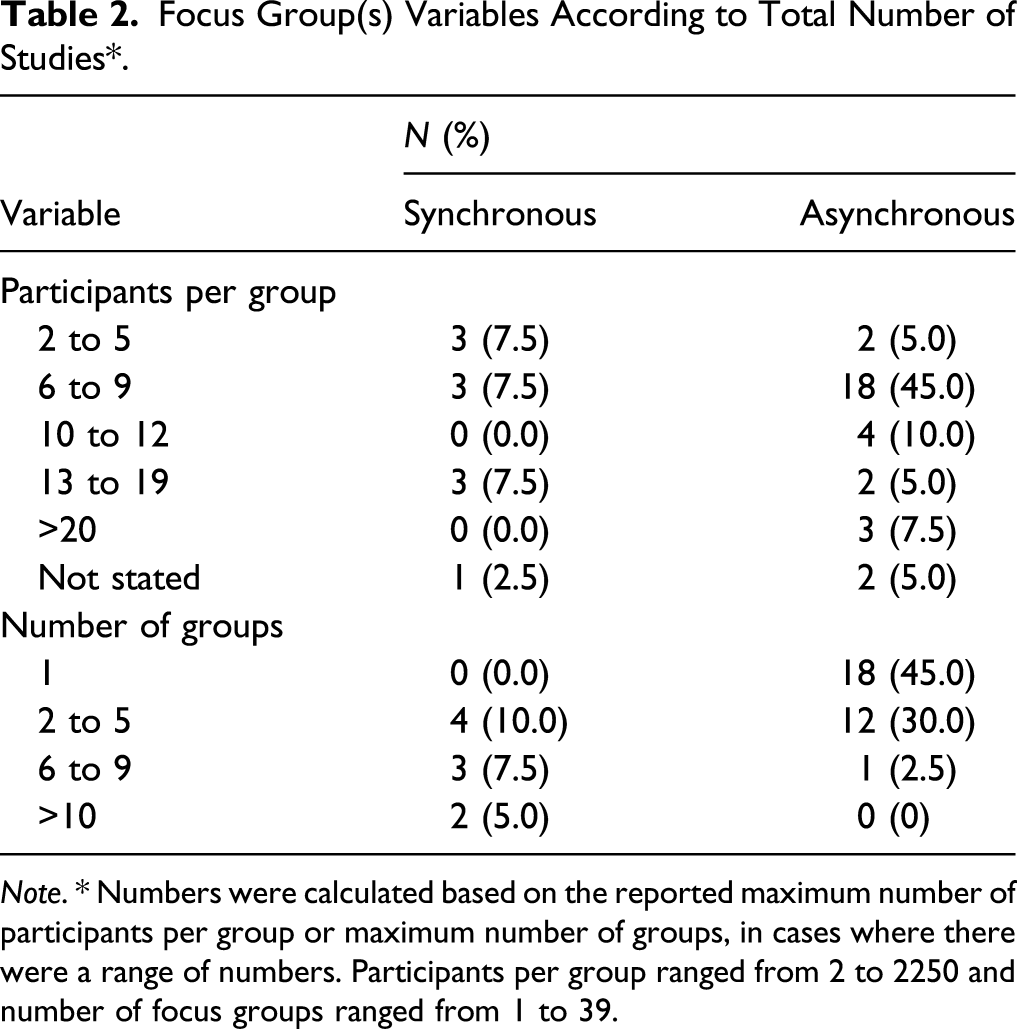
Note. * Numbers were calculated based on the reported maximum number of participants per group or maximum number of groups, in cases where there were a range of numbers. Participants per group ranged from 2 to 2250 and number of focus groups ranged from 1 to 39.
The majority of the studies included in this review were specific to adult participants. Specifically, 32 studies (80%) included participants over the age of 18 years, nine of which had a minimum age of at least 30 years of age; two (5%) included participants under the age of 18 years; three (7.5%) included multiple age groups (e.g., children, adolescents, and parents); and three (7.5%) did not specify the age of their participants.
Moderator Methods
When considering the moderator approaches used in virtual research, three studies did not include any details with respect to how many moderators were used to facilitate the data collection process. In addition, comprehensive details around the specific actions taken or guides followed by the moderator(s) to facilitate focus group research were provided by most, but not all studies. Moderator numbers were tallied based on those that had participant interaction. In some studies, secondary moderators were used to support the primary moderator; these numbers were not recorded as part of this review. Common moderator practices reported included the use of discussion probes, pre-determined discussion topics, (occurring at specific time intervals in asynchronous studies), and the use of more informal discussion regulation (as needed-basis). Various asynchronous studies (10%) indicated that moderator-initiated reminder messages, occurring at regular time intervals, were important to engage participants in discussion. Strategies to maintain active discussion are important when conducting virtual rehabilitative focus group research, especially in the context of asynchronous data collection. Caron and Light (2015, 2016) used Stewart and Williams’ (2005) guidance to regulate their discussion, including requesting participation, commenting, and adding a probing question, while Dattilo et al. (2008) used Morgan and Krueger’s (1998) suggestion of soliciting input or requesting expansions on comments made by participants. To minimize bias, it is recommended that the moderator should avoid influencing or dominating the focus group(s) discussions. Muttiah et al. (2016) used Gaiser’s (2008) guidance to “provide adequate leadership for the substance of the group to ensure that participants actively participate in the discussion while not being overly present as to cause influence on the discussion” (p. 344). Minimizing moderator influence is also outlined by Gill et al. (2008) moderator’s principles, used by Vasluian et al. (2013). In practice, this involved refraining from rephrasing and evaluating statements and instead repeating comments using the participants own words and providing positive reinforcement through neutral comments and probes.
Considering the group of synchronous focus group studies included, four used two moderators, four incorporated two moderators into the discussion process, and one study did not report on moderator method. Incorporating dual moderators in virtual focus group research was reported to assist with discussion monitoring, frequent probing, troubleshooting of logistical or technical issues, and time management; primary and secondary moderating roles help focus the discussion on that included in the guide (Howells et al., 2017; Lynch et al., 2018; Ramo et al., 2019). Four of the asynchronous studies used two moderators, with one of these using three moderators; the moderator method was not reported for one asynchronous study. The majority of asynchronous studies incorporated the use of a single moderator (75%).
Technologies Used
Technology Used for Focus Group Data Collection.

Bold is used for heading level 1 and represents the focus group delivery method type (Synchronous vs Asynchronous). Italics is used for heading level 2 and represents the specific platform used within the delivery method type.
Mediators of Virtual Focus Group Methods
Mediating Factors Reported in Virtual Focus Group Studies.
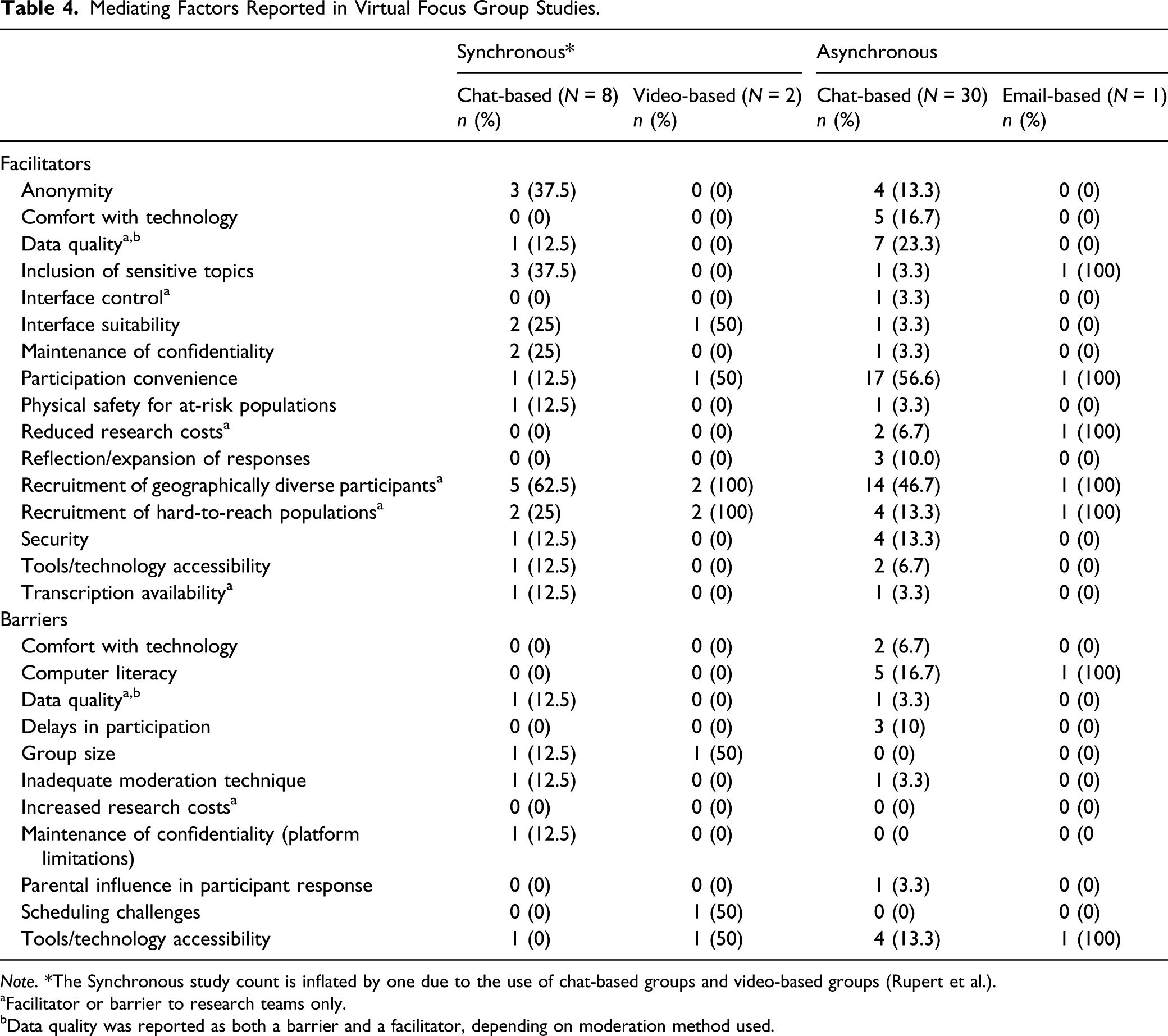
Note. *The Synchronous study count is inflated by one due to the use of chat-based groups and video-based groups (Rupert et al.).
aFacilitator or barrier to research teams only.
bData quality was reported as both a barrier and a facilitator, depending on moderation method used.
Privacy, Security, and Confidentiality
It is important to consider the privacy, security, and confidentiality risks that can accompany the use of virtual data collection platforms. In this review, three studies specified steps taken to ensure data privacy. It is possible that other studies also took steps to protect against data privacy risks; however, they did not clearly define the steps taken to address them. Slev et al. (2017) and Walden and Bryan (2011) required participants to use a pseudonym or anonymous email address to ensure participants anonymity and to ensure confidentiality. Boman et al. (2013) gave participants the option of maintaining anonymity by using an alias during the focus group. Rupert et al. (2017) used a proprietary platform that protected participant privacy and confidentiality, opting against the use of public platforms that did not protect privacy and security, such as Skype or FaceTime. In addition to taking extra precautions, such as those previously mentioned, it is important to inform virtual research participants of any potential risks during the informed consent process. Institutional ethics review boards can help safeguard against and privacy, security, and confidentiality risks, in addition to aligning all research tools/technologies and methods with applicable legislative standards (e.g., Health Insurance Portability and Accountability Act [HIPAA] or Personal Health Information Protection Act [PHIPA] compliant).
Virtual Focus Group Analyses
The most frequently adopted analysis approach in our sample was the Braun and Clarke (2006) method of thematic analysis; this method involves steps such as data familiarization, coding, and thematic analysis (seeking, reviewing, and identifying). Grounded theory, from Strauss and Corbin (1994), was also used by three studies, whereby the analyses and theory development occurred after data collection. Seventeen additional guidelines for conducting qualitative analyses were cited, with 40% of the sample using more than one approach. Additional techniques for reflexivity and minimizing bias were cited, such as Krefting (1991) assessments for trustworthiness and Rose et al. (1995) bracketing technique.
Discussion
We conducted a scoping review of the literature that included 40 studies to synthesize the available evidence on virtual focus group methods used in rehabilitative sciences research, including sample and group sizing, discussion planning, and selection of moderator methods and technologies used for the delivery of the groups. A secondary purpose was to compare specific methodologies used, as they related to the barriers and facilitators across synchronous and asynchronous methods. Our synthesis of these data has contributed to knowledge on how focus group studies differ in their method, both asynchronous and synchronous. Overall, asynchronous virtual focus groups were reportedly used more often than synchronous methods. Results indicated variability in the reported methods and conduct for both discussion types.
The idea that focus groups seem deceptively simple to conduct, and therefore may be misused as a research method, is discussed in the literature (Vaughn et al., 1996). Regardless of whether they are conducted F2F or virtually, researchers should pay attention to the crucial steps to consider in planning for the conduct of a focus group include: (a) determining the purpose of the focus group, (b) constructing the study guide and moderator roles, (c) establishing the size and number of focus groups, and (d) identifying the location (Vaughn et al., 1996). All studies should aim to follow best practice guidelines in the development, conduct, and data analysis as this serves as a means to achieve rich rigor (Tracy, 2010).
The development of a discussion guide remains an important step when preparing for virtual focus groups. The modifications made to focus group discussion guides should consider the type of group being conducted and the format with which the group is taking place. The research team should also consider the role of the moderator(s) and how information will be shared in the virtual space. For example, this may include the use of screen sharing, collaborative online tools such as polling, and other text-based response choices. It is important for research teams to familiarize themselves with the technology and platforms being used when establishing a discussion guide to facilitate meaningful virtual discussion.
The majority of studies in this review reported facilitators to the virtual focus group method used, specifically when considering the need of rehabilitative research studies. Traditionally, in rehabilitation sciences focus group methods, researchers often cite the inability to recruit participants from groups that are hard-to-reach or those that have health problems, and also report high cancellation rates among this cohort (Tausch & Menold, 2016). Some facilitators found in this review included the ability to recruit hard-to-reach participants and physical safety for at-risk groups (Hastings et al., 2016; Holton et al., 2019; Lynch et al., 2018). The most commonly reported facilitators included convenience and greater ease by the participants to participate, accessibility of the focus group from any location, and the research teams were able to recruit geographically diverse participant populations. The use of an online platform also provides anonymity to participants in non-F2F groups, where participants can use pseudonyms when prompted, which facilitates participant comfort, especially when discussing sensitive topics. There is a need for more research using more synchronous and F2F focus group methods specific to health and rehabilitation sciences, as this review only included two studies that used such methods. The benefit of using a virtual approach to collect data has come to the forefront during the COVID-19 pandemic as physical distancing requirements have limited in-person data collection for researchers worldwide. Further exploration and reporting of virtual data collection completed during the pandemic will help expand knowledge around the mediating factors to virtual research.
While there were reported facilitators associated with virtual focus groups, there were also barriers associated with this method of data collection. Two primary barriers revealed in our scoping review included access to technology as well as technology literacy. When considering technology, primary cited barriers included limited access to a computer and/or an internet connection; these technologies are minimally required to facilitate access to the platform(s) being used to host the virtual focus group. Further, participants need to be literate and comfortable with using the required technology, enabling participants to follow instructions and engage in a virtual environment (Tuttas, 2015). Facebook was reported to be an effective method for both asynchronous and synchronous chat groups in our sample; in part due to participant familiarity with the platform, its optimization to facilitate communication, offer notification functions for new comments, and ensure privacy with “secret groups” (Bryen & Chung, 2018; Thrul et al., 2017). A variety of virtual platforms were used in this review, especially for asynchronous methods. Not all virtual platforms would meet the ethical considerations of institutional human ethics review boards when considering privacy, security, and confidentiality, perhaps including Facebook; therefore, research teams need to consider these components, along with ease-of-use when choosing a platform.
The role of the moderator(s) and their performed functions are inextricably connected to each aspect of the focus group and thus serve as a central component to the success of a focus group interview (Vaughn et al., 1996). Moderators of asynchronous studies should aim to organize the discussion thread in a way that facilitates readability for participants, and moderators of synchronous studies should enable a consistent flow of conversation, preferably when they have a commonality to the participating group(s). Thrul et al. (2017) noted that a large number of active participants and questions can cause confusion when the order of questions and comments are constantly updating. They addressed this issue by “tagging” participants in specific questions that were difficult to locate. The choice of moderator can have an influence on the focus group, as indicated by two studies (5%) in our sample; these studies recommended some form of commonality between the moderator and the participants when the research team selects the moderator(s) for the focus group(s). Dattilo et al. (2008) included individuals with disabilities on their research team, borrowing this approach from Krogh and Lindsay (1999). Rackensperger et al. (2005) also employed this strategy by selecting a moderator who had personal experience with using an augmentative and alternative communication (AAC) device when studying the experience of individuals who learned to effectively communicate with AAC technology. This decision positively influenced the quality of the focus group discussion, as the moderator was able to “bring personal experiences and insights to the development of the questions used in the focus group script and to the adlibbed questions used to obtain additional information from participants who posted to a discussion” (Rackensperger et al., 2005, p. 166).
Technology should not always be considered a safe and secure method of data collection, as it can be susceptible to software and hardware glitches, as well as data breaches; thus, for studies that include sharing of health information, the platform needs to be compliant with the policies in place that act to protect health privacy (e.g., HIPAA or PHIPA compliant). Rupert et al. (2017) examined common virtual study claims, such as the notion that virtual focus groups provide faster data, as well as reduce participant burden. Although both of these factors were found to be true in their study, it was also noted that research preparation time was the same or longer, when compared to in-person focus groups, with a higher rate of cancellation and no-shows reported virtually.
Three studies in our review acknowledged the lack of nonverbal cues and intonations as a possible disadvantage in the conduct of the study as it related to observing or enabling participants’ ability to express their feelings (Dickerson, 2005; Meaux et al., 2014; Vasluian et al., 2013). However, it was noted in one study that participants who seek out these types of studies are familiar with the interactions across the virtual mediums and this does not have to be a barrier to all (Dickerson, 2005). Some researchers argued that asynchronous methods are not suitable alternatives for in-person focus groups, as they lack the sense of participant engagement and immediacy of responses (Matthews & Cramer, 2015; O’Connor & Madge, 2003). While also seen as a facilitator, the ability for participants to reflect and respond to prompts and questions at their convenience creates limitations on capturing spontaneity and reduces conversational flow (Tuttas, 2015). Vasluian et al. (2013) addressed this possible disadvantage in their study by enabling the use of emoticons for participants to express their feelings. In conducting a synchronous study, Howells et al. (2017) addressed this limitation through predetermining precisely phrased questions to ensure clear language and continuity of discussion. The use of videoconferencing tools to facilitate F2F discussion could mitigate the disadvantages related to lack of nonverbal cues as they more closely replicate the in-person focus group experience. Videoconferencing technology allows for immediacy and spontaneity in participant responses, facilitates the role of the moderator, and gives the researcher a deeper look into the quality and extent of participant interaction and engagement through the visual component, factors that are important in rehabilitative sciences research (Tuttas, 2015). Web conferencing technology can present limits on group sizes, or a decline in video and/or audio quality, when conducting larger group sessions; for instance, Skype recommends limiting group size to five (Tuttas, 2015). Two synchronous studies included a F2F component in addition to their virtual data collection method (Gupta & Raja, 2017; Rupert et al., 2017). Rupert et al. (2017) provided information comparing in-person and virtual focus groups with respect to costs, recruitment, and participant logistics. In contrast, Gupta and Raja (2017) study did not provide such comparisons; had there been more focus group discussions that used F2F synchronous methods, it may have been possible to generate more information regarding the potential effectiveness of these tools. The findings of this scoping review will be relevant to researchers in the rehabilitation sciences who conduct focus groups and are considering the use of a virtual platform.
This review has also highlighted the need for guidance around virtual focus group methods and subsequent reporting requirements. Findings from this review include data coded as “unknown” in the absence of clearly reported methods; these unknown variables were commonly associated with group size, the virtual platform used, and/or moderation methods. Future research should consider whether the methods incorporated are appropriate for virtual research and whether key methodological characteristics have been adequately reported to help guide virtual best practices.
Limitations
In scoping review methodology, a quality appraisal of the included studies is suggested, but not required. In this review, a quality appraisal of the studies was not included; the included studies were not judged for trustworthiness or validity. Although gray literature material is permissible in scoping reviews, we chose to limit our search to academic, peer-reviewed literature, as we assumed during the peer-review process that a quality appraisal of the individual studies would have been a consideration prior to publication.
Conclusion
Virtual focus groups are increasingly gaining momentum and interest in health and rehabilitation sciences. This may be related to the COVID-19 pandemic but may also be related to the perceived and real value in using them. The results of this scoping review found that asynchronous methods were more frequently used in research studies than synchronous. Focus group sizes varied, with an average size between six and nine participants. There are perceived and real advantages and disadvantages to the use of both asynchronous and synchronous methods; researchers are advised to consider these prior to deciding on which approach to use in their research.
There is methodological best practice guidance available for the conduct of focus groups; however, these need to be modified to be more applicable for virtual focus group methods. Researchers who utilize virtual focus group methods are encouraged to clearly document their protocol, data collection, and analysis methods for others to learn from. They are also encouraged to include effectiveness measures so that a better understanding of the effectiveness of virtual focus group methods is known.
Footnotes
Acknowledgments
This work was supported by an Undergraduate Student Research Internship from the Faculty of Health Sciences, the University of Western Ontario. We would like to acknowledge Marisa Tippett, a Research and Scholarly Communications Librarian at Western University. Marisa kindly assisted us in developing an effective search strategy for this review and provided guidance in this area throughout our protocol development.
Declaration of Conflicting Interests
The author(s) declared no potential conflicts of interest with respect to the research, authorship, and/or publication of this article.
Funding
The author(s) disclosed receipt of the following financial support for the research, authorship, and/or publication of this article: Funding for this scoping review was provided through the Western Undergraduate Summer Research Internship (USRI).
