




Abstract
This article suggests that the understanding of an interview as a social practice can be enhanced by the notion of social action mediated by language and material tools as proposed in nexus analysis methodology. Interviews can be viewed either as a source of gathering information or social practice. The latter approach advocates for a greater sense of reflexivity about the interview situation. This article suggests that nexus analysis methodology can help concretize the greater reflexivity about interactional resources of an interview in different ways. One such way is to explore how parties in an interview interaction use material places to bring out discourses that may otherwise not have been triggered if conventional qualitative interview approaches were used. This is illustrated with interviews about the impact of gold mining on human well-being in the Ahafo Region of Ghana, carried out on a gold mining site. This article concludes that paying attention to the interview site has an unrealized potential to strengthen the reflexivity about the interview situation.
Keywords
Introduction
This article suggests that the approach to interviewing as a social practice can be enhanced by the notion of social action mediated by language and non-linguistic resources as proposed in the nexus analysis methodology of Scollon and Scollon (2004). Interviews can be viewed either as a source of gathering information or social practice. The latter approach advocates for a greater sense of reflexivity about the interview situation. Yet, existing conventions for representing interview accounts tend to obscure the importance of the interaction and practices in an interview situation.
In the social science literature, metaphors such as “interview as a traveler” and “interview as mine,” have been used to describe the interview process (Heyl, 2011). The “interview as a mine” metaphor describes the non-problematized positivist approach to interview as an instrument of data collection (Heyl, 2011). In contrast, the traveler metaphor is used to emphasize the influence of both material things and language on the interview interaction (Heyl, 2011; Mann, 2011). Similarly, Holstein and Gubrium (1995) emphasize the local accomplishment of the interview interaction. However, works in discursive psychology (Griffin, 2007; Hepburn & Potter, 2012; Smith et al., 2005) and applied linguistics (Heyl, 2011; Mann, 2011; Talmy, 2010) underscore the inadequacy of the decontextualized set-up of conventional qualitative interviews. The decontextualization of an interview set-up often results in: (a) the exclusion of the identity category from which respondents are selected; (b) lack of a prior declaration of an interview task to the participants; and (c) the researchers’ inability to account for social issues of interest in their ethnographic environment (Mann, 2011).
The account offered here suggests that the approach to interviewing as a social practice, particularly the reflexivity on the set-up and the local accomplishment of an interview is not new. What appears not to have received adequate attention is how an interview can be organized to ensure that interview representation and analysis account for how the interviewer and interview participants use both the language, places and events within places to accomplish an interview task. Thus, this article presents a multimodal approach to reflexivity on the interview situation, which centers on setting up the interview interaction at routine places where events of relevance to the interview participants and the researcher occur. Moreover, we argue that the nexus analysis introduced by Scollon and Scollon (2004) can help concretize this in different ways.
One such way is to explore how a researcher and interview participants can use: (a) everyday places where actions of interest to the interviewer(s) are going on or have occurred; and (b) the practices of walking, pointing at and taking pictures of semiotic resources in routine places to accomplish an interview task in a way that brings out discourses which may otherwise not have been triggered if conventional qualitative interview approaches were used. This approach is motivated by Scollon and Scollon’s (2004) theoretical and methodological position that social interaction is mediated by both language and non-language tools in place.
This article’s interview approach is illustrated with interviews about the impact of gold mining on human well-being in the Ahafo Region of Ghana. The interviews were carried out on the gold mining site of the company Newmont. Newmont Ghana Gold Limited Project ([NGGL], as it was then called) is a greenfield project in the Ahafo Region of Ghana (Newmont Ghana Gold Ltd, 2005). NGGL operates deep cut mining at its Subika site and open-cut mining in various communities including Ananekrom, Dokyikrom, Yarogrumah, and Kantinka (Boakye et al., 2018). The choice of the NGGL Ahafo Project is motivated by the paradox of Newmont winning the Best Mining Company of the Year Award for the year 2015 and local community activists’ protest over inadequate corporate social responsibility (CSR) and environmental performance (Boakye et al., 2018). Newmont’s award as the best mining company of the year 2015 is attributed to its Ahafo Project CSR, occupational health and safety, and environmental sustainability performance.
Two critical questions are addressed in this article; (a) how can an interview be organized in a way that it accounts for a social issue in its natural place? (b) How can other semiotic objects and linguistic tools in place of an interview influence the local achievement of the interview task differently? This is illustrated with examples from the impact of gold mining on human well-being in the Ahafo Region of Ghana.
Theoretical Underpinnings
This study is influenced by the constructivist ontological position that though reality exists, meaning and meaning-making are socially constructed. Also, this article is mediated by Fairclough’s critical discourse analysis (CDA) theoretical position that discourse exists in a dialectical relationship with other elements of social practice (Fairclough, 2015, 2016). This implies that the interaction between a researcher and interview participants exists as a different interaction but not discrete from other discourses close in place and far away from the interview. Expressed differently, the interview talk is a part of a whole which includes: (a) situations or individual experiences; (b) physical objects in place; (c) human practices in place; (d) the power relations between the social actors behind the discourse; and (e) practices and events far away in time and place of the interview. Fairclough’s dialectical relations approach (DRA) is relevant in this article as it provides a theoretical hook to foreground the relationship of affordance between language and other semiotic resources which come together to facilitate the interview interaction. Analytically, Fairclough’s CDA influenced the structuring, in this study, of the interactional resources within the interview into language and other semiotic tools, and thus the analyses of the complex relationship of affordance between the discursive and material tools. The DRA perspective connects to the approach to interview as a social practice which regard an interview interaction as situated talk influenced by broader social practices.
Conventional Qualitative Interviews
The literature on an interview as social practice criticizes the conventional qualitative interview methodology, defined as a technical process of getting into the inner worlds of interviewees (Heyl, 2011; Mann, 2011; Prior, 2018). According to Heyl (2011), challenges of conventional qualitative interviews are that (a) interview data are seen as reports of objective knowledge, (b) the interviewer’s role is neglected, (c) power relations between interviewer and interviewee are obfuscated, (d) interview as means to offer the interviewee a voice becomes an issue if particular groups are always spoken for by others, and (e) there is a failure to connect micro details of interview talk with analytical claims. The challenges outlined by Heyl (2011) are similar to those enumerated by Potter and Hepburn (2005), who point to (a) the exclusion of the interviewer, (b) the representation of the interview interaction as neutral practice, (c) the absence of identity category from which the interviewee is selected, and (d) the failure to conceptualize interview as social interaction.
Mann (2011) has modified Potter and Hepburn’s (2005) conceptualization of challenges of conventional qualitative interviews into discursive challenges of interviews. Our reading suggests that this modification includes shifts from: (a) an interviewee centered approach to seeing the interview content as a co-construction; (b) a focus on what the interviewee says to greater attention to the interviewer’s role; (c) a decontextualized set-up to a reflexibility about the interactional context; (d) a focus on the content to focus on both the what and how of the interview; (e) concern about questions asked to how researchers recruit, set-up and manage the interviews; and f) detachment from the data to how researchers develop a reflective and sensitive approach in both analysis and representation. These discursive shifts can be linked to studies that theorize interviews as social practice (Heyl, 2011; Prior, 2018; Talmy, 2010). Studies like these seek to take qualitative interviews away from a focus on the object of the interview to the interview as situated interaction mediated by other semiotic resources. Put differently, the interview as a social practice approach aims to move away from seeing an interview as a means of generating neutral data to a critical focus on the interactional resources within the interview.
Similarly, Silverman’s (1973) and Cicourel’s (1964) perspective of the interview as a “social encounter” is a significant critique of interview methodology in qualitative research. The interview as a social encounter implies that though an interview is a situated interaction, an interview interaction is equally influenced by broader social practices and events. For instance, an interview talk about a mining company’s environmental effects at a certain place can be influenced by broader discursive events such as the practices of formulating mining policies to get the best outcome from mining companies. The “social encounter” notion connects with Heyl’s (2011) perspective of an interview as a site of meaning-making within the immediate interaction and an ongoing relationship between the interviewer and interviewee. Furthermore, Kvale’s mining and traveler metaphors emphasized the significance of the interactional relationship between the interviewer and interviewee in the construction of meaning (Kvale, 1996, cited in Mann, 2011). The element of an ongoing relationship is supported by Dordah (2019) who experienced the relevance of developing an ongoing relationship with the interview participants to gain access to interview participants’ practices and routine places.
Like an interview as a social encounter, Holstein and Gubrium’s (1995) concept of active interview foregrounds the interviewer’s role in co-constructing the interview content, and the local accomplishment. This implies that the interview is a joint activity between the interviewer and interviewee aided by semiotic resources in place.
Reflexivity of the Interactional Context of an Interview
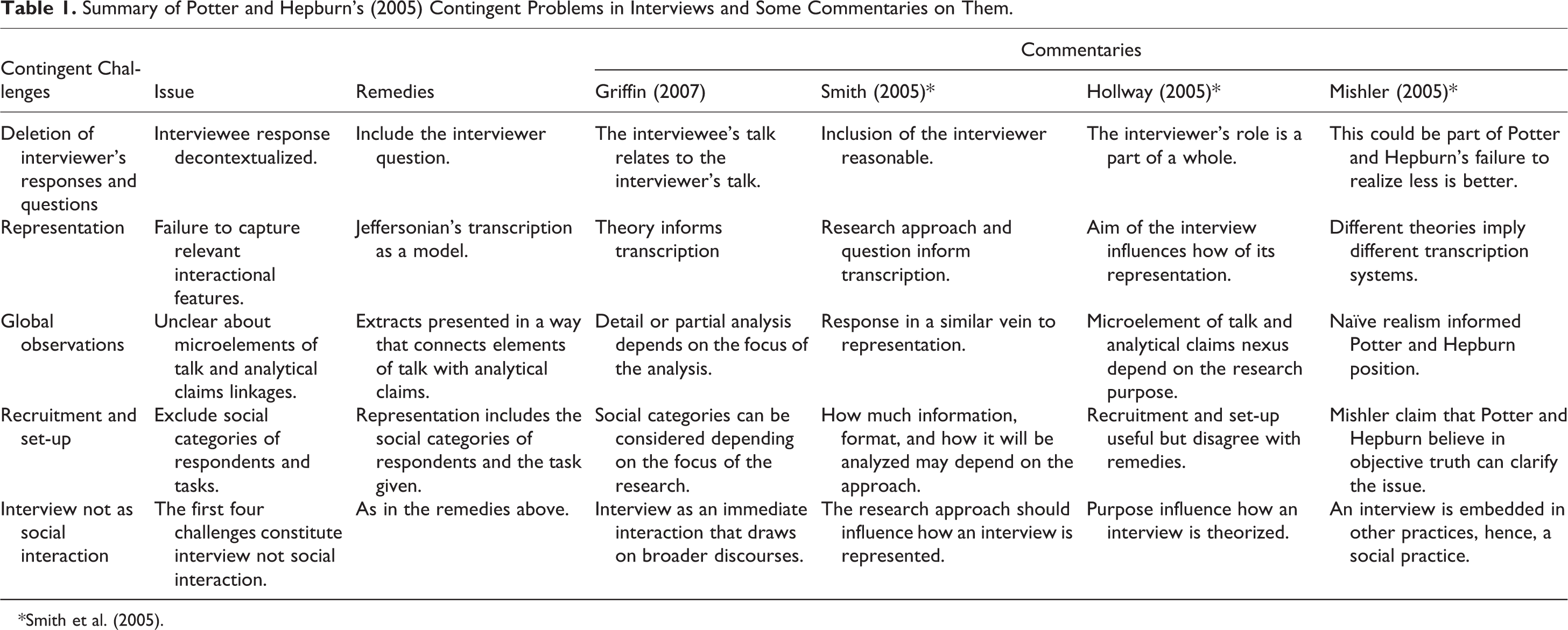
According to Mann (2011), part of reflexivity of the interactional “context” of qualitative interviews includes desisting from quoting portions of interview extracts which serve the researcher’s interest to fuller dissemination of the interactional “context” provided; (a) dissemination of the fuller interactional context is non-sensitive; (b) there is no opportunity for deductive revelation: and (c) requisite permissions are obtained. Similarly, Hepburn and Potter (2012) observed that the representation of the interactional features of an interview is inadequate. Table 1 represents Hepburn and Potter’s, (2012) five contingent problems in qualitative interviews, their main issues, remedies, and notable commentaries from Griffin (2007) and Smith et al. (2005). To make clearer the actions and practices going on in an interview, Potter and Hepburn (2005, 2012) advocate the use of CA representational designs.
However, this suggestion elicited commentaries from scholars such as Griffin (2007) and Smith et al. (2005). It can be observed from Table 1 that Griffin (2007) and Smith et al. (2005) all agree on the relevance of the interactional “context” in understanding the actions and practices going on in an interview. Nevertheless, both Griffin (2007) and Smith et al. (2005) reject a one-size-fits-all approach as in Potter and Hepburn’s (2005) suggestion for the use of Jeffersonian’s transcription model. According to Smith et al. (2005), each research event has different goals and these goals influence how much details of the interactional context should be represented or not. Additionally, the different research theoretical approaches and questions influence which model to use to represent actions and practices going on in interviews (Smith et al., 2005).
However, Potter and Hepburn (2005) observed that Smith et al. (2005) did not show interest in concretizing the actions and practices going on in interviews; neither do they show interest in an evidence-based approach to the design, conduct, and representation of interviews. Besides, it is apparent from Table 1 that though Griffin (2007) and Smith et al. (2005) agree with the identification of contingent problems, yet they expressed less support for Potter and Hepburn’s remedies. For instance, Hollway and Smith (Smith et al., 2005) hold that Potter and Hepburn (2005) approached the interview from a different perspective while Mishler (Smith et al., 2005) is of the view that new positivism is being introduced in qualitative interviews. Potter and Hepburn’s focus on the details of interactional resources suggests that details exist out there and can be known. Potter and Hepburn (2005 as in Smith et al., 2005) concluded that Smith et al. (2005) failed to provide a counterargument to Potter and Hepburn’s (2005) argument that existing conventions for representing interviews obscure the actions and practices going on in an interview.
Heyl (2011) takes the debate on the reflexivity of interviews beyond details of the interactional context to include: (a) a critical awareness about the ideological implications of the interview; and (b) representation, authority, and a voice. The latter implies that reflexivity in qualitative interviews is beyond what is evident in the situated interaction between the interviewer and interviewee; it also implies that the immediate interaction indexicalizes unequal power relations in society.
Clark and Emmel (2010) used walking interviews to make sense of places and neighborhood networks and how far networks are contextualized and reproduced in place. However, this article differed because places and their meanings are tools used by the participants to represent a mining company’s effects which notion of mediation is not the case in Clark and Emmel’s (2010) mobile interview sense-making about places.
The literature accounted for here has emphasized that the interactional features and the ideological implications of the interview situation should be analyzed. This implies that the interview as a social practice does not exclude working with interviews for data/research purposes, however, the issue as is found in the existing literature is about reflexivity and transparency. For instance, the emphasis on interactional features and their connection to broader discursive practices suggests that there is no context-free information; neither is language a transparent medium nor does this exclude the influence of physical place on the interview interaction. Despite the ideological issues, the interview remains a useful approach to generating data.
Table 1 summarizes the key issues of concern and debate in the literature on the approach to interviewing as a social practice. They include: (a) decontextualization of the interview interaction; (b) failure to represent details of an interview’s interactional context; (c) lack of evidential basis of analytical claims; (d) exclusion of the social category of interviewees; and (e) failure to pre-inform interviewees about their task. These issues index the multimodal character of qualitative interview interaction. Yet the major remedy so far has been the suggestion by Hepburn and Potter (2012) and Potter and Hepburn (2005) to use the Jeffersonian transcription system to capture details of the language elements in the interview interaction.
Summary of Potter and Hepburn’s (2005) Contingent Problems in Interviews and Some Commentaries on Them.
While not dismissing the CA approach, we observe a knowledge gap in terms of how an interview can be organized in the ethnographic environment of the social issue of interest rather than in a decontextualized environment decided by the interviewer, and, more particularly, how the interviewer and interviewees can use concrete places and their meanings to facilitate the interview interaction. This line of thinking is influenced by multimodal discourse analysis which argues that “simply analyzing linguistic resources as they are used in a situated interaction can result in a distorted understanding of what is going on in the situated interaction” (Jones, 2012a, 2012b). As demonstrated by Scollon and Scollon (2003), the meaning of signs is anchored on both the social/language and the physical world. To contribute toward filling this gap, this article suggests that Scollon and Scollon’s (2004) nexus analysis methodology can contribute to greater reflexivity about how places and discourses in place can be used to bring out discourses that may otherwise remain buried.
Nexus Analysis Methodology
Nexus analysis (NA) methodology focuses on a moment of action involving social actors, their interaction orders, historical bodies, and discourses in place (Scollon & Scollon, 2004). From this moment of action, NA aims to analyze the historical trajectories of each component emanating from and anticipating broader social practices (Jones, 2009; Larsen & Raudaskoski, 2018; Scollon & Scollon, 2004). Put differently, NA methodology is a kind of discourse analysis combined with ethnography through which the historical trajectories of individuals, places, and objects engaged in a moment of social action is analyzed and linked (Jocuns, 2016). This approach is the result of Scollon and Scollon’s lifetime works such as multicultural communication, mediated discourse analysis, and language in use in the material world.
According to Larsen and Raudaskoski (2018), most studies which use Scollon and Scollon’s (2004) NA methodology are interested in; (a) how social interactions are mediated by discourses in place, objects, and people; (b) how discourses and social relations are shaped by various mediational means; and (c) the affordances and constraints of people, spaces and objects to the accomplishment of situated social action. One can infer from these that not only is NA methodology a multimodal framework, but also it aims to determine what actions, texts, objects, places and people are important for social actors participating in a mediated action. This paper selectively draws from these three aspects to use an interview tour of routine places as a site of engagement within which local community activists represent the impact of gold mining on human well-being in selected mine-affected local communities.
However, the concept of mediated action differentiates NA’s considerations about a local accomplishment of social action from those from CA perspectives. Unlike interviews inspired by CA tradition, which deal with local accomplishment based on what is brought into the interview interaction by the parties, Scollon and Scollon’s (2004, 2008) concept of mediation implies a sociohistorical perspective in the analysis of a moment of social action. This means that a situated interview interaction is influenced by the discourses in place and other social practices located in different spaces and times (see section “Circumferencing the Interview”). Moreover, unlike CA, Scollon and Scollon (2004) regard language as just one element of social practice. Therefore, to theorize interview as a social practice and yet focus the representation and analysis on only linguistic elements which are brought into the interview may imply a too limited focus on what is happening in the situated interaction.
Besides, NA methodology and interview as a social practice meet at the level of the unit of analysis and how to go about studying actions and concrete practices. Based on our reading of Potter and Hepburn’s (2005) response to Smith et al. (2005) the main issues of qualitative interviews as a social practice is about: (a) how an interview representation and design make clear the actions and practices going on in interviews; and (b) concrete design, conduct, and representation of interviews. Similarly, NA methodology is interested in unpacking a moment of social action through analysis of the interaction order, social actors, mediational means, and the discourses in place as well as their historical trajectories. Also, the interview as social practice focus on situated social action together with an ethnographic approach is equally implicated in the tasks of NA.
The Task of Nexus Analysis Methodology
The accomplishment of NA involves three interconnected tasks: (a) engaging the nexus of practice; (b) navigating the nexus of practice; and (c) changing the nexus of practice (Scollon & Scollon, 2004).
Engaging the nexus of practice involves identifying the social actors, the actions they participate in, their interaction orders, and experiences about the social action. A crucial aspect of the task of engaging the nexus of practice is to identify a zone of identification through which others can recognize and accept the nexus analyst as a legitimate participant who shares in the values of those engaged in the action and can contribute to changing the action. This entails an awareness of the positionality of the researcher on the actions, practices and the individuals who conduct the actions under study.
Navigating the nexus of practice involves mapping and circumferencing. Mapping refers to an attempt to understanding the semiotic cycles of discourses, objects, places, and concepts that flow into the moment of social interaction (Scollon & Scollon, 2004). According to Scollon and Scollon (2004), circumferencing refers to the analytical act of opening up the angle of observation on a moment of social action to broader practices across time and space. The task of changing the nexus of practice entails participation, action, and activism (Scollon & Scollon, 2004). But the nexus analyst does not seek to change the nexus of practice from a disengaged position but rather from a politically engaged position.
Nexus Analysis Methodology and Reflexivity in Interview Methodology
In NA, the notion of an “engaged nexus analyst” implies that there is no study of social action from a distance (Jones, 2013; Scollon & Scollon, 2004). For this reason, the analyst must account for how his or her involvement affects the social action and its various components such as social actors and their interaction orders. This connects with an interview as a social practice approach that advocates for the inclusion of interviewer questions because the interviewee responds to the interviewer’s questions.
Like discursive psychology (DP), nexus analysts are interested in the local accomplishment of social action from a sociohistorical perspective. 1 This suggests that NA perceives the interview as social interaction. Being a social interaction implies that the interview encounter is influenced by immediate and displaced events, situations, experiences, and discourses. As a result, the nexus analyst endeavors to account for the affordances of present and past experiences on a moment of actions. This makes NA methodology relevant to understanding the role of interactional resources in accomplishing interview task.
NA adds more reflexivity to the interview because of its greater awareness of the influence of historical events and actions on a moment of social action. Furthermore, NA offers more reflexivity due to its multimodal position that opens up for considering the influence of the physical and material world which surrounds the text (Scollon & Scollon, 2003, 2004). This awareness can contribute to overcoming the decontextualized representation and analysis of interview accounts by foregrounding the significance of places, the meaning of place, and the practice of pointing at places as evidence and how these conjoin to influence what goes on in an interview. In other words, NA methodology provides a multimodal ethnographic framework for analyzing the affordance and constraints of language and non-language elements which flow in and out of a mediated action.
Research Design
A research design refers to the structure of an investigation, which enables the research to generate evidence that unambiguously answers the research question (de Vaus, 2001). This study aims to answer questions of how affected individuals represent the effects of mining and what tools in place afford their representation. Thus, this article is inspired by NA methodology’s longitudinal research design. This refers to immersing the interviewing in routine places and offering the participants the opportunity to give a longitudinal account of actions and events in-situ.
By this design, we aim to extend Scollon and Scollon’s (2004) ethnography of real-time action to an ethnography of representations of actions. Three strategies were used to focus the analysis on accounts of social action: (a) an interview tour of local-local places 2 where Newmont’s actions are ongoing or occurred; (b) memory and sense account of Newmont’s activities by local-local individuals; and (c) local-local individuals’ 3 reference to concrete action of NGGL as the basis for beginning the interview talk.
To operationalize this strategy, it was necessary to identify and recruit interview participants who are members of the community of experience of NGGL’s environmental effects. Scollon and Scollon’s (2004) field guide suggests that social actor surveys be used to identify the social actors and their roles in the action being studied. However, this study used a snowball approach because the focus here is to identify individuals who are affected by Newmont’s actions and who are involved in a struggle with Newmont for a change. Additionally, the study is interested in interviewing individuals who know routine places where Newmont’s actions occurred or are taking place.
In this study, as part of the interview strategy, we assigned the interview participants the task of navigating the sites of engagement and offering accounts of Newmont’s environmental effects within these sites of engagement. This strategy stands in contrast to the conventional practice of inviting the interview participants to place(s) outside of the natural contexts of the actions represented. Selecting and allowing the community of experience to navigate the sites of engagement could suggest that the research design has a bias toward Newmont.
Philosophical Underpinnings of Research Design
This article’s design is informed by Fairclough’s (1995, 2001, 2003, and 2010) critical realists’ ontological position that discourse can create different representations of the world, but whichever becomes consequential is dependent on the power relations between the social actors behind the discourse. This implies that local activist’s representations of Newmont material effects are particular versions of reality, not the only reality. This is relevant to this article’s focus on understanding and explaining the issue of the paradox of Newmont receiving an award as best in sustainability practice amid local community struggles over Newmont impacts on human well-being. Nevertheless, this does not make the local activists’ representation less valid. Rather it lends attention to how human actions are mediated by the physical spaces they inhabit, the practices in place and prior action (Scollon & Scollon, 2003).
Research Environment
Newmont-Ahafo, located in South–West of Ghana, is a greenfield activity because the Ahafo Region is not a traditionally 4 known commercial mining region in Ghana (Newmont Ghana Gold Ltd, 2005). Before Newmont acquired Normandy Mining Company’s lease, about 97% of the population of the then Asunafo South District were farmers (Newmont Ghana Gold Ltd, 2005). Given the evidence of loss of farmlands to mining, the heightened competition for arable land (Taabazuing et al., 2012), and the Asunafo South being a predominantly farming area (Newmont Ghana Gold Ltd, 2005), Newmont’s open-cut and underground mining activities imply that local individuals whose livelihoods depend on land could come into conflict with Newmont’s activities. At the time of this study, there existed an uneasy relationship between the NGGL and mostly the youth of the five mine-affected communities. The youth group calls attention to discrimination in employment, negative environmental effects, and the NGGL’s failure to adequately implement its social agreement (Boakye et al., 2018). The resistance by concerned residents of Kenyasi (n.d.) coupled with the Ghana Chamber of Mines’ recognition of Newmont as the best performer in sustainability practice suggest struggles over how to link Newmont’s actions to human well-being. To understand how this paradox came to exist this study used an interview tour of routine places as an interaction order within which Newmont’s actions in place are represented. The interview tour was conducted by the researcher and selected local community activists who are engaging in advocating for change.
Data Generation
Data generation in discourse research includes processes such as: (a) sampling (b) linking the research to a discourse theoretical position; (c) clarifying the feature of material the research focuses on; (d) processes of transcription; (e) providing a background or context of the material; and (e) determining whether the research focuses on the natural or unnatural talk (Wetherell et al., 2001). In this article, processes of generating data include an account of how the interview was conducted, circumferencing and sampling and clarifying the analytical focus and what the features of the material of interest are.
Materials Feature of Interest
This article’s analytical approach categorized the interactional features of interest within the interview into linguistic and non-linguistic resources. The non-linguistic interactional resources within the interview include places, visual images, local social action within the interview, and individual human bodies. On the other hand, linguistic resources include turn-taking, deictic, demonstratives, and personal pronouns.
The aim of this article is not to engage in conventional discourse analysis or to analyze new data but to make methodological points about interviews. Thus, this article’s analytical approach focuses on analyzing how an interview can be designed, conducted, and represented to enable the interviewer and the interview participants to represent a social issue through: (a) the use of everyday places and their meanings as semiotic tools; (b) the use of individual/collective experiences associated with a place to represent a mining company’s effects; (c) how the use of pronouns, deictic, demonstratives, and turn-taking conjoined with the practices of pointing at places influenced the accomplishment of the task of the interview; and (d) how the combination of the first three connects to broader discourses on mining and human well-being. The analytical focus on places and their meanings as mediational means has implications for who gets selected for interviewing and who decides the places where the interview takes place.
Sampling
The sampling procedure adopted for this study is influenced by: (a) the issue of contention over Newmont’s contribution to human well-being; (b) the interest in studying meaning-making with fidelity to their natural context; (c) the interview strategy adopted; (d) the intension to generate multimodal data to answer a “what” and a “how” question; and (e) the researcher’s prior ethnographic engagement in places where stakeholders interested in the topic do their everyday activities like drinking and chatting.
Purposive sampling is the main sampling approach of this study. This is a type of non-probability sampling in which the researcher selects the sites and participants of the study based on their relevance to the research question or the purpose of the study (Bryman, 2016; Morehouse, 2012; Neuman, 2007).
First, we purposively selected Newmont as a case study because it exemplifies the ambiguity and contention 5 which surround the mining and development relationship. Second, a snowball or chain referral sampling approach was used to select participants from four mining-affected communities. Snowball sampling refers to the practice of selecting initial participant(s) who can answer the research questions and those initially selected propose others who can answer the research questions (Bryman, 2016; Creswell, 2009; Neuman, 2007). The first stage involved selecting a gatekeeper who knows those who are interested in and are talking about Newmont’s effects on human well-being. The second stage involved an interview with a local community activist proposed by the gatekeeper. At the end of the interview, this local community activist also mentioned another participant as someone interested in and involved in talking about Newmont effects on human well-being. This process was repeated until a total of four local community activists were interviewed.
The participants selected through snowball sampling were told the task of the interview and their consent to use their responses for publication was obtained. In most cases, upon a question on the relevance of the interviews to the interview participants, they were informed that publications that may arise from the interviews can help share their concerns to a wider audience thereby enlarging and empowering local activists’ voices. Additionally, the interview participants were allowed to navigate the nexus of practice by taking the researcher to everyday places of their interest as a form of transferring power to the interview participants. Interview participants navigating the sites of engagement is an ethnographic strategy that aims to address the analytical question: what are the interviewer and interview participants doing at a place and how are places and their meanings used as semiotic tools to accomplish the task of the interview? The theoretical positions which informed this study imply that beyond places and their meanings different practice conjoins to influence how places and their meanings are used as mediational means.
Circumferencing the Interview
The account of how different practices which come to influence what goes on in a site of engagement such as an interview interaction is referred to as circumferencing (Scollon & Scollon, 2004). In this article, the analytical act of circumferencing the interview is about telling the story of how the interview came about, the interactions that led to the interview, and made it possible.
The interview tour of places evolved from the ethnographic processes of engaging the nexus of practice. In the process of identifying social actors, places, discourses, and their connections the study discovered that the local-local activists’ use semiotic objects like visual images of people and places to represent Newmont’s environmental effects on individuals, places, and objects in the remote communities in which mining takes place. The social practice of using visuals as evidence of Newmont’s negative environmental effects motivated the conduct of interviews right at the places where the actions occurred or are ongoing.
Additionally, the practice of developing a relationship with social actors who are engaged in the social action of interest can be connected to the interview approach of walking and talking about Newmont’s environmental effects at material settings where the actions are ongoing or have occurred. It is the relationship the researchers developed with local-local activists over a period that led to the local-local activists promising and taking the researchers “to the remote places” where Newmont’s actions are going on or have occurred.
Furthermore, the social practice of discovering scenes where social action of interest takes place or is talked about can be connected to the practice of an interview tour of settings in which Newmont’s actions occur. In the process of surveying the scenes, we discovered that Newmont’s negative environmental effects on individuals, places, and objects occurred in the remotest villages, not nodal towns like Kenyasi and Ntotroso. To represent Newmont’s actions, we must walk together with the local-local activists at natural settings in selected remote local communities to jointly represent Newmont’s actions in-situ.
Besides, the interview tour of places evolved from the ethnographic practice of engaging the nexus of practice. As part of engaging the nexus of practice to discover discourses, people, and places and their connections, a researcher embedded himself in a local-locals social media platform. The local meaning-making circulating within the virtual space equally prompted the researchers to tour local-local places together with some of the activists. At these local-local places, the local meaning-making circulating within the local-local social media platform influenced the questions the researchers bring into the interview talk. Moreover, this study interview approach is linked to the challenge the researchers faced in accessing naturalistic data from institutions and entering face-to-face interactions with Newmont’s officials. The failure to obtain naturalistic data and conduct institutional interviews partly influenced the choice of walking and talking about Newmont’s actions in their natural settings. And the practice of touring places and using objects and events in place to motivate the talk relates to the questions which NA aims to address.
Nexus Analysis of an Interview Tour of Places
According to scholars in MDA (such as Cserzo, 2016; Jones, 2013; Scollon, 2008; Scollon & Scollon, 2004), a fundamental question in NA is; what action is going on, and how is discourse used to accomplish the action? In this case, the action going on is using an interview to give an account of Newmont’s socio-environmental effects on people, places and objects. However, lower-level social practices which occur within the interview include walking, talking and taking pictures of places and objects, giving memory and sense account of a place, and the use of visual semiotics to index environmental effects and their linkages to other entities. These lower-level actions are relevant and throughout the interview both R and P1 remained focused on them because they are the practices through which the task of the interview can be accomplished. NA invites us to pay closer attention to those lower-level actions and their use of mediational means. In the following, we give examples of different ways in which attending to place related mediational means can widen our understanding of interview as a social practice. In contrast to Cserzo’s (2016) study where the interviewees were engaged in a parallel activity while the interview remained focused on the task, in this study both the interviewer and interviewee were focused on the task of the interview. The difference can be attributed to the practice of the interviewee deciding and taking the interviewer to places of interest to the interviewee.
Choosing the Places to Visit
As part of the interview strategy, R inquired from P1 whether there are some places of interest to visit. Line 264 of extract 1 shows P1’s positive response to R’s question, “Yeah, we can go over there.” The question about places of interest to visit and the response indicates that, unlike conventional qualitative interviews, in this study, the specific sites to visit are not pre-planned. Besides, the deictic “over there” but not to a different place or faraway place suggests that the next site is within public distance from where the immediate interaction is taking place. The microelements of the interaction such as P1 use of demonstratives and deictics are indications that the issues talked about are close to where the interview is taking place. For instance, in line 267 of extract 1, the use of the deictic “here,” suggests that the social issue which the talk focuses on exists close in place and time of the interview interaction.
Extract 1
Are there some sites you want us to visit now
Yeah, we can go over there
Thank you
Mine leakage water they left it over here
Mine leakage water leftover here
gives P1 mobile phone to snap alleged leakage water [.]
You see this pipeline
Offers P1 mobile phone camera to snap the pipeline
And P1 took the mobile phone camera and snapped the pipeline
picture of the pipeline

Yes
it is being used to draw water from that place that points to the
mines
Yes, okay
And eerm look at how it leaks over here
Previously, this leakage water was crossing into our village
Okay
And when it gets here, you see there is a farm here
Yeah
when it cross over and come into our farm, all the crops have to go
283 down
The practice of touring places presents an opportunity for P1 to account for Newmont’s environmental management practices as present ontologies which exist in a situated place albeit in a passive form, “it is being used.” Thus, touring places presents material places and objects as mediational means to accounting for mining effects on social practices at concrete places.
Places and Objects as Mediational Means
At the places chosen, the researcher offered the interview participant a mobile phone to take pictures of places and objects in place as evidence of Newmont’s environmental effects. Line 268 of extract 1, shows that R offers P1 a mobile phone, to take a picture of a pipeline in place of the interview. And lines 270 and 271 of extract 1 instantiates the practice of taking pictures of places and objects and their consequences on the immediate interaction. Specifically, P1’s reference to a pipeline (line 269 of extract 1) and R’s affirmation (line 270 of extract 1) as in offering P1 the mobile phone camera demonstrates the influence of the use of visual evidence in place to represent Newmont’s actions. Compared to the conventional decontextualized interview approach, the tour of places allows the interviewee to point at material objects in place as evidence of the inadequacy of environmental mitigation measures.
Moreover, there is the action of pointing at Newmont and local individuals’ social actions at a place as a way of making a place-based meaning between Newmont’s environmental effects and human well-being. For instance, line 266 of extract 1, P1 points at Newmont’s material environmental effects, the discharge of liquid substances from the mine at a place, and its implication on local social action, farms. Line 282 of extract 1 linguistically realized a negative connection between Newmont and local individuals’ social action in the evaluation, “when it crosses over and comes into our farm, all the crops have to go down.” This implies that whenever there is a spillage of discharges from Newmont Tailings Storage Facility (TSF) into the farms all the crops in the affected farms die off.
Material Objects as Mediational Means
Beyond taking pictures of places and objects, material objects are used as tools to index real-world social practices and relationships going on at the site of the interview. Material objects are used in the interview interaction as “represented participants” to narrate events, actions, and processes of change in material places. For instance, line 41 of extract 2 shows that P1 refers to a concrete borehole, “the borehole,” to account for Newmont’s material corporate good works at a place close to where the immediate interaction is taking place.
Extract 2
Newmont says that they have provided you with alternative sources
of water.
Because they have blocked Subri, but they have drilled boreholes.
And the borehole is, should be okay for you.
So why do complain about this posing negative effects on your lives?
The borehole that they drilled, they did not drill it into the very
deep of the earth.
Sometimes when you drink the borehole, the water it stinks.
You can sense some this thing […] some ionisation this thing.
It seems like rusted chemical in the […].
So and the water too we suggest it is very close to their pit and
the tailing’s dams.
It can leak through.
There is someplace that the tailing
And it is the same place that […] is not far from where the borehole
is
So we are afraid it can leak through that one too.
offers P1 a mobile phone camera to take a picture of a borehole
Takes the picture of the borehole
Picture of a borehole, a researcher and “a together with”
Source: Dordah (2019)

So, do, do you have people, who have eer, had proven cases of eer,
proven medical cases, that eer, they, they eer, experts say is due
to eer, the drinking of contaminated
water?
Yeah, we have had that problem.
I think that was last 2 years ago, some people get foot rotted,
skin rashes.
As you can see this brother here, he has experienced severe skin
rashes.
And he went to the clinic they told him that he has been using
contaminated water.
And those and this, this the one we use to bath, to wash, to do everything.
Furthermore, the location of the borehole close to the discharge from Newmont’s TSF constitutes a material tool that P1 used to buttress his account of Newmont’s negative effects on the local community’s potable water. Because the borehole is located close to where the TSF leaks, P1 and those he represents are afraid, “So we are afraid it can leak through that one too” The collective fear expressed by P1 can be realized in the discourses in place within the perceptual space such as, “the water it stinks” (line 43 of extract 2), “You can sense […] some ionisation this thing” (line 44 of extract 2), and, “it seems like rusted chemical in the…” The meaning of these words as expressing fear can be understood in the context of P1’s account that Newmont provided a borehole close to where its tailings dam allegedly leaks. These words suggest that the chemicals which Newmont uses in its operations have contaminated the borehole.
Individual Experiences as Mediational Means
At the interview sites, the participants point at other persons human bodies as material evidence of mining effects on human health. For instance, P1 saying, “As you can see this brother here,” requires R to locate an individual’s human body to be able to make sense of what P1 is saying. But the practice of pointing at other person’s human bodies is itself mediated by individual experiences, for example, about the emergence of strange diseases and what used to be the case in time past. However, the interaction also demonstrates that mediational means are not static; rather, they are dynamic and can be linked to the historical experience of individual social actors. Whereas P1 uses the history of experience of strange ailments as mediational means, R seeks to insert P1 and his group experience in scales beyond the immediate interaction. This implies that the methodological strategy of touring places empowers the interview participants by exposing them to place-attached semiotic resources that are used to express alternative discourses.
Memory and Sense of Places
The presence of a specific place is also used to prompt discourse on how this place used to be. At a specific place, as shown in lines 135 to 137 of extract 3, R invites P1 to give memory and sense account of a place.
Extract 3
So before Newmont came into being and before eer these things were
here, so when you now see this place now, what comes to your memory
What do you remember that this place used to be like
Our land is being destroyed because previously all here were cocoa
farms, they were full of crops, fruits, vegetables and now look at
it
How beneficial were those to you? Cocoa farms, crops
Cocoa farms we get money, our schools’ fees were taken care of, we
were not hungry and now, they are all gone
They have graded it away
Thus, P1’s response in line 138 of extract 3 reveals Newmont’s environmental effects on a parcel of land collectively owned by P1 and the group he represents. Also, P1 accounted for the implications of the destruction of the land on the attainment of basic human needs such as income and food because farming used to be done on the land. Additionally, lines, 142 through 143 of extract 3 contain P1’s representation of a downstream linkage between practices of farming at a place and other social practices like parents and guardians paying school fees of young people and providing food for household consumption. But due to Newmont’s environmental effects farming which is positioned as the growth pole no longer exists at a place, “they are all gone […] They have graded it away.” Thus, the tour of the place provides the opportunity for P1 to refer to material practices and events like farms that used to exist at a material place.
Upscaling Micro-Actions to Broader Discourses
As indicated in the previous section, the practices of situating the interview at a certain, relevant place may invite the interviewee to articulate broader discourses associated with that specific place. For instance, in extract 4, the researcher and the interview participant jointly connected the here and now talk about Newmont’s environmental effects on human functioning to Newmont’s corporate discourse which exists in a different space. This arose from P1’s account of local-local past positive discourses like farming and generating income and food to meet human needs associated with a place where the interview is taking place. Specifically, in line 145 of extract 4 because of P1’s talk about Newmont’s negative discourse R brings into the immediate interaction Newmont’s discourse of providing scholarship packages through the Newmont-Ahafo Development Fund (NADeF). Thus, R represents Newmont’s CSR practices as a mitigation to the disappearance of cocoa farms, crops and vegetables, and the consequences on parents’ ability to cater for their children’s school fees.
Extract 4
Newmont-Ahafo says they’ve come eer to in place of cocoa they now
have eer NADeF, eer Newmont-Ahafo Development Foundation which is
doing so well in education so if your cocoa farm has gone, have
gone away and they are now paying your school fees through NADeF
and building schools, they built Ntotroso Nursing Training
College, they have done this, you have ICT training centre then
what is the difference
Erm, previously, how we were managing ourselves, it quite different
from how they are telling us that things are going
That NADeF support that you talk about is not all that easy and
is not all that people that get access to it
It is a few people and eerm, I can say it is even those within the
Newmont that use the, the NADeF system
We the villagers and the poor people when you go there, they don’t look at you
First, P1 connects the immediate talk to another scale as in how a collective manage themselves in times before Newmont came. This is verbalized in line 152 of extract 4 as previously, “how we were managing ourselves.” Second, in response to R’s question, P1 connected the here and now talk to the difficulty of a self-categorized collective group, “We the villagers and the poor people,” have in getting access to NADeF scholarship packages. The unequal access to the NADeF fund can be linguistically realized in the negations, “is not all that easy” (line 155 of extract 4), and, “is not all that people that get access to it” but rather it is a privileged few people within the Newmont system who have access to the fund.
The Affordance of Non-Linguistic Resources
This section aims to summarize abstractly how material tools are used to represent Newmont’s environmental effects at places. According to Scollon (2001), these include material objects in the world such as designs, furniture and computers. By this definition, the main material mediational means in the interview interaction between R and P1 are (a) mobile phone camera used to capture images; (b) places and the meaning of places; and (c) how images are used to prompt the talk and to give evidence.
The most clear-cut semiotic tool is the mobile phone camera device which is used by R and P1 to take images of places and objects of significance to P1. In terms of the environment of the talk, the way interview is organized in the ethnographic places of Newmont actions together with the use of mobile camera jointly influenced what R and P1 can capture as Newmont environmental effects at a place. For instance, images are used to visualize collaborative interactional practices going on between R and P1 such as jointly taking pictures of places and objects as evidence of the Newmont environment effects. In other words, visual images are used to move beyond the talk about the research interview as a co-construction and finding out information to illustrate the research interview as moments of co-construction. The practice of R giving P1 a mobile phone to take pictures of places that prompt the interview talk instantiates the interview interaction as moments of co-construction.
Visual images of places and objects are also used to represent both conceptual and narrative relationships among represented participants. For instance, the image of the pipeline which is used to redirect spilled water from the TSF into the mines constitutes a conceptual system of representation in the sense that the picture paints an abstract situation of Newmont’s environmental effects. This is because there is no vector of gaze or direction of movement depicted in the picture itself, except for the verbal narrative which linked the picture to social action close to the place of leakage. Therefore, the conceptual system of representation provides material means for the interaction participants to accomplish the task of the interview.
Besides, in this study, images are used to narrate how Newmont’s actions came to exist at a place and the relationships among the elements represented in the images. The image of a borehole drilled by Newmont, the multiple gazes of the researcher and “a together with” in the picture, demonstrates an instance where P1 uses visuals to show relationships among the objects in the picture. The gaze of the two social actors in the picture demonstrates that both parties are paying attention to the borehole. And the individual behind the researcher’s gaze on the borehole connects to P1’s verbal representation of a negative relationship between this individual’s body and the water the individual drinks from the borehole.
Further, the borehole which indexes Newmont’s corporate good works is connected to the pipeline through P1’s talk in a negative way because discourses in a place like the affected local community consumption of water from the borehole, the sense made from the scent of the borehole water link the borehole to Newmont’s negative environmental effects. Normatively, the provision of boreholes by mining companies is a positive social practice, valued by both local communities and Ghana’s minerals and mining policy. But from a place semiotics’ perspective, images take their meaning based on the practices going on at where the image is located. An instantiation of place semiotic can be found in extract 4, where the image of a borehole takes its meaning from its placement close to where the TSF exists and is leaking onto the external environment. The image in extract 4 is used to do two things: (a) demonstrate that Newmont’s CSR events are inadequate to offset the environmental effects; and (b) concretize the material effect of Newmont’s environmental effects in the body of an individual at a place.
As reiterated above, R and P1 use visual semiotics to point at Newmont’s actions going on at concrete places but these practices of pointing at Newmont’s actions and their linkages to people, objects, and places are not discrete from the language in use in the interaction.
The Affordance of Linguistic Resources
For instance, the material practices of R handing a mobile phone camera device to P1, the practice of taking pictures of material places and objects are mediated by language in use. Common linguistic structures used to index Newmont’s negative environmental effects in place include deictic, demonstratives, personal pronouns, tense, the stress of words, and turn-taking. The use of deictic and demonstratives suggests that the meaning of accounts of Newmont’s actions represented can be understood from where these actions are located and the gestures (as in the use of demonstratives) to point at places. For instance, the interpretation of the demonstrative, “this,” and the deictic, “here,” depends on whether the listener can identify who exists close to the place of the interview and is being gestured at. To understand what is going on, the listener must know the pattern of events at a place and the experience of the individual P1 gestures. However, because this study used audio recording and the focus of the study is on representing Newmont’s action, details like bodily gesture which may have accompanied the use of demonstratives and deictic are lost. The methodological point about the use of deictic and demonstratives is that the way the interview is organized provides the option for R and P1 to use these linguistic expressions to link the talk material places, people and objects close in time and place of the interview. Not only do language and material tools afford the interview interaction but also R and P1’s joint focus on the task of the interview demonstrates the co-accomplishment of the interview task.
The Role of the Researcher in the Interview
Throughout the interview, the researcher encourages, collaborates and facilitates the interaction by acknowledging and offering the mobile camera to P1 to take pictures of places and what is going on at places that are relevant to P1. For instance, lines 270 in extract 1 and line 53 of extract 2 are instances where the researcher facilitates the interaction by offering P1 a mobile camera to take pictures of events of interest to P1.
The researcher plays the devil’s advocate role by referring to scales such as Newmont’s representation of its corporate good works as legitimation for the actions of Newmont in place. This practice of introducing company social responsibility practices into the interview provides an opportunity for P1 to contrast what Newmont’s claims it has done with good effects to the alternative framing of local activists based on the meaning they make out of what exists or used to exist at a place. Lines 36–40 of extract 2 and lines 145–151 of extract 4 instantiate the researcher playing the devil’s advocate role by introducing other scales to contradict P1’s representations. Specifically, in line 36–40, the researcher brings into the talk Newmont’s practice of constructing boreholes as a part of its CSR practices. By representing this practice and further asking a “why question” in line 40 of extract of 2, R motivates P1 to evaluate what Newmont says it has done with good effect by contrasting it with Newmont actions close to the place where the borehole is sited.
Besides the researcher ensures that the talk achieves the goal of the interview, linking Newmont’s effects in place to human well-being. The researcher achieves this by asking questions and evaluating the responses. For instance, the episode captured as extract 3 reveals that the researcher refers to time scales different from the time of the interview and asks P1 to make a memory and sense of a particular place relative to sometime past. Line 140 reveals that the researcher probes further by asking the P1 to express the relevance of past practices associated with a place to P1 and possibly those P1 speaks for.
In the interview tour of places, the researcher’s role as in facilitating taking pictures of events in place and providing the opportunity for P1 to use objects in place to contradict Newmont’s representations indicates that the place and its meaning are crucial to understanding local affected individuals’ meaning of a mining company’s effects on human well-being. But different practices which exist in different venues come to influence how the researcher came to play one role or another in the interview interaction, and these should be accounted for.
Discussion
The article aims to illustrate how an interview can be organized in a way that accounts for a social issue in its natural setting and how greater awareness of linguistic and material tools within an interview can be used as tools to accomplish interview tasks.
Conventional approaches to qualitative interviews do not account for the actions and practices going on in an interview and the big issues the actions and practices indexicalize (Potter & Hepburn, 2005). To address this, Potter and Hepburn (2005, 2012) proposed CA transcription as an approach that can highlight the actions and practices going on in an interview. Smith et al. (2005) agree that existing approaches to qualitative interviewing are inadequate in capturing the actions and practices going on in an interview situation but reject Potter and Hepburn’s suggestion to use Jeffersonian transcription.
Thus, if an interview is a social practice, how can the interview be organized in a way that ensures the interview talk, representation, and analysis focus on the actions and practices in their natural setting? Various practices conjoin to produce a site of engagement in which Newmont effects are represented in their natural settings. They include an (a) interview tour of the local-local places where the action is going on or occurred; (b) a memory and sense account of NGGL’s activities by local-local activists; and (c) local-local individuals’ reference to concrete action of NGGL as the basis for beginning the interview talk.
Hepburn & Potter (2012) argue that conventional approaches to qualitative interviews do not capture relevant interactional features, hence the suggestion to use Jeffersonian transcription. This study’s approach of walking and using semiotic resources to talk about Newmont’s actions in their natural settings demonstrates that the issue of capturing relevant interactional resources can be helped by a focus on materiality and place without fully using the Jeffersonian transcription model.
In this study, the opportunity granted the local-local activists to navigate the sites of engagement concretizes interview as a social practice concerned to reduce the unequal power relations between the interviewer and the interview participants. Moreover, this study’s approach of an interview tour of local-local places determined by the local-local individual participants is a methodological departure from the traditional interviewing practice of inviting interviewees to a place decided by the researcher. The approach provided an alternative epistemological option which ensured that the researcher does not impose pre-conceived categories on the talk through questioning, footing, positioning, and turn-taking practices.
Besides, this study’s interview approach takes the focus on the interview situation beyond a focus on turn-taking, footing and positioning to include a focus on the influence of people, discourses in place, historical body of both the researcher and the participant, the mediated social action together with displaced fields which influence the “what is going on.” Though scholars like Talmy (2010) and Heyl (2011) have emphasized that the interview situation should be analyzed, these scholars are not explicit about a focus on the affordances and constraints of the material mediational means in the interview. In this study, the affordances and constraints of material tools in place together with displaced field thus become the site of analysis.
This article concretizes the representation of an interview as a journey metaphor through Scollon and Scollon’s (2004) analytical act of circumferencing. That is, telling the story of how the interview came about concretizes the representation of the interview as a journey metaphor. Thus, circumferencing extends the notion of an interview as a situated practice linked to broader discursive practices to a notion of an interview as a social practice embedded in other material practices which made interview talk possible.
Besides, there is an issue in DP and applied linguistic literature that qualitative interviews do not include the social categories and settings from which interview participants are recruited (Hepburn & Potter, 2012; Mann, 2011). In this article, the analytical act of circumferencing the interview suggests that the issue of exclusion of social categories and settings from which interview participants are recruited can be enhanced by connecting the moment of interview talk to the practices of discovering social actors who are engaged in action, for example through the scenes and social actors’ identification strategies.
In this study, the practice of situating the interview in relevant places motivates both local place-attached and broader discourses associated with certain relevant places. The use of places to talk about near and far discourses supports Hollway’s (Smith et al., 2005) position that maximum meaning is derived from being in-situ. But rather than the researcher taking field notes about the context, this study focused on the material places, objects, individual and collective experience which local-local activists used to accomplish the task of representing Newmont’s actions in situ. This strategy contrasts conventional interview reports such as Mumuni et al. (2012) that use numbers of respondents who perceive negative effects as mediational means to represent mining effects on farming.
The representation of the practice of taking visual images together with representing how deictic and demonstratives are used to indexicalize Newmont’s negative environmental effects supports Mann’s (2011) position that reflexivity of interactional context should include a wider sharing of the interview data. But beyond achieving transparency in representing interview interactional context, in this study, visuals and linguistic elements, which index Newmont’s actions in place are represented because they are interesting, used as evidence and tools to drive forward the local meaning-making in the interview situation. Additionally, the local-local activists’ use of visual images of places, individuals and objects as concrete evidence of Newmont’s actions support the position of Smith et al. (2005) that CA’s traditional transcription cannot be regarded as total inclusion of detail interactional features. CA’s transcription captures more of language than materiality and place.
Scollon and Scollon (2003) observed that visuals and voice as forms of representation turn to dominate the sense of smell, temperature, touch, or taste. In contrast, this study observes that physical events like a borehole and reference to different semiotic zones such as physical entities like rashes on a human body and smell from the water of the borehole constitute relevant local meaning-making tools. This implies that a significant part of how local individuals make meaning out of Newmont’s CSR practice is how things smell and how things feel. This implicitly connects with Hollway’s (Smith et al., 2005) suggestion that the qualitative interview researcher’s record emotions expressed in interview interaction as valid data.
The inclusion of the interviewer and the practices he and the interview participant jointly undertake support Smith et al.’s (2005) position that the inclusion of the interviewer should be part of a whole. This implies that in this study the interview participant’s response is not based only on the researcher’s question but the task which was assigned to them before the opening of the audio recorder for interaction to start. This study extends the notion of inclusion of the interview as part of a whole by telling the stories of prior social practices which made the interview possible.
Conclusion
This article suggests that interview as a social practice approach can be enhanced by Scollon and Scollon’s (2004) NA methodology’s notion of social action as mediated by language and non-linguistic resources in place. The article concludes that NA can add to the approach of an interview as a social practice through (a) a focus on place and the meaning of places to the local individuals; (b) the influence of historical events and experience on a moment of social action; and (c) regarding a moment of social action as connected to other material social practices which made the moment of social action possible.
This article concludes that the application of the analytical concept of circumferencing extends the notion of an interview as a situated social interaction plus a relationship flowing out of the social interaction to include a notion of an interview as embedded in prior practices that influenced the interview. Additionally, this article extends the reflexivity of the interview interaction from a focus on linguistic features to how places and their meanings afford the interview interaction. Lastly, we conclude that paying attention to the interview site has an unrealized potential to strengthen the reflexivity about the interview’s interactional context. The NA methodology’s addition to greater reflexivity about interview interactional context is by no means a complete project. However, we have demonstrated how parties in an interview interaction use material places to bring out discourses that may otherwise not have been triggered if conventional qualitative interview approaches were used. The application of NA to interviewing as social practice suggests that a multimodality approach to interviewing as a social practice should be given greater consideration.
Footnotes
Declaration of Conflicting Interests
The author(s) declared no potential conflicts of interest with respect to the research, authorship, and/or publication of this article.
Funding
The author(s) received no financial support for the research, authorship, and/or publication of this article.
