




Abstract
Family qualitative research poses unique methodological considerations. In choosing a methodology when the research unit is a family it is critical the philosophical underpinnings, characteristics, and methods of the methodology can align with a family systems paradigm and accommodate transactional level data collection. While other qualitative methodologies have been utilized with family units (grounded theory, phenomenology), the combination of narrative inquiry (NI) and families is unique. In this paper, I describe why and how I used NI to explore families’ perspectives of the impact of acquired brain injury (ABI); adding to existing methodological knowledge by demonstrating NI has potential relevance and applicability for research with family systems.
Introduction
Crotty (1998) declared methodology is the master research blueprint or strategy that justifies the choice and use of particular methods to align with the research question, theoretical underpinnings, data collection, and measures of analysis. For qualitative researchers studying the impacts of chronic health challenges on families, methodological choice requires heightened consideration. Families are a complex system and it is possible to study the family through the context of individual members, the sum of its individual members, or the individual and the family together. Historically qualitative family health researchers have focused on the needs of individual family members rather than the family as a whole primarily by interviewing individual family members rather than the family (Eggenberger & Nelms, 2007).
Family qualitative research poses unique methodological considerations. In choosing a methodology when the research unit is a family it is critical the philosophical underpinnings, characteristics, and methods of the methodology can align with a family systems paradigm and accommodate transactional level data collection (data derived from family interactions that can only be generated through discernable interactions among multiple family members [Fisher et al., 1985; Sullivan & Fawcett, 1991]).
Other qualitative family health researchers have utilized the methodologies of phenomenology (Eggenberger & Nelms, 2007), and grounded theory (West et al., 2020). In a recent study undertaken in the Canadian province of Manitoba (Karpa, 2019; Karpa et al., 2020), I set out to investigate families’ perspectives of the impact of acquired brain injury (ABI). The objectives included understanding families’ experiences with ABI; exploring the impact of ABI on families’ attitudes, beliefs and identities; and gaining greater understanding of families’ relational experiences to each other, their community and health care practitioners. The research question asked: How do families make sense of their experiences living with ABI? To answer this research question, I employed a qualitative narrative inquiry (NI) approach.
In this paper, I present the rationale for choosing NI to address my research question, and demonstrate how I used NI research methods to develop interpretive holistic case findings concluding with the assertion NI has potential relevance and applicability for health research with family systems.
Why NI Methodology and Families
Narrative inquiry is embedded in the epistemological position of constructionism. Constructionism supposes that meanings are co-constructed, subjective and interpreted into multiple realities (Crotty, 1998). Historically the epistemology of constructionism arose from a rejection of the objectivist view of the nature of reality (Crotty, 1998). The objectivist view stated reality and knowing what is real, resides outside of human consciousness, therefore meaning is posited and discovered (Crotty, 1998). Constructionism espouses there are multiple realities and meanings that come out of a reciprocal engagement process between humans and their world (Crotty, 1998); therefore “meaning is not discovered, but constructed” (Crotty, 1998, p. 9). According to Crotty (1998), constructionism also positions itself firmly within a social perspective, referring to an already pre-existing social system of meaning. Humans are born into a social system of meaning—culture. Humans are members of social groups and culture provides humans with pre-set meanings of not only social constructs like behavior and emotions but also of natural and physical constructs (Crotty, 1998). Co-constructed meanings infer there is no absolute truth rather a multiplicity of subjective truths or perceptions (Boss, 2006; Lieblich et al., 1998). A major tenet of constructionism states there are no true or valid interpretations just useful interpretations (Crotty, 1998; Lieblich et al., 1998).
These epistemological assumptions connote individuals construct stories out of cultural life as a method of telling about their lives and assembling meaning (Polkinghorne, 1988). Ontologically, narrative is perceived as a condition of social life, therefore, to be human is to be storied (Smith & Sparkes, 2009). Narratives are regarded as the preeminent way in which humans form meanings (Maloney, 2008; Polkinghorne, 1988; Riley & Hawe, 2005). The purpose of narrative inquiry is to capture how people make sense of their world and to reveal the meanings represented in the narratives. Therefore, narrative inquiry mirrors what individuals and families do naturally, they co-construct stories to themselves and about themselves that unveils the ways in which families collectively interpret their world (Fiese & Sameroff, 1999).
There are also contextual characteristics of NI that reflect features of family processes making it an advantageous methodology to examine families. These distinguishing NI characteristics are meaning, relatedness, identity, and temporality (Karpa, 2019).
NI and Meaning
A key focus of NI is in the illumination of how people make sense of their world and reveals the meanings represented in the narratives they create. Family narratives are built from reflecting on how they make sense of their world, express rules of interaction and create beliefs about relationships (Fiese & Sameroff, 1999). In recounting events, families often co-construct a set of perspectives that personify their struggles (Fiese & Spagnola, 2005). Meaning-making in the family is associated with family adaptations to stressful conditions such as: immigration (Farias & Asaba, 2013); mental illness (Stern et al., 1999); acquired brain injury (Boss, 2006; Hyden & Antelius, 2011; Medved, 2011); infertility (Sandelowski et al., 1990); and, organic brain issues (Hyden & Orulv, 2009; Hyden, 2011).
One outcome of co-constructed meanings is evident in the beliefs and values that families form (Wright & Leahey, 2009). Families’ beliefs and value systems form the basis for patterns of behavior and emotional experiences of family members. Therefore, families’ abilities to adapt to stressful and chronic health events like an ABI are shaped by their beliefs (Boss, 2006; Wright & Leahey, 2009). By illuminating meaning, narrative inquiry focuses on understanding the families’ beliefs and values that underpin their thoughts, feelings and actions. Therefore, narrative inquiry provides the opportunity to facilitate examination of the implicit, explicit, differing, and unexamined beliefs that families hold about relationships and critical events (Fiese & Spagnola, 2005).
Meaning making functions are, however, common in other qualitative approaches such as phenomenology, grounded theory and, ethnography (Gilgun, 2005). With narrative inquiry, meaning is privileged as narratives are also recognized as being embodied (Smith & Sparkes, 2009). People depend on their bodies to engage with the world. They, therefore, tell stories through their bodies as the body projects subjective realities (Smith & Sparkes, 2009. Family members use their bodies to communicate and relate with each other. Individuals and families affected by ABI will also use their bodies in telling their story to others. One dynamic that can occur with ABI effected families is that the effected family member can be viewed as being a “different person” and therefore may no longer be accepted by the family. This type of dynamic can be observed through the embodied gestures of family members i.e., how close they sit to each other. Physical space placement can be a marker for connection or disconnection of relationships since the ABI can interrupt a sense of belonging. The ability of narrative inquiry to capture embodied meanings is an important feature.
Narrative and Relatedness
NI is distinguished from other qualitative methodologies in terms of the position it affords relatedness, as it encourages a focus on the ways relationships between people shape, enable and restrict lives (Smith & Sparkes, 2009). For families, relatedness is associated with the bonding of its members leading to a sense of belonging (Broderick, 1993). Bonding and attachment are reciprocal processes leading to ties of affection (Wright & Leahey, 2009). Families’ sense of belonging is governed through rules families develop to maintain family boundaries (Broderick, 1993). For families experiencing chronic health issues, relationships between family members can be significantly altered causing disruptions to families’ capacity to maintain boundaries and affectionate ties around who still belongs (Boss, 2006, Kean, 2010; Landau & Hissett, 2008). The work of Hyden and Antelius (2011) with couples, in which one spouse has a communication disorder, is an example of using NI to explore issues of relatedness. By concentrating on the communicative forms individuals with communication disorders use in order to negotiate the telling of a story or be a part of a story, Hyden and Antelius (2011) demonstrate the importance of jointly constructed stories contributing to maintaining a sense of coupleness.
Narrative and Identity
Stories are vital to the development of individuals (Mishler, 1995) and families (Broderick, 1993, Boss, 2006) as they provide a structure through which identities are formulated (Lieblich et al., 1998; McMahon & Watson, 2013). In other words, as stated by Lieblich et al. (1998), “narratives provide us with access to people’s identity and personality” (p. 7). Identities are shaped along two pathways: (1) the stories individuals create about themselves as they experience themselves in relation to others; and, (2) the stories others tell about their perceptions of the individual (Corey, 2009; Lieblich et al., 1998; Mishler, 1995). Identities can change through the re-telling of experiences told at different points in people’s lives (Mishler, 1995), so as stories change so do identities (Corey, 2009). Iteratively, as identities alter so do the stories. Boss (2006) explained through families’ patterns of interacting, families develop a family identity. According to Boss (2006), the connections families develop with their social world mold their perceptions and identities, and as families’ relationships with internal members and external systems are revised so are their family’ identities.
Narrative and Temporality
Temporality, the notion of time, is a key construct in narrative inquiry (Clandinin & Connelly, 2000). The definition of temporality as affixed to narratives denotes that life is not only experienced in the “here and now”; experiences also have a past, and a potential future (Clandinin & Connelly, 2000). Stories are situated within historical contexts (Clandinin & Connelly, 2000) and enable a “looking back and recounting lives” (Riessman, 2008, p. 7). Some scholars claim time is an ontological construct as, “Experiences do not simply appear to be connected through time; they are continuous” (Clandinin & Rosiek, 2007, p. 40). The fluidity of time was demonstrated in a study examining a family’s meaning making processes of “recovering” and “recovered” following the mother’s brain injury (Medved, 2011). In the analysis of the family’s conversations surrounding a particular event, Medved (2011) established how “recovering” meant the present time, while “recovered” was considered for time in the future.
The notion of temporality is also situated in the phenomenological state of lived experience (van Manen, 1990). In NI temporality is the primary method of organizing experiences and documenting the passage of time (Smith & Sparkes, 2009). Families’ use of language, tenses (i.e., before, now, and after) can create storytelling that involves a beginning, middle and an end (Smith & Sparkes, 2009).
NI Methods and Families
NI shares similar features with other forms of qualitative research methodologies in examining meanings, interpretations, and subjective experiences of family members. Qualitative researchers take into account circumstances that surround a particular event, however, in NI particularities and context come to the fore (Riessman, 2008). NI focuses the researcher on attention to details; how and why a particular event is storied; what is accomplished when a narrator develops their story a certain way; how does the story effect the reader or listener; and what effect does the audience have on the telling of the story (Riessman, 2008).
As narratives include multiple elements, methods of narrative analysis need to consider the various strategies in which the parts of narratives can be analyzed. There is no one correct narrative analysis method and scholars agree that the choice of the method of analysis needs to be consistent in fitting with the research question, unit of analysis, and theoretical frameworks (Clandinin & Connelly, 2000; Lieblich et al., 1998; Marcellus, 2006; Riessman, 2008). Families are complex and the central tension in examining families narratively is that no family, no matter what the event, has absolute shared meanings. The goal in narrative interviewing is to generate detailed accounts rather than brief answers or general statements (Riessman, 2008, p. 23). Narrative research interviews are considered to be conversations between speakers, building stories through the use of open ended questions (Riessman, 2008).
The facilitation of family narratives occurs during a joint interview process that involves multiple family members. In the interviews, it is critical the researcher elicits diverse views from individual family members as it is through the range of similarities, and differences that family narratives are constructed. In choosing a model of analysis for family narratives it is important the methods of analysis allow for the deconstruction of the individual perspectives and the re-construction of the overlay between individual experiences. The final interpretive product becomes the greater family narrative.
Qualitative researchers can choose from a variety of models of narrative analyses. Polkinghorne (1988), Mishler (1995), Fiese and Sameroff (1999), Webster and Mertova (2007), Clandinin and Connelly (2000), Riessman (2008), and Lieblich et al. (1998) have all developed models of narrative analysis.
Narrative analysis, while having aspects common with other case-centered approaches, relies on accounts that are analytically treated as whole units rather than fragmented into coded categories as evidenced in other qualitative approaches (Riessman, 2008). In examining how people make meaning of life experiences, stories are the object of inquiry, and thus are not fractured (Polit & Beck, 2012). In studying families, data analysis needs to capture issues and concerns and relational processes that are shared between family members (Chesla, 1995). Methods of family level data analysis are not readily identified in the literature as most models have been designed with the individual in mind. For the study on families’ experiences living with ABI the NI analysis model of Lieblich et al. (1998) was chosen.
Model of Narrative Analysis by Lieblich, Tuval-Mashiach, & Zilber
This particular model of narrative analysis is rooted in the context of life-story research. In life-story research the narrative is the active telling of a life-story. Life-stories are holistic retrospective accounts of memories of past events, situations, actions, and relationships (Brannen, 2013). Lieblich et al.’s (1998) research on life-stories is particularly embedded within the discipline of psychology and is based on the psychological assertion that life stories are linked to and become people’s identities. In procuring a life-story narrative, Lieblich et al. (1998) use a stage outline procedure. Interviewees are asked to think about their life as a book and to insert their life into titled chapters that are structured around age. Once the stage outline is completed, the researcher/interviewer focuses the narrator (interviewee) on four questions for each stage: (1) “Tell me about a significant episode or a memory that you remember from this stage; (2) What kind of person were you during this stage?; (3) Who were significant people for you during this stage, and why?; and (4) What is your reason for choosing to terminate this stage when you did?” (Lieblich et al., 1998, p. 26).
Lieblich et al. (1998) organized and classified their approaches to analysis of narratives along two major dimensions which they labeled: (A) holistic versus categorical; and (B) content versus form. “Holistic” in Dimension A refers to the unit of analysis, whether the text is analyzed as a “whole” or in subsections (Lieblich et al., 1998). “Categorical” in Dimension A is similar to traditional content analysis in which individual lines in the text are analyzed and select words and or phrases are then organized into categories (Lieblich et al., 1998). Dimension B is concerned with distinctions between content and form of text (Lieblich et al., 1998). Content analysis prioritizes either the explicit or implicit content of a narrative account, while form analysis is focused on: plot structure; event sequencing; elements of temporality; levels of coherence; invocation of feelings; and, style of the narrative (Lieblich et al., 1998). Intersecting dimensions A and B results in a grid of four cells: “holistic-content; holistic-form; categorical-content; and categorical-form” (Lieblich et al., 1998, p. 13). According to Lieblich et al. (1998) narrative material can be analyzed using only an individual cell or in combination with other cells. Although Lieblich et al.’s. (1998) area of narrative research is centered on the form of life-stories they acknowledge their classifications of analysis are useful for other narrative forms.
Putting It All Together
As this was the first known study to incorporate a narrative inquiry approach to accommodate family transactional level data and data analysis it can be considered unique. In this section I showcase how I adapted the life stage interviewing method and analysis strategies of Lieblich et al.’s (1998) to obtain interpretive holistic family case synopses (each family interview transcript was managed as an individual case); demonstrating the relationships between NI and the research findings. Another publication by Karpa et al. (2020) focuses on the findings from the second level of across case thematic analysis of this same research project, Therefore, these synopsis can also be read in conjunction with the early publication.
However, in order to set the stage a brief overview of the study and the six participating family units will be presented.
Study Overview
Six families were recruited from different regions of the prairie province (Karpa et al., 2020). Consistent with the constructivist definition that the family is who they believe themselves to be, each study “family” consisted of the member with the ABI and up to four other perceived family members. In accordance with beliefs of a family’s right to self-refer, family members themselves choose who participated in the family interview. All individual and family participants were required to be a minimum of 18 years of age at the time this study was conducted. Each of the participating families were unique, varying in structure, culture, and ages. Family structures included; (1) intact biological members (father and or mother and children); (2) blended families; and (3) friends as family members. One family self-identified as Indigenous while the other families were observed to be white and of European heritage. All family members’ ages ranged from 23 to 67. The individual family members with the ABI, were diagnosed within a range of moderate to severe as a result of either a non-traumatic or traumatic brain event. Of the six family member participants that had the brain injury, five were female and one was male.
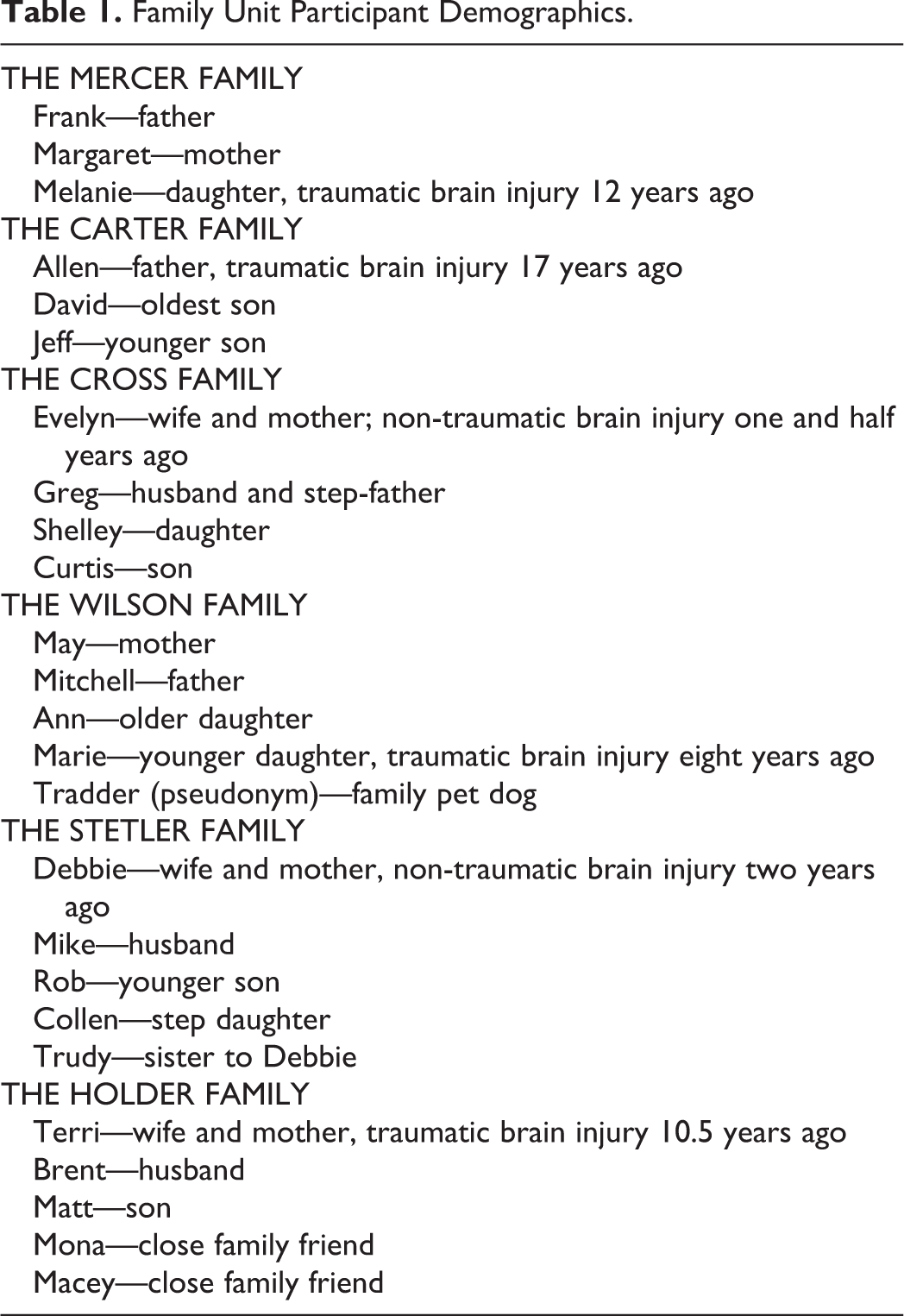
A demographic description of the family unit participants (identified by pseudonyms) is provided to assist with participant identification and understanding (Table 1).
Family Unit Participant Demographics.
During the interviews, to initiate the process of narrative opportunities, the premise of Lieblich et al.’s. (1998) life story stages was used to help families structure their narratives around their experiences living with ABI. I asked families to think about their life experiences with ABI as three life stage chapters in a book about their family. The first chapter was about their family life before the ABI event, the second chapter is now—living with ABI, and chapter three concerns their future family life. For each chapter, I provided the initial narrative conversational opportunity by prompting the family with opening prompt such as: “Tell me about a time in your family before the ABI event that reflects who you are;” “Tell me about a time after the brain injury that reflects who you are as a family now;” and; “tell me about how you envision your family’s future.” Some families found the open-endedness difficult in finding a place to begin. When this was the case, I followed up with an alternative probe and or question: For example, “Tell me about a particular family ritual…;” “Describe how you functioned, how you were together;” “If I was a fly on the wall what would I have seen, heard?” “Tell me about what has changed in your family.” As their stories unfolded and particularities arose, I added further probes and questions to achieve clarity or to encourage them to continue. By utilizing this life story interview structure, the temporality characteristic of NI was illuminated as temporality was affixed to the families’ narratives in their lives before the ABI, living with the ABI, and the potential future of living with the ABI.
Showcase of Findings
The six family synopses showcased (below) represent my global holistic interpretation of each families’ greater family narrative of how they made sense of their experiences living with ABI. Each individual interpretive family synopses was generated predominantly from analysis using the holistic-content cell classification as outlined by Lieblich et al. (1998), which allowed for the deconstruction of the individual perspectives and the re-construction of the overlay between individual experiences. As these families’ transcripts held unique attributes, specific elements of the holistic-form, categorical form, and categorical-content modes of analysis were incorporated to elucidate family idiosyncrasies. Lieblich et al. (1998) acknowledge in the reality of data analysis there is no clear separation of cells and researchers need to make decisions about the size and breadth of cells.
Within each family synopsis, the NI characteristics of relatedness, identity, and beliefs/attitudes were illuminated. Relatedness was manifested by the families’ acute sense of belonging to each other. Family unit identities were revealed in their stories of solidarity, stoicism, commitment, and healing. Families’ beliefs and attitudes were uncovered and demonstrated the ways in which they interpreted their world in living with ABI. Beliefs about the ABI event itself. Beliefs in family working together to support each other as they support their member with the ABI; belief in caring for others; and an attitude of acceptance of the loved one who will never be they way they were prior to the ABI. These individual interpretive family synopses are distinctive, which uniquely afforded me the opportunity to gain a deeper understanding of family dynamics, and a greater awareness not only of families’ struggles but their capacities for adaptation and resiliency.
Pseudonyms are provided for all participating families, and the “I” in the family synopses refers to the researcher.
The Mercer Family
The Mercer family narrative lends itself more to the global impression of the qualities of family solidarity, strength and resiliency. Their narrative unfolded through full descriptions of their family life. Their accounts engendered images of a busy active family who self-identify as Aboriginal. Professional career parents raising their two children; involved in living in their community, playing sports, and taking many family vacations to visit family in other parts of the province. Their narrative took them through a family life cycle of children growing up, moving away and the birth of their first grandchild. Sad times including family deaths and significant health concerns were also revealed; all the while weaving a tale of family as: “community sharing knowledge and experience; teachers; presence; and healers.”
Their narrative was told sitting around the family kitchen with Frank (father), Margaret (mother) and Melanie (daughter with ABI). Melanie’s two children, April and Brian, could not participate as they were not adults. However, Brian could be heard playing guitar, and on several occasions, he came through the kitchen to which Frank commented; “he is listening, learning, and paying attention.” Melanie’s contribution to their narrative included responses that were repeated and given without inhibition as she would interrupt on occasion and retell her story of how embarrassed her children were when she walked into a male washroom. During these moments, Frank and Margaret sat quietly making no response, until Melanie had finished, and then they would continue with their narratives as if no interruption had occurred. Their patient and calm demeanor was interpreted as a sign of acceptance of her cognitive challenges, as there were earlier years when Melanie’s repeated communications would cause angry frustrated responses from family members; now they know the “question can be asked many times and you just answer it.” I observed Frank and Margaret also lived with the Melanie who could respond appropriately to the look of pain on her mother’s face and ask if she needed her legs lifted, and make more tea when “our cups were empty.”
The Mercer family defined themselves as “closer” and “never far from each other.” I interpreted their response as evidence of their solidarity, strength and resiliency in understanding and accepting of the ambiguity that is a part of their experience living with an ABI.
The Carter Family
Elements of the holistic-form cell were assimilated into the holistic-content cell for the Carter Family, as their transcript signified a complete life story, structured around a plot that had a beginning, middle and an end. Their plot centered around the family breakup due to a marital breakdown and the reconciliation and healing that occurred as a result of the father’s ABI event. Elements of the categorical-form mode of analysis were assimilated into the holistic-content cell, particularly when a family’s emotions became a part of my global interpretation. This was evident at times as the Carter family told their story.
This all male family’s narrative evokes a strong sense of commitment to rebuilding hope and healing from scarred and broken connections. Led by the younger brother, they recount a story of reconciliation. The global impression is one of connections, missing connections, and reconnections. Theirs is an emotional narrative as expressed by the participants. For this family, the father’s ABI event is thought to be a blessing, a means of re-connecting father and sons. However, opportunities for reconnecting are being missed as those members who have different thoughts and perceptions remain on the periphery of this male family unit.
Participants in this all-male family unit are: father Allen; older son David, and the younger son Jeff. The family interview took place in Jeff’s home at the kitchen table, and once I arrived Jeff’s wife and children left the home for the 1.5 hours duration of this interview. Allen had initiated the interview and asked his sons to participate, which they agreed.
The plot unfolded led by Jeff. Their narrative developed from adversity and ascends to healing and reconciliation. Jeff begins by saying. “I’ll start us off then…my parents are separated.” The first two segments of the global impression, connection and missing connections occurs early in this narrative. Family life prior to the ABI revolved around the children maintaining connections to Allen who, due to his job, was often away from home. During the marital breakdown some realignment of family connections occurred.
However, it is the catalyst of the ABI event that shifts their narrative from adversity to one of hope for emotional healing, reconnecting, and reconciliation. Allen’s ABI event occurred when he was living in another province and away from his children. Allen’s retelling of his ABI event and the subsequent consequences to his life appeared to be an important piece of the reconnecting process between father and sons; as Allen wanted his sons to understand what he went through and the resulting changes for himself. Again, as told by Jeff:
“This was kind of a blessing for our family We’re more understanding of each other. It kind of fast tracked us to where we are right now. Where we do stuff for each other and we want to do things with each other.”
The retelling of their earlier family life elicited displays of strong emotions as all three of them were tearful at several times thorough out the interview(at one-point Jeff got up from the kitchen table and retrieved a box of Kleenex and brought it back for them to use), especially for David as he appeared to be the most emotionally affected and speaking was difficult. David acknowledged: “Just going back on thinking about it all…still quite painful.” Even though aspects of the Carter Family’s story were painful essentially the global impression is one of the fluidity of connections. Recognizing the complexity of connections and relationships this family has demonstrated their strength in reclaiming meaning of family and building a family identity which holds the three of them and their spouses and children together as a family unit. Jeff concluded their story by stating: “I think we all have changes no matter what…family means a lot that we make adjustments to continue what we have and make sure that we’re all included.”
The Cross Family
This blended family’s narrative evokes a sense of lives being brought together and learning to live as a new family unit yet members continuing to maintain their own individuality and separateness. With the advent of the Evelyn’s ABI, this family has again come together to accommodate and support through the sharing of roles.
This family came together 11 years ago as a result of the marriage between Evelyn and Greg. Joining the family at that time were Evelyn’s two children Shelley and Curtis. Ellen was born 10 years ago. Ellen because of her age could not participate in the interview. Although she was seated in the kitchen area doing homework with ear phones on, a couple of times her voice was heard jumping in to add something to the conversation.
Shelley’s words helped to provide the impression of their experience of being a blended family; separate yet together.
“We also would do family camping trips. Not necessarily always all of us together. Sometimes it would be mom and Greg with Curtis or mom and Greg with me or sometimes separately but camping trips has definitely come up quite a bit. And Curtis and I had lived here in or out both of us at different times. But never all of us under the same roof in a long time at this point…But then a typical day seems like everybody had their own isolated agenda or something that they’re getting towards. Everybody has a different schedule. And you’re all trying to interact and go through.”
However, since the ABI, this family has minimized their level of independence and come together to share in the responsibilities of caring. While Greg has become the main caregiver, Shelley and Curtis share in this role, resulting in increased communication and contact. Shelley explains “Since then, I would say that my brother and I are much more in communication and contact. We’re all very independent beforehand…We’ve been trying to chip in as much as we can. Greg’s obviously taken on 98% of it. But we try to do what we can. Everyone has to adapt and hopefully mom pulls through.” Together they all are, including Ellen, learning how “to relate and react to the brain injury.”
The Wilson Family
The categorical-content mode of analysis was used to extract the number of times a particular phrase or statement was being verbalized by family members. The findings from this cell dimension are most notable in the Wilson family synopsis with their multiple use of expressions like “just do it” and “one day at a time. Embodied elements were also seen in the Wilson family synopsis as they joke about “being paid” to say nice things about their family.
The Wilson family narrative evokes a strong sense of connection and stoicism, from an active busy family life working and parenting two daughters (what they called normal), to their central focus of living with the ABI event of their youngest daughter. The Wilson family participants included: father Mitchell; mother May; eldest daughter Ann; and youngest daughter Marie, the member with the ABI.
I was struck with the family’s visible display of connections to each other. Sitting around the dining room table they conversed freely and easily with each other often using humor to display emotional connections. At one-point Ann complimented her parents for having a “good upbringing.” Following this remark, I observed Dad pulling out $20.00 bill and pretending to give it to Ann. Their display of connection also extended to the family pet dog Tradder (also a pseudonym). Tradder not only greeted me on both occasions when I entered the family home, he was allowed to join us for both interviews remaining underneath the dining room table chewing on a “treat.” In particular, I observed the special bond between Tradder and Marie, as she was consistently picking him up and talking to him.
The impression of stoicism comes from the family’s mottos of “just do it” and “one day at a time.” In their narratives, these phrases were stated at least 13 times by different family members. These mottos have helped the family cope through difficult stressful life events, (i.e., caregiving of elderly parents, and Marie’s brain injury) as they “didn’t have time to go wallow.”
A prominent figure in the impression of family stoicism is the mother, May Wilson. May’s stoic attitude is thought of as a strength by other family members. Daughter Ann declared:
“My mom was the strong one out of everybody, she presented really well. She probably hid some of the stress stuff. She probably didn’t want everybody to know what was going on…I think if you keep going and you keep your mind busy and you keep going, sometimes you don’t have time to stop and reflect on stuff so you don’t let it get to you.”
May herself disclosed the level to which she would maintain her stoic appearance. “There were times I wanted to lose it and cry…I just didn’t do it in front of you guys…just cry a little bit by myself.”
May’s disclosure yields an inkling that sharing vulnerabilities may not be a part of this family’s identity or relational dynamics, rather they appear more comfortable showing their “funny side” alongside the face of stoicism.
The Stetler Family
Elements of the categorical-form mode of analysis were also assimilated into the holistic-content cell, particularly with the Stetler family has they passed around Kleenex while telling their story.
The Stetler family narrative lends itself to the formation of two main global impressions. The first being the recognition of just how powerful and traumatic the ABI event was for this family, and secondly how it has been the women of this family that have guided and nurtured the value of caring.
Debbie Stetler (family member with the ABI) chose the family members that she wanted to have participate in the family interview. Therefore, those who sat around the home dining room table included: Mike (husband); Rob (younger son); Colleen (step-daughter); and Trudy (Debbie’s sister).
The story of the ABI event was significant for this family. It was as if they were reliving the event as they told their story. As they began to recount the day it happened, several family members became emotional and a box of Kleenex was passed around the table. The ABI event occurred early evening and led to 911 being called and once Debbie was brought to hospital the family was faced with the words of the surgeon, “If we operate two things can happen…she could be paralyzed or be a vegetable.” Debbie explained her tears:
“Guess it was just such a traumatic experience for everybody. I remember the look on everybody’s face. The pain I felt inside just looking at their looks on their faces. Nobody wants to see pain in their children’s face and that’s what I see. That’s what goes through my head when I bring this all up again.”
Trudy stated: “But if it happened to her, it happened to us. It affects the whole family. And she was so close to dying and all those thoughts go through your head about what am I going to do without my sister? What am I going to do without my mom? And then you’re so thankful when, when she survived….”
For Rob seeing his mom unconscious brought up another traumatic memory that of the death of his father from a heart attack; “I gave him CPR in the driveway. He died in my arms. And this was just a repeat of it, but she came out.”
Another key element in this family’s narrative is “caring.” This narrative is led by the women in this family, in particular, Debbie and Trudy. As stated by Trudy:
“I think as a family, we each kind of live our own lives. We don’t interfere in anybody else’s lives. We’re there for support. Probably the biggest bond Debbie and I have is the care of our mom. I think too, most of us, it’s very important for us to get together as a family say for Christmas, Thanksgiving, Easter, that kind of stuff…I’m trying to keep the family together as much as I can and I think my sister is trying to do the same thing. And I think Colleen also appreciates, well we all do, the value of family.”
In this family caring is important and means being genuine, “real not fake,” and no pretense or “judging.” Debbie specifically chose the family participants based on their caring actions. “I wanted my husband because he is with me every day…I wanted Colleen because I owe her my life…and my sister and Rob always been so supportive.”
This family has created a circle of caring solidified by the trauma of the ABI event.
The Holder Family
The Holder family narrative evokes the sense of lives committed to the ministering of others. Terri (individual with the ABI) and Brent (her husband) while raising a family of two children worked in demanding and consuming professions. Both worked in the church ministry; Terri as a congregational Minister and Brent as a prison chaplain. However, since the arrival of the ABI event this family is in the position of being ministered too, as friends and the church community have become a significant part of their support network
Alongside the biological family participants, Terri, Brent, son Matt, this family also invited two family friends to participate; Mona and Macey. It is the words of Mona and Macey that reveal how important Terri is to the congregational community and the tremendous impact and influence both she and Brent have in their roles.
“We hired her as our minister. She was a young vibrant minister who brought tremendous gifts to our church, our congregation. And you know, it was the beginning of our very deep friendship. Brent was and still is the kind of man that young people are attracted to. I think he, by gaining their independence or letting them push those boundaries, even when their parents didn’t want those boundaries to be pushed, and I think that’s why they (referring to the young people) loved him so much.”
Mona and Macey’s statements contribute to the impression the family identity is centered on ministering to others.
Following the ABI event, with Brent readily admitting “It think I felt confused about it and used the opportunity to kind of work harder,” the family experienced a lot of support that gives the impression they were being ministered to:
“…the two of you (speaking to Mona and Macey) you spent a lot of time with her drinking tea and being a gentle presence as well, right? We had a lot of people. I had a lot of people touching base with me. But because we’ve lived in the same circle, vis-à-vis the church, right, and so they know both of us. And the support I got, I had two colleagues, one who I didn’t know very well, would take me out for lunch to check in to see how I was going. It was very helpful.”
Through these acts of ministering the overall impression I was left with was the creation of a strong and secure safety net which will carry this family and their community forward into the future.
Discussion
A distinctive contribution of the union between NI, family research, and transactional level data collection is the findings are representative of a “holistic” perspective; allowing the interrelatedness among the families to be elevated to the foreground signifying the findings are a product of the system different from the sum of its parts (Fisher et al., 1985). Thus empowering the researcher to understand and engage with altered perspectives.
Predominantly, the literature has consistently reported ramifications of ABI on families as negative; with prolonged exposure to stress and strain and harmful effects on families’ social, emotional, structural, and financial functioning; role changes; and challenges to core values and resources in families (Brooks, 1991; Christensen et al., 1997; Degeneffe, 2001; Dell Orto & Power, 2000; Florian et al., 1989; Kosciulek & Lustig, 1999; Lezak, 1988; Mauss-Clum & Ryan, 1981; Townsend & Norman, 2018; Webster et al., 1999). Rather, the findings from this study offer a counterbalance to these bleak reports.
Embedded in family systems theory is the notion that families are engaged in dynamic processes that over time allows them to find numerous ways of coping and adapting (Walsh, 1996, 2012). As the theory and science of family systems evolved, families were no longer viewed from a deficit pathological model perspective (Gottlieb, 2013; Hawley & DeHaan, 1996; Walsh, 1996, 2012). Instead a strengths- based perspective arose, assuming families, when dealing with family stresses and challenges had their own resources and strengths that allowed them to resolve their difficulties (Black & Lobo, 2008; Gottlieb, 2013; Hawley & DeHaan, 1996). Accompanying this focus on family strengths was the emphasis on family resilience (Hawley & DeHaan, 1996). Family resilience research recognizes the importance of the identification of protective mechanisms families use to mediate the relationship between their exposure to stress events and successful adaptation and competence (Patterson, 2002). These family protective factors have been mainly categorized under the domains of: belief systems; cohesion; flexibility; communication/problem solving; and, resources. Belief systems are considered protective if families are able to develop meaningful perspectives about the adversity (Walsh, 2002, 2003). Olson and Gorall (2003) defined cohesion “as the emotional bonding that couples and family members have toward one another” (p. 516). Families that are connected are more protected than families less engaged with each other (Olson & Gorall, 2003). Families demonstrating a stronger ability to be flexible when handling disruption, change and stability are considered to be demonstrating resilience (Olson & Gorall, 2003; Walsh, 2002, 2003). Clear communication, use of positive problem-solving strategies, and families’ abilities to utilize resources are also considered to be important factors toward demonstrating family resilience (Benzies & Mychasiuk, 2009; Walsh, 2002, 2003).
Narrative inquiry methodology assisted in casting light on families’ beliefs about their identity as a family unit that were maintained and became more solidified while living with the ABI. These families described an increased sense of belonging and used their relationships as resources for each other; thereby having less functional difficulties as noted by Segev et al. (2018). Establishing collective beliefs and meanings of the ABI situation helped these families tolerate the losses and adjust to the different circumstances.
Conclusion
The methodology of NI offers valuable tools to help researchers think about families. Through NI, researchers can more deeply and richly appreciate the complexities of family life; you can’t know a part without delighting in the whole. Given how valuable NI was for this particular ABI research, I anticipate it holds similar promise for other family health research initiatives.
Footnotes
Authors’ Note
The study was approved by the research ethics committees of the relevant Universities {Approval numbers: E2016:126 (HS20242); 22276}.
Acknowledgment
The researcher would like to acknowledge the families who participated. Their willingness to share their stories of living with an acquired brain injury event was an illuminating experience.
Declaration of Conflicting Interests
The author(s) declared no potential conflicts of interest with respect to the research, authorship, and/or publication of this article.
Funding
The author(s) disclosed receipt of the following financial support for the research, authorship, and/or publication of this article: Funding for this research was provided by the Manitoba Centre of Nursing Health Research, College of Nursing Endowment Fund Graduate Student Research Grant and the Fort Garry Legion Poppy Trust Fund Grant.
