




Abstract
Increasingly popular in qualitative and mixed-methods research design, visual timelines help organize participants’ life histories with an emphasis on temporality and the context in which important life events and experiences take place. Often, research using timelines focuses on individual participants. Yet, we know that life events, experiences, and decisions that individuals highlight in life history and narrative forms of research are relational in nature. Dyadic interviews allow for participant interaction, exploration of relationality, and the potential for increased breadth and depth in data collection. Recently, LGBTQ+ researchers have begun to evaluate dyadic approaches to timeline research. This paper describes a dyadic approach to timeline development designed to be combined with dyadic narrative interviews. We explain the data elicitation process, utility and value derived from the approach, and detail the development of post hoc linear, graphic timelines. This complementary approach leverages the strengths of dyadic narrative interviews and visual qualitative data synthesis and analysis to explore shared lives in context, highlighting their value as applied in research focused on a sample of sexual minority female couples (a community in which particular types of health disparities have been documented) from across the United States engaged in a series of clinically intensive shared decisions.
Keywords
Introduction
Timelines and other visual life history techniques have become increasingly popular across academic disciplines. In research, visual life history techniques can organize participants’ narrative data (Patterson et al., 2012), aid in depicting changes over time (de Vries, 2013; Elder, 1998), and facilitate the analysis of life transitions, transformations, and trajectories (Berends, 2011; Boyd et al., 1998; Bremner, 2020; de Vries, 2013; de Vries et al., 2017; Fals-Stewart et al., 2003; Gramling & Carr, 2004; Gray & Dagg, 2018; Nico, 2016). As a participatory process, timelines offer research participants an opportunity to identify and discuss subjectively important life events, help anchor the interview in participants’ lived experiences, and enable participants and researchers to together explore events and experiences in greater depth (Bagnoli, 2009; Goldenberg et al., 2016). Timeline methods encourage reflexivity among participants (Berends, 2011; Bremner, 2020; Gray & Dagg, 2018; Kolar et al., 2015), and may contribute to improved understanding of the significance and meaning ascribed to life events (de Vries, 2013; de Vries et al., 2017; Gramling & Carr, 2004).
In health research, examination of visual displays of life histories through participant timelines helps to place clinical problems or processes in context—personal, sociopolitical, and historical (Berends, 2011; Boyd et al., 1998; de Vries, 2013; Gramling & Carr, 2004). For example, researchers have used life history techniques to study phenomena including substance abuse (Berends, 2011; Boyd et al., 1998), intimate partner violence (Fals-Stewart et al., 2003; Kolar et al., 2015), and stigma associated with sexuality (Thomeer et al., 2018) to gain improved understanding of these phenomena and to inform development of useful interventions.
The majority of research using timelines has focused on individual-level data elicitation and exploration of events or time periods from an individual perspective (de Vries et al., 2017). Yet many events included in individuals’ life histories are relational (de Vries et al., 2017; Gergen & Gergen, 1988; Sandelowski, 1999). That is, the events identified are interpersonal and involve other people. Yet minimal literature attends explicitly to relationality using visual life history methods. Additionally, prior qualitative research has demonstrated that narratives may differ based on who is present to tell a story, highlighting what shared story-telling can disclose (Eisikovits & Koren, 2010; Holmberg et al., 2003; Morgan, 2016; Valentine, 1999). Dyadic approaches to timelines (e.g., romantic couples), which take into consideration the relational and shared aspects of life experience, are both feasible and useful (de Vries et al., 2017; Thomeer et al., 2018). In discussing life events in sequence with a dyadic approach, researchers have an opportunity to glean insights from both partners’ perspectives as well as the couple as a unit (Hochman et al., 2020; Manning & Kunkel, 2015). They may illuminate congruence and divergence of perception within couples. Each person may ascribe similar or different weights to life events (de Vries et al., 2017; Holmberg et al., 2003). Through co-construction, timelines may facilitate negotiated narration and affirm the shared experiences that have shaped couples’ relationships. These can lead to unique insights fostered by the collaborative process. Thus, couples may reveal what might otherwise be overlooked in individual timelines and narratives (de Vries et al., 2017; Hochman et al., 2020; Reczek, 2014).
Data collection in health research that explicitly focuses on couples from marginalized backgrounds may enhance data quality and richness. Furthermore, methodological innovations that allow health researchers to capture the shared lived experience of couples may contribute to the development of more structurally competent and responsive care for historically marginalized populations. Exploration of shared understanding and experiences among couples is timely given the prioritization of equitable models of care nationwide.
While researchers have described relationship timelines in the literature (see de Vries et al., 2017; Thomeer et al., 2018), this article highlights several adaptations to the method. First, we elicited timelines in a virtual setting (i.e., dyadic interviews done with video conferencing). Unlike previous research with co-constructed relationship timelines (i.e., de Vries et al., 2017; Thomeer et al., 2018), participants in our study did not construct visual timelines themselves during the interview or some other defined time (e.g., Bremner, 2020). The narrative data that resulted from transcribed dyadic interviews, which explicitly sought to elicit the chronologies of participants’ relationships and clinical journeys in sequential order, were used to devise unique graphic, linear timelines post hoc. In contrast to previous studies, couples did not draw on a predetermined menu of events or milestones when they described their timelines (de Vries et al., 2017; Goldenberg et al., 2016). Rather, because we know so little about the participant population and their shared experiences, we tried to remove assumptions about what led couples to this point in their lives. Thus, the process was left open-ended and participant participant-directed. Finally, from post hoc visual linear timelines, which were text heavy, we transformed text into icons to represent common events and milestones.
Therefore, the goal of this study is to describe our approach to implementing a dyadic timeline technique used with couples. Three objectives guide our work. First, we describe the data elicitation process whereby couples narrated their relationship timelines. Second, we elucidate how couples negotiated their exchanges with one another, elaborating on events, experiences, and contexts as they told their stories to co-create shared timeline narratives. Finally, we depict our synthesis approach to graphically represent the timelines they described during narrative interviews.
Method
The parent study, the Queer Pregnancy Decision-making Study (QPyD), aimed to qualitatively explore pursuits of pregnancy through assisted reproduction among sexual minority women (SMW) couples (i.e., cisgender, non-heterosexual women, in same-sex relationships) in the United States, at both the individual- and couple-levels (i.e., each partner in a couple and the couple as a unit). The QPyD Study incorporated a brief demographic questionnaire, an online survey, one-on-one in-depth individual interviews with each member of a couple, and dyadic timeline co-construction and narrative interviews with couples as a unit (See Figure 1 for a flow chart depicting data collection and transformation). This article attends specifically to analysis of data collected through the dyadic interviews, which focused on couples’ relationship histories in the context of shared fertility and family expansion experiences among SMW couples who used clinically assisted reproduction (CAR) for pregnancy.

Data collection and transformation.
Recruitment and data collection occurred between June and August 2019 through social media ads disseminated on Instagram and Facebook, by word-of-mouth, and through snowball sampling. All potential participants were invited to complete an online screener via email. Potential participants clicked a link to a Qualtrics form maintained by secure University of Pennsylvania servers. Inclusion criteria consisted of residence in the United States; self-identification as lesbian, queer, bisexual, or some other non-heterosexual sexual orientation; assigned female at birth and identification with female gender; over the age of 18; part of a committed relationship; both members of a couple willing to participate in one-on-one and couple interviews; English speaking; and, report having or planning to have had donor insemination or embryo transfer within the six months prior to the first study interview. Prospective participants were excluded if they did not speak enough English to participate in interviews, were other than female gender, and either had not yet tried to conceive with health care provider assistance or tried more than six months prior to contact with research team. Of people who expressed interest in the study, three couples were excluded because they did not meet the criteria related to timing of CAR (no more than 6 months prior to having contacted the study team). One couple was excluded because both partners were not able to participate.
The study interviewer reviewed informed consent with study participants prior to initiating protocols and addressed all questions or concerns promptly. The study protocol involved three interviews for each couple: first, the first author conducted individual in-depth interviews with each partner separately; second, individuals came together for dyadic interviews structured by narrative timelines for each enrolled couple (n = 10 couples).
Narrative dyadic interviews were guided by relationship timeline co-construction, anchored chronologically by when and how couples met as the earliest point in the timeline and ending with their hopes and dreams for 5–10 years into the future. Based on previous research (de Vries et al., 2017), the intention of relationship timelines was to anchor individuals in their identities as a couple through collaborative action and dialog, while jointly offering negotiated narratives of their relationships (Holmberg et al., 2003; Manning & Kunkel, 2015; Valentine, 1999).
To create conditions that allowed for clear communication and understanding between researcher and participants, the interviewer sought to build rapport in an egalitarian and empathetic manner that prioritized respect for participants’ boundaries and sensitivity of the subject matter. Measures were taken to preserve the confidentiality and privacy of participants during joint interviews, in this report, and in the visual, graphic timelines. Some of these measures included use of pseudonyms, removal of details that could compromise confidentiality (e.g., locations, professions), and independent checks of portrayals by professional colleagues who signed data confidentiality agreements to determine whether fact patterns or specific details required modification to further protect privacy and confidentiality of participants. Data elicitation took place over a secure online video conferencing platform housed by the University of Pennsylvania. All narrative dyadic interviews were digitally recorded with the consent of participants. Audio of each interview was transcribed verbatim and checked for accuracy. The University of Pennsylvania Institutional Review Board approved the study’s protocol and procedures.
Analytic strategy
Procedural analysis of the methodological innovation and value observed in the use of dyadic narrative interviews and timeline co-construction involved three discreet stages: data familiarization, deriving post hoc chronologies from narrative timelines, and creation of visual, graphic timelines. Informed by Braun and Clarke (Braun & Clarke, 2006; Braun et al., 2019), data familiarization involved listening to interviews, evaluating transcription accuracy, and iteratively reviewing participant responses through field notes, memos, and reading and re-reading interview transcripts.
Following the data familiarization step, the first author and two trained research assistants coded each couple’s transcript for “timeline events”. Timeline events were defined as any mention of milestones, events, and/or experiences shared by the couple as having been key inflection points in their relationship. Couple-level narrative interviews were inductively coded for elements specific to the ways in which the co-creation of timelines evolved. Transcripts were coded for couple interactions, which included moments when partners jointly clarified narrative details, assisted one another with recall, negotiated story-telling, and reflected together. Reflection-related codes included what preceded or resulted from moments of reflection (in contrast to recounting or recalling elements of their shared stories.
“Timeline event” data were extracted as text within the context of the interview to preserve conversational context and the order described by participants. These timeline events were then compiled and ordered in sequence according to their dates (when possible) or narrative sequences reported during interviews if specific dates were not immediately recalled by participants. Thus, chunks of text were extracted and ordered sequentially. This process yielded textual chronologies of the events for each couple.
Finally, consistent with the transformation of narrative chronologies into visual, graphic timelines described by Boyd and colleagues (1998), we mapped couples’ events across a horizontal line that denoted time, on which demarcations for years included in couple chronologies were separated by an equal amount of space. These visual representations of couples’ narrative timelines appeared crowded, making it difficult to discern what took place and when. A solution to this visualization challenge came in the form of data reduction, in which types of events were denoted by unique icons. For a menu of events and their associated icons, see Figure 2 in the Appendix. All textual narrative timelines were distilled down to icons with minimal explanatory text when needed to discern relationship trajectories and couples’ experiences. We juxtapose two timelines, one that is text heavy (Figure 3) and one that we consider exemplar (Figure 4).
Findings
Participants represented eight states in each of four census regions across the United States (West, Midwest, South, and Northeast), and were in relationships that ranged in length from three to 14 years. Demographically, participants identified as lesbian, queer, and/or bisexual, and racially as Black (n = 1), Latinx (n = 3), and/or White (n = 18); ranged in age from 28 to 40 years; and had annual household incomes that ranged from USD $67,000 to $200,000.
Data Elicitation
Dyadic interviews ranged in length from 30 to 90 min. This range in discussion length varied based on the length of couples’ relationships, the depth of detail couples provided, and the characteristics of each unique relationship.
Engaging couples’ timeline co-construction and dyadic interviews differed from conducting the one-on-one, individual interviews (where chronology or order of events were not central to the method). At the outset of each dyadic interview, partners in each couple interacted directly with one another, communicating a unification, a sense of identity in their togetherness. All 10 couples displayed multiple expressions of intimacy with one another, such as glances exchanged, touch, verbal and nonverbal communications, which reflected their anchoring together as a unit. The 10 couples enrolled in this study appeared unified and intimate throughout the interviews, sharing intimate details about their lives. Couples appeared to have relatively healthy, sharing relationships during the course of interviews, working together as teams. Each relationship was different, but no relationship came across as unhappy, unhealthy, or overly strained. Given the salience of these observations, the interviewer took copious notes after each interview, pertaining specifically to the interactions between members of each couple, and memoed extensively during review of the digital recordings and transcriptions to note interactions between members of each couple as they engaged in the one-time dyadic narrative interviews with timeline co-construction.
The interview guide (see Table 1 for a subset of prompts) was designed to elicit couple-level data through co-construction of narrative relationship timelines. The act of timeline narration facilitated a shift from individual perspectives to telling a story as a couple. Couples’ dyadic narrative interviews began with the prompt, “Tell me about when you first met,” and ended with a future-oriented question about hopes and dreams couples had for their families 5–10 years in the future. Attention to the chronological order of events was enhanced by using clarifying questions and field notes when conversations shifted organically during the discussion. This strategy enhanced our ability to incorporate and follow non-linear parts of the narrative while also answering the research questions.
List of Dyadic Interview Prompts.
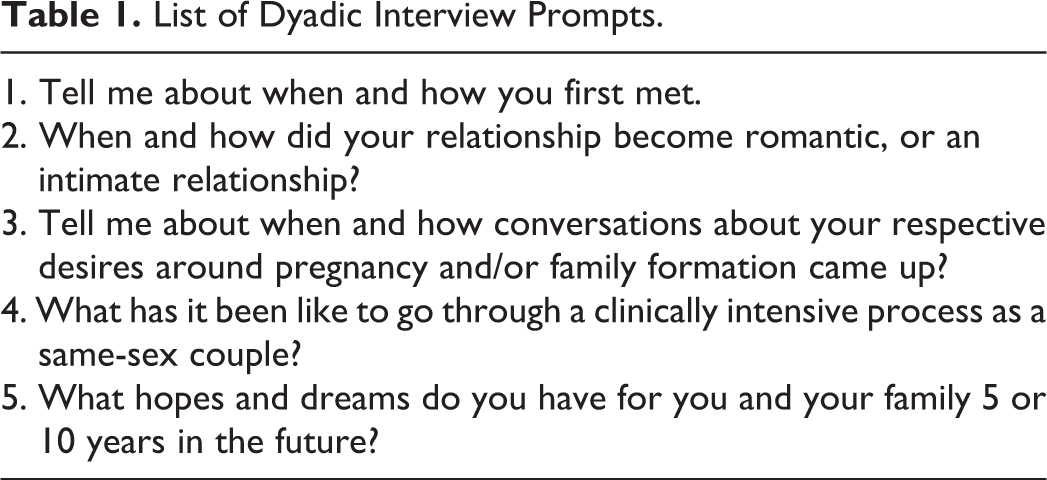
Supported by probes, the initial prompt (i.e., “Tell me about when you first met.”) led couples to together extend their narratives with descriptions of how their relationships evolved, to identify important milestones, and to share important aspects of their relationship trajectories. For example, Jody (31) and Amy (29), a married couple in relationship for four years from a small, rural Midwestern town, described an important milestone (i.e., marriage) in their relationship, and the contextual factors associated with their shared experience.
We got married here in town. And there were a couple of things here and there. Small town newspapers—they put in the paper marriage license. And we weren’t comfortable with being quite that public. So there’s some weird small-town stuff—people talking. But overall, I mean, we’ve been pleasantly surprised at how—yeah—how kind people have been.
Yeah. That’s great.
It’s just all very public. I mean, people definitely know we’re in the –
It feels like you’re like the –
—five queer couples in town.
—token—yeah. Token lesbian couple.
In this passage, they conveyed their situatedness in a couple identity as they described what it was like to marry and for their relationship to be seen publicly in their local community—they casted themselves as a “token lesbian couple”. Speaking from the point of view of the couple identity, they stand out in their local community because of their sexual minority couple status. Amy and Jody’s dialogue demonstrates how most couples identified marriage as an important milestone and described the social dynamics around their marriage specific to sexual minority status and local community culture. Prompted by a query about how and when the two women met, Amy and Jody described their initial meeting and seamlessly extended their relationship timeline to the point in time when they decided to marry. They provided contextual information related to same-sex marriage within the social, cultural, and regional milieus within which they are situated. This exemplar exchange demonstrates a common trend across dyadic narrative interviews and how couples co-constructed their timelines.
Couple Co-Creation of Timeline Narratives: Negotiation and Elaboration
As couples discussed milestones in their relationships, partners elaborated on events and experiences and engaged in processes of clarification and negotiation. By negotiation, we mean the couples demonstrated a give-and-take in the process of responding to questions. For example, participants used the timeline co-creation process to revisit experiences where they had both convergent and divergent recollections or interpretations of the events. Lisa (31) and Renee’s (29), a couple who had been in relationship for three years at the time of the interview, exchange provides an example of co-creation.
We met on Tinder in –
You met on Tinder.
—June.
Three –
Three years and one month ago on Tinder, in Brooklyn.
Okay. In Brooklyn? You were both living in Brooklyn for work –?
We were—I was living and working there, and Lisa was in grad school.
Yeah.
Lisa also can speak.
[Laughter]
I’m more of a dominant interview personality.
I’ll correct her when it’s not true.
Most couples articulated timeline events and decisions as shared using “we” and “us” to refer to timeline events from a relational perspective, as opposed to individualized framing (i.e., “I”, “me”, or “my” statements). Exemplary of the type of negotiated story-telling that occurred across couple interviews and the co-construction of chronologies, this exchange between Linda (33) and Angie (30), a married couple from the rural South in relationship for nine years, describes the way their relationship transformed from platonic to romantic:
We just ended up, she was like just come over one night and, they, I went over and never left I guess.
Yeah it was,
I mean really, her and her friends, were having like a bonfire or something,
A bonfire.
In the backyard. And, I went over that night and we just talked, and we apologized to each other, like, we were like, why are, you know, why did we do this for two years and really don’t think we ever left after that day.
Like, we spent, like, I say like within two weeks we were like telling each other we loved each other, like.
Yeah.
And then, probably within a few months we were like, we should get married, like, we got engaged like immediately, it was,
So, yeah. So we got, so we got engaged. We moved in together in what, January.
Yeah.
Of 2013. And, and then, we got married in April of 2014.
This illustrates the give-and-take interactions that exemplified joint chronologies shared in this dyadic study. The section begins as they described the night that things changed between them and then they jointly tell the interviewer how they quickly moved in together, got engaged, and married.
Reflexivity and enhanced understanding
Timeline co-constructions also presented a rare opportunity to witness and record dyadic reflections on important issues that each individual in a couple independently identified (LeBlanc et al., 2015; Zarhin, 2018). These reflexive moments periodically led to enhanced understanding between members of each couple. In another part of their interview, Linda and Angie described an especially difficult time in their lives when Linda faced severe depression. Angie described her sense of helplessness to aid her wife, and Linda recalled how challenging it was to see Angie struggle in response to her (Linda’s) suffering:
It was just helplessness. I mean it was helplessness and I didn’t know what to do.
I would catch her, crying in another room. Like she didn’t wanna…she hid her emotions from me, I guess to be strong for me. And, like, I’m grateful for that but where I found her crying in the laundry room-- that would break my heart.
I really don’t know, yeah I mean it was hard.
It was awful…It was bad, like, I, I literally like lost interest in everything in my life, like, even my career, you know, and that was my best year. I was teacher of the year the year before that, like.
Yeah, I mean. Linda: I mean I was on top of the world and I’m like literally, I told my students, I teach high school, and told them what I was going through, and I was like, can’t teach, right now, like I’m broken.
I mean she would be at school crying.
Like my kids would be. They knew like, they went through it kind of with me, like. It was my, it was one class, like I had two periods in a row, because they’re in my advanced class. But I had had these kids for four years, you know, they’re in their senior year, and um, I mean I had to be open with them because they could see it, like,
I mean it really feels, it affected every part of life, and.
It was like,
And it was hard to get her like,
I don’t know how I was gonna get out of that.
To do stuff like. You know, you tell, she was, she, her. Linda was like, well you’re the counselor, tell me what to do. And I’m like, you need to go to a counselor. (laughter) I can’t be your counselor. And she wouldn’t do it, and you would just lay in bed, and it was just, I mean, it was heart breaking. It was just heart breaking.
It is worth noting that after the interview, the couple contacted the interviewer to communicate that the dyadic interview gave them an opportunity to discuss and better understand one another’s experiences of that time in their lives. Linda and Angie had a unique opportunity to reflect on Linda’s depressive episode and its impact on their lives within the context of the dyadic interview.
Elaboration, shared meaning, reconciliation
This methodologic approach facilitated expression of shared meaning and created space for elaboration on timeline events. Margaux (32) and Steph (28), a couple who met in an urban area of the Northeast and who now live on the West Coast, spoke about gender expression and normative gender role behaviors within the context of their relationship. Here, they conveyed shared meaning about their perceptual and behavioral understanding of their roles in the context of their relationship dynamic:
Yeah so I started to say that I think we have two layers of talking about what are roles are gonna be, and that just feels like a a natural, what are we good at, what are our strengths, what’s our situation, how are we gonna like balance this,
Yeah.
And then then, for me at least this, anxiety of, “oh like how are people gonna see us and what does that mean?” And Margaux has this running, not a joke but, it’s funny to me, this just, she’s always has been like, ‘I don’t do yard work, like I don’t.”
I don’t!
And just being like, you’re gonna have to do that if we ever have a yard.
Or hire someone.
No. Um and, and its fine and I like doing yard work like and I grew up like mowing the lawn and stuff and whatever, but I have like, especially its its kind of layered on like my evolution of like my identity and how I’m like presenting. I’m just like having a lot of anxiety now in general about being op- letting more masculine-presenting than I have been in the past. And so then, added to this like being a parent with you and you having given birth and like, just like all of these layers of like people are gonna see us as such a like, as trying to fit into this like, this box of like gender roles even though, so it feels like almost like extra pressure to not fit into those boxes, but also like,
But there’s so many way we don’t fit into those boxes too,
I know, and you can’t like live your life based on other people’s expectations, so it’s just this weird like amalgam of feelings that I have.
Yeah I feel like you focus more on the ways that we do, and what that means, and not on the ways that we don’t. And I really just don’t have any thoughts about it.
The timeline co-construction also provided an opportunity for members of each couple to reconcile disagreements about the sequence of events and other facts in their narratives. It helped to facilitate review of narrative details and recall of memories. This excerpt from Eleanor (38) and Jenny’s (40) interview highlights some of these patterns of recall, disagreement or uncertainty about timing, review, and reconciliation. This married couple lived in the regional South and were in relationship for 14 years. In this passage, Jenny helped to fill in a gap in the timeline because Eleanor did not recall a critical phone call and decision they made together.
Yeah, they called…
Okay. I don’t remember this that well –
You don’t?
—which is weird—I remember everything.
Yeah. That’s okay.
Yeah, I’m sorry.
I’ll remember for you.
Okay. Tell me about this conversation.
In the context of the timeline narration, this couple demonstrates the ways in which participants together clarified the sequence of events and details of shared experiences. As illustrated above, Jenny provided details as Eleanor, to both of their surprise, struggled to recall a series of events; together, they resolved the timing of an important incident. This and many other instances of recall, disagreement, review, and reconciliation occurred across couple interviews, belying the strength of this approach to narration and attention to the order of events and experiences.
Future orientations
Participants also explored their individual perceptions with one another in the dyadic context and considered potential future choices and considerations in their shared lives. This approach to timeline generation granted not only retrospective accounts, but opportunities to deliberate about future possibilities and decisions they might encounter. The opportunity for relational engagement during timeline narration and dyadic interviews also helped to reveal meaning-making among partners. For example, Lisa and Renee discussed how geopolitical conditions informed their potential future steps as they thought about how to navigate the changing world in which they hoped to raise children together:
I have a lot of concerns that our country is sort of splintering at the seams, losing its ability to sort of problem solve and move forward together. I’m very concerned about our children being left with paying off the debt or handling the major debt crisis, and I’m concerned about things like violence or climate change or whatever, but I also know that the impact, for better or for worse, on my specific child is negligible.
Why do you think that?
Because we have resources and because we can isolate our child from all of these problems.
Yeah.
I think that every generation has had pretty serious concerns, and so in general it would be kind of weird to just stop having children because you had concerns about the country or the planet. But I don’t know. I still feel a little conflicted about that and will probably continue because I think there’s a lot of things that will be very specific to this generation that I disagree—I don’t think that there’s a way to protect them from. But then again, I think that’s always how it’s been, so I don’t know how to say that this one is particularly worse.
When asked about their hopes and dreams for the future, couples drew on their positive experiences, described opportunities they looked forward to, and discussed how they might address their concerns. While many couples highlighted fears about climate change and associated threats, they also demonstrated care and consideration in balancing those risks with the motivations to start families of their own. Even as they acknowledged these looming changes, they pointed out their desires to share the mundane daily, seasonal, and annual activities that families traditionally enjoy (e.g., dinners together, parties with friends and relatives, holiday celebrations, and participation in organized activities). Some also spoke of the importance of transmitting to their children a sense of social justice and the ability to negotiate challenges they may face in society.
Graphic Timelines and Data Synthesis
We assembled graphic timelines after data elicitation, preparation, coding, and extraction. Graphic timelines were constructed beginning when couples met, and provided a space to incorporate events that happened until the time of the interview, as well as hopes and dreams they hold for their evolving families in the next five to 10 years.
Events and associated dates, as well as narrative details, were used to build timelines anchored primarily by what couples believed to be important in their relationships. While a few a priori milestones were identified during study design (e.g., when couples met and when they initiated conversations about family formation), members of couples independently identified important decisions, events, and experiences. Extracted data were arranged in a vertical bullet-pointed list to order dates and associated narrative text. Narrative text and field notes that described and contextualized events and decisions or provided other details about locations and emotional responses to experiences, were added to the list. Listed events were then added to a horizontally-formatted linear graphic representation on a Power Point slide. Timelines were identified by pseudonyms of each partner, couple ID, and interview date.
The visual, graphic timelines were developed with the inclusion of month and year of the event and text describing each event. Given that these visual renderings were text-heavy, not easily interpretable, and included details judged too specific to maintain confidentiality, we created a synthesized version of these timelines. The synthesized timeline graphics highlighted important milestones identified by participants, a priori domains of interest (e.g., timing of first conversations about marriage and/or parenthood), and contextual historic, economic, and sociopolitical elements reported by participants. To further reduce the text-heaviness of the timelines, we incorporated icons to represent significant events, with minimal text used to describe other details important to the interpretation within and across graphic timeline representations. A legend (see Figure 2) helped convey diverse events in each timeline. The use of color to differentiate icons was an additional step to aid in interpretation of the timelines. Icons associated solely with one partner were color-coded red (e.g., red syringes between 2018 and 2019 in Figure 3), and the icons solely associated with the other partner were color-coded blue (e.g., a blue basket in July 2019 in Figure 3). Icons that denoted a shared milestone, decision, or event were designated purple (e.g., purple cake icon denotes a couple’s wedding).
Developing timelines conceptually and graphically allowed for analysis of timelines. One noteworthy observation that became apparent within and across timelines were the shifts or transitions (i.e., an event or decision that marked a significant change), that occurred during the course of couples’ relationships. For example, transitions included “coming out” as non-heterosexual to loved ones, geographic moves, and job changes and other unanticipated professional developments. Specific unanticipated events marked a departure from intended paths and were depicted in the timelines by yellow triangles to signify a delta or change.
Visual analysis clearly demonstrated differences in transitions across the set of co-constructed timelines, illuminating potentially important forms of heterogeneity across couples, despite demographic homogeneity. For example, within timelines, the spread (or clustering) of events is made visible at a glance. The timelines provided a way to visually analyze patterns of change within each relationship without having to read through narrative chronologies. By transforming narrative chronologies into linear, graphic timelines, the visualization of data also helped to emphasize what was going on in couples’ lives when they mentioned stressful experiences and how those experiences informed decision-making. The uniformity of symbols incorporated into post hoc timeline representations also helped highlight key changes within and across couples’ journeys. For example, given the impact of the United States Supreme Court ruling regarding same-sex marriage (“Obergefell v. Hodges”, 2015), the timelines captured couples’ experiences before and after Obergefell.
Discussion
Researchers have acknowledged the effectiveness of timelines and other life history methods in data elicitation and organization, visualization of the sequence of life events in context, and facilitation of analysis of transitions, transformations, and trajectories with individuals (Berends, 2011; Boyd et al., 1998; Bremner, 2020; de Vries et al., 2017; Fals-Stewart et al., 2003; Gramling & Carr, 2004). In our study, the complementary application of timeline data elicitation as part of dyadic interviews elevated our insights into couples’ shared lived experiences, decision-making, and future orientation related to important social and behavioral health decisions. Together with the development of post hoc visual timelines, these tools provided opportunities for qualitative data transformation, synthesis, and analysis in ways that centered the couple as a unit. The participatory process between the interviewer and the dyad facilitated couples’ negotiated storytelling, collaborative narration, and the interrogation of shared experiences. These findings align with prior research noting how timelines can create participatory research processes with opportunities for participants to identify and share life events they deem important, help to anchor participant interviews in their lived experience, and make space for in-depth exploration of life events (Berends, 2011; de Vries et al., 2017; Thomeer et al., 2018). Consistent with prior research, the timeline process also supported our ability to synthesize the narratives through graphic representations of couples’ timelines, offering useful ways to visually depict health issues and challenges in context (Berends, 2011; Boyd et al., 1998; Fals-Stewart et al., 2003; Gramling & Carr, 2004).
Timelines paired with narrative interviews (Holmberg et al., 2003; Koenig Kellas et al., 2010) provide methods to explore shared lived experiences and collaborative meaning-making. We contribute to this growing body of literature by combining dyadic narrative interviews with narrative timelines and post hoc graphic representations in research that explores the relationships of sexual minority couples (de Vries et al., 2017; Goldenberg et al., 2016; Thomeer et al., 2019). Evidence suggests that timelines jointly constructed by romantic partners provide opportunities to gain insights otherwise unattainable when relying solely on individual-level data collection (de Vries et al., 2017; Thomeer et al., 2018). This approach may also create important opportunities to investigate the distinctive experiences of same-sex couples who encounter stigma, prejudice, discrimination, and marginalization as a direct consequence of their sexual minority relationships (Frost, 2013; LeBlanc et al., 2015; Petruzzella et al., 2019; Rostosky et al., 2007). Given the inherent importance of sociocultural transformations and significant policy changes for marginalized groups, the combination of dyadic narrative interviews with timelines and development of post hoc visual representations leverages temporality and context—two fundamental components of timeline research. Taken together, narrative timeline co-construction and dyadic interviews may facilitate opportunities to glean insights about alternative perspectives within same-sex couples, congruence and divergence of shared experiences, negotiation and affirmation of relationship experiences, and attribution of different weights to the same events among. Moreover, from collaborative processes researchers can make unique observations.
Our study illustrated the feasibility of conducting virtual dyadic interviews using relationship timelines to structure and ground the data elicitation process. Prioritization of the sequence of events within dyadic interviews provided a structured opportunity to witness the dynamic interactions and negotiations within SMW couples as they together told their relationship stories, with a particular focus on a cadre of health-related experiences. Like de Vries and colleagues (2017) who pointed to the relational nature of events often included in individual-level timelines, we found evidence that a dyadic approach to timeline construction offered opportunities to observe relational perspectives shared in a dyadic context. We found that couples demonstrated enhanced understanding of their shared lives and perspectives as they together discussed the trajectory and transformation of their shared lives. Additionally, opportunities arose in which SMW together expressed shared meaning, reflections, and interpretations. Similar to prior dyadic studies (Koenig Kellas et al., 2010; Trees & Kellas, 2009), couples were able to reconcile disagreements about events during these exchanges. They also discussed and integrated new information, cultivated mutual understanding, and explored potential future steps in their relationship trajectories as part of their joint interviews. Taken together, these findings underscore the uniqueness of dyadic interviews—as compared to individual interviews—in facilitating opportunities to elicit shared experiences and difference in perception of shared experiences.
Post hoc development of linear, visual timelines shaped data synthesis and analysis. Visualization of text-heavy versions of timelines led to a data reduction of narrative text. The use of icons to represent milestones and events made for more easily-interpretable visuals. These timelines highlighted salient milestones as well as historic, economic, and sociopolitical contexts. Icon versions of graphic timelines made it possible to interpret the clustering or spread of events and milestones at a glance. Furthermore, this approach fostered a realization of the new types of questions related to time and timing that we might ask in future research. For example, future work may examine how couple-level milestones and/or social events shape couples’ decision-making and elucidate the dynamics, stability, and health of relationships among those for whom health disparities persist.
The use of timelines among same-sex female couples engaged in a series of online interviews offered an interesting, effective technique for understanding couple-level trajectories, transformations, and transitions through narrative and visual qualitative data. Research about many underrepresented groups, who are often invisible or erased, remains sparse for numerous reasons. In some cases this is a result of sampling challenges. The success of our approach to data collection suggests that we can leverage virtual settings to diversify who can participate in research and whose stories receive attention. Given the sampling challenges faced by researchers who focus on SGM health, successful online data collection highlights opportunities to cast a wider net that enables inclusion of often neglected groups. For example, SMW couples in some regions of the U.S. are more difficult to recruit than others. An online approach to recruitment and data collection facilitates reaching couples across diverse geographic regions. Moreover, given the barriers to in-person data elicitation and research participation brought into relief by the current pandemic due to the COVID-19 virus, a diversity of innovative approaches that tap into technological applications will continue to contribute to the evolution of timeline and other life history visualization techniques. Future work that integrates technologies to enable remote participant-researcher interactions (e.g., video conferencing) and simultaneous production of visual timelines may provide opportunities to glean different insights. Others, for example, have used Adobe Illustrator to enable participants to generate visual data during remote interactions (Zhu et al., 2016).
We recognize that relationships are dynamic and that couples continuously reimagine their lives and shared stories together. While timelines developed from this cross-sectional study are rich in depth and breadth, they account for narratives shared at 1 point in time. The results of this analysis and other longitudinal narrative research (Holmberg et al., 2003) points to the potential wealth of information and analytic insight that may come from prospective studies using similar methods. A longitudinal design may grant access to important dimensions of shared experiences such as the potential to illustrate which aspects of their lives are accentuated or minimized at different data collection points. In addition to dynamic changes in the lives of couples, broader societal changes such as shifts in social stigma related to sexuality and gender identity, levels of sexual minority stress and coping, and other contextual factors over time suggest the importance of prospective approaches. Further, while the 10 couples interviewed exhibited unity and intimacy, it remains unclear how this methodology might work with SMW couples who may be experiencing conflict or relational strain. Finally, given the importance of context (e.g., sociopolitical, economic, historic) in timeline methods, future work in this domain must center the voices of LGBTQ Black, Indigenous, and other people of color whose stories and voices are limited in this particular study.
Like de Vries and colleagues (2017), the application of the couple-level co-constructed timelines in this study reflects the strength of jointly-completed timelines, which allowed for unique insights into couples’ shared relationship narratives. Timelines and other visual life history techniques applied in research, theory development, and clinical practice have been well documented (Bremner, 2020; Gramling & Carr, 2004; Kolar et al., 2015). The use of co-constructed timelines in this study further corroborates the idea that putting shared life experiences in the context of other life events can be very informative.
Conclusion
Incorporating co-constructed relationship timelines provided unique insights into couples’ shared relationship narratives. The relational aspects of decision-making and shared experience make dyadic elicitation with relationship timelines a potentially useful method for researchers to explore a wide variety of phenomena and may contribute to instrument development and related interventions. Our study illustrates the feasibility of timelines within dyadic interviews and their utility in helping ascertain how couples jointly express their perspectives and make meaning of temporally situated experiences. Given the anticipated and unanticipated insights gained by using timelines to ground dyadic interviews and transforming narrative data into visual timelines, researchers seeking to explore social, behavioral, health, and dyad-oriented phenomena in underserved, marginalized communities may benefit from adapting or adopting these methods.
Footnotes
Appendix
Acknowledgment
Thank you to our colleagues at the University of Pennsylvania’s Program on Sexuality, Technology, and Action Research (PSTAR) for their helpful feedback on this manuscript.
Declaration of Conflicting Interests
The author(s) declared no potential conflicts of interest with respect to the research, authorship, and/or publication of this article.
Funding
The author(s) disclosed receipt of the following financial support for the research, authorship, and/or publication of this article: This work was supported by the Penn LGBT Center, the Hillman Scholars in Nursing Innovation, and an NRSA T32 predoctoral fellowship (T32NR007100).
