




Abstract
Rich understandings of the phenomenon, urban household food waste (HFW), are critical to realizing the vision of sustainable, inclusive human settlement. In 2018/19, an exploratory study of HFW perceptions and practices of a diversity of urban residents, was conducted in the Bezuidenhout neighborhood, The Hague (Netherlands). Nineteen participants, communicating in one of three languages, as per their preference, participated through-out this visually enhanced study. The sequential “Snap-Send-Share-Story” qualitative, participatory action research (PAR) inspired methodology, employed in the study, is introduced in this paper. Focus groups (“Story”) which resourced and followed photovoice individual interviews (“Snap-Send-Share”) are principally emphasized. Three focus groups were conducted viz. Dutch (n = 7), English (n = 7) and Arabic (n = 5), within a narrative, photo elicitation style. Explicit and tacit, sensitive, private and seemingly evident yet hard to succinctly verbalize interpretations of HFW—shared and contested—were expressed through group stories. Participants accessed a stream of creativity, from photographing HFW in the privacy of their homes to co-constructing stories in the social research space of focus groups. Stories went beyond the content of the photographs to imagine zero HFW. This approach encouraged critical interaction, awareness of HFW, reflexive synthesis of meaning and deliberations regard social and ecological action.
Introduction
Ensuring that all people have access to food, at all times and managing the resultant household food waste (HFW) is a particular social, ethical and ecological nexus in food systems (FAO, 2019; Rockström et al., 2020). Food systems, from production to consumption, where waste is systematically inherent, are an important feature of sustainable urbanism (Vieira et al., 2018). This is further intensified in urban contexts due to rapidly increasing population sizes, diversification and urban sprawl, as urban communities expand across the landscape. Predictions are that by 2050, approximately 70% of an estimated 9.7 billion global population will live in urban communities (United Nations, 2019a). Countries in the European Union (EU), like the Netherlands, are committed to the United Nations 2030 Sustainable Development Agenda, including, Goal 12.3 which targets a “responsible” 50% reduction in global consumer food waste (United Nations, 2015). In these developed countries, food waste occurs in the latter stages of the food system in retail and consumption, with household consumers identified as a major contributor thereof (Gustavsson et al., 2011; Stenmarck et al., 2016).
Accessing the lived experience of HFW including the perceptions and practices of a diversity of urban residents (consumers) is challenging. The phenomenon is complex, hidden from sight through home and municipal routines and often tacitly understood. In the literature, there are strongly supported views that HFW is contradictory, emotional, habitual and dynamically negotiated, with food interpretively transitioning to waste e.g. diet, leftovers, edible/inedible parts, safety and excess (Evans, 2012; Quested et al., 2013; Russell et al., 2017; Southerton & Yates, 2015).
In 2018/19, a mixed method, interdisciplinary study explored the everyday HFW perceptions and practices of urban residents living in the diverse, international city of The Hague, Netherlands. Participants comprised Dutch, English and Arabic speaking residents. An interpretive methodology located within a “subtle realism” paradigm defined the qualitative component of this study. Independent reality, as per “subtle realism,” was viewed as only accessible through people’s social constructions thereof (Hammersley, 2013); and as per social constructionism, knowledge was regarded as contextual and strategically constructed by people in the experience of their everyday lives (Berger & Luckmann, 1991; Gergen, 2015). This paper introduces the study’s sequential “Snap-Send-Share-Story” visually enhanced and participatory action research (PAR) methodologically inspired qualitative design, with a specific emphasis on focus groups (“story”). Insights into design choices and motivations underpinning the view that this offers a valuable approach to studying urban HFW, in this context, are elaborated upon.
Participatory Action Research (PAR) and Visual Methods
Inspiration for the creation of a “Snap-Send-Share-Story” design was drawn from PAR which is premised on the collaborative democratic engagement between researchers and participants and directed toward empowerment and social change (McNiff, 2017; Reason & Bradbury, 2005). In this study, PAR informed the use of participants’ photographs as per visual research methods. The use of visual images, like photographs, enhances the research engagement beyond the constraints of the verbal (Pain, 2012); where images, physically, “evoke deeper elements of human consciousness” (Harper, 2002, p. 13). Interpretations resource lived experience and the dynamic discourse between the self and interpretations in wider social circulation (Harper, 2002; Mishler, 1991). “What we choose to photograph, when and how, is shaped by what our community values as well as how we would like to reflect our lives” (Liebenberg, 2018, p. 3).
Popular visual qualitative approaches, such as those that use photographs, taken by participants and/or contributed to by the researchers in individual and/or group interviews, to inspire and solicit meaningful constructions, are said to facilitate a rich understanding of social phenomenon (Collier & Collier, 1986; Harper, 2002; Pain, 2012). This is especially evident in the fields of sociology, anthropology and global public health. Two closely related, sociological interpretations of photographic “interviews” were employed in the “Snap-Send-Share-Story” design viz. photo elicitation and photovoice. Directed by the HFW and urban diversity research interest as well as the considered importance of reducing power in the interview/interviewee relationship, photo elicitation was viewed as a PAR approach whereby participants creatively take photographs of the research topic, review and then select which photographs will be used in their interviews and/or focus groups. Photo elicitation was the overarching frame in the “Snap-Send-Share-Story” PAR methodology, present through-out the sequence but especially associated with the “story” i.e. narrative focus groups, where participant HFW photographs were inserted to empower, promote learning through awareness and encourage enthusiastic visual and verbal narrative engagement through the re-connection of participants to the creative moments of taking their HFW photographs and their sequential research journey. Notably, in narrative focus groups the moderator strives to skillfully facilitate a focused participatory engagement with spontaneity, gently prompting and probing participants’ stories, rather than leading with directed questions and answer follow-up to participants as is the approach in group interviews and some group discussions (Barbour 2007; Barbour & Kitzinger, 1999; Riessman, 2008).
Broadly speaking, in as much as photo elicitation is about using photographs to enhance interviews (or focus groups), photovoice can be viewed as a photo elicitation technique. However, it is a very particular version thereof and involves more than interactive research discourse. Photovoice has a track record in public health studies and is increasingly employed in other disciplines’ due to its “ease of use” and democratic, participatory character (Liebenberg, 2018). Even so, it is underutilized, in community development and environmental studies (McNiff, 2017). Typically, photovoice involves marginalized participants who “snap,” “show and tell” photographs depicting significance in their daily lives (C. Wang & Burris, 1997). Participants’ photographs are explored, in semi-structured interviews, using five photovoice SHOWeD (acronym) questions namely: “What do you
The Multi-partner EU-REFRESH (Resource Efficient Food and dRink for the Entire Supply cHain) qualitative, consumer food waste behavior study of the Netherlands, Hungary, Germany and Spain, used participants’ photographs as well as researcher provided cartoons and challenges as visual stimuli, in semi-structured “task and topics” focus groups (van Geffen et al., 2016). Unlike the structure and visually multi-modal EU-REFRESH study (van Geffen et al., 2016), this is a PAR study wherein an urban diversity of researchers and participants more fully engage in interpretation, learning and social action, with a single visual mode. Participants’ photographic material (or part thereof), remains a consistent thread, which can be reflexively resourced in the particular constructions of individual and group meaning/s, about who people and society “are” within their lived experience of HFW.
Design and Implementation of “Snap-Send-Share-Story”
The aforementioned, qualitative urban HFW study was conducted in the Bezuidenhout neighborhood of The Hague using the “Snap-Send-Share-Story” method. The study area overlaps the boundaries of the Central Innovation District (CID) and borders the core city center. Bezuidenhout comprises a diverse urban population of approximately 17,000 people (“Den Haag in Cijfers,” 2019). Mirroring global population trends, in the Netherlands, the population is predicted to continue growing and diversifying (United Nations, 2019b).
Recruitment
Purposive sampling facilitated the recruitment of 19 participants. Principal recruitment criteria required participants to be (i) 21+ years, (ii) resident in the Bezuidenhout neighborhood, (iii) from one of the three targeted language groups viz. Dutch, English and Arabic, and (iv) engaged, routinely, in some way in their household food—food waste story e.g. planning, and/or purchasing food, preparing meals, food storage and/or waste management. Recruitment was informed by the research question and notably, as participants were to be involved in all “Snap” to “Story” phases, the focus group (“story”) recruitment requirements needed to be attended to e.g. language, composition, number of participants and the possibility of participant drop-out. Three homogenous focus groups were planned, of between five and seven participants per group, on the basis of language. These languages resonate with the diversity of languages spoken in The Hague, and with particular resonance to the Bezuidenhout neighborhood. Participants chose which language focus group they wished to be assigned to. Researchers engaged directly in Dutch and English and contracted an Arabic interpreter to assist with their engagement with Arabic speaking participants. The study emphasis on participant HFW meanings was supported by the participants ease of communication in a language of their preference. Gender and age were not selected for, but where possible, attention was paid to achieving a spread of gender and age per focus group.
Community networks were used to facilitate recruitment access e.g. local schools, library, community center, community organizations, neighborhood street events and community radio. This networking also assisted with participant trust i.e. gave the research team more of a connection to the neighborhood. Recruiting Arabic language community participants proved challenging, in part, because of the small study area and their time constraints. Arabic participants were identified as potentially vulnerable due to their recent settlement in The Hague. Notwithstanding this, during recruitment they expressed a keen interest to share their HFW views.
At point of recruitment, further information was made available and a few baseline questions answered. Informed consent forms which included sharing participants’ photographs in a group context and to a wider audience were presented and signed. Participants were remunerated in the form of a 100 Euro grocery voucher. It was made clear to them from the start that this renumeration was an incentive to participate in all phases of the “Snap” to “Story” i.e. with the requirement to take HFW photographs as per their interpretations, send and share them with the research team and talk about them in focus groups with other participants. This study was approved by the University of Leiden Faculty of Global Governance and Affairs Ethics Committee.
From “Snap” to “Story”
In a departure from PAR, because HFW is not something many participants comfortably acknowledge the full extent of (van Geffen et al., 2016; WRAP, 2007), the researchers initiated the research question. However, care was taken not to overly frame the research interest and participants were expressly requested to give their HFW interpretations. In essence the “Snap-Send-Share-Story” method was designed and implemented as follows: Snap: Participants use their mobile phone cameras to “Snap” photographs of their HFW story, on a daily basis, for seven consecutive days. Send: Photographs are emailed directly to the lead research team. Share: Semi-structured individual photovoice interviews are then conducted via telephone; where participants “share” insights into their photographs. During interviews, participants are invited to select three of their photographs for “sharing” anonymously in a focus group—in which they will also participate. Story: Co-construct group “story” (or stories) about HFW in a moderated focus group. Participants’ selection of HFW photographs used as a shared group resource.
(Individual interviews and focus groups: audio-recorded with permission)
Nineteen photovoice individual interviews (“Snap-Send-Share”) were conducted using participants HFW photographs (Thrivikraman et al., 2019). Shortly thereafter, these same photovoice participants were distributed, on the basis of language preferences, into three moderated, narrative focus groups (“story”) viz. Dutch (n = 7), English (n = 7) and Arabic (n = 5) that drew on photo elicitation. Following individual interviews with the wider social context of focus groups extends the research engagement and in turn reflexive consideration thereof. Focus group interaction builds on this to potentially reveal meanings-in-construction that often only arise in part or not at all during individual interviews e.g. sensitive, tacit, partial, complex and/or private meanings (Barbour, 2007; Barbour & Kitzinger, 1999). This sequential method is cohesive in that from “Snap” to “Story” participants’ HFW photographs are resourced and the same participants are involved.
“Story”: A Closer Look at the Focus Groups
Focus groups opened with efforts to make participants feel welcome and at ease alongside the presentation of the “rules of engagement,” including respect of all participants anonymity and emphasis that there were no right or wrong answers. The flow and flexible structure of the topic sheet was designed to generate data through the focused, synergistic and spontaneous engagement of participants (Ritchie et al., 2013, Chapter 8). Expressing HFW in practice and through narrative sense making of what was and imagining what could be and why, was of interest to participants. Consistent with the inductive, exploratory and equitable participatory character of this study, the topic sheet was informed by the approach to narrative life story interviewing: “Creating possibilities in research interviews for extended narration…Encouraging participants to speak in their own ways” (Riessman, 2008, p. 24).
It was important to provide a focused and safe engagement space, contextualize HFW within the food system, and promote participants telling of their HFW stories, alongside the deeply evocative tug of their photographs (Harper, 2002); with participants and the moderator following participants’ narrative threads and pulling upon threads. Many threads were of research interest including unexpected, plural and contested interpretations and those which resonated with the literature, such as family composition, diet, hospitality, plastic food packaging, “best before” dates, leftovers, composting and recycling. During the interviews, participants expressed that they were increasingly aware of their HFW and were in the reflexive process of understanding how, why and what they wasted and what this meant in respect of their notions of who they were and were not as well as their worldviews. The focus groups then sought to further encourage this reflexive journey. Attention was also paid to social and ecological webs of significant meaning (Ingold, 2000) as constructions of food transitioned, linearly and non-linearly, from food to waste. Focus group sessions lasted approximately 2 hours by which point engagement reached a saturation point.
Initial participant presentations of the meaning of food and HFW led into a photographic activity, where participants were requested to construct a group HFW narrative—single, multiple and/or vignettes, as per their creative choice. This was done verbally and supported by the selection of photographs which participants had chosen to “share” during the photovoice interviews. Photographs were presented as a shared group resource. Prior to each session, photographs were printed in high quality color, numbered, and laminated. Numbering the photographs facilitated the clear communication of which HFW photograph was being referred to at any time in the focus group and, subsequently during analysis, to better link verbal and visual narrative meaning. Post-it-notes and pens were made available as “creative substitutes” should groups wish to add in any imagined “photograph/s” to aid in narrative coherence. During the activity, participants were requested to identify photographs by number. They were also instructed to reduce the total number of photographs—between 15 and 24, depending on the group—to 10 or 18 photographs respectively. This aimed to reveal further insights through the decision process of “forced” selection. Approximately 20 minutes of activity was followed by a group synthesized discursive narration of their photographic food waste story/ies. Figure 1 presents a portion of the Dutch speaking focus group’s photographic group food waste narrative; and Box 1 provides an illustrative, cleaned transcript excerpt showcasing dynamic interaction and meaning creation in the same group—during the initial HFW photographic narrative construction.
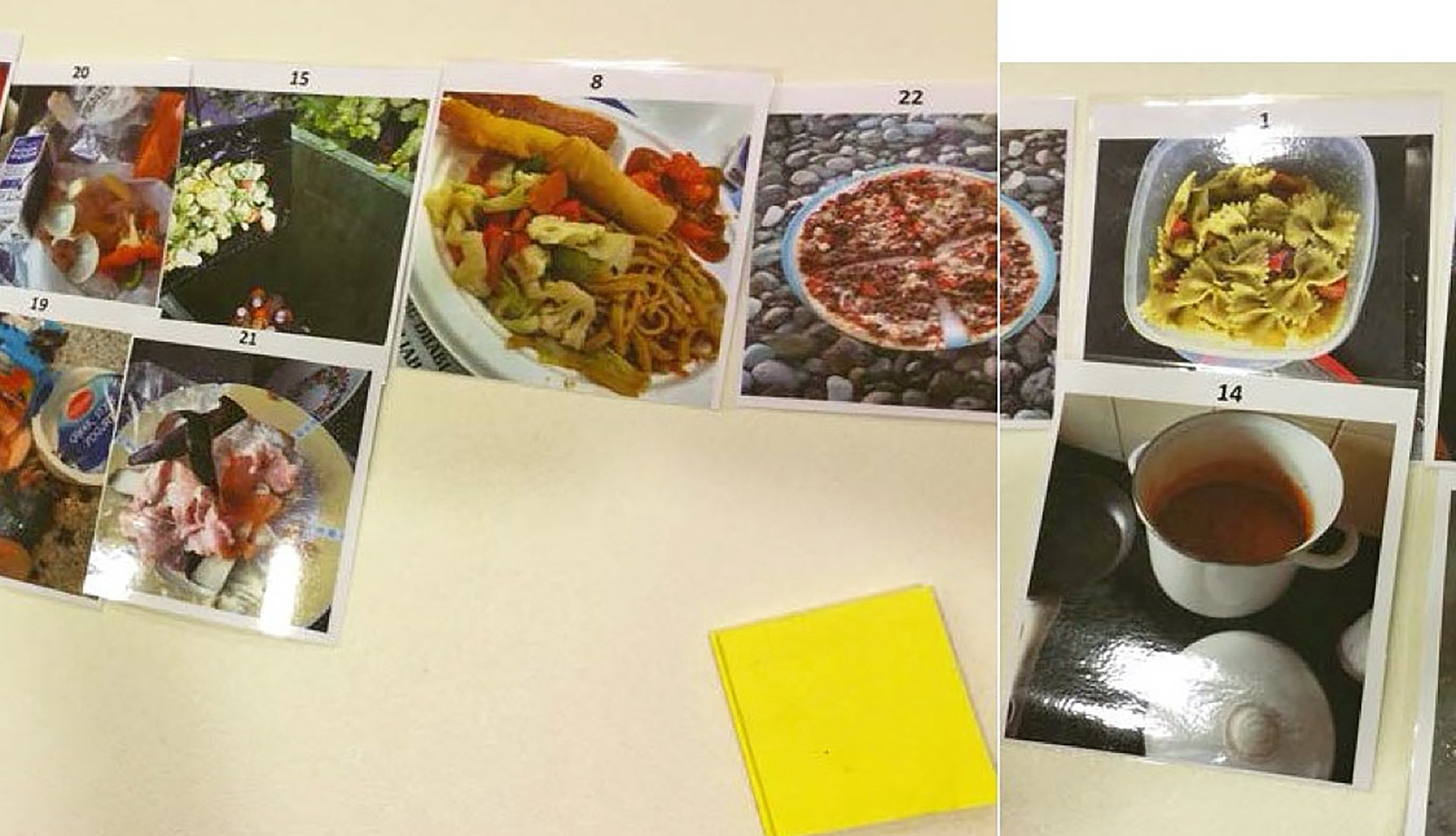
Portion of the Dutch speaking focus group’s photographic food waste narrative.
Dutch and Arabic speaking focus groups constructed similar style photographic group narratives with a main storyline and two separate vignettes. Albeit with different nuances, both concerned the story/ies of their food transitions to food waste. The English speaking focus group presented three narratives structured around the extent to which they considered their food waste as within or beyond their control; with the third narrative, a vignette of “other.” Edible and inedible food, mixed intimate food-plastic items, composting, excess, leftovers, storage, diet and health, ethics of frugality, anthropocentric and eco-centric ethics, family and hospitality, emotion, habit, retail food unit quantities and municipal waste services formed part of the different focus groups photographic narratives—to different extents and expressions. Groups’ photographic narratives remained visible on the table throughout each session—a subtle stimulus. Notably, by the end of the English speaking focus group, participants had discretely added in the excluded photographs. This suggests an intention to provide a more coherent picture, as informed by the group engagement during the session.
Focus group forming from individual strangers to group progressed rapidly. This was especially noticeable from the group photographic narrative activity, which connected participants to the privacy of their own homes while engaging in a social group space. Participants spontaneously interacted and stood up to more fully engage during the photographic narrative activity, identified their photographs and enthusiastically, fluidly and strategically co-constructed shared group narrative/s. Standing up gave participants an “aerial” perspective of the photographs as well as the emerging narratives. It also enabled them to move photographs any which way for viewing and storytelling. Space was provided wherein the interpretive tension inherent in social norms between individuals and social groups could emerge and be observed. Interestingly, and as an indication of trust and comfort, all participants identified their photographs during the focus groups although this detail could have remained anonymous. After this photographic narrative activity, themes, such as, connections within the wider food system and imagining a home with zero food waste, encouraged participants to move beyond the focus of their routine HFW practices and what they had photographed and also provided imaginative space. In closing, participants were invited to reflect on their research experience from “Snap” to “Story.”
Empowerment and Contributions to Social and Ecological Action
Analysis and findings are not reported on in this paper—but do inform pending papers. It is noted that translations and transcripts were quality checked and thematic content analysis conducted. Photographs and transcribed audio-recordings were viewed as integral rather than separate with respect to meaning construction. Beyond democratic participatory “analysis” as part of interpretation and meaning construction during interviews and focus groups, the researchers conducted the analysis and determination of the findings without the participants’ engagement. Even so, given the PAR character of this study, analysis and reporting strove to ensure that participants’ voices could be heard even as analysis distanced researchers, readers and social action from the original data. This attends to the ethical research imperative that participants are heard; and in ensuring policy makers have access to these voices, a valuable contribution to social change is realized. Community outreach events, involving research participants and the wider community, at the end of the study, presented a different approach to the comprehensive participation of PAR. Throughout the community outreach, findings were presented by the research team and then discussed, followed by the sharing of HFW knowledge and skills by a local community food waste organization (de Compostbakkers). As a means of social action, report findings were shared with political institutions, including the City of The Hague, an article was published in the local community newspaper and researchers shared the findings during high profile speaking events in the Netherlands.
In Search of Inclusive, Equitable Understandings of HFW
HFW is a sustainability conundrum that is heightened in the particular case of urban settlements, like the study area in The Hague (Netherlands), as such cities continue to diversify and grow. The “Snap-Send-Share-Story” PAR methodological design, as explicitly and transparently reported upon, reflects the researchers’ best efforts to realize inclusivity, equitability and social change through the research process whilst in the pursuit of a rich understanding of HFW, in this context.
Early on in the design stage, it was evident that to be inclusive and to engage with the tacit, hidden, private, sensitive, emotional, habitual, plural and contradictory character of HFW perceptions and practices (Evans, 2012; Quested et al., 2013), an extended visual, storytelling research engagement would be beneficial. Photovoice was initially favored because of its PAR goals as well as its ease of use, in a city where many people had mobile phones and were familiar with taking photographs with those phones and sharing them. Upon critical consideration most especially of the diversity of languages and lived experiences characteristic of residents living in an international city like The Hague, together with the complex and hidden nature of HFW, it was decided that a more extended and sequential data collection design was needed—a design that remained visual, inclusive and participatory with an advocacy dimension but that could go one step beyond individual photovoice interviews. These interviews, where meaning could be constructed, while potentially rich, were viewed as socially constrained with only an interviewee and interviewer engaged and would be overwhelmingly focused on the SHOWeD and tell (C. C. Wang, 1999) regard participants’ HFW photographs. Nevertheless, this visual focus is the value of these interviews—including those versions which employ group photovoice interviews. Additionally, in practice the semi-structured SHOWeD photovoice approach (C. C. Wang, 1999) ensured consistency between interviews when engaging a diversity of people, with different backgrounds and preferred languages, about HFW who were wordier in their efforts to convey the significance of their photographs as well as their “A-ha” moments when they realized they did indeed waste food and how and why.
Excerpt of Dutch speaking focus group’s photographic narrative activity engagement*.
[excerpt preceded by laughter] […] So that wasn’t a picture of, from the starting stage of the preparation? No. But more at the end. Perhaps this is more, number 7 […] look, there are all the ingredients that, and already a bit cut too. But there is everything that’s in the dish, let’s say, so then the next step is that it is completely cut and put in the pan. Yes, but perhaps first just the cut products indeed, leftovers that are thrown away- Yes, yes, yes. Yes, number 9, I think. That is not used anymore. Number 2, that is how the food is being prepared.
* cleaned transcript; where […] = deleted text.
Valorizing the benefits of the individual photovoice interviews in a reflexive, data collection sequence that culminated with narrative photo elicitation focus groups, we felt would better facilitate the exploration of urban HFW perceptions and routine practices. Indeed, this was the implemented experience thereof. Having experientially constructed meanings of their HFW in the individual photovoice interviews, participants were seemingly more confident, aware of their HFW and interpretations thereof and more trustful of the research engagement. We assert that this would not be achievable with the use of surveys and/or non-visual, qualitative individual or group interviews. During the focus groups, participants comfortably engaged with one another as evidenced by the fluid, spontaneous, at times humorous, and imaginative visual and verbal storytelling about HFW. Storytelling constructions drew on theirs and other participants’ HFW photographs. Moreover, dynamic resonance and tensions between selves, social groups and the wider society were evident as constructions resourced a variety of HFW discourses (Mishler, 1991; Riessman, 2008). Through this “Snap” to “Story” design, participants enjoyed creative freedom to capture and then discuss their HFW. This was fundamental to rooting participants within the reflexivity of their lived HFW experience, centering them in meaning construction and deepening their emotional investment in HFW as well as this research. A consequence of this was that participants expressed an inspiration to be a part of the change (sustainability) at home and in the wider society.
Liebenberg (2018) critiques the wide-spread popularity of photovoice due to its “ease of use” with a caution to honor communities’ “wisdom and expertise” and appreciate that photovoice in itself does not replace “long-term ethnographic engagement” and fieldwork immersion (Liebenberg, 2018, p. 1). This caution can be extended to the photo elicitation and photovoice interpretation of the presented “Snap-Send-Share-Story” PAR methodology. As designed and implemented in an exploratory urban HFW study this methodology offers a valuable and practical approach. The detailed qualitative analysis of the visual and verbal stories participants constructed about their HFW adds to the robustness of this study. Moving forward, the exploratory research question would need to evolve together with a critical appreciation of how best to approach the design of extended, longitudinal ethnographically oriented studies of challenges, like urban HFW, which are undergoing rapid development and which have recently come under intense social, economic, political and environmental pressure to transform.
Relativism can be a criticism of creative meaning construction e.g. in narrative focus groups. However, meaning was not open to infinite imagination; with participants having to reference meaning that could be recognized and/or legitimated even if it was respectful acknowledgment, as well as shared in consensus narratives. This research was interested in participants’ rich, particular and strategic meanings—what Riessman (2008) refers to as narrative truth (Riessman, 2008). The stories people construct are not wildly imaginative, and tend to resource interpretations that circulate in wider society (Gubrium & Holstein, 2015; Riessman, 2008). Similarly, it is contended, with respect to HFW stories.
That said, the challenge of who speaks for whom arises, especially in PAR studies like this one, where participants were not fully engaged in the analytical and reporting processes and where there is a diversity of communities involved. In this the reflexive linking to participants’ HFW photographs and centered constructive position of participants in the individual photovoice interviews and then the photo elicitation narrative focus groups as well as the community outreach greatly assists in overcoming this constraint. Furthermore, as Hennink (2017) declares, focus groups offer flexibility and sensitivity together with methodological rigor when engaging in cross cultural research (Hennink, 2017).
The language in which researchers and participants engage remains an enduring challenge. Robust motivation and implementation in research decisions are required. Focus groups, as designed in this study, it is argued, supported meaning construction, of the illusive expression of HFW, across languages. Similarly, with respect to understanding the interpretive nuances of HFW as per different languages. Participant interaction with one another as well as interpreters have a role to play. For example, the Arabic language community participants regularly and spontaneously translated Arabic into English among themselves, and flipped between languages, as they co-constructed meaning—by extension a form of member checking (validity).
Sustainability for people and planet, including the production and consumption of food, is more than a vision. It is about necessary transformation-in-practice regard the routines of how people live, within webs of social and ecological relationships (Ingold, 2000). It is about how people define themselves, in part through the practice of food and its waste, across an array of social similarities and diversities. It is also about how individuals and societies interpret and realize prosperity. Challenging sense making, in the stories people construct of their lived lives and the narratives of societies, sustainability as unsustainability is a complex construction of that which has “gone awry”—what Riesman (2008) declares, drawing on Aristotle’s critique of the Greek tragedy, as a narrative peripeteia. Moreover, where sustainability is constructed as sustainability, it is a champion striding across stories, rescuing people and societies from unsustainability, making them apart of a shared project and offering visions of a new utopia on Earth. As an interpretive PAR methodology, the “Snap-Send-Share-Story” method offers a way to access these deep, emotional, imaginative, reflexive and polysemic sustainability sense making endeavors and interpretations, of a diversity of people as they interweave their HFW stories of that which is visible and invisible, with those of wider society/ies. Together with the participatory, empowerment and action goals of PAR, this offers a robust, appropriate and valuable approach to studying sustainability phenomenon.
Conclusion
Urban HFW is a major sustainability conundrum. Definitive and comprehensive interpretations of HFW, within an urban diverse community like The Hague, can be illusive. “Snap-Send-Share-Story” as a sequential, PAR methodology attempts to provide an inclusive, equitable, empowering and advocacy-oriented research space wherein the visually enhanced voices of a diversity of people can be heard. The use of visual photovoice and photo elicitation with narrative methods, in a sequential flow, deeply and reflexively connected participants to their lived HFW experience and gave them the time and space to more fully and critically explore their HFW perceptions and practices. This approach accommodated polysemic and hard to succinctly verbalize interpretations of HFW. Through their photographs and the interaction with other participants, rich, spontaneous, emotional, imaginative and inspirational storytelling about the meaning of HFW at home and in wider social circulation occurred. Increasingly, over the sequence, participants expressed their empowerment through awareness of theirs and others HFW realities and inspiration to “act” with the intention of realizing positive social and ecological change.
Footnotes
Acknowledgments
We acknowledge and thank the study participants. ATJ, MC, JT and DVM were jointly involved in this HFW project, and hence contributed to conception, design and data acquisition. ATJ conducted the data analysis and interpretation of the focus groups. ATJ drafted and then revised the manuscript based on the critical feedback of all authors.
Declaration of Conflicting Interests
The author(s) declared no potential conflicts of interest with respect to the research, authorship, and/or publication of this article.
Funding
The author(s) disclosed receipt of the following financial support for the research, authorship, and/or publication of this article: This research was facilitated by the CID The Hague, and sponsored by City of The Hague, Leiden University, Delft University of Technology and The Hague University of Applied Sciences.
