




Abstract
Qualitative researchers place value on taking a closer, insider look at data as well as the subsequent data analysis and interpretation. On one end of the interpretive spectrum, researchers should be fully imbued with the coding-to-theorizing process by attending closely to the coding that leads to their analysis. On the opposite end, are those researchers positioned in the positivist paradigm, who vividly question the “researcher-as-data” analysis and its explicit subjectivity. As a middle ground, qualitative researchers have worked collectively in broader teams and/or used independent, practiced coders to add rigor to the coding process. These approaches clearly reflect the philosophical positions researchers adopt in following a research process. For the current study, the authors used the framework of Wuity thinking, which prompts exploratory learning and draws on Eastern-based wisdom. By using Wuity as both a method and a theory, an independent coder with prior knowledge of the coding process oriented a team into the epistemic practices of qualitative coding. The study found that the subtleties of a Wuity lens show delicate and enabling thresholds for expanding mindsets and practices within epistemic communities. The authors concluded that a coding team, working in a different manner, may well advance novel points of departure for qualitative analysis.
Keywords
Introduction
This article sets out the role of an independent coder (IC) who joined an already-established research team comprising four members (all lecturers at the College of Accounting Sciences at a university) to support their analysis of semistructured interviews. Notably, the IC was not yet part of the research project when the interviews were conducted. Thus, independent coding, within this study, comprised the systematic, qualitative coding carried out by an experienced coder, working independently from the initial phases of the research project and core data collection process. Coding, as an integral foundation of qualitative data analysis, entails linking short, essential meanings to text or visual data (Brent & Slusarz, 2003; Gibbs, 2018; Kurasaki, 2000; Saldaña, 2016). As such, coding establishes patterns or discoveries in data, which aid with interpretation and theorizing (Levitt et al., 2018). Team-based, multiple or intercoding practices have been covered in the extant literature (Barbour, 2001; Burla et al., 2008; Gibbs, 2018; Kurasaki, 2000; MacPhail et al., 2016; Smith & McGannon, 2018), where different researchers code the same data to verify the subsequent interpretations and enhance their trustworthiness and rigor (Nowell et al., 2017). The study on which this article is based sought to explain the team’s conceptual use of the IC’s outputs toward interpreting qualitative data. There was consensus that the use of an IC constituted a departure from the research team’s usual way of working. As such, the team members were open to using exploratory ways of tracing their research journey, using the framework of “Wuity thinking.” Wuity—an established concept in Eastern philosophy, which is not widely applied in Western knowledge systems—traces how people develop new skills intuitively and through naturalistic discovery. As such, it is acknowledged as a relatively new approach to understanding how people (particularly adherents of more Western-based traditions) learn. The process is reliant on having an open, accepting mind (despite facing difficulties in crossing intellectual boundaries) and using opportunities to advance unfolding insights (Li, 2014; Wang & Gloor, 2017, p. 4). This article therefore makes a contribution to implementing “out-of-the-box” approaches for developing improved understanding among recognized epistemic communities (Cetina, 2009; Clarke et al., 2015; Wang & Gloor, 2017), while broadening discipline-based research horizons.
The Research Problem
The research problem sets out two main contradictions around qualitative coding approaches: The first positions independent or multiple coding as a convention in research, yet problematizes the use of an IC in a research team that has an existing epistemic identity. The team members’ respective and collective research positioning may well constitute their “personal signature” (Saldaña, 2015, p. 6) in relation to the inquiry and, therefore, not encourage an “outsider” perspective. The second proposition is the realization of the need to build capability for novice coders around coding, which is achievable by including an experienced IC in the coding process. Notably, the researchers in question are well established in their respective research approaches, thus the IC had to work reflectively, yet within the context of the first contradiction.
The existing literature covers dual or multiple coding relationships within a team, where there are cases of a shared level of competence and understanding of qualitative coding. Barbour (2001) and Housley and Smith (2011) highlight how researchers have worked with ICs to open up deeper or alternative interpretations of data. In particular, Barbour (2001, p. 1116) welcomes the unique viewpoints, differences, and cross-checking that ICs bring to coding strategies. Burla et al. (2008), Campbell et al. (2013), Kurasaki (2000), MacPhail et al. (2016), and Smith and McGannon (2018), by contrast, illustrate the strengths and the complexities of other coders’ interpretations. Yet these discussions often revolve around intercoder reliability scores, and the authors’ arguments place value on using other coders to strengthen quantitative counts (see, e.g., Popping, 1988, for indices) to distill coding agreement and trustworthiness, despite the limitations inherent in using such scores (Barbour, 2001). As a further example, ATLAS.ti™, (hereafter ATLAS.t), a qualitative data analysis tool, has intercoder mode for quantifying intercoder agreements for different coders coding the same data, using the same codebook, the latter which is explained further below.
The credibility and ownership of the coding may be associated with a sole researcher or collectively and consultatively (within a research duo/team; Barbour, 2001). Methods aimed at securing ownership of the final coding may be based on coders doing the coding, as agreed, often using a prescribed, collaborative codebook (DeCuir-Gunby et al., 2011; Housley & Smith, 2011; MacPhail et al., 2016).
As indicated in the first contradiction, including other viewpoints in coding raises a question about the researcher’s epistemological “signature,” which is “uniquely [his/her] own, since [s/he is] most likely to think like no one else” (Saldaña, 2015, p. 6). The IC might not necessarily “countersign” or interpret the data sources in alignment with the researchers’ perspectives. At the same time, qualitative analysis is strengthened by a “repertoire of different thinking methods,” which leads to robust interpretation and “consolidation” (Saldaña, 2015, p. 3). The way in which researchers who are not versed in the “epistemic cultures” (Cetina, 2009, p. 8; Clarke et al., 2015, p. 37) of qualitative coding undertake research requiring such coding and/or how they work with an experienced IC have not yet received widespread attention—this issue addresses the second contradiction.
In recent unpublished Academy of Management workshop proceedings, Balogun (2018) suggests that little has been written about the lived practice of coding and how such practices differ from published pieces on coding. The literature is also silent on how the skills of an “outsider” may be deliberately and intuitively used (Wang & Gloor, 2017) to induct a relatively novice team into the coding process, as a matter of routine in the qualitative sciences.
In practice, subjective realities speak of a lack of skill and “being lost” when novice researchers embark on a coding project for the first (or even second and third) time. Interestingly, a Wuity perspective on cognition encourages a “beginner’s mind” or “empty cup” to achieve the forms of innovation and higher cognition which are anticipated of researchers (Wang & Gloor, 2017, p. 5). The question that prompted this study was the following: Could taking more novice coders through a different way of receiving coded data open up possibilities of shifting toward innovative thinking within qualitative data analysis?
The consideration of this research question prompted the case for the study on which this article is based.
The Case for the Current Research
The research focused on a team of four accounting lecturers as co-participants in this study (anonymized as L: lead researcher, Y, P, and M) and the workings of an IC. The IC was asked to “show them the ropes” around coding qualitative data and how better to analyze future projects. Given the numerical nature of the accounting domain and the inclination toward quantitative research, the steps toward achieving robust data analysis on the basis of coding (rather than numbers) are not yet well understood (Llewelyn, 2003).
Two of the team members had previously undertaken qualitative research, while the other two had mainly followed a quantitative approach. All of them admitted, however, that they needed help with qualitative methodologies, particularly in respect of coding and clustering the rich data into themes and assertions (Saldaña, 2016). Accounting research has enjoyed a rich tradition of rigor in quantitative approaches, hence the importance of improving methodological know-how within this domain has been sufficiently highlighted (Accounting Standards Board [ASB], 2019; Llewelyn, 2003). The team endorsed this view. Regular conversations held among the authors in the course of this study, along with other reflections that the IC shared when advising in this particular higher education context (accounting sciences), indicated that many scholars are still unsure about “thinking qualitatively.” An envisaged outcome of this study was therefore to create momentum for the researchers, allowing them to show others how to “use primarily…words rather than numbers as media for analysis” (Saldaña, 2015, pp. 2–3).
Prior to the IC joining the team, the four members conducted 22 interviews at various accounting firms. The interviews sought to determine the fit and alignment of an existing higher education accounting curriculum to the skill requirements of accounting firms (ASB, 2019).
Based on a premise that a relatively novice (in qualitative terms) research team would benefit from being hands-on with the actual coding process, the members took an explicit decision to expand their “epistemic cultures” (Cetina, 2009, p. 8; Clarke et al., 2015, p. 37) by engaging with an IC who regularly does intercoding and multiple coding projects. Additionally, the IC facilitates training in technical and conceptual coding and other uses of ATLAS.ti software for computer-assisted data analysis (see Scherman et al., 2018).
The discussions herein outline the IC’s foray into the disciplinary space of accounting and the team’s learning process around the practice of coding, using the framework of Wuity thinking. Centrally, Wuity seeks to spur insights rather than to offer explanations and embraces wisdom through creation and discovery. Wuity also values the gradual process of uncovering knowledge rather than the Western way of more instantaneously grasping meaning (Li, 2014). As such, Wuity expresses itself as a balancing act, which, in this case, the IC followed while working with experienced researchers who expressed the need to be open to newer research methodologies and improve their way of interpreting data. The present discussions are framed through the literature review that traces epistemic cultures, the practice of coding, and the Wuity thinking framework.
Theoretical Framing
Cetina (2009, p. 8) states that “epistemic cultures” evolve through repeated ways of working in varied knowledge disciplines, specializations, philosophies, and paradigms, in such a way that a distinctive practice develops within a research setting. Practice is seen to consist of interlinked socially established patterns, routines, or ways of doing or being and includes bodily, mental, improvised, and emotional dimensions, as well as knowledge (Jarzabkowski et al., 2015; Schatzki, 2005).
Ironically, there is extensive scholarship around practice, but perhaps not enough time has been devoted to considering the actual practices involved. Reflexivity and wakefulness within qualitative work are those practices that self-referentially require researchers to pause, think of, and question their practices (Govender, 2018). In doing so, they might explore different forms of processing, understanding, creating, and re-creating data, as advocated by Jackson and Mazzei (2011) and suggested by Wuity (Wang & Gloor, 2017).
Coding, in particular, involves many institutionalized practices (Gibbs, 2012; Saldaña, 2016) that are offered in singular explanations or as part of an overall team rubric. The stance around the researcher, as coder, has long persisted (with good reason, given the seminal paradigms that researchers within qualitative studies claim in their data journey; Guba & Lincoln, 1994). The central role of the researcher/s as active coder/s is understandable when one considers how coding should “best” be done: close to the “knowing” of the data and in line with the premise of “researcher-also-as-data.” Such sole or co-coding by researchers assumes that there is indeed a researcher who “knows coding” or that confidence around coding capability exists within research teams (Barbour, 2001). The literature reflects on “additional” coders meeting criteria that improve rigor (intercoder reliability as one measure) and delving more deeply and “objectively” into the exploratory power of qualitative data (Barbour, 2001; Burla et al., 2008; Campbell et al., 2013; Gibbs, 2018; Kurasaki, 2000; MacPhail et al., 2016; Smith & McGannon, 2018). Barbour (2001) acknowledges the importance of independent experts in qualitative coding, yet asserts that the contribution, which ICs bring to the coding process is not to acquire paradigm-shifting acumen but to ensure a systematic coding process.
While coding and coding levels, steps, and cycles have been explored as analytical and interpretive acts (Hesse-Biber & Leavy, 2010), the intrinsic intellectual processes around creativity and thinking (higher cognition) have perhaps not been investigated sufficiently. Given this gap, the concept of Wuity has convening potential. Wuity, as drawn from Chinese philosophy (and hence problematic to do full justice to, in other languages), has been explained as “the capability of deliberate intuition and intuitive insights” (Wang & Gloor, 2017, p. 1). Wang and Gloor (2017, pp. 5–6) described the “six steps” of Wuity as providing some clarity around thinking concepts. Those steps, whose numbered order was adjusted for the current study, are as follows: (1) mindful observation/beginner’s mind; (2) visual analogy; (3) gaining insight; (4) implementing; (5) getting stuck; and (6) letting go (Wang & Gloor, 2017, pp. 1–2). Deeply seated within Wuity is a more subtle and gentler way of learning and creating balance, as well as a holistic and nondualistic orientation. This creates a more harmonized way of knowing and being. In many ways, Wuity captures “intuitive perceptual processes” which often seem to be that which cannot be said. As posited, attendant to these stages are human beings’ higher and unfolding levels of cognition (Wang & Gloor, 2017, p. 1).
Wang and Gloor (2017, pp. 5–6) expand on the concepts of Wuity by explaining that deliberative intuition can also be described as “sensible intuition.” Unfolding insights are formed through grouping counterpointing cognitions of imagery, relational reasoning processes, and analytical thinking. Our minds should thus not only compute but also seek organic enlightenment (Li, 2014). Within deliberative intuition, there is mindful observation, which is similar to being present—as if one is experiencing something with a “beginner’s mind.” It is akin to the rich processes one observes in a child perceiving the world as if for the first time. Importantly, “mindful observation” is a starting point in Wuity, and it is facilitated through “attentive observation, critical curiosity, [a] ‘beginner’s mind’ and presence” (Epstein, 2003; Wang & Gloor, 2017, p. 6).
This flow of embodied meaning-making is prompted by confronting the threshold of “getting stuck” and then moving onward through “letting go” of certain views (Wang & Gloor, 2017, p. 5). Wuity entails opening oneself up to an arc of different ideas by going through all (or some of) the aforementioned steps on the continuum. This thinking may be linked to an established disciplinary community viewing data and research from a new perspective.
Method
Design and Methods of Data Collection
The research undertaken was treated as an intrinsic case (Stake, 1995), involving adapting Wuity as both a theory and a way of explaining and tracing the research methodology. Wuity has mostly been used as an innovation process or theory (Wang & Gloor, 2017) and is not necessarily deemed a research methodology.
Ethical approval was obtained from the Ethics Committee of the researchers’ university to include an IC who would both code interviews and facilitate the learning of the research team. The IC project commenced with an orientation meeting between the IC and the lead researcher (L), who had, prior to the focus of this research, conducted many of the 22 interviews that required coding. The two participants (IC and L) agreed to a research process, which is summarized in Figure 1.

Methods of data collection.
The lead researcher and the IC (hereafter coders) subsequently had a session during which they jointly coded a sample of the transcripts, so that the IC was inducted into the disciplinary specificities of the content of the interviews. The coders used deductive codes (derived from the interview questions) and inductive codes (derived from the data), with the IC specifically guiding the initial processes, as detailed below.
The IC and L, as coders, read the transcripts, paying close attention to the interview schedule. They created prefix codes (Friese, 2014) for the topics of the questions and also discussed, and arrived at, opportunities to inductively do the coding. Once the coders had achieved coding stability on the patterns of the sample of data, the IC was left to complete the remaining interviews with the lead researcher reviewing the coding as “member checking,” while the cycles of coding were underway. The IC used ATLAS.ti 8, for the project. This phase employed Barbour’s (2001, pp. 1116–1117) non-“technical fix” tenets as follows: Within the sample data (two coders), deliberating on each code (the “whats” and “whys”) without pushing toward “concordance” but ensuring systematic clarification, exploration, discussion, and probing before settling on a coded meaning for the data (Barbour, 2001, pp. 1116–1117). Another person closely reviewing the evolving coding framework (L, M, and IC), taking into account unfolding messiness as the IC and lead researcher revisited the evolving coding framework. This entailed reinterpreting when “competing” views, with ongoing discussions toward achieving consensus and complementarity of coded quotations (Barbour, 2001, pp. 1116–1117). Articulating a logical and transparent process in such a way that the team could follow what had been done. The explicitness of the process would be held up for scrutiny by the research team (Barbour, 2001, p. 1116).
The codes generated through the coding of the 22 interview transcripts arising from the IC’s work are not included in this article, as they are not the focus of the current unit of analysis.
The unit of analysis, instead, was how an IC engages, using Wuity as a lens, with a team of researchers around the coding process followed for their data set. The data collection methods for the current study are summarized and explained in Figure 1 and in the subsequent sections.
The coding of the transcripts was compiled into coding and quotation reports, which included tentative explanatory notes on the emerging categories. The IC was responsible for compiling these reports, drawing extensively on the Report, Network, and Memo functions of ATLAS.ti. The research team used these artifacts and the input of the IC to draft their own research reports and articles.
At this stage, it is important to emphasize the need for a balanced threshold (coding vs. analysis). Coding includes working with raw data, but taking this data forward, toward interpretation, implies stepping into the researchers’ own influence (Hesse-Biber & Leavy, 2010). The team endorsed the notion of showing ethical respect for this threshold. The IC consciously stopped short of interpreting or theming the data around the disciplinary theories of the accounting sciences. This was done so as not to blur the line of whose intellectual contribution would emanate from the scholarship of the project.
In advance of the first participant observation (PO1; see Figure 1), the ATLAS.ti artifacts were shared electronically with the team. Each researcher went through the materials, making their own notes and recording any questions. The lead researcher convened a consultative session (PO1; Barbour, 2001), which was facilitated by the IC. The session included a detailed discussion of the coding under the headings of the emergent categories. The IC clarified the coding processes and the logic of the reports, in addition to fielding discussions and responding to the observations and questions of the research team. Simultaneously, the IC did participant observation using the lenses of the theoretical framing of this study to discern the responses of the team. After the consultative session, the IC undertook the second participant observation (PO2) during an article writing session, which included the team’s use of the various coding outputs. During PO2, the IC was invited to join the respective team members in the more detailed processes of making sense of the data, as they incorporated the coding reports into their research areas of analysis.
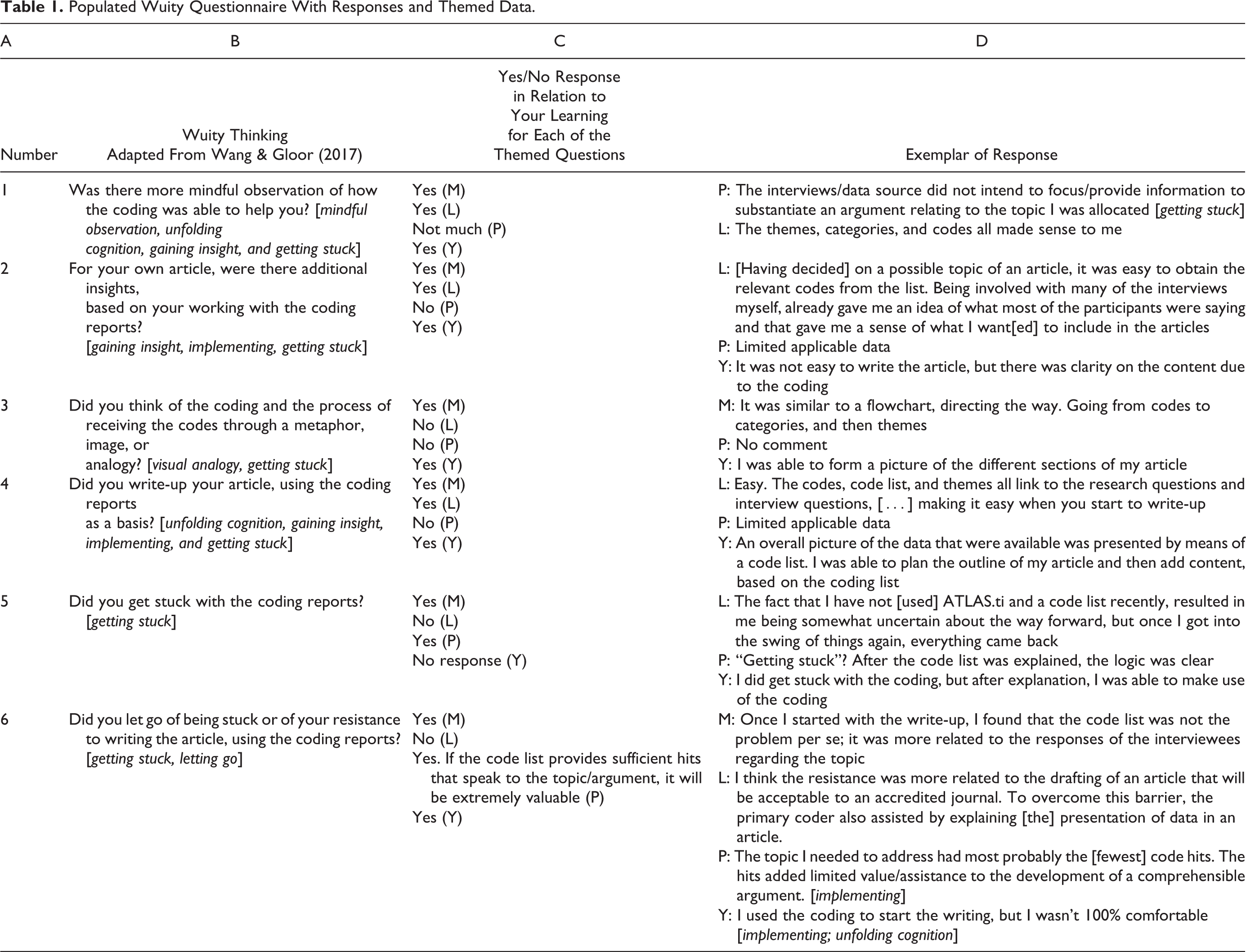
After the formal sessions, the researchers continued using the coded data in their articles and report writing (for approximately 4 months). They were then invited to reflect formally on the inclusion of an IC and her coding reports, through a Wuity questionnaire, which was emailed to the team. The Wuity thinking framework was covered with the team by means of articles and discussions. To illuminate the learning of the team, the IC devised the Wuity questionnaire (Table 1) to consciously overlay this approach as a learning framework. The questionnaire treated Wuity as a theory for this study and integrated the related philosophical ideas as a novel method for data gathering (see Figure 1; Tables 1 and 2). Wuity was therefore used as both theory and method.
Populated Wuity Questionnaire With Responses and Themed Data.
Themes With Summative Interpretations.

Note. IC = independent coder.
Methods of Data Analysis
Actual quotations from the field notes (PO1 and PO2) were coded in relation to Wuity themes and deepened practice (see Figures 2 –5: network views). Next, the research team summarized the data from PO1 and PO2 around the Wuity thinking concepts (Wang & Gloor, 2017, pp. 2, 5–6) to form themes. Epistemic practice (Cetina, 2009; Clarke et al., 2015) was included as a crosscutting theme. The themes were named and explained in the light of the process adopted in the current study (see Table 2). The Wuity questionnaire (see Table 1) was analyzed in the same way, with sample responses to the questionnaire being provided to demonstrate their link to the Wuity process.

Data exemplar: Unfolding cognition.
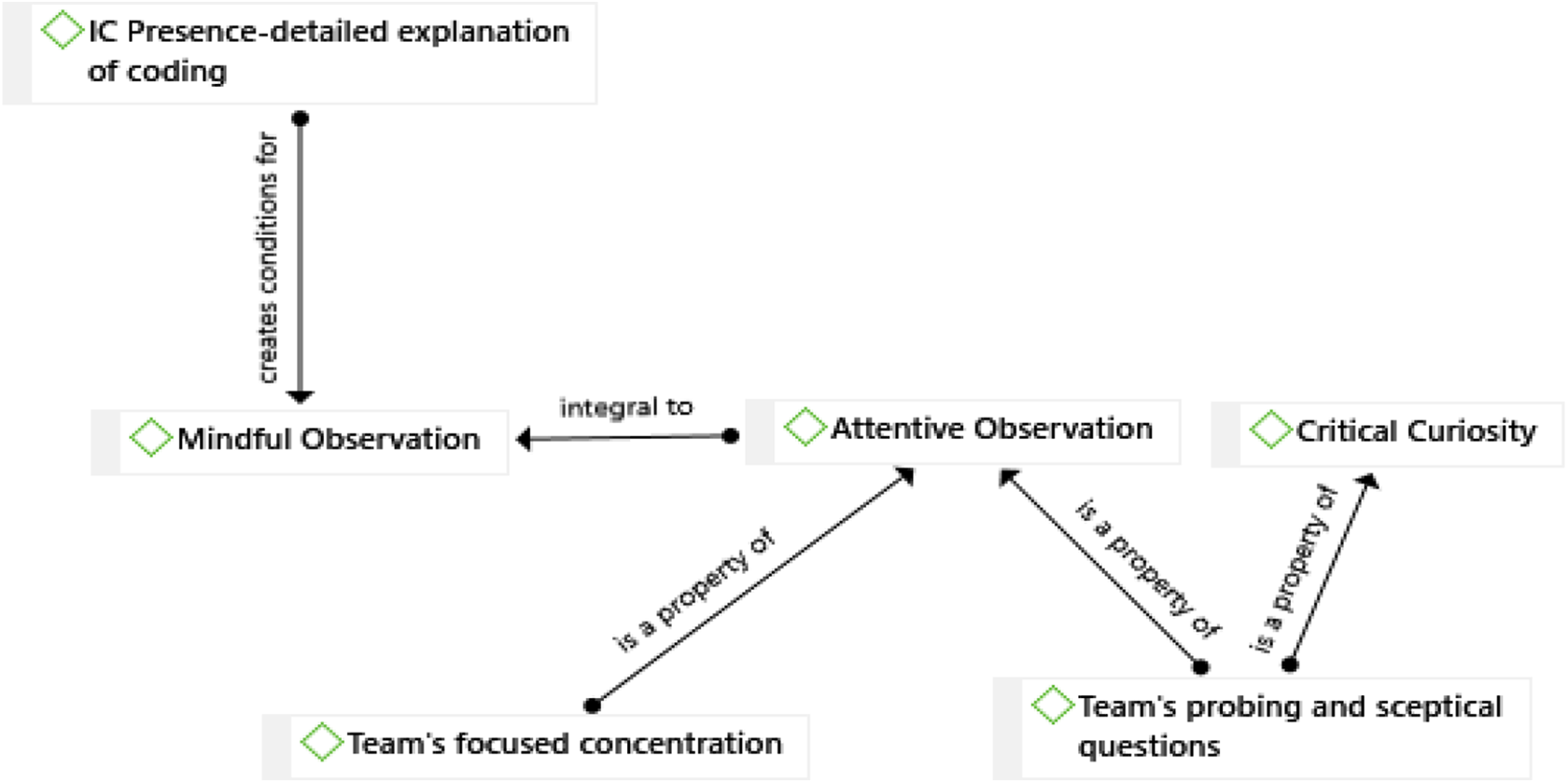
Data exemplar: Mindful observation.
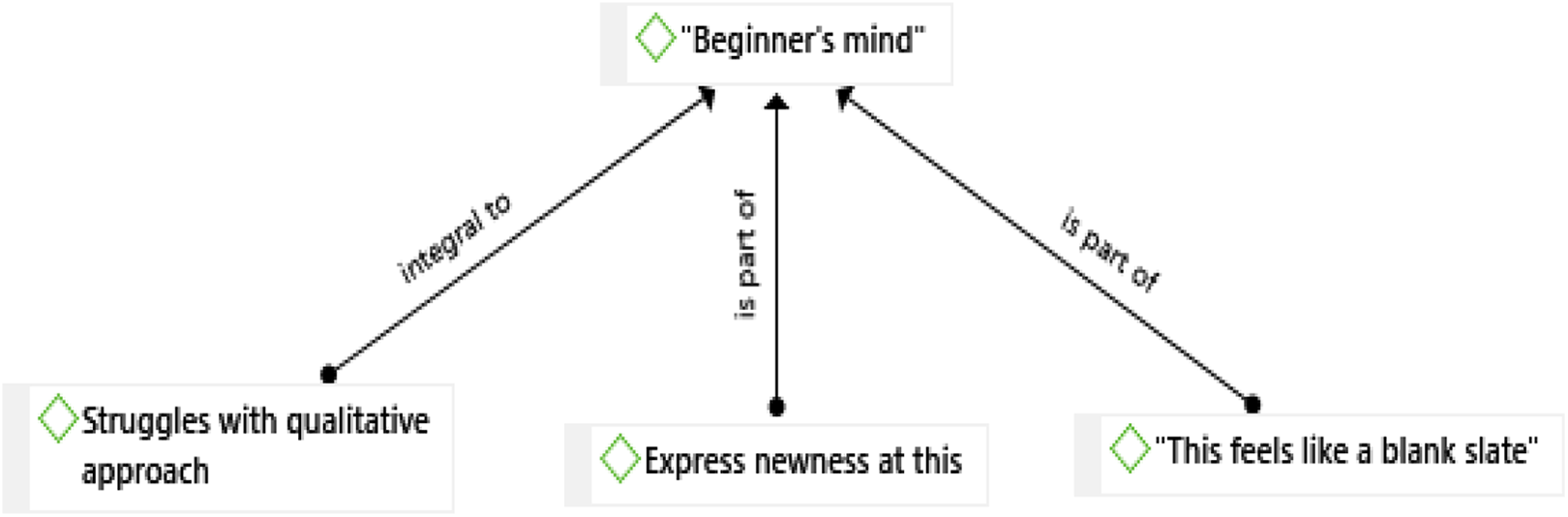
Data exemplar: Beginner’s mind.

Data exemplar: Getting stuck, letting go, and gaining insight data were then themed from the network views.
Data Presentation
The data from the study are presented below under the various data collection methods.
Method 1: PO1 and PO2
The data were written up in field notes derived from PO1 and PO2. Thereafter, quotations from the field notes were coded using Wuity concepts, and network views were created, both of which aided in creating themes for the study. Consistent with Tracy (2013, p. 207), who states that raw data may be credibly represented in exemplar data, the latter are included herein as network views (Figures 2 –5).
Themed Data
The themes of Table 2 are grounded in the data and drawn from the theoretical framing. The summative insights of how the participants interpreted their learning are provided to explain the themes.
Method 2: Wuity questionnaire completed
Further to exploring the team’s cognition around working with an experienced coder, the IC provided questions probing for Wuity thinking (see column B, Table 1). The Wuity philosophy acknowledges that human responses are interrelated and harmonized (Wang & Gloor, 2017, p. 2). This is consistent with qualitative analysis, where multiple meanings intersect. Therefore, while the questions are distinct, the themes are linked. In the team’s responses, there was a consciousness of having to apply Wuity concepts to their own learning and practice in a reflective and integrative way.
The Wuity themes are indicated in italics and square brackets in column B and the teams’ affirmation and denial of the Wuity concepts in respect of their learning appear in columns C and D. In the summative analysis, the team agreed that while the questions focused on Wuity, the responses collectively indicated how the presence of the IC and her work were integral to their orientation and use of qualitative epistemic practices. Equally, all responses amounted to shifts in epistemic practices.
Discussion
The study demonstrated that building novice coders’ epistemic practice in qualitative data analysis may usefully follow the concepts or “steps” of Wuity-based thinking (Wang & Gloor, 2017, p. 5). The presence of an experienced coder was instrumental in expanding the researchers’ insights and learning.
The novelty of Wuity as a theoretical perspective and methodology suggests that deliberation may have been stronger than intuition, given the slow, almost hesitant taking on of newer epistemic practices within Wuity’s concept of “deliberate intuition.” The data show that cognition and implementation did take place, yet it was more “unfolding” and indicative of primary thinking than the higher, more creative, cognitive “leaping” and innovation described by Wang and Gloor (2017, p. 2).
The lack of real depth around the visual analogy, as a telling example, suggests that such “mental leaps” were (and perhaps need to be) concrete rather than fuzzy. Shifting epistemic practice might work better using concrete code reports, as opposed to working abstractly with intellectual innovation. Wang and Gloor (2017, pp. 3, 6) argue that the symbolic visualization stage is definitive for “triggering inspiration” and prompting creative conceptual jumps rather than the Western-style “conceptual logic” and “propositional representations,” which, in their view, appear to be more readily used by researchers. Furthermore, exemplars from the participants’ responses (Table 1) around the theme of “getting stuck” show that a journey is involved and that there is some resistance to change, either in respect of research habits or toward more ambiguous, fluid reasoning (Wang & Gloor, 2017, p. 9). The current study endorsed a practical link between being stuck/blocked and releasing/letting go as sequential steps but treated these steps (as with the others) in an incremental way, and within a worldview of Eastern “flow,” of dawning apprehension/realization and insights.
There was evidence of epistemic practice changes, more so with the unfolding sensemaking on the part of the team. The team members (M and L), who had worked in qualitative approaches before, were able to diversify more than P, who had worked mainly in other paradigmatic approaches and whose responses are indicative of “getting stuck.” Y, by contrast, who was also used to quantitative approaches, reflected positively on the coding as providing the support needed when writing an article. Y’s responses, in Table 1, show a noticeable shift.
The use of a skilled IC created conditions for conversations around epistemic practices. The current authors’ epistemic practices (as seen in the network views; specifically Figures 2 –5) were nudged or shifted incrementally rather than being replaced or changing fully toward the more ambiguous, fuzzy worlds of qualitative and Wuity philosophies. This is consistent with the contention of Clarke et al. (2015) that the principles and norms around epistemic communities are deeply embedded. Communities work within habitual modes or practices, with knowledge communities often being driven by the organizations and sectors in which they are situated, where they are used to particular traditions (Clarke et al., 2015). Accounting science has a long, practice-based tradition of favoring quantitative evidence (ASB, 2019).
The presence and role of an IC, as primary coder, triggered the Wuity “beginner’s mind” (Suzuki, 2010, p. 143) regarding qualitative approaches and how coding may be done. This is especially evident in Figure 4, with the expressions of “blank slates” and “newness.” The coding presented in the network views (Figures 2 –5) also illustrates the IC’s quest to adapt to, and build bridges within more novice mindsets. The researchers showed degrees of unfolding cognition and implementation by struggling with the coding outputs and then managing to incorporate those outputs in their article writing. Y’s views show a move from initial caution to quite strong implementation and unfolding insights. Despite initial resistance, all the researchers sought additional insights and were willing to work collaboratively and organically around data presentation strategies for their articles. Researcher P conceded that the coding outputs were useful, provided there was sufficient groundedness within the data to address a topic for an article. All researchers followed the system of coding—a decision that aligns with Barbour’s (2001) view that systematic, independent expertise adds value to qualitative coding. The team’s decision to use the knowledge of the IC not only for the required coding but also (deliberately) for learning created opportunities for meta-learning and a chance to reflect, gain “insight,” and experience unfolding “cognition” (Wang & Gloor, 2017, p. 2) within the intervention. The study identified the notion of enhanced awareness being brought about by experience in coding. Within Wuity (Wang & Gloor, 2017, p. 3), there is room for an observer (participant observation of the IC) to be understood as “an accurate and reliable observation tool” (the IC’s coding was taken on board and was evident in the writing session, without any rejection of qualitative outputs by the team). To be trusted, the observer may serve as a Wuity “light” rather than merely offering explanatory logic (Li, 2014, p. 30).
Conclusion
The current study attended to the gap in scholarship around the contradictions of the “presence” of an IC (presence as a Wuity concept) within a domain that privileges the respective researchers’ epistemological signatures (Saldaña, 2015, p. 6; Wang & Gloor, 2017, p. 1). The findings showed that when novice qualitative researchers’ cognition unfolds, an IC might provide delicate thresholds for showing different practices within an epistemic community. A central finding of this study was that an experienced IC facilitates awareness and gradual insights, while sparking cognition and independent academic work, as the team used the coded output and the IC’s presence to support them in writing up their articles. Using the subtle lens of Wuity, there is an appreciation for researchers who start with a “beginner’s mind”—not an easy space to occupy, for the experienced scholars who formed part of this team. The research team members were aware that this notion ruptures several dearly held principles pertaining to their embeddedness in their coding and the initial stages of data analysis. It begs the question of how “hands-on” or “hands-off” an IC should be.
As originally studied in the Wuity articles, the steps seemed to resemble a continuum rather than a set of disparate points—this also showed up in the interplay between the theoretical framing, the methodology, the data, and the themes. The current research contributes to qualitative methodology by having used Wuity as a qualitative method (a groundbreaking approach) and proposing its additional extension as living up to its ingrained Eastern roots of being close to a continuous and iterative flow, and mutability. An abiding insight was that learning coding this way proved transformational. Additionally, while words and analyses attempted to articulate what had happened, there was also “something” about the process, being consistent with Wuity’s Daoism and Zen roots that cannot be adequately communicated. This had to do with the intangible and intuitive flows of learning captured in the subtextual elements of the PO sessions.
Epistemic collectives using newer practices were explored in this study and confirmed the strength of epistemic cultures but also suggested that practice was being nudged (gently pushed) toward epistemic diversification. These nudges are consistent with the philosophy of Wuity’s flow toward different ways of being and thinking.
The researchers signal limitations to this work, in that the research was conducted around a small team who worked together and might already have bonded in respect of their supportive epistemic practices. This arrangement includes the detail that the IC’s experience and track record were known to the team and, while not a colleague, she worked within their broadened scholarly domains. This may have induced the softer “landing” of this research and evoked reduced resistance to her inputs. The research was qualitative in approach and did not seek to compare core variables of IC coding and/or the influence of IC coding in more pragmatic modes of thinking. While building toward theoretical analysis and extension, the research remained exploratory in terms of the inclusion of the IC. Wuity, as an enabler of innovation, is a newer theoretical model and novel as both a theory and methodology for higher education innovative thinking, thus making it fresh, yet without amplification in other like-for-like scholarship.
Several threads of research might still be gainfully explored. The theoretical contributions offered by Eastern philosophies need additional study in Western knowledge systems. A more pronounced strategy for seeing Wuity as an innovative model in higher education and research is thus advocated. Using IC expertise in relation to core research teams is an evolving practice, and the more nuanced roles of coding—using different learning philosophies—could fruitfully be investigated beyond existing studies.
Harnessing the single visual analogy from this study, “[i]t was similar to a flow chart, directing the way” (see Participant M, Table 1), we propose that this study has given a version of the “flow” associated with Wuity, especially in terms of firstly, shifting epistemic practice and secondly, using an IC, both of which furthered an underrecognized way of learning the practices of coding.
Footnotes
Authors’ Note
Ethical clearance for the research projects was granted by the College of Accounting Sciences, University of South Africa.
Acknowledgments
The authors would like to thank the University of South Africa for funding the current research project. They also express their appreciation to the anonymous reviewers whose insightful comments facilitated the quality of this article.
Declaration of Conflicting Interests
The author(s) declared no potential conflicts of interest with respect to the research, authorship, and/or publication of this article.
Funding
The author(s) disclosed receipt of the following financial support for the research and/or authorship of this article: This work was supported by the University of South Africa.
