




Abstract
Project title:
Occupational Therapy Approach to Sexuality in People with Acquired Brain Injury (ABI) in Subacute Stage.
Design:
Qualitative study with a phenomenological approach.
Context of Study:
The relevance of the occupational therapy approach to sexuality regarding people with acquired brain injury in the subacute stage.
Objectives:
General objective: Explore the perceptions of people with ABI, who are in a subacute situation, and their relatives and partners, about their assessment of the relevance of the approach toward sexuality during their occupational therapy intervention. Specific objectives: Describe and analyze the perspectives of users, family members, and partners about the importance of this activity and its relevance in daily life; what is included in the approach to sexuality; the differences that may arise between the perspectives of the participants according to gender; and the differences that may arise between the perspectives on the subject by age groups.
Study Population and the Total Number of Participants:
The study population is made up of people with ABI in the subacute stage who attend occupational therapy at the physical rehabilitation unit of a hospital in Spain, and their families and partners. The size of the sample is conditioned by the qualitative study’s design. The number of participants will be established when theoretical saturation of the data is reached. First results are now available.
Contributions to the Current Understanding
There is a need to carry out a study that investigates how sexuality is affected after suffering an acquired brain injury (ABI) and to determine what occupational therapy interventions can be performed for people who have suffered from this as well as their families and partners. It is necessary to know their perspectives on this area in order to find out if they consider it a priority in the subacute stage of the recovery process or believe that, on the contrary, there should be no intervention or it should occur later in a chronic phase.
Background/Study Justification
Occupational therapy is a discipline that proposes a client-centered practice and that conceives of this in a holistic way (Kielhofner, 2009). Therefore, when an occupational therapist develops their professional practice, they should take into account all the spheres of the person. The American Occupational Therapy Association (AOTA, 2014), in its Occupational Therapy Practice Framework, records sexual activity as an activity of daily living. However, this activity is not completely addressed by the professionals of the discipline when it comes to working together with clients. Sexuality constitutes another part of the person and, according to authors such as Malón, it must be considered, respected, and cultivated by professionals (AOTA, 2014). In addition, it is important to note that when a person suffers acquired brain damage, for various reasons, the sexual activity of that person can be altered by physical, neuropsychological, emotional, or behavioral conditions (Malón Marco, 2009). If the occupational therapist really seeks the empowerment of the person and the recovery of the greatest possible independence, it must be assumed that sexuality also forms part of the patient’s daily life. Therefore, approaching this topic may be another objective to take under consideration in therapeutic intervention (De la Cruz Martín Romo & Rubio Arribas, 2010).
Therefore, if possible, what we want to investigate in this study is whether for people who have an ABI, and their families and partners, it is relevant for occupational therapy to intervene in the area of sexuality. We seek to know patients’ and their families’ perspectives on this subject in order to know whether they consider it a priority in the subacute stage of the recovery process or believe that, on the contrary, there should be no intervention or it should be done later in a chronic phase.
Objectives
The general objective of this study is to analyze whether people with acquired brain damage who are subacute and their relatives and partners consider the approach toward sexuality in their occupational therapy intervention to be appropriate. In addition, the specific objectives are the following: → To describe and analyze the perspectives of users, family members, and couples about the importance of this activity and its weight in a person’s daily life. → To describe and analyze the perspectives of users, family members, and couples that pertain to the approach to sexual activity. → To describe and analyze the differences that may arise between the perspectives of male and female users, family members, or couples on the subject of the study. → To describe and analyze the differences that may arise between perspectives on the subject by age groups in users, families, or couples.
Explanation and Justification of Method
The study that has been carried out has a qualitative methodology. This gives it a phenomenological focus because it seeks to know the subjective experience of the people with whom we work. We sought to know the experiences and perspectives of these persons in order to analyze them and draw conclusions related to the central theme of the work. To obtain this information, the main data collection tool was the interview. A semistructured interview was also used (the Canadian Occupational Performance Measurement Instrument of Occupational Therapy).
Materials and Methods
○ Study period: The study was carried out between September and June 2018. The fieldwork was carried out from February to the end of April, during the student’s period of university clinical practice.
○ End of the study: The date of completion of the study was the second week of May.
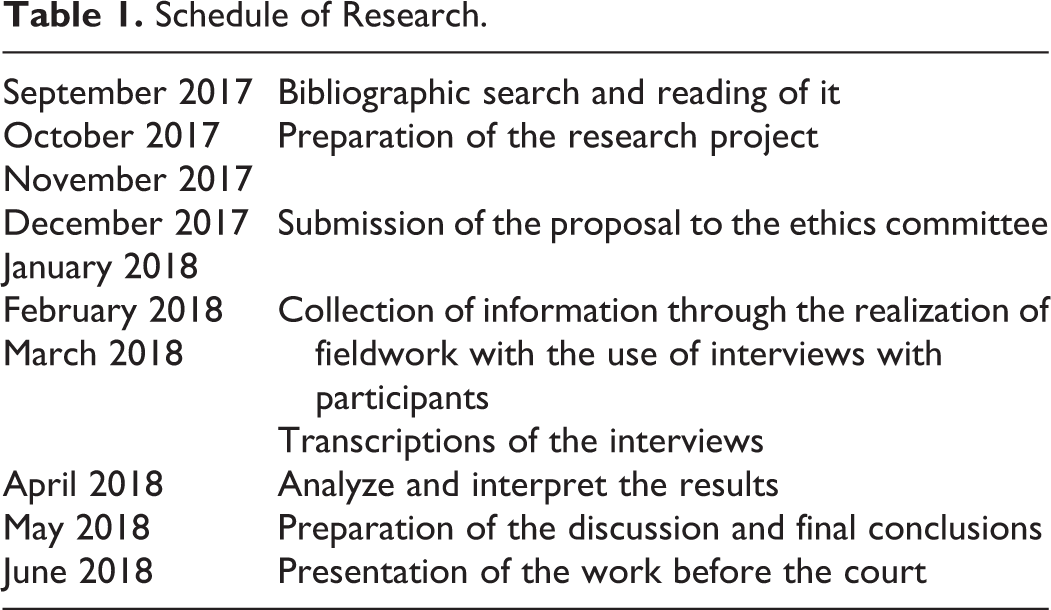
○ Scope of the study: This is a study in the discipline of occupational therapy in a hospital space, specifically in the Maritime Hospital of Oza, with clients with ABI and their relatives and partners. Table 1 includes the schedule of the study.
○ Measurements and intervention: In order to collect the data, a semistructured interview was carried out by a student with the participants, with the support of the principal investigator and the supervision of the occupational therapist at the Maritime Hospital of Oza. Participants agreed to participate in the study and authorized the student to interview them. This interview was different depending on whether it was with a person who suffered the ABI, their partner, or their relative. In addition, in order to know the occupational priorities of these people, a semistructured occupational therapy interview called Canadian Occupational Performance Measurement was used. The use of this was limited to knowing these occupational priorities and, therefore, the instrument was not used in its entirety. That is, because this instrument is used to assess the occupational priorities of a person over a period of time, only the section in which these priorities are known was used because there was no reason to use the other information.
Schedule of Research.
These interviews were conducted in one of the rooms of the occupational therapy area of the rehabilitation service of the Maritime Hospital of Oza. This classroom was occupied only by the study participant, the person in charge of conducting the interview, and the occupational therapist of the hospital. No one could enter this room during the performance of the same in order to ensure maximum privacy and confidentiality of information.
The interviews carried out with the participants were recorded in audio format. After the completion of each of the interviews, they were transcribed in a coded manner and kept under lock and key by the hospital occupational therapist to guarantee confidentiality. The recordings were destroyed immediately after the transcription of the same. At no time was access to the clinical history of the participant necessary in the development of fieldwork.
Sampling/Recruitment
○Selection of participants: For the selection of participants, it was important to indicate that there were to be three groups of informants. The main group comprised the clients of the service who presented acquired brain damage and the other two groups were composed of their partners and relatives who agreed to participate in the study. The use of these three groups allows us to know whether there are differences between their perspectives regarding the main topic of study in order to know the possible differences, coincidences, or contradictions that could exist. Therefore, there were certain criteria for the inclusion and exclusion of users and other criteria for partners and relatives.
● Selection criteria of people with ABI:
■ Inclusion criteria
→ Aged over 18 years.
→ Had a diagnosis framed within the concept of ABI.
→ In the subacute stage after the ABI.
→ Engaged in occupational therapy at the neurology service of the Rehabilitation Unit of the Maritime Hospital of Oza (CHUAC) for a minimum of 2 months.
■ Exclusion criteria
→ Did not agree to participate in the study.
→ Presented a decrease in level of consciousness.
→ Presented alterations at a cognitive level that suggested a score of less than 20 on the mini-mental state examination (MMSE).
→ Presented disinhibition after acquired brain damage.
→ Presented sensory aphasia.
● Selection criteria of relatives and partners of people with ABI:
■ Inclusion criteria
→ Aged over 18 years.
→ Was a partner or relative of a person who had a diagnosis framed within the concept of ABI.
→ Was a partner or relative of a person who was in the subacute stage after the ABI.
→ Was a partner or relative of a person who was engaged in occupational therapy at the neurology service of the Rehabilitation Unit of the Maritime Hospital for a minimum of 2 months.
■ Exclusion criteria:
→ Did not agree to participate in the study.
→ Presented a decrease in level of consciousness.
→ Presented alterations at the cognitive level that suggested a score of less than 20 on the MMSE.
● Withdrawal criteria: Voluntary withdrawal from the study and/or discharge from the hospital.
○ Recruitment of participants: The recruitment of participants in this study was done by the occupational therapist of the hospital in order to facilitate entry into the field of study as a person known to people with ABI, their relatives, and their partners. She was the only person with full access to medical records. This professional was in charge of recruiting the participants and was the one who offered participation in the study to those patients who met the inclusion criteria and who were the most representative in order to obtain the best possible information because it is characteristic of qualitative research to use an intentional and convenience sample. In addition, the occupational therapist was the person who presented the information sheet and the informed consent form, requesting authorization for the college student, with her supervision, to conduct the interviews that are presented in this document. In addition, once the participants accepted, the occupational therapist offered their partners and family members the chance to participate. Once the information was disseminated, those who freely accepted to participate in this study were told to contact the principal investigator and the student by telephone or e-mail to give their consent. These contact details appeared in the adult participant information sheet.
○ Justification of the sample size: The size of the sample was conditioned by the qualitative study’s design. The number of participants was established when the theoretical saturation of the data was reached.
Data Handling/Analysis
The analysis of the data that were collected from the interviews with the people participating in the project was studied, triangulated, and interpreted by the researchers, once they were codified and moved from the Maritime Hospital of Oza to the Faculty of Health Sciences under the custody of the principal investigator, as already indicated above. The interviews were transcribed (codified) and their content was analyzed, including their categorization, in order to answer the study questions. For this, an inductive approach was used, which facilitates the themes which emerged from the previously obtained data. Thus, several categories were identified that made it possible to directly present, in a reliable manner, the experiences and perceptions of the participants themselves. In addition, in order to obtain an external verification of the qualitative results, a process of “researcher triangulation” or intersubjective verification was applied. This allows the contrast of information, analysis of data, and subsequent discussion, leading to greater credibility and objectivity. The purpose of this analysis is to know firsthand the meanings and the definition of the situation itself as well as the experiences of the participants.
Ethical and Legal Aspects
● Compliance with Standards of Good Clinical Practice and Declaration of Helsinki: In order to carry out the present work, compliance with the Good Clinical Practice Standards was taken into account. It was not necessary to take into account the Declaration of Helsinki because the study does experiment with human beings, but rather the research was based on information gathered from the interviews carried out with the participants without actually working with them directly after the collection of information. The present study assumes the following main principles of the declaration: ○ The primary purpose of medical research involving human subjects is to understand the causes, development, and effects of diseases and improve preventive, diagnostic, and therapeutic interventions (methods, procedures, and treatments). ○ Medical research is subject to ethical standards that promote and ensure respect for all human subjects and protect their health and rights. ○ While the primary purpose of medical research is to generate new knowledge, this goal can never take precedence over the rights and interests of individual research subjects. ○ It is the duty of physicians who are involved in medical research to protect the life, health, dignity, integrity, right to self-determination, privacy, and confidentiality of personal information of research subjects. ○ Physicians must consider the ethical, legal, and regulatory norms and standards for research involving human subjects in their own countries as well as applicable international norms and standards (World Medical Association, 2013).
● Confidentiality of the information: The confidentiality of the participants in this work was given priority at all times. Personal data were encoded by a letter and a number. Therefore, all information collected was protected by compliance with Organic Law 3/2018 of December 5 on the Protection of Personal Data as governed by Spanish law. The information sheets and transcripts of the interviews were stored under lock and key in the facilities of the Faculty of Health Sciences (UDC), where the main researcher carries out her activities. In addition, it is essential to indicate that, following Order SSI/81/2017 of January 19, which publishes the Agreement of the Human Resources Commission of the National Health System (Spanish legislation), in order to ensure and protect the right to privacy of the patient, the student was not able to access the personal data of the patients. The occupational therapist of the hospital was in charge of these procedures and asked for authorization from the patients so that the student could carry out the interviews presented in this project. Therefore, the occupational therapist was also the custodian of this personal data until they were codified.
● Informed consent: It was essential to obtain informed consent from participants; therefore, the hospital occupational therapist provided an information sheet to each adult participant. If they wished to participate in the study, the participants subsequently signed the informed consent form. The occupational therapist indicated that the student would be the one conducting the interviews, under her supervision. Once this was done, participants who were interested in participating could contact the main researcher of the project and the student in order to confirm their participation (Online Appendices 1 and 2).
Rigor
○ Consistency
That rigor criterion was met with the triangulation of the data through analysis by three different researchers. ○ Confirmability
The methodology of research is well described and it was followed during the research. The interviews were recorded in audio and, then, transcribed for data analysis. Sociodemographic characteristics are described and other relevant features are included. ○ Credibility
To meet with this criterion, researchers used the following resources: notes in a field diary during the interviews, textual transcriptions of the interviews, and data analysis through triangulation. ○ Transferability
A description was made of the place where the study was developed as well as the characteristics of the people who participated in it.
Discussion
It is important to clarify different aspects related to ethical concerns due to the complexity and sensitive subject of this research. Apart from the previous description about general ethics, the research group took into account the special protection of the privacy of the participants, and their right to leave the study whenever they wanted to. Special ethical aspects were applied in this research, and they are listed as follows: ○ A study protocol was elaborated and approval was obtained from the Galician Ethical Research Committee (ref. 2017/587). ○ Permission to carry out the study was requested and obtained from the management of the Hospital and Rehabilitation Service. ○ The study was presented to the users of the rehabilitation services who met the inclusion criteria, inviting them to be involved in the research. ○ The information sheet (Online Appendix 1) was presented with a complete and careful description of the aspects related to participation in the study, clarifying all questions formulated by candidates. That document included the purpose of the study and the potential risks of participation. One of these could be the psych emotional discomfort associated with the delicate and private main topic of the study. Another risk could be the lack of importance given to the subject by participants who consider sexuality to be a secondary aspect in their health and lives. ○ Informed consent was obtained from the participants who finally decided to be involved in the research (Online Appendix 2). ○ Ethical considerations for interviews were taken into account. Each participant was assigned a unique study ID number, guarantying their confidentiality and privacy. During interviews, researchers did not register any personal or demographical data. All recordings were stored on a server with strong password protection, situated securely in the hospital.
Given all this, and from an ethical point of view, it was necessary to take an approach that included not only the clinical characteristics of participants but also both their emotional and social life contexts. Thus, the research contributes to increasing the quality of the health service, integrating all important factors from a holistic perspective.
Limitations of the Study
The subgroups of participants were formed by a small number of persons. Therefore, the size of the sample is one of the main limitations. The theoretical saturation of data from participant interviews could not be reached, due the smallness of the sample. There are noncontrolled factors that could have relative influence on the interviews of participants, like mood, the possible effects of drugs, or difficulty expressing themselves with respect to that sensitive topic. Another limitation is the obvious taboo which exists in society with regard to the theme of sexuality and sexual activity among people with disabilities. Therefore, it is essential to understand the importance of breaking down the surrounding taboos, not only to sexuality but also to disability so that people with acquired brain damage have holistic and integral attention from a subacute stage.
This research is a first step in acquiring a complete background about sexuality, the training needed in this topic by health professionals, and the influence of taboo on the type of attention and care offered to that population by health services.
Supplemental Material
Supplemental Material, Appendix - Approach to Sexuality From Occupational Therapy in People With Acquired Brain Injury in Subacute Stage: Study Protocol
Supplemental Material, Appendix for Approach to Sexuality From Occupational Therapy in People With Acquired Brain Injury in Subacute Stage: Study Protocol by Nuria Rico, Pablo Cantero, Javier Pereira, Betania Groba, Laura Nieto and Thais Pousada in International Journal of Qualitative Methods
Supplemental Material
Supplemental Material, Statistical_Analysis_Plan - Approach to Sexuality From Occupational Therapy in People With Acquired Brain Injury in Subacute Stage: Study Protocol
Supplemental Material, Statistical_Analysis_Plan for Approach to Sexuality From Occupational Therapy in People With Acquired Brain Injury in Subacute Stage: Study Protocol by Nuria Rico, Pablo Cantero, Javier Pereira, Betania Groba, Laura Nieto and Thais Pousada in International Journal of Qualitative Methods
Footnotes
Authors’ Note
The study is registered in ClinicalTrials DataBase: NCT03911752 (https://www.clinicaltrials.gov/ct2/show/NCT03911752?term=NCT03911752&draw=2&rank=1).
Declaration of Conflicting Interests
The author(s) declared no potential conflicts of interest with respect to the research, authorship, and/or publication of this article: The authors report no declarations of interest. The authors declare that the research was conducted in the absence of any commercial or financial relationships that could be construed as a potential conflict of interest. ○ Study protocol code: 2017/578 ○ Centers where the study is planned: University Hospital Complex of A and Faculty of Health Science of University of A Coruña (UDC). ○ Qualification of the person responsible for monitoring: Occupational therapist of the Rehabilitation Service.
Ethical Concerns
The study has the approval of the Chief of Physical Rehabilitation Service of the Oza Hospital and the support of the Occupational Therapist of the service and tutor of practices of the student. The study protocol was approved by the ethical committee of the Galician Health system, with the code: 2017/587.
Funding
The author(s) disclosed receipt of the following financial support for the research, authorship, and/or publication of this article: All the economic costs involved in the study will be borne by the research team. During the study, the main researcher received an individual competitive scholarship from the Government of Spain (Ministry of Education) to complete their training in research (code: 998142). The diffusion and publication of this research was funded by the authorities for the accreditation, structuring, and improvement of research centers and consolidated strategic groupings of the University System of Galicia (reference ED431G/01), whose funding comes from the European Union through the European Regional Development Fund in 80%, and in the remaining 20% of the Xunta de Galicia.

Supplemental Material
Supplemental material for this article is available online.
References
Supplementary Material
Please find the following supplemental material available below.
For Open Access articles published under a Creative Commons License, all supplemental material carries the same license as the article it is associated with.
For non-Open Access articles published, all supplemental material carries a non-exclusive license, and permission requests for re-use of supplemental material or any part of supplemental material shall be sent directly to the copyright owner as specified in the copyright notice associated with the article.
