




Abstract
Over the past several years, academic discourse has included discussions around improving research methodologies, particularly related to Indigenous people. Using Western research methodologies and methods when undertaking health research with Indigenous people, in the direction of Indigenous communities, has not been very effective. This is due to the fact that Western research methodologies do not address the need to foster relationships, mutual respect, and reciprocity. Engaging Indigenous communities empowers them to take an active role in how the research is conducted and ensures that the research is relevant to their communities. Engagement with Indigenous communities is also important during the analysis of qualitative data in the form of interviews, focus groups, and sharing circles. Without adequate engagement, data analysis often reverts back to Western methods, leaving the community out of the data analysis process. Bartlett et al. developed the “Collective Consensual Data Analytic Procedure” (CCDAP) in 2006 to address the lack of community involvement in the data analysis process. Analyzing the qualitative data using a community panel to reach a group consensus reduces the possibility of biases that any one person could bring to the research. Furthermore, group participation helps foster relationships and camaraderie within Indigenous communities. The process outlined by Dr. Bartlett could however become tedious and lengthy when dealing with a large number of interviews and data entries. This is why the CCDAP process was streamlined by first doing a thematic analysis of the data using the NVivo software. Following the thematic analysis, digitalization was added to the process by the way of Microsoft PowerPoint presentation and Excel spreadsheet. This made it quicker and easier to perform the analysis remotely using any videoconferencing platform that allows for screen sharing.
Keywords
Introduction
Background Introduction
There is a history of research being done to Indigenous communities and on Indigenous peoples without their consent. For example, between 1942 and 1952, nutrition experiments were conducted on Indigenous children attending residential schools. Groups of malnourished children were denied proper nutrition in order to examine the effects of various nutritional supplements (MacDonald et al., 2014). Since this highly unethical research was performed without the consent of the participants, it is safe to say that it did not take into account the needs of the community. It also had a complete disregard for respect, relevance, reciprocity, and responsibility, which caused tremendous harm to the people involved. Rightfully so, there is now a strong sense of distrust in Indigenous communities for various types of academic and research institutions coming to their communities to perform research that could ultimately be beneficial (First Nations Information Governance Centre [FNIGC], 2018).
Chapter 9 of the Tri-Council Policy Statement: Ethical Conduct for Research Involving Humans (TCPS2), titled Research Involving the First Nations, Inuit, and Metis Peoples of Canada, is one of the few regulatory documents that attempt to provide context and bridge the gap between researchers and Indigenous communities in Canada. First, the document acknowledges that primarily either non-Indigenous individuals or entities have conducted the overwhelming majority of research on Indigenous populations in Canada. In order to conduct ethical research in the present and in the future, it is essential to follow a framework that respects Indigenous populations but does not overlook the ethics and traditions of the populations that they are working with (TCPS2, 2018).
This is why in recent years, more and more Indigenous communities have taken control of the research that is being conducted within their communities (Chilisa, 2012). With organizations such as the FNIGC, which outlines principles of Ownership, Control, Access, and Possession (OCAP®), Indigenous communities are encouraged and empowered to take possession of the research and knowledge that they hold as Indigenous community members. Founded in 1998, OCAP® is a set of principles that guide the process of data collection, protection, usage, and sharing in Indigenous Communities. Indigenous communities are further empowered to determine how this knowledge is being processed and translated (FNIGC, 2018).
There are no laws that protect the Indigenous communities’ rights and interests when it comes to their data and information (Battiste, 2007). Historically, academic research methods such as “helicopter research” were employed, where Western academia would come to observe, and research on Indigenous communities only to leave with the data, never to be seen or heard from again (Campbell, 2013). This was the case in high-profile research such as the Barrow Alcohol Study of alcoholism in Alaska in the 1970s (Foulks, 1989) and the Nuu-chah-nulth First Nation “Bad Blood” research during the 1908s (Dalton, 2002). Indigenous communities therefore needed to protect themselves and their information. OCAP® empowers communities to take ownership of their knowledge, data, and information, control the research that is being planned or performed, and determine who has access to the information collected. They then remain in possession or decide on stewardship of their data and information. OCAP® has been successfully applied in many Indigenous communities, helping Indigenous people assert jurisdiction over their knowledge and decide who has access to it. The FNIGC provides OCAP® training to any researcher or academic who wants to know more about the principles, how to conduct research with Indigenous communities, and how to safeguard the data (FNIGC, 2018).
The concept of respect, relevance, reciprocity, and responsibility (the four Rs) are important concepts in Indigenous communities. Kirkness and Barnhardt (2001) discussed the effects these concepts have on Indigenous youth when lacking in higher education institutions of Canada. First, Westernized institutions do not respect the culture of Indigenous youth, often forcing them to feel that they must adapt and be integrated to fit into the system. Universities can be seen as hostile environments that bring little-to-no culture or traditions to their teachings. Courses offered have no relevance to the worldviews of Indigenous youth, including spirituality, service, diversity, culture, tradition, and history. The learning and teaching are not reciprocal; there is no sharing of knowledge or negotiation on how this knowledge is transmitted. The separation between the teacher and the student is a barrier, unlike the more traditional mentorship learning models that these youth may be used to. Finally, responsibility through participation is needed because acquiring knowledge also involves an acquisition of power and authority. Therefore, there is a collective community responsibility to determine how the knowledge is transmitted and how it is used (Kirkness & Barnhardt, 2001). It is therefore clear to see why the four Rs are relevant should be applied to research within Indigenous communities.
Indigenous people have always conducted research, more specifically gathering knowledge and passing it on orally through storytelling. The conversational method of gathering data aligns with Indigenous ways of communicating knowledge (Kovach, 2010). In his 2001 work “What Is an Indigenous Research Methodology,” Wilson described methods that are “useful from an Indigenous perspective” and that “are really built on the dominant paradigms and are inseparable from them” (p. 177). In other words, while the method or methodology that is being used may not necessarily be Indigenous itself, should the method or methodology align itself with the philosophy of the Indigenous worldviews, it could be adapted in the context of the data that are being gathered. Using community-based participatory research allows for the community to be recognized as a unit of identity, builds on strengths and resources of the community, facilitates collaborative partnerships, integrates reciprocal knowledge and action, and promotes mutual learning (LaVeaux & Christopher, 2009; Lewis & Boyd, 2012). Furthermore, research with Indigenous communities should be centered on ceremony, using traditional medicines (such as gifting tobacco in the form of tobacco ties, smudging, and sweat lodges) and involving Elders (Flicker et al., 2015). It is therefore suitable to use such phenomenology data collection techniques as focus groups, sharing circles, and even one-on-one interviews, which engage the community members in sharing their stories and lived experiences. Ultimately, Indigenous research should always be conducted at the service of the community with Indigenous researchers. The community should pose the questions that they want answered, share in the development of the research methodology, participate openly in the data collection (or gathering), and have access to and safeguard over the data that were collected (Weber-Pillwax, 1999).
During the last few decades, several important Indigenous research methods and methodologies were explored as a means of data collection, such as storytelling, sharing circles, autoethnography, and self-location (Botha, 2012; Castleden et al., 2008; Gillies et al., 2014; Hurworth, 2003; Kovach, 2010; McIvor, 2010). All of these important methods of Indigenous research discuss at length procedures that incorporate Indigenous values, beliefs, and ways of knowing that are respectful, collaborative, and reciprocal. Indigenous research methods should always promote equality and inclusion from the inception of the project through project development, data collection, and dissemination of results (Castleden et al., 2008).
However, when it came to analyze the data that were gathered by the community, reverting back to Western qualitative data analysis methods was the standard. This meant going out of the community and back into the lab for solo or research team–driven data analysis (Iwasaki & Bartlett, 2006). Traditional individual researcher open-coding or data reduction is not useful in Indigenous research because it predetermines which parts of the interviews are relevant. Furthermore, the shortcomings of data analysis methods perpetuated colonization through the use of Western data analysis methods and by removing the researcher from the community in order to complete the data analysis (Cunsolo-Wilcox et al., 2013). This left an open niche to develop a data analysis method that would satisfy the needs of Indigenous research worldviews: to address the need for relationships, mutual respect, facilitating reciprocal information sharing and ensuring that the findings are relevant to the communities it serves.
Method Introduction
With this perspective in mind, Dr. Judith Bartlett developed the “Collective Consensual Data Analytic Procedure” (CCDAP) as a method for data analysis within the context of Indigenous research. The CCDAP is similar to other methods of qualitative data analysis; however, the most significant innovation developed in this modality is what Dr. Bartlett described as “collective thinking mode” (Iwasaki & Bartlett, 2006). This is simply the concept that when community-based research is being conducted in an Indigenous community, a level of negotiation must take place with community partners to ensure that the research and data regarding their community members are handled responsibly and that all parties involved are empowered to all four of the principles within the framework of OCAP® as defined by the FNIGC (2018). To achieve this, there must be a “community–researcher” engagement; the community is more likely to be involved in the research if they feel the research is relevant to them. Not only does this concept empower community members to become more involved with their own data, it also reduces the probability of collection bias and the directness of the outcomes allows community policy makers to act on data promptly (Iwasaki & Bartlett, 2006).
The CCDAP method calls for collection of data via open-ended questions during focus groups and interviews. Collecting data via open-ended questions is effective for Indigenous community–based research and ensures participants and community leaders share information in a culturally appropriate manner (Kovach, 2010). The goal after transcribing the interviews, sharing circles, or focus groups is to place key phrases or words of the interviews into several columns. In this process, a panel of experts, community members, participants, Elders, Knowledge Keepers, and the researchers are gathered together to do the collective data analysis. The panel could be as small as 3–4 people or as big as 20–25. Together, the panel will discuss the placement of the key phrases or words into each column based on the similarity of each key phrase or word. After the data are clustered into columns, the panel may easily identify patterns or themes (Iwasaki & Bartlett, 2006).
Although the CCDAP method of data analysis was developed and adapted for Indigenous health research, it is important to note that it does have applications in any field that engages in community-based research. This is demonstrated by a research team who examined the framework of water governance in Canada through the lens of Indigenous research methodologies and who describe CCDAP as an exceptionally effective tool to analyze data gained from Indigenous sources and methodologies, such as oral knowledge transfer and storytelling (Arsenault et al., 2018).
Method
CCDAP Method as Described by Dr. Bartlett
The CCDAP method as developed by Dr. Bartlett et al. (2007) is explained below in its original format prior to being digitalized and does not make use of much, if any, information technology. Data are collected through interviews, sharing circles, or focus groups using phenomenology. The goal is to collect “lived or living experiences” from the participants through open-ended questions. These interviews are transcribed verbatim. The process is broken down into four parts: data collection, data reduction, data display, and conclusion and verification (Figure 1).
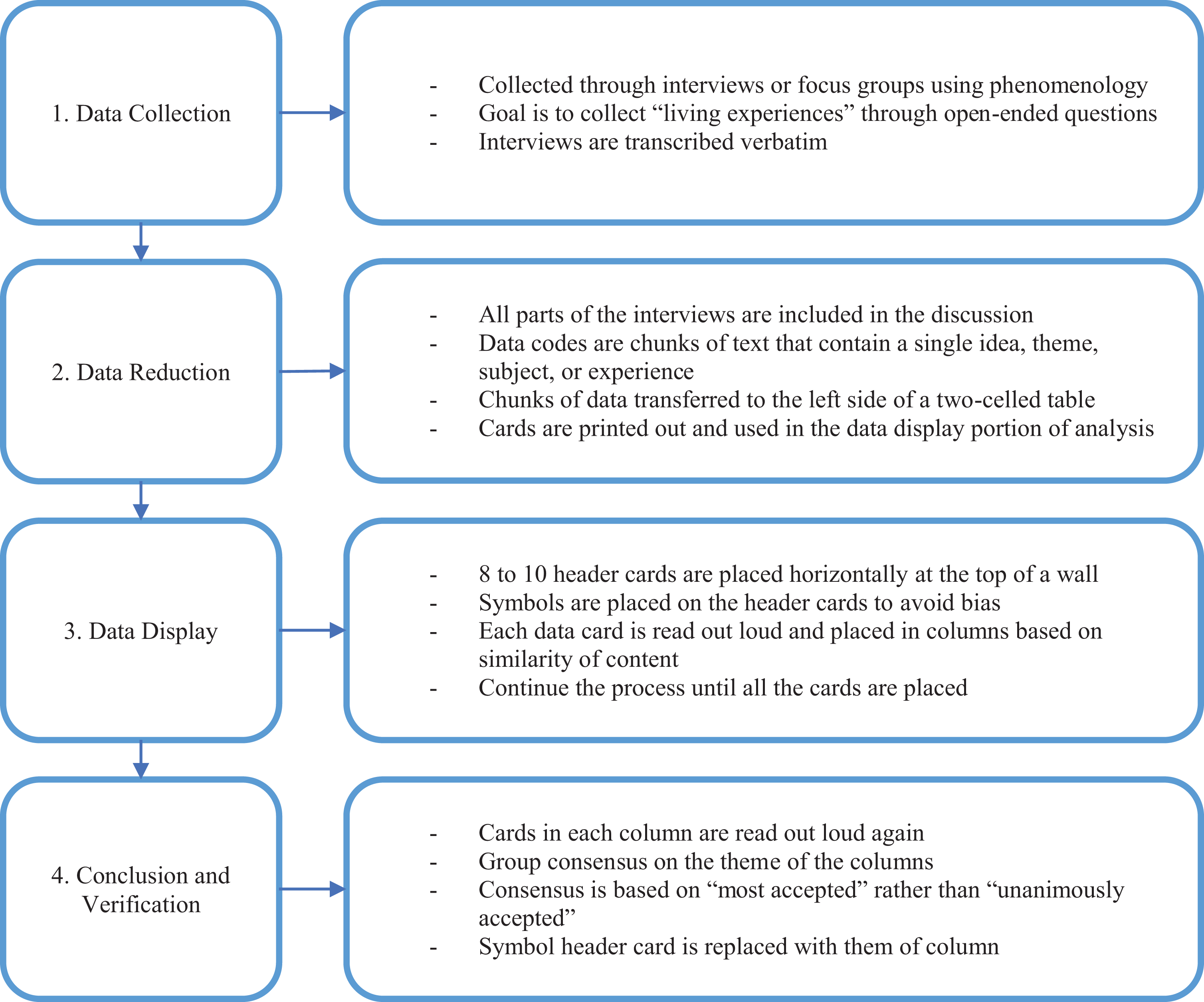
The process of using Collective Consensual Data Analytic Procedure as described by Dr. Bartlett.
During the data reduction phase of the CCDAP process, all parts of the interviewees’ quotes are turned into data codes. The data codes themselves are chunks of text that contain a single idea, theme, subject, or experience. Each data code is transferred to a cue card, either handwritten or computer-generated, and the codes are used in the data display portion of the analysis. Eight to ten header cards are placed horizontally along the top of a wall. Symbols are used on the header cards to help to avoid creating bias when sorting the data during the data reduction process. Each data card that was created during the data reduction process is read out loud by a facilitator (typically the project lead). The first card is placed in the first column below the first symbolized header card. Subsequent cards are read out loud, and the panel discusses whether the context of the data is similar or different to the first card. Should it be similar, it can be placed in that column, and if it is different, it is placed in the second column. This is repeated until all the cards have been placed; 8–10 columns usually arise from this process, although there can be more or less. In the final step, all the cards from each column are read out loud again, and the panel comes to a consensus on what the theme of the column is. A card with the theme written on it then replaces the symbolized header card. It is important to state that the theme is “the most accepted” rather than being “unanimously accepted.” Not everyone needs to agree, as long as there is a general consensus on the theme of each column.
Adapted CCDAP method Dr. Bourassa: Nanâtawihowin Âcimowina Kika-môsahkinikêhk Papiskîci-itascikêwin Astâcikowina [Cree, Medicine/Healing Stories Picked, Sorted, Stored]
The CCDAP method that was developed by Dr. Bartlett, while very useful for research in Indigenous communities, proved to be sometimes lengthy, especially when dealing with a large volume of interviews and data. Furthermore, recruiting professionals and community members to participate in the panel could sometimes be challenging, let alone having them commit for a process that may last for a few days. Dr. Bourassa’s team, with the help of Devin Dietrich (a data analyst for the Native Women’s Association of Canada [NWAC] and a research associate for the Centre for Rural and Northern Health Research), sought to streamline and digitize the process in order to more effectively sort and code the data from several different research projects and to reduce the time it took to perform it. The process was broken down into data collection, data preanalysis, data digitalization, data reduction and display, and conclusion and verification (Figure 2).

The process of Collective Consensual Data Analytic Procedure (CCDAP) as adapted by Dr. Bourassa. In the adapted version of CCDAP, the interviews are first broken down into minor themes. Once each code of data has been placed in unnamed columns, each minor theme is read out loud, and the group discusses the meaning of each and how they relate to each other to find the common theme of the column. Group reflection to further discuss each column is encouraged upon the completion of the process. Finally, digitalization of the data helps facilitate writing process and to assist with producing the various products that are outcomes of the research projects.
The first step in streamlining the process was to have the data undergo a rough thematic analysis prior to the collective data analysis. This preanalysis is done using the software NVivo (v. 11), a qualitative data analysis software. Importing the data in NVivo also helps in accessing the large volume of data (especially quotes) in a matter of seconds. This is particularly helpful with the writing process and with developing the various products that are outcomes of the research projects. Transcriptions from interviews, focus groups, or sharing circles are imported, and each quote is grouped into a “node.” Typically, the title of the node would be the question that is being asked during the interview, focus group, or sharing circle. Hence, the same questions being asked during several interviews, focus groups, or sharing circles are brought together and grouped into their respective nodes. Furthermore, each quote (which can sometimes be lengthy or long-winded) is brought down to three to four words that best described the main idea of the sentence. For example, when asked “Why did you not make an appointment?” the answer “I did not make any appointment because there is a lack of general practitioners” could be shortened down to “lack of general practitioners.” Results of the preanalysis are exported into a Microsoft Word document, ready for processing.
The second step in streamlining the process was the digitalization. The original method called for all the quotes to be written or printed on cue cards. This was eliminated, replacing the cue cards with a Microsoft PowerPoint presentation, and the physical columns on the wall replaced with an Excel spreadsheet with the symbolized headers along the top. A computer with a projector is used to project both the presentation and the spreadsheet.
The biggest challenges in assembling the panel are timing and geography. A strong advantage of digitalization is the ability to use videoconferencing platforms to bring the panel together. These include but are not limited to Zoom, Webex, and Google Hangouts. Many of the panel members might have busy schedules, and it would be unreasonable to expect them to dedicate a full day to data analysis. Furthermore, community members are often from remote and rural communities, and it can be challenging for them to get to the site of data analysis. By introducing videoconferencing, panel members are brought together more seamlessly, allowing for increased participation. Panel members can video conference into the data analysis session, and the Microsoft PowerPoint presentation and Excel spreadsheet are readily available for them to see on their own computer monitor through screen sharing. Challenges sometimes arose in remote or rural communities concerning access to the Internet, in which case the research team would do their best to accommodate panel members from these areas by finding a local, which could provide Internet access in order for them to participate.
As in the original CCDAP method, data display is done by reading the first slide out loud and placing it under the first symbolized header in the Excel table. Having the quote projected on the wall allows for panel members to be able to read the quotes and reflect on them as the discussion is happening; this eliminates having to repeat the quotes over and over again. Subsequent slides are read out loud, and a discussion takes place by the panel to determine under which similarly themed column the data should be placed into until all of the data have been placed under a column. If a slide is difficult to place, it may be skipped and reread at the end.
Upon completion of the data reductions, the facilitators read the quotes within each column. The panel will discuss and decide the major themes of each column and replace the symbolized header with the major theme of the column. Once again, the discussion does not need to come to a unanimous consensus, rather a most accepted consensus. After each column has been given a major theme, there can be a reflection period, where all the members of the group are encouraged to think about what is contained within the themes. They are encouraged to share their analytical thoughts or any thoughts that they have about the process.
On July 20, 2019, CCDAP was renamed by the grandfathers during a sweat lodge ceremony held by Elder Betty McKenna. After Tobacco Ties were given to Elder Betty McKenna, she asked the grandfathers and was given the name: Nanâtawihowin Âcimowina kika-môsahkinikêhk papiskîci-itascikêwin astâcikowina or NAKPA, from Cree translating to Medicine/Healing Stories Picked, Sorted, Stored. It was very interesting to take it [CCDAP] from what it was before, which was placards, like little cards, with literally stuff written on each side against the wall and convert that into an electronic format. I felt that this makes the methodology more universal. It deals with some of the travel costs because if you can get people from various places who have computers you can basically run CCDAP remotely, virtually, which is very nice. (Devin Dietrich during an interview concerning his involvement in the adaptation and streamlining of the CCDAP process)
CCDAP Method Adaptation Summary
The method that was initially developed by Dr. Bartlett was certainly revolutionary and filled a niche in data analysis that was much needed for Indigenous communities. However, as the analysis could become long and tedious when large quantities of data were added, an adaptation by Dr. Bourassa’s team was done to streamline the process with the permission of Dr. Bartlett. This allowed for quicker turnaround time with the added bonus of being able to perform the analysis from virtually anywhere through videoconferencing platforms.
Results and Discussion
Dr. Bartlett stated the following in an interview concerning the development of CCDAP, What I found is that none of the methodologies and particularly none of the analysis fit with what I actually felt and lived. So, the closest I could find in terms of a methodology was phenomenology. But it still felt wrong for one person to go and ask a bunch of people about their opinions and then sift around in my own head and think I know something. So, it did seem to me like you just can’t create knowledge that way because you’re biased, you can’t possibly figure out what people mean without having a group that knows that population participating in analysis of the data.
As late as 1997, Catterall and Maclaran explored how little discussion there was around the analysis of focus group data. A rather negative attitude was taken toward the holistic nature of group discussions in research, and there was a dismissiveness to the use of coding of the data collected during focus groups (Catterall & Maclaran, 1997). However, there was a strong evidence that engaging people during a focus group session would result in a more productive data analysis, as participants would respond to each other’s thoughts, forgotten details may resurface upon hearing someone else’s testimonial, and it helps lower inhibitions during conversation (Merton et al., 1956). One-on-one interviews and focus groups for gathering data about life experiences falls within Indigenous worldviews and is a traditional way of doing research and passing on knowledge within Indigenous communities.
As CCDAP is a relatively new model of qualitative data analysis, it has yet to be used extensively in academic research spanning various fields. Literature that utilizes the CCDAP method as its primary method of data analysis is limited. This is especially true for literature regarding Indigenous health studies in Western Canada. One of the earliest examples of its application comes from Dr. Bartlett who adapted the CCDAP method from the Institute of Cultural Affairs in 2006 and published this method in 2007 in “Framework for Aboriginal-guided decolonizing research involving Métis and First Nations persons with diabetes.” As this methodology is so new, the article even expresses the author’s enthusiasm with the CCDAP method. “We review the key methodological elements of our research as a basis for discussing this decolonizing process framework that challenges traditional Western ways of doing research and requires the reformulation of underlying assumptions and methods” (Bartlett et. al., 2008).
The Bourassa-adapted CCDAP method was first used by the NWAC, which produced a 2013 article titled, Understanding from Within: Research findings and NWAC’s contributions to Canada’s National Population Health Study on Neurological Conditions (NPHSNC). This project engaged Indigenous women across Canada who generously shared their experiences of how they conceptualized neurological conditions, the impacts on their families and communities, and the resources and supports needed to provide culturally safe and appropriate care. The data were collected through direct one-on-one interviews and focus groups. Interviews were conducted with key informants, primarily Indigenous women living with neurological conditions, and Indigenous individuals who cared for family members or loved ones living with neurological conditions.
The authors expressed that major themes and subthemes were recognizable during the interview process but were further examined with the CCDAP method. The data were first transcribed and categorized by standard qualitative data analysis strategies but then were analyzed a second time with the CCDAP method, so that the data gained input from a wider spectrum of experts including community members, Knowledge Keepers, and Elders (NWAC, 2013).
The CCDAP method was adapted for this particular project in two ways. The first deviation being that one side of the card used was the subtheme title and the other side was a description of what data were available within that subtheme, as the data had already undergone a thematic analysis. Second, the process of data display was done remotely rather than on a wall as was traditionally done due to budgets, time constraints, and geographical limitations. The team had to adapt the data to be displayed on a PowerPoint slide, which was shared with remote members who joined the analysis using an online meeting service (NWAC, 2013). In this project, 69 Indigenous women and 11 Indigenous men were interviewed as key informants for a total of 80 participants. This was the first time that the team attempted a technological adaptation with the help of Devin Dietrich.
Devin Dietrich, who helped streamline the CCDAP process during the NWAC project Understanding from Within: Research findings and NWAC’s contributions to Canada’s National Population Health Study on Neurological Conditions (NPHSNC), said of the CCDAP process: This is an evolving methodology and I think change is good and change should be encouraged. If people who are using this methodology find that changing it works for them and changing it makes what they are doing work out better, I would encourage that. I think one of the biggest problems with the mainstream academic methodology is they’re pretty unmovable. (Devin Dietrich)
The adapted CCDAP method was used in another CIHR-funded First Nations–specific dementia project by Dr. Bourassa’s team. In a submitted manuscript entitled “Technology User Needs of Indigenous Older Adults Requiring Dementia Care,” interviews were conducted to examine the needs for technology to support and maintain the well-being of aging Indigenous adults who required dementia care. With the help of community members, caregivers, health practitioners, Elders, Knowledge Keepers, and the Community Research Advisory Committee in the File Hills Qu’Appelle Tribal Council in Saskatchewan, the data from three focus groups (N = 40) were analyzed using the adapted CCDAP method. Strong findings relating to below standard information and communication technology, general lack of computer use, and data security concerns were found.
Boyer and Dr. Bartlett (2017) once again used CCDAP in their work titled, Tubal Ligation in the Saskatoon Health Region: The Lived Experience of Aboriginal Women. The article presented findings of the living experiences of Indigenous women residing in Saskatoon and its surrounding areas who have been subject to forced sterilization methods. Once the data were collected, the researchers used CCDAP to analyze it, as the researchers expressed that it was the most appropriate method to avoid preconceived biases regarding the data. The CCDAP method was used twice, once for the Indigenous women and again for the health-care and social services professionals. The outcomes were used to write a “Call to Action” draft report with the intent of providing feedback to the Saskatoon Health Region (Boyer and Bartlett, 2017).
Dr. Bourassa team used CCDAP most recently in 2018 in the data analysis from a Photovoice workshop that was done with women living with HIV through a CIHR-funded nation-wide collaborative project called the Canadian HIV Women’s Sexual and Reproductive Health Cohort Study (CHIWOS). The workshop looked at exploring how the women felt about their current health status, how they felt about the health care they were receiving, and how they envisioned their ideal health and health care. The panel consisted of researchers and community members from three different regions of Canada: the research team and community members in Regina, a research assistant in Calgary, Alberta, and two research assistants in Sudbury. The panel gathered using the platform Webex by Cisco, which allowed for screen sharing. Despite the distance, the data analysis was quite rapid and was carried out with tremendous success; the report was submitted to CHIWOS. The results of the photovoice were presented at the 28th annual Canadian Conference on HIV Research in Saskatoon (Lefebvre et al., 2019).
Reflecting back on his time streamlining the CCDAP process, Devin Dietrich described the impact of CCDAP on Indigenous communities: Indigenous methodology or Indigenous research tends to bring community people into the research organizing and coding. But for CCDAP specifically, it allows the researcher to bring in people from the community as well as a group of researchers in another way; to look at the data and collectively analyze it. (Devin Dietrich, 2018)
Research within Indigenous communities must be done at the service of these communities. This is achieved by establishing trust between the researchers and the communities through researcher–community engagement. The community must not only be implicated in the research as participants, they must be included in its inception, in the development of the methodologies, and in the sharing of knowledge. Data possession and stewardship are done by the community. With CCDAP, the community can be actively involved in the analysis of their data in an unbiased and consensual manner. CCDAP is rooted in OCAP® principles and follows the four Rs of Indigenous research: respect, relevance, reciprocity, and responsibility. It fosters relationships, builds comradery, and facilitates information sharing. This model fits perfectly in the framework of Indigenous community-based research.
The limitations of the CCDAP method are minor. First, as far as available literature details, this method has been exclusively utilized with Indigenous populations in Canada. This may not seem to be a glaring issue, as this method was designed for this specific population. However, utilizing this method for data analysis within Indigenous populations residing in countries such as Australia and New Zealand may yield positive outcomes for these populations and would test the versatility of this method on a global scale. The same may even be argued for applying this Indigenous method with non-Indigenous populations to test the applicability of this data analysis. Indeed, new publications released in 2019 have shown that certain research groups are now training interview participants in qualitative data analysis, so that the participants themselves can participate in the overall analysis of the data collected, a method known as patient and public involvement (Cowley et al., 2019). The second foreseeable limitation with this method is that while it is a simple qualitative data analysis technique in practice, it can appear to be somewhat convoluted when written or verbally described. This is especially true when the method is described to laypeople, nonacademics, and community members.
Having undertaken and promoted Indigenous health research at the direction of Indigenous communities for 20 years, Dr. Bourassa is recognized as one of Canada’s foremost experts in Indigenous research, which has led her to become the Scientific Director of the CIHR Institute of Indigenous Peoples’ Health. Her areas of expertise include mentorship, ethical engagement and research, cultural safety, healthy aging and end-of-life care in Indigenous communities, and the effects of HIV, AIDS, and HCV among Indigenous communities and Indigenous women’s health across the globe. It is her stance that while thematic analysis in qualitative data analysis is nothing new, developing a method to perform the data analysis in a way that reflects Indigenous worldviews is the focus that was needed when creating CCDAP. Inviting the community, participants, and Elders to participate in the data analysis reinforces and reaffirms that every part of the research process should and must include the community at all times. CCDAP has now become Dr. Bourassa’s lab gold standard in data analysis and has been showcased, approved, and used in the communities for almost 6 years. A tool kit is being developed in order to train communities and institutions in using CCDAP when doing qualitative data analysis with Indigenous communities. Two videos have also been developed: The first one explores the history of CCDAP and its importance in Indigenous community-based research and the second one is a training video that will be used in tandem with the tool kit. The videos are available through the Morning Star Lodge YouTube account on the Morning Star Lodge website (www.indigenoushealthlab.com).
According to Margaret Kisikaw Piyesis, the CEO of All Nations Hope Network in Regina, SK, “Research is alive. It’s something that’s living. It can bring life to communities. When it’s done in a good way, and in a respectful way, that’s when we see change begin to take place.” (Margaret Kisikaw-Piyesis 2018).
Conclusion
As the CCDAP method is one that was developed a mere decade ago, its true applicability to the academic macrocosm is yet to be determined. However, it can be noted that its use for qualitative data analysis is beneficial not only for the creation of impartial data but also as a technique that can further aid bridging the gap of distrust between academy and Indigenous populations. The use of this data analysis model for Indigenous research within Indigenous communities satisfies the need for building relationships, sharing, mutual respect, facilitating reciprocal information sharing, and ensuring that research findings are relevant. Furthermore, we believe that this method could be used in any type of qualitative research, as it reduces the risk of bias that could be introduced by a single person undertaking the data analysis. Having the research team, community, and topic experts in the discussion truly brings out all the strengths of the data.
Footnotes
Acknowledgments
First, we would like to acknowledge that Morning Star Lodge works out of Treaty 4 Territory; home of the Cree, Saulteaux, Dakota, Lakota, Nakota, and homeland of the Métis. Morning Star Lodge enters in a research agreement with all its community partners, including the File Hills Qu’Appelle Tribal Council (FHQTC) and All Nations Hope Network (ANHN). Our Community Research Advisory Committee (CRAC), consisting of Ethel Dubois, Judy Sugar, Sylvia Obey, Lois Dixon, Natalie Jack, Lorraine Walker, Millie Hotomani, Orval Spencer, Leona Peigan, Rozella McKay, Roxanne Queweznance, Rhonda Van Der Breggen, Mindy Koochicum, Glenda Goodpipe, Bonnie Peigan, and Melissa Blind, has been instrumental to the development of this data analysis method. Their direction and dedication are always appreciated and recognized. As always, the work that we engage in is for the Community, by the Community.
Declaration of Conflicting Interests
The author(s) declared no potential conflicts of interest with respect to the research, authorship, and/or publication of this article.
Funding
The author(s) disclosed receipt of the following financial support for the research, authorship, and/or publication of this article: This qualitative data analysis was developed during the course of projects that were funded by the Public Health Agency of Canada, the CIHR, and AGE-WELL NCE.
