




Abstract
Background:
The Two-Eyed Seeing approach has been advocated for use in research with Indigenous people as it creates a space for Western and Indigenous ways of knowing to come together using the best of both worldviews to aid understanding and solve problems. Foundational literature presents its use as a promising way to promote ethical exchanges between Indigenous and non-Indigenous people, but the practical application of its concepts to research remains vague.
Method:
This integrative review, using the Whittemore and Knafl approach, describes the state of the literature pertaining to the interpretation and application of Two-Eyed Seeing. Following a search of the literature, 37 articles were selected for inclusion, and primary studies (n = 11) were critiqued for quality. Data were extracted, analyzed, and synthesized into themes.
Results:
Three themes were compiled from the literature including (a) defining characteristics of Two-Eyed Seeing, (b) suggested attributes of those engaging with Two-Eyed Seeing, and (c) the application of Two-Eyed Seeing in research.
Conclusions:
This review demonstrates inconsistencies in how to date researchers have interpreted and applied Two-Eyed Seeing in research with Indigenous people. The collection of key attributes of researchers and application procedures to research discussed in this review present a new standard for the application of Two-Eyed Seeing to research with Indigenous people. Researchers using Two-Eyed Seeing should thoroughly describe their application of its concepts to promote its maturation into a well-defined framework for research with Indigenous people.
Keywords
Background
Two-Eyed Seeing, introduced by Mi’kmaq Elders, Albert, and Murdena Marshall, from Unama’ki (Cape Breton), Nova Scotia, Canada, in 2004, stresses the importance of viewing the world through both Western (what is considered to be mainstream) and Indigenous worldviews (Bartlett, Marshall, & Marshall, 2012). Initially, the use of Two-Eyed Seeing was developed and promoted as a strategy to encourage the participation of Mi’kmaq university students in pursuing the study of science, valuing and including both Indigenous and Western ways of knowing in relevant science curricula (Bartlett et al., 2012). While its roots are Mi’kmaq, Two-Eyed Seeing seeks to bring together various Indigenous and Western perspectives and ways of knowing and is not exclusive to Mi’kmaq worldviews (Bartlett et al., 2012). Since its development, the use of Two-Eyed Seeing as a guiding framework for delivering education to, as well as conducting research with, Indigenous people has been advocated by numerous organizations and institutions including the Canadian Institute for Health Research, the Natural Sciences and Engineering Research Council, and the Social Sciences and Humanities Research Council (Bartlett et al., 2012).
Various terms have been used in the literature to describe this approach, including an ethical protocol, a guiding principle, and a framework. For the purpose of clarity, Two-Eyed Seeing will be referred to as a framework in this article. A discussion of this terminology is included further on. Other concepts included in this review include Indigenous ways of knowing and worldviews. Indigenous ways of knowing describe the ways in which Indigenous people come to understand the world around them, and these can vary between cultures and individuals (Dehaas, 2018). Indigenous ways of knowing can be difficult to define, particularly by non-Indigenous people who tend to interpret ways of knowing, such as dreams or visions, through a Western lens (Dehaas, 2018). Finally, the term worldview describes one’s philosophy of the world, how the world is understood, interacted with, and perceived (Hart, 2010).
Two-Eyed Seeing stresses the importance of viewing the world through one eye using the strengths of Indigenous worldviews and with the other eye using the strengths of Western worldviews, to see together with both eyes to benefit all (Bartlett et al., 2012). A weaving of perspectives is emphasized, with both having equal importance, but acknowledging that in some instances, one perspective may further our understanding of a specific concept or situation more than the other (Bartlett et al., 2012).
Researchers are encouraged to learn how to weave back and forth between Indigenous and Western ontologies, epistemologies, and methodologies as required. The authors use a visual of two jigsaw pieces intersecting, one not having a larger portion of the “big picture” than the other, but both contributing equitably important perspectives to the phenomenon of study (visual available online at http://www.integrativescience.ca). Four big picture philosophical questions, including integrating ontology, epistemology, methodology, and overall knowledge objectives, have been visually depicted by the developers of Two-Eyed Seeing in an online format for learners (Institute for Integrative Science & Health, 2013). In the first, Indigenous ontology is depicted as interconnected and animate, consisting of a constant balance between spirit, energy, and matter, while Western ontology is depicted as objects consisting of their parts and wholes, in constant evolution (Institute for Integrative Science & Health, 2013). In the second big picture philosophical question, Indigenous epistemology is described as relational, respectful, and reciprocal, while Western epistemology is based on hypothesis and theory construction (Institute for Integrative Science & Health, 2013). Although Western epistemology has been defined in this way by the developers of Two-Eyed Seeing, not all Western research is based on hypothesis or theory construction. Examples include most qualitative and community-engaged approaches to research, which commonly recognize knowledge construction as relational and reciprocal and aim to inductively create meaning and understanding (Creswell, 2013). Yet Wilson (2008) stresses that differences between Western and Indigenous ontologies and epistemologies remain. He describes Western ontology as being external, or “something out there,” while Indigenous ontology stresses one’s relationship to reality (p. 73). Wilson (2008) illustrates this difference using language; in English, a “pen” is described using a single word, while the word in Cree translates to “something that you write with” (p. 73). This example highlights a distinct difference between Western ontology—an external object—and Indigenous ontology—one’s relationship to the object. Similarly, Indigenous epistemologies also reflect a relational approach to the world and are believed to be eternally available through ancestors, dreams, and visions (Cardinal, 2001). It is not surprising, then, that Indigenous axiology emphasizes relational accountability and that Indigenous research methodologies hold this to the highest regard. Therefore, while some Western approaches to research may appear to align with Indigenous worldviews, their roots are distinctly different, and thus, Western researchers continue to struggle to fully grasp relational ontologies and epistemologies to the extent emphasized by Indigenous worldviews (Martin, 2012; Wilson, 2008). Two-Eyed Seeing can assist in bridging this gap of understanding through bringing together both Indigenous and Western worldviews in a collaborative and equitable approach to research.
In the third big picture philosophical question, as described by Albert and Murdena Marshall, the founders of Two-Eyed Seeing, Indigenous methodologies consist of a weaving of patterns within nature and relationships among love, land, and life, while methodologies in Western science tend to unravel nature’s patterns to understand them and to build models to explain the interactions of their components (Institute for Integrative Science & Health, 2013). Finally, goals from Indigenous perspectives are collective, with the purpose of understanding and sustaining the environment, while Western goals tend toward what is testable and constructible to understand how the world works (Institute for Integrative Science & Health, 2013).
Researchers to date have developed their own interpretations of Two-Eyed Seeing and what its application to research with Indigenous peoples entails (Clark, 2014; Hatala et al., 2017; Marsh, Cote-Meek, Young, Najavits, & Toulouse, 2016; Martin, Thompson, Ballard, & Linton, 2017; Peltier, 2018). Although Two-Eyed Seeing has been described from a theoretical and philosophical standpoint in numerous articles, guidance within the methodological literature remains vague on its practical application. This has resulted in inconsistent practices among researchers on how Two-Eyed Seeing is interpreted and applied in research. Therefore, the purpose of this integrative review, guided by the Whittemore and Knafl (2005) approach, is to address this disparity and clarify how Two-Eyed Seeing has been interpreted and applied by researchers to date. The Whittemore and Knafl’s (2005) approach involves five stages: (a) problem identification, (b) literature search, (c) data evaluation of quality, (d) data analysis, and (e) data synthesis. Having clearly defined the problem, the following describes the remaining four stages of the approach.
Method
Literature Search
Following the initial identification of the problem—the lack of a decisive interpretation and application of Two-Eyed Seeing to research—a systematic search of the literature was completed using OVID Healthstar, Embase, Medline, CINAHL, and Pubmed databases and the search term “Two-Eyed Seeing.” Additional search terms were not used as they narrowed the results significantly and did not result in additional relevant articles. Articles were included if they were published in English prior to December 2018, regardless of discipline or article type, and if authors discussed their interpretations and/or applications of Two-Eyed Seeing in any context. Once duplicate articles were removed; all articles underwent an assessment of relevancy by reviewing the titles and abstracts. Following a full-text review, articles were excluded if authors did not substantively discuss their interpretation or application of Two-Eyed Seeing (see Figure 1).

Flow diagram of search strategy and article selection.
Data Evaluation of Quality
Included studies that were primary research (nine qualitative studies, one quantitative study, and one mixed-methods study) were critically appraised for quality using a relevant tool from the Critical Appraisals Skills Programme (2017a, 2017b) library of appraisal tools. Any included mixed-methods studies were appraised using the tool developed by Pluye, Gagnon, Griffiths, and Johnson-Lafleur (2009). The quality appraisal was conducted to validate the quality of the extracted data included in the data analysis and synthesis of findings but did not influence their inclusion in the analysis itself.
Data Extraction and Data Analysis
Data relating to the interpretation and application of Two-Eyed Seeing were extracted separately from each article and further separated into educational and scientific research disciplines (see Table 1). During data analysis, data relating to the interpretation and application of Two-Eyed Seeing were analyzed separately and compared for similarities and differences. The constant comparison method as described by Miles and Huberman (1994) was used during this stage, comparing each piece of datum to another. Similarities in the groupings were initially sorted into codes and then further grouped into themes during the later stage of data analysis. Three nonresearch education articles were excluded during analysis of data concerning the application of Two-Eyed Seeing in primary research (Kapyrka & Dockstator, 2012; Mckeon, 2012; Stephens, 2000), as these authors’ application of Two-Eyed Seeing was related to curriculum development and not scientific research. The following is a presentation of the synthesis of the data in the form of themes.
Interpretations and Applications of Two-Eyed Seeing in the Literature.

Note. FN = First Nation; GDM = Gestational Diabetes Mellitus; OCAP = Ownership, Control, Access and Possession.
Results
A total of 76 articles were screened by title and abstract for inclusion in the review. Following this initial screening process, 38 articles were excluded as they did not meet the inclusion criteria of describing the authors’ interpretation and/or application of Two-Eyed Seeing. A full-text review of the remaining articles (n = 38) resulted in the exclusion of one article as the authors did not substantively discuss their interpretation or application of Two-Eyed Seeing (see Figure 1). A final 37 articles were included in the review, consisting of 6 foundational articles authored by the developers of Two-Eyed Seeing, 3 articles describing the application of the framework to education curriculum development, 11 articles describing primary research (9 qualitative studies, 1 quantitative study, 1 mixed-methods study), 15 reviews, and 2 editorials. Numerous disciplines were represented, including education, medicine, nursing, anthropology, and environmental studies. Review articles consisted of literature reviews of Two-Eyed Seeing (n = 6) and discussions on the real or theoretical application of Two-Eyed Seeing to primary research studies (n = 9).
Results from the data evaluation exercise revealed that all but one of the qualitative studies (n = 9; Clark, 2014) demonstrated moderate to high methodological quality. Study limitations included inadequate descriptions of study methodology by four studies (Cabrera, Beattie, Dwosh, & Illes, 2015; Clark, 2014; Marsh et al., 2016; Rand, 2016), inadequately addressing the potential influence of relationships between the researcher and participants by three studies (Cabrera et al., 2015; Clark, 2014; Whiting, Cavers, Bassendowski, & Petrucka, 2018), and insufficiently describing how rigor was maintained during data analysis in five studies (Cabrera et al., 2015; Clark, 2014; Marsh et al., 2016; Martin et al., 2017; Rand, 2016). The quantitative study, although of high quality, was not powered to show statistically significant results (Hunt et al., 2018). The mixed-methods study (n = 1) did not specify a mixed-methods research design and did not adequately address rigor in the data analysis of qualitative data (Mantyka-Pringle et al., 2017; see Table 2).
Critical Appraisal of Primary Studies Resulting From Two-Eyed Seeing Literature Review.
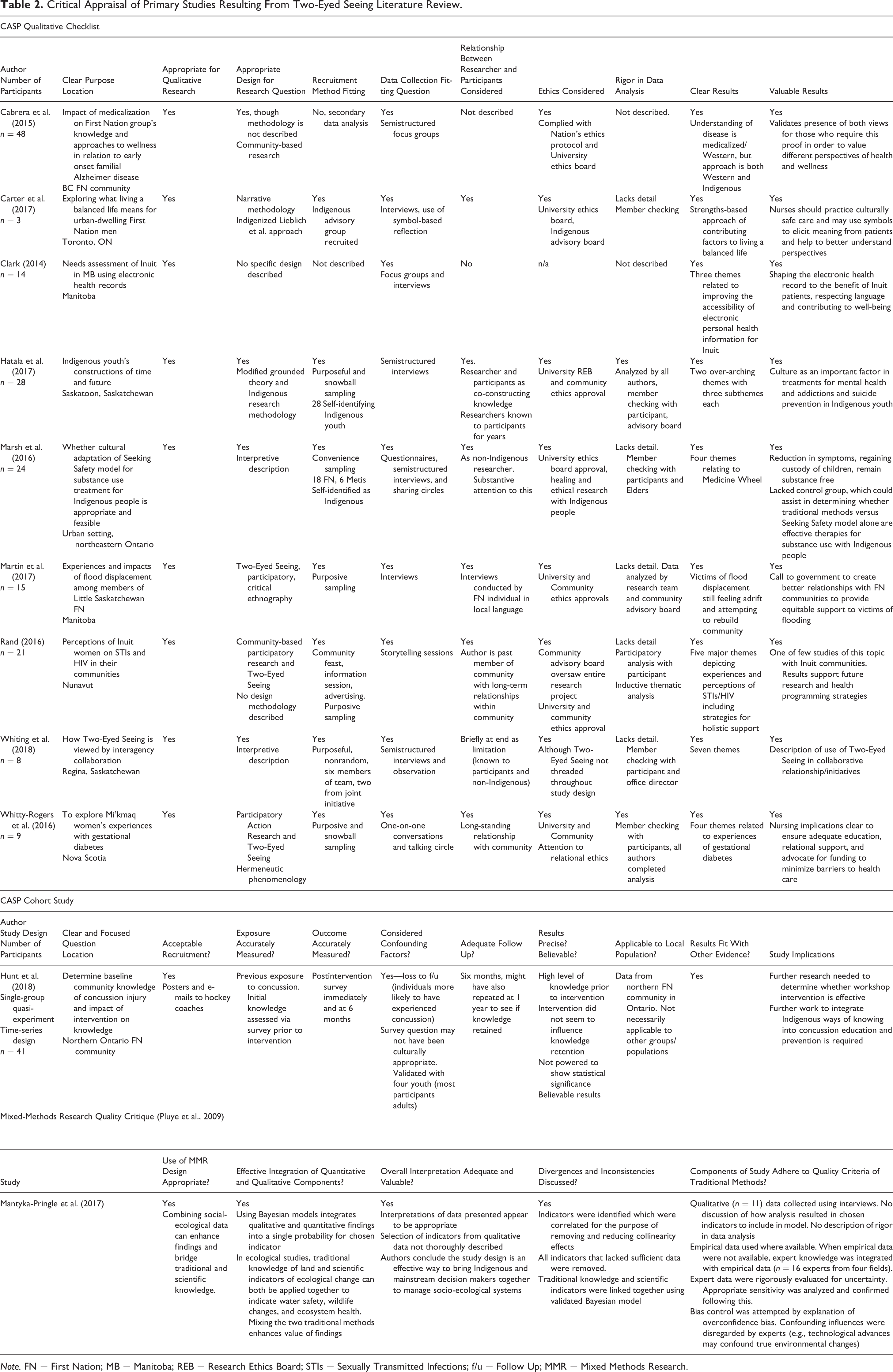
Note. FN = First Nation; MB = Manitoba; REB = Research Ethics Board; STIs = Sexually Transmitted Infections; f/u = Follow Up; MMR = Mixed Methods Research.
The following three themes emerged from the analysis and represent a synthesis of the data: (a) defining characteristics of Two-Eyed Seeing, (b) suggested attributes of those engaging with Two-Eyed Seeing, and (c) application of Two-Eyed Seeing in research. These themes are listed, along with a summary of key components, in Table 3.
Summary of Results.

Defining Characteristics of Two-Eyed Seeing
The original developers of Two-Eyed Seeing defined it as an equitable approach to shared perspectives in which all viewpoints are valued, an approach that extends the understanding of an integration of perspectives, using the best from each worldview, is holistic and requires a reflective approach. Those with differing worldviews must value working together with others to cocreate knowledge and learn from and appreciate each other’s differences. A holistic approach should be undertaken, considering the mind, body, and spirit, and individuals must be reflective, examining their own perspectives, worldviews, beliefs, and values. The analogy of trees holding hands beneath the ground (with their roots) is used to describe this joining together with one another despite our differences (Bartlett et al., 2012).
Since its inception, new authors engaging with Two-Eyed Seeing have agreed with these defining features and expanded further on concepts and terms. For example, several terms have since been used to describe the concept of integration including blending, weaving, and merging. Yet Iwama, Marshall, Marshall, and Bartlett (2009), one of the original authors of Two-Eyed Seeing, stress that this integration is not simply an amalgamation of perspectives in which pieces of Indigenous worldviews are merely pasted together with Western views, but that it is a thoughtful integration of the best each perspective has to offer to solve problems and benefit others. Two-Eyed Seeing has more recently been defined as a conscious integration of Indigenous knowledge and worldviews, reflected by action-based approaches, requiring flexibility on the part of the researcher, and involving the Indigenous community in research including traditions and ceremonies (Hall, Dell, Fornssler, Hopkins, & Mushquash, 2015; Martin, 2012). Despite being derived from a Mi’kmaq worldview, Two-Eyed Seeing has been viewed by researchers as inclusive and applicable to other groups with varied ways of knowing. Its Mi’kmaq roots are recognized by researchers as essential to the authentic development of the framework and its goals. Additionally, Two-Eyed Seeing has been considered a decolonizing approach, in that it privileges Indigenous knowledges, methodologies, and worldviews and seeks to critically analyze power inequities, promoting an equitable and collaborative approach to research with Indigenous people (Chambers et al., 2018; Hall et al., 2015; Iwama, Marshall, Marshall, & Bartlett, 2009; Kapyrka & Dockstator, 2012; Martin, 2012; Peltier, 2018). Other researchers interpret Two-Eyed Seeing as a strengths-based approach to research—conducting research with aims to abolish negative stereotypes of Indigenous people as being weak or vulnerable and emphasizing the strengths and resiliency of communities (Carter, Lapum, Lavallée, Schindel Martin, & Restoule, 2017; Chambers et al., 2018; Clark, 2014; Hatala et al., 2017; Hovey, Delormier, McComber, Lévesque, & Martin, 2017; Hunt et al., 2018; Latimer et al., 2014; Marsh et al., 2016; Rand, 2016).
Finally, there are differences in the literature as to whether Two-Eyed Seeing is considered as an ethical protocol (Hall, 2015), a guiding principle (Hunt et al., 2018; Lemke & Delormier, 2017), or a framework (Cabrera et al., 2015; Chatwood et al., 2015; Lemke & Delormier, 2017; Martin et al., 2017; Peltier, 2018). Often these key terms are used interchangeably by the original and subsequent authors using Two-Eyed Seeing. Some suggest that Two-Eyed Seeing is much more than a set of prescriptive guidelines to ethical research with Indigenous people, in that it is a philosophy and a way of life that influences the entire research process from inception through to completion (Hall et al., 2015; Hovey et al., 2017). This perceived confusion likely stems from Two-Eyed Seeing being relatively new and the need for its further refinement in the literature. These authors contend that Two-Eyed Seeing is not best described as an ethical protocol as it does not merely describe a set of minimum standards for researchers to ensure ethical conduct. Similarly, Two-Eyed Seeing has evolved to provide more than a single principle with which to guide research protocols and procedures, and its constructs are not static or testable, and thus it is also not adequately described as a single guiding principle or as a theory. Instead, these authors refer to Two-Eyed Seeing as a framework because it provides a basic structure on which researchers and communities can build upon and expand to suit their unique needs (Merriam-Webster Dictionary, 2019). Its basic structure will likely continue to evolve in the literature as researchers reflect on its application with various communities and methodologies.
Suggested Attributes of Those Engaging With Two-Eyed Seeing
First and foremost, a non-Indigenous researcher engaging with Two-Eyed Seeing requires the support of at least one other individual with Indigenous knowledge and perspectives. This enables the collaboration and the weaving of both worldviews to promote understanding of a phenomenon. In some instances, it may be appropriate for Indigenous researchers with both Indigenous and Western perspectives to apply Two-Eyed Seeing to their work independently. These authors suggest, however, that the collaboration of at least two researchers may be appropriate to add rigor to the research—as at least one can focus using an Indigenous lens, while another uses a Western lens (Morse, 2015). Since its development, authors have expanded on the required attributes of individuals who have chosen to use a Two-Eyed Seeing approach to guide their work, adding ideas not previously emphasized by the original developers, including requirements for knowledge, skills, and attitudes. First, researchers must have the knowledge and appreciation of spiritual wellness to truly engage with Indigenous perspectives (Rowan et al., 2015). Next, skills in effective communication and building trusting and equitable relationships are necessary to engage with others while using the Two-Eyed Seeing approach (Fornssler et al., 2018; Hatala et al., 2017; Kapyrka & Dockstator, 2012; Mantyka-Pringle et al., 2017; Marsh, Cote-Meek, Toulouse, Najavits, & Young, 2015; Marsh et al., 2016; Martin et al., 2017; Peltier, 2018; Vukic, Gregory, & Martin-Misener, 2012; Whitty-Rogers, Caine, & Cameron, 2016). Relational skills, such as patience, are also important as the process of engaging with multiple viewpoints is time-consuming and often does not adhere to formal funding agency guidelines (Hall et al., 2015). Additionally, those engaged in Two-Eyed Seeing must also have skills in strengths-based perspectives, to emphasize the resiliency of Indigenous people, promote Indigenous self-determination and governance, and not further perpetuate negative stereotypes (Carter et al., 2017; Marsh, Coholic, Cote-Meek, & Najavits, 2015; Martin et al., 2017). Finally, researchers must embody important attitudes to effectively apply Two-Eyed Seeing in research with Indigenous people. First, honesty is required between those with differing worldviews to support sharing perspectives and to resolve conflicts between opposing opinions (Fornssler et al., 2018). Next, researchers must be open to change, as embarking on initiatives using Two-Eyed Seeing is a largely new undertaking (Whiting et al., 2018). Lastly, individuals must be willing to engage in self-reflection, analyzing their own perspectives, beliefs, and values to fully appreciate commonalities and differences between the worldviews of all involved (Carter et al., 2017; Marsh, Coholic, et al., 2015; Martin, 2012; McKeon, 2012; Peltier, 2018; Stephens, 2000). These attributes are key to an effective and authentic application of Two-Eyed Seeing to research with Indigenous people.
Application of Two-Eyed Seeing in Research
The use of Two-Eyed Seeing in research varies from author to author based on different interpretations of the framework and a lack of consistency in the literature concerning its application procedures. While some authors describe their use of Two-Eyed Seeing as a rationale for their valuing different perspectives from those of Western viewpoints (Cabrera et al., 2015; Clark, 2014; Latimer et al., 2014; Mantyka-Pringle et al., 2017; Paraschak & Forsyth, 2010), others incorporate its ideals throughout the research process in varying ways. Six components of the impact of Two-Eyed Seeing on the research process can be gleaned from the work of researchers who interpret the application of Two-Eyed Seeing as more than just appreciating a differing perspective from the mainstream. These six components include (a) authentic relationships, (b) reciprocal research, (c) relational accountability, (d) Indigenous involvement, (e) Indigenous methodology, and (f) Western researchers deferring to Indigenous leadership. Not every component is enacted by all researchers or carried out in the same way, but collectively these six components encompass how Two-Eyed Seeing has been applied in research to date.
First, authentic relationships between researchers and the Indigenous community with whom research is being conducted, including relationships with participants, are valued and regarded as important to ethical research with Indigenous people (Hatala et al., 2017; Marsh, Cote-Meek, et al., 2015; Martin et al., 2017; Peltier, 2018; Rand, 2016; Whitty-Rogers et al., 2016). Research is reciprocal, meaning that not only do researchers benefit by gaining knowledge, answers to research questions, or acknowledgement for their work, but participants also benefit as healing and wellness is promoted throughout the research process by building relationships and learning from one another (Fornssler et al., 2018; Hall et al., 2015; Peltier, 2018; Whiting et al., 2018). Similarly, relational accountability is an expectation of researchers who, by engaging with Two-Eyed Seeing, assume responsibility for the health and well-being of the research team, community, and participants throughout the research process (Chambers et al., 2018; Hatala et al., 2017; Marsh, Cote-Meek, et al., 2015; Peltier, 2018). This is accomplished by involving Elders in the research process to integrate traditional teaching and ceremonies. The involvement of the Indigenous community in research processes is common throughout this literature, although the extent varies. Indigenous Elders, knowledge holders, and community members are most commonly involved in the research process by making up an Advisory council that oversees and directs the study as initially advocated by the founders of Two-Eyed Seeing (Bartlett et al., 2012; Carter et al., 2017; Hatala et al., 2017; Hovey et al., 2017; Marsh, Coholic, et al., 2015; Marsh, Cote-Meek, et al., 2015; Martin et al., 2017; Rand, 2016). In many cases, Elders or Indigenous researchers are also actively involved in various aspects of the research, including recruitment, data collection, data analysis, and knowledge translation, and may provide traditional teaching and ceremonies as a study procedure method and/or a knowledge communicator (Chatwood et al., 2015; Fornssler et al., 2018; Hall et al., 2015; Hatala et al., 2017; Hunt et al., 2018; Marsh, Cote-Meek, et al., 2015; Martin et al., 2017; Peltier, 2018; Rand, 2016; Rowan et al., 2015; Whiting et al., 2018; Whitty-Rogers et al., 2016). In this review, most researchers recognized and valued local Indigenous customs and traditions and sought guidance prior to initiating research with the Indigenous community. Research designs were commonly influenced by Indigenous ways of knowing through the selection of methods that respected oral tradition (such as storytelling; Fornssler et al., 2018; Hall et al., 2015; Peltier, 2018; Rand, 2016), adapting Western methodologies for Indigenous ways of knowing (such as grounded theory; Hatala et al., 2017), engaging in member checking with participants to validate findings (Carter et al., 2017; Peltier, 2018; Whitty-Rogers et al., 2016), integrating land-based activities (Chatwood et al., 2015), and incorporating traditional teaching and ceremonies throughout the research process (Fornssler et al., 2018; Hall et al., 2015; Hatala et al., 2017; Marsh, Cote-Meek, et al., 2015; Peltier, 2018; Rowan et al., 2015; Whiting et al., 2018). Finally, some authors described the role of Western researchers in Two-Eyed Seeing to be that of follower, listener, and learner as the original developers also described. To complete research using Indigenous ways of knowing and methodologies, Western researchers must be willing to take a back seat and allow others with Indigenous knowledge and lived experience to lead the research process (Fornssler et al., 2018; Hall et al., 2015; Iwama et al., 2009; Rowan et al., 2015).
Discussion
This is the first integrative review to analyze and synthesize the interpretation and application of Two-Eyed Seeing in the literature. Such a review was necessary as discrepancies pertaining to Two-Eyed Seeing in the literature have led to researchers attempting to use the approach without clear application procedures. The findings of this integrative review offer a synthesis of key attributes and application procedures for consideration by researchers choosing to apply Two-Eyed Seeing to their work.
Two-Eyed Seeing is a unique approach to research in that its aims go beyond a respectful and collaborative approach advocated by other community-engaged research approaches (Kemmis & McTaggart, 2005; Mikesell, Bromley, & Khodyakov, 2013). In addition to these important components, Two-Eyed Seeing also necessitates a blending of both Indigenous and Western worldviews and perspectives throughout the research process (Bartlett et al., 2012). This integration was enacted in differing ways by researchers, such as the use of methods and methodologies that reflect Indigenous ways of knowing, and the inclusion of land-based activities, traditional teaching, and ceremonies. These differences reflect the varying degrees in which researchers interpret Two-Eyed Seeing and its application to research. Some researchers have used the approach to support the importance of eliciting Indigenous perspectives in their work, while others have fully integrated Western and Indigenous perspectives throughout the research process, from conceptualization of the research problem to dissemination of results. The key attributes of researchers engaging with Two-Eyed Seeing have been extracted from the literature, providing a list of necessary characteristics researchers should be willing and able to exemplify before undertaking work with Indigenous people. For example, researchers who are honest with themselves and others, have effective communication skills, value different perspectives, prioritize building relationships, and exercise patience are likely to have the attributes necessary to enable equitable and collaborative research with Indigenous people. Similarly, authentic relationships with Indigenous people necessitate reciprocity and accountability and should lead to equitable engagement and involvement of members of the Indigenous community throughout the research process. If researchers embody these attributes and engage in these application procedures, it is likely that their work will be congruent with decolonizing approaches to research and founded in Indigenous knowledges, methodologies, and ways of knowing (Kovach, 2009).
It is our opinion, along with many of the authors of research included in this report, that researchers applying Two-Eyed Seeing must do so in authentic and all-encompassing ways (Chatwood et al., 2015; Fornssler et al., 2018; Hall, 2015; Hatala et al., 2017; Hovey et al., 2017; Marsh et al., 2016; Martin et al., 2017; Rand, 2016). In fact, a simplistic application of Two-Eyed Seeing (e.g., as merely supporting rationale for the consideration of Indigenous perspectives) undermines the entire premise of the approach as egalitarian and collaborative. A respectful integration of both Indigenous and Western worldviews is required throughout the research process and not just at steps along the way. We recognize, however, that decisions concerning application procedures must be driven by an authentic, respectful, and collaborative relationship between Western and Indigenous researchers and community members.
Finally, this review demonstrates that a better understanding, interpretation, and application of Two-Eyed Seeing in the literature is required in order to assist other researchers wishing to use this approach. The collection of attributes and application procedures described in this integrative review provide researchers with a representation of how Two-Eyed Seeing has been used in health research with Indigenous people to date. This in turn will support researchers and Indigenous communities to more carefully consider what the Two-Eyed Seeing framework means to them and how they can best apply it to their work. In future, researchers should strive to thoroughly describe their approach and decisions related to the application of Two-Eyed Seeing to research with Indigenous people. A critical discussion of the application procedures used by researchers applying Two-Eyed Seeing will assist other researchers and Indigenous communities while bringing clarity and a deeper understanding of the framework to the literature.
Strengths and Limitations
The literature included in this integrative review represents what is currently available within mainstream databases where some Indigenous journals are not indexed and did not include unpublished PhD dissertations. As such, some literature using Two-Eyed Seeing may not have been included in this review. As well, all but two of the primary studies included in this review used qualitative methodology, which may have limited authors’ abilities to adequately report details pertaining to methodology due to publication restrictions. To mitigate this limitation in future, researchers could consider publishing an additional methods article that thoroughly describes their interpretation and application of Two-Eyed Seeing.
Conclusions
A thorough review of the literature was undertaken to better understand how Two-Eyed Seeing is interpreted and applied in research. The results demonstrate both commonalities and differences in the interpretation and application of Two-Eyed Seeing. Data synthesis reflects the defining characteristics of Two-Eyed Seeing and identifies the suggested attributes of researchers engaging in Two-Eyed Seeing and the ways Two-Eyed Seeing has been applied to research to date. The results are useful to researchers wishing to engage with Two-Eyed Seeing and to more thoughtfully consider its characteristics and application to research. Researchers engaging with Two-Eyed Seeing should aim to clearly reflect on and describe their application of the framework in their publications. Going forward, researchers should strive toward a thorough integration of Two-Eyed Seeing in their work and suggest ethical standards for its application. These critical interpretations are necessary if Two-Eyed Seeing is to be more meaningfully applied and continue to inform future research with Indigenous peoples.
Footnotes
Declaration of Conflicting Interests
The author(s) declared the following potential conflicts of interest with respect to the research, authorship, and/or publication of this article: The first author has received personal fees from Mallinckrodt Pharmaceuticals for consulting and reimbursement of travel fees to attend a conference. All other authors have no conflicts of interest to disclose.
Funding
The author(s) disclosed receipt of the following financial support for the research, authorship, and/or publication of this article: The first author has received funding for this research from the Canadian Institutes of Health Research (CIHR) Fellowship, Priority Announcement: Research in First Nations, Metis and/or Inuit Health. FRN 146613.
