




Abstract
There is increasing scholarly attention to the creative ways in which young people are engaging in policy dialogue. Yet what other ways may we study the impact of youth-produced images on audiences? Here, we explore the role that visual researchers occupy as audiences to youth-led participatory visual work addressing critical issues. Drawing on qualitative research approaches in autoethnography, we use a methodology of researcher reflexivity to invite visual researchers through semistructured interviews to position themselves with respect to youth-produced images of sexual violence, refugee experience, and colonial trauma. In shifting our attention from studying the privileged position of researchers with respect to facilitating participatory visual research, we learn about the researcher’s privileged perspective on how other audiences may view the work, such as policy makers and community and family members. This study highlights some ethical and methodological considerations of facilitating dialogue between youth and various stakeholders on the critical issues impacting the lives of young people.
Keywords
Introduction
How are the images produced by children and young people used in community and policy dialogue? How might this work have an impact on families and those closest to the producers? What are some of the tensions and limitations of screenings and exhibitions for these audiences? What are the implications for arts-based youth-led research? In this work, the issues themselves are particularly sensitive, and the producers may be vulnerable. Unlike top-down, bird’s eye view formal conceptions of the policy process—we conceptualize participatory policy-making and social change–oriented work as a bottom-up grounded method. In this way, we may better understand how change is actually experienced by those populations on which it is focused. How do we study this and how can the findings inform more nuanced questions about youth-led participatory visual methods to address areas such as sexual violence?
In writing this article, we acknowledge that work with participatory visual approaches, such as photovoice and digital storytelling, comes out of several traditions: arts-based methods (Knowles & Cole, 2008), participatory action research (Whyte, 1992), and visual research (Mitchell, 2011), especially in the context of community-based research.
Grounded in Rose’s (2012) work on researcher reflexivity as a critical component of visual research, we explore the ethical and methodological considerations for framing the study of questions such as these with the idea that visual researchers occupy a very particular role as audiences in participatory visual research, both in relation to the images that participants produce and in relation to seeing how other audiences such as policy makers, community members, and family view the images. To date, the investigation of images of sexual violence and other critical issues produced by children and young people through drawing, photovoice, participatory video, and digital storytelling is itself an understudied area, but so too is the voice of the researcher as audience in this research. Yet works such as Sontag’s (2004) Regarding the Pain of Others and Batchen, Gidley, Miller, and Prosser’s (2012) Picturing Atrocities remind us of the power of images, especially those of human suffering, to haunt. While in one way, the visual researcher is everywhere when it comes to working with participants and interpreting the work for various academic audiences, and in other ways, the perspectives of visual researchers may not explicitly appear and in fact may even disappear within the framework of participatory visual research. We are not arguing for adult researchers to reassert our privileged position in research, particularly at a time when there is a rich appreciation for the ethics of working with children and young people (e.g., Akesson et al., 2014). Rather, we are interested in the ways in which this position of researcher privilege carries with it a responsibility to reflexively engage in meaning-making across time and across audiences.
Our investigation draws together work from several separate but overlapping methodological areas for engaging participatory visual researchers in “looking back” at previous visual projects with young people (Figure 1). One approach termed as “go ask” by Mitchell, De Lange, and Moletsane (2017, p. 125) looks at the notion of the “meta” in studying impact and social change: “[There is] an increasing need to adopt a go ask approach in our fieldwork. By that we refer to building in a meta-level to our work with participants and with other researchers” (p. 89). This approach is informed by the work of Gubrium and Harper (2013) and especially their involvement of the research community itself (i.e., visual researchers) in studying the overall effectiveness of participatory visual methodologies by looking back facilitated by a series of one-on-one interviews. In their book, Participatory and Digital Methodologies, for example, they draw on interviews with various participatory visual researchers as a way to study issues such as ethics and community engagement.
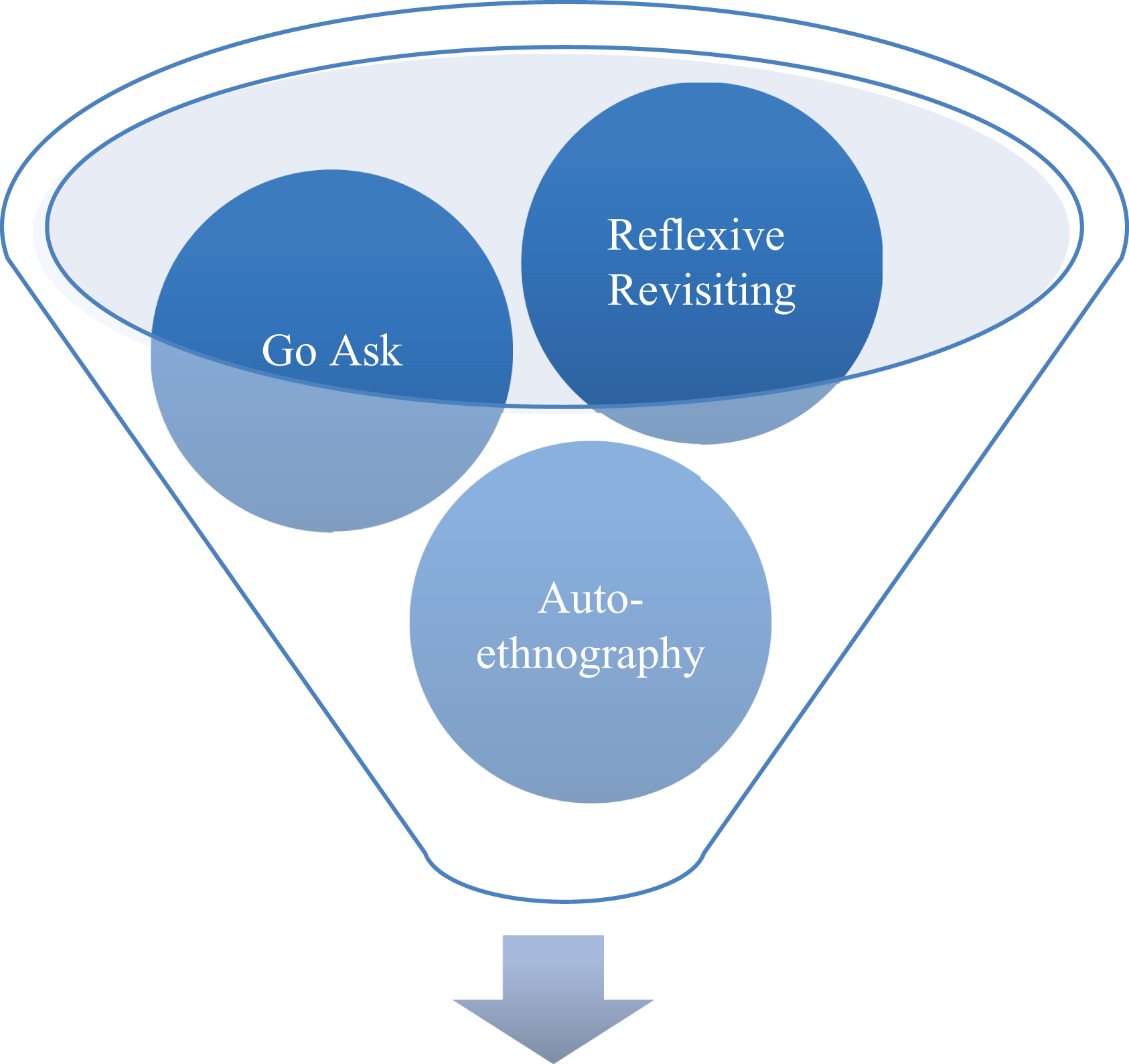
Looking back and beyond.
A second and related approach is informed by the work of Burawoy (2003) in the area of reflexive revisiting and the significance of researchers engaging in reflexive ethnography in “returning to scene,” as it were, of previous research studies for the purposes of deepening an understanding of long-term effects, changes in perspective, and so on. The revisiting process does not seek to replicate a previous study, but rather it sets out “to focus on the inescapable dilemmas of participating in the world we study, on the necessity of bringing theory into the field, all with a view to developing explanations of historical change” (Burawoy, 2003, p. 647). The idea of studying the “afterlife” of interventions (Mitchell et al., 2010) is something that seems particularly relevant to addressing the question “What difference does this make?” in relation to participatory visual studies and dialogue. What does it mean to study a site some time later (several years, a decade, or even longer), either as the original research team returning to study what has happened to the participants or returning to the same site years later and studying not the original participants but the current population of the same age or experience? But to add to these permutations, we might also think about what it might mean to return to the participants who have been part of these studies to reflect on a particular set of shared experiences (Mitchell, 2015; Sefton-Greene & Rowsell, 2015; Walsh, 2012).
Added to these tools and methods is the strategy of autoethnography itself where the researcher initiates a focused and systematic looking back that seeks to take account of “then” and “now.” As explored elsewhere (Mitchell, 2015), autoethnography offers a “wide angle lens” for capturing meaning-making.
Method
Our focus in this article is on go ask reflexive interviews with visual researchers who have worked with young people. The development of the actual interview questions framing these reflexive accounts was located within the larger study of Networks for Change and Well-Being: Girl-Led From the Ground Up Policy Making to Address Sexual Violence in Canada and South Africa, focusing in particular on one node of the study “Engaging Policy Makers.” Unlike other components of the study where the focus draws on the voices of girls and young women themselves, this component of the study was meant to provide opportunities for interviews and focus groups with policy makers and researchers engaged in participatory visual research with young people. The interview questions posed to the researcher–participants were intended to encourage critical reflection on the details of how they designed their participatory visual research projects to foster youth engagement in policy dialogue. Below is the list of reflexive interview questions that were used when interviewing the participatory visual researchers: Please describe a particular arts-based project involving Indigenous or other marginalized youth that included some type of public exhibition or screening. How did you feel as you were watching the images/videos/performances produced by the Indigenous or other marginalized youth? Were there one or two images/videos/performances that really stood out for you? What were they? What do you think was the main message (or messages) in the images/videos/performances? How did the images/videos/performances add to your knowledge of the everyday lived experiences of Indigenous or other marginalized youth? How were these images/videos/performances the same (or different) from the images/narratives that you typically see in local media on Indigenous or other marginalized youth? Was it important that Indigenous or other marginalized youth produced the images/videos/performances (as opposed to professionals)? Why or why not? Did the project(s) have an exhibition/screening/performance aspect? Who was in the audience? What was your impression of how the audience experienced the exhibition/screening/performance? How were audience members engaged in the project after the exhibition/screening/performance? How do you see the voices, or lived experiences, of Indigenous or other marginalized youth reflected in policy-making? (e.g., How may art exhibitions/screening/performances by Indigenous or other marginalized youth translate into policy change?) What advice would you have for other researchers designing studies regarding the challenges and benefits of implementing arts-based methodologies that seek to address specific audiences?
Recruiting Participants
Building on the work of Gubrium and Harper (2013) noted above, we were interested in talking with researchers with multiple experiences in participatory visual research with young people with the idea that some sort of a comparative frame (more than one study), as well as an overtime component would be critical, particularly in relation to studying impact or tracking change. We have not limited the study to one participatory visual methodology; indeed, in keeping with our own experiences, we have been interested in the varied rationales any one researcher might have for using photovoice, participatory video/cellphilming (cellphone + video), and digital storytelling. To locate researchers, we have drawn on personal contacts, professional and academic networks, and ongoing reviews of academic literature. To conduct the study, we sought and received ethical approval from the McGill Research Ethics Board and, in all cases, approached potential participants through e-mail or direct contact along with a follow-up description of the project. Participants were of course given the option of having their real names used or being anonymized.
Positioning Ourselves in the Research
As a research team, we have a shared interest in participatory visual and other arts-based approaches to working with youth and common concerns about studying audience and impact. While we might have differing experiences in such work (as arts practitioners, or learning specialists, or as researchers and members of transnational implementation teams using participatory visual methods), the broad area of youth studies is central to our work. Here, we situate ourselves within the context of this study as a way of being transparent about our respective researcher positionalities in “writing up” the vignettes or reflexive accounts of other visual researchers.
For Claudia, the focus of this project is on its applicability to the specific area of sexual violence and girl-led “from the ground up” approaches to policy dialogue in transnational perspectives, informed by her work in Ethiopia, South Africa, Rwanda, Kenya, Mozambique, and with Indigenous youth in Canada. In this way, her positioning looks across various social and geographic sites. For Pamela, as a settler Canadian and former clinical nurse, her interests are in the area of human rights–based approaches to institutional accountability in decolonizing health-care education. Acknowledging that anti-Indigenous discrimination exists in health systems, her research investigates how participatory visual methodologies can inform programs and policies to reduce health disparities and health-care inequities among Indigenous populations. For Haleh, her professional interests as a learning specialist focus on providing effective strategies to improve academic and learning outcomes for young adults. As a researcher, her focus is on the practicality of youth-led, grassroots policy-making in order to bring new learning to individuals, communities, and societies. These perspectives are informed by her interest in the impact of educational and health policies on the sexual health of girls and young women in Iran.
Three Vignettes
We draw in this article on a series of go ask reflexive accounts or vignettes of participatory visual researchers in relation to work with children and young people. In asking visual researchers to critically reflect on issues of audience, we use these vignettes from our interviews to explore the political and social engagement that is often at the heart of arts-based research. The accounts are part of the larger study and are selected for inclusion in this article for the ways in which they help to illuminate differing aspects of impact, particularly as informed by participatory visual work with young people. We start with interviews with Katie MacEntee and Sarah Flicker that directly take up the issue of policy dialogue and the limits on finding or tracking policy change in their experiences of working with girls and young women. From there, we go to an interview with Liz Miller and her account of an arts-based project with refugee youth in Montreal that led her to consider the significance of community dialogue. The third vignette, with Sophie Guerin, shifts the discussion toward families as intended audiences of films created by Indigenous youth.
Impact on policy dialogue
The first interview, carried out by Haleh, involved Katie MacEntee of York University, Toronto, and drew on her participatory visual research with girls and young women from a rural area of South Africa, exploring the issue of gender-based violence in the era of AIDS (MacEntee, 2015). In her chapter Facing Responses to Cellphilm Screening of African Girlhood in Academic Presentation (MacEntee, 2016) in the book What’s a Cellphilm? Integrating Mobile Phone Technology Into Participatory Visual Research and Activism (MacEntee, Burkholder, & Schwab-Cartas, 2016), she reflects on her project with young South African girls with a critical lens as to “What difference does this make?” How does the presentation of the cellphilms produced by youth contribute to any change? What is her role and responsibility in the dissemination of the data to ensure that young girls’ messages have traveled the world? She raises a concern about how meaningful these visual productions are to the public audience outside of the context in which these visuals have been produced. She was conscious of the possibility that, removed from their particular sociocultural context, these visuals may not only lose their meaning but also their potential to impart intended messages or impact any kind of social change (for further discussion, see also Mitchell, De Lange, Stuart, Molestane, & Buthelezi, 2007).
Katie was asked whether she could identify any of her projects that resulted in policy or a social change or made youth part of the policy dialogue (at individual, communal, or societal level). While trying to define the blurred boundaries of what constitutes policy change, she shared the following response: My first impulse is to say no. Whenever I think about the bigger questions around policy change, I get confused around what policy is. Policy has a lot of different forms: people talk about different personal policies, and then obviously government policies. I don’t know how much policy change was really a goal of any of the work that I have done but if we really talk about social change I think the work that I have done has created a platform that recognizes that young women in particular are able to very eloquently engage in social discussions and they have something to say and something to contribute. I don’t know for certain if it results in any specific policy change per se, but I think it has certainly demonstrated this. But again this is my sense and I don’t have any follow up to prove that. (K. MacEntee, personal communication, June 6, 2018) But if I think about it in the larger context of the global HIV dynamic, it’s actually kind of embarrassing that the International AIDS conference in Durban in 2016, there was this emphasis on youth and in particular young women’s involvement. [They recognized that] they need to involve young women in policy change and in developing programs and all of these things. And this was such a huge topic! And of course they should involve them because it is like 2016! And this was the big outcome of the International AIDS conference?!!! Like get with it guys!!! So clearly creating these participatory visual methodologies like photovoice can contribute to that or can at least support that when used with young women when that’s appropriate. (K. MacEntee, personal communication, June 6, 2018) I was in contact with a couple of the participants for a while afterward and they always wanted to do more. They would always contact me and ask, “What more can we do? I’d like to stay on this and I’d like to do more.” So, they took part in the project because they were interested in it. I think this project made them interested in it and more energetic and engaged in the topic. (K. MacEntee, personal communication, June 6, 2018) They felt there are more things they can do. I think they saw that the door opened to them and much more needs to be done for the change to happen. They felt like if we have this podium, then we can do more. (K. MacEntee, personal communication, June 6, 2018)
Also when it comes to policy change, there seems to be a gap between the message produced by girls and young women through their artwork and the policy outcome. How to deliver the girls’ message to policy makers who leads to a new policy is the key. Sarah Flicker from York University in some of her work focuses on HIV prevention among Indigenous youth in a Canadian context (see Flicker et al., 2014, 2017). Sarah talks about how Indigenous youth synthesize and deliver health messages and health promotion strategies through arts-based methods. While she focuses on the importance of messages produced by youth, she also suggests that in order to include youth in the policy dialogue, it is important to get specific about the policy one is trying to change. In an interview with Pamela, Sarah recounted, “If that’s really your goal to impact policy change, then being far more specific about the parameters of what you’re asking people to do will get you closer to those policy recommendations that are implementable” (S. Flicker, personal communication, January 27, 2017).
Impact on community dialogue
Liz Miller, Professor in Communication Studies at Concordia University, Montreal, led the project mapping memories: participatory media, place-based stories and refugee youth (Miller, Luchs, & Jales, 2011). While leading the mapping memories project with refugee youth in Montreal, Liz observed that although she identifies herself first and foremost as a filmmaker and facilitator (as opposed to a policy lobbyist or strategist), she has a deep appreciation for the ways in which the various productions created by the youth contributed to building alliances with community and support groups. As she commented in an interview with Pamela: Mapping Memories was a participatory media project working with youth with refugee experience, and using video, storytelling, and mapping as a way to facilitate young people sharing difficult stories. Different than some projects, one of the important aspects of Mapping Memories was helping young people take their stories public. So it wasn’t simply about facilitating a space where people with different lived experiences could feel less alone and could have an opportunity to share and shape their story, but it was also about thinking about how that story could be useful in the world. There’s a risky component to building in outreach or advocacy or that kind of public place in storytelling workshops, but I think the flip side of it is that it facilitates a process that says there’s a reason that we revisit difficult stories. That they can in fact move others—who are in policy, in education, or in different contexts. That lived experience, and especially lived experiences that are sometimes socially considered shameful or difficult, can really serve to help others. (L. Miller, personal communication, January 10, 2017) Refugee experiences are often represented through the media with an angle on the tragic. Even trying to get into the country you have to tell a story of victimization. There is a certain inherent drama, though it’s as if audiences will only be interested if that drama is present. And yet there are so many dimensions to how people cope with complex things. A lot of the work that the youth created was more understated: consciously trying to avoid narratives that ended in victimization, and incorporating a part of their story that was also about survival and resilience. (L. Miller, personal communication, January 10, 2017)

Image from mapping memories tour blog.
Finding herself in the role of the researcher as the first audience, the question arose of what to do with potentially problematic narratives (what might be read as victim narratives) when thinking of curating those images for different communities: Explaining why you would want to take those stories beyond that circle and share them in the public was another really critical dimension of the project. Some of these stories were really just hard to witness—at first, certainly. When somebody tells you a story, you have your own emotional response. The challenge then is how to help that individual—how to remove yourself a little bit from the intensity and the depth of the story to be a facilitator. (L. Miller, personal communication, January 10, 2017) I think that there is a way in which people communicate an enormous amount about their psychological state, about their feelings through a photograph in a way that they simply wouldn’t just talk to you about, necessarily. And that can really evoke moods and feelings and states of being in a way that texts can’t. For many people the photograph and the staging of a scene or a place in their room can really be a mirror to something deep that they want to say. […] There is a way that photographs become a bridge, and it’s always surprising. […] I think that there is a way that a photograph can get you close to someone in a way that just maybe starting a conversation with somebody couldn’t. (L. Miller, personal communication, January 10, 2017)
Impact on family dialogue
The idea of the medium of images made through participatory research becoming a bridge to emotional worlds—especially in relation to family—is considered in this vignette from an interview with Sophie Guerin, a filmmaker and youth mentor with Wapikoni Mobile (http://www.wapikoni.ca/home), a Montreal-based nongovernmental organization (NGO) focusing on Indigenous youth as filmmakers. The 2-hr interview with Sophie was conducted over Skype. As a non-Indigenous person, Sophie spoke about how she learned through first-person narratives how Indigenous youth are addressing colonial histories and ongoing adversities. While many of the films made through Wapikoni Mobile are intended for an intimate audience of family and community, Sophie reflected on how the integration of Indigenous youth perspectives and experiences into the films contribute to deconstructing the negative stereotypes that have been created and upheld by non-Indigenous people for generations and that have perpetuated intergenerational trauma. The film that she refers to in this interview excerpt is “Neka (Mother)” by Nemnemiss McKenzie. Sophie assisted the young woman to transform drawings from her own child (Figure 3), produced on aged paper, into a haunting film as an homage to her mother, who is a survivor of residential schooling. Sophie recounted: The thing with Wapikoni Mobile is that we come into the community as outsiders. We’re not Indigenous; the community doesn’t know us. But most of the time they want to talk about their specific story, and a lot of the projects are testimonies and stories about personal suffering. One film that really moved me, the participant wanted to do a movie about her mother. If you know a little about the history of the Duplessis era, when Indigenous children were taken from their families and put in residential schools run by Catholic nuns and priests—when the children returned to their communities they didn’t know their parents and they didn’t speak their native language. So this participant wanted to talk about that story, which was her mother’s story. So she wrote a text in the Inuit language, and she translated it but she wanted to talk to her mother in her mother’s language. Her story was about asking her mother, “How did you survive what happened to you?” So she was specifically addressing her mother. We decided together to use her daughter’s drawings to illustrate the story. [pause] Yes, this film moved me. (S. Guerin, personal communication, January 24, 2017)

Still image from the film Neka.
In Canada, Indigenous leaders and activists assert that the process of truth and reconciliation (see Truth and Reconciliation Commission of Canada, 2015) is moving too quickly and that there cannot be reconciliation without full acknowledgment of the truth. Not to be forgotten, Canada originally voted against the United Nations (2008) Declaration on the Rights of Indigenous Peoples when it was adopted by the General Assembly in September 2007 and only removed its objector status in May 2016. We are only just beginning to recognize the intergenerational impacts of colonial legacies, which are encompassed in the concept of “ethnostress.” The Tribal Sovereignty Associates (1992) coined the term ethnostress, and define it as follows: “Ethnostress, comes from two words: ‘ethnicity’ which refers to the roots of our Aboriginal identity and ‘stress’ pertaining to the impact that the reality of our experience has on the psychosocial development of the Aboriginal person” (n.p.).
Non-Indigenous researchers (w)rest with the necessary ethical dilemma, “Can non-Indigenous researchers do research on issues related to Indigenous peoples?” Many Indigenous scholars assure that the struggle is real and that this seemingly interminable and unresolvable question is an essential reflection for all non-Indigenous persons contemplating every step of such research (e.g., Wilson, 2008). Thus, it is vitally important for the researcher to locate herself and her positionality (e.g., White settler origins) within the always already nonneutral research context (see Aveling, 2013). Feeling apprehension is not reprehensible. Mindful, even compassionate self-reflection is critical. This process, however tenuous, may better position us to better visualize the oscillations between vulnerable and powerful subject positions of researcher and participants in notwithstanding historically deleterious research partnerships with Indigenous peoples. There is a paradoxical relationship between the categorization of Indigenous peoples as vulnerable in academe (e.g., by the Tri-Council Policy Statement on research involving Aboriginal peoples, 2014) and the strength-based “resilience-as-resistance” ethos of Indigenous peoples (see Kenny & Fraser, 2012; Valaskakis, Stout, & Guimond, 2009).
All this points to the work that needs to be done among researchers to make concerted efforts to deconstruct and decenter the often privileged perspectives and experiences that become embedded in policy, education, health services, and popular media. In hearing what participants are communicating through arts-based research, researchers may not only learn to unlearn biases but discover something new about how they feel with respect to once deeply held and now suddenly shifting beliefs, values, and worldviews. This becomes the idea that transformational learning happens at the cognitive-affective nexus, reminding us that our ability to listen and respond is as much about thinking as it is about feeling.
Arts-based research that is truly participatory requires a “buy-in” from participants that cannot be co-opted by the researcher. Participatory visual work like the film “Neka” yields creative expressions of ownership and self-governance. Creativity is a fountainhead of resilience-as-resistance: collective empowerment, breaking out of isolation, and building social cohesion. This is participatory arts-based research as intervention. As Sophie reflected: I think the main message of the film Neka was to make peace with this story. Her mother was not able to talk to her daughter about these events in her life. The family relations were tense. So I think she wanted to tell her mother that she understood why their relationship was like this. And she wanted to forgive her mother. I think it’s a story about forgiveness. […] The woman who made Neka was 34 years old. We see the difference between generations in the films. […] When she disseminated the project, showed it to her community, she received a lot of praise. And I think that was the first time she heard something like this. (S. Guerin, personal communication, January 24, 2017)
Discussion: What Are We Learning?
There is extensive research in the field of participatory visual methods that shows that young people can play a major role in identifying their needs and suggesting practical solutions (Conrad & Kendal, 2009; Gubrium & Harper, 2013; MacDonald et al., 2011a, 2011b; Reich et al., 2017). In their book, Learning From the Ground Up, Choudry and Kapoor (2010) examine many instances of grassroots movements that provided a platform for political activists and social scientists to challenge and to some extent dismantle an NGO’s, state’s, and governments’ act that on the surface seemed to benefit marginalized groups. Despite the vast body of literature on studies that have used participatory visual methodologies, there remains a gap in tracking the outcomes of these various studies, particularly in the context of the question “does anything change?” Can youth really be involved in the change process and what are some of the barriers to bringing about youth-focused social change through participatory visual projects?
What cuts across the vignette accounts is a simultaneous tentativeness on the part of the visual researchers and a strong passion or enthusiasm for this type of engagement with young people. What this highlights is the importance of the work being youth-led and the recognition that as researchers it is not possible to predetermine finite outcomes and, indeed, there is perhaps a sense that we should be suspicious of work that is too neat.
Although never mentioned directly in any of the interviews, Katie, Sarah, Liz, and Sophie all considered themselves as “outsiders” in relation to the communities in which they conducted their research, and all three of them researching on culturally sensitive topics that could potentially traumatize, upset, or silence their participants. Yet it seems that by using art and the visual, a two-way communication was facilitated between these researchers and their participants, which enabled them to generate new possibilities for ensuring that youth are part of the dialogue.
Taken as a whole, the interviews underscore the significance of expanding our definitions of impact. For example, in the vignette about the film Neka, as an homage to the filmmaker’s mother, Sophie reflected that where family relations may be detached, closer connections may be fostered by sharing personal narratives created through participatory visual methodologies. A recent study with girls and young women in the small town of Paterson, South Africa, highlighted how young people are effectively using digital platforms and personal connections as a grassroots approach to reaching audiences in their community about issues of sexual violence (Mitchell & Yamile, 2018). Bypassing more conventional routes such as public exhibitions, screenings, or performances organized by researchers or teachers, the girls in the Paterson example commented that they simply went and showed their cellphilms to their parents, teachers, and friends on their cellphones. Taking into account their network of personal connections, the girls described their strategy as one of “trending in Paterson.”
At the same time, though not directly stated by the participants, publication bias may be one of the limitations of studying “What difference does this make?,” as research that results in undesirable outcomes may be less likely to get published (Catalani & Minkler, 2010). Researchers may be reluctant to publish on their projects that did not result in desirable outcomes or that do not have an obvious fit with being transformative. Addressing this limitation, the go ask approach allows for investigation of the unpublished aspects of the studies through a platform that supports reflexivity.
Finally, we want to comment on the go ask approach and the subsequent writing of the vignettes. It is beyond the scope of this article to offer a comprehensive account for our “hand” in the writing of a set of vignettes, a term that we borrow from Kirk (2004) in her reflexive engagement with women teachers in Pakistan. However, we are committed to the writing as a type of polyvocality, as Pithouse-Morgan and Samaras (2015) describe the collaborative effort, and as such see the value of writing that is exploratory and conversational as aligning well with the nature of the go ask interviews.
Conclusion
Given the significance of trying to deepen an understanding of what impact means, we see these vignettes as drawing attention to some of the critical issues attached to the idea of impact, especially, as we note in the Discussion section, the importance of expanding ideas of what impact might mean when it comes to engaging young people in the arts to address such concerns as sexual violence, HIV and AIDS prevention, and migration. In order to generate methods of fostering debate and deliberation in sustaining audience engagement, it is clear that we need to attend to the ways in which viewing images and working with images may be deeply affecting (Lamb, 2018). We know that policy dialogue and policy change are often seen as the “gold standard” components of this work, but it is clear that the impact on family and community is key. Indeed, in focusing too much on whether something has led to policy change, it is possible to miss the impact of the everyday. We of course would also see this work as complementing studies that look at the impact of the work on young people themselves in relation to what they believe they can do to effect change in their lives. Clearly, these vignettes may raise more questions than answers, but what is hopeful in this kind of work is researcher reflexivity in work that seeks to be transformative.
Footnotes
Authors’ Note
Parts of this article were presented by Claudia Mitchell at the International Qualitative Research in Health Conference, Quebec City, Canada, October 17, 2017.
Acknowledgments
We are grateful to Katie MacEntee, Liz Miller, Sophie Guerin, and Sarah Flicker for their participation in the interviews.
Declaration of Conflicting Interests
The author(s) declared no potential conflicts of interest with respect to the research, authorship, and/or publication of this article.
Funding
The author(s) disclosed receipt of the following financial support for the research, authorship, and/or publication of this article: The work for this article was supported through a Social Sciences and Humanities Research Council of Canada grant (award number 895-2013-3007) and an International Development Research Centre grant (award number 107777-001).