




Abstract
Health research is complex, often asking questions that have uncertain, indefinite, or inarticulate answers. Embodied health research, which incorporates subjectivity and social relationships centered on the body, adds further complexity. There exist several calls for embodied research methodology, and it is now important to explore aligning methods and further develop embodied health research methodology. Using artistic and interview data from the Beyond the Present: Risk and Body Stigma in Public Health project, this article argues that imagination is a useful methodology and sculpting a fruitful method to draw out health stories. Sculpting and imagination allow material and conceptual malleability and are valuable in addressing complexity and uncertainty in critical qualitative health research.
Addressing the Complexity of Embodied Health Research
Embodied health research is complex. Embodiment, a concept derived from Merleau-Ponty’s work, states that the body is not only a material object but also the subject of human experience (Csordas, 1999; Grosz, 1994; Satina & Hultgren, 2001). It is the relationship between the material body, simultaneously the means through which (subject) and with which (object) we understand the world, and the perceiving body (Satina & Hultgreen, 2001). The metaphysical (e.g., sociological discourses) and material (e.g., sitting in a crowded café) contexts of a body are imperative to understanding oneself as embodied (Grosz, 1994) since metaphysical and material contexts provide concrete boundaries and situate bodies sociologically and materially (Csordas, 1999).
Because embodiment is contextual and simultaneously subjective (the body is experienced by the self) and objective (the body exists as a material object in space and time), an impossible challenge arises in capturing, interpreting, and reducing the state of embodiment to written research findings (Chadwick, 2017; Silk & Andrews, 2011; Smith, 2007). The methodological question is therefore prompted: how, then, is the body represented or made meaningful? Hall’s (2013) observations and theorizing on what “representation” means support the idea that meanings map onto the material world, but such constructionist frameworks for understanding “representation” still cannot fully describe the simultaneous relationship between the subjectivity and objectivity of “embodiment.” The body can be the cultural output or input to representation, and Csordas (1999) notes the eternal methodological cleft representation forms between the existential condition of the body and its subjective experiences.
The challenge of understanding the experience of embodiment through research has been addressed through suggesting: reflection on embodied research that takes physical spaces into account (Chadwick, 2017; Ellingson, 2006; Friedman & van Ingen, 2011; Giardina & Newman, 2011a, 2011b; Spatz, 2017), visual methods (Harrison, 2002; Lorenz & Kolb, 2009), methods which focus on multisensory input (Pink, 2009; Sparkes, 2009), and research that facilitates understanding the input of each of the senses as one simultaneous, whole experience (Pink, 2012). With each suggestion for method and methodology, poststructural researchers see the same subjects in a new light, from new angles, and with added dimensions.
This article is an exploration of the possibility sculpting and imagination offer as a link between representation and embodiment. Sculpture is a representation of experience, one in which a subject and object is created by an embodied subject and object. Csordas (1999) notes that the body has “existential meaning beyond representational meaning” (p. 147). The link between the meaning of the material body and the body-as-representation is a site of unique and interesting methodological opportunity for sculpture and imagination.
Beyond the Present and Methods
This article is one part of a research project entitled, Beyond the Present: Risk and Body Stigma in Public Health. Beyond the Present took place in fall 2016 in Toronto, Canada, with ethics approval #32844 from the University of Toronto research ethics board. The project’s goal was to understand what “health risk” means and how people make sense of uncertain futures and pasts through their present embodiment. Beyond the Present tells stories of embodied health risk.
In order for risk to exist, Luhmann (1993) notes, an individual must be able to identify a decision point in their past and discrete options from that point. Next, this individual must be able to attribute an outcome to one of these discrete options. Beyond the Present applies this sociology of risk to health, asking participants to create embodied characters and identify what sorts of events matter for embodied health. The project understands the body as the answer to Luhmann’s (1993) problem of the “unity paradox” or how an ever-moving present is the meeting point of the past and the future. The body is understood as that which connects the past and the future.
Thirteen adults were recruited using an untargeted targeted 1 approach with intentional focus on inclusion. They were given an information letter outlining the project title and goals. Participants selected a pseudonym and were asked to self-identify in whichever ways were important to them (see Table 1).
Thirteen Participants.

To my project on embodied health risk’s end, I proposed four methodological characteristics for critical qualitative health research: (1) embodied or tactile, (2) creative, (3) imaginative, and (4) absurd.
2
Inspired by Gastaldo, Magalhaes, Carrasco, and Davy’s (2012) body mapping, Bagnoli’s (2009) time lines, and Longhurst’s (2000) life maps, I deployed these foundational characteristics to build a tripartite research platform with the goal of understanding how people make sense of health risk. This platform included:
Sculpting: Participants were instructed to sculpt “someone who will die of noncommunicable disease.” This prompt was intentionally vague to allow participants to sculpt anything/anyone they felt fit that description.
Lifeline (Kriger, 2016): Each participant was given a white foam board, approximately 20″ × 15″, and access to various art supplies and magazines; the artistic process resembled collage. Participants were asked to (a) represent time (a past, present, and future) on the board, (b) give their sculpture a name or title, (c) situate their sculpture on or around their lifeline, and (d) populate the lifeline with what is important to their sculpture’s life.
Interview: Each person participated in a one-on-one semistructured interview with the researcher where we talked about the participant’s art, stigma, risk and health, and method. The participant’s sculpture and lifeline were placed in front of us for the interview. In some cases, participants interacted with their art during the interview (e.g., adding finishing touches, touching the art, pointing to it, and moving it around to see it from various angles).
Sculpting and lifelining took place in three weekly 2-hr sessions at a local art café. Two-hour interviews were scheduled between the researcher and each participant after the completion of the art.
Sculpting and Imagination
The methodological incorporation of imagination and method of sculpting in my research have been valuable in addressing complexity in embodied health research. These two aspects contribute to embodied health research in particular and embodied complexities in general. Sculpting and imagination take methodological suggestions from multisensory and embodied research and add methodological possibilities through which to express the simultaneity and wholeness of the bodily experience. The physical malleability of sculpting and conceptual malleability of imagination open up the potential for understanding complex, simultaneous, and uncertain phenomena. There are several ways in which sculpting and imagination were useful to understanding how individuals made sense of “health risk” which will be used to structure the discussion of this article: (1) through the creation of concrete and reflective objects and the relationship to subject; (2) through allowing unknowledge, imperfections, and the expression of partially formed ideas; and (3) through allowing ontological multiplicity and the exploration of “shadow lives,” Phillips’s (2012) term for the lives we did not or do not live which shape the lives we do.
Concrete and Reflective: Relating Objects and Subjects
In research on health risk and the body, the definition of “health,” the embodied experience of health, and how health risk is understood have each been identified as ever-changing and nonuniversal. Duffin (2005) recounts the historical evolution and dynamism of the definition of health; Crawford (1980) and Beck (1986/1992) each argue for the role broad social context has in, respectively, (a) shaping the experience of health through neoliberalism and (b) shaping the mechanism of risk via modernity. Lupton (2013) summarizes various sociological models of risk in health which change over time and through space, and sociological health scholars have theorized how identity plays into the embodiment of health through biopedagogies or how we teach bodily expectations in relation to subjectivity (e.g., Harwood, 2009; Shilling, 2008). Each of these ever-changing and nonuniversal predicaments adds to the subjectivity and instability of situating health research. The goal of embodied health research is to unpack and understand each of these predicaments as they are experienced by an individual: as one simultaneous and interactive mess. This is different than ordering them or asking about each of them one at a time and different than presupposing one predicament is, or several predicaments are, static while the others are dynamic. Embodied health research is research about complex, simultaneous, and uncertain phenomena.
The complexity, simultaneity, and uncertainty of health research is aptly addressed by sculpting. In contrast to methods that metaphorically “paint a picture” or capture a moment in time, sculpting allows each of the unstable and dynamic predicaments of health research to exist as a kind of field in fluctuation. Sculpting does not ignore any of the moving parts and does not draw particular attention to one part over another. Participants could express their definitions of health and understandings of risk and body based on what aspects mattered to them. They could express these evolving, embodied concepts as an integral experience.
Creating a sculpture gave participants something to talk about. When we ask other people or ourselves difficult or complex questions, such as “what is health risk?,” we can, perhaps, give an answer. However, this outright answer does not encourage flexibility, multiplicity, or complexity as the outright answer requires conclusions, stability, and definition. Interview questions, for example, form a method that often elicits and aims to elicit a singular or articulable or ordered or orderable answer. In doing so, such methods already choose which moving pieces are most important and which are assumed stable, prioritizing the “rational” realm of that which makes sense. Evelyn describes: It was also really good to be able to like…that it was tactile…. It was good for a body thing to be using something so free.

Tinika’s sculpture: The guardian.
Participants further spoke to how the physical presence of the sculpture allowed them space and time to think and reflect and how sculpting opened up the range of what they could talk about through the physical manifestation of their sculpture
4
: I know [researchers] just want you to do things and you’ll talk about it later, and it’s more interesting to let things happen organically…cause you get more interesting insights that way. (Elizabeth) Before this interview, I didn’t tie this together. And now it kind of makes sense to me. (Tinika) I think it was cathartic…to see it materialized. Cause this was sort of going on in my head in some way, in a less articulate [way]. (Nell) I think it’s a really good medium to open up conversation…. I thought “OK, I’ll just interpret [the prompts] how I want,” and that’s what I did. (Anna) [Touch] can become part of the experience of making [the art/research] even deeper! (Dove) …it didn’t lead to answers, or like the sculptures in certain directions…it kept it open. (Evelyn)
Additionally, the three dimensionality of sculpting a body became an important feature of the process for participants. This research sought representation of ideas about the body. Ideas about the body can manifest in different ways, and each way has underlying assumptions about the chronological order of thought and embodiment. 5 Sculpting provided individual participants with the ability to think first or do first. Some participants described following an idea, a “think first” approach, which is not immediately dissimilar to or distinct from other methods of inquiry. However, there were also stories of how “doing” happened first and how the viscerality of the method entered the process of sculpting and changed participants’ ideas. A common example is where the participant’s idea of what body to sculpt came from a three-dimensional position or stance (see Figures 2 –8).
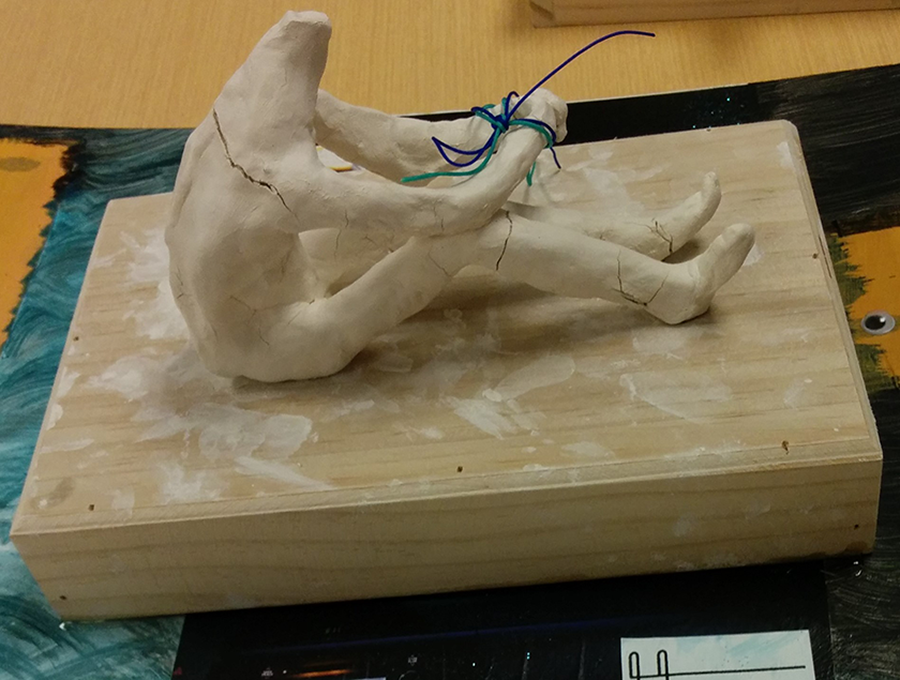
Francis’s sculpture.

Grace: “I wanted her to have texture…It’s really important for her to have this like overhanging belly…. She really embod[ies] some of these things that we see as flaws.”

Dove: “I decided she would dance, and she was going to be joyful.”

Evelyn: “[I got ideas] from his body shape.”

Samantha: “I knew I wanted that kind of image of bending over, of feeling the weight.”

Elizabeth: “…it started with the sculpture, and once I got the idea of her being slouchy…that was kind of what centered it.”

Veronica: “…it’s a very visceral process.”
Suzanne describes how the visceral process of sculpting changed the body she sculpted: I originally…had this idea that I was going to sculpt some big FAT person…so I’m a bit surprised…I was really just playing with the material…it was very unconscious. (Suzanne) Like I would love to say “no,” because that’s what I logically believe, but there’s a reason why, obviously, I chose this shape. (Francis)
It was the multidimensional shapes and positions that inspired participants. It was also these shapes and positions to which participants reacted and onto which they built, bringing into practice Grosz’s (1994) postulate that “bodies are not inert; they function interactively and productively. They act and react. They generate what is new, surprising, unpredictable” (p. xi). Participants and sculptures evolved together forward through time.
Sculpting was a way to embody research and process through touch. Touch reaches toward an exposition of matter and form as processual states. When I reach out to touch you, I touch not only the you who is fixed in space as preorchestrated matter/form, I touch the you that you will become in response to my reaching toward. (Manning, 2006, p. 87).
Uncertainty, Unknowledge, Perfection, and Half-Formed Ideas
Health is an uncertain enterprise, given that much of what “health” is has to do with the future. A future which, despite our best efforts, remains unknowable; a particular life among options. As is health, so touch is also a process and not an end, adequately allowing room for uncertainty as sculpture emerges. Instead of insisting upon concrete ideas, this method literally builds uncertainty into something concrete. Whincup (2004) describes the root of the problem of representing uncertainty as the necessity to cohere with existing social symbolic systems. He submits that using objects, such as the sculptures in this research, may not require coherence to already existing systems. Sculpting gives expression to uncertainty; a chance to contradict oneself, to be unsure, to not know, or to fumble through a response. The act of building sculpture gives participants something to talk about both when there are too many things to talk about and when the contents of those “things” are uncertain or unknown.
“Unknowledge” describes such a simultaneous state of complexity, with too much and too little information—where it is hard to distinguish between what is relevant and what is not. Current conceptions of risk allude to futures that are unknown and unknowable (Furedi, 2009). Part of this project was understanding how individuals construct unknowable futures as a present embodied person. Unknowledge is a way to describe a present absence, knowledge one has but cannot fully access or articulate. It is the sense an individual has about a phenomenon, concept, or experience but cannot precisely describe what the sense is or how, exactly, it works. Sculpture allows for unknowledge, an important kind of information to examine. Unknowledge is particularly useful to examine in research on embodied or complex topics.
Sculpting and lifelining as methods offered the option of presenting unknowledge, which participants reported released them from the constraints of creating something perfect and from the constraints of being perfect participants. “Perfection” is understood here as the “perfection codes” of health which conform bodies to particular sociocultural health roles (Shilling, 2008) and was similarly elaborated upon by participants as fulfilling social, experimental, or representational expectation. Embodied perfection does not exist in the material world but instead relies on a shared social imagination of an original “perfect” body that becomes the point of reference against which “other” bodies are measured (Clare, 2017). In a bizarre and unintentional allegory to embodied experiences of health, stories of the process of sculpting another body and lifelining depicted abandonment of the need to achieve a perfect particular form or perfect representation of one’s ideas: So, even though this was a short time, I think it gave me that space and that freedom that it didn’t have to be perfect, it didn’t have to be exact, it didn’t have to be everything I wanted to express…and so, in that sense, it was very freeing and therapeutic and for someone like me, with a lot of anxiety and tension…headaches and stuff like that…it was beneficial, is what I’m saying. (Samantha) It was difficult…. I’m a perfectionist, I want to know everything. Like, I want to know all the instructions. And I want to plan…. I just had to kind of say to myself, “you’re going to do this thing, and it’s not going to be perfect, and that’s okay”…. It was good to just let it be a creation and you can just do this and it doesn’t have to be perfect and it can just be what it will be. (Grace; emphasis in original) Here’s the thing with sculpting: I don’t know what I’m doing. With photography, it’s different: I have a vision and try to visualize and sort out the props…But with sculpture, I don’t know what I’m doing! So the only thing I can do is just to be organic about it and do the best possible thing. Like, I didn’t really have a vision of what’s to come, but I tried to improvise it and…be authentic about it. (Tinika) It was really interesting going into it, because I didn’t know what I was going to make…. I usually like to be given a lot of direction, so it was a bit different for me. But then, once I set my mind to what I was going to do…since it was dad, I kind of know, oh, let’s make it look like dad. And let’s show both dialysis techniques instead of just one. (Anastasia) The ability to build onto it was really good and constructive because then you didn’t have to decide on the first day what something would look like. (Evelyn) And then once I got into it, it was kind of okay…. I’ll just see where this leads…. Once I was there, I just felt…don’t even fight it. Just play. So I started to play…. I…just put all this stuff together to the best of my ability. Have fun, and then I titled it. No thought. It just came out. (Dove) …I was just playing with the [clay], it was when we first got it and I was just playing with it…[then] I was like: Wait a minute! Dice [that was created through play] is perfect! (Samantha) …maybe things are more unconscious when you have less time…you’re not in your head as much. You’re just…doing. (Suzanne) I was really just playing with the material…it was very unconscious…. (Suzanne) …it was such an organic process…working with my hands and not my brain. And…there’s a certain freedom in that, in art and creativity…it surprised [me] what things turn up. (Suzanne) I had the general idea and I tried not to overthink things too much. (Elizabeth) I found [the vague prompts] frustrating, quite honestly. Cause I was listening to a table near us…. I’m like: no! You’re interpreting it wrong! Right? And then you were like: but it’s okay! And I was like: it’s NOT okay!…so…it’s whatever I feel and think?…. So maybe in the end, it was helpful? But in the moment, frustrating. (Francis) I wanted to help you, like give you what you need…like, because [the prompt] was so vague,
6
I was just…wondering…like, I didn’t want to do something to throw you off. (Kingo) …am I doing it right? Am I following the instructions correctly? And I’d be like FUCK THAT, just do what you’re doing!…I don’t care. This is what I think is important and I want to talk about and this is a way of doing activism…. I don’t care what the researcher wants, I’ll say what I think needs to be said. (Grace) And I was like: well, could be anything! So let’s just answer it my way! (Elizabeth)
Imagination, Ontological Universalism, and Shadow Lives
Imagination is key to the flow of ideas as it allows a freedom of thought that facilitates multiplicity and necessitates ownership. Not simply a matter of “making things up,” imagination leaves the constraints of, but represents worlds which are inevitably anchored in, reality. Fumanti (2016) contends that imagination represents the capacity of a human to locate themselves and others and rethink one’s relationality to/within the world. Sartre (1936/2012) and other philosophers debate about the extent of “thinginess” of imagination and the dimensions of reality it can or cannot disrupt (e.g., Rapport, 2016). Regardless to how much of a “thing” we believe imagination to be, adding imagination to sculpting adds something, a field or landscape, to sculpture, bringing in the context necessary to understand a particular human’s embodied being. In some ways, the capacity facilitated through imagination is antithetical to the concreteness of sculpture, relating to Deleuze and Guatarri’s (1987) instructions on becoming a body without organs in that both encourage temporary exploration of flows and potential and subsequent return to a material reality. Grosz (1994) notes that the body without organs opposes the structure of the body through nonmaterial means, a simile to imagination’s opposition to structure in embodied health research. Imagination offers rich methodology when such unstructured possibility is expressed in material ways.
Imagination allows representations of research data to remain relevant and exploratory and breaks away from the need for ontological singularities amid shared physical perceptions. Its conceptual malleability allows plurality in responding to questions: The response does not need to be a single, articulable story or describe a single reality. As such, imagination holds promise for envisioning and practicing toward better futures by widening the realm of possibilities (Hayes, Sameshima, & Watson, 2015) and can serve as a way to address the Western assumption of ontological universalism (Law, 2004). It is through imagination that we can access the possible, a hopeful promise in general and a fruitful methodological anchor. Imagination is the place where our desires and fears meet our reality.
Understanding risk is an exercise in conjuring the possibilities of what might occur, always based in what does occur. Imagination is especially suited for embodied health research, meeting at the convergence of Crawford’s (1980) statement that “the loss of control over health is eased by its endless pursuit” (p. 383), Giddens’s (1991) understanding of “risk” as a colonizing of the future, Berlant’s (2011) narrative of the cruelty of constant striving for an unreal good life, and Phillips’s (2012) observation that “the story of our lives becomes the story of the lives we were prevented from living” (pp. xiii–xiv). Taken altogether, these four ideas explore and expand on the imaginary of “good health,” linked to reality through embodiment. As Condon (2014) readily summarizes, imagination is particularly useful in health-related research, enabling examination of limitless possibilities.
Nell’s lifeline (Figure 9) specifically shows the difference between an imagined life and reality, which shows, in Nell’s words, that “the lived experience is not necessarily as people imagine.” The way imagination plays into Nell’s work is direct and also implicit in process. Nell observes, “it helps we were cutting from random magazines…a magazine is like a catalogue of aspirations.” Here, there are several layers to imagination’s impact on her work: On one level, Nell understands health as a lived reality that is potentially distinct from an imagined health, and on another level, Nell moors the process of using imagination in the material reality of the aspirations in magazines. Whether directly illustrated or not, the ability to express and embrace possibilities provided context in which reality became situated. When speaking of a complex phenomenon, such as health, imagination lends multiple possible realities and does not force only one into existence. Law (2004) introduces the competition between ontological universalism and ontological multiplicity. Western methodologies, Law (2004) points out, rely on ontological universalism: There are multiple ways of knowing, but reality, whether poststructural or postpositivist, behaves the same way and exists only through one ontological lens. Conversely, imagination allows for ontological multiplicity: the existence of multiple modes of reality at once.

Nell’s imagined future in diminishing returns.
Malleable research methodologies support multiple ontologies. The process of imagination gives life to what Phillips (2012) calls our “shadow lives”: the lives we could have, but did not or will not, live. Imagination as research methodology can reveal and address the discrepancies between a possible “shadow life” and reality and moors the discrepancies in a material, embodied experience.
Consider, for example, how imagination, potential, and reality fit into Grace’s comments about their art: “…it’s really hard to paint the future you want with magazines that don’t give you what you want, in terms of IS there a future where this body will not have to deal with this messaging?” In imagining a different time, place, or self, Grace is conflicted between what she wants, what she considers to be their potential for a healthy future, and the interaction of this imagined circumstance with the material realities of what is available in magazines, a reflection of sociocultural context, and embodiment. From this point, research can examine the discrepancies or similarities between imagined lives and embodied ones and start to elaborate on the relationships between them.
Imagination shows us the context of what we see and believe. If we each subscribe to one embodied experience, our experiences exist in the context of possible ones. Pink (2009) describes imagination as an everyday place-making process foundational to how we each make sense of our places in the world, as opposed to a process through which one detaches oneself from the world’s reality. Treating the reality we live as the tip of an iceberg of possibilities can help us make sense of what is readily exposed and allows us to see a little more of what goes into the sensemaking processes of health. Suzanne notes that the process really “got [her] imagination engaged,” and Anastasia, Kingo, and Anna each express how their creations were fueled by imagining embellishments or extensions of their real lived experiences that gave life and purpose to their sculptures. Imagination was key to making their sculptures “full people.” Kingo notes: “I guess there’s a setting that’s real, and then you just try to imagine how people felt in that situation. So that’s what I was trying to do with Galan.” Imagination enables and facilitates thought experimentation that breeds multiple versions of reality and possibility, to the advantage of health research in particular, but to any complex contextual research problem in general.
Participants saw the ability to expose the contextual iceberg as a benefit: I very much created a real human here! (Francis) The idea of creating the context for the sculpture was really appealing. And not just having it sit there as a thing…. I was wondering if it would be like the general lifeline of someone who would “have noncommunicable disease,” but having it be this specific person…was a little bit more attractive and let me get a little more, a lot more, creative. (Elizabeth; emphasis in original) …her story came to life through the lifeline…. As the class thing started, I started building a story for her and what her life was like. (Veronica) …that creature, that silhouette, became a character in my mind…infused with my own experiences. (Nell)
Embodied and imaginative research methods do not require a conclusion, despite having an end point. Much like how our bodies are processes, these methods produce processes. Such embodied and imaginative methods force individuals to make decisions about the state of their reality and the context of the sculptures and to create a world for someone else anchored in one’s own. This process does not require knowledge but can support learning: “So I guess [the art] is me trying to explore this kind of person and lifestyle that I don’t understand at all” (Elizabeth). Imagination allows a person to conceptually leave the body, but then always comeback to it, as per Deleuze and Guatarri’s (1987) suggestions on becoming a body without organs. With sculpting and imagination, participants can broaden their area of knowledge outside their embodiment but must always return to their embodiment in order to sculpt what they understand. The substance of decisions on building a reality and the process of making these decisions are revealed, which unearth important insights that complement current understandings of embodied health.
Because imagination breeds multiple possible realities instead of stories that explain one singular reality, the methodology also allowed participants to work through complex problems or challenges and to uncover meaning for themselves. For Samantha, imagination helped to imagine complex problems and reflect on how she draws conclusions. At one point during the interview, Samantha speaks to how thinking through “imaginary situations” helped identify the different aspects of her answer to a question. If we allow participants methodological space to imagine several stories, we can uncover what makes scenarios different from one another. In Samantha’s case, she realized that the kind of disease an imagined person had changed her answer—There were multiple realities that occurred to Samantha simultaneously.
Conclusion
The malleable methods of sculpting, lifelining, and interviews, mediated by the proposed characteristics of critical qualitative health research (embodied/tactile, creative, imaginative, and absurd), deepened my embodied health research by allowing the representation of complexity, simultaneity, and uncertainty. Sculpture gave participants a real thing to produce and upon which to reflect, react, and reform. In research where there are no categorical answers, sculpting facilitated the flexibility of participants’ creations and thus allowed expansive rather than narrowed thinking. Sculpture did not require a final or definite answer; it allowed uncertainty and unknowledge to be represented.
The viscerality of the process allowed a different understanding of the viscerality of embodied health. Instead of translating the three-dimensional, multisensory world into words or fewer dimensions, participants could express the simultaneity of embodied existence the way we experience it in the world and explore or invoke particular positions, gazes, or stances. Sculptures are things to which we must relate, things we must position, and forming a sculpture to which we must subsequently relate is a great methodological tool to find out about how we make sense of embodied concepts from our own lifeworlds. It is useful in research that takes a poststructural inclination, avoiding the assumption of what a participant’s or researcher’s identity means. Sculpting opens different methodological questions about translation and the senses: What does the expression of a body using a body mean? What do embodied representations created through tactile methods say about reality? and What information is lost or gained as we move through creative qualitative endeavors?
Imagination forgives perfection, exact knowledge, and allows expression of half-formed ideas. Asking participants to use imagination breeds possibility and taps into capacity rather than necessitating reality, allowing ontological multiplicity. Taken together, sculpting and imagination facilitate exploration of shadow lives and possibility and allow us to come back to a particular, specific possibility. Out of the infinite futures a body could have, sculpting and lifelining forced participants to go somewhere particular and describe one future a body did have. The richness in lived experiences this kind of method reveals is vast, and the kinds of realities we see in that vastness offer information on the body, on what we know, and on what we do not.
Sculpting and imagination are methods that add to embodied health research. They offer great potential as methods for all kinds of embodied research, further fodder for methodological debates on the senses and ontologies, and encourage new questions about practicing embodied research. As, for example, affect inches closer to becoming a key outcome of and input into critical qualitative health research findings, so methods such as sculpting and imagination can be examined in new and pertinent ways.
Footnotes
Acknowledgments
The author is deeply grateful to her supervisor, Dr. Margaret MacNeill, and to her supervisory committee, Drs. Caroline Fusco and Michael Atkinson, for their encouragement and guidance for this project and article. She would also like to acknowledge the anonymous reviewer(s) of this article for their very helpful comments and suggestions.
Declaration of Conflicting Interests
The author(s) declared no potential conflicts of interest with respect to the research, authorship, and/or publication of this article.
Funding
The author(s) disclosed receipt of the following financial support for the research, authorship, and/or publication of this article: This research was funded by the Canadian Institutes of Health Research through a Banting and Best Doctoral Research Award.