




Abstract
The article presents the developing of a tool aimed to analyze the decision-making (DM) processes in critical care contexts. It was developed in a study conducted through a phenomenological approach. By analyzing the discursive practice through which physicians in an intensive care unit (ICU) arrive at decisions, we construct a discursive profile of each ICU involved, to improve the ICU team members’ knowledge of the complexity of their DM processes. To do so, we develop a system of analysis capable of capturing discursive actions faithfully. Our method facilitates a system of analysis that highlights the role of the various discursive acts in conversational flow, starting from the needs in an ICU setting, which are spontaneously recognized from the data, to the almost simultaneous processes of description and understanding. This has led to the creation of a tool follows the phenomenological-grounded route.
What Is Already Known
The study is focused on intensive care unit physicians’ decision-making processes, which is a rather few investigated issues. The perspective chosen to tackle this issue is discursive practice.
What Does This Paper Add?
The description, step-by-step, of how a research team interweaves empirical phenomenological method and grounded theory. The creation of a tool of analyze aimed to discursive actions in an intensive care unit setting.
Introduction
This article presents the methodological insights coming from a qualitative study aimed to investigate the decision-making (DM) processes among physician in intensive care unit (ICU). More specifically, it describes the steps through which the research team interweaves empirical phenomenological method (EPM) with grounded theory (GT) in order to analyze the data, and how it leads to develop a tool of analysis that able to investigate the impact of different discursive acts on DM processes in an ICU setting.
The Generative Reason
The Rational
The research presented in this article starts from a problem highlighted by the Italian Group for the Evaluation of Interventions in Intensive Care Units (GiViTi). In the last 10 years, GiViTi has carried out an extensive quantitative research that involved more than 250 hospital wards with the aim to identify what factors influence the quality of health-care practices in ICUs. Researches had chosen to focus their attention on the treatment of infections because this issue, given its importance within critical care contexts, had been considered a litmus test capable of highlighting the key aspects that characterize the quality of health-care practices in the ICUs involved. This study was not able to achieve its goal but it underlined that communicative, relational, and organizational elements have a role in the quality of health-care practices. In this regard, GiViTi hypothesizes a process that connects communicative, relational, and organizational elements is DM. Therefore, it decides to foster a qualitative research with the aim to discover how physicians make decisions when they deal with a key issue (like in this case, the control of infection; Bertolini, 2014; Nattino, Finazzi, & Bertolini, 2014).
There is still much to be discovered about ICU physicians’ DM and particularly about what elements can influence them (Giacomini, Cook, & Deirdre, 2009) but what emerged from previous studies is that often they use their experience as an heuristic device, something useful to face uncertainties (Beresford & Evans, 1999; Berenholtz, Dorman, Ngo, & Pronovost, 2002; Falzer, 2004; Hall, 2002, Patel et al., 2002). Nevertheless, it is not easy to analyze how this happens in naturalistic contexts because if it is clear that physicians reach decisions starting from evidences, these evidences “invariably [are] perceived evidence in the physician’s mind” (Kaufman, Kushniruk, Yale, & Patel, 1999, p. 162).
In order to shade light on what happens within the “black boxes” of the physicians’ minds, we decided to deal with issue through the analysis of discursive practice. Indeed, how people build their discourses reveals the meaning and the processes that underlie their making and for this reason, discursive practice is useful to inquire human experience (Blumer, 1969; Kress, 2011). Consequently, the research question is “how do different discursive practices lead to different DM processes and what discursive profiles do emerge in ICU teams when a decision regarding a key issue (e.g., infection) must be made?”
The Field
GiViTi chooses the sample group of the qualitative research on the basis of its previous researches, identifying four ICUs with different profiles. More specifically, the aim of this choice is to pick out the wards that cover the most diverse situations, from quite similar conditions about nosocomial infections to multiresistant organisms’ infections, which would allow the comparison of the results. The choice of the four wards is made following a progressive step procedure. The initial selection includes only ICUs with more than six beds because small ICUs probably have predominantly elective postsurgical patients or noncomplex patients, and consequently they have specific conditions about nosocomial infections and multiresistant organisms’ infections (76 wards). For similar reasons, the ICUs having a percentage of elective postsurgical patients equal or greater than 40% and ICUs having a percentage of patients admitted for less than 24 hr equal or greater than 40% are excluded (63 wards). The statistical data reveal that on average patients spend in ICU 6.8 days; hence, the ICUs where patients stay on average less than 5 days are excluded (53 wards). Once again due to statistic reasons, the ICUs having less than 400 admissions in a year are excluded, and likewise ICUs revealing an excessive variation of the incidence of nosocomial infections and multiresistant organisms during the observation period (from 2 to 3 years) are excluded (39 wards). These units are analyzed by GiViTi using standard evaluation tools (checklist) and are consequently classified into four groups related to the infection’s pattern. The four ICUs that would participate in the qualitative research are randomly selected inside the four groups that have been indentified (Table 1).
The Fields.
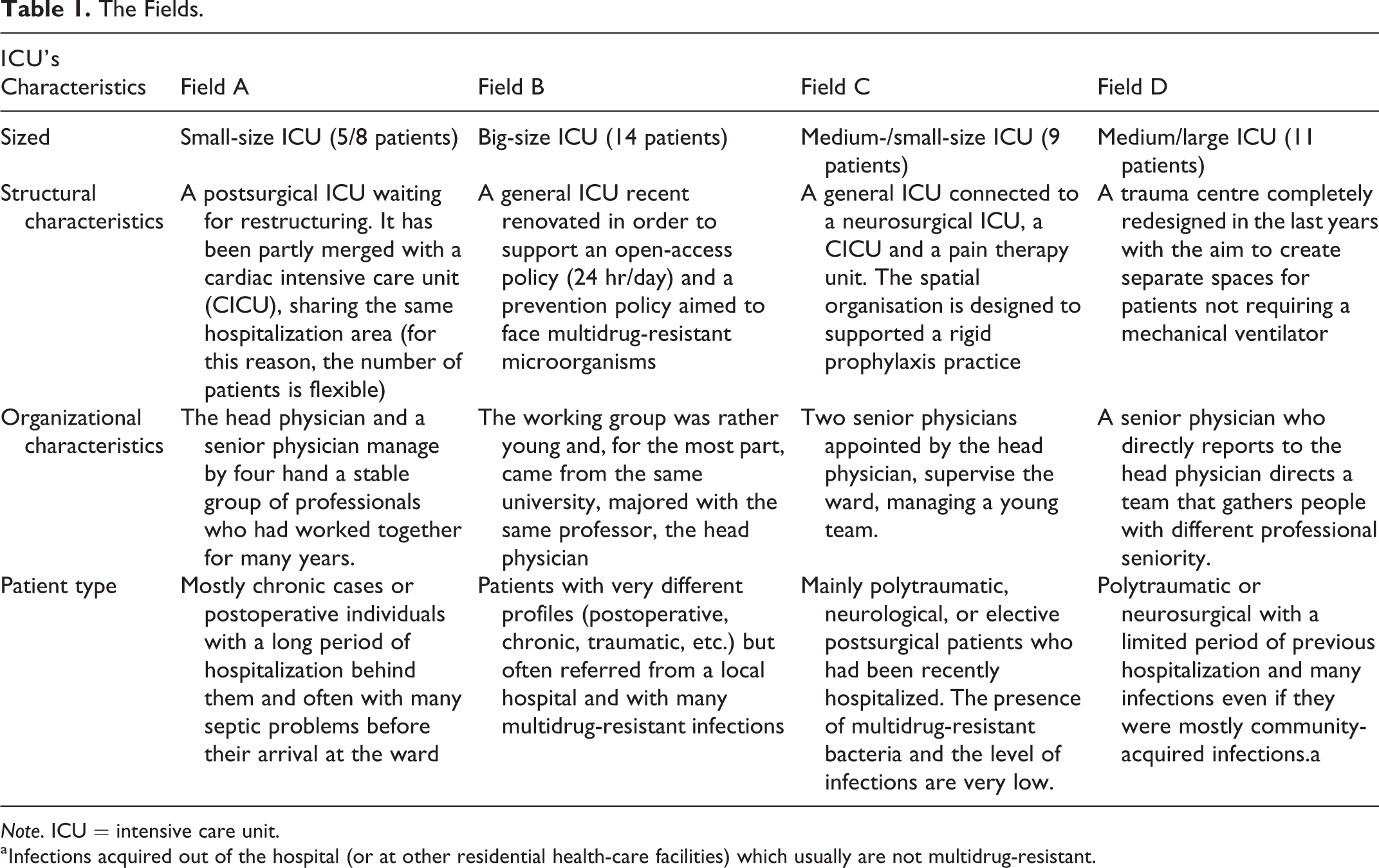
Note. ICU = intensive care unit.
a Infections acquired out of the hospital (or at other residential health-care facilities) which usually are not multidrug-resistant.
In order to collect the data, the researchers spend 3 weeks in each field and videotape every meeting in which the patients’ conditions are discussed by the teams. All the physicians involved in the research and the patients’ relatives present in the wards are informed that their participation is voluntary, and a written informed consent is obtained giving them a brief description of aims and method of the study.
The videotaped material is composed by an amount of 26 hr and 47 min of interactions. In order to proceed with the analysis, these videotape data are transcribed by the researchers using a very detailed procedure that faithfully reported participants’ speech including repetitions, hesitations, nonlexical expressions, pauses, speech overlap, and so on; the transcription reports also nonverbal actions (gazes, gestures, etc.) that are relevant for the analysis of social actions (Jefferson, 2004). Then, these transcribed texts are organized in tables (for an example see Table 2) that has: in the first column, an identification number that identifies a specific part of the transcription; in the second column, the speaking person; in the third column, the speech; in the fourth column, a space for the notes of the researchers.
An Example of Transcript Material.

Building the Tool
The Epistemological Basis
In the recent methodological debate, there is an increasing number of scholars who investigate how to integrate different methods because their triangulation increases the validity of the analysis and gains a deeper comprehension of the phenomena. The most part of these scholars focus their attention on the mixing between qualitative and quantitative methods (Bryman, 2006; Fielding & Schreier, 2001). Despite that, in some case, it has been underlined that it may be more appropriate to mix different qualitative methods in order to reach an “in-depth understanding of the phenomenon” (Denzin, 2008, p. 7).
Nevertheless, few of the researchers involved in studies that integrate different methods define the “methodological or theoretical underpinnings and implications of integrative research strategies” (Mason, 2006, p. 10). In our research, we realize that, in order to respond effectively to our research questions, it is necessary to use a method that integrates different qualitative methods. Indeed, we need a method, which allows us to remain faithful to the phenomenon but at the same time guarantees (us) a systematic process of analysis, which is necessary to analyze a large amount of data through the cross-examination of the different researchers involved. For these reasons, we decided to use a method that interweaves the empirical phenomenological method (EPM) with GT, an approach that was previously developed (Mortari, 2002, 2007, 2009, 2010).
In the past, some scholars had underlined the risk of slipping into a “method slurring” connected to the entwined use of GT and phenomenology approaches (Baker, Wuest, & Stern, 1992), but more recently some studies have found a methodologically sound approach for combining these different qualitative methods (Annells, 2006; Lewis & Grimes, 1999). This is coherent with a new vision of qualitative research according to which the researcher becomes an “interpretive bricoleurs” for whom “invention is not only the child of necessity, it is the demand of restless art” and consequently qualitative approaches “become the ‘invention,’ and the telling of the tales—the representation—becomes the art” (Denzin & Lincoln, 2000, p. 1061). Indeed, in some case, GT and phenomenology approaches are entwined by scholars that consider them “complementary for gaining vital” goals that “could be useful for best practice about a phenomenon central to a problem” (Annells, 2006, p. 58). Similarly, in our research, we resorted to this composite method, that can be considered a kind of triangulation, because it allows us to “investigate the diversity” that characterizes a phenomenon that is rooted in the “intricacy and paradoxes” of a complex context, with the aim to produce a “rich, contextualized, and multidimensional theory” (Lewis & Grimes, 1999, p. 686).
In order to deepen the reasons that lead our choice, here we define the basis of the integration of these two qualitative approaches, starting from the description of both these methods. The first source of this method is EPM: In order to apply a phenomenological approach to an empirical research, it is necessary to transform Husserl’s “philosophical epistemological language into an empirical language” (Dahlberg, 2006, p. 18). Indeed, Husserl theorized the phenomenological method for eidetic research, which moves on a radically different plane compared to the empirical research. In order to apply phenomenology in the empirical sciences, it is necessary to take account of its origin, reflecting on the difference between eidetic and empirical science and therefore on the feasibility of the phenomenological concepts that belong to eidetic knowledge. Indeed, when we talk about an EPM, it is therefore necessary to explain how the underlying reasons for the formulation presented are argued.
Phenomenology is the study of phenomena based on the ontological assumption that every phenomenon inheres an essence (eidos) which “has the character of essential necessity, and therefore with a relation to essential universality” (Husserl, 1962, p. 47). From the Husserlian point of view, a research has a scientific value when it captures the essential qualities of the investigated object. Phenomenology is defined as a way able to capture the essence of phenomena and its specificity consists in seeking a rigorous description of the phenomenon in order to bring it to evidence (Husserl, 1962). Hence, phenomenology is a descriptive science: It does not try to explain the genesis of phenomena, but it aims to capture the profile of a phenomenon in its original essence and wonders about the universal essence of things reaching it through an “eidetic reduction” (Husserl, 1962, p. 40), while the empirical qualitative sciences investigate phenomena focusing on their concrete manifestations. This highlights a hurdle in using phenomenology in empirical contexts because they are subjected to continuous variations that are not easy to put in relation with the world of invariance, which is the object of interest of phenomenology. Anyway, a reflection on the possibility to connect these two shores can start from the Husserl’s affirmation according to which the task of phenomenology “is to clarify the sense of this world, precisely the sense in which everyone accepts it” (1983, p. 420). Indeed, in order to discover the sense through which people accept the world, we must disclose the sense through which people accept the phenomena that make them experience the world. Actually, people experience the world through the concrete manifestations of the phenomena. For these reasons, a bridge between phenomenological approach and empirical research, therefore a bridge that provides the possibility “to resolve the crisis and bridge the existing gap between research and praxis” (Giorgi’s, 2006b, p. 87), seems to be feasible. This bridge is embodied by EMP, that is, a qualitative empirical approach aimed to explore a phenomenon through the investigation of the meanings that people ascribe to the phenomenon itself in relation to the practices that they act (Aspers, 2009). This way of investigating the world implies to pay attention to the “visible profile of things” integrating it with the “hidden one” (Mortari & Tarozzi, 2010, p. 19) because it is focused on defining the concrete “facts” that an essence assumes in its contingent form—“which is defined by the characteristics that outline the profile of a phenomenon in its factual and therefore finished manifestations”(Mortari, 2010, p. 17)—and on “analyzing the meaning that such facts assume for the subjects and the way in which their consciousness intends those objects” (Mortari & Tarozzi, 2010, p. 18). This makes phenomenology a “style of thinking” (Merleau-Ponty, 1962, p. 8), valuable for informing qualitative empirical research because it offers “sophisticated and effective instruments for a descriptive practice that represents a fundamental standpoint from which to access the qualitative exploration” of the world (Mortari & Tarozzi, 2010, p. 15). Nonetheless, at the same time, it leads researchers to be aware that the existence of “things” does not imply that their meaning exists independently from our consciousness (Crotty, 1998).
In order to achieve this heuristic function, it is essential that EPM research actions are accompanied by a specific epistemic thought that must be made explicit (Hein & Austin, 2001; Mortari & Tarozzi, 2010). Indeed, right because the mediation “between the fundamental concepts of philosophical phenomenology and the practices of sound scientific research” is “not […] easy to be accomplished,” it is necessary to reserve a specific attention to the “frame of mind” that illuminates it, that assumes the shape of a way to look at the world (Giorgi, 2006a, p. 360). The nature of this way of looking at is strictly connected to the aim of EMP which is to examine a phenomenon starting from data that embody what happens in the real context where the phenomenon occurs. In order to do this, EPM “operationalizes” phenomenological concepts in order to achieve a way able to bracket the preconceptions (Moustakas, 1994) but this is not possible except starting from the fundamental epistemic move of phenomenology: epoche. Epoche is a self-meditative process through which it is possible to bracket the comprehension about the investigated phenomenon, in order to remain faithful to its essential qualities and putting thus into effect the principle of faithfulness to the phenomenon (Husserl, 1962). Concretely within the EPM framework, epoche is embodied by the research of a “temporary suspension of all existing personal biases, beliefs, preconceptions, or assumptions in order to get straight to the pure and unencumbered vision of what a thing “essentially is” (Sanders, 1982, p. 355). This description makes clear that, despite its importance, epoche is a mental attitude difficult to carry out. The EPM deals with this problem affirming that a qualitative empirical research based on phenomenology should embody “an attempt to return to the immediate meaning and structure of behavior” but that there isn’t a predetermined way to achieve this goal (Van Kaam, 1966, pp. 28–29). This means that an EPM researcher should find his or her own way to put in act epochè and that he or she should find his or her own way to analyze the data in order to reveal the “shape” of the original given, starting from the characteristics of the specific research problem he or she is facing. Indeed, we can see that systematic methods to analyze data have been developed within the phenomenological perspective. Amedeo Giorgi has created an analysis method that, even if it could be applicable to other human sciences, is particularly useful to gain a phenomenological psychological analysis because it lays its foundations in a reflection that investigates the intersection between philosophy, science, and psychology (Giorgi, 2009). In the development of his analysis’ method, Giorgi shows how it may be necessary, in order to effectively grasp the meaning of a complex phenomenon, to adjust the phenomenological approach, respecting its epistemological pillars and at the same time adopting a creative perspective (Giorgi, 2009).
The second source of this method is GT: It has the aim to catch the essence of a phenomenon producing a theory that “fits with reality” (Strauss & Corbin 1990, p. 426) following a systematic and exhaustive procedure that develops a detailed and accurate description of the investigated phenomenon avoiding the risk of excessive simplification (Glaser & Strauss, 1967; Strauss & Corbin, 1990). The GT is not considered as a fixed method but, on the contrary, as a flexible analytic guideline that can be adapted according to the necessity of the research problem in order to avoid an excessive rigidity that would divert it from the naturalistic epistemology of which it is a branch. Nevertheless, it is clear that it is characterized by a very precise and organized structure that provides an important reference for the empirical researcher who chooses this method (Strauss, 1987; Charmaz, 2005).
The strong point of GT contrasts with what was said before about the EMP: While EMP gives very few practical clues to an empirical researcher, GT proposes a very precise and detailed procedure that guides the researcher during the empirical phase. This shows how the blending between these two methods would lead to fruitful outcomes, and moreover, this methodological weave is legitimized by the fact that the heuristic principle at the basis of the two methods is quite similar, that is, to remain faithful to the qualities of the investigated phenomena. EPM considers that faithful descriptions are nodal to produce a theory able to describe the observed experience, while GT states something similar affirming that it is fundamental to remain grounded in the data in order to generate a theory that fits the phenomenon. This interwoven has enabled us to obtain a method that, on one side, gains a direct contact with the original givenness bracketing the preconceptions and on the other side builds a systematic process of analysis thought different steps that allows to build a coding able to faithful describe the observed phenomenon.
We certainly do not want to affirm that the use of a method of analysis that integrates the EMP and GT is possible under any conditions or terms or that this graft is free from possible negative consequences if not carefully designed. The first element to be taken into consideration that requires a certain caution concerns the paradigm on which GT is based: GT has traditionally been placed in a positivist or, according to some perspectives, post positivist inquiry paradigm (Hall, Griffiths, & McKenna, 2013) and “elements of postmodern thought are evident in evolutionary movements regarding Grounded Theory method” (Annels, 1996, p. 391). Nevertheless, “Grounded Theory has an evolving fit to the constructivist paradigm of inquiry” (Annels, 1996, p. 391), and the most recent interpretations of GT insist on the fact that “pragmatism and symbolic interactionism are fundamental to GT” and commit to the idea that “the researcher is the analytical instrument” and encourage “the use of memos to reflect on interactions and findings” relating to a constructivist approach (Hall et al., 2013, p. 21). At this regard, Corbin (2009) affirms that “it would be better to think to Grounded Theory as a compendium of different methods” and that “each version of Grounded Theory method [have] its own philosophical foundation” while they share “some common procedures” (p. 41). These statements make it more understandable how, starting from a version of the GT that is not traditionally understood, it is possible to make an engagement between EPM and GT. The second element regards the complexity involved in a blending method that interconnects EPM e GT: Indeed, if on one side its being multisided allows to investigate issues characterized by a high complexity; on the other side, this characteristic, because of its establishing numerous steps and recursive procedures, is something that can make the work of analysis particularly challenging and time-consuming, especially when the data analysis handle a large amount of data. This consideration makes clear that, in order to be properly allayed, this method should involve, as in this case, not only a single researcher but a research group characterized by constant dialogical interchanges (Table 3).
The Empirical Phenomenological Method and the Grounded Theory.

In the case of this study, the choice to use a blending method that interconnects EPM e GT is due to the fact that the topic under investigation is characterized by a high complexity and requires a multisided tool to achieve a faithful and detailed description of the phenomenon.
In regard to the data gathering, even if the use of conversations’ transcriptions is more common in other kind of methodological framework, it can be adopted in researches based on a phenomenological approach because the data for these studies are “anything that is able to describe the qualities of experiences that were lived through” (Holloway & Todres, 2003, p. 348); whereas, in regard to GT, as Glaser states “GT works with any data—’all is data’—not just one specific data” (Glaser & Holton, 2004, p. 12). In this specific case, the transcriptions of the ICU team meetings are coherent with the aim to remain as much as possible faithful to the original essence of the phenomenon.
Step-by-Step
Here we present a punctual description of every phase of this method, in order to make clear the process through which it has been effected. Therefore, we present the goals of each phase, the actions implemented to reach them and the output through which these goals are reached.
Step 0—The overall knowledge of the research material
Step 0 is aimed to gain an overall knowledge of the research material: In order to reach this goal, the research group repeatedly read the transcriptions gaining a familiarization with the material, which is necessary for the analysis. This step reechoes what has been affirmed by Giorgi (1975) about the necessity to grasp the overall meaning of the data in order to provide a context for the emergence of specific units of meaning.
The Step 1—The developing the provisional coding
The goal of Step 1 is to develop the provisional coding characterized by descriptive labels. This step is related to a phenomenological analysis because, in order to produce labels, it divides the transcription into units of meaning and then repeatedly reads them in order to gain the essence of the meaning expressed in the unit (Giorgi, 1975). Nonetheless, it is also related to open-coding GT because in it the “data are broken down analytically” in order to gain a deeper comprehension of the data themselves (Corbin & Strauss, 1990, p. 423). The aim of this step is to identify the specific quality of every conversational moves from its communicative intention (seeking information, appraisal, ask, nod, etc.) 1 developing a brief description for each one. The researchers firstly work individually, analyzing all the transcribed texts and generating descripting labels, and then compare the labels that everyone had developed, examining the descriptive alignment and interpretive dissonances between them. To find distinct labels is extremely complex, and how this challenge is experienced and dealt with is an important heuristic object that deserves to be documented for making the process of analysis transparent. In order to keep track of it, every researcher writes reflexive notes in the Life of the Mind diary that describes the cognitive experiences that accompany the labeling work (Mortari, 2007, 2008, 2009). (Table 4).
An Example Piece From the Life of the Mind Diary.
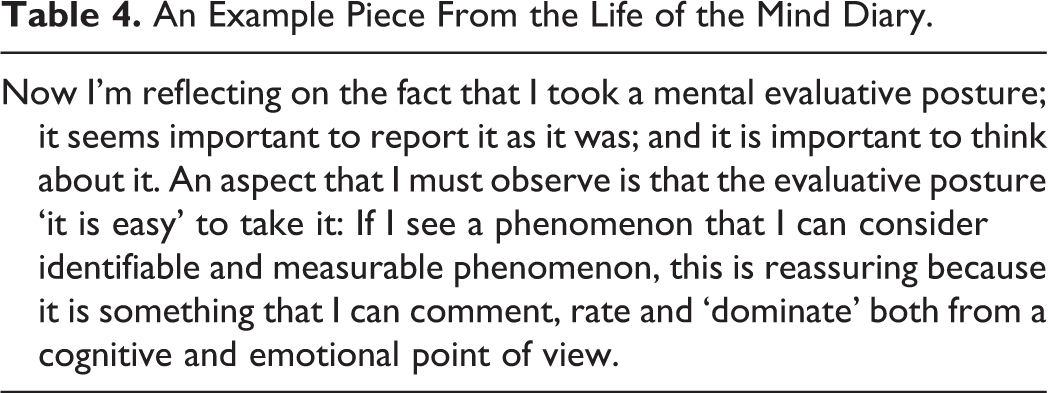
The diaries, deriving from the phenomenological approach, are essential to discover the difficulties inherent in achieving a labeling.
The Step 2—The involvement of the experts
The creation of the provisional coding discloses that some parts of the text have not found appropriate labels, and the Life of the Mind diary reveals that often it happens because the researchers, who have not a medical background, are not sure to have correctly understood the meaning of the exchanges. Starting from these considerations, the Step 2 is aimed to solve this problem through the involvement of health professionals in the discursive data analysis.
These sessions begin with the joint reading of a transcribed meeting in order to bring to their mind the “moment” which is the object of our attention. The researchers read the transcribed texts with the speakers of the conversations themselves (physicians and nurses coming from ICUs involved in the research) and often “integrate” this joint reading using other materials collected during the observation’ sessions (the videotaped meeting from which the transcriptions are derived, the clinical story of the patient, etc.) in order to bring to their mind the moment which is the object of attention. Then, the researchers come back to the transcriptions and ask to the health-care professionals to disclose the meaning that underlies the discursive exchanges, in order to bring out what they really mean. This happens through questions that have the aim to reveal coding to be not only appropriate but also clear coding to be not only appropriate but also clear the achievement that they were trying to reach through their words (“what do you mean when you say X,” “what are you trying to achieve saying X,” etc.), (Table 5).
An Example of Analysis.

The considerations emerged during these consultations, reported in a specific note session, allow to revise the coding adding some labels and modifying others, in order to make the coding as close as possible to the profile of the phenomenon.
The Step 3—The redefinition of the coding
In Step 3, the coding so obtained is redefined through a recursive process to verify the capacity of the coding to describe every discursive action in an adequate and effective way because the previous step had revealed the difficulty of finding labels that precisely defined the quality of the discursive acts. In order to do this, the researchers separately applied the coding obtained after the consultation sessions with health-care professionals to the transcribed texts and then compare them. The aim of this phase is to redefine the labels testing the descriptive adequacy of the labels and achieving a faithful conceptualisation of the different discursive acts, close to the original profile of the phenomena. These comparison sessions are repeated until the researchers found a shared and appropriate conceptual label for every conversational move analyzed without overlaps. This is a reflexive and demanding work that requires on the part of the researchers a deep cognitive effort, and it is also a time-consuming process, but it is essential because only a repeated comparative analysis would ensure that the principle of achieving faithful descriptions of the object was followed (Mortari, 2002, 2007, 2009).
TheStep 4—The “tuning” of the coding
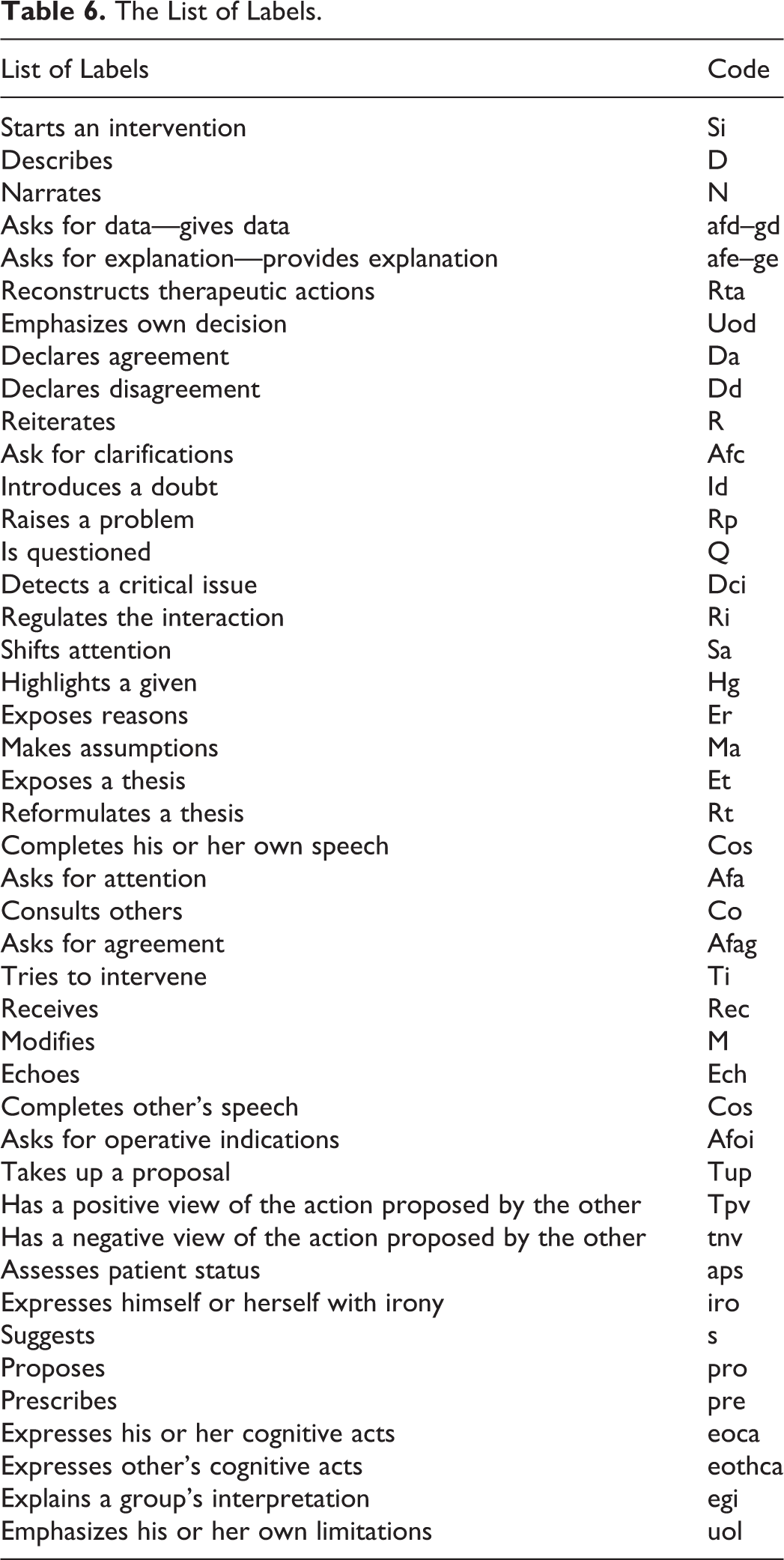
The aim of Step 4 phase is to test its capacity to capture the qualities of the discursive actions in different critical care contexts. In order to this, the researchers cooperatively apply the revised coding to all the transcribed material belonging to the four ICUs involved in the research intervening renaming some labels when they notice that one are not able to describe with sufficient clarity and precision the specific action that has been identified. This “tuning” allows the coding to be not only appropriate but also clear. Below is the list of the identified labels, flanked by a code, that are used in this stage of labeling (Table 6).
The List of Labels.
The Step 5—The categories
While identifying labels is the first step to building a descriptive theory of a phenomenon, the granularity of data produced by such labeling sometimes impedes its understanding. Therefore, these descriptive grains (labels) must be organized in a system of order because the production of categories constituted the first level of formalization of the theory. The aim of the Step 5 is to organize the labels into categories each of which refers to a specific “macro-discursive action.” This phase is related to the purpose of the phenomenological analysis because it is connected to the development of a description able to define different aspects of the phenomenon (Denzin & Lincoln, 2000; Marton, 1996; Mortari & Tarozzi, 2010) but, at the same time, it refers to the GT by virtue of the fact that the definition of the categories which emerged from the data is one of the key steps of the GT analysis (Corbin & Strauss, 1990).
In order to complete this step, the labels are regrouped into categories (second-level labels) with analogous types of text units, and they were then placed into homogeneous sets, producing a list of categories that characterized the qualities that mark the different discursive profiles. The next chart describes the different categories of labels developed in this study (Table 7). Each category shows a region of the investigated phenomenon and is characterized by a distinctive color that is functional to the next stage of the analysis (Table 8). Once the coding system was appropriately developed, the researchers reanalyze all conversational sequences.
The Categories.

The Final Coding.

Step 6—The focused analysis
In Step 6, the final coding system is applied to all conversational texts for an extensive material analysis following a new structure for the organization of the data. Columns are added to the transcript—one each for every speaker involved in the meeting. These columns carry the labels indicating the various conversational acts, along with color corresponding to the label category. All the transcribed texts are analyzed using this model, and, after that, the researchers focused their attentions on the sequences that contained deliberative matter. They observe the connections between the deliberative acts and other discursive actions because this allows to describe what happens in different contexts when a decision is reached and how different discursive actions impact on the deliberative acts, shaping different ways to develop DM processes (Table 9).
An Example of Analysis.

This second level of mapping immediately clarified the distribution, the frequency, and the variety of the various acts as well as the discursive profile of each speaker (Mortari, 2002, 2007). These data are examined, compared, and conceptualized: This heuristic action constitutes the second level of extraction in the process of inductive theory because this analysis allows for “the structuring of the gradual process of interpretation and systematization of data” (Mortari, 2014, p. 15).
Finding and Conclusion
The Methodological Achievements
From a methodological point of view, this research gains an occasion to test the efficacy of a method that interweaves EPM and GT, developed in previous studies (Mortari, 2002, 2007, 2009, 2010), allowing to describe step-by-step how a research team apply it. This can be considered a “meta-research achievement,” because the study not only made possible to answer the research questions, but at the same time it takes a closer look at the way in which researchers act one of the crucial moments of the research, the analysis.
Indeed, the article opens a window on this phase revealing the path the researchers follow to achieve finding, showing the difficulties they face during the analysis but also how they overcome them. This allows us to show how the epistemological principles that lead this method have been applied to the hurdles that arise in practice during the analysis, in order to guide researchers toward solutions that are both effective and methodologically founded.
As stated, this study follows a phenomenological-grounded route, and this means that the researchers needed to firstly understand the meaning of sentences (content analysis) and then ascertain the discursive function of the operation (formal analysis) and this makes necessary to elucidate the possible relationship between description and interpretation.
Cohen and Omery (1994) pinpoint in the history of phenomenological philosophy three different approaches: (a) the “Eidetic Phenomenology” (p. 137), (b) the “Hermeneutic Phenomenology” (p. 146), and (c) the “Dutch Phenomenology” (p. 150). The aim of eidetic phenomenology is to “uncover and describe the fundamental structures of our life-world.” The tool that, according to this perspective, is able to gain access to the essence of phenomena and describe their essential structures is eidetic reduction (Cohen & Omery, 1994, pp. 137–138). Instead, the aim of “Hermeneutic Phenomenology” is “different” because its goal is the “discovery of meaning that is not immediately manifest to our intuiting, analysing and describing'' going “beyond what is given directly”. In order to do this, it doesn’t use eidetic reduction but interpretation because it is what can lead to use “the ordinary, everyday given” as a “clue for meaning that are not given, at least explicitly” (Cohen & Omery, 1994, p. 146). The “Dutch School” merged the previous approaches combining “features of descriptive and interpretive phenomenology” with the aim to reach a deeper knowledge of phenomena (Cohen & Omery, 1994, pp. 149–150). This articulation seems based on the assumption that description and understanding are two acts that can exist separately. On the contrary, the practice of research shows that it is not so: A rigorous research needs descriptions, and a description of the quality of an utterance presupposes the understanding of the content of the utterance. Following the phenomenological-grounded method (Mortari, 2007), the essential quality of a sentence must be synthesized in a label, but before performing this analytic operation (or encoding), it is necessary to achieve consensus about the content (Gadamer, 1989). At this point, the quality of the utterance can be described both in terms of content and discourse function. Thus, our practical research experience shows that there is no opposition between description and understanding.
On the basis of these considerations, we empirically confirm Heidegger’s theory that the logos of phenomenology have “the character of ermhneúein” 2 —of interpretation of a phenomenon (Heidegger, 1976, p. 58). Consequently, phenomenology is hermeneutic—a method that makes possible the understanding of things. Thus, a phenomenological research process should aim to understand what a certain phenomenon means, and for this purpose, it must combine description and interpretation. One of the challenges of this process of analysis is that it is time-consuming. However, it must be like that both from an epistemological and an ethics point of view. Research, especially when it involves the construction of meanings and draws on the living experiences of stakeholders, requires the use of an inductive procedure, characterized by slow progresses. The codes emerge from the words, and the coding is built through a recursive path: When labels extracted from the analysis of a unit do not seem consistent with the next one, the researcher has to return to the previously analyzed material and refine the labels. This recursive step ensures complete faithfulness to the words. Therefore, the strength point of this interwoven method is that it uses a rigorous and systematic process that is particularly suitable when a team collaboratively works together on the same analysis, to go deeper into the qualities of an (complex) observed phenomenon, combining description and interpretation. On the contrary, its weakness point is that it is indubitably time-consuming.
Anyway, a study that wants to analyze a phenomenon from an empirical perspective must be aware that the time needed to accomplish this aim is considerable: If the results of an analysis are quickly obtained, these may be symptoms of a search that has undermined the true complex and dynamic nature of the task.
The DM Process
The analysis of the transcripts has led to the development of discursive profiles for the four ICUs when they are involved in a DM process, clarifying what speech acts characterize the communicative exchanges that led the team to the deliberative act. The analysis also identifies the individuals within the teams who actually express deliberative acts and the discursive style that characterizes the leader (Table 10).
The Discursive Profiles.

a A senior physician to whom the head physician had assigned the responsibility of running the ward.
These findings seem to interact with the researches that investigate the theme of bounded rationality and leadership in critical care contexts. In regard to bounded rationality, this is the cognitive process that physicians put in action when they must make a decision even if they do not have all the information that would be necessary. It is the ability to make choices based on approximations that takes into account the limitations of complex environments and allows to use clinical experience as a heuristic device able to light up situations characterized by a high level of complexity and urgency that cannot be solved by simply applying clinical protocols (Angnus, 2016; Abbott, 2004; Gorry & Morton, 1971; Hall, 2002; Hey, 2016; Simon, 1979). In regard to leadership, some studies have underlined that a leadership style characterized by a hieratic approach reduces the involvement of the physicians in the DM, with potential negative consequences on clinical outcomes. On the contrary, if the leader involves the team in a shared situational awareness, this leads to a more effective DM process (Ezziane, et al., 2012; Reader, Flin, & Cuthbertson, 2011; Rouse, 2009; Srivastava, 2013).
About these topics, our findings reveal that meta-reflective acts can be used to show to less experienced physicians how their bounded rationality “works” involving them in a reflective environment and supporting the development of their critical thinking. The findings also highlight how developmental and problematic acts can be used by the leader to reinforce physicians’ engagement in the DM process. On the contrary, a leader who often uses normative acts reveals the presence of a no-shared DM environment.
Moreover, this research produces a tool of analysis (the coding, see Table 7) useful to analyze the discursive actions in an ICU setting, highlighting the role of the various discursive acts in a conversational flow and minimizing the distance between description and meaning. This tool can be used in an in-service physicians training program in order to show them that their discursive practices are related to their cognitive and leadership patterns influencing the building of an attending patient community and that the use of specific discursive acts can facilitate DM. This training experience allows physicians to see their actions from a different perspective, showing them what kind of discursive practices emerge when they take a decision. According to this aim, the in-service training program starts with a presentation of the coding system, that illustrates to the physicians the characteristics of every label (or rather, of every discursive act) making them able to use the coding system autonomously and to see the patterns that link together different labels. Afterward, the physicians are involved in a shared data analysis’ session on the basis of significant pieces of transcribed interactions with the aim to reveal the role of different discursive acts in the achievement of a clinical decision. This action allows physicians to discover the recurring dynamics related to their cognitive and leadership patterns revealing how these have an impact on DM processes and developing, in the meanwhile, their reflective and critical eyes about these themes.
Hence, our findings can have a role in the debate aimed to discover the best method to improve physicians’ reflective and critical capabilities, essential to manage DM in contexts in which the truth of a certain element assumes a degree of probability rather than certainty, through the use of simulations (Bates & Young, 2003; Flin et al., 2007; Maran & Glavin, 2003; Moorthy, Munz, Adams, Pandey & Darzi, 2005).
Footnotes
Authors’ Note
The responsibility of single paragraphs should be attributed as follows: to Luigina Mortari section 1 and section 2.1; to Roberta Silva paragraph 2.2 and paragraph 3. The data collected for this study comprised audio- and video-recorded meetings between the physicians of four ICUs. Thus, field notes were also used in to supplement video-based observations. The study did not involve any action that might influence any medical interventions. All the participants were informed that their participation was voluntary, and each of the participants signed an informed consent form.
Acknowledgments
The authors would like to thank all the members of the research team who provided insight and expertise that greatly assisted the study and all the staff of the ICUs involved in the research.
Declaration of Conflicting Interests
The author(s) declared no potential conflicts of interest with respect to the research, authorship, and/or publication of this article.
Funding
The author(s) disclosed receipt of the following financial support for the research, authorship, and/or publication of this article: Funding for this study was provided by the Italian Group for the Evaluation of interventions in Intensive Care Units (GiViTI), a network that connects more than 150 Italian ICUs, related to the Research Institute “Mario Negri,” which is a nonprofit organization.
