




Abstract
The use of theory in science is an ongoing debate in the production of knowledge. Related to qualitative research methods, a variety of approaches have been set forth in the literature using the terms conceptual framework, theoretical framework, paradigm, and epistemology. While these approaches are helpful in their own context, we summarize and distill them in order to build upon the case that a balanced and centered use of the theoretical framework can bolster the qualitative approach. Our project builds on the arguments that epistemology and methodological rigor are essential by adding the notion that the influence of theory permeates almost every aspect of the study—even if the author does not recognize this influence. Compilers of methodological approaches have referred to the use of theory as analogous to a coat closet in which different items can be housed or a lens through which the literature and data in the study are viewed. In this article, we offer an evaluative quadrant for determining the appropriate use of theory in qualitative research and a diagram of the qualitative project that points to the central role of a theoretical framework. We also caution against the overreliance on theory in the event that it begins to limit the ability to see emergent findings in the data.
Keywords
What Is Already Known?
Among the widespread definitions for a theoretical framework, we distill them to mean an explanation of the way things work. The source, size, and power of those explanations vary, but they all link back to an attempt to understand some phenomena. As Anfara and Mertz (2015) have described, scholars have varied perspectives about the use of theoretical frameworks in qualitative research. The following article endeavors to summarize and present variations in usage and understanding. Currently, the use of theory in qualitative approaches has included (1) clarification of epistemological dispositions, (2) identification of the logic behind methodological choices, (3) building theory as a result of research findings, and (4) a guide or framework for the study. Furthermore, methodological dispositions on the reflexive symbiosis with theory and other parts of a study are included to set the stage for focusing on the theoretical framework.
What This Article Adds?
This project explores the role of theory in qualitative research and presents an overview of different approaches to theory. We examine previous work on the conceptual framework, consider epistemology and the selection of theory, cases and coding, and then present tools for implementing theory in research. This article builds upon existing notions of the use of theory in qualitative research that have primarily emphasized theory in understandings of methodology and epistemological dispositions by advocating for a clearer use of a theoretical framework. We synthesize previous literature to advance the idea that a strong theoretical framework can allow the researcher to reveal existing predispositions about a study and assist in data coding and interpretation. This modest proposal is balanced by the recognition that overreliance on a theory can produce other types of problems. We include a theory/method quadrant (Figure 1) to demonstrate and clarify the importance of the relationship between theoretical framework and methodology and highlight how the theoretical framework can be integral to the qualitative process (Figure 2).
The first part of the article provides background by presenting a brief overview of knowledge production, reflexivity, and the use of theory in qualitative research. Sections on the confounded conceptual framework, epistemology, and coding are used to highlight various portions of the research process that can be interwoven with the theoretical framework. The last two sections offer some concrete ways to visualize the potentially central role of theory as well as some cautions around limitations for overreliance on theory.
Introduction
The purpose of this article is to examine and advance the role of the theory as a device in the qualitative toolbox—an admittedly pragmatic premise. We review the various ways in which theory has been considered in qualitative methodology publications and highlight the ways in which a central role for theory can be useful for a study. Our developmental perspective is most useful for those who may not have fully considered the value of theory. We present theory as symbiotic with our actions and dispositions. Each section of this article works to modestly clarify the role of theory while avoiding the perception of a methodological orthodoxy around the tool.
Theory, theoretical frameworks, theory of method, and conceptual frameworks are terms that have blurred lines within qualitative methods literature and either suffer or benefit from widespread nuanced differences. In general, a theory is a big idea that organizes many other ideas with a high degree of explanatory power. Theory of method (or methodology) provides guidance to make sense of what methods will actually help answer the research questions. A conceptual framework is loosely defined and best functions as a map of how all of the literature works together in a particular study. A theoretical framework is the use of a theory (or theories) in a study that simultaneously conveys the deepest values of the researcher(s) and provides a clearly articulated signpost or lens for how the study will process new knowledge. A theoretical framework is at the intersection of: existing knowledge and previously formed ideas about complex phenomena, the researcher’s epistemological dispositions, and a lens and a methodically analytic approach
Working through these three components renders theory a valuable tool to the coherence and depth of a study. Although there may be instances where the exploratory nature of a study overrules the benefits of a theoretical framework, theory-free research does not exist (Lincoln & Guba, 1994). A researcher who cannot articulate a theoretical framework may not have done the difficult and essential work to unearth their deepest operating principles and preconceptions about their study. The belief that preconceived notions do not exist or impact a study is, in fact, a theoretical disposition. This article maps the advantages of a theory-centric approach to qualitative research, while also considering the critiques and disadvantages of overreliance on a theory.
Theory and Knowledge Production
There are debates in all disciplines about the creation and use of theory and the degree to which starting from data (induction) or with a hypothesis (deduction) are more useful for knowledge production (cf. Hanson, 1958; Peirce, 1935). Consider a science that relies more upon inducting from data as opposed to generating a hypothesis. A potential lean away from deduction led Hanson (1958) to use physics to highlight the complexity of generating a hypothesis like universal gravity or acceleration even in the absence of evidence. The essential role of deductively formulating these ideas by Galileo and Newton were important in the knowledge production process. This poignant historical example was used to highlight the importance of balance between the role of theory and hypothesis and starting with data. Moving from natural science to social science and qualitative research, we acknowledge and take into account advanced discussions about how theory can be generated. For example, Timmermans and Tavory (2012) build on Peirce (1935) and Hanson (1958) to move beyond an inductive/deductive binary to consider abduction in grounded theory in order to enhance the potential ability for research to lead to innovative theories. Abduction is the creative process of generating new theories based on “surprising research evidence,” which ultimately leads a researcher away from old ideas to new insights coded into theory (Timmermans & Tavory, 2012, p. 170).
Even in traditional grounded theory there is a “reluctant engagement of theory” and the use of abduction advocates for a shift away from that hesitancy: Abduction thus depends on the researcher’s cultivated position. The disposition to perceive the world and its surprises—including the very reflection on one’s positions in this world—is predicated on the researcher’s biography as well as on an affinity and familiarity with broader theoretical fields. Abductive analysis, consequently, rests for a large part on the scope and sophistication of the theoretical background a researcher brings to research. Unanticipated and surprising observations are strategic in the sense that they depend on a theoretically sensitized observer who recognizes their potential relevance. (Timmermans & Tavory, 2012, p. 173)
The pathway leading back to positionality is the net that captures the combination of epistemology, ontology, and methodology, which Guba (1990) calls a paradigm or interpretive framework, that is, a set of fundamental beliefs that guide action. Denzin and Lincoln (2011) offer the most comprehensive connections between paradigm/theory, criteria, form of theory, and corresponding method or type of narration (this arrangement builds upon previous work by Guba & Lincoln, 1994). A paradigm is an inclusive concept that captures the embodiment of theory and the necessity of reflexivity in researchers.
Reflexivity and Embodiment
Theory can live within us and emerge from our lived experiences, moving “from our lips to the streets” (Zita, 1998, p. 207). We resonate with the following expression of gratitude by hooks (1991) for those theory makers who have risked exploring and disclosing painful lived experiences: I am grateful to the many women and men who dare to create theory from the location of pain and struggle, who courageously expose wounds to give us their experience to teach and guide, as a means to chart new theoretical journeys. Their work is liberatory. (p. 11)
Whether a commonsense theory, a scientific theory, or a conspiracy theory, theories attempt to explain phenomena logically and meaningfully, often following narrative structures, and in this way “theories are stories” (Goodson, 2010, p. 11). Therefore, the use of theoretical frameworks should seek to provide opportunities for scholars to “discover their own voices, along with the intellectual resources to construct theories that seek to emancipate, rather than control” (Georges, 2005, p. 55). There is an intricate relationship between researcher subjectivity (beliefs and interpretations about the world) and reflexivity (ability to see, know, and contemplate subjectivities; Bott, 2010). In order to examine the role of the theory, we also know that our ability to engage in a meta-examination is filtered by our own beliefs about the world.
Collins
My operating system is rooted in the Social Construction of Reality (Berger & Luckmann, 1966). The notion that habits become routines and that routines become legitimated knowledge is an essential component of a socially constructed reality. A pinnacle of legitimacy is the existence as an accepted reality. Competing definitions of reality must be either incorporated through assimilation or eliminated through annihilation. The act of nihilating is an action of violence imbedded in the dynamics of power, oppression, dominance, and inequity. As such, the social reproduction of reality is a powerful force. Because systems, processes, definitions, and identities are socially constructed, it is important to understand how they can be deconstructed.
I identify as a White straight male. The singularity of gender, sexual attraction, and race carries an enormous weight of ontological force. Because of the power of normativity, I constantly hold in tension my own existence with understanding the world through critical perspectives. In this way, my understanding of reality and my existence within that reality will never be fixed or stable. My own supremacy is akin to a virus that mutates for survival, and my ability to participate in a critical social science requires a constant attention to my natural inclination to defend dominance (Collins & Jun, 2017). I resonate with Denzin and Lincoln’s sentiment (2011, p. 11): “We want a social science committed up front to issues of social justice, equity, nonviolence, peace, and universal human rights.” Building from there, Kincheloe, McLaren, and Steinberg (2011) define a criticalist as someone who uses research or theory with social/cultural critique and accepts basic assumptions, including:
– All thought and power relations are socially and historically constituted.
– Facts cannot be separated from values or ideology.
– The relationship between concept and object or signifier and signified is not fixed and is understood through conditions created in capitalist production and consumption.
– Dominance and privilege exist in service to benefit some groups while subordinating others.
– Mainstream research practices are often implicated in the reproduction of class, race, gender, oppression. (paraphrased from sections on p. 164)
The complex layers of dominance in my identity and my role as a researcher shape a vantage point within my web of reality. This is a cornerstone in my critical search for social structures that reproduce power and undermine equity. Any method I use to untangle this web cannot be separated from my view of reality—thus making ontology, epistemology, and theory inextricably linked “in ways that shape the task of the researcher” (Kincheloe, McLaren, & Steinberg, 2011, p. 170).
Stockton
Like Collins, I operate from a belief that reality and the interpretation of our experiences in the world are socially constructed and that power dynamics must be a significant consideration in the production and preservation of knowledge. Therefore, an analysis of my embodied experience in the world and the power it does or does not afford me is essential to assessing the ways in which I approach the creation of knowledge and the pursuit of understanding. In this view, “the boundary between me as a researcher/theorist and me as an embodied human being” (Davies, 2000, p. 16) is collapsed. My experiences as a White straight woman led me to explore feminist and womanist theories because my lived experiences as a woman have not historically been represented and reflected in much of the historical and current production of knowledge.
I embrace the emancipatory nature of feminism in its advocacy for equality between women and men and celebrate the sacrifices made by many to ensure that the stories of women are nurtured, emphasized, and validated. More recently, however, my increasing understanding of the historic emphasis on whiteness in the feminist tradition has caused me to explore the theory of womanism. When coining the term womanist, Walker (1983) wrote that “womanist is to feminist as purple is to lavender” (p. xii), indicating the need for a more inclusive theory. Womanism has centered the voices of African American women, providing a lens for me to interrogate the mind-set of White dominance that lives within me through their regard for intersectional identities, inclusivity of men in the work, and the importance of spirituality.
In an edited volume, Luttrell (2010) wrote that “research is not a linear process—it is dynamic, unfolding over the course of time, and is contingent on multiple and sometimes unpredictable factors” (p. 10). In that same volume, Luttrell has an entire section on reflexive writing exercises designed to help make the researchers’ thinking more visible. Through those exercises we, as coauthors, were reminded of the unobtainable pursuit of getting it right, but that our efforts may possibly bring our intellectual life, actions, and the pursuit of justice a little closer together.
An Overview of Using Theory in Qualitative Research
A theory, according to Saldaña and Omasta (2018), distills research into a statement about “social life that holds transferable applications to other settings, context, populations, and possibly time periods” (p. 257). These “big truths” have four properties and an explanatory narrative: (1) predicts and controls action through an if-then logic, (2) accounts for variation, (3) explains how and why something happens through causation, and (4) provides insights for improving social life (Saldaña & Omasta, 2018, p. 257). There are at least three primary applications of theory in qualitative research: (1) theory of research paradigm and method (Glesne, 2011), (2) theory building as a result of data collection (Jaccard & Jacoby, 2010), and (3) theory as a framework to guide the study (Anfara & Mertz, 2015). Differentiation and clarification between these applications will aid in further developing the use of theory; this section covers a broad overview from a variety of approaches from generalist qualitative research literature. The variety of approaches presented here serves as background information for a continued discussion aimed at drawing clarity and some new considerations for qualitative researchers.
Discussions of theory in qualitative research relate to the theories that ground a methodological approach (e.g., phenomenology, ethnography, narrative) or the epistemological paradigms that guide a study (e.g., postpositivist, constructivist, critical). Understanding theories that influence methodological and epistemological decisions for a study is critical, but there may be room for more clarification between the use of theories of method and the theoretical framework. Glesne’s (2011) exposition of philosophical frameworks, methodological considerations, and associated theorists is useful for unpacking the varying layers that go into a theoretical framework (cf. figure 1.1 and table 1.1 on pages 7 and 8). “Your task,” Glesne wrote to researchers, “is to figure out for yourself where you stand philosophically and politically on doing research” (p. 16). This approach primarily connects the concept of a theoretical framework to the researcher’s epistemology.
Certain qualitative methodological approaches explicitly call for the construction of a theory from the study’s findings (e.g., grounded theory), but qualitative studies utilizing any methodological choice may result in theory construction (Maxwell, 2013). Saldaña (2015) challenged the notion that theory construction should be the primary type of theoretical thought in qualitative research and urged researchers to consider utilizing the frameworks of noted theorists to guide qualitative studies. Other scholars have articulated the inextricable presence of theory in the process of obtaining knowledge, describing facts as theory-laden (Lincoln & Guba, 1994), and noting the influence of a theoretical lens to arrive at observation statements (Flinders & Mills, 1993).
In our experience of teaching qualitative research in a doctoral program and presenting at conferences, we have observed hesitancy, confusion, and avoidance at using theory as a cornerstone to make implicit assumptions explicit. In a review of published studies in the health field, Green (2014) noted that existing approaches fail to make explicit the theories that guide their research construction and data interpretation. Some generalist qualitative research scholars have recommended the inclusion of conceptual or theoretical frameworks to articulate these theories (Maxwell, 2013; Ravitch & Riggan, 2017).
Maxwell (2013) defined a conceptual framework as a tentative theory about the phenomena being studied that informs entirety of the study’s design, noting that “this may also be called the ‘theoretical framework’ or ‘idea context’ for the study” (p. 39). The use of this theory assists the researcher in refining goals, developing research questions, discerning methodological choices, identifying potential threats to validity, and demonstrating the relevance of the research. The primary source of the conceptual framework, from his perspective, does not necessarily need to be an existing theory. Four primary sources are options from which to derive a conceptual framework: (1) knowledge based on experience, (2) existing theory, (3) exploratory research, and (4) “thought experiments” (p. 44). Maxwell argued that the use of existing theory has potential advantages as well as liabilities and described the advantages utilizing two metaphors: theory as a coat closet or a spotlight. A high-level theory, like a coat closet, can provide a framework through which to organize and connect data. A theory can also shed light on observations and data that might be overlooked or misinterpreted with the spotlight of an existing theory. Two ways researchers fail to use existing theory effectively are, according to Maxwell, to be overly reliant or uncritical of the theory or to fail to use it enough.
Merriam (2009) contended that all research has a theoretical framework that is either explicit or implicit, even in the midst of an inductive approach. Merriam recommended two ways to identify a theoretical framework which she referred to as the “structure, scaffolding or frame” (p. 66) for the study. First, researchers should examine their disciplinary orientation (e.g., education, psychology, sociology), and second, the literature related to their study will inform the identification of a theoretical framework. The recommendation to examine the disciplinary context of the research problem results in a stronger case for the use of existing theories; however, Merriam also includes the use of concepts, terms, definitions, and models in a theoretical framework. Consistent with Maxwell’s assertion, Merriam asserted that every part of a study is informed by a theoretical framework and described the relationship between the research problem at the framework as a “set of interlocking frames” (p. 68).
Anfara and Mertz (2015) addressed the topic of theoretical frameworks in qualitative research quite comprehensively in their recent work. They identified three primary understandings of theory in qualitative research: (1) theory is not important in qualitative research, (2) theory only informs epistemologies and methodologies, and (3) theory is “more pervasive and influential” (p. 11) than methodology alone and should guide many of the researcher’s choices in a qualitative study. Theoretical frameworks are defined, according to Anfara and Mertz, as “any empirical or quasi-empirical theory of social/ and/or psychological processes, at a variety of levels (e.g., grand, mid-range, explanatory), that can be applied to the understanding of the phenomena” (p. 15). This text presents 10 examples of studies that utilize theoretical frameworks to guide the research ranging from Patricia Hill Collins’s Black Feminist Thought to Bourdieu’s Field Theory. Theoretical frameworks provide four dimensions of insight for qualitative research that include: (1) provide focus and organization to the study, (2) expose and obstruct meaning, (3) connect the study to existing scholarship and terms, and (4) identify strengths and weaknesses.
Wolcott (1995) distinguished between the abstract notion of the use theory in qualitative research and the practice of using theory in fieldwork. Accordingly, theory offers five practical benefits that include (1) the convenience of labels, (2) broader perspective when a study is modest in scope, (3) connection to a larger body of data that addresses concerns with generalization, (4) a critical perspective, and (5) disproof by providing negative cases (Wolcott, 1995). As has been demonstrated above, researchers have differed in their views of how theory should be incorporated in qualitative research. Although researchers may be familiar with many of these differing views, our purpose here is to put forth some of the most prolific methodologists and their corresponding notions to make clear the various anchors in the spectrum. We intend for a presentation of the relationship between theory and the more specific aspects of the conceptual framework, epistemologies, and data interpretation to provide context for implementing tools to use theory with increased acumen in qualitative studies.
The Confounded Conceptual Framework
The conceptual framework and theoretical framework are often conflated by students and novice researchers. This equivocation may happen because established researchers have varying perspectives on how conceptual or theoretical components function. In our experience earning doctorates and teaching in doctoral-level methods courses, we have witnessed disagreements. In a recent presentation at the International Qualitative Methods Conference, faculty also reported confusion and disagreement within their departments in fields of health and education. One of our favorite qualitative researchers takes a confounding approach. Maxwell (2013) begins by articulating that the conceptual framework includes “the systems of concepts, assumptions, expectations, beliefs, and theories that supports and informs your research” (p. 39). Then, Maxwell (2013) confounds, or even conflates, the terms conceptual and theoretical by saying, “I use the term in a broader sense, to refer to the actual ideas and beliefs that you hold about the phenomena studies, whether these are written down or not; this may also be called the ‘theoretical framework’ or ‘idea context’ for the study” (p. 39). Similarly, Merriam and Tisdell (2016) added: Yet another point of confusion is that the terms theoretical framework and conceptual framework are often used interchangeably in the literature. We prefer theoretical framework because a theoretical framework seems a bit broader and includes terms, concepts, models, thoughts, and ideas as well as references to specific theories; further, conceptual frameworks are often found in the methodology chapter or section of a quantitative study wherein the concepts and how they are to be operationalize and measured are presented. (p. 84)
The preference for one term over the other does not aid in clarity.
Consider a broader idea about theory as “webs of interlocking concepts that facilitate the organization of empirical material by providing explicit interpretive frameworks that researchers use to make their data intelligible and justify their choices and methodological decisions” (Bendassolli, 2014, p. 166). This understanding is closer to the most cohesive presentation of a conceptual framework across the methodological literature we reviewed. The conceptual framework “Should show how she [the writer] is studying a case in a larger phenomenon. By linking the specific research questions to the larger theoretical constructs or to important policy issues, the writer shows that the particulars of this study serve to illuminate larger issues and therefore hold potential significance for that field” (Marshall & Rossman, 2011, p. 7). Perhaps the best way to display a conceptual framework is to design a visual image or map of how existing ideas in the literature work together.
A variety of scholars have done extensive work on diagraming concepts, themes, and data, which are good sources for enhancing the skill of concept mapping (Albarn & Smith, 1977; Attride-Stirling, 2001). Distilling parameters for the conceptual framework from the literature is an effort in both simplicity and distinction. The literature that shows the conceptual framework as a map of how previous research and literature work together to shape a research project gives the best opportunity to enhance understanding of the distinct role of theory. By harnessing a more specific and simple approach to the conceptual framework, we believe the strength and centrality of the theoretical framework becomes clearer. Beyond the network of concepts from the literature are the guiding constructs of epistemology and theory.
Epistemology and the Selection of Theory
Epistemological and ontological dispositions represent the architecture of how a researcher sees the world and the production of knowledge. Qualitative methods bring clarity to the ways in which these dispositions influence the role of the researcher. Merriam and Tisdell (2016) wrote, “Although it is good to explore your ideas about the nature of knowledge and its construction (epistemology)…this is more often discussed in the section on methodology” (p. 84) because theories of epistemology are not the same as a theoretical framework for a study. Epistemology then influences the selection of theory, and the degree to which the two can work together in the analytic approach to data depends upon explicit connections. Every research study is “informed by a higher-level theory, even though researchers sometimes are not aware of these theories because they are embedded in their assumptions about the nature of reality and knowledge” (Glesne, 2011, p. 5).
Because of the expanse of enlightenment-oriented thinking, the scientific method, and the positivistic beliefs that are inherent in statistical methods, there is, at times, a need for quantitative therapy in order to understand the abilities and advantages of qualitative research. We call it quantitative therapy because it is a process of confronting a fixed mind-set around the creation of knowledge where positivism related to quantitative methods has occupied a concrete mental space. Addressing methodological assumptions of normativity is not only an important first step, but an important way to improve a researcher’s approach to naturalistic observations. Guba and Lincoln (1994) outline the theory-ladenness of facts by explaining that conventional techniques claim to confirm or falsify a hypothesis in a study by taking an objective and theory-independent approach to searching for facts. The assumption underlying the conventional approach is deemed “dubious” because facts and theories are interdependent, which means that facts can only be observed through the lens of a theoretical framework, thus undermining the notion of objectivity (Guba & Lincoln, 1994, p. 107). Put differently, the conventional approach has demanded expertise and preunderstanding but then requires the researcher to follow this expertise with a blank slate when searching for data. This approach could end up leaving researchers feeling or acting with split personalities instead of dual personalities where they are able to balance the nuances of research to “use their pre-understanding but are not its slave” (Gummesson, 1988, p. 65). This idea works in tandem with Maxwell’s (2013) warning that “There are two main ways in which qualitative researchers often fail to make good use of existing theory: by not using it enough, and by using it too uncritically and exclusively” (p. 53).
In a brilliant display of reflexivity, Bott’s (2010) study of lap dancers and migrant workers excavated the divide between personal and professional representation. A primary conclusion of the study is related to the role in which context shapes epistemology and the ways in which class, race, ethnicity, and gender play a role in the context. Bott ends the article by saying the project has shown “how the ‘othering’ of researcher subjectivity by research subjects and how we as researchers feel about those often ‘othering’ appropriations, as well as our own intellectual reactions to them, can affect the empirical, epistemological and ethical concerns of the research” (p. 172). The conclusion and the point are about linking epistemology and research (for a full discussion on the topic of linking, see Doucet & Mauthner, 2002). In essence, epistemology plays a role in the selection of theory, making the two mutually interdependent. The central role of theory comes into greater clarity when the mutual interdependence between epistemology and theory selection is made explicit. Then, the influence on the selection of a case and a framework for analysis flows naturally.
Cases and Coding
There are many ways in which a theory can influence the methodological approach and the boundaries of a study and then later, the analytic approach. For example, case study is one of the most flexible approaches to qualitative research. After the boundaries of a case are defined, the techniques are so broad, some researchers consider the approach undefined—unless there is a theoretical framework: The value of theory is key. Although case studies may begin with (in some situations) only rudimentary theory or a primitive framework, they need to develop theoretical frameworks by the end which inform and enrich the data and provide not only a sense of the uniqueness of the case but also what is of more general relevance and interest. (Hartley, 1994, p. 210)
Rich and thick descriptions are at the cornerstone of qualitative work, but in a highly contextualized case, if there is not a strong framework, the details may devolve into a story that is difficult to transfer to other settings. Furthermore, once data are collected and ready to be analyzed, the organization schemes are often depicted with some renewed sense of magical objectivism by talking about mechanistic coding and the use of software.
Theories make sense of difficult social interactions and phenomena, and articulating a theoretical framework helps the sense-making process to be more explicit. In this way, “theoretical frameworks rely on metaphysical subjectivism in that truth depends on beliefs and is relative to situations and across cultures” (Howell, 2013, p. 23). Take, for example, the in-depth intellectual exercise executed by Jackson and Mazzei (2012). The authors examined how the cycle of putting theory into data into theory can produce new meanings. Using a conventional interview-based study, the authors engaged six poststructural theoretical frameworks: Derrida (thinking with deconstruction), Spivak (thinking with marginality), Foucault (thinking with power/knowledge), Butler (thinking with performativity), Deleuze (thinking with desire), and Barad (thinking with intra-action). As the researcher and the method blends, the centering of the theoretical framework becomes clearer. The practice of applying and plugging different frameworks into a project also reveals different roles of the researcher-actor self. The reflection on the exercise is profound: We not only read the data with Derrida, Spivak, Foucault, Butler, Deleuze, and Barad looking over our shoulder, but we also read with each of us looking over the other’s shoulder…while what we set out to accomplish was to think with theory, how we were constituted in this process of thinking was not fully predicted or expected. What emerged as a result of thinking with multiple theorists and their concepts across the data was not merely exhausting in the sense of fatiguing, it was exhausting in that we were constantly pulled back into the threshold, into the data, into new thinking. We began to think and enact data analysis differently because, once in the threshold, there was no way out. (Jackson & Mazzei, 2012, p. 138)
This reflection portrays a profound intellectual exercise that further highlights the influence of a theoretical framework.
When it comes to coding and analyzing, the connections between the theoretical framework need to be explicit. One way to accomplish this is to list predetermined codes in the analysis section of the methods and clarify for the reader how these codes were generated as a deductive analytic strategy. This will make the inductive strategy even more powerful. Merriam and Tisdell clarified, “The sense we make of the data we collect is equally influenced by the theoretical framework. That is, our analysis and interpretation—our study’s findings—will reflect the constructs, concepts, language, models and theories that structured the study in the first place” (2016, p. 88). The search for the unexpected finding as part of the inductive strategy is also related to the theoretical framework: Rather than being a monolithic and monological set of ideas, theory arises from the dialogue between a theorist and antecedent theories, contexts, problems, cotheorists, and so on, and a theory develops through processes of testing and experimentation (dialogue with research) and of practical application as theorists apply and reflect on the theory (dialogue with practice) and as they elicit and respond to critique (dialogue within a community of scholarship). (Rule & John, 2015, p. 2).
Assessing and Marking the Central Role of Theory
In this section, we move to make some applications of the previous material and offer some simple models to promote thought and discussion on the topic. There is some natural and dialogic tension between several aspects of a qualitative study and most certainly between the method and the theory. In order to generate some intellectual exercises around this tension, we excavated our own research projects and experiences as well as thought about the struggles we have witnessed in educational research settings that use qualitative methods.
When accomplished well, a full commitment to rigorous methods and a theoretical framework can create a kind of tension that produces rich findings. An imbalance between the two will yield more liabilities or weaknesses within the study. In Figure 1, we offer an evaluative quadrant to highlight the importance of method and theory. By way of example, we contend that a low commitment to theory and method (Monthly Report) yields a simplistic product that lacks insights and is potentially irrelevant or not even considered knowledge production. A high focus on theory and a low focus on method (Novella) may read like more of an essay and not create the proper union between original data and a framework for analysis. Conversely, over attention to the method without a high focus on theory (Impotence) may suffer from an overemphasis on technique. This quadrant represents the biggest liability for most qualitative research. It also connects back to the need for therapy to get out of positivistic and quantitative-dominant thinking.
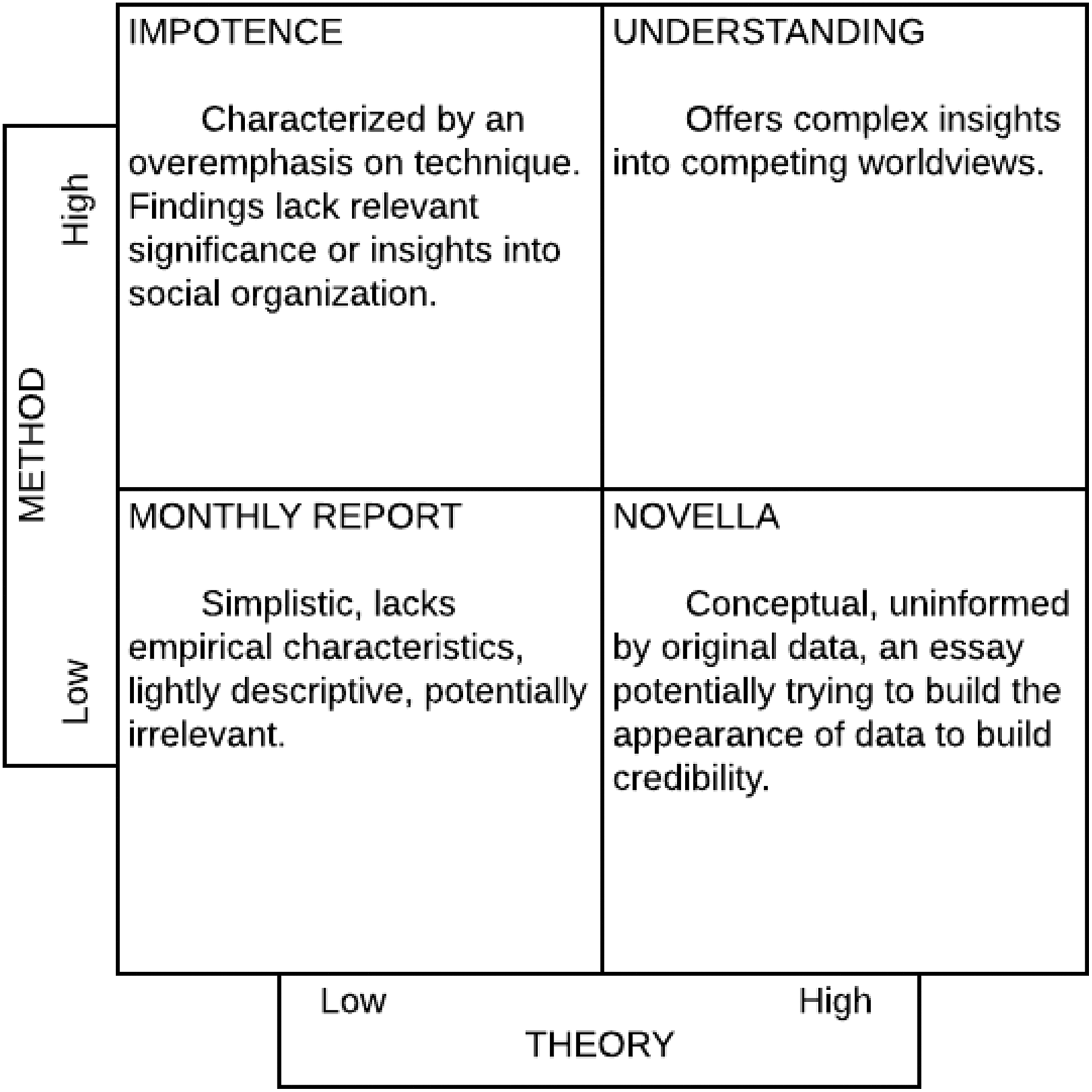
A theory/method quadrant.
Figure 1 depicts method as very systematic and does not fully acknowledge some the inductive component of methods. Neither theory nor method is inherently inductive. However, confusion arises about the place of theory in qualitative research because of the belief that it is inherently inductive. According to Merriam and Tisdell (2016), The argument could be made, however, that most qualitative research inherently shapes or modifies existing theory in that (1) data are analyzed and interpreted in light of the concepts of a particular theoretical orientation, and (2) a study’s findings are almost always discussed in relation to existing knowledge (some of which is theory) with an eye to demonstrating how the present study has contributed to expanding the knowledge base. (p. 89)
The purpose of the quadrant is to highlight the anchor points of method and theory so that the balance of both becomes mutually reinforcing in the greater pursuit of knowledge. Beyond the conceptual balance, the influence of theory in multiple aspects of a study is essential to recognize.
Ravitch and Carl (2016) have advocated that “You must consider the roles that existing, or formal, theory play in the development of your research questions and the goals of your studies as well as throughout the entire process of designing and engaging in your research” (p. 46). In order to explicate this process, Figure 2 highlights some of the specific areas where the theoretical framework should be integral to the qualitative process.
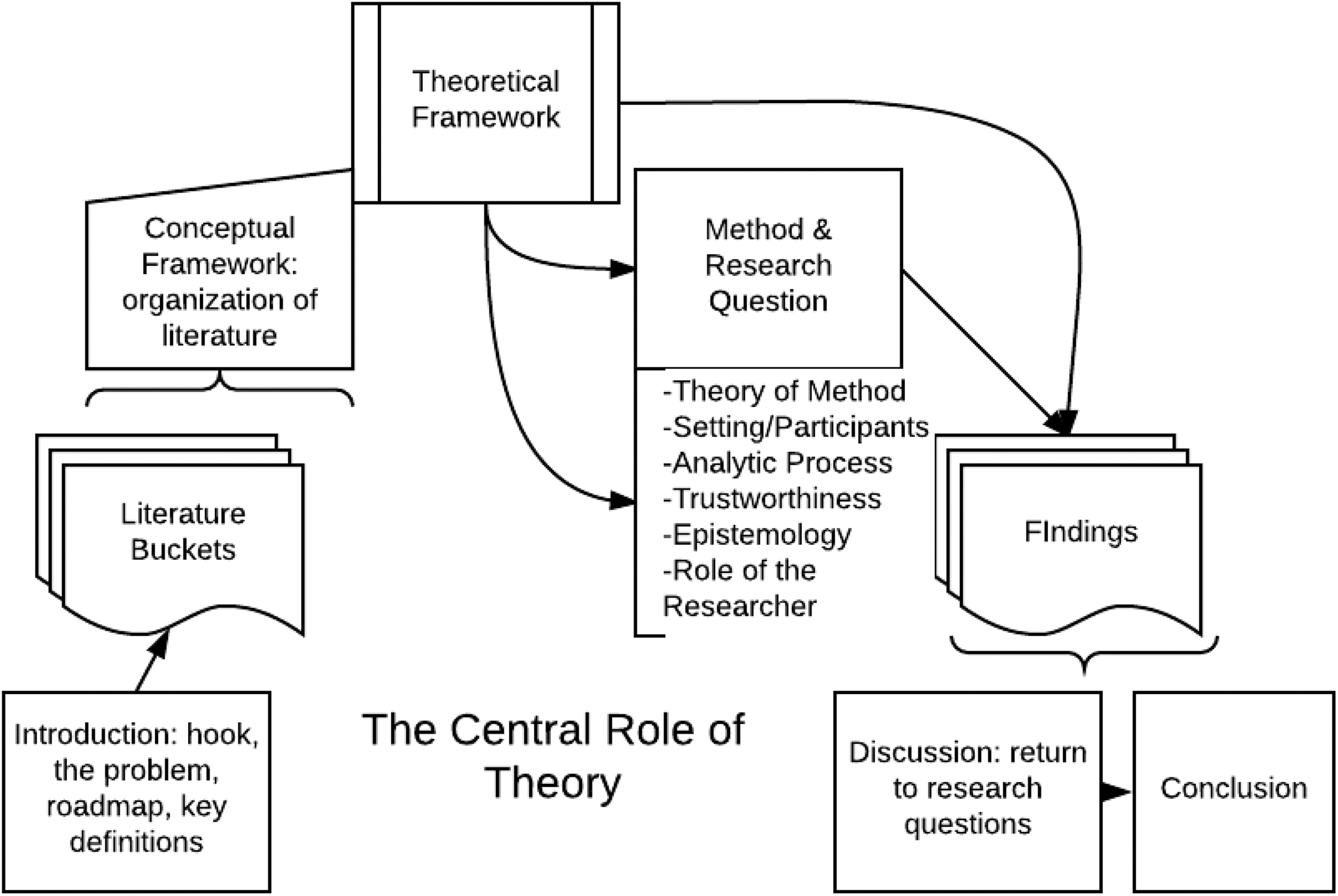
The qualitative process.
Traditional academic work starts with a problem and generates a base of literature to both substantiate the problem and give a record of what has already been said about it. From there, we advocate that the literature can and should be organized logically and visually into a conceptual framework. This image demonstrates the ways in which the literature covers or leaves available room to explore certain questions. From there, the theoretical framework can be a fulcrum and pinnacle portion of a qualitative study. Figure 2 includes arrows pointing from the theoretical framework to the method and research questions, with special attention to the analytic process (where theory can influence predetermined codes), trustworthiness (the deductive approach should include a search for negative or discrepant cases in relation to the theory), epistemology, and the role of the researcher (how does the selection of theory indicate something the reader needs to know about the researcher?). There is also an arrow from the theoretical framework to the findings because of the influence of the analytic approach, which also feeds into the discussion.
There are numerous ways to construct and design qualitative work, but our purpose here is to encourage direct links between the theoretical framework and many aspects of the research project design. When these links become explicit, the explanatory power and legitimacy of qualitative research will continue to grow.
Limitations and Conclusion
Evaluating the rigor or quality of research is both conflicted and contentious. There are various concepts and strategies that are used to signal rigor; however, signaling in the absence of transparency and detail may create other problems for understanding the knowledge producing capabilities of qualitative research. For example, terms like saturation and triangulation have garnered the perception of carrying scientific weight, but a critical review of these terms show that uncritical usage becomes an inappropriate and generic signal about quality (Kincheloe et al., 2011; O’Reilly & Parker, 2013).
There are naturally occurring pitfalls and limitations to centralizing the role of theory in a research project. It is easier to articulate the pitfalls because an imbalance of anything (even good) can become a liability. Consider the role of cholesterol in health, it is both good and bad, or consider Wolcott’s (1995) assertion that: Theory is something like physical exercise or taking Vitamin C: Some people get hooked on it, even to excess; others give it as little conscious attention as possible; no one can do without it entirely. That prompts a redefinition that at once elevates a formal theory to what I call ‘capital ‘T’ Theory,’ or Grand Theory, and leaves numerous other terms more modest in scope--hypotheses, ideas, assumptions, hunches, notions--that also capture the essence of the mindwork that is critical to fieldwork. As an ideal, Grand Theory stands clearly at the pinnacle. Grand Theory offers us the ultimate means to transcend the limits inherent in our modest individual efforts. (p. 183)
Naturally, an overreliance on theory could prevent the salience and importance of data from coming through. This is, however, a liability for the research, not a limitation of centralizing theory. The variations of qualitative research are enormous, and “theory addresses the issue of sense-making. It keeps us from getting caught up in rendering accounts dismissed as travelogues or personal diaries” (Wolcott, 1995, p. 184). Choosing to center a particular theory comes with the threat of becoming myopic. An overreliance on a theory may also produce a tendency toward or the perception of confirmation bias. Balanced centering of theory produces the opposite. Recognizing and centering a theory aids in identifying presuppositions and connections to epistemological dispositions, which in turn allows the researcher to methodically look for negations of either what was presupposed or what was predicted. Maxwell (2013) describes this as the search for negative or discrepant cases. Built into the systematic approach to finding knowledge is the search for data that goes against the grain of existing conceptions.
Furthermore, Flyvbjerg (2011) points to the explanatory power of negation, meaning that disproving a theory is a powerful act of knowledge production. Wolcott (1995) adds that: Theory offers a useful way to harness the power of disproof. We can never ‘prove’ anything through efforts at qualitative research. We can, however, disprove ideas by providing negative instances. Theory allows us to make better use of that power by inviting us to look at classes of events rather than only single instances. (p. 189)
The existence and central role of theory must be present in order to harness the power of disproof. A liability, however, lies in avoiding the heavy work to design a study that balances all elements of the study.
Beyond liabilities for the researcher, which still point to the strengths of centralizing theory, there are other limitations to be considered. In our view, the most salient limitation is the fundamental value of exploration. Indeed, even a study with a centralized theory can be highly exploratory, but the type of exploration designed for grounded theory and various types of ethnography may be better suited to being more unhinged from a strong theoretical framework. Any rigid and dogmatic application of a theoretical framework in these designs could emerge as a real limitation to the study. The question in these cases is, How can researchers be explicit and forthcoming about their role and disposition while still maintaining an openness that is characteristic of exploration? This is a difficult task to achieve and one that requires more work for the field of qualitative methods. The issue of bracketing is often interpreted to mean extracting the researcher’s view from the data. We find this task impossible and also a misinterpretation of bracketing. Instead of extraction, we believe the strength of bracketing is in the recognition of the role of the researcher and in distinguishing the words and perspectives of the participants from the interpretations of their words. Indeed, even this endeavor is impossible because the researcher is the one who framed the question.
A potential employer conducting an interview with a potential employee will often ask, “What is your biggest weakness?” Candidates somehow find a way to answer the question with content that points to their strengths. The same is true in examining limitations of centralizing the role of theory—they ultimately point to not only the strengths but the potential to enhance not only a qualitative project, but the craft in general.
Footnotes
Declaration of Conflicting Interests
The author(s) declared no potential conflicts of interest with respect to the research, authorship, and/or publication of this article.
Funding
The author(s) disclosed receipt of the following financial support for the research, authorship, and/or publication of this article: The authors received financial support for the publication of this article from the Faculty Research Council at Azusa Pacific University.