




Abstract
Within the context of a study about the lived experiences of Indigenous males living with HIV in Vancouver, Canada, we explored the utilization of an innovative method of collecting the narratives of study participants. This article describes and assesses the use of the Life Story Board (LSB) as a potentially rich interview tool for qualitative research and explores the process, as well as its advantages and challenges. The LSB uses sets of cards, markers, and notation on a play board to create a visual representation of a verbal narration about someone’s life situation or story. Five study participants took part in a conventional face-to-face interview and 4 months later were interviewed with the use of the LSB. These study participants were asked toward the end of the LSB session about their experience of being interviewed with and without the LSB. Data were also gathered from the interviewers’ experience. The findings suggested that the LSB offers interesting opportunities when used in qualitative research. Study participants found it to facilitate a reflective and more in-depth narration of their lived experience. The interviewer’s perspective for the most part corroborated these observations.
Keywords
What Is Known?
That there is poor adherence to HAART among Indigenous males living with HIV. Furthermore, there is a link to historical trauma experienced by Indigenous peoples in Canada. What is less known is how the lived experience of historical trauma relates to adherence to HAART among Indigenous males living with HIV. Furthermore, how can research be more attentive to their experiences and listen to the narratives in a way that can be more reflective and in-depth?
What This Paper Adds?
To the understanding of the lived experience of historical trauma by assessing a methodological tool for qualitative research, the LSB. It adds a process of data collection that facilitates a reflective and in-depth narration of the lived experience of the study participants, Indigenous males living with HIV.
Within the context of a study about the lived experiences of Indigenous males living with HIV in Vancouver, Canada, we explored the utilization of an innovative method of collecting the narratives of study participants. The article describes and assesses the use of the Life Story Board (LSB) as a potentially rich interview tool for qualitative research. The study was part of a broader study (not reported here) that explored the impact of historical trauma on highly active antiretroviral therapy (HAART) adherence among Indigenous males living with HIV. This article first provides the context about historical trauma among Indigenous people in Canada and the role of narrative in lived experiences of historical trauma. After a description of the LSB, this article assesses its use as an interview tool for qualitative research and for exploring the process and its advantages and challenges.
Previous studies of the LSB have suggested that it can be a good method for eliciting lived experiences compared to conventional interviews (Chase, Medina & Mignone, 2012). Among its strengths is that it can assist in breaking the ice and building trust and rapport between the interviewer and the interviewee (Medina, Chase, Roger, Loeppky & Mignone, 2016). As well, it offers more creativity, by giving a pictorial representation to the interviewee’s memories. This is of particular relevance for the psychotherapy and counseling field because the LSB appears to promote cognitive distance and relief as it helps participants externalize traumatic experiences. However, the previous scholarly work on the LSB focused on its use within the psychotherapy field. To date, there is no published study on the LSB as a tool for research purposes. Our study examined the LSB in this light.
Literature Review
Historical Trauma Among Indigenous Peoples in Canada
The lives of many Indigenous peoples in Canada have been, and continue to be, impacted directly and indirectly by the residential school legacy. Residential schools were part of a flawed educational system that ran from 1892 to 1996, which fell short of educating Indigenous children (Royal Commission on Aboriginal Peoples, 1996). Instead, its forced assimilation policy resulted in a whole new reality for generations that followed the first school opening (Barlow, 2009), resulting in historical trauma. The exposure to historical trauma for most Indigenous peoples is evident in manifestations of unresolved grief, feelings of helplessness/disempowerment, depression, inability to trust, and self-destructive behaviors among other issues (Aguiar & Halseth, 2015; Bombay, Matheson, & Anisman, 2009). These issues become heightened for those living with HIV.
Over the past several years, a number of reports have documented links between residential schools and HIV/AIDS (Barlow, 2008; Jackson & Reimer, 2008). For instance, there is an overrepresentation of HIV incidence, prevalence, and mortality rates among the Indigenous population in Canada. It has been suggested that many do not adhere to HAART partly because of unresolved historical trauma. Over the years, there has been a continued inability to understand intergenerational trauma as experienced by Indigenous peoples (Chase. Medina & Mignone, 2012). Unmasking historical trauma to understand its relation to Indigenous peoples, its transmission across generations, and its dominant role in shaping today’s health inequities is thus necessary in the development and implementation of therapeutic and preventative approaches (Aguiar & Halseth, 2015; Mehrabadi et al., 2008; Pearce et al., 2015). As part of this process, it is necessary to better understand the lives and stories of residential school survivors 1 to explore the historical trauma that Indigenous people face (Sotero, 2006). Many survivors have shared stories of their past and their ongoing struggles (Morris, 2007; J. L. Reading, 2009). While poor adherence to treatment and high mortality rates give an idea of how many lives have been affected by historical trauma, they cannot fully capture the physical, psychological, spiritual, and cultural wounds meted out on survivors, their families, and communities across generations (Dion-Stout & Kipling, 2003).
The Role of Narrative in Lived Experiences of Historical Trauma
Lived experience of historical trauma refers to the subjective and unique perception of one’s experience of health or illness while living as a member of a minority or oppressed group. As suggested by van Manen (1997), one’s lived experience gives meaning to his or her life history. When considering the narration of someone’s lived experience, it must be noted that the expression of trauma is determined by inequities and that there are differences in these lived experiences depending on the person’s unique Indigenous culture, survivor status, and geographic location of residence (National Collaborating Centre for Aboriginal Health, 2013; C. L. Reading & Wien, 2013).
Research suggests that through telling one’s stories and making sense of reality, a deeper understanding of subjective experiences and of oneself may be gained (Dyer, 2001). Storytelling has the power of ordering, situating, and providing meaning to survivor’s traumatic experiences. Storytelling facilitates existential mastery (control and resolution/integration of experiences) over traumatic experiences to achieve balance between one’s past and present existence (Mattu, 2014). It has been argued that explaining adversity through storytelling fosters a sense of coherence between people, self-esteem, and a strong sense of Indigenous identity, thus protecting against disease syndemics (Herrick, 2011).
The interview process chosen by the researcher is critical in determining the degree to which Indigenous male residential school survivors living with HIV share their lived experience. The conventional face-to-face interview format of sequential open-ended questions may adversely affect the interviewee’s comfort and openness to sharing, given different cultural approaches to conceptualizing and communicating life experience and in light of past and ongoing trauma and stigma. One particular aspect is that conventional interviewing tends to be more linear, whereas other methods may facilitate more open narratives, akin to storytelling, when prompted by visual elements. This research project provided an opportunity to conduct a trial with a small subgroup of study participants an alternative interview format using a visual narrative interactive tool called the Vidaview LSB.
The LSB
The LSB uses sets of cards, markers, and notation on a play board to create a visual representation of a verbal narration about someone’s life situation or story. The co-constructed, externalized depiction of people, relationships, events, and their corresponding internal feelings and meanings moves the conversation onto the table, literally and figuratively. The resultant “lifescape” becomes the shared focus of attention in the course of the session and the basis for further elaboration, visual or verbal.
The LSB was first developed by the author Robert Chase by adapting the genogram, the graphic representation of family structure and relationship (McGoldrick, Gerson, & Petry, 2008), into a physical play board for an expressive arts program with war-affected children in Sri Lanka (Chase, 2000). Further refinements led to its current form with a play board utilizing magnetized cards for use on a table in office settings. The LSB is intended for use by counselors and therapists working with children and adults alike. Early research found the LSB is particularly valuable in facilitating the disclosure of traumatic life events (Medina, Chase, Roger, Loeppky & Mignone, 2016) and as an alternative mode of engagement to face-to-face conversation with clients with cultural barriers (Chase, Medina & Mignone, 2012).
The LSB board surface has colored zones on which to place cards and notations that correspond to elements in the narrative. The yellow zone corresponds to the interviewee as observer/storyteller; the green zone is for people (family, friends, and others), places, and situational elements; the red zone is a timeline to situate events along the continuum of past, present, and future. The LSB tool kit contains element cards, graphic marker sets, and colored chips and clay, with accompanying guide sheets and a handbook (Figure 1). Various components in the LSB tool kit are selected for a given application, depending on the setting, type of client, session purpose, and the relative value of storyboarding with respect to the narrative process. Similarly, which aspects of the conversational interaction are storyboarded and to what level of detail is determined by many factors. Typically, the interviewer sits to one side of the interviewee, so that both can easily see and handle the cards. This shifts the gaze of the interviewee away from the interviewer and onto the board. When the LSB is used as an interview tool for social researchers, as is the case presented here, the verbal narrative is audio-recorded and transcribed as the principal data source for review and analysis. The visual lifescape itself may or may not be a data source. As part of the session’s closure, a photograph can be taken of the lifescape, as a record for the interviewer and as a memento for the interviewee.

Life Story Board and tool kit.
As in therapy, the LSB is central to the interview process, as a means to focus and navigate the conversation. As the lifescape forms, it helps to both focus attention and contextualize the subject matter. Visual representation of verbalized subject matter may give rise to cognitive insights and reflections that would not otherwise occur at the level of speech alone.
Some features in the LSB are useful for a trauma-informed process, such as “zone cards” designated as “safe spaces” or “containment zones” to navigate difficult subject matter and “secret cards” to denote aspects in the enquiry the interviewee chooses not to share. This enhances how the process is consensual and respectful and may result in deeper, more nuanced participation.
Study Objective
Within the context of the broader study that explored the impact of historical trauma on HAART adherence among Indigenous males living with HIV, the objective of the article is to describe and assess the use of the LSB as an interview tool for qualitative research. It explores the process, advantages, and challenges of the LSB as an interview tool within a particular population.
Method
For the broader study “Revisiting historic trauma: Impact on treatment in Aboriginal males living with HIV/AIDS in British Columbia,” 36 Indigenous males were recruited, ranging in age from 43 to 63 years, and were interviewed face-to-face using conventional interviews in 2016. Nine of those interviewed also participated in a focus group. The participants were HIV-positive Indigenous males living in Vancouver, who were on HAART and received most of their HIV-related care from the Vancouver Native Health Society (VNHS) clinic. The purpose of the interviews and focus group was to generate knowledge using interpretive description (Hunt, 2009; Thorne, 2008), in a process in which the main researcher interacted with participants, using informed questioning, critical examination, and reflective techniques to construct understandings of different, but shared, multiple social realities (Hunt, 2009). Recruitment was done with the collaboration of the VNHS clinic research committee. Information about the study was provided to individuals who attended the clinic. Ethical approval was obtained from the Research Ethics Board at the University of Northern British Columbia. In seeking to gain a deeper understanding of the lived experiences of how historical trauma may impact adherence to HAART, 5 of the 36 individuals were again interviewed 4 months later by the same interviewer, this time using the LSB. The interviewer, although not Indigenous, was from a visible minority and had worked for several years with Indigenous men living with HIV and consequently had gained strong trust from the agency and potential interviewees. The interviewer was trained by the developer of the LSB during a 4-hr, in-person training session, followed up with two informal conversations over the phone and one e-mail guidance package. The criteria for reinterviewing were having directly experienced residential schooling, and the first interview having lasted less than 30 min in duration due to these interviewees being less talkative than most others. Five participants fit these criteria. The length of time of the LSB interviews ranged from 50 to 100 min.
The LSB was used to construct a visual/pictorial representation of the person’s life situation, including events, personal relationships, health status, and family and community views. During the session, elements were placed on the board methodically, such as events along the timeline and people when they were mentioned, or spontaneously in response to the narrative as it unfolded in a process of co-construction. Both interviewee and interviewer were active in the LSB process. Guiding probes for questions included the historical trauma as experienced by the survivor within the contexts of culture, history, personality, and relationships; the individual’s ability to cope with its impact; the changes and resultant effects over time; and possible culturally safe programs, behavioral, clinical, and structural interventions or services that participants would like to see being developed and implemented. The LSB interviews were digitally audio-recorded and transcribed verbatim. Photographs of the board were taken at intervals during the sessions, and the final lifescape on the board was photographed (Figure 2).
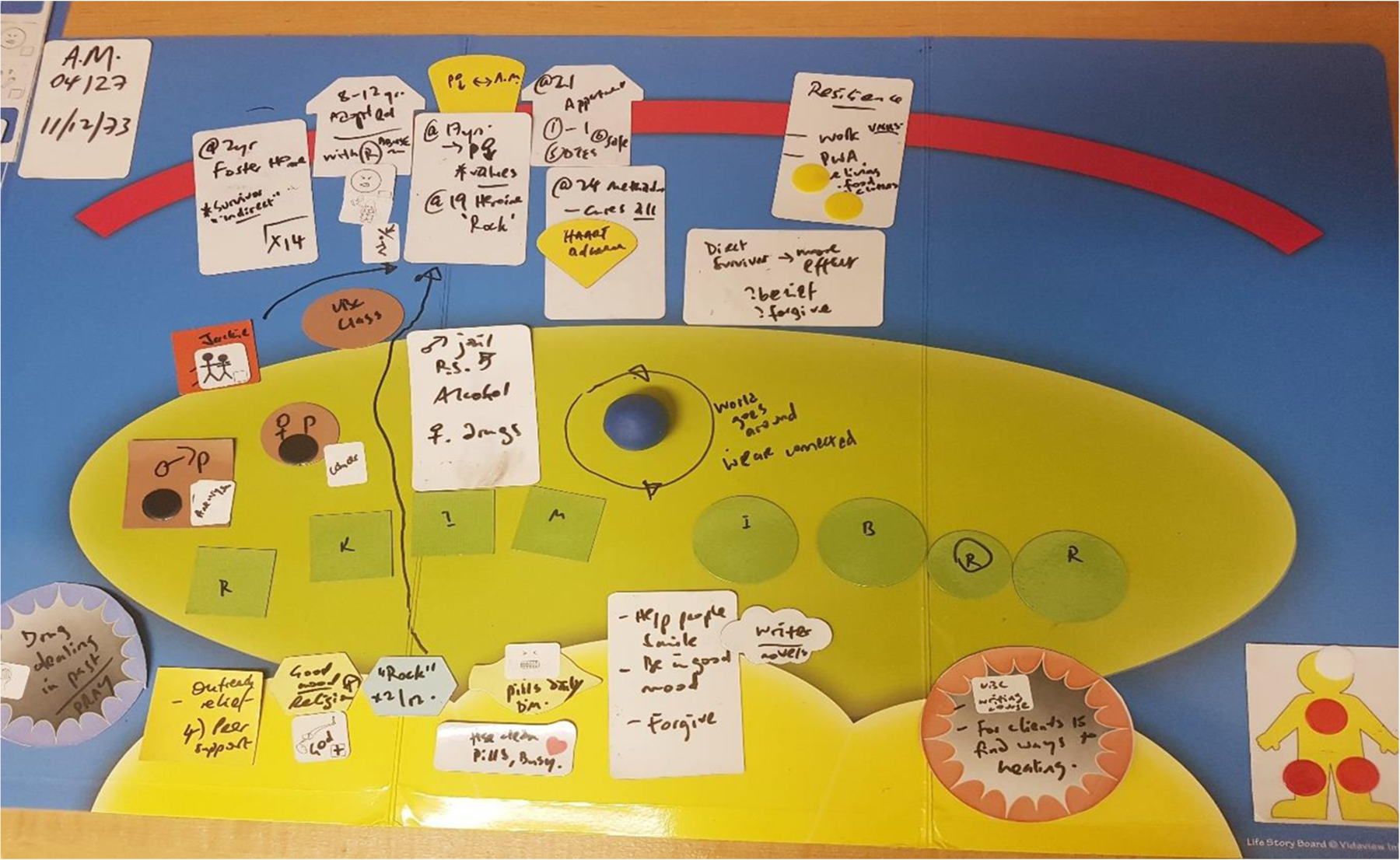
Example of a Life Story Board as seen once interview was finalized.
For the purpose of assessing the LSB vis-à-vis conventional interviewing practices, interviewees were asked toward the end of the LSB session about their experience of being interviewed with the LSB as well as without it. To illustrate, we provide a few of the questions asked: What did you like and what did you not like about the LSB? How would you compare an LSB session with a one-to-one interview without it? What kinds of emotions or personal reactions did you have after the LSB session? Furthermore, the interviewer was required to keep comparative notes of the interviews and was himself interviewed by an external researcher (coauthor Mignone) to gain information about the experience of using the LSB and how it compared with the conventional interviewing experience. This interview was also audio-recorded. All interviews were transcribed verbatim by a transcriber hired by the research team who signed a confidentiality form and entered into NVivo 10 qualitative software for coding.
The data transcripts of the interviews were analyzed separately line-by-line for content analysis. The analysis used an inductive approach. The analysis developed codes that identified themes. The coding system ranked for logical relevance seeking to identify and locate themes. The choice of thematic analysis was to facilitate an initial focus on broad questions to seize the overall gist of the data rather than synthesizing, theorizing, and re-contextualizing data. The first author was responsible for the coding, with a separate coding oversight by the second author. After several iterations of reviewing all full transcripts, revisions, and comparing themes, these were organized, and statements illustrating the themes that related to the experiences and perceptions during interview sessions with the LSB were inserted.
Findings
Table 1 summarizes basic information of the LSB interviewees. The subsections that follow offer the assessment of the LSB by the interviewees and the interviewer, with a final subsection offering a broader perspective of the findings.
Participants Information.

LSB From the Perspective of Interviewees
Four main themes emerged from the feedback provided by the interviewees in relation to their experience being interviewed with the LSB. These are reflective experience/more disclosure, hope for recovery/pictorial view, finding meaning/beginning healing, and control of conversation/safety/shorter time.
Reflective experience/more disclosure
Interviewees commented that the LSB process allowed them to revisit questions and answers during the interview and that it helped them to “dig deeper” into their own experience. They seemed to be able to reflect more on their lived experiences. The quotes that follow illustrate this. It was pretty cool to see my life, look at it. Going back over and so, brought back more memories. I remembered more and I talked about other things that I couldn’t have otherwise, you know. It’s a good idea, definitely. (A032) I’d never seen this before. It helped me a lot. It brings a lot of dimensions out. It makes you think of how you were back then, some reflection about how things were in your life compared to today. (A034) The family thing, I like it because it has helped me think about my family right. Their names and everything. I haven’t thought about them for a long time. (A020) With one-on-one interviews, you can’t get in-depth answers to questions you may not understand too. You don’t tend to answer or give everything. This is way better. I’ve talked about more things now. (A036)
Hope for recovery/pictorial view
Most interviewees felt that because they could see their lives unfold on the board as a pictorial view, they were able to observe where they were before, where they were at in the present, and that there was still ongoing hope for recovery in the future. They commented: I guess, it really helps me come to the realisation that, you know how I view the world…in terms of how those who went to residential school are, how I am. It helped go back to residential experience. That my dad, even being a free living person that he is, how he has brought that onto me. (A020) I made a salmon in water out of clay. It represents mother earth, food, healing, peace, togetherness, wellness, and sobriety amongst the people so that people can have hope, so that people can heal. (A034)
Finding meaning/beginning of healing
For some of the interviewees, telling their story using the LSB enabled them to realize and step out of their current situation of disorder to find meaning to move on to a place of order. They thought of it as a step in healing. One participant commented: This has, of course, it has healing effect. If you don’t talk about it nothing happens. You have to talk about things for you to heal. Simple language helps to talk about things and just putting little pieces down you know. Helps to talk about residential school and so. This helps me to understand life a little more. To look deeper into things and just to think about what harm I’ve done to people. And just realize, I am a good person. What kind of a good person I am now, you know. (A034)
Control of conversation/safety/shorter time
A number of aspects of the LSB session gave the interviewees a sense that they could control the gist of the conversation in their own words: using simple language without medical jargon, being able to do some of the writing on the cards, and placing some of the status markers on physical and emotional/mental health and resource chips on the board. It appeared to give them more freedom to describe their lived experience—not merely explaining symptoms—and thus contribute to their own interpretation of experiences and events. As well, the rapport facilitated by the LSB seemed to help the interviewees feel they had more time to explain their traumatic experiences and resilience. Two participants commented: I felt I could control the conversation, you know. I felt comfortable, I mean, I was fine with it. I mean, I like the fact that you asked me if there was anything I didn’t want to talk about. I felt safe, you know. (A036) The timeline is cool. I like how you’ve got papers and you write on them, and place markers. It was simple. The simple language, there was nothing that I didn’t understand. Very clear and to the point. There was nothing that confused me and I could go back…when I forgot, you know. (A030)
Having the freedom and control of the conversation, participants could talk about other problems, ailments, as well as disease syndemics affecting them. An interviewee mentioned that he felt he was the one controlling the interview and not simply giving the answers “the way you want them.” One participant commented: The forces against me…right now I’m dealing with cancer and it’s probably the hardest thing I’ve gone through in my life. Residential school equals the same amount of pressure I’m going through right now. The physical and mental pain, and other things I’m going through every day, is very excruciating. It adds up. It’s like residential school…you don’t know when it’s going to end. (A034) This board seems to make the time go over quickly. It’s better than the (conventional) one-on-one interview. (A032) This is way better than a one-to-one interview where you just ask me question one, question two. (A030)
LSB From the Perspective of the Interviewer
The intention to use the LSB in the study was to obtain more detailed information about the lived experiences of several study participants who were less talkative in the initial interview. In that sense, the LSB was intended as a method to supplement previous information. According to the interviewer, the LSB helped elicit contributing factors mediating the experience of difficult life events that impacted the individual’s adherence to HAART. Several themes emerged from the interviewer’s feedback of the use of the LSB: ease of use and potential barriers, reflexivity and more in-depth information due to use of the board, and comparison with previous conventional interviews.
Ease of use and potential barriers
Some initial training on how to use the LSB was necessary. To interview with the LSB was not puzzling as such; the interviewer prearranged the cards to be readily at hand following a step-by-step process according to the question prompts. For instance, “you go through person card, feeling card, event type cards and so forth. So that helps you to actually use the LSB…So, we’ll do the whole thing and then start again and look at every single aspect now and see how to build around things like that.” Nonetheless, it has to be practiced and it is helpful to have some background in alternative methods, for instance, methods that use art.
Of the five interviews using the LSB, three were done at the VNHS clinic, one at the home of the interviewee, and one in the hospital room of the interviewee. This showed that despite having to set up the board and the pieces, the LSB could be used with relative ease in different settings. What seemed to be necessary was to allot an adequate amount of time for the interview. Compared to the more conventional interviews, the use of the LSB needs to factor in some time to set it up. Furthermore, the time allotted may need to be more flexible because it appeared that some of the narrations of interviewees became longer when interviewed with the LSB. One hour on average seemed to be appropriate.
The interviews with the LSB seem to evoke more in-depth reflections about the interviewees’ lived experiences. In fact, it seemed to elicit sensitive, traumatic events. As such, and particularly with study participants who have experienced trauma, this may impact them emotionally. The study had organized a quick referral system in case interviewees would need to see a counselor postinterviews. In fact, two of the five interviewees decided to talk with the counselor soon after the interview.
Reflexivity and more in-depth information with storyboarding
Consistently, the use of the LSB appeared to stimulate more reflexivity among interviewees and more in-depth information about their lived experiences. The fact of seeing their life unfold on a board seemed to help them to reflect and to look at where they were before and where they are now. For instance, an interviewee included in the hollow zone the fact that he had not only been doing a lot of drugs but also selling drugs. Being now clean, the individual saw this situation on the board and wondered how those people he had sold drugs to are today, if they are still doing drugs.
It appeared that putting the pieces on the board helped them to look at their life. The interviewer recalled that an interviewee had mentioned that he had not thought of his cousins and sisters for a long time and that during the LSB, he got to reflect and mention their names, which reminded him that he actually had a family. The visual aspect of the LSB may prompt the interviewee to remember and go back to some topic or issue. This converged with the possibility they had of choosing their own emotion stickers and cards and thus having a sense of being more in control. As stated by the interviewer, “They were the ones who were actually doing the stuff.” A particular example was when one of the interviewees created his clay figure, a salmon, and started explaining that it signifies hope, peace, healing, connectedness with the land, and so forth.
For the interviewer, seeing things on the board also helped to have a better sense of what the interviewee was saying as well as helping to prompt other questions. For instance, while interviewing individuals, the interviewer actually sees what the interviewees have put on the board first, as they talk about the traumas they had suffered at different times, their emotions, and their relationships with loved ones they had lost. It helped the interviewer as a cue to ask them further questions.
Comparison with previous conventional interviews
The interviewer initially used similar questions for the conventional interview and the LSB interview. However, the order of the questions eventually became quite different. During the LSB sessions, the interviewer focused on aspects related to pieces that the interviewees put on their lifescape. As well, the interviewee would tend to dig deeper in some of these aspects that were visually present. Apparently, the LSB seemed to create a more spontaneous conversation and bring up material not mentioned otherwise. In fact, one interviewee explicitly acknowledged that there was so much he would not have said in the conventional interview compared to what he said during the LSB interview.
Even though the questions in both the conventional interview and the LSB interview were open-ended, the timeliness and order of the questions varied between them. Usually in an interview, a next question is asked to supplement and build on the previous one. When using the LSB, the interviewer felt freer to jump into other topics because the visual aspects of the board would remind him more readily to go back to previous issues not explored more in depth. This made it easier to not have to follow a particular order and made the interviewee feel more of a conversation rather than a question and answer exchange. Furthermore, it seemed that the interviewee had an easier time expanding more on issues.
Discussion
The study sought to describe and assess the use of the LSB as an interview tool for qualitative research. It explored the process, advantages, and challenges of the LSB as an interview tool within a particular population. The findings suggested that the LSB offers interesting opportunities when used in qualitative research. From the viewpoint of interviewees, they found it facilitated a reflective and more in-depth narration of their lived experience. The pictorial view seemed to play an important role, for instance, in helping to find meaning. As well, they felt they had more control of the conversation when interviewed with the LSB. The interviewer’s perspective for the most part corroborated these observations. Overall, the interviewer’s comparative observation of interviewing study participants with and without the LSB seemed to favor the former.
In relation to the particular study group, the LSB appeared to provide a new and critical space for researchers to explore the complexities of healing and reconciliation (Government of Canada, 2015). Skelly (2016) talks about processes that loosen up the brain and facilitate being open to new ideas. The feedback both from interviewees and the interviewer in our study suggested that the LSB facilitated this, in particular helping to capture and confront issues related to HIV/AIDS (Rao et al., 2009) and residential school impacts. It would seem that seeing the lifescape enabled the narration of difficult lived experiences of the HIV-positive Indigenous men interviewed. This seemed to be particularly relevant in that the LSB facilitated a holistic examination of life that included individual, family, community, and societal levels, both from a current and a historical perspective. It also seemed to confirm what previous authors have signaled that the LSB can assist in breaking down cultural barriers (due to the use of symbols that transcend language and cultural differences), in addressing challenges related to trust, and possibly in diminishing recall bias (Chase, Medina & Mignone, 2012; Napastiuk, 2015). The LSB with the particular study population produced more detailed and highly personalized information than that obtained from the conventional face-to-face interviews.
We speculate next on possible reasons for the strong potential of the LSB as an interview tool. It would appear that laying out fragments of the interviewees’ stories may have helped organize their thinking, increased their focus, and helped deepen insight. Nonetheless, it could also have played a limiting role. It may have been the case that some participants, when disclosing, laying down issues on cards, and actually seeing their life unfold on the board, may have felt intimidated. There is the possibility that the intimidating aspect of visualizing the lifescape may have limited the information they disclosed. On the other hand, the LSB appears to offer a fluid process (with questions moving through one’s life span from birth, with the ability to move back and forth on the timeline) that more closely follows a narrative. As such, it may be more adaptable, comfortable, and safe for those suffering from trauma and those who may not be able to swiftly shift from topic to topic as questions in a conventional interview may dictate (Chase, 2008; Chase, Mignone & Diffey, 2010). This process is strengthened by the safeguards (the secret cards and the safety/containment zone) that are built into the LSB. When a participant feels uncomfortable with something at any given point, he or she can place a secret card on the board indicating something they want to either block out or keep secret and whether they want to return to the issue later. If there is a place, event, or person that the participant does not want to discuss, a safety/containment zone card can be put on the board. This can then be revisited when the participant is ready (Medina, Chase, Roger, Loeppky & Mignone, 2016). The LSB thus reflects the participant’s extension of self/personal space that is private, only to be entered or altered with consent. Furthermore, the LSB offers more time for reflection, through breaks during the session, for participants whose life stories are emotionally heavy to bear.
Another feature is that both interviewee and interviewer are active in the LSB process, observing and interpreting feelings, thoughts, and behaviors, and both cocreate meaning (Farber, 2003). This may be particularly valuable for people who have experienced trauma. It relates to the ability to place the lived experience into narrative form to manage a traumatic experience (Denham, 2008; Dyer, 2001). It can be speculated that qualitative data-eliciting methods, such as the LSB, may help reintegrate the lived experiences while not presently invoking uncomfortable and/or anxious reactions and at the same time disentangling thoughts (perceptions and interpretations) and locked and patterned emotions (Vaccaro & Lavick, 2008). Nonetheless, this raises the ethical issue of being prepared to deal with the discomfort of the verbalization/disclosure of sensitive experiences and details by individuals who have experienced adversity and trauma (Chase, Mignone & Dffey, 2010; Chase, Medina & Mignone, 2012, 2014; Breslau, 2004). The LSB is a way to externalize and reflect on such memories and feelings, but at the same time, when being used for research, it is not a psychotherapy session. Thus, the crucial importance of offering the interviewee the opportunity to be referred to a counselor if need be, as actually occurred with two individuals in our study.
The use of the LSB elicited strong and raw narratives in some study participants who sometimes lacked cohesion in the development of the story itself. However, this was remedied by the time, flexibility, and ability to revisit what was forgotten on the timeline. It suggested that the use of the LSB made it easier to talk about their experiences from childhood through adolescence to adulthood, whereby participants were comfortable, felt confident and in control, and found their voice to speak in a safe environment. Using the LSB in this way, placing the narrated experience on a board, provided these Indigenous men living with HIV a sense of self-worth and encouraged self-reflection (MacDonald, 2016). The guided storyboarding process mediated their ability to continue their journey as the LSB provides a critical space for exploration of the antecedents and outcomes of historical trauma. Providing the photograph of the board (lifescape) at the end of the interview to each of the participants not only seemed to serve as a record of their experiences but also as something to keep them motivated in their healing journey (Skelly, 2016).
Although the focus of the substudy was the LSB as a research tool, its potential as a healing tool became evident. It would seem that the LSB embodies some elements of art therapy by enabling expressive writing and sculpture making within any given session. Such may be familiar to and helpful for many Indigenous peoples in their healing process (Dyer, 2001). Research suggests that using art as a healing tool is not foreign to Indigenous peoples as they have embraced and used creative expression in healing processes from time immemorial (Archibald, Dewar, Reid, & Stevens, 2012; Stuckey & Nobel, 2010).
Psychologically, trauma is stored in symbols in our brains. For instance, for someone who experienced sexual or physical abuse in their foster home growing up, the depiction of this by putting pieces on the board for their deceased parents and a picture of a house brings the past experience into the foreground, but from a somewhat detached perspective as observer. For men who have experienced trauma and discrimination, and for those who may struggle to verbally disclose their lived experiences while living with HIV, the LSB can provide a route of nonverbal expression, an avenue of acceptance, and thus be an effective means to promote disclosure and healing (MacDonald, 2016; Rao et al., 2009). Working with the LSB may prove to be a creative process that affects more than the interviewees’ identity with illness. They may be more able to create harmony between their affective states and their conceptualization of reality. Through this imagination and creativity, healing and identity is founded (Stuckey & Nobel, 2010).
One finding of practical significance was that the interviewer felt comfortable using the LSB and did not think it posed more difficulties than conducting conventional face-to-face interviews, with one exception, time. The experience of the interviewer suggested that because the LSB set needs to be set up, there is need for somewhat extra time. Nonetheless, the extra time needed did not seem too long, as the suggestion was to plan for the entire interview to last 1 hr. Interestingly, the location of the interview did not seem to be of concern. Despite that the LSB interviews in the study took place at an outpatient clinic, at a home, and in a hospital room, the different locations did not affect the interviews as long as there was sufficient time to set up the board.
Study Limitations
A limitation of the study is that it involved only five interviewees and one interviewer and within a particular population group. Consequently, the range is quite limited. Furthermore, the fact that these five participants felt more comfortable talking during the LSB interview than during the first interview may have partially also been due to the rapport built during the first interview. There is no expectation that the findings are generalizable although many aspects can be potentially extrapolated to other contexts. Furthermore, the amount of data collected specific to assessing the LSB was not very extensive, vis-à-vis the objectives of the broader study.
Notwithstanding the limitation, there are particular strengths. This is the first study thus far where the same research interviewer interviewed the same participants with, and without, the LSB, allowing for a unique comparison of experiences. Participants were explicitly asked to provide their feedback with no particular bias favoring one method or the other. The result that using the LSB was found to be successful with a stigmatized and vulnerable population such as Indigenous males living with HIV impacted by historical trauma suggests that the method can be used in other population groups with similarly complex lived experiences.
Future Research
The study showed the feasibility and strengths of using the LSB for qualitative research. It suggested that the LSB enhanced the rapport and quality of information shared in research interviews. Nonetheless, further research is required to properly assess its utility, relative efficiency, its potential for wider use, as well as its limitations and the trade-offs of its use in qualitative research. For instance, the analysis of the transcripts of an LSB session may be less intelligible in parts where the interviewee gestures to the lifescape without verbal reference. As well, a crossover design would be necessary to compare LSB and conventional interview formats in order to isolate the effect of the rapport created from the prior interview.
To contrast and compare the LSB modality to conventional interviews raises tantalizing questions. For instance, how does the storyboarding process reconfigure cognitive, expressive, and communicative processes of the interview process? As well, does the researcher’s participation in co-constructing the lifescape influence the narrative process so that it constitutes a form of bias?
In a wider comparative study of interview methods, more delineated parameters could be used to evaluate differences in terms of validity, authenticity, degree of participant engagement, and depth of reflection. Finally, LSB participants described a positive healing effect from the session. This raises the issue if there has been a blurring in the distinction between research and therapy, that is, the process of enquiry to generate narrative content as data that also potentially affect the participant in positive and/or negative ways.
Footnotes
Acknowledgment
The authors wish to acknowledge the Indigenous males living with HIV who generously participated in the study.
Declaration of Conflicting Interests
The author(s) declared no potential conflicts of interest with respect to the research, authorship, and/or publication of this article.
Funding
The author(s) received no financial support for the research, authorship, and/or publication of this article.