




Abstract
The overarching aim of this research is to extend and examine the way in which the inspiration economy (IE) can be applied in different contexts and countries, bearing in mind how social and cultural contexts influence the way in which research methods and fields are utilized. This is achieved through a reflexive analysis of a research study in the context of Bosnia and Herzegovina. The originality of the method focuses on the involvement of research groups in collecting and analyzing data with minimal resources and on the role of mentoring which gives group members greater ownership of the process and results/outcomes. This leads to the different researching teams building an internal drive to implement an IE case study, which was the core study of all the research studies. The study concludes with recommendations concerning the importance of involving research groups and of opening up a new path for the knowledge community. It also stresses the power of youth and research groups for the future of research in conducting and implementing research outcomes.
What Is Already Known?
Various methods, such as focus groups, group interviews, talking circles, and observations, have been used successfully in social research projects for many years. However, by addressing reflexivity issues, the use of sequential or serial focus groups means that the repeated meetings allow deeper knowledge to be elicited.
What This Paper Adds?
The researchers believe that this is one of the few field research studies that has collected data via research groups rather than by individual researchers only. The details provided in this article concerning the process, its potential benefits, and other considerations will help guide other researchers in the field, especially those interested in applying the inspiration economy (IE) method in other contexts. The study demonstrates that IE is an appropriate and effective method to explore opportunities in different contexts.
Introduction
The main research idea focuses on how the world is in need of a new economy and proves that the theory of inspiration economy (IE) can be applied in different contexts. The researchers found that the social and cultural contexts of the research field can shape and modify the use of qualitative research methods through a reflexive analysis of the research study, as the research methods were modified in order to implement IE; this was done to prove the theory rather than merely to validate the data collection method. Thus, this article examines how proving the theory shaped the research process rather than vice versa. The work therefore engages with the researchers’ position through reflexive analysis because they were foreigners although they were also the creators of the IE theory.
Today, more than ever the world is in search of different economic concepts that make sense. Most of us, however, are more followers than creators of our fate, and it is due to such materialistic economies that we rarely manage to engage with or control our own fate. This research calls for a transition from this position as IE comes from within us and serves all of us without depending on resources or external power. An inspiration-based economy, it is believed, can be built by many enablers and different inspiration-generation theories, without which a competitive and sustainable future cannot be envisaged (Buheji & Thomas, 2016)(Buheji & Thomas, 2016). Therefore, it was important for the researchers to prove the validity and reliability of an IE model and to implement it in the context of another country rather than only in their own region. In addition, using research groups to collect data not only makes group members believers in discovering and applying the model, it helps in conducting research without resources by using research groups; this is an overarching IE concept.
Background
Since the late 1980s, a growing body of literature has criticized the idea of the neutral, detached researcher and has promoted the use of reflexivity in social research (Okely & Callaway, 1992). Reflexivity is the process of looking both inward and outward with regard to the position of the researcher and the research process (Shaw & Gould, 2001). It is also part of the production of knowledge (Blaxter, Hughes, & Tight, 2006; Hammersley & Atkinson, 2002). Clearly, researchers will always have an effect on the setting and the people they are studying, and data collection may be modified by their presence. They also play an important part in analyzing and interpreting the data that are produced. In short, researchers cannot avoid having an impact on the process of research (Kosygina, 2005). However, in this study, during the whole process, from deciding on the scope of research to the collection and interpretation of the data, the effect of the research leaders was minimized by the involvement of research group teams.
This study concerns the fieldwork research experience of the researchers during their stay in Bosnia and Herzegovina (B&H) and argues that IE theory can change societies without resources and power; it can also be applied in different contexts. This was not only proved by the researchers but also by research group members who have acted as researchers in some situations.
What Is the IE?
This is an economy that focuses on discovering the potential and raising the capacity of human beings where their abilities are the currency of competition and the source of a planned outcome and legacy. Thus, IE is a mix of many disciplines that leads to inspiration practices that motivate the spirit to a level that creates waves of inspiration in socioeconomic development. These mixed disciplines and practices can include, for example, entrepreneurship, innovation, risk-taking, and seeking/creating opportunities, along with a focused and change-driven mind-set. It is a type of economy that would be based on the abilities of our societies and organizations to discover the potential and capacities of human beings and then capitalizing on these through inspiration (Buheji & Thomas, 2016).
Setting
The IE theory and model was applied by the founders of this concept in different countries within the Arabian Peninsula, mainly in the Kingdom of Bahrain, an area known for its petroleum resources, though IE was applied in the area without resources. Apart from oil, the Kingdom of Bahrain has very limited resources, and therefore, this was a good context within which to apply IE in the beginning. It could be argued that, since the founders were insiders in the region, different types of resources and power might have been used, such as their positions, networking, and so on. Therefore, the founders decided to prove the theory in a totally different context: in an ex-communist country with limited resources and where they were total outsiders in cultural terms. The research was therefore applied from July to November 2016, mainly in the city of Bihac within the Una-Sana Canton in B&H.
Research Design
This study explored the IE model by implementing it in B&H. It adopted a qualitative ethnographic case study approach and applied it through formal and informal teams, groups, and organizations, using observations, individual and group interviews, focus groups, and surveys carried out by the teams.
Teams were divided according to the main issues and problems that were observed (see Figure 1) during the researchers’ first field visit in April 2016. After that, the teams’ studies and data collection were conducted in July 2016, as shown in Figure 2.

Teams.

Research time line.
Each team was led by a member of the Bosnian youth with an academic mentor, the group consisting of young people from the Una-Sana Canton in Bosnia. By September 2016, an international group of young people and mentors of the IE joined the team to support the data interpretation. The team structure is shown in Figure 3.

Team’s structure.
Each team had a clear mandate and objectives for the expected outcomes. In addition, they all had at least one institution that they worked with and where they applied their prototype.
Moreover, before the teams were divided and structured, a daily workshop was conducted for 1 week in early July 2016 to make sure that that all team members had a good understanding of their roles and what was expected of them.
The young people participated in the project voluntarily after it was announced in local media and in social media with support of academics in Bihac University and a few schools. In addition, each young person who participated was source for bringing more people on board, rather like a snowball technique, which is used when a researcher is able to recruit a small number of participants who can then introduce them to further people who can be recruited (Blaxter et al., 2006; Cohen, Manion, Morrison, & NetLibrary, 2003). For example, one volunteer team leader was a daughter of one of the academics; she later brought with her most of the young people from her high school and from her neighborhood. In addition, the team leader of the values team was the member of one of the nongovernmental organizations (NGOs) that was participating in the project; she brought her brother who then introduced his school which became a partner in the project as well. This demonstrates that a snowball technique was used to introduce both individuals and institutions. In total, the final team numbered around 100, of whom 80 were young people. Fifty of these worked on the research continuously while 30 participants were involved intermittently.
As observation is the main tool in IE, it was therefore used from the early stages to identify areas of work; teams were then divided accordingly. From there, a great many interviews, focus groups, and surveys were conducted. In total, the data collected by all the groups totaled 1,095 acceptable samples (Table 1). Most of these came from young Bosnians although some of the interviews and focus groups were conducted with academics, service providers, and policy makers who worked closely with young people such as the Minster of Education in Una-Sana Canton, Bihac University, the Chamber of Commerce and Industry, and so on.
Data Collection.
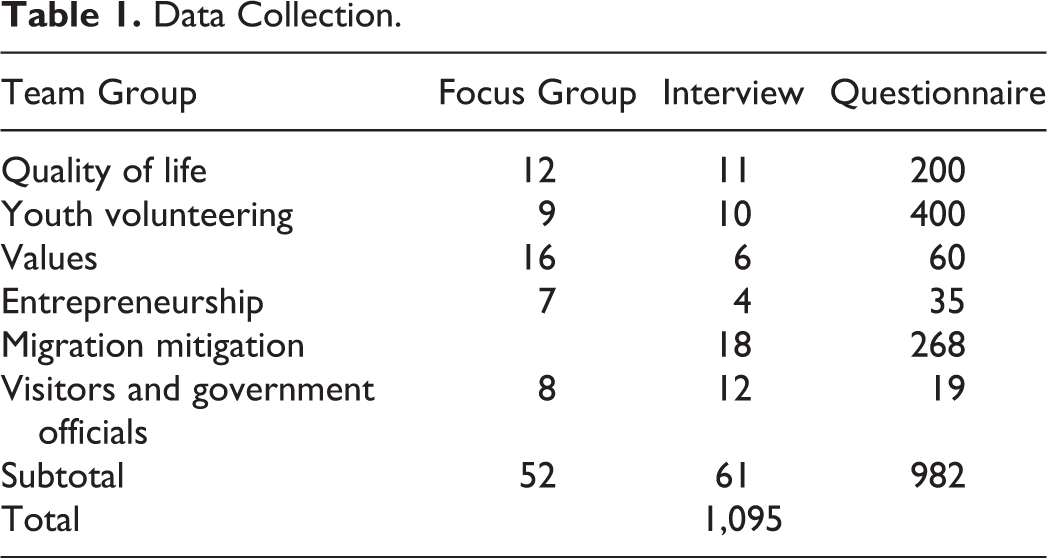
All the data were collected in order to find opportunities, apply them via prototypes, and then measure changes that could be made without resources. As shown in Figure 2, research groups were involved in the third stage of the research while the final findings of the researchers were also dependent on the findings elicited from the research groups.
Research groups helped not only in collecting data but also in analyzing them and presenting them in a forum, with a view to making future plans to apply IE and create changes in society. The research groups managed to collect a sample of around 2,000 responses using different data collection methods, as mentioned earlier. However, after validation, only 1,095 of the responses were taken into consideration, especially responses to the surveys. In addition to their observations, interviews, and focus groups, all of which were conducted without any direct interference from the researchers. The research groups received guidance from the researchers with regard to the surveys, the analysis, and ways forward, but the main work was carried out by the research groups. This made the group members strong believers in the findings and made them eager to create changes in their society by using IE model techniques. All these data were collected and analyzed in less than 2 months, which shows that a lot can be done with minimal resources. Thus, the secret of motivating the research groups was that they were given responsibility and were informed that they would present their data in a forum with coverage by the media. In addition, the research groups were divided into teams and were informed that, after a year, there would be a competition among the teams according to their prototypes and the subsequent changes they would make to their society.
It may be argued that this methodology is an action research method, which involves a research group collecting data and assisting the researchers in improving the research (Sagor, 2000). However, this research group was involved in choosing and validating the main issues, in deciding how the data would be collected, and in collecting and analyzing the data themselves. In addition, as an applied research method, each group implemented their work in a different setting and institution. Moreover, the research groups continued to work on these projects even after main researchers had left the country. They will achieve the final results and analysis of Stage 6 of the research cycle in July 2017, as explained earlier in Figure 2 when they can, as a final step and as different groups, present their research to a jury. At this point, the research groups and teams will be evaluated according to the outputs of their research. From there, the researchers will make a compilation of all the data and findings, which will all become part of one main research study about young people. This explains how this research used a novel method.
Outcomes
Although this article has tended to present the project from methodological viewpoint, some examples of the outcomes are given to allow a better understanding of the research.
The first outcome concentrates on the efforts of the value team. This team was established as a result of the observation that there were a great many betting shops in the area. As the team started to search using Google maps, they found a minimum of five betting shops were situated around each school; they also realized that not all betting shops are identified on Google maps, as shown in Figure 3. Therefore, they tried to construct a model where they worked with one school and brought activities into the school, so that students would have mental protection against betting. Hence, the overall goal was to build a model school which was free from students who gambled. The goal was to achieve this without depending on the support of the law.
A second outcome concerned enhancing the role of young people in voluntary work and in NGOs and to see how this could create influence in global affairs. In one of the studies that was carried by the inspiration and youth economies’ projects, in collaboration with young Bosnians, it was found that few NGOs really address the needs of young people and their roles in the socioeconomy. The team found that young people need to ensure the provision of extracurricular classes. It assessed the effectiveness of the voluntary programs for the young in B&H and then moved on to focus on the most essential types of youth NGOs needed for Bihac and the Una-Sana Canton.
The third outcome involved creating a model with regard to the role of young people in improving the quality of life, with the project showing their role in having a positive influence on social well-being. The team focused on the journey of the young in creating a better socioeconomic climate by focusing on selective indicators such as youth health, youth education, economic and physical safety, governance and basic rights of the young, the natural living environment, and leisure and social interactions.
The fourth outcome concerned creating migration. The migration team managed created role models to show how to mitigate the risks of migration where migrants are encouraged to return, contribute, and migrate with plans to come back with entrepreneurship projects and/or explore potential opportunities in Bosnia. Live successful models were presented to young people during the conference.
Reflections on Positionality
This section offers a reflection on the positionality of researchers in relation to this study. It highlights the multilayered nature of positionality and therefore the need to reflect on a range of issues including nationality, ethnicity, religion, gender, and being founders of IE. While it is necessary, for the purposes of this article, to discuss these issues separately, the researchers recognize that these divisions are artificial as they interface with each other. Hence, the researchers were both insiders and outsiders in different circumstances, which can be the situation of most researchers (Ahmed, Lewando Hundt, & Blackburn, 2011; Dwyer & Bukle, 2009).
Trust
A key component of a good research relationship is trust (Ahmed et al., 2011; Ryen, 2004). Trust has been associated with a positive experience, and the research groups gave researchers open access to their premises and talked freely about issues related to their organization and society.
A key factor that shapes the kind of data generated in any study is the relationship between an interviewer and an interviewee (Ahmed et al., 2011; Green & Thorogood, 2004). One of the important aspects emphasized by Ryen (2004) concerning interviews is trust. She noted that “Trust is the traditional magic key to building good field relations” (p. 234). Where there is trust, for most interviewees, the interview can be a positive experience as they get the opportunity to talk about their lives, personal experiences, and stories. However, interviewees will not talk in this way unless they trust the interviewer (Green & Thorogood, 2004). Green and Thorogood (2004) noted that, although such relationships can have advantages, such as making access easier, they will also have certain disadvantages such as assumptions concerning shared meaning. The researchers were trusted by the research groups because of their shared academic background and because of their previous work in forums and journals.
Insiders
Being academics and dealing with academic circles helped the researchers to gain access to the respondents (Ahmed et al., 2011; D’Cruz & Jones, 2004; Gibson & Abrams, 2003; Labaree, 2002; van Heugten, 2004). Some of the academics were colleagues who had attended previous IE forums; this helped in achieving a better understanding. In addition, having taken part on a forum allowed the understanding of the concept to be clearer before the research period as sharing experiences and understanding with some participants gave some insight into their perspectives, as well helping in gauging their understanding of verbal communication and body language (Gilgun & Abrams, 2002; Labaree, 2002).
In addition, the researchers and research groups shared the same religion, and this appeared to help some participants to interact more freely, encouraging them to share their experiences (Ahmed et al., 2011; Gibson & Abrams, 2003). This allowed both the group members and researchers to use the word “we” when relating issues to religion while the research groups used “us” in referring to other positionalities.
Outsiders
While having an insider status can have its advantages, it can also have certain disadvantages such as the assumption of shared understandings that are not made explicit (Green & Thorogood, 2004). It was common for participants to assume that the researchers had no understanding of some issues, which gave them a chance to tell their full stories or give detailed accounts.
One of the elements that made the researchers outsiders in some situations was that most of the research group members were young while researchers were aged 40 and 53. Although the researchers tried to make their style of discussion and power accord with youth, the age gap remained a situation in which the young people felt the researchers did not understand them.
Speaking a different language also, on certain occasions, made the researchers outsiders, especially with service providers who mostly did not speak English. With youth groups, this was generally not an obstacle, and in addition, the young people often acted as translators for service providers.
Recording
In some research, such as that of Cotterill (1992), it may be difficult to know when to switch on a recorder and start the proper interview when working with friends. This is because, in such a situation, informal talk will continue within the interview although it is not necessarily relevant. However, Cotterill (1992) asserts that some people find it more difficult to talk to strangers because they cannot be natural; they have to be more formal or try to give ideal answers and hide their own views as they think these may not be accepted. They may not mean to do this or they may be used to adopting such behavior with strangers. Interviewees may respond differently to the same question when they know the interviewer better and trust the interviewer more. In such cases, there are advantages to interviewing people you know. On the other hand, Cotterill (1992) explains that when the researcher is a stranger, it may be easier for interviewees to talk as the relationship between interviewer and interviewee will cease with the end of the interview, which can make disclosure more comfortable (Ahmed et al., 2011; Cannon, 1989; Cotterill, 1992).
The order of topics may be an important issue, especially in discussing sensitive issues (Ahmed et al., 2011; Sands et al., 2007). The researchers tried to adopt a suitable approach and kept sensitive issues until the end of the interview when participants were more relaxed. Therefore, all questions about criticizing the way services were run were asked at the end as the relationship between the researcher and the research groups was more comfortable at the end of the interview, which could make disclosure more likely (Ahmed et al., 2011; Cannon, 1989; Cotterill, 1992).
Contextualizing and Modifying Research Methods
Impact of gender
General literature has been published on how personal status and gender influence topics that are deemed acceptable to talk about and the ways in which access may be limited (Finch, 1984; Labaree, 2002; Oakley, 1981; Pini, 2005). A discussion of gender issues was not the main topic in this research. In addition, most of the research groups were affected by communist thought. However, meeting cultural barriers was most likely since this was a rural area where gender could be barrier to accessing many premises, especially for women NGOs and those working with young women. However, as the researchers were a couple, this helped in overcoming this barrier.
In addition, the researchers utilized the device of fictive kinship to neutralize cross-gender relations, using fictive kinship terms such as “brother” or “sister” or “daughter” when speaking with participants, especially with females. This is a common practice in Muslim society because it means that each person deals with another with respect and as socially neuter (Ahmed et al., 2011; Al-Krenawi & Graham, 2000; Al-Makhamreh & Lewando-Hundt, 2008; Hudson, 2005; King, 2005).
In Muslim society, body language differs depending on gender. For example, shaking hands or making any type of bodily contact between different genders is not common for religious cultural reasons. However, here the issue was slightly different since, although it was Muslim country and most of the research group members were Muslims, barriers were crossed, even by hugging, with the male researcher on many occasions. This was not the case with female researchers, which shows that the power to cross barriers lies with women while; on the other hand, men show respect to women.
Requesting informed oral consent
Working with foreigners may result in reduced feelings of autonomy when it comes to taking part in research. It can be helpful if the research is introduced to them by professionals who work with them or who work locally (Valentine, Butler, & Skelton, 2005); this approach was used in this research.
There are both advantages and disadvantages to this approach. Firstly, it may make interviews easier as the interviewee has already agreed to be interviewed. However, it may also mean that the researcher is not able to present the research in the way she or he intended, and this, in turn, may affect the relationship between the researcher and the professional in question (Beresford, 1997). In this study, some of the interviews and meetings were arranged through a local intermediary, and so, while the researchers spent more time in the country building their own network, meetings started to be arranged immediately without an intermediary.
At the beginning of each interview, the purpose of the study, and what would be done with the research data and recordings, was explained by the researchers to the research groups (Costley, 2000). In addition, it was explained that all video recording would be uploaded to the researchers’ channel in YouTube for teaching purposes and for spreading the concept. Burgess (1982) asserts that a number of advantages can be gained from offering this explanation since it results in discussion that can itself be considered as feedback. It was emphasized that the interview could be stopped at any time and that interviewees did not have to answer any questions they did not want to.
The researcher asked for informed consent orally from each interviewee. Written consent was not sought as it would have complicated issues more, especially since both researchers and members of the research groups spoke different languages.
Confidentiality issues
Being foreigners, the researchers had the advantage that the research groups considered them as outsiders and this made them describe things in detail. This sometimes allowed them to reflect on issues and think about them in different ways; they had never carried out this kind of reflection before as they were used to taking everything for granted.
One of the main methods in IE is that any researcher should work as if he or she knows nothing about the field. This helps in avoiding prior assumptions, which might affect the research’s findings. Therefore, being outsiders to the society helped in applying this model.
The social configuration of space and time for interviews
As the researchers did not have a permanent office, most of the focus groups were carried out either in research group premises, such as the University, NGOs, sports clubs, or in a hotel restaurant located in the city center, to make the venue accessible and neutral to all. All were reassured that group conversations would take place in locations that would maintain privacy and that no interruptions would occur during the conversations by any one not involved in the research. Most interviews were recorded, which meant that privacy was less of an issue regarding the conversations. In addition, interviewees always had the right to stop the recording if they wanted to maintain their privacy with regard to any issue. The interviews could have been carried out in interviewees’ homes. However, then there would have been less control over privacy as other members of the household would want to participate (Ahmed et al., 2011; Green & Thorogood, 2004) and also provide hospitality.
It was important to be flexible when interviewing by adjusting interview timings and lengths to the circumstances of individual participants. If an interviewee was tired or needed to end the interview because of other commitments, another appointment was arranged. This rarely happened, as most interviewees enjoyed talking and wanted the interviews to last longer as they said they had never talked to anyone about these issues before.
Both researchers are Bahrainis who do not speak the Bosnian language. Using translation made some focus groups and interviews longer and was sometimes an obstacle to getting information at firsthand. Gillham (2000) suggests that, ideally, researchers should spend time with the interviewee before the interview takes place to establish a relationship. Beresford (1997) suggests that it may be helpful to involve a familiar person in the interview. In this research, this was the case in some focus groups and interviews but not, however, in all. For example, when interviewing a youth groups, there was no need for translation, and therefore, interviews and focus groups were conducted directly. This was done mostly without having any of the older group members present as these were mostly in a position of power, as teachers or family relatives. However, as the sample consisted of young people aged 16 and above, they could be interviewed without involving anyone else.
Conclusions
This article addresses how social and cultural contexts affect research methods and the process used for data collection in different social and cultural settings. In this case, study involving young people, issues of informed consent, gender, and the social configuration of space and time modified the way in which the research was carried out.
This article has shown how the positionality of the researcher is key, with insider–outsider status requiring reflexive reflection (Blaxter et al., 2006; Gibson & Abrams, 2003; Hammersley & Atkinson, 2002; Kosygina, 2005; Shaw & Gould, 2001). The device of using fictive kinship terms was also used to neutralize gender differences (Al-Makhamreh & Lewando-Hundt, 2008). There are particular issues of positionality in relation to conducting research in a foreign country, which need to be considered.
Informed consent is a major issue in research. It is accepted by many ethics committees that, in certain contexts, oral consent can be given and recorded by the interviewer as being given on a consent form (Gordon, 2000). This research shows how oral consent is also appropriate in research in countries where verbal agreements have more weight than written ones and when interviewing foreigners or vulnerable people (Beresford, 1997; Costley, 2000; Valentine et al., 2005).
Therefore, data collection helps researchers to understand a situation and have measures in place before starting any project as they can then use this information to compare a situation before and after. This means that the research groups will collect data again that will be added for further research. Hence, introducing competition, giving responsibility, obtaining publicity, and involving them in changing their own society were the motive for using group researchers. This results in sustained research, creating change for a longer period.
The uniqueness of this research was that it involved a research groups in the research. This helped not only in the data collection and analysis but also in achieving results, proving that the IE model can be applied in different contexts.
Footnotes
Authors’ Note
The authors wish to disclose that the research was carried out without any funding as all the research groups and teams worked voluntarily. While participating in the forums, each participant paid his or her own share; this included the main researchers who were self-funded. This proves that the IE model works and that the changes can be made with minimal resources and without the need for power or legislation. At least for the prototype level, it proves that the changes can be made and shows how small changes can lead to bigger changes in society.
Acknowledgments
We would like to thank our research groups and partners for their support, guidance, and participation, as well as the members of our research groups who facilitated and supported the research. Special thanks go to the main facilitator and translator of the research, Ms. Arbella of the University of Bihac; all team mentors, facilitators, and participants; Una Sana Canton Radio and Television; NAHLA women nongovernmental organization (NGO); Marhamat Bihac NGO; Iskra women NGO; Cazin Islamic school; and all others who facilitated this research.
Declaration of Conflicting Interests
The author(s) declared no potential conflicts of interest with respect to the research, authorship, and/or publication of this article.
Funding
The author(s) received no financial support for the research, authorship, and/or publication of this article.