




Abstract
Critical research demands that we interrogate our own positionality and social location. Critical reflexivity is a form of researcher critical consciousness that is constant and dynamic in a complex spiral-like process starting within our own experiences as racialized, gendered, and classed beings embedded in particular sociopolitical contexts. Across diverse critical methodologies, a group of graduate students and their supervisor explored their own conceptualization of the reflexivity spiral by reflecting on how their research motivations and methodologies emerged from their racializing, colonizing, language-learning, parenting, and identity negotiating experiences. In this article, they present a spiral model of the critical reflexivity process, review the literature on reflexivity, and conclude with a description of critical reflexivity as a social practice within a supportive and collaborative graduate school experience.
Keywords
What is Known:
Critical reflexivity is a crucial aspect of any research using a critical methodology. Reflexivity is an ongoing and relational process which requires active and continuous engagement from the researcher. This process allows the researcher to unveil their biases and assumptions, negotiate unique socio-cultural and political contexts, and uncover various power dynamics within the research design.
What This Paper Adds:
This paper outlines the development of a critical reflexivity model in the shape of a spiral, which represents the different stages of the research journey with “I” as not only the starting point but as the core. It also demonstrates the dialectic relationship among the different facets of the researcher's identity, and the complex and at times unjust social contexts in which the researcher, the participants, and the power dynamics are embedded. Just as importantly, this paper emphasizes that reflexivity can be a collective social engagement and knowledge construction process, creating enriching and empowering research relationships. The authors propose that this spiral model is particularly beneficial for graduate students and their supervisors.
Within the vast umbrella of qualitative research approaches resides a subset of methodologies—critical research methodologies—that “attempt to reveal the sociohistorical specificity of knowledge and to shed light on how particular knowledges reproduce structural relations of inequality and oppression” (Muncie, 2006, p. 51). The four adult education authors of this article have been engaging with the following critical research methodologies in their research: indigenist decolonizing, critical hermeneutics, critical ethnography, and antiracist feminist narrative.
Such critical methodologies demand of researchers a high level of self-reflexivity through constant interrogation of social locations and positionalities and how they influence and inspire researcher journeys. Reflexivity begins with personal identities and experiences, and then, from the vantage point of the chosen methodologies, researchers repeatedly reconsider personal experiences and remain open to engaging with emergences and understandings of self and the world as they select methods, collect data, and analyze findings (Finlay, 2002; Guillemin & Gillam, 2004; Kleinsasser, 2000; Valandra, 2012). This cycle of reflexivity, as represented by the spiral, is an integrated process in a critical researcher’s journey.
This article draws on the experiences of a graduate supervisor and her graduate thesis students, whom she brought together to form an academic support group called “the sup group.” Every week, the sup group met at the university, in one of their homes, or at a coffee shop to provide mutual support to one another during diverse phases of the graduate program. Regardless of the stage of individual research, members of the sup group discussed and offered advice on one another’s research question, methodology, research proposal, ethics application, analysis of themes and theories, and dissertation writing all the while sharing their lives and experiences through the academic journey. Each week, members shared their struggles and questions and the group offered their collective (or conflicting) advice, all the while encouraging the individual to think differently about their research. In academic environments nowadays, it is challenging to find spaces for collaborative engagement that resist the competitiveness of funding, grading, and job seeking (Chovanec et al., 2012). Furthermore, professors are expected to simultaneously supervise a number of students conducting research across diverse methodologies, thereby limiting the amount of time and guidance they can devote to each individual student. To address these issues, the sup group, including the supervisor, created a space for a collaborative and critically reflexive process to emerge and thrive. In the process of analyzing this experience together, they recognized some key features of the reflexivity process that were then depicted in a spiral.
This model of community, collaboration, and collective reflexivity is one that worked successfully for the members of the sup group. As qualitative researchers, memory comes before knowledge (Hampton, 1995), and the self is embedded in the research from beginning to end. The sup group’s spiral model offers one way for researchers, graduate supervisors, and graduate students to not only combat the isolation and individualism fueled by contemporary academic environments but also to inculcate the crucial role of reflexivity throughout the research journey. However, the authors do not claim that this model works for all collaborative research groups; rather, they offer their experiences and analysis as one means of conducting reflexive research across diverse critical methodologies.
In the next section, each of the authors relates their diverse and complex research journeys including their critical methodological approaches and their emphasis on reflexivity. This is followed by a conceptualization of the reflexivity spiral that emerged out of these experiences and then with a review of the literature on reflexivity in qualitative research. Finally, this experience of critical reflexivity as a social practice is discussed within a supportive and collaborative academic space. The article concludes with an urge to readers to consider creating and protecting such spaces within their own academic locations.
Researcher Stories
Ash-te-he: Misty’s Journey Toward an Indigenist Research Methodology
Misty’s study, grounded in a corn peoples’ worldview and indigenous theories of knowledge and knowing, seeks to bring forth marginalized ways of knowing within her family and community. Central to this research is an indigenist methodology that lifts up the question, how does traditional corn knowledge travel across generations?
Misty’s approach to her research involves great caution and humility as she is conscious of being both colonizer and colonized. While her family, community, and indigenous ancestors have suffered from the oppressive effects of colonialism, Misty has benefited because she is racialized as White. Inescapably, researcher reflexivity plays a foundational role in her research, encapsulated in an understanding of the interconnectedness of all living things and the responsibility of those relationships to each other. This is ash-te-he: I am you being me. It is the spiral, the energy and wisdom inherent within the spiral that is created through our interconnected being.
The Mvskoke practice of ash-te-he will guide Misty in adhering to an indigenous onto-epistemic axiology. Collectively with her community, Misty will enact an indigenist research methodology grounded in the cyclical, timeless, and continuous ceremony of vce (corn).
“I” and “My” Research: Reflexivity in Li’s Critical Hermeneutic Study
When I received my admission letter to a Canadian university with outstanding English proficiency scores, I never expected to face tremendous frustrations while trying to learn and speak English. However, just one semester after my arrival, I wrote with tears in my diary: “I need somebody to speak English with! But who?” As a language learner and researcher, I needed to figure out why I felt so marginalized with so many native English speakers around me.
As a Chinese international student and an English as a second language (ESL) speaker, Li struggled linguistically and socioculturally to fit into Canadian society. Finding opportunities to teach Chinese as a foreign language (CFL) provided a turning point in her ESL socialization, which showed the value of her home culture and empowered her through a reciprocal social environment. As some of Li’s students complained about their previous studying abroad experiences in China, it reminded her of the other CFL international students in the Chinese university where she once worked who had frequently expressed challenges in identity negotiations as linguistic minorities in Chinese communities. Li could now relate to their challenges and, inspired to explore further, formulated a critical hermeneutic study of North American international students’ Chinese learning experiences in China.
Within her research, Li has integrated her reflections: (a) as a linguistic and sociocultural minority in Canada, through autoethnography and (b) as a cross-cultural researcher in China during the data collection process, through reflexive journaling. Li’s personal reflexivity helped her to develop a stronger sense of language learning and use of socioculturally embedded practices in an inequitable world. In her critical hermeneutic study, continual examination of researcher subjectivity enabled her to develop a better understanding of herself, the research, and the social contexts in which she and her participants are functioning.
Learning Politics: Donna Participates in an Intergenerational Critical Ethnography
One day during fieldwork in Chile, my 3-year-old daughter shared with me her Barbie doll play scene. “Mommy, here is the man and here is the lady. They are having a big wedding in a white dress.” “Oh my gosh, have I blown it already?” the supposedly progressive parent in me panicked. “What about the possibility of being in a gay relationship? What about never getting “married?” And where did those White Barbie dolls come from anyway?!”
In that moment, Donna realized just how hard it was going to be to raise her daughter while surrounded by the values and images in our patriarchal, homophobic, racist, and capitalist world. Finding no obvious models for political parenting at home in Canada, she and Misty are conducting a critical ethnography of intergenerational political learning in activist families.
In this project, researcher reflexivity is deeply connected to Donna’s identity and role as a parent. Being reflexive throughout the research process has introduced many opportunities to problematize the education, race, and class privilege that allow her to make choices that are unavailable to poor and working class parents, while also learning to appreciate her roots as a woman in a working class, immigrant family. After talking about the “up and down” of class privilege at home, her daughter began to “see that every day. So that shaped my opinion of how I look at things and about how I judge things.” Hurray, we’re on our way…but it is a never-ending journey.
Hijab, Identity, and Activism: Ayesha’s Journey as a Feminist Narrative Researcher
Where are you from? Why do you wear that thing? Aren’t you a little overdressed for the weather? Don’t you feel hot wearing all those clothes? But you’re different from all those other Muslims…
Born and raised in Canada, Ayesha considers herself to be Canadian. Yet constant queries about her identity caused her to question others’ views of her subjectivity. Ayesha has made a conscious decision to externally and visibly denote her inner identity through the practice of hijab, which she defines as an outward expression of personal identity practiced by some Muslim women and visible by the covering of the head and modest clothing. Ayesha and others who practice hijab negotiate the paradoxical space in which, as they seek to cover themselves, they are increasingly recognizable and visible. Challenges to her identity prompted Ayesha to construct the research question: What is the experience of “being Canadian” for Canadian-born Muslim women who practice hijab?
Ayesha’s journey as a feminist, narrative researcher required her to continually be reflexive and clarify how her research emerged from her personal experiences. In particular, Ayesha was confronted with “the reflexivity of discomfort” (Hamdan, 2009, p. 378) when conducting interviews and a focus group with other Canadian-born Muslim women in hijab. As she negotiated her simultaneous insider/outsider status, discomfort emerged from the surfacing of new understandings of self.
Critical Reflexivity Model
Building the Model
In sup group, narration, discussion, supervision, and peer suggestion became vital to personal and academic identity negotiation. As individuals, members simultaneously tried to make sense of themselves and their research. After almost 1 year of sup group meetings, they decided to find a way to analyze and share their experiences, 1 which resulted in critical reflection on the means by which the group came together to form a model of support and guidance. During one such brainstorming session, they listed their diverse research questions, theoretical frameworks, and methodologies on the whiteboard and began to investigate the particularly poignant emotional moments that had led to the group scaffolding individual members to their current stages in their research journeys.
Reexamining these milestones, they began to recall how these key concepts and choices revealed themselves. For instance, Misty engaged in memory work (Hampton, 1995), which revealed the centrality of corn culturally, thus leading her to a completely different research project; Li cried about her frustrating experience as an ESL student in a Canadian service-learning project and started to emphasize the social supports for CFL students in her Chinese teaching program; Donna described her intergenerational political learning project and how her daughter inspired her research topics; and Ayesha tried to synthesize the narratives of the women on racism with the existing academic literature, struggling to highlight the women’s words and experiences in her academic writing. The more they recalled, the more they perceived the shadow of themselves in their critical research. What emerged from this group reflection was the “I” in “my research,” particularly in the selection and articulation of critical methodology.
Typically, researchers devote a considerable amount of time to researching and defending their choice of methodology, including the theoretical framework for the research, the research question(s), the appropriate triangulation of methods, and methods of participant recruitment before engaging in data collection and analysis. This attention to methodology is all consuming, particularly for graduate students as they prepare research proposals for defense. However, upon critical reflection and dialogue, the team realized that methodology is a much smaller part of the research journey than initially supposed. Additionally, they found that choosing methodology first, as the first step in the research journey, is not always the best choice. Rather, perhaps the choice of methodology should occur after the researcher has engaged in critical reflexivity. The group began to envision the research process as a spiral, within which methodology is only a segment. Methodology is not only the first step, but a step to which one repeatedly spirals back to throughout the process (see Figure 1), including when collecting data and then again when analyzing and writing. In order to visualize this process, they drew conceptual maps on the whiteboard, which had become a common practice during sup group meetings as it helped to articulate sophisticated concepts and relationships.
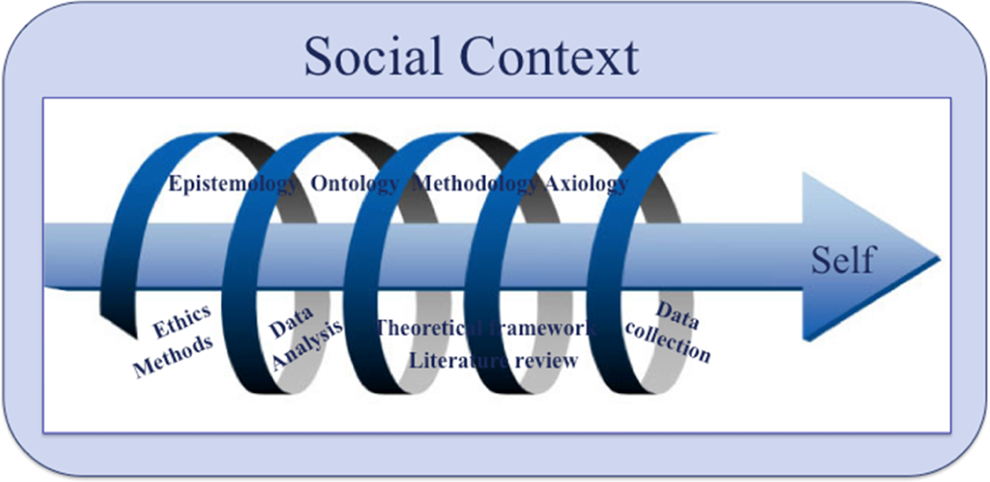
Critical reflexivity model. This figure illustrates the spiral relationship among research elements, the self, and the social context.
The evolution of this final critical reflexivity model (see Figure 1) took about 1 month. Although this model was based upon limited sup group members’ personal experiences and cannot be generalized for the research journeys of all researchers, its emphasis on a better understanding of “I” in my research has the potential to inspire other students, supervisors, and researchers who are interested in critical methodologies.
Embracing the Spiral
This critical reflexivity model demonstrates the relationship between the researcher, their research, and the social context in which both are situated. To begin with, the researchers’ reflexive journeys helped elucidate research motivations and methodological choices, which occurred far before and further beyond the methodology moment itself. This is especially true in the positioning and repositioning of the researcher, “I,” while learning, choosing, and using critical methodologies. In other words, before they had methodologies, they had stories and reflections on stories of real lives with real challenges, traumas, and intriguing questions, which brought real people into the research space.
Before, during, and after Misty adopted indigenist research methodologies, we learned about the colonial legacy of identity fragmentation. She was inspired by her community’s tradition of corn that has been kept alive through traditional farming practices, story telling, and ceremony despite systematic repression. She stays true to the cosmic interconnectedness of ash-te-he to honor the decolonizing work of her research project. Before, during, and after Li adopted critical hermeneutics for her doctoral research on CFL international students in China, she experienced first-hand complex and unpleasant encounters with identity negotiation for linguistic minorities and chose to capture this experience through autoethnography. At the same time, she developed her project using critical hermeneutics where text, context, and reflexivity are key to uncovering power dynamics in contexts similar to those in which she is living. Before, during, and after Donna combined critical theory with political purpose to conduct a critical ethnography of intergenerational political learning, she viscerally experienced the challenges of parenting in a heteronormative, patriarchal, capitalist, and racist world. As she negotiated this new space, she learned to problematize her privilege while also accepting her roots. Before, during and after Ayesha, constructed her master’s research project, racism, religion, gender, and class determined Ayesha’s experiences as a Canadian-born woman who practices hijab. In her research, she linked personal narratives to dominant social discourses and structures that construct exclusionary definitions of Canadian identity. However, in the process, she found herself experiencing the “reflexivity of discomfort” as she negotiated her insider/outsider status as a researcher and wondered how she could explain her role and status as both a member of the researched group as well as the researcher—she realized that there was no room (or reason) for objectivity in her research.
This ongoing and interactive relationship between the researcher, her reflexivity, and research design is exactly why the authors envisioned the research process as a spiral within which methodology is only a part, but a part to which they repeatedly spiraled back and forth throughout the research journey. For example, they foreshadow and reflect on methodology when choosing and illustrating research epistemology, ontology, axiology, theoretical framework, and literature review. They also go back to refer to methodology when considering ethics, methods, data collection, analysis, and writing.
In addition, as the authors thought and rethought this spiraling process through the lens of their own experiences, they realized that the self or the “I” should not be located outside of or even side by side with the research project. It is actually the core of the spiral, the soul of the research journey, the center around, and through which the rest of the research process is experienced. Methodology is not an inert concept that exists outside of themselves. It spirals back and forth to who we are in the world. Although the “I” is demonstrated as a straight arrow in the model, it does not mean that the researcher’s identity negotiation is unidimensional or smooth. Instead, with ups and downs, the reflexivity of the researcher is constantly changing and is dialectically interwoven with methodology development as well as the entire research journey.
Lastly, researcher stories are not just about individual selves; they are embedded in the social, political, economic, and historical context in which we exist not only as neutralized researchers but also as racialized, classed, and gendered beings. This contextualized understanding of our research process is evident in the stories above. For critical methodologies and research, acknowledgment and analysis of power dynamics are key to reflexivity.
In summary, the critical reflexivity model demonstrates how the seed of methodology takes root and sprouts in the soil of our own stories and self-reflection. The self or identity of the researcher is the core of the research journey and significantly impacts the ongoing research process, particularly the choice and development of methodology. Social context, then, not only surrounds the self and the research spiral but also enables researchers to make meaning of power dynamics and relationships.
The building and rebuilding of this model inspired sup group members to recognize its importance for other graduate students and novice researchers. Most graduate students can get through graduate school without paying any attention to this model. However, if, like the authors, one chooses a critical methodology, the methodology demands constant self-reflection, and this can and should be commenced as early and as consciously as possible. The first step that can be taken by new critical methodology researchers is to refer to the critical reflexivity spiral and keep the following questions in mind: What are our assumptions about the world, about knowing, about being, and about learning? What do we know? What have we forgotten? What do we need to learn? Or what do we need to relearn? What is the context within which, and in relation to which, ourselves and our research are embedded? We come back to these questions again and again, always with our stories to guide us as we write and rewrite them within the never-ending spiraling process.
Learning From the Literature
As critical scholars, it was inevitable for the authors to engage in a reflexive process, and working together, they formulated their own conceptual model of the process. Only later did they investigate the literature on reflexivity wherein they found a robust and rigorous base of literature in qualitative research that validated their process and conceptualization.
Researcher reflexivity has a long history as a meta-analytical process of self-awareness integral to qualitative research (Finlay, 2002). Reflexivity has been described as important in the evolution of qualitative research (Finlay, 2002) for providing a distinguishing characteristic that contrasts with quantitative research (Seganti, 2010; Walsh, 1996); is “essential in augmenting the integrity, credibility, and trustworthiness of qualitative inquiry” (Valandra, 2012, p. 204); and is “central to debates on subjectivity, objectivity and, ultimately, the scientific foundation of social science knowledge and research” (Hsuing, 2008, p. 211).
Reflexivity is defined as “an awareness of the ways in which the researcher as an individual with a particular social identity and background has an impact on the research process” (Robson, 2002, p. 22). Researchers are expected to actively and continuously engage in critical reflection throughout the entire research process including while identifying the research problem and questions, gathering information, analyzing and interpreting findings, and writing the research (Finlay, 2002; Guillemin & Gillam, 2004; Hamdan, 2009; Kanyangale & Pearse, 2012; Kleinsasser, 2000).
Traceable to anthropological research, such reflexivity was originally thought to be a means of controlling the “researcher’s own values, assumptions and biases…as part of a rigorous pursuit of neutrality and objectivity” (Kanyangale & Pearse, 2012, p. 192). However, this view was later questioned by feminist and critical qualitative researchers who sought to uncover the power dynamics within the research relationship (Ellwood, 2006; Finlay, 2002; Kanyangale & Pearse, 2012) and by constructivist researchers who “conceptualize the researcher as an active participant in knowledge reproduction rather than as a neutral bystander” (Hsiung, 2008, p. 212).
More recently, conscious self-awareness of one’s theoretical predispositions, intellectual assumptions, beliefs, biases, and values (Hsiung, 2008; Kleinsasser, 2000; LaBanca, 2011) and one’s positionality, subject locations, identities (Hsiung, 2008; Mosselson, 2010; Patiño Santos, 2011), and “upbringing, memories and sensibility” (Mignolo, as cited in Ellwood, 2006, p. 68) have become an expectation of qualitative researchers. According to Walsh (1996), it is the researcher’s task to simultaneously comprehend the participant’s “web of social and historical meanings” and the researcher’s “web of assumptions” (p. 378). The rationale for a reflexive approach is as follows: as “an acknowledgement of the inquirer’s place in the setting, context, and social phenomenon he or she seeks to understand” (Kleinsasser, 2000, p. 155); as a means of enhancing the rigor, quality, validity, trustworthiness, and transparency of the research (Finlay, 2002; Guillemin & Gillam, 2004; Mosselson, 2010); as an evaluation of the research process itself (Kanyangale & Pearse, 2012); and as a means to reveal power dynamics and the role of social context in the research process (Ellwood, 2006; Finlay, 2002; Kanyangale & Pearse, 2012; Kleinsasser, 2000; Mosselson, 2010).
Reflexivity is a social, relational, and intersubjective process between the researcher and the research participants (Kanyangale & Pearse, 2012; Valandra, 2012) that is often conceived of as a collaborative, mutual, coconstituted, and negotiated endeavor (Finlay, 2002; Santos, 2011). According to Finlay (2002), “collaborative reflexivity offers the opportunity to hear, and take into account, multiple voices and conflicting positions” within particular social contexts (p. 220).
The practice of reflexivity recognizes that knowledge is coconstructed (Finlay, 2002; Guillemin & Gillam, 2004; Hsuing, 2008) and acknowledges research as a learning process (Labanca, 2011; Mosselson, 2010). According to Guillemin and Gillam (2004): Reflexivity involves critical reflection of how the researcher constructs knowledge from the research process—what sorts of factors influence the researcher’s construction of knowledge and how these influences are revealed in the planning, conduct, and writing up of the research. A reflexive researcher is one who is aware of all these potential influences and is able to step back and take a critical look at his or her own role in the research process. The goal of being reflexive in this sense has to do with…recognizing the limitations of the knowledge that is produced. (p. 275)
Critical and feminist researchers who emphasize the power relationships embedded in the social microcosm that is the research process demand that researchers engage in a critically reflexive process, so that “we can contribute to a fuller understanding of power in culture and society from which we would all benefit” (Mosselson, 2010, p. 493). Finlay (2002) argues that researchers who presume shared and equal realities are disguising “essentially unequal relationships” (p. 220). She advocates reflexivity as a “social critique” situated within theoretical understanding of the social construction of power, and she suggests that “reflexivity has the potential to be a valuable tool to…empower others by opening up a more radical consciousness” (p. 225).
Thus, the literature supports the authors’ critical reflexivity model that visually depicts the components of research, the self, and the social context in relationship to each other. The literature also validates their idea of reflexivity as a continuous and ongoing element of the research process. From the authors’ own experience, they depict this relationship as a spiral, signifying the way the critical researcher revisits all the components again and again with new understandings each time, so that they learn “the same lessons from new angles” (Bateson, 1994, p. 40) and “what appears to be a repetition is often a return at the next level of a spiral” (p. 29). Bateson’s learning spiral particularly captures their attention because it speaks so well to their own spiraling experience. “Because it is impossible to step into the same river twice,” Bateson reminds us, “one can learn from each return” (p. 44).
Conclusion
Qualitative research is concerned with human meanings and interpretations mediated by language and social processes. Personal reflexivity in the research process “requires an awareness of the researcher’s contribution to the construction of meanings throughout the research process, and an acknowledgment of the impossibility of remaining ‘outside of’ one’s subject matter while conducting research” (Nightingale & Cromby, 1999, p. 28). Thus, in a reflexive research process, we must constantly turn the gaze onto ourselves, including our own thoughts and assumptions. Epistemological reflexivity encourages us to reflect upon the assumptions (about the world, about knowledge) that we have made in the course of the research, and it helps us to think about the implications of such assumptions for the research and its findings. (Willig, 2001, p. 32) Situating oneself in the social space from which one comes and considering the lenses through which one views one’s position, as well as considering how the research topic relates to one’s self, are all channeled into my understanding of reflexivity. (p. 379)
If reflexivity is truly “indispensable to the qualitative researcher,” then, as Kleinsasser (2000) suggests, the habit of critical reflexivity must start early (p. 158). Furthermore, “reflexivity must be developed and valued, especially in graduate school experiences. One way for beginning researchers to develop reflexivity is to practice it” (Kleinsasser, 2000, p. 158). For the four authors of this article, the collaborative intellectual space of sup group afforded the opportunity to reflect upon reflexivity and to collectively develop the model introduced in this article.
For the authors, critical reflexivity is a form of researcher critical consciousness that is constant, dynamic, and infinite. In reflecting together upon their own research journeys, they observed that the starting point of the spiral was within themselves, within their own experiences as racialized, gendered, and classed beings embedded in complex, contradictory, and unjust social–political–economic–historical contexts. As researchers, they ask challenging questions; choose critical methodologies; and engage with social, political, cultural, and economic analyses that return them again and again to the self. In this way, researchers spirals through their research journey, constantly reflecting on dynamics of power and privilege, context, and location.
But, they don’t do it alone. Indeed, the very notion of reflexivity implies a social engagement between self and other, researcher and participant, an engagement that consciously attends to the social context within which people and the research are embedded.
Moreover, a researcher doesn’t have to do it alone. This group of authors did it together within a collective but fragile space that they stubbornly carved out of the often inhospitable environment of the academy today. In sup group, they decentered the “individual,” debunked the myth of the individual learner/scholar/student and made space for a community of scholars (Chovanec et al., 2012). They drew on the diverse experiences and rich perspectives of each group member who brought not only their thesis research but also many years of life and research experience. This has been usually referred to as collaboration, but they see it as more than that. They see it as knowledge that is collectively constructed. For them, the synergy of this collective knowledge creation has almost a spiritual dimension when, for example, the combination of a whiteboard, colored markers, and everyone’s input almost magically materialized into coherent research questions. They also decenter power while still recognizing that there are always power dynamics in play. They consciously work at negotiating power dynamics and flattening hierarchies, even though they have occasionally regressed, for example, when the supervisor inadvertently assumed institutional decision-making power (Chovanec et al., 2012).
As adult educators, the authors appreciate the prevalence and importance of informal learning in their daily and work lives. Through sup group, they brought this wisdom into the academy. They recognize that learning is situated, that is, learning is not “owned” or held by individuals but exists and develops in the relationships between people, objects, and spaces (Fenwick, 2003).
They urge graduate supervisors and students to work together to create and protect communities and collective spaces in which critical reflexivity is experienced as a shared social process, especially when novice researchers are grappling with complex methodologies that have become unmoored from their source in complex lived experiences and social identities.
Footnotes
Authors’ Note
This article is dedicated to the memory of the author Donna Chovanec who passed away in March 2015. She was a compassionate educator–scholar–activist whose wisdom, passion, and generosity inspired everyone who met her. The four authors of this article acknowledge the contributions of the other students in our graduate supervisory groups Ariel Bowering, Evelyn Hamdon, and Laura Servage, whose experiences added to the wisdom that ultimately led to this article and the model contained herein.
Declaration of Conflicting Interests
The author(s) declared no potential conflicts of interest with respect to the research, authorship, and/or publication of this article.
Funding
The author(s) received no financial support for the research, authorship, and/or publication of this article.
Notes
References
Supplementary Material
Please find the following supplemental material available below.
For Open Access articles published under a Creative Commons License, all supplemental material carries the same license as the article it is associated with.
For non-Open Access articles published, all supplemental material carries a non-exclusive license, and permission requests for re-use of supplemental material or any part of supplemental material shall be sent directly to the copyright owner as specified in the copyright notice associated with the article.
