




Abstract
Communicating research information to stakeholders can be challenging, but it increases research uptake and impact beyond the academic audience. Using art-based methods to convey research results has been shown to be very effective in reaching diverse audiences. The project reported herein used Forum Theater to convey study results on different perspectives about water security. Performances included built-in data collection procedures, which verified previous research findings from more conventional study types. Postperformance focus groups examined the efficacy of Forum Theater for research communication. Audience members suggested that the play was very engaging and a salient, credible, and legitimate means of communicating research results. Implications for researchers, policy makers, and stakeholders are discussed.
Keywords
Introduction
Sonar works by transmitting and receiving sound pulses, called “pings” in acoustic and electrical forms to measure the distance to an object, which, by reflecting that ping, provides a cursory form of two-way communication. Researchers, in this age where science and society are renegotiating their relationship (Estabrooks et al., 2008; Gibbons, 1999), are actively seeking ways to transmit their research results to wider audiences and receive wider signals about where their research is making an impact. Further, society has started sending out their own pings in search of researchers who will listen to their needs and echo them in return with products that help solve actual problems rather than conceptual ones. Various emerging fields of research, such as sustainability sciences, are actively building frameworks and models describing how researchers should approach the design of transdisciplinary and problem-based participatory research (see, e.g., Lang et al., 2012; Miller et al., 2014; Wiek, Ness, Schweizer-Reis, Brand, & Farioli, 2012). Only recently have new methods for research communications in these contexts emerged.
In this article, we describe a Forum Theater (Boal, 1995) presentation of social science-based water security research results. We explain how we used a novel arts-based research translation tool to deepen a conversation about water security in a river basin. We also test the credibility, salience, and legitimacy of the knowledge mobilization product. We begin by describing the need for the tool through our literature review. We then discuss the conceptualization of the product, its implementation, and the evaluation of the product with respect to our goals. We provide a flowchart depicting the process we followed. Results from the built-in data collection and evaluation steps are reported. We discuss the implications of the protocol for researchers and society in general and conclude with future research directions. The goals of this article, then, are to describe one method of: overcoming the community-based barrier of community members being used as research subjects without mechanisms for influencing future research directions (Weerts & Sandmann, 2008); overcoming the academic barriers of time commitment for dissemination of results using engaged research (Calleson, Jordan, & Seifer, 2005); creating a knowledge mobilization policy space where policy makers, stakeholders, and researchers could come together (Cooper, Levin, & Campbell, 2009); and providing a new way to empower communities and enlighten scholars that extend from mutually agreed upon engagement (Bharadwaj, 2014).
This research has practical implications for university departments, administrators, and research coordinators by describing a project that brought together two very different disciplines, water security, and performing arts. The research is also useful for theater practitioners including playwrights, directors, and actors-seeking opportunities to find source materials from off the beaten path, increase research profiles, and work with interdisciplinary partners. Finally, this research is useful for stakeholders wanting to advise research partners on different ways of engaging with them beyond the conventional report, presentation, or manuscript formats.
Background
A Fleet of Workshops
Beginning in January 2012, a series of mixed-method water security workshops were held across the Saskatchewan River Basin (SRB). The SRB is a large river basin spanning the three prairie provinces of Canada (Alberta, Saskatchewan, and Manitoba) and exemplifies many global transboundary river water struggles (Gober et al., 2015; Strickert et al., in press). Each workshop sought to include water stewards who were engaged in water management or who had livelihood responsibilities connected to water. Prior to each workshop, a web-based survey was administered to participants (see Gober et al., 2015). In the subsequent workshops, four methodologies were used including: q-sorts, mind maps, focus groups, and a synthesis exercise in the form of a mock press conference. Data from these workshops were recorded, transcribed, and analyzed by multiple researchers (Strickert et al., in press). We presented a range of perspectives among water stewards in the SRB. Following the presentation, participants engaged in a sense-making activity. The participants were content with the results and provided sound narratives to explain the results. One participant stated, “not only are these perspectives accurate, I could put names and faces to the perspectives.” Still, the leader of the research team left with a feeling of dissatisfaction. When discussing with another member of the research team, the leader stressed the need to try something different to convey the essence of the perspectives. Hitherto, the perspectives had been presented in static form using the conventional PowerPoint presentation and time-intensive workshops. The other team member’s suggestion to overcoming convention was radical: use the perspectives to form the basis of a theatrical play.
The Research-Policy Gap
The gap between research, policy, and practice is often described, both in the arts and the sciences (Champagne & Lemieux-Charles, 2004; Cooper & Levin, 2010; Nutley, Walter, & Davies, 2007). Research policy gaps include the lack of scientific outputs in a format that policy makers understand, the consideration of how scientific research results will alter the policy world, and the knowledge that the scientific products are going to address the needs of policy makers. The search for ways to strengthen the connections between researchers and society and thereby improve the contribution of research to policy and practice is occurring across sectors, disciplines, and countries (Cooper et al., 2009; Levin, 2008; Sin, 2008). In fact, the focus of the Connections Grant program of the Social Sciences and Humanities Research Council in Canada (SSHRC) is “knowledge mobilization”—the multidirectional flow of research knowledge across academia and society as a whole in order to inform Canadian and international research, debate, decision, and actions (SSHRC, 2014). The multidirectional flow of information has been called a triangular policy space (Thompson, 2008). A triangular policy space is required for effective knowledge mobilization and coproduction (Figure 1).
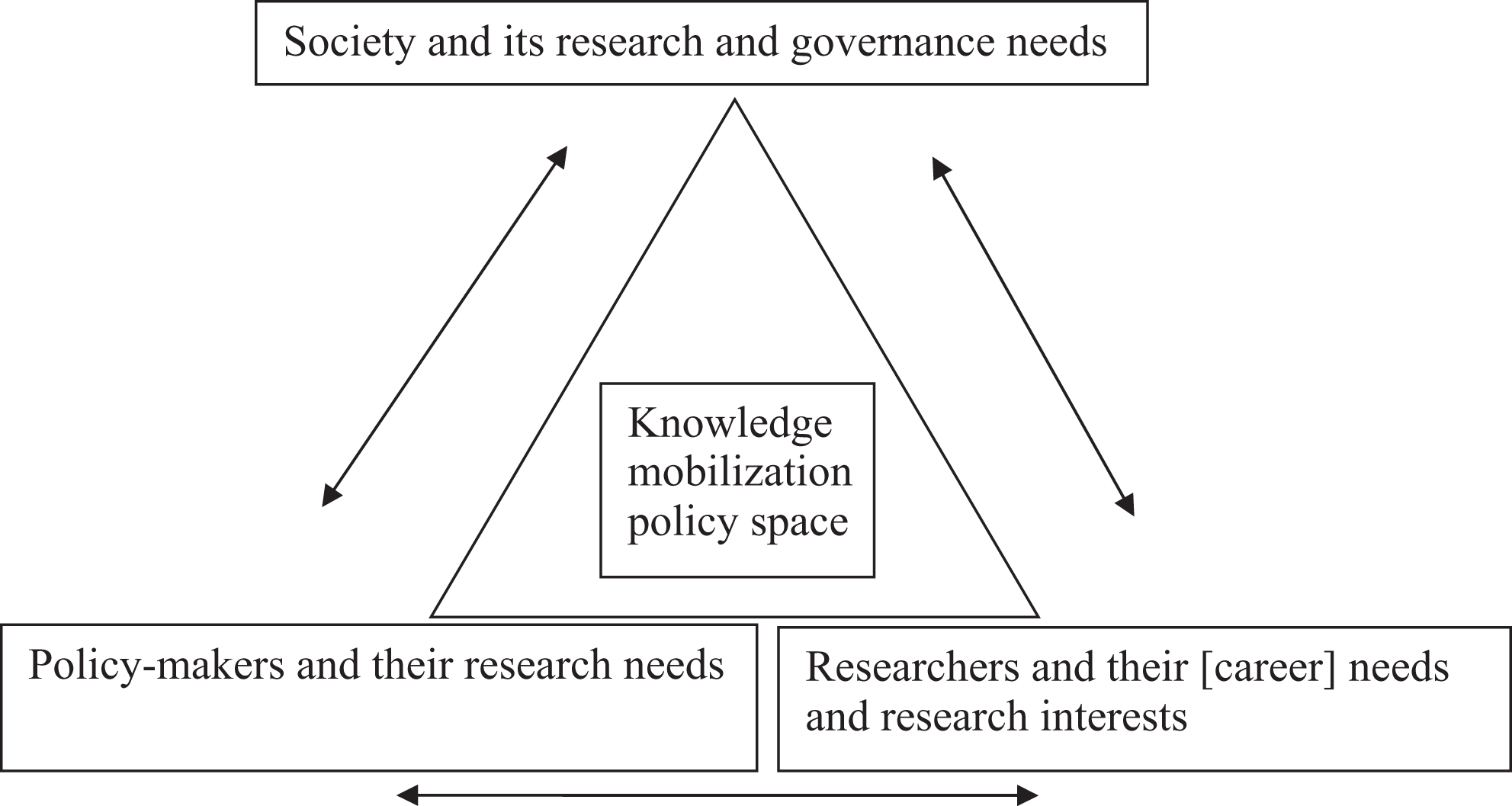
Triangular knowledge mobilization policy space.
The science and policy literature has identified gaps between the current supply of scientific information and the knowledge requirements of policy makers (Crona & Parker, 2011; Klerkx & Leeuwis, 2008; Sarewitz and Pielke, 2007). It is recognized that researchers and stakeholders diverge in their perspectives of what constitutes effective governance and policy. This divergence can impede policy making (Ascher, Steelman, & Healy, 2010; Larson, White, Gober, Harlan, & Wutich, 2009; Parker & Crona, 2012). At the same time, it has been pointed out that flexible, multidirectional, and iterative engagement is needed for science–policy interactions (Lemos & Morehouse, 2005) and also for hearing and responding to diverse stakeholder voices to achieve effective deliberative processes (Beck, Belliveau, Lea, & Wager, 2011; Ney, 2009; Thompson & Hoggett, 2001). Hence, engaging the three key players needs to be more than an outreach activity, it is a social process that lends itself to social science inquiry (Crona & Parker, 2012; Dilling & Lemos, 2011; Jacobs et al., 2010; White et al., 2010;). It is no longer enough to metaphorically send out pings as a researcher or policy maker nor for a stakeholder to be only a captive audience; one must also now listen for the audience’s replies, evaluate one’s performance, and reflect on one’s effectiveness to bridge the science–policy divide. Bridging that divide only resolves a part of the knowledge mobilization policy space. Stakeholder perspectives deserve a place at the table and are augmenting policy debate through knowledge coproduction channels (Needham, 2008; Pohl et al., 2010).
Knowledge coproduction should aim to be scientifically credible, locally legitimate, and salient for decision makers (Ascher et al., 2010; Cash et al., 2003; Kates et al., 2001). A challenge for coproduction is using appropriate objects and language that brings diverse people together toward a common goal (Wenger, 1998). Boundary objects are concrete or abstract tools that facilitate the translation, sharing, and use of knowledge across disciplines and cultures (Crona & Parker 2012; Guston, 2001; Star & Griesemer, 1989; Wenger, 1998). Boundary objects can facilitate knowledge coproduction and its use in community, research, and policy settings. Examples of boundary objects include figures, maps, field notes, or even stories that link different people together and allow collaboration over a common problem. Researchers have suggested that knowledge coproduction can be enhanced by using artistic products as boundary objects to open a discussion about scientific findings (Boydell, Gladstone, Volpe, Allemang, & Stasiulis, 2012; Rossiter et al., 2008).
Arts-Based Knowledge Mobilization Policy Spaces
Arts-based approaches are increasingly being employed as a way for conducting and disseminating research in scholarly settings (Beck et al., 2011). Artistic expression has been used as a means of gathering, analyzing, and disseminating data (Kerry-Moran, 2008; Rossiter et al., 2008), especially in the education field (Knowles & Cole, 2008). Art has been used successfully to communicate research results in health research (Boydell et al., 2012; Mienczakowski, 2001; Rossiter et al., 2008), reconciliation (Johnston & Pauls, 2014), and feminist theory (Butterwick, 2003). Working from the arts perspective allows for an expansion of representational possibilities due to a more fully embodied response from researchers and from audiences (Boydell & Jackson, 2010; Kontos & Naglie, 2007 in Boydell et al., 2012). Moreover, presenting research results as art allows dissemination to a wider audience than the conventional manuscript, formal report, or community presentation (Cole & Knowles, 2008). Arts-based dissemination also allows researchers and artists to cocreate boundary objects and performances that induce change and direct dialogue about social issues (Gergen & Gergen, 2011).
Theater engages audiences on a cognitive and emotional level (Cole & Knowles, 2008). By using verbal and nonverbal communication, theater has the potential to enhance understanding of complex emotional, interpersonal, psychosocial, and transboundary dynamics that arise in resource policy and management deliberations (Nwadigwe, 2007; Shanley & López, 2009). Forum Theater originated with Boal (1995) and is a type of theater that acts as a forum to help people understand how they can change their world (Brown & Gillespie, 1999; Colantonio et al., 2008; Schutzman & Cohen-Cruz, 1994). In Forum Theater productions, audience members are considered actors and can direct the way the play reaches its climax through various processes (Boal, 1995). Forum Theater is more than a one-way outreach activity; it provides a forum for stakeholder, researchers, and policy makers to discuss problems in a contextualized way (Jacobs et al., 2010; Shanley & Lopex, 2009). Using Forum Theater, community members can influence the expression and outcome of a research or policy-driven narrative to provide messages about future research directions, policy alternatives, and context-specific factors. Academics can also triangulate their findings through the audience’s response to the narratives and Forum Theater directives they provide to the actors as well as the audience’s reception of the production.
During this project, we studied whether a Forum Theater performance can portray the interactions between contending perspectives on water security in the SRB. We first used a draft script as a boundary object, then the actual performances as social science research triangulation (i.e., looking at something from different angles or viewpoints; see results below).
Creating the Play
The process for this project involved three stages (Figure 2). The first was research translation, which included developing the script. The parts of the play that needed collaborative consideration were the characters, plot, set, and Forum Theater components. The second was the methodological preparation stage where rehearsals began, the tour schedule was finalized, methods for studying the social processes were established, and a pilot performance occurred. The third stage was mobilization and reflection, which included actual performances, data analyses, and postproduction debriefing and reflection.

Protocol for the Downstream production.
Developing the Script and Characters
To bridge the gaps between science and policy, researchers (a sociohydrologist, a social psychologist, and several hydrologists) from the Global Institute for Water Security (GIWS) began an iterative engagement and multidirectional information flow with water stewards in 2012. Eight workshops were held over a 2-year period and results are emerging (see Strickert et al., 2015). A partnership was subsequently formed between the GIWS, Department of Drama, and the School of Environment and Sustainability to coproduce a theatrical performance with built-in social science research components and to then take it on a tour to various communities in the SRB. The characters and plot lines in Downstream were based on the 2012–2013 workshop results (Table 1). In consultation with the Department of Drama, we hired the University of Saskatchewan’s playwright in residence to produce a script for us. The playwright worked frequently with the project team to understand what the results of the water security workshops meant in terms of human interaction and characterization. The perspectives derived from the workshops and their transformations to characters in the play are described in Table 1. Water management sectors, which argue for resources during the second part of the play, are derived from the perspectives as well but include social and operational consequences of policies in their scripted lines to alert the audience to how decisions affect the different sectors. This stage of the process was the most intensive for the research team, translating the results into workable characters and consulting with the playwright on each character’s lines and features involved both tension and moments of brilliance as has been found in other similar ventures (Belliveau & Lea, 2011; Boydell, 2011; Rossiter et al., 2008).
Research Translation and Representation in Script.

The Plot
The plot of Downstream was crafted to mimic salient issues of water security in the SRB. The plot opened with a “stewardship board” meeting called to come up with a drought management plan. The board meeting was chosen in part to typify a normal event in watershed planning but also to be comical at the extreme portrayal of board member behavior. Each of the characters from the board table were “caricatures” (extreme versions of the perspectives we captured in our workshops), and in the script, we used direct quotes from workshop focus groups with participant permission. During a break in the meeting, it is made apparent that a major flood event is occurring and the board had no plan in place for such an event. Then, the board members “transformed” into stereotypical items representing competing elements of the “water sectors” (i.e., fish habitat to represent idealistic sustainability). As the flood moved downstream, it passed seven different sectors represented by a character. Each character pleaded to the audience for protection and argued with the other actors who presented counter arguments.
During the early stages, the script development team suggested that the audience members could be involved in making controversial decisions during critical points in the performance. Such decisions would direct the outcome of the play, which meant audiences could explore two critical contexts in water management: the difficulty of creating water policy amid competing interests and dealing with unexpected natural events. To construct research data collection opportunities within the script, the team discussed methods of measuring decision making during the show. These included having options for surveying during intermissions, show of hands for directing the plot, and technological advancements such as TurningPoint and audience response system. We settled on an idea of using ping–pong balls to allocate disaster management resources among different “characters” or “sectors” in water management. The play was like a game show, where the different perspectives fought for support from the public (audience) to sway decision makers (key people identified in each local who are actively involved in water management decisions). Using ping–pong balls as allocations allowed for the viewing of decisions on stage through carefully designed set pieces (see The Set below).
The draft script was shared with various stakeholders in the SRB in a modified Delphi strategy. First, a graduate-level class in the School of Environment and Sustainability conducted a script reading with the playwright as an activity designed to expose students to pluralistic democracy, methodological considerations in the construction of research narratives, and issues of power and privilege in Canadian society. This reading also served to help the playwright test how the perspectives were coming through in the characters and text and served as a first level of knowledge mobilization: from researchers into the graduate student classroom. The script underwent more revisions after this initial reading.
Next, the script was shared with stakeholders in a reading performed by students from the Department of Drama. This reading was attended by 10 stakeholders but was also audio recorded and shared electronically with the Socio-Hydrology Research Group of the University of Saskatchewan and other stakeholders who could not attend in person. Comments were provided by these members for the playwright, project coordinator, and producer to revise the text and the plot. This reading and recording served as a second level of knowledge mobilization and an opening of the knowledge mobilization policy gap to a wider researcher, stakeholder, and policy-maker audience.
In consideration of the feedback we received from several stakeholders in the headwater community still recovering from a recent flood, the script was revised to be less satirical about the impacts of a flood. The script was also altered to reflect a more accurate portrayal of the hydrology associated with the basin. Resource allocation options were revised to reflect what was more realistic during the flooding event, and how each sector could be impacted in the fictional river basin. We also wanted to have Aboriginal voices included in a more meaningful way. The script was sent for final comment in December 2013 to a Aboriginal leader as well as leaders of watershed organizations and hydrologists and was completed by February 2014. Research translation into a workable script thus took approximately 6 months.
The Set
The set was designed to be portable, as the performances were part of a touring show. A reverse projection screen was used onstage. The screen allowed the posting of the agenda during the scenes in the boardroom (Figure 3a). As the focus of the performance shifted from drought to flooding, photos of recent floods in the SRB were projected. The board table transformed into podiums with images to depict the sector. Further, lighting effects were used to highlight the allocation of resources as audiences and key decision makers worked through the scenarios (Figure 3b).

The set components for Downstream.
Direct quotes from focus groups that took place during the previous workshops were displayed on time with the actors saying them, when possible. Additionally, the options for flood protection were presented on the screen after the actors pleaded for resources (Figure 3c). It was important that this occurred so data collection on the decision making in the performance corresponded to the choice elements that the research team sought to test.
The main set piece was a board table that at first looks like a rather dull set piece. It worked well to quiet the audience and transport them into a tedious board meeting to which they could easily relate. The table was transformed into repositories for the ping–pong balls part way through the show. The “tubes” then contained the allocated balls for the duration of the performance, so audiences could be reminded of their choices and so the balls could be recounted for verification after the show was complete (Figure 3d).
Forum Theater Activities
On entering the performance venues, a map of the SRB was presented in order to prime audience members about the region that would be discussed in the play. Research team members and stage crew greeted the audience members individually. Audience members were asked to sign a map of the SRB titled “I Care About Downstream” (Figure 4). The map was also presented to educate the audience on the size of the basin, destination of upstream wastes, and existing downstream communities.

Map of Saskatchewan River Basin with signatures.
Five members of the audience who had participated in workshops were recruited via e-mail before each performance to act as decision makers during the Forum Theater portion. Informed consent was received prior to the performance. Decision makers were selected based on their roles in the water sector. The decision makers were instructed that they would make decisions about how to allocate resources at specific points in the performance. Each decision maker was given a bag of resources (i.e., 40 ping–pong balls) and was directed to front-row seating for the performance. Decision makers were instructed that before making their decisions, they would hear arguments presented from different characters. The audience would also be free to make demands on the decision makers. The decision makers could additionally draw on their own personal experiences. At each decision point in the play (Table 2), the decision makers had limited knowledge, time, and resources to make their allocation choices, just as in real life. They could not simply select the best strategy for each case in the play or they would run out of resources.
Scripted Decision Points and Descriptions.

At each decision point, the audience and key decision makers were presented with between two and four choices for flood protection options for the water sector arguing their need. After each actor spoke, the general audience was directed to coerce the decision makers. The decision-making scenes ended with an active process, where decision makers had to deposit the balls into containers on stage, and audience members could see the record of decisions throughout the performance (see Figure 3d).
The general audience members were given one ping–pong ball as they entered the venue and told they would need it at some point during the performance. During select decision points (prairie town, oil field, and delta village), audience members were permitted to donate their resource to the common cause of flood protection just as citizens can contribute to similar efforts in real life. The total amount of balls that the decision makers started with was 200 balls, however, to select the most costly strategies over the course of the performance would require more than 200 balls thus forcing tough choices. There were also 40 secret balls held by the actor representing the oil field, a recommendation from participants in the pilot performance and which represented the view that the energy sector was wealthy and could provide for their own infrastructure protection.
Finally, we wanted to learn about the audience’s reception of the perspectives as they were personified by characters and water sectors. Therefore, follow-up focus groups were conducted with willing audience members and key decision makers at each venue. Informed consent was again received prior to the focus group.
Thus, the script, plot, characters, set, and built-in research design offered the opportunity to let stakeholders in the audience drive the decision making through their coercing of key decision makers (also stakeholders) contributing to Goals 1 (using a mechanism for community to influence further research) and 3 (creating a knowledge mobilization policy space). The researchers could then measure and learn from the audience about how they would allocate resources during uncertain decisions during the Forum Theater activities. The researchers were also given the opportunity to learn about the effectiveness of Forum Theater as an engaged research method through the focus groups and follow-up analyses, informing Goal 4 (enlightening scholars from engagement).
Results
The play was performed 5 times in four locations spanning the SRB during February 2014 (Table 3). Performances occurred in Calgary (an upstream urban center), Medicine Hat (a midstream small city), Saskatoon (midstream city), and Cumberland House (downstream delta community of First Nations and Métis people).
Performance Location and Attendance.

aAn unexpected snow storm prevented more audience members from attending this performance.
Pilot Performance
We invited students, academic staff, and government workers in relevant departments with a presence on campus (Environment Canada and Agriculture and Agri-Food Canada) to attend a dress rehearsal as a pilot test of the data collection protocol. We also contracted the on-campus media and production services to record the performance and produce a video and a short trailer for the show to be used as an educational tool for local high schools and other interested departments on campus (https://www.youtube.com/watch?v=k6USx9JaQ94). The pilot provided valuable feedback: The oil field was allocated a secret supply of resources, the mechanics of voting with ping–pong balls was tested, and focus group interview guides were refined.
Decision-Making Results
We next turn to describing the results from the performances, beginning with the allocation of flood protection resources (ping–pong balls) in the different locations. The decisions made during the performances revealed interesting trends (Figure 5). There is an immediate divergence of ideas by the downstream audience, the delta First Nations community, in the first decision scene. The decision makers from the First Nation community chose to flood and compensate growers in the upstream Irrigation District while the three urban and midstream audiences chose to do nothing and hope for the best. The divergence continues as the flood moves downstream; at a key fish habitat, one group decided to rescue the fish and another decided to restore fish habitat postflood, while three groups decided to riprap the bank for fish habitat protection. As the flood hit the First Nations Reserve Golf Course, four groups converged choosing the least costly option of building a tiger dam, while only one group chose a slightly more expensive option of a rapid deployment floodwall. All five groups chose to build a rapid deployment floodwall to protect the water treatment plant. To save the prairie town, four of the groups chose to construct a rapid deployment floodwall around the entire town, whereas one group decided to build a round bale barrier to protect the central business district. As the flood approach an oil and gas field, four groups chose to place sandbags around each well, while one group decided to do nothing and hope for the best. Finally, at the delta village, three groups chose to increase the height of existing levels and two groups decided to evacuate the community.
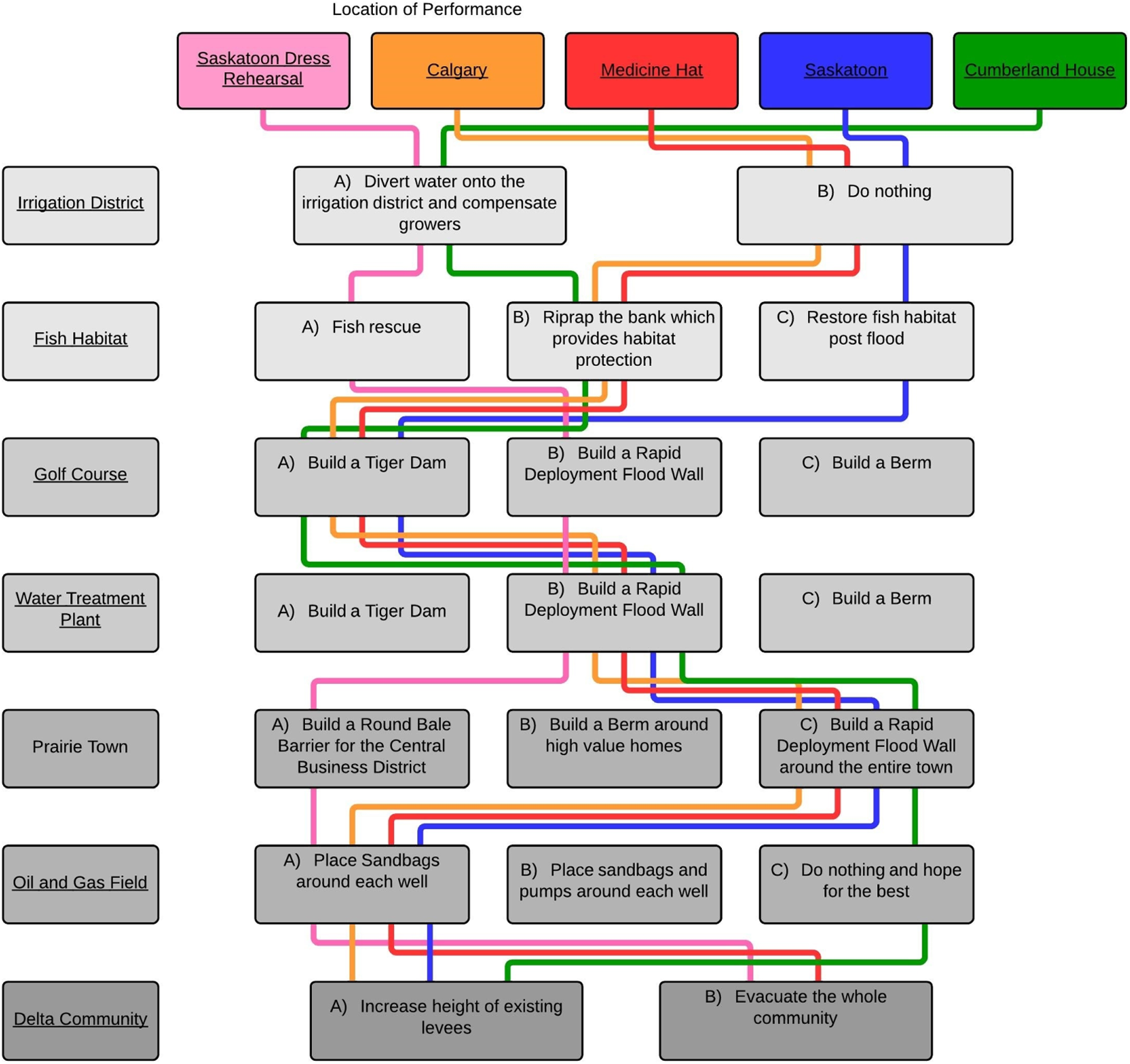
Allocation choices made in each performance. Note the number of balls available to the general audience (nondecisions) was controlled in each performance to create enough scarcity of “resources” to warrant trade-offs.
Postperformance Focus Groups
After each performance, we ran two focus groups, one with the general audience and one with the five key decision makers. The audience members were first asked to describe how they felt about the play, in terms of how it reflected what they believed happens in water management (Appendix).
Their general comments were positive about the entertainment value of the performance. I really like this, how you had the audience involved. That was fun. It wasn’t just a talk at you drama, it was get you thinking, get you involved, I think it was a really smart way to do it. You could see us discussing things and playing things out. That was much more engaging I think. It made one think of our Saskatchewan neighbors. I think it puts the audience in position to have to make actual decisions based on the divergent viewpoints and I think that’s the position that policy makers are going to end up in. I think it really catches the dynamics of a board trying to make decisions around a table, and uh it’s never cut and dry how people make decisions and they always bring their personal, um, I guess part of the decision-making into it, and uh it’s really hard to get people to think collectively about the same thing and not like I say bring their personal views into it—what’s going to benefit them. That was a very unique way of presenting the challenges of managing a many-stakeholder operation. I think it’s great! You know, having sat through the board meetings of [Watershed Association], you covered at least as much in this hour as we have in the last two years in a much more memorable fashion. I think most of the key points about the challenges of water management were touched on but, it’s, you know that complexity and how do you actually tackle it remains the big questions … I think it just illustrates it to a lot of people who haven’t had to make those decisions before. It’s the emotional decisions that come out of this that really lose the science and I find that a bit disappointing. I think honestly having the different interest groups represented by characters—that’s an excellent strategy. It nailed it on the head. Well, can’t we just do nothing? On the other hand, diverting water into low-lying areas is one of the few ways that you can actually manage a flood I think it’s pretty realistic that there are competing interests, and whether it’s directly accurate about whether they’re necessarily butting heads directly all the time it maybe not true. But I think it’s accurate in that it portrays you know the fact that here’s my side of the story and here’s how it affects you and you might not like it. Pretty entertaining, it’s refreshing to not have death by PowerPoint, thank you. I thought it was interesting, well more interesting than having someone just rail off statistics and different views at you so …. I agree it’s a good way to do it, and it’s a different way to do it and um yeah I just think it’s innovative and it’s good to bring a lot of perspectives into the whole decision-making on water security. We’re all a part of this and we’re all affected by it and it’s very, very good to have the audience and everybody to participate in this because it all affects everybody. I agree and especially when we got to poll the audience, because that included more people not just decision-makers, and that, uh, by seeing faces also its sort of like oh that person’s in favor so that might have influenced my decision.
Overall, the feedback from the focus groups was that the performance was an interesting, legitimate, and effective tool for learning about the challenges of making decisions on water management in a river basin. If you look at most of the successful social movements of the twentieth century … they’ve all used music, … theatre, … methods that appeal to the whole person, … you know a change of heart is by definition not cognitive. One of the biggest mistakes that is often made, particularly within academia, is this idea that evidence alone is going to change anything, and this gets way be beyond that conception … I think the opportunities are virtually endless, … it really does penetrate very deeply.
Achievement and Discussion
Our first research goal was to test one method of overcoming the barrier of community members being used as research subjects without mechanisms for influencing future research directions (Weerts & Sandmann, 2008). We overcame this barrier in three ways: First, we used data from previous workshops to create the characters, plot, and Forum Theater components in the play, which, itself, is a follow-up research project. We sought the insights of previous participants on the draft script. We also combined the feedback from the audience members via the decision points in the play. Their comments in the follow-up focus groups can inform our future research directions by asking what were the most contentious points, moments of synergy, and empathy in water management struggles and the meta-question on the use of Forum Theater for knowledge mobilization in water management.
Our second goal was to test one method of overcoming the academic barriers of time commitment for dissemination of results using engaged research (Calleson et al., 2005). By collaborating with an on-campus fine arts department (drama) and the playwright in residence, we were able to mobilize the research into the performance and conduct five performances within 1 year, comparable, in some cases, to publishing a manuscript. The intensive stage for the researchers was during script generation, where the playwright and researchers needed to communicate regularly about the results to gain a better understanding. Once the script was finalized, the researchers needed to step aside and allow the technical skills of the Department of Drama to lead the production. The researchers involved in this production gained valuable experiences: We learned about how to translate research results into script components, how to triangulate a script among a transdisciplinary research group, and how a touring production is organized. The experiences have enhanced our abilities to write for different audiences and improve the “showpersonship” of knowledge mobilization activities. Additionally, the cast and crew from the Department of Drama learned about water security issues in the SRB; in fact, during parts of the performances they had to be versed enough in the debate to put forward arguments to members of the audience and respond in turn to audience comments.
Our third goal was to create a knowledge mobilization policy space, where policy makers, stakeholders, and researchers could come together. We found that, although the stakeholders and researchers were well represented among our audiences, there was a shortage of policy makers involved. Although preferences for certain actions during crises could be drawn from the ping–pong ball allotment of resources, general opinion on current or potential future transboundary policy was difficult to glean from the plot design and subsequent results. One way to overcome this gap could be to involve more policy makers at the outset and discover their needs prior to script generation, then to include plot components that create a policy space that includes micro- and meta-level policy needs. As a complement to existing knowledge mobilization on transboundary water management in the SRB, the play was successful at engaging a different audience. Outputs from the GIWS include mainly academic manuscripts, workshops, conference presentations, and media releases. Downstream was the GIWS’s first arts-based piece and it received wide media coverage both on-campus and off-campus. The show was free of charge and was performed in smaller, community theaters to allow for broad audience makeup. It enhanced the policy space between researchers and the public through this accessibility.
Our fourth goal was to empower communities and enlighten scholars through mutually agreed upon engagement (Bharadwaj, 2014). By creating this play, we empowered scientists on campus to look to Arts departments to support their knowledge mobilization goals, and we enlightened researchers on a harmonizing research translation format. We shared research results with other researchers on campus through our interactions with faculty in the Department of Drama and with the playwright on campus. We also improved our abilities as academics to use boundary objects (e.g., characters, a script, and set) to discuss research findings among stakeholders, academics, nongovernmental organizations, and government agency workers. We conducted additional research that verified previous results by embedding decision-making situations in the play and by doing focus groups after the performances. We empowered community members to provide feedback on the perspectives we shared and to share their own feelings of water security with us in future projects or with their local watershed associations.
Two context-dependent objectives were also met. According to our focus group participants, we were able to convey the range of viewpoints specifically on water security in the SRB. The six viewpoints came across through the characters of the play, and audience members were vocal in their support for and against particular lines of reasoning for sectors needing protection. We additionally assessed the efficacy of Forum Theater for research communications across the transboundary water policy space through our focus groups and found that this approach was lacking in higher level policy debates. The plot of the play needed to be one that could be delivered in a short-time period and still allow for audience participation. With more time and collaboration, we believe a play that explores deeper policy issues beyond what to do in a one-off crisis situation could be developed. We also learned from our focus group feedback that, at times, the emotional pleas of the characters meant that the science was not a main focus. As we drew our results from workshop data that explored social science themes, we were limited in our exploration of the watershed science. Further collaboration with scientists and the playwright could increase the scientific content of the play in future iterations. (Figure 6)
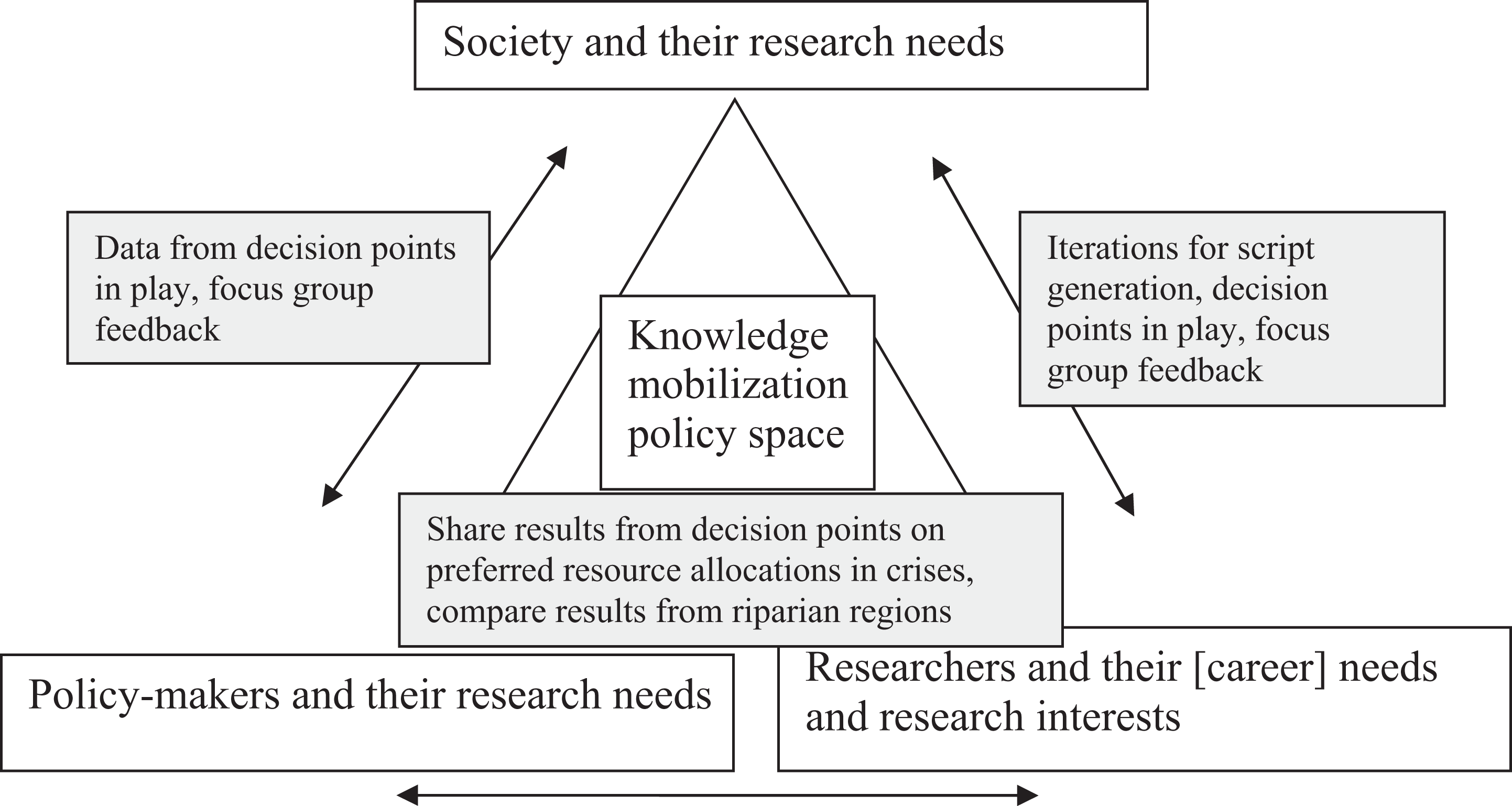
Knowledge mobilizations policy space.
Communicating research information is a challenge that requires outside-of-the-box thinking. Conveying watershed management knowledge through arts-based productions shows promise. In the “information era,” knowledge mobilization requires the multiway exchange of ideas and tools that allow access for all into the policy space are needed.
The production of Downstream connected scientists, artists, and stakeholders in three phase triangular sharing and coproduction of information. First, the research translation stage involved the creation of a script which captured many challenges associated with water security and water governance linked to core viewpoints and critical water sectors. The script additionally acted as a boundary object to bring together researchers from various disciplines, stakeholders, and policy makers from across the SRB to create an artistic product (see Crona & Parker, 2012). Researchers’ experience with the script generation triangulation meant the knowledge coproduction around water security perspectives was enhanced (Boydell et al., 2012). The play was more scientifically accurate based on hydrologists’ input. It offered legitimate decision points through the input of practitioners around the basin. The play was also salient in terms of perspectives being balanced through the input of stakeholders and scientists. The measurement of resource allocations via the ping–pong ball exercises during the play helped to verify results that arose during more standard research studies (Gober et al., 2015; Strickert et al., in press). It also provided opportunities for stakeholders, policy makers, and researchers who were in the audience to use the same mechanisms for sharing their preferences during the difficult decisions. Stakeholders mentioned that they felt that the experience of doing so was similar to what the actual decision makers would be facing in crises.
The second stage of the project included designing the set, finalizing the touring program, and testing the built-in data collection procedures. The set was a key piece of the production that focused the attention of the audience on the key messages being delivered on screen and through the ping–pong ball allocations. The implementation of the tour engaged audience members in reflexive deliberation about the salience, credibility, and legitimacy of the performances.
Our audiences indicated that they were engaged on both a cognitive and emotional level (Cole & Knowles, 2008) and preferred the theatrical production to more conventional reports and presentations. Our audiences did direct the play in different ways across different locations in the SRB (Boal, 1995), but some patterns emerged and are useful for sociohydrologists. Upstream audiences were less likely to take early action to prevent downstream floods, while downstream users did so at the first opportunity and also did not have much empathy toward upstream resource extraction industries. Results such as these are useful for policy makers to understand potential riparian drivers of water management across large river basins undergoing economic development. We also learned that choice experiments need not be laboratory or survey based, and that deliberative processes can be observed in real time through the use of strategically planned Forum Theater components.
As researchers, it is imperative that while we advance approaches for conducting problem-based research, we also advance outreach and engagement tools that are responsive to community needs and present results to communities in accessible and fun ways. Although there is room for improvement, the use of Forum Theater shows promise in complementing conventional knowledge mobilization and research translation tools.
Footnotes
Appendix: Questionnaire
Acknowledgments
We are grateful to the Social Science and Humanities Research Council of Canada, the Canada Excellence Research Chair in Water Security, and the University of Saskatchewan, Department of Drama who provided funding for the program. We are especially grateful to the staff at Greystone Theatre, without whom Downstream would not have been possible. Specifically, we’d like to thank Kenneth T Williams, the Playwright in Residence at the University of Saskatchewan, for writing the script and for being very open to changes put forward by many stakeholders; Natasha Martina who did an exceptional job of casting and directing the play; Ian Rose and Carla Orosz who designed and built a portable set that exceeded our and the audience’s expectations; Beverly Kobelsky and Angus Ferguson who created costumes and props that portrayed perspectives; and Greg Marion for his dedication to the project. Additionally, we would like to thank the cast of students who demonstrated a level of professionalism and dedication that was truly remarkable: Chris Donlevy, Jillian Borrowman, Kody Manson, Jenna Berenbaum, Lauren Younghusband, Phil Munson, Kelly McTaggart, Jesse Fulcher Gagnon, Andrea Folster, and Kashtin Moen. We would also like to thank Douglas A. Clark from the University of Saskatchewan School of Environment and Sustainability for helping us to navigate some tricky political rapids in the production of Downstream.
Declaration of Conflicting Interests
The author(s) declared no potential conflicts of interest with respect to the research, authorship, and/or publication of this article.
Funding
The author(s) disclosed receipt of the following financial support for the research, authorship, and/or publication of this article: Social Science and Humanities Research Council of Canada; University of Saskatchewan; Howard Wheater, Canadian Excellence Research Chair in Water Security.