




Abstract
Traditionally, children’s “voices” have been underrepresented in the field of cultural geography. Rather, “adultist views” dominate. In this article, we describe the methodological process of undertaking a comprehensive, participatory action visual methodologies project known as the Hamilton Photovoice Project (HPP) with children from low socioeconomic status neighborhoods in Hamilton, Ontario, Canada. We also discuss the lessons that we have learned along the way. The purpose of the HPP was to investigate how children in downtown Hamilton experience their metropolitan landscape. Specifically, we examined walking routes for the purposes of identifying desired environmental changes that may increase the use and enjoyment of community walking routes and spaces along routes. In doing so, we discuss what was learned from the methodological process of collecting and working with children’s visual productions, including how children appear to use visual methods. Although children’s visual productions appear to convey complex emotional, social, and political sentiments about their spatial experiences and desired environmental changes, the methodological process is invariably constrained by the institutions that govern and police children today during the research process. Thus, this study contributes toward the ongoing dialogue about the merits and tensions inherent to using children’s visual productions as a way to capture perceptions toward place.
“You have brains in your head. You have feet in your shoes. You can steer yourself any direction you choose. You’re on your own. And you know what you know. And YOU are the one who’ll decide where to go … ” Dr. Seuss, Oh, The Places You’ll Go!

A tattered soccer ball.

Youth shadow.
Literature Review
Pertinent Issues in Children’s Geographies
Cultural geographers posit that children of the late 20th and early 21st centuries are navigating the environment in ways that differ dramatically from the past. Children’s environments today are not only highly regulated and policed by adults but also marked by growing anxieties regarding their safety. Paradoxically, although we are increasingly concerned about the welfare of late 20th and early 21st centuries children, a “safety” discourse characterizes their relationship to the environment today. This safety discourse has greatly diminished children’s opportunities for independent negotiations of their environmental localities (Ross, 2007). Mitchell, Kearns, and Collins (2007) argue that the reduced spatial autonomy resulting from safety concerns may have a profound impact on children’s cognitive, spatial, and experiential geographies. Mitchell et al. (2007) purport that “chauffeured” children of the 21st century may develop a myopic island geography, in which they are acutely aware of the intricacies and nuances of the spaces they are chauffeured to and from but experientially restricted from knowing the everyday localities in between. Further, parents of 21st century children largely do not regard them as competent to make safe environmental decisions (Faulkner, Richichi, Buliung, Fusco, & Moola, 2010; Valentine, 1997). The inability to trust children’s capacity to make independent navigation choices has resulted in children seeming “out of place” in the neighborhood when they are unaccompanied by a parent (Mitchell, Kearns, & Collins, 2007).
Qualitative Descriptions of Children’s Places
Although researchers have conventionally used quantitative research approaches to describe children’s spaces, such as survey or geographic information systems, increasingly, efforts are being made to render qualitative descriptions of children’s spaces from child informants themselves (Fusco, 2012). Qualitative researchers have conventionally relied on interviews, focus group, and visual methodologies to understand children’s environmental relationships. Through verbal narratives and photographs, children consistently suggest that green, natural places facilitate positive perceptions of place. For example, Greves et al.’s (2007) qualitative study with low socioeconomic parents in Seattle found that “being close to nature” was a primary benefit associated with walking their child to school. In a qualitative study conducted with 10, 11- to 13-year-old youth in New York City, Schaefer-McDaniel (2009) found that parks, green spaces, and large outdoor expanses were associated with positive environmental perceptions. Further, a number of researchers have found that the opportunity to engage in social activities with others leads to positive environmental perceptions for children. In a qualitative study by Veitch, Bagley, Ball, and Salmon (2006) that examined parental perceptions toward children’s free play, parents reported that a strong, robust social network with other children was a primary determinant of their child’s engagement with the environment. Similarly, a qualitative study undertaken with socioeconomically deprived youth in New York found that police presence in the neighborhood environment facilitated children’s perception of safety (Schaefer-McDaniel, 2009). Ross’s (2007) qualitative study demonstrated that children’s relationships to significant companions in the environment made for positive evaluations of neighborhood places. In a qualitative study, Fusco, Moola, Faulkner, Buliung, and Richichi (2012) found that those youth who transport actively to school derive much pleasure from the social aspects of their journey, such as interactions with other children, crossing guards, or safe adults. The children in Mitchell et al.’s (2007) study also reported positive constructions of space as a result of social engagement with others. One of the primary benefits associated with participating in Auckland, New Zealand, for children was the opportunity to meet and interact with new friends. In a qualitative study undertaken with socioeconomically deprived, racialized youth in Madison, CA, Oleander (1994) found that a complex web of engaging social relationships are what give meaning to children’s physical landscapes and demarcate adult and child understandings. The opportunity to create and engage in meaningful social transactions characterizes children’s positive spatial perceptions and constructions of place. With respect to other pleasurable environmental experiences for children, research indicates that exposure to natural spaces outdoors may equip them with much needed opportunities to engage in quiet contemplations and reflective musings (Fusco, Moola, Faulkner, Buliung, & Richichi, 2012; Ross, 2007). Ross (2007) states that when children spend time in natural places, they may enhance their ability to generate imaginative geographies.

Seminar artwork.
However, qualitative researchers—including those that rely on visual methodologies—have consistently found that traffic concerns, stranger danger, and parental barriers make for negative spatial experiences. Parents are consistently more likely to regard their own childhoods as safer. They nostalgically hark back to some pure age of innocence, one that was marked by greater play and freedom, and less concern and complexity. They simultaneously do not regard their children as capable of making independent spatial decisions, while, at the same time, fearing that they will encounter harm from dangerous drivers or kidnappers (Faulkner, Buliung, Flora, & Fusco, 2009; Greves et al., 2007; Kearns & Collins, 2003; Veitch, Bagley, Ball, & Salmon, 2006). Empirical literature by Schaefer-McDaniel (2009), Ross (2007), Fusco (2008), Mitchell et al. (2007) emphasizes that children construct their own personal landscapes of risk. Children’s environmental concerns are largely characterized by traffic-related anxieties and fear of dangerous encounters with unknown others (Ross, 2007), such as kidnapping, molestation, rape, or shooting. Interestingly, children who engage in less independent mobility through the environment report greater safety concerns. While children who engage in independent navigations are also scared of traffic and strangers, they are likely to draw on experience to nullify their spatial anxieties (Fusco, 2008; Holt, Spence, Sehn, & Cutumisu, 2008). While children have agency and can negotiate spatial licenses with their parents to allow greater spatial freedoms, their spatial agency is ultimately limited. As illustrated by Faulkner, Richichi, Buliung, Fusco, and Moola (2010), parents are the final arbiters regarding their child’s spatial freedoms and independent mobility. Qualitative researchers have found that inclement weather, fear of getting injured, boredom, and complex time/space/distance negotiations also determine whether children can partake in environmental activities (Fusco et al., 2012).
Research Gaps and Rationale
A review of the existing literature, then, illustrates changing views toward children and place. Children of the late 20th and early 21st centuries negotiate potent risk discourses that have contributed toward their exclusion from public spaces. Although quantitative methods characterize conventional approaches toward measuring environments, it is well recognized that the qualitative paradigm can help us make sense of the complex meanings that children ascribe to space. Access to green, natural spaces, opportunities for social engagement, and a chance to stop and stare characterize the pleasurable aspects of children’s private geographies. Traffic, strangers, and a parental stranglehold on spatial freedoms constitute children’s landscape of environmental risk. Although the literature has greatly advanced our understanding of how the 21st century urban child conceptualizes place, thus far, there is an absence of research that has described the process and methodological insights associated with undertaking visual, place-based research with child informants, and what this may convey about their perceptions toward space. Further to this, most qualitative work has been undertaken with White, middle class youth. While it is known that youth from LSES neighborhoods may negotiate harsher environments (Oleander, 1994), their voices are notably underrepresented in the existing scholarly literature. For example, children from inner-city LSES neighborhoods navigate an inherently riskier environment than other children. Research indicates that such children are more vulnerable to be victims of both physical assault and theft (Deakin, 2006). The adult dominated nature of the outdoor environment is also further intensified in LSES neighborhoods. In particular, there is no existing qualitative methodological work that investigates the spatial experiences of children from LSES neighborhoods in Hamilton, Ontario, Canada, nor the best way to undertake visual research with them in a manner that facilitates communication about these experiences. Building on these critical research gaps, the purpose of this theoretical and methodological article is to reflect on the process of visual methodological work with children involved in the HPP, that is, a visual methodologies project undertaken with Hamilton children that is seeking to change adultist environmental policy with the youthful voices of local stakeholders (Fusco et al., 2012). In doing so, we comment on the purposes, contributions, and weaknesses of this methodology in communicating their place-based experiences and environmental perceptions.

Seminar placards.

Youth learning tree.
Method
Visual Methodologies
The HPP was conceptually informed by community-based visual methodologies. Visual methodologies—such as community art, drawing, and photovoice—are influenced by the pedagogical insights of Brazilian educator, Paulo Friere. As a Marxist, Friere attempted to further the critical education of oppressed groups. With specific reference to migrant workers, Friere’s pedagogical aim was to critically conscientisize the oppressed from a state of silence and disenfranchisement to critical awareness. He sought to forge the problem solving education necessary to think critically about—and ultimately change—vulnerable communities that face hardship (Friere, 1970; Wang, 1999). Children from LSES neighborhoods in Hamilton, Canada, may perhaps be considered as a vulnerable group. This is because they are more likely to be situated in environments that expose them to greater risks, such as pollution, drug use, and heavy car traffic. They may also lack the same access to material resources that wealthier child counterparts have.

Youth group work.

Garbage in a yard.
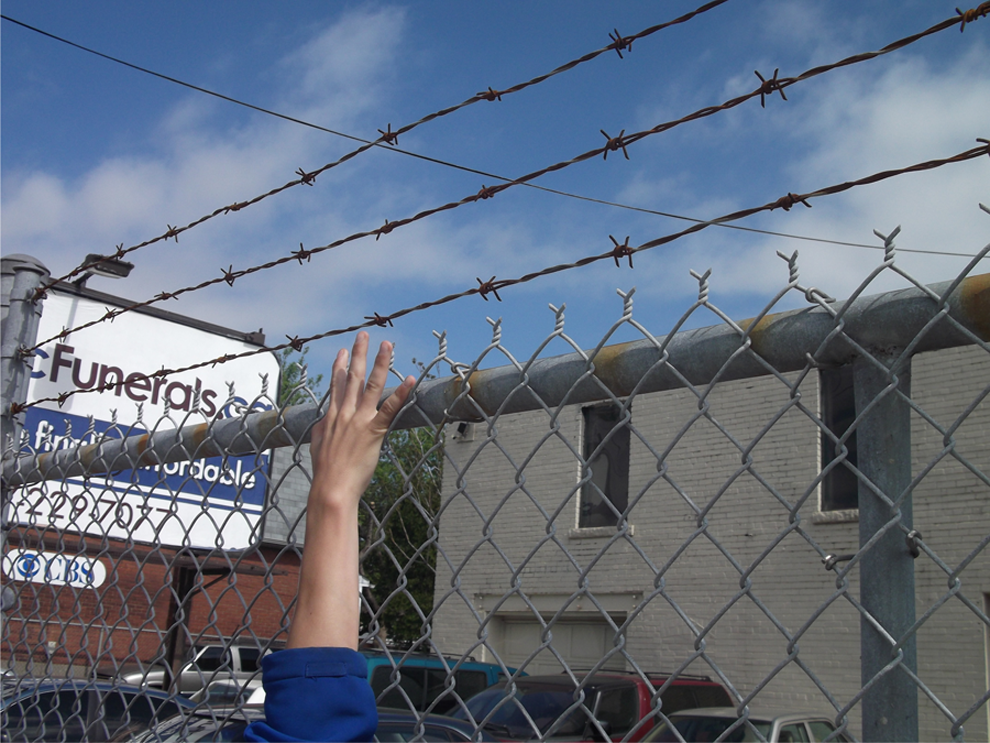
Barbed wire and fence.

Feces on sidewalk.

Flooded sewer.

Graffiti on wall.
It is important to outline the epistemological and methodological assumptions that inform visual methodologies (Rose, 2001). As expressed by Rose (2001), visual methodologies depart from the assumption that the visual world not only matters, but, rather, should be considered as a valuable source of knowledge and information in and of itself. Challenging the linguistic stranglehold on knowledge production—that something must be uttered to be known—the visual world is thus regarded as a legitimate source of knowledge that can contribute toward and extend information derived from typical, language-based approaches. Second, visual methodologists acknowledge that meaning making is not derived solely from the means of production or what the image creator wants to convey. Rather, the making of meaning is a complex process that is influenced not only by the site of interpretation—or what impression audiences bring to the image—but also the social context in which viewing occurs.
As a pedagogical tool for oppressed communities, visual methodologies have a few central purposes. First, they provide community members with an opportunity to comment on their community’s strengths and weaknesses, illustrating areas of potential change. Second, through visual techniques, it is possible to provoke critical dialogue about community issues. Finally, visual methodologies can be a useful way to impact on and reach policy makers (Wang, 1999).
There are several advantages associated with employing visual methodologies to undertake community-based research. Wang (1999) suggests that this methodology enables researchers to take the perspective of nondominant groups who typically do not have control over how the world is imaged. Visual methodologies can communicate the perspective and ingenuity of inaccessible, vulnerable groups that have traditionally been denied the opportunity of imaging and communicating their perspectives. Visual methodologies can help to generate knowledge with vulnerable groups, about whom we know little. Visual methodologies are particularly useful for those with socially stigmatized identities or who do not communicate in the dominant language, such as refugees, migrant women, people with disabilities, or children. Thus, because it does not rely on conventional forms of meaning making, it is particularly sensitive to other forms of communication and knowledge generation. Visual methodologies have other notable benefits, such as the opportunity to conduct a community needs assessment, generate a sense of community pride, and visually depict a range of community experiences—including its capacities, celebrations, and tragedies. Additionally, community-based theories may be narrow in scope and context stripped, failing to capture the richness of community life. By showcasing how and why theories about community, place, and environment are inadequate (Wang, 1999), visual methods can illustrate theoretical failures.
Visual methodologies are commonly employed with children and are a component of what is thought to be child-centered research (Darbyshire, MacDougall, Colin, & Schiller, 2005; Mayall, 1998). For children in particular, who may feel more comfortable engaging in nonverbal modes of expression (Cheever, 1999; Mitchell et al., 2007), visual methodologies—which do not presume the ability to read or write—may be a particularly useful way of eliciting and conveying their experiences. With respect to the environment, adult researchers may depict community deficiencies and disarray and gloss over the sense of security, hope, and belonging that children in seemingly oppressed communities communicate. Moreover, children may draw our attention to environmental details that we have forgotten to see (Mitchell et al., 2007). Rather than depicting neutral physical landscapes, children may photograph places that derive their significance from the stories, events, and social relationships that they ascribe to place. In addition to being a relatively enjoyable, nonintimidating, and cognitively appropriate methodological tool for children that affords no communicative advantage to adults, visual research undertaken with children may be empowering because it makes their knowledge visible (Mitchell et al., 2007).
Visual methodologies come with associated limitations. It can yield an abundance of complex data that are difficult to analyze (surely, something that has affected us in this study!). Finally, we must be sure that essentialized assumptions about children—for example, that they like to draw—are not entirely driving the choice of research methodology (Mitchell et al., 2007). Since we are all “former” children—colored by the memories and ghosts of our pasts—we often regard children as less complete versions of ourselves rather than a distinct sociological group with its own culture and traditions (Adams, Theodore, Goldenberg, McLaren, & McKeever, 2010; Mitchell et al., 2007; Valentine, 1997). Therefore, we may prematurely foreclose the significance of children’s visual productions (Mitchell et al., 2007). However, at the very least, visual methodologies aid in depicting the complexities of particular sociological niches and behavioral settings of often alienated groups (Wang, 1999). Visual methodologies are an excellent way to generate debate and dialogue about community issues and concerns and work toward necessary policy changes. For these reasons, such an approach was adapted for our project.

Pollution and traffic on road.

Overflowing garbage in park.

Home garden-front yard.
Overview and Description of the HPP
Hamilton is a medium sized city of approximately 700, 000 people in Southern Ontario. It is located within the Greater Toronto and Hamilton area. Hamilton is a multicultural and diverse city. Behind Toronto and Vancouver, it has the third highest percentage of residents who are born outside of Canada (21.9%). At 18%, Hamilton has a relatively high percentage of the population that is under the age of 14 (Canada Census, 2011). Somewhat paradoxically, Hamilton upholds a dual identity. It is simultaneously known as an industrial city—Steel Town—while also contributing toward world renowned, pioneering biomedical research and practice through the McMaster Health Sciences Centre. While the University area and surrounding neighborhoods are populated by students, faculty members, retirees, and middle/upper class families, the downtown Hamilton core is characterized by socioeconomic hardship. Within close geographic proximity, there are vast differences in health and well-being.
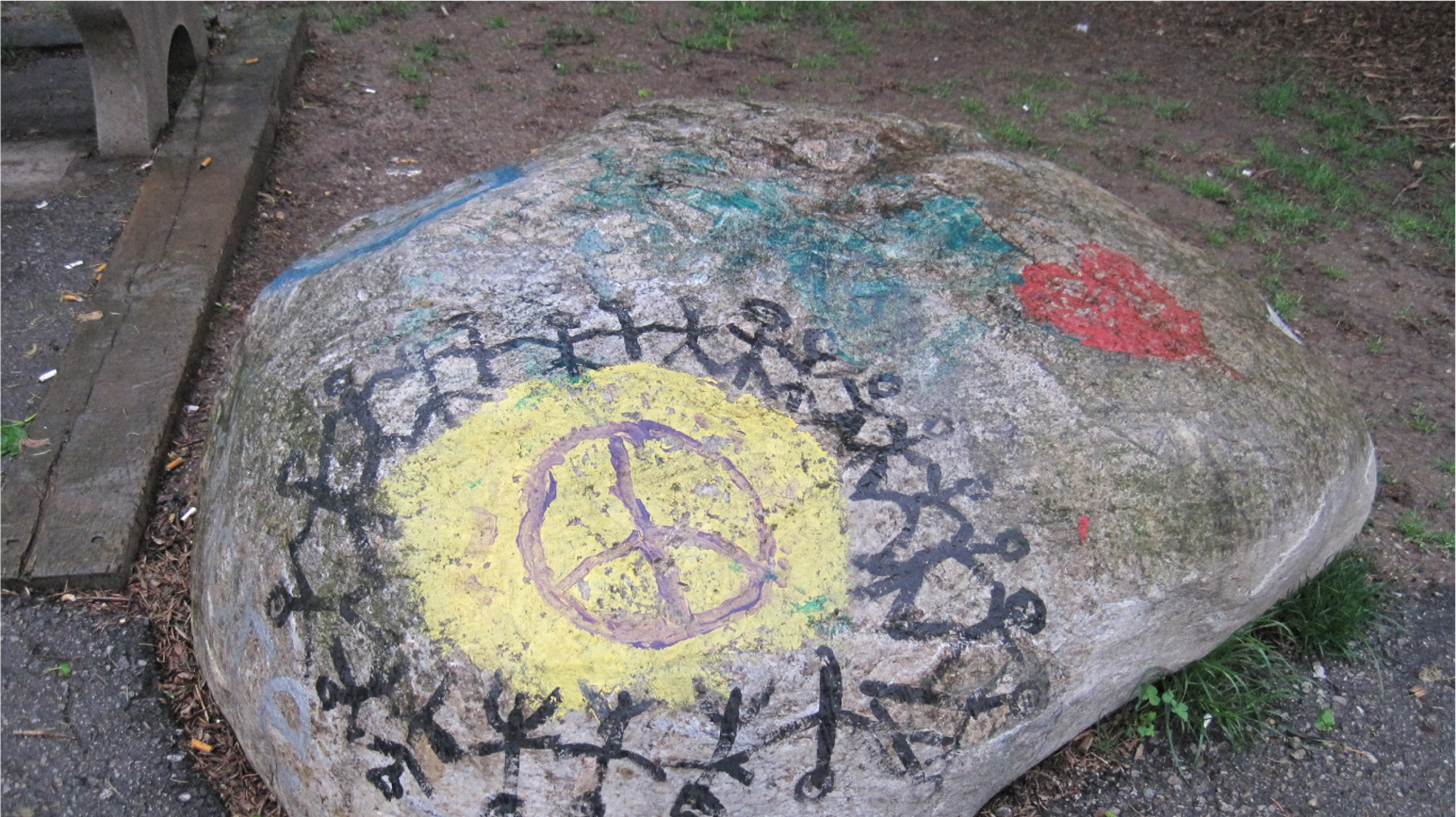
Painted “peace” rock in park.

New tree stump.
The HPP was a joint venture that occurred between Metrolinx, Green Communities Canada (a national nonprofit organization), the City of Hamilton, three elementary schools from the Hamilton-Wentworth Catholic District School Board, and the Faculty of Kinesiology and Physical Education at the University of Toronto. The HPP occurred in the winter, spring, and summer of 2010 and was ethically approved by the Hamilton-Wentworth Catholic District School Board. HPP was part of a broader multicity school travel planning project called “Stepping It Up,” undertaken with 30 elementary schools. HPP was spurred in response to the challenges associated with engaging students and parents in inner-city schools, and the recognition that traditional school travel planning methods were ineffective. We recognized that Hamilton’s inner-city children may navigate unsafe environments on their way to and from school and are routinely exposed to drug, gang, and prostitution cultures as well as environmental decay. In addition to better understanding Hamilton children’s transport experiences to school, principals, and teachers, city planners, members of Metrolinx, and University of Toronto students and faculty members hoped that the project would be an effective means of communicating children’s voices to parents, city planners, and policy makers. Kearns and Collins (2003) suggest that there has been a shift in children’s geographies—from inquiries into the construction and representation of children’s geographies and the power relations therein—to some practical examinations of how environments might be better produced and managed for the benefit of children. Following this call, the HPP sought to inform policy with local voices in the hopes of affecting desirable changes to Hamilton children’s local environments. While the project was not entirely child centered—and constrained by various barriers discussed below—the children in our study strongly influenced both the development of the project and the dissemination of their work to the community.
A teleconference meeting was arranged between staff of Metrolinx, City of Hamilton, Green Communities Canada, Green Venture (local nonprofit), and University of Toronto students in March 2010. The potentially unsafe environments that Hamilton children may be navigating through—from the vicinity of three inner-city schools involved in the Stepping It Up project in particular—were discussed at this meeting, in addition to the impact on the children’s independent mobility and health. Interest in a children’s photovoice project was discussed. After discussing the unsafe environmental context that affects Hamilton children and its impact on health and walkability in the neighborhood, University of Toronto researchers searched the literature to devise an appropriate study protocol for the HPP. In keeping with the participatory nature of our methodological approach, however, we were aware that the protocol should be flexible in nature. As we illustrate below, the children ultimately changed and enhanced the nature of the methodological process, requiring us to question assumptions about our research design. The purpose of the HPP was to investigate how children from LSES neighborhoods who attend three selected elementary schools in downtown Hamilton experience their metropolitan landscape and to identify desired environmental changes that may increase the use of active spaces. The following is an outline of the study protocol.
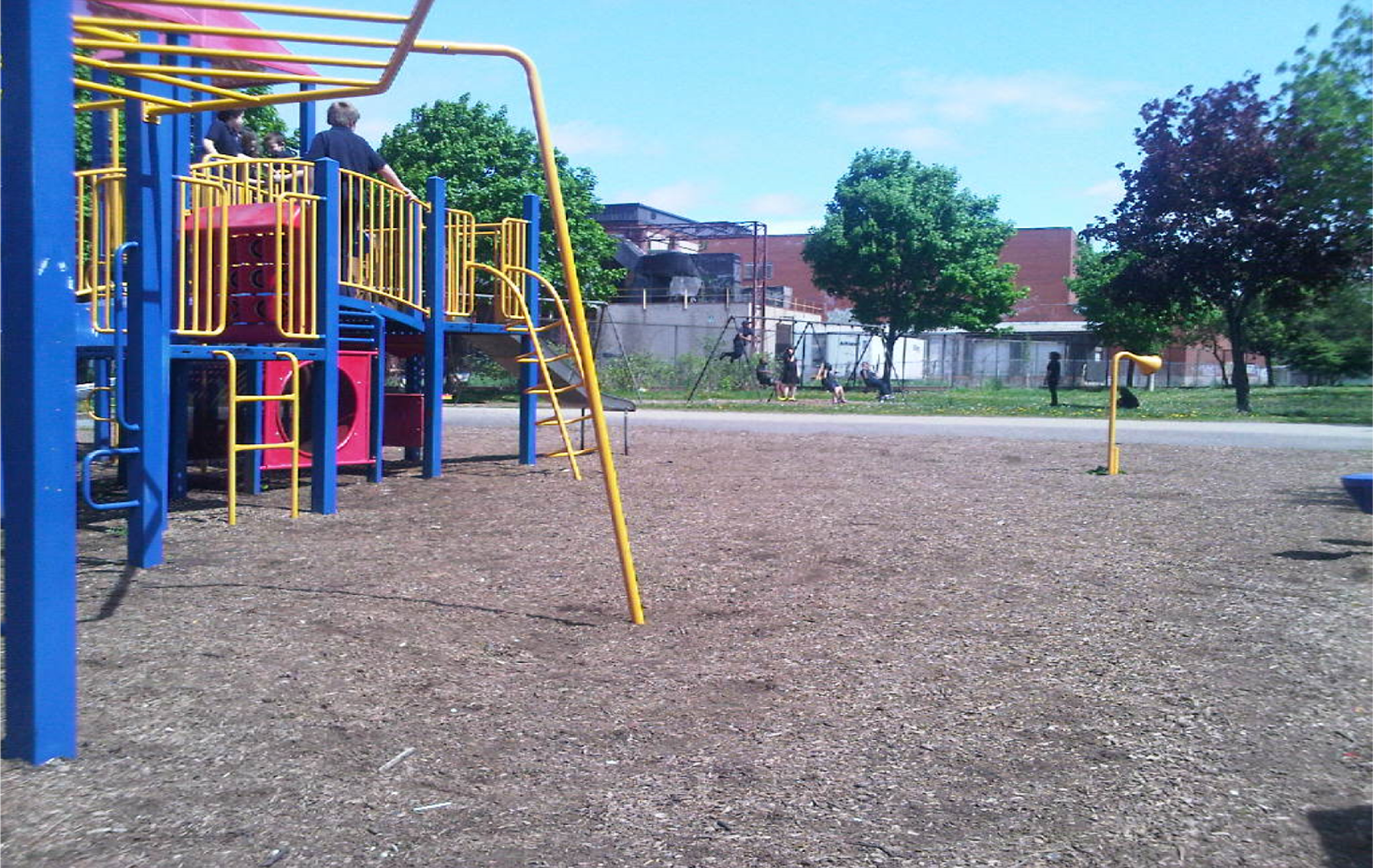
Neighborhood park.

City bus.
Schools and Participants
Three local schools from the downtown Hamilton core participated in the HPP. The schools were selected to reflect different learning and environmental experiences in Hamilton. From those schools, 46 students (Grade 4–8), whose parents or guardians consented to their involvement, participated. Thus, 19 students from School 1, 12 students from School 2, and 15 students from School 3 took part. The study involved three sessions within each school. Although many scholars contributed toward the generation of the project plan, the project was implemented and conducted by a research assistant from the University of Waterloo as a component of a cooperative employment term at Metrolinx.
Study Protocol
In each school, the project occurred over the course of 3 days. Following a compilation of results from all three schools, a joint student seminar was held for students to learn from one another and develop community solutions. The time line was staggered such that data were collected from one school at a time. The research assistant worked closely with a principal, teacher, and/or parent liaison in each school who helped facilitate the project and recruited all child participants.

Youth drawing of neighborhood abandoned building.

Youth drawing of neighborhood bar.
On Day 1 of the HPP, the research assistant met with participating students. The project goals—and the tasks that would be involved—were explained and discussed in an interactive fashion. Informed and written consent to participation was obtained from students’ parents. On Day 1, the students created a neighborhood map for Day 2’s activity—“the community walk about.” Each child was asked to “please draw a walking map of your community.” The children collectively contributed toward drawing a community map that included pictures, words, and walking routes. The community maps were considered as a data source and subject to later data analysis. The research assistant put forth an effort to generate not only enthusiasm and interest for the project but also a sense of project ownership and pride—such that the project was considered to be “theirs.”
On Day 2 of the project, the research assistant and teacher facilitator met with the students again. Digital cameras—borrowed from staff and faculty members—were distributed to the children and students were paired. Using the neighborhood map that the children had created during Session 1 of the HPP, the group engaged in a neighborhood walkabout. This research method is well documented in the literature and is a particularly useful way of drawing attention to those aspects of the environment that children regard as significant as well as providing opportunities to take photographs. The ethics board required that adults be present during the community walkabout and that the children not photograph other people. While these were invariably methodological constraints that are discussed below, teacher liaisons did not provide any input to the children regarding what they could or could not photograph on the community walkabout. The children were prompted to “please take pictures of things in your environment that are meaningful and important to you.” The community walkabout was about 1 hr in duration. The children engaged in active dialogue and discussion during the community walkabout. As well, they photographed meaningful places in their physical landscapes that were significant for them, depicting spaces that they regarded to be both “beautiful” and “ugly.” At the end of the community walkabout, the cameras were collected and a brief discussion was had. The photographs were considered to be a data source.
On Day 3 of the HPP, the research assistant and other adult facilitators led a focus group discussion with the students to chronicle and discuss their experiences. In this activity, children’s photographs served as a prompt to discuss their perceptions toward the environment—including capacities, deficits, their perception of their environment, and how the children envisioned community environmental changes. We began by asking each child to tell us about their photographs in an organic and informal manner. While a list of potential questions was on hand, we followed the children’s conversational lead in an effort to maintain an organic conversation. Although it was not a part of the methodological plan, after the focus group, the children expressed interest in using media and materials to create items that further conveyed their environmental experiences. While this required us to move away from our research plan, the children added several data sources to the study. They wrote poems, drew pictures, created a PowerPoint presentation, and made a video to convey their environmental perceptions. While photographs, focus groups, poems, drawings, the PowerPoint presentation, and the video were all considered to be data sources, in this study, we reflect on the methodological insights gained from the visual data sources only (photographs, maps, and drawings). All the visual productions were coded with anonymous labels in an effort to preserve confidentiality. Thus, the final session provided students with an opportunity to talk about their experiences in the HPP and their perspectives toward their neighborhood. The same procedure was repeated in the other two participating schools.
After data were collected and compiled from all three schools, staff from Metrolinx, the City of Hamilton, the three schools, and University of Toronto faculty planned a “children’s conference” in the Hamilton community. All students who participated in the HPP were invited to attend. Forty students participated, along with principals, teachers, parents, and staff from the City of Hamilton, Metrolinx, and local community groups and organizations. Children were asked for their permission to showcase their environmental productions at the conference. The children selected which visual images and productions that they wanted to showcase at the children’s conference. While it cannot completely ensure confidentiality, by only using the coded productions by the children, we tried to ensure anonymity. Since data ownership is important to the participatory action research tradition, we photocopied the final visual productions for our records and gave the children the originals. The community event was held after the formal study. The conference provided a child-centered community forum for the students to hear about one another’s positive and negative experiences and work with planners and policy makers to brainstorm shared solutions to the issues they experienced. Below is a sample of pictures from the children’s conference.
Visual Analysis
Visual analytic traditions vary greatly in the existing literature. Some visual researchers suggest that the visual analytic tradition is less well developed than other qualitative analytical frameworks. Bearing these limitations in mind, we used Rose’s (2001) visual analytical process to analyze our data. The data corpus is extensive—including drawings, maps, and photographs—and includes novel visual methods that were not a component of our initial investigation. All of the visual data that the children produced were included in the analysis. Thus far, we have analyzed the photographs, maps, and artwork only. Rose’s visual analytical method entails (a) an intensive examination of the visual data, (b) identification of the source of production, (c) identification of the medium and method, (d) discussion of the literal and metaphorical content conveyed, and (e) discussion and interpretation of the sight of interpretation. Rose’s analytical process encourages researchers to recognize that the “meaning” of the visual world is a complex process that is influenced by the producer, the intended audience, and the interpretive lens used. The resulting findings from our analysis are reported elsewhere and the included photographs are for illustrative content only. Below, we reflect on the strengths and limitations of our methodological process and the lessons we have learned about using this methodology to capture children’s environmental perceptions.
Methodological Insights and Lessons Learned
In the HPP, children appeared to use visual methods as an opportunity to showcase areas of perceived environmental constraint and concern. The bulk of the photographs, drawings, and maps were largely focused on environmental barriers, such as pollution, garbage, glass, graffiti, animal feces, traffic, barbed wire, crack houses, places where prostitutes may frequent, and fences. Not unlike the children in Fusco et al.’s (2012) and Mitchell et al.’s (2007) study, then, visual methods provided children with a way to express their disdain toward socioeconomic hardship and environmental disarray.
However, we also found that children may use visual methods as a way to reflect on community strengths and capacities. In reflecting on the advantages of employing visual methods with children, Mitchell et al. (2007) suggest that when researching socioeconomically deprived or disenfranchised areas, adult researchers often depict problems, such as deficiencies and areas of environmental disarray. In contrast, through visual methods, child participants may draw attention not only to areas of environmental concern as indicated in the above photographs, but also to those facets of the neighborhood that they consider to be beautiful. Our participants appeared to use the HPP as a way to communicate those aspects of the environment that they are proud of and that are pleasurable to experience, such as painted rocks; community gardens; representations of ethnic, racial, and cultural diversity in the neighborhood (e.g., a Caribbean food shack); and community attempts to beautify the environment. One of the initial impetuses of the HPP was to research the potentially negative impact of a harsh neighborhood environment on Hamilton children, such as exposure to violence and environmental decay. However, it is critical that researchers not naively assume uniformly negative environmental experiences (Wang, 1999). Rather, we must be cognizant of the power of visual methods to depict community strengths, belonging, capacity, and hope (Oleander, 1994).
Further, children photographed physical landscapes to narrate stories about their environments. Following Oleander (1994), children’s photography of physical landscapes in the HPP was not neutral, but, rather, embroiled in the complex web of social relationships and stories that children bring to place. Children appear to attach social relationships and storytelling to their physical worlds and landscapes. Thus, a picture of a grocery store or a community garden conveys not only content and environmental perceptions but, rather, brings with it an associated set of stories and related experiences that give the place meaning. For example, the children shared stories about special events that had happened with family members and friends at these particular places.
Another methodological insight relates to children’s use of visual methods to convey both literal and symbolic/nonliteral representations. This insight was derived in focus groups upon asking children to tell us about what their photographs mean and realizing that not all of these meanings were of a literal nature. Children appear to take pictures that reflect literal content, such as grocery stores and restaurants that they find appealing in the neighborhood, or environmental decay and disarray that they find unappealing. However, children also use visual methods to convey nonliteral or metaphoric content such that the picture is not what it appears to be. A tree, for example, can be made to represent a magical play area or something that it is not. Similarly, a photograph of a group of children’s hands and feet can be used to convey a sense of camaraderie among friends. These nonliteral conversations were not prompted by us, as researchers. Rather, we noticed that when asked to “tell us about your picture,” children’s discussions were replete both with factual information about their personal navigation experiences and imaginary, nonliteral content. As researchers, we should consider the ways in which children employ visual methods not only as a means to convey concrete and literal representations of the neighborhood but also for the nonliteral and metaphoric communication of environmental experiences. Thus, in children’s visual depictions of their physical landscapes, what is seen may not always be what’s implied (Rose, 2001).
Methodologically, we also noticed that children often use visual methods to communicate sophisticated, nuanced, and intelligent explanations for neighborhood and social events that are unfolding in the sociological microcosm around them. They also use visual methods to convey politicized statements, and, in so doing, point to the intelligent, politicking capacities of children. For instance, in depicting a downtown Hamilton street corner that prostitutes frequent, children did not only discuss fear and discomfort. In contrast, one child photographed and drew a prostitutes’ dwelling to communicate that it is important for other adults to take care of prostitutes and help them.
Methodologically, we also learned that the children wanted to change the research process in a participatory fashion based on their interests and needs. Initially, we created a four-step research protocol to implement in three Hamilton schools. However, the participating children changed the project to suit their needs, and while we adhered to the general structure of the research protocol, it was greatly modified and adapted by the participants in ways that were meaningful for them. While quantitative researchers or “purist” qualitative researchers may critique such participant involvement as compromising researcher neutrality, we suggest that future researchers embrace the participant-centered nature of the design and display a flexible methodological approach that is open to change. Arguably, by adopting a flexible participant-centered research design that is receptive to change—and being open to the invariably “messy” nature of qualitative research—it may be possible to create projects that are more meaningful for participants and better approximate their lived experiences. Clearly, issues of researcher control and project rigor need to be balanced with the production of participatory knowledge that is informed by local voices and aims to effect changes that are personally meaningful for participants.
Challenges in Undertaking “Child-Centered” Research
During the process of undertaking the HPP, the challenges of developing truly child-centered research programs were all too apparent to us. Although we strove to involve children in the design and development of their project, undertaking truly child engaged research is invariably constrained by a number of institutional constraints that guard and police the way in which research can be undertaken with children. For instance, the research ethics and informed consent process invariably limits the participatory nature of the work that can be undertaken with children. For example, more progressive, child-centered institutions, such as the Toronto Hospital for Sick Children (www.sickkids.ca), are moving toward a commendable model of child consent that recognizes the cognitive, social, and developmental ability of some children to provide consent regardless of their chronological age. We recognize, however, that a more traditional approach used in this study—in which adults consent on behalf of children—is not only paternalistic but also makes the problematic assumption that parents are in a position to speak to the research desires and preferences of children. Further, some research has shown that children may not always understand what they are consenting to during the research process or feel pressured to agree. Further, the nature of visual data collection with children is a particularly ethically charged matter. For example, ensuring the privacy of children’s visual representations and a sense of data ownership are very important matters. By coding participants’ visual productions with anonymous labels, we sought to ensure their privacy. Further, by assuring children that their visual productions would be returned to them after the study, we tried to ensure data ownership by the children. However, there are lingering, unaddressed ethical questions that beg further study. For instance, what would we have done if a child requested to keep a camera indefinitely? If the ethics board did not permit this, where were we to draw the line between ethical mandates and child desires? Further, although children were not “allowed” to take photographs of other people on their community walkabout to ensure safety, what if the children had expressed interest in taking pictures of friends, family members, and community members? Thus, we are all too reflexively aware that although much research falls under the rubric of child-centered work, merely involving children and seeking their input, is not sufficient to ensure a truly child engaged research process. This is an uncomfortable realization for us as child health researchers. While we continue to work within the systems that govern childhood today—such as schools, hospitals, and community centers—it calls for us to participate in broader discussions about what child-centered participatory action research means and how to create programs of work that not only involve children but also value them as coresearchers. Thus, the way in which child-centered research is invariably constrained by the broader institutions that govern childhood was an uncomfortable methodological lesson learned along the way.
In terms of the methodological lessons learned from the HPP, then, children appear to depict places of hope and resilience in addition to despair. Children also appear to take pictures for a variety of reasons, some of which include the opportunity to tell stories, convey literal and nonliteral depictions of the environment, teach and educate others, and engage in politicking. Children’s visual depictions of their physical landscapes also illuminate their ability to engage in complex, abstract reasoning that defies assumptions about normal, developmental stages (Mayall, 1998; Moola & Norman, 2011). Methodologically, we learned that children want to participate in the design and development of their own study and that such involvement is both exciting and novel. However, the institutions that guard child research invariably constrain the participatory nature of research with children.

Youth poem about environment.

Photo of abandoned shoes in a puddle.
Conclusion
Historically, there has been a strong association between children and the visual world. We tend to regard visual productions—such as artwork and drawing—as inherently childlike. This article described the methodological process and lessons learned in the HPP. The research process described here not only affords future researchers with valuable methodological lessons but might be used as a feasible and adaptable research plan for undertaking visual research on children’s environmental perceptions. However, researchers who work with children must be cognizant of the institutional constraints that stand in the way of truly child-centered research programs and should make efforts to see children as coresearchers. Indeed, where children may have deeply affective, emotional, and imaginative relationships to place and environment, the children in the HPP effectively employed visual methods to illuminate the heartbeat of Hamilton, Canada—including its celebrations and tragedies (Valentine, 1997).
Footnotes
Authors’ Note
This article was prepared as part of the Stepping It Up pilot project, which was led by Metrolinx in partnership with Green Communities Canada, the City of Hamilton, the Region of Peel, and the University of Toronto, with funding provided by Transport Canada’s ecoMOBILITY program and Metrolinx.
Declaration of Conflicting Interests
The author(s) declared no potential conflicts of interest with respect to the research, authorship, and/or publication of this article.
Funding
The author(s) disclosed receipt of the following financial support for the research, authorship, and/or publication of this article: Guy Faulkner is supported by a Canadian Institutes of Health Research-Public Health Agency of Canada (CIHR-PHAC) Chair in Applied Public Health.