




Abstract
This analytic glossary, composed of 52 terms, is a practical reference and working tool for persons preparing to conduct theoretically informed qualitative social science research drawing from institutional and political activist ethnography. Researchers using these approaches examine social problems and move beyond interpretation by explicating how these problems are organized and what social and ruling relations coordinate them. Political activist ethnography emerges from, and extends, institutional ethnography by producing knowledge explicitly for activism and social movement organizing ends. The assemblage of vocabulary and ideas in this word list are new, and build on existing methodological resources. This glossary offers an extensive, analytic, and challenging inventory of language that brings together terms from these ethnographic approaches with shared ancestry. This compilation is designed to serve as an accessible “one-stop-shop” resource for persons using or contemplating using institutional and political activist ethnography in their research and/or activist projects.
Keywords
This 52 term glossary is intended to serve as a practical reference and working tool for people wanting to carry out theoretically informed social science inquiries using institutional (D. Smith, 1999, 2005, 2006) and political activist ethnography (“Remembrances of George Smith,” 2005; G. Smith, 1990, 1995; G. Smith, Mykhalovskiy, & Weatherbee, 2006). Researchers who examine social problems and set out to move beyond interpretation to identify and explicate these problems use insights from these approaches. Their investigations explore how social problems are organized, explicate the social relations coordinating these problems, and uncover what consequences these arrangements have on people. Institutional ethnography and political activist ethnography share a common ancestral lineage epistemologically, ontologically, and theoretically. The latter, however, extends traditional institutional ethnography through an explicit stance and commitment to producing knowledge that can be mobilized by civil society activists and members of social movements.
While in institutional and political activist ethnographic research “orienting concepts are drawn from existing sociological vocabularies” (McCoy, 2008, p. 713) within an anti-positivist paradigm, some focused effort is required to learn how and why certain conceptual terms are used distinctively in these approaches. Social scientists who draw insights from these methods commonly choose to employ certain technical terms rather than other ones in their oral presentations (Bisaillon, 2012a; French, 2012; Sanders, 2012) and written work (Deveau, 2011; Hussey, 2012; Taber, 2010). There are no universally accepted definitions for the terms featured in this glossary, and this resource is not prescriptive. The list of terms that make up this glossary is, however, appreciably comprehensive.
Background
I was motivated to formulate this glossary largely for the benefit of neophyte ethnographers. I intend for this resource to be accessible, useful, and relevant to this audience. The selection of terms and the formulation of explanations herein emerge from my experience as a graduate student where, as a largely self-taught institutional ethnographer, I worked to gain proficiency in the language of institutional and political activist ethnography. The vocabulary and elaborations provided in this glossary have proved to be helpful resources. For example, they were useful starting points for academics and practitioners from several milieus who collaborated as members of my doctoral committee. All but one of these people had limited familiarity with institutional ethnography, and even less familiarity with political activist ethnography. It was, however, necessary that they gain an understanding of the approaches that guided my doctoral project (Bisaillon, 2012b).
This lexicon has also been, and continues to be, an instructive resource in my teaching and oral presentations. On these occasions, I regularly communicate how I employ institutional and political activist ethnography as tools for pursuing critical qualitative research and activist sociology to examine social organization, explicate social relations, and produce knowledge for activism and social movement purposes. It is my intention that this quick reference serves as a convenient and effective one-stop-shop source of information for persons using or contemplating using these critical modes of social inquiry in their academic research and/or activist projects. I would also like this lexicon to serve as a tool that invites exploration, provides challenging descriptions that sidestep unnecessary jargon, and, ultimately, enables people to carry out thoughtful and socially useful research with confidence and success. A well-researched reference section is provided as a resource at the end of this glossary.
Existing Resources and Methods
The particular choice and configuration of terms appearing in this word list is new. This glossary brings together vocabulary from both institutional and political activist ethnography, in addition to explaining key orienting and rhetorical terms that the user will find helpful when using these approaches. A scan of the literature and resources relating to institutional and political activist ethnographic research was conducted within the auspices of my recently completed doctoral work (Bisaillon, 2012b). With varying degrees of thoroughness and detail, published research (and unpublished research, such as graduate dissertations; for example, see Clune, 2010) drawing from the companion approaches of institutional and political activist ethnography generally integrates succinct definitions of key methodological terms. Working descriptions of how some of the terms included in this glossary are used, what they can uncover, and how they offer the possibility of opening up social relations for critical investigation are thus integrated into other reports and scholarly work (see Campbell, 2010; Campbell & Gregor, 2004; McCoy, 2008). Two glossaries of vocabulary associated with institutional and political activist ethnography are published in edited book collections. These appear in Sociology for Changing the World: Social Movements/Social Research (Frampton, Kinsman, Thompson, & Tilleczek, 2006, pp. 27–38) and Institutional Ethnography. A Sociology for People (D. Smith, 2005, pp. 223–229). There are two concise resources published in scholarly journals where definitions and discussions of conceptual terms, as understood in institutional ethnography, are organized into discrete sections. These are in “Examining the Institutional Ethnographer's Toolkit” (Deveau, 2008, pp. 4–15) and “Institutional Ethnography” (D. Smith, 2002, pp. 40–47).
How to Look in Institutional and Political Activist Ethnography
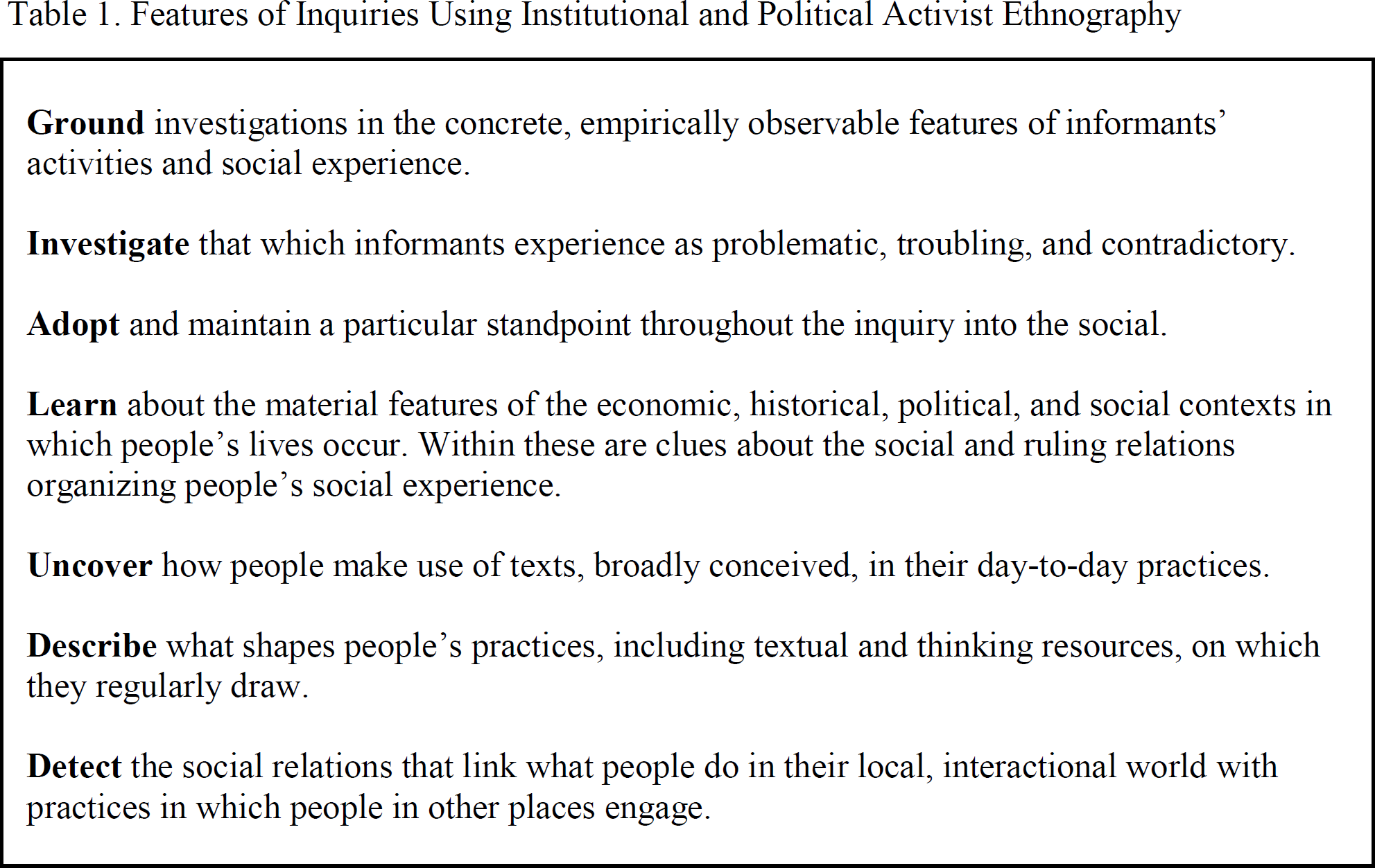
Table 1 summarizes the main features of investigations drawing from institutional and political activist ethnography through which the researcher investigates social organization and explicates ruling relations. The conceptual language and orienting terms appearing in the table below are identified and explored in this glossary.
Features of Inquiries Using Institutional and Political Activist Ethnography
Glossary
Activist Scholar
A person who foregrounds the political aims of the research she or he carries out. In addition to participating in the academy, this person is commonly a participant in or member of civil society organizations. This individual aims to produce knowledge about social organization and relations from the perspective of people occupying places of marginality and/or social movements (Campbell, 2006; Kinsman, 2006; Ng, 1988; Pence, 2001; G. Smith, 1990).
Actualities
These are people's lived experiences as they describe knowing and living them. This is “the same world in which [the researcher] is doing the work of exploration” (D. Smith, 2005, p. 223). Actuality is a methodological term that orients analytic attention to “a world of things, activity and experience that includes, but is not coterminous with, texts and language” (McCoy, 2008, p. 705).
Actually
This word appears recurrently and frequently in research using institutional ethnography. It is used repetitively as a rhetorical strategy to emphasize that people's activities, their social experience, and the material circumstances of their lives are valid grounds for knowledge and are valuable starting points for research.
Boss or Governing Text
This term refers to a text or set of texts that supplies the context for what we can see, hear, and know. There are subsidiary documents that come into being and are organized under these texts, which are positioned at the top of a hierarchy of texts. Dorothy Smith (2010) explains that boss texts are authorized through institutional procedures through which specific people are instructed to carry out specific practices. Boss texts coordinate organizational relations so “how people work is controlled in conformity with the selective requirements of the boss text … There are layers and layers of them” (D. Smith, 2010, not published, on file with author).
Concept or Conceptual
This word points to and is firmly rooted in the concrete or material practices in which people engage and the social relations that connect them. A guiding assumption is that ideas and concepts are produced through people's material practices. This is a key ontological commitment that rejects a conceptual starting point in a place that is independent of people's practices and knowledge of the circumstances of their lives (see Marx & Engels, 1846/1970). For elaboration about how research into the organization of people's activities can open up social relations as the subjects of social science investigation, see Dorothy Smith's (1990) Conceptual Practices of Power.
Discourse
This is a “systematic way of knowing something that is grounded in expert knowledge and that circulates widely in society through language, including most importantly language vested in texts” (Mykhalovskiy, 2002, p. 39). Discourses are socially organized activities that circulate among people and through institutions. We all participate in discourse, and through our actions, discourses are brought into being. Looking at how people participate in discourse, how they talk about what they do, what texts they circulate, and what is reproduced in people's labour, is of the utmost analytic interest in institutional and political activist ethnography.
Discourses “come to stand over [and] against [people], overpowering their lives” (D. Smith, 2005, p. 41). This point makes discourses important activities to investigate and understand. Consistent with philosopher Michel Foucault's (1972, 1980, 1981; see also Rabinow, 2010) use of discourse, institutional and political activist ethnography centers on uncovering asymmetries of social power within social practices of language, and on exposing the effects these have on people. Different from Foucault's conception of discourse is the way that these companion ethnographies conceive of discourse originating in, and existing only because of, people's participation in textually mediated social relations in particular ways and at particular times.
Disjuncture
This refers to disconnections between people's experience and knowledge of the world and the official or authoritative representations of these. Sociologist George Smith (1990) assigns the geographical metaphor “line of fault” to this place of epistemological rupture that is a contested space between the inside and the outside of the “objective, bureaucratic domain of a politico-administrative régime” (p. 631). This metaphor usefully calls attention to differences in social locations that people occupy. George Smith maintains that the usefulness of uncovering how things are socially organized is the promise of identifying effective places to intervene, to challenge and transform ruling relations. A disjuncture, dissonance, “split” (D. Smith, 1990, p. 4), or rupture in consciousness commonly provides the analytic impetus and starting point for an institutional and political activist ethnography.
Embodiment
This concept, from anthropology, cultural studies, and feminist or women's studies, emphasizes people's knowledge of the world as generated from the experience of their lives. Embodied knowledge is a process of knowing that provides “an alternative to … external authority” (Frampton et al., 2006, p. 30). Importance is given to exploring how people know and speak about things from within their experience and the activities in which they engage. The term is a useful orienting tool that reminds the researcher to be especially attentive to the activities that peoples' bodies are involved in as a strategy to keep the focus on what people do. Anthropologists Margaret Lock and Vinh-Kim Nguyen (2010) refer to embodiment as a dynamic process of the “lived entanglement of local biologies, social relations, politics, and culture” (p. 2).
Empirical Approach
This is an approach to investigating how the world works from a starting point within the material and concrete circumstances of people's lives. This includes their observations about their day-to-day activities and the thinking resources they employ to carry out these activities. The lens offered by institutional and political ethnography focuses analytic attention on empirically investigable features of people's lives. Therefore, this is not, and should not be confused with, empiricism. Research produced using these approaches offers empirically informed arguments and analyses.
Epistemology
This is a term meaning the theory of knowledge. It refers to how we know what we know about the world, and it grounds and underlies all approaches to research (Crotty, 1998). The foundation for knowledge in institutional and political activist ethnography is located within an anti-positivist paradigm (Guba & Lincoln, 1994). Here, understandings of the social are produced through making social organization and social relations explicit. Thus, research drawing from these methods moves beyond interpretation and in a different direction from interpretive sociologies. A guiding assumption in these forms of ethnography is that how and what we know are socially organized processes. Researchers drawing from institutional and political activist ethnography examine social problems and move beyond interpretation to identify and explicate how these problems are organized. They also uncover features about the social relations that coordinate these problems and make visible the consequences of these arrangements for people as they experience them.
Ethnography
This is a qualitative research approach with origins in both anthropology and sociology (see discussion in Burawoy, 2000; Mitchell, 2010). Ethnography is at once a process, design, and product of research where the aim is to “render obscure matters intelligible by providing them with an informing context” (Geertz, 1983, p. 153). As a process, ethnography usually involves extended observations—often of people and their surroundings—where the researcher immerses in and records the events of people's day-to-day lives. Interviews are often also part of ethnographic data collection and fieldwork. Ethnographic work has historically focused on interpreting and learning about people's cultural qualities, behavioural traits, and their subjective experience to generate rich descriptions of social happenings (as per Creswell, 2007, pp. 68–72). Critical approaches within ethnography, of which institutional and political activist ethnography are examples, displace culturalist approaches, and are located outside of (and challenge) conventional framings (Good, Fischer, Willen, & DelVecchio Good, 2010; Fassin, 2007; Fassin & Pandolfi, 2010; Melhuus, Mitchell, & Wulff, 2010; Nguyen, 2010).
Everyday
This word is frequently and recurrently used in research using institutional and political activist ethnography as a rhetorical device to underscore analytic focus on the ongoing, meaningful effort that people engage in to carry out their lives. Language used to generate the same emphasis includes daily, day-to-day, quotidian, and “everyday/everynight worlds” (D. Smith, 2002, p. 42).
Evidence
In institutional and political activist ethnography, the material events and concrete circumstances of people's lives constitute forms of evidence. Building an empirically supported body of evidence about how social happenings occur, to contribute to redressing social problems, is an analytic aim in projects using these approaches. In contrast, in positivist science, this term refers to “that which can be repeated, independently verified, and measured according to standards upon which we can all agree” (Murray, Holmes, & Rail, 2008, p. 273). It is understood that there is no unbiased or objective form of analysis, evidence, or observation (see Gillies & Alldred, 2002; Grypdonk, 2006).
Experience
The starting place for research using institutional and political activist ethnography is within people's everyday practices. The term experience is used to validate and provide grounding in people's social experience and bodily being. Analytically, experience is used as a basis for providing clues about the coordination of people's lives and the working of society. In this usage, and more importantly, experience is not understood as individual or as a form of truth. This is because knowledge from any standpoint is partial because people know the world from within their particular location in it. A successful institutional and political activist ethnography supersedes a single account of any one individual experience. Instead, the aim is to uncover details about how a person's immediate and interactional world is connected with the world of other people living and working elsewhere. In this pair of approaches, people and their social experience are not per se the objects of research; “Experience is a door through which the ethnographer goes to explicate the institutional processes that shape [people's] experience” (Deveau, 2008, p. 14).
Experiential Knowledge
This refers to a form of knowledge about the world that is generated from within social experience. This way of knowing sits in contrast with ideological or conceptual ways of knowing about something. Where knowledge is produced apart and abstracted from relational experience, the social circumstances shaping experience are elided or subsumed. Experiential knowledge is a legitimate and useful resource for examining ruling ideologies and social discourses. For example, George Smith (1990, 1995) used his experiential knowledge as a gay man living with AIDS as a resource for investigating how the worlds of gay men, colleagues, friends, and other people living with AIDS were socially coordinated.
Expert Knower
In institutional and political activist ethnography, people are conceived of as authorities on the events in their lives because “only the experiencer can speak of her or his experience” and, likewise, her or his working knowledge of what happens there (D. Smith, 2006, p. 224). Deploying this term or its conceptual synonym, skilled practitioner, also commonly used in research drawing from institutional and political activist ethnography, embodies the epistemological commitment to paying attention to people's experiential ways of knowing the world they inhabit.
Explicate
This term signifies clarifying the functioning of something that is hard to reach and obscure. In institutional and political activist ethnography, explication involves producing analytic descriptions of how things are socially organized to occur. Through this process of explication, implicit features of social organization are brought into focus for investigation, and new and explicit forms of knowledge are generated. Exploration and explication of social relations is the goal of an institutional ethnography (see Campbell & Gregor, 2004, pp. 8 & 86).
Extra-Local Informant
This term refers to research participants who typically inform a project in a second phase of fieldwork and beyond (Bisaillon & Rankin, in press). The term is connected to, and juxtaposed with, standpoint informant; the latter informs a project's standpoint and typically the earliest phases of data collection. In adopting this language, a key understanding is that informants are located at different places within knowledge and ruling relations. Trans-local informant can be used synonymously to communicate the same idea.
Ideology
This is a form of knowledge that is uprooted and ungrounded from the social circumstances in which it is produced. This application “is not to be confused with its politically oriented English cognate. [I]t is simply an idea-system” (Bakhtin, 1975/1981, p. 429). Critique of people's ideological practices is a key constituent in Karl Marx and Frederick Engels's (1846/1970) analysis of social relations, and is also a key research practice in projects drawing from institutional and political activist ethnography.
Interrogation, Inquiry, or Investigation
These terms are often used interchangeably to refer to a research process and set of investigative practices that illuminate how the social world is organized. The researcher adopts practices that identify features of social organization that are not readily visible, and in doing this, exposes and describes how ruling relations function. This orientation to research makes the researcher's assignment (and challenge) comparable to detective work. In this way, these terms are deployed purposefully and for rhetorical value, calling attention to the subversive, and challenging the status quo.
Institutions
These are processes that stretch across time and place to coordinate people's activities. They identify “complexes [emphasis added] embedded in the ruling relations that are organized around a distinctive function such as education or health care” (D. Smith, 2005, p. 225). Examples of other functions include immigration, incarceration, humanitarian work, and community organizing. In this application, institutions do not refer to a singular institutional place such as prisons, asylums, hospitals, or factories—as per the work of several generations of sociologists including Erving Goffman, Howard Becker, Herbert Gans, Robert Castel, and René Lourau—or research on these. “The institutional is to be discovered in motion” (D. Smith, 2005, 225).
Institutional Capture
This is a process where the researcher and the researched are drawn into the ruling relations of the milieus in which they work, live, teach, or research. These are settings that are inherently and implicitly familiar. Because of this familiarity, we might not commonly pause to think critically about the social organization of these milieus. Through proximity and personal investment, we might also neglect to interrogate and challenge the very language, concepts, notions, and ideas that we are accustomed to using; those things that inform how we carry out our work. In doing this, we can lose sight of informants', and our own, experiential ways of knowing.
Critically inquiring into the taken-for-granted features of how our thinking is organized is an important exercise in institutional and political activist ethnography. This is because such a reflexive exercise contributes to a critique of ideological practices. Aware of the possibility of such “capture,” the researcher purposely takes on the difficult challenge of exploring the discursive organization of how things are described in writing, and how people speak about them. This serves a dual purpose. First, to reveal qualities of the social relations embedded within the institutions that are the objects of research. Second, to avoid the need for the researcher to be accountable to the activists and social movements with which they work by intentionally moving beyond the institutional relations that organize the researcher's association with these.
Institutional Ethnography
This is a theoretically informed research approach that aims to make visible and explicate the socially coordinated character and organization of people's lives. Institutional ethnography is a form of critical social inquiry that took shape during the 1970s, originating in the work of sociologist Dorothy Smith (1977, 1987, 1999). It is a “formal, empirically based [and] scholarly” (Mykhalovskiy & McCoy, 2002, p. 20) research strategy that draws on Marxist and feminist theorizing to uncover how society's institutions regulate people's lives (Carroll, 2006; Marx & Engels, 1846/1970). See Marie Campbell and Ann Manicom (1995) and Liza McCoy (2008) for overviews of the approach's intellectual lineage and antecedents.
In this mode of inquiry, the skills and capacities of ethnography are turned towards describing and addressing the ruling arrangements that are embedded in society's institutions. Sociologist Kevin Walby (2007) notes the method's “humanist approach” (p. 1018), where analytic attention is turned to understanding how society's institutions regulate people, and where explications of how things are socially coordinated are key endpoints. The understanding of texts as coordinators of peoples' activities distinguishes institutional ethnography from much anthropological or sociological ethnography. The latter point notwithstanding, extended case method (Burawoy, 2009), global ethnography (Burawoy, 2000), multi-sited ethnography (Marcus, 1998, 2010), and political ethnography (Schatz, 2009) are approaches that share several common features with institutional and political activist ethnography. In these forms of ethnography, there is commitment to staying closely connected to the material features of people's practices, which are the sources of data. Here, people and the material features of their activities replace theoretical understandings of these.
Intertextuality
This term refers to the relations and interdependence of texts, which are ordered in hierarchies in relation to one another. “[H]igher level texts establish the frames and concepts that control and shape lower level texts” (D. Smith, 2005, p. 226).
Levers or Targets for Intervention
This refers to the promise and intention that research drawing from institutional and political activist ethnography carries into the world outside of academia. That is, these inquiries describe and uncover how ruling relations are organized so that the analyses produced explicate social relations of struggle. From here, we can identify specific places, rather than general others, where it will be most useful for activists, reforms, and intervention efforts to promote social change. The ability to identify these “levers or targets for … intervention” (DeVault & McCoy, 2004, p. 754) makes the companion approaches valuable for activist scholars who are organized by the social and ruling relations of funding bodies concerned with knowledge diffusion practices, among other institutional relevancies.
Lived Experience
This term is used to purposefully locate and emphasize “those interchanges of awareness, recognition, feeling, noticing, and learning going on between body and the world that are prior to and provide sources for experience as it is evoked in dialogue” (D. Smith, 2006, p. 224). This concept is understood and used in similar ways in anthropology (see Finkler, 2007).
Local
This term refers to the circumstances of the immediate and interactional settings where people live, work, and research. Analytic focus is on understanding how what occurs in our immediate and interactional environments is connected with and shaped by what happens elsewhere. In institutional and political activist ethnography, it is understood that there are empirically traceable connections between what happens here and what happens in extra- or trans-local places there. The connections between these are not necessarily obvious or apparent to us, which is why they are objects of critical social inquiry. Learning about and explicating these connections is the analytic aim of projects drawing from institutional and political activist ethnography.
Mapping Metaphor
The exercise of explicating social relations, which is the aim of institutional and political activist ethnography, has been likened to cartography, where findings are schematically presented in textual or diagram form for the reader to interpret and use (see D. Smith, 1990, 1999). Beyond this analytic technique, the mapmaking, and sometimes x-ray, metaphor is commonly mobilized to explain the objectives of these approaches. The deployment of this metaphor as a rhetorical device is explicit in the title of Marie Campbell and Francis Gregor's (2004) Mapping Social Relations. This resource is a practical guidebook that provides direction for carrying out an institutional ethnographic project.
Mapping the Social Relations of Struggle
This is a set of practices aimed at developing understandings about how both ruling relations and social movements function. This is done through examining the work accomplished by social movements, and considering the struggles, contradictions, and confrontations people working in these movements experience. Researchers set out to investigate “the organizing logic of the ruling regimes they oppose … to produce a grounded social knowledge for more effective forms of activism” (Frampton et al., 2006, p. 9).
Materialist Inquiry
This is an approach to social scientific research developed by Karl Marx in the nineteenth century (Marx & Engels, 1846/1970). The materialist project starts within the circumstances of people's lives, including their actions, social experiences, and the “concrete, sensuous world of people's actual practices and activities” (G. Smith, 1990, p. 633). It is understood that these circumstances are socially produced within particular historical, economic, and political contexts, which are within the purview of a materialist investigation. This sort of inquiry sits in contrast with abstract and ideological approaches that are uprooted from the social circumstances of people's lives. For a discussion of Marx's materialist method and the contributions of this approach to institutional ethnographic practice, see William Carroll (2006).
Method
This term refers to the framework, design, and process through which research is carried out. Researchers who use institutional and political activist ethnography pursue a certain line of research from an explicit ontological position. They do this with the understanding that this opens up possibilities for seeing and knowing the social and political worlds in distinct ways. Investigations using these approaches are not theory-driven, in the conventional sense, but they are not atheoretical either because research choices are informed by theoretical presuppositions.
Methodological Pluralism
This is a process of incorporating strategies from various research approaches to innovate and benefit the quality of analysis and findings. Professor of Education Nancy Taber (2010) demonstrates the value of blending insights from various methods, particularly in situations where “powerful elites … may rather not have their organizational policies and practices questioned” (p. 21). In reorganizing her research practices, Taber managed the “restrictions and obstructions” (p. 21) that the dominant institutions she sought to understand posed to her research (as per Taber, 2012). Adapting strategies and insights from a variety of research methods, with consistent ontological and epistemological commitments to those of institutional and political activist ethnography, also enables researchers to engage in critical social inquiries that suit their ethical and political intentions.
Official or Authoritative Knowledge
This refers to a way of knowing the world from within textually coordinated accounts of happenings. With this form of knowledge, a degree of abstraction from people's lived experience occurs. A useful example of the transformation of lived experience into a textual reality is in Dorothy Smith's (1990) analysis of the language used in published accounts of the death of English writer Virginia Woolf. In this example, concepts and categories supplant social experience and obscure social relationships. This way of knowing is in contrast with people's experiential forms of knowing.
Ontology
This word references understandings about how the social world is produced. Such assumptions inform all theories, whether or not these are made explicit. In institutional and political activist ethnography, a guiding assumption is that the world is produced through the coordination of people's activities. That the social world is produced through people's practices means that it is possible for people to affect change. (This is in contrast with structuralist, poststructuralist, and discourse-driven ontologies where it is understood that people are regulated in largely unavoidable ways). In these approaches, power and state are not reified or “‘thingifi[ed]’ [where] human agency and activity disappears” (Frampton et al., 2006, p. 37).
Ontological Shift
This is a key methodological term in institutional and political activist ethnography, and it organizes how the researcher approaches her or his research and looks at the world more generally. Drawing from Marx, George Smith (1990) describes the “ontological shift” (p. 633) that must occur in thinking and research practices when embarking on an institutional and political activist ethnography. This involves a commitment to seeing the world as brought about in people's activities (see Mykhalovskiy & Church, 2006). This way of thinking involves validating people's experiential, contextualized, and particular knowledge of what happens in their lives. There is an explicit commitment to rejecting abstract and speculative ways of knowing about these happenings; “Making an ontological shift means transferring agency away from concepts … back into the embodied knower ” (Deveau, 2008, p. 5). The social relations that organize peoples' practices are analyzed rather than “presupposed” (D. Smith, 1990, p. 37). For example, class is a social relation consisting of “what people do together in the social world” rather than a classification category (Frampton et al., 2006, p. 37).
Political Activist Ethnography
This approach took shape during the 1980s in the work of George Smith (1990; see Frampton et al. 2006, pp. 6–11). While it shares ontological and epistemological commitments with institutional ethnography, the strategy extends traditional forms of the latter through its explicit political commitment to engagement and to generating knowledge for activism purposes. “It interrogates institutional relations from the vantage point of social movements that confront them, and maps out the social relations of struggle facing these movements so they can grasp how to transform the relations they find themselves in/within” (G. Kinsman, personal communication, June 21, 2012).
Political activist ethnography is intent on opening up possibilities for transforming oppressive social relations and setting a course for using knowledge derived from empirically informed research to inform the social justice and political work of those labouring on behalf of oppressed or marginalized people. George Smith (1990) conceives of using “political confrontation as an ethnographic resource” (p. 629) in uncovering how ruling relations are organized. Smith suggests that “by being located outside of and yet constantly in interaction and struggle with ruling regimes, activists can explore the social organization of power as it is revealed through the moments of confrontation” (Frampton et al., 2006, p. 35). Here, the political activist ethnographer is concerned with putting in place the “scientific basis for the political strategy of grass-roots organizing” (G. Smith, 1990, p. 629).
Praxis
This term refers to the fusing of theory and practice where the two mutually constitute and inform each other. This merging incites researchers and practitioners to move beyond interpreting and studying the social world to actively engaging and acting within it. Doing this serves as a useful reminder to the researcher that she or he also inhabits and participates in the social world she or he endeavours to investigate and understand (see Marx & Engels, 1846/1970). “Such a critical perspective proceeds from the recognition that social life as we know it is marked by inequities that are deeply structured yet contingent features of human organization” (Carroll, 2006, p. 234).
Problematic
This is a methodological term that embodies and points to problems, tensions, and contradictions that arise in the relations between people and how society is organized. This term provides an organizing frame and gives direction to projects that start from within the activities and relevancies of standpoint informants. In this application, problematic is different from a research problem as it is commonly understood in scientific research, and this is because it is only after the researcher is immersed in the field, and has talked with people, that the problematic necessary for investigation crystallizes. A problematic in this usage is grounded in social experiences that people encounter as troubling or difficult. Here, a research problematic “organizes inquiry into the social relations lying ‘in back of’ the everyday worlds in which people's experience is embedded” (D. Smith, 1981, p. 23).
Reflexivity
This is the interactive and mutually determined character of the social world and the knowledge produced about it. The term comes from ethnomethodology, which is an approach that conceives of people as skilled practitioners and knowers of their worlds. The aim of ethnomethodology is to learn about how people make sense of what they do, which includes looking at the strategies people deploy in their day-to-day lives (see Garfinkel, 1967). This approach has a significant organizing presence in both institutional and political activist ethnography. Reflexivity also refers to “[a]n effort to foreground the place of the researcher in the process of conducting research and writing scholarly texts as a means to disrupt and undermine notions of objectivity” (Haggerty, 2003, p. 155).
Ruling Relations or Regimes
This methodological term describes and “demonstrate[s] the connections between the different institutional relations organizing and regulating society” (Frampton et al., 2006, p. 37). Ruling relations are types of social relations that are textually mediated through print, film, television, the Internet, and the professions, among other sources. The state, professional bodies, corporations, agencies, the academy, and science, for example, are involved in a web of relations through which ruling is achieved. Ruling relations enable organization that “generates specialized systems of concepts, theories, categories, [and] technical languages” that shape what is known and said about the world (D. Smith, 1996, p. 47). Ruling relations operate by replacing people's social experience with textual accounts of experience, which obscures and transforms what is known. Campbell and Manicom (1995) first employed the term ruling relations to move to a language evoking and embodying human action and coordination. This innovation was intended as a move beyond the related concepts of power and the state.
Science
This is the social organization of knowledge and people's research practices from which we can produce reliable knowledge. This understanding draws attention to science as a socially organized process where, through people's participation and labour, new understandings emerge.
Social
Social is defined as people's ongoing actions as these happen in coordination with the activities of others in “across-time-and-place conversations” (D. Smith, 1996, p. 46). Social organization and relations produce the social, and learning about and critically investigating the lineaments of how these work is the focus of institutional and political activist ethnographic work.
Social Organization
This is a key organizing term in institutional and political activist ethnography. The interaction of social relations is central to social organization, which builds from the assumption that people's lives are socially organized to happen as they do. The material and reflexive coordination of people's actions, as observable and reproduced across time and place, constitutes the social organization of people's experience.
Social Location
This is the particular historical, economic, and political context within which research is carried out. An investigation (and the researcher) begins within the local circumstances of a particular place. In work drawing from institutional and political activist ethnography, this social place is made explicit, discussed, and used as a resource for the inquiry.
Social Relations
The conceptual heart of institutional and political activist ethnography is social relations. Drawing from Marx, this term describes sequences of interdependent actions that shape people's daily practices. The interplay of social relations constitutes social organization that connects people's immediate worlds to places beyond. Social relations are simultaneously material—since they are people's activities, and reflexive—since they are the social lineaments that articulate people's practices to those of others. We “participate in … [social relations] without knowing what we are doing,” writes Dorothy Smith (2006, p. 3). This is because social relations are located in people's interactional activities, which invite explication before they can be fully evident. Sociologist Liza McCoy (2006) explains the concept as follows: “You get out of bed, turn on the tap, make coffee, read the newspaper you collected from your front step—and you are participating in [social] relations (municipal water systems, international trade, the mass media)” (p. 111).
Standpoint
Standpoint is a social position from which most institutional and political activist ethnography work begins. It is informed by the bodily experience, relevancies, and problems of a designated group of people. This particular stance explicitly informs the research design of projects drawing from these approaches. Such a starting place for inquiry establishes a subject position, and it also offers an alternative starting point to “the objectified subject of knowledge of social scientific discourse” (D. Smith, 2005, p.228).
This usage of standpoint is not a standpoint epistemology where knowledge of one group of people is favoured over the knowledge of another group (Clough, 1993; Mann & Kelley, 1997). A guiding idea is that starting from within the standpoint of oppressed or exploited people holds the promise of revealing aspects of the social world that are invisible from other social locations (D. Smith, 1987, 2005). How standpoint is used as an organizer to investigate social and ruling relations is communicated in Dorothy Smith's (2006) “woman's standpoint” drawing (p. 3). This pictorial was recently adapted and used to explain the contours of a project using insights from institutional and political activist ethnography (Bisaillon & Rankin, in press).
Standpoint Informant
This term identifies a specific group of participants, and the word standpoint is used to emphasize that research is carried out from a particular perspective. The language highlights and reminds us that work drawing from institutional and political activist ethnography is materially grounded in the everyday, interactional, and local worlds of a defined group of people (Bisaillon & Rankin, in press).
Standpoint Politic
This refers to the politics embedded in, and the explicit aim of, projects drawing from institutional and political activist ethnography (Bisaillon & Rankin, in press). In these ethnographies, researchers are intent on creating “knowledge from [people's] standpoint that provides maps or diagrams of the dynamic of macrosocial powers and processes that shapes their/our lives” (D. Smith, 1996, p. 55).
Taken-for-Granted
This term, commonly used in published research drawing from institutional ethnography, and used similarly in ethnomethodology as the natural attitude (Garfinkel, 1967), points analytic and rhetoric attention to features of the social world that might otherwise go unexamined. These features become the loci of inquiry in institutional and political activist ethnography. People's everyday, routine, and seemingly mundane practices are explored for what they reveal about the social relations that permeate, organize, and connect people who are at a distance from one another. The idea is that making explicit the subtle or commonly unacknowledged features of how society works opens opportunities to redress inequalities, inequities, and injustices. The use of this expression comes from feminist scholarship that has generated an understanding of women's domestic labour as valid and productive forms of work, despite that this work was historically not accounted for or framed as work (DeVault, 1991).
Texts and Textual Practice
These are material artefacts that carry standardizing messages. Texts can include, but are not limited to, print, film, photographs, television, mass and electronic media, and radio. See Marjorie DeVault and Liza McCoy (2004), McCoy (1995), and Leanne Warren (2001) for examples of texts that have been used in institutional ethnography. Legislation, regulations, policies, and instructions are examples of texts that come into view in these approaches. Texts are integral parts of what people do, and in institutional and political activist ethnography, what people do with texts—their textual practice—is carefully studied. “Texts are like a central nervous system running through and coordinating different sites” (DeVault & McCoy, 2004, p. 765). In contemporary societies texts are replicated across time and place, and they appear in many places simultaneously. This connects people's local setting with that of people outside their interactional world. It is the examination of this coordination that is analyzed because an assumption is that the circulation and reproduction of texts, and the standardizing messages they carry, are key organizers of how societies work to rule and regulate people's lives (see Kinsman, 1995).
Theory
This refers to the social organization of knowledge within which is a set of ideas and principles that we use to decide what we pay attention to and what we consider data for purposes of research. Theoretical practices are situated “within historically bounded contexts and [are] applied in specific ways” (Chabal, 2009, pp. 2–3). Institutional and political activist ethnography reject “the dominance of theory” (D. Smith, 2005, p. 49). This is because conventional uses of theory are understood as, in and of themselves, conceptual practices, historically divorced from people's experience. Producing knowledge that explicates social organization and ruling practices can contribute to the aims of activism insofar as activists can use empirically supported evidence to inform their political strategies.
Work
In this context, work is used as a metaphor to direct attention to everyday practices in which people engage and that their labour produces. This includes formal participation in the labour market and activities that people do that they might not normally think of as work. Work in this usage also includes people's practical consciousness emerging from their efforts. In this sense of the word, all that “people do that takes some effort and time, that they mean to do, that rel[y] on definite resources, and [that] is organized to coordinate in some way with the work of others” comprises work (D. Smith, 2005, p. 46). This generous approach to understanding work emerges from feminist domestic labour debates and the theoretical work leading up to the development of wages for housework.
Talking about and observing people's activities is a useful strategy for framing institutional and political activist ethnographic work. This has been a useful organizing frame for interview dialogue between informant and researcher (Bisaillon, 2012b; Making Care Visible Working Group, 2002). Sociologist Liza McCoy (2006) suggests that it is valuable to conceive of work as an “empirically empty term” (p. 110) into which rich and detailed descriptions of people's daily activities can be added to explore how people participate in institutional processes. For example, sociologist Marjorie DeVault (1991) shows how women's domestic labour—otherwise taken-for-granted or not conceived as work—is actually produced in such a way as to sustain families. She brings to the fore the myriad of decision-making activities that women do to feed their families, such as making food choices at the supermarket, researching low cost food, coordinating meal times, and preparing and serving food, among other responsibilities.
Conclusion
This analytic glossary, composed of 52 terms, identifies key words and provides detailed explanations of a variety of ideas as these organize the work of researchers who draw insights from institutional and political activist ethnography. This lexicon is designed primarily for people newly initiated to or contemplating using these modes of critical social science inquiry. One aim of this tool is to provide an innovative and accessible one-stop-shop guide that sidesteps jargon and assists the user in her or his exploration and reflection about the possibilities for research using these approaches. The reader will acquire a taste for how social investigations drawing from institutional and political activist ethnography are carried out in ways distinctive from and similar to other forms of social inquiry.
While glossaries listing the diction associated with institutional and political activist ethnography have appeared in print before this one, the vocabulary assembled and analytically explored herein represents a new, extended, and challenging configuration of terms. It is encouraging that the glossary on which this one builds has already proven helpful in illuminating the orientation offered by institutional and political activist ethnography for persons from various academic fields and civil society milieus (Bisaillon, 2012b). It is hoped that this resource prepares and assists people to “think organizationally” (D. Smith, 2006, p. 24) as they endeavour to create and conduct programs of empirically informed projects that carry the promise of stimulating social change.
Footnotes
Acknowledgements:
I am grateful to my colleague sociologist Gary Kinsman for his thoughtful critique and careful consideration of the manuscript that led to this article. Through this article I remember sociologist George Smith, whose contributions have continued resonance for many (and whom I wish I had had the pleasure of knowing).