




Abstract
This narrative account describes a collaborative qualitative video data analysis process between a bilingual Deaf female researcher and a bilingual Puerto Rican female researcher. Via three processing points, we examine our journeys to co-construct meanings from a single video data source which was part of a larger ethnographic study of an urban community change initiative. We highlight how our respective epistemologies informed the process of watching, analyzing, and interpreting nonverbal and verbal interactions from a video segment. The video watching process included a hunch and discovery of a critical incident. While engaging independently and collaboratively in analysis, we confirmed how the critical incident revealed concepts of access and participation. This article is distinctive in that it highlights Deaf epistemology and qualitative inquiry processes through video data analysis of nonverbal interactions. Our work contributes to the growing body of methodology literature emphasizing collaborative social practices for video data analysis.
There is a growing interest in collaborative approaches to qualitative inquiry using video data. Yet there is a need for more explicit accounts of critical and reflective approaches to and epistemological grounding of video watching (Derry, 2007; Erickson, 2006; Goldman, Erickson, Lemke, & Derry, 2007). The main purpose of this paper is to share with readers how we, as a Deaf, White, bilingual (American Sign Language and English) female researcher and a bilingual (Spanish and English) Latina researcher, co-constructed meanings from the nonverbal and verbal interactions that emerged in a chosen video data source. This paper offers a narrative account of our research journeys as we engaged in the video data analysis process. Although some researchers may view video data as a complete record, we view video data as an information resource (Erickson, 2007) in addition to the rest of the data from an urban community ethnographic project. We highlight our critical and reflective approaches to and epistemological grounding of video watching. Our collaborative qualitative inquiry required diligent thinking about how we communicated and respected each other's reflexivity while we explored how residents of a community change initiative interacted and participated during a celebration event.
Urban community change initiatives can, or often, involve engaging with a traditionally non-dominant population's input and leading collaborative efforts toward authentic and meaningful community transformation (Solórzano & Delgado Bernal, 2001). Since 2006, a comprehensive resident-driven organization known as the Community with the Children of Lakeview (CCL)—pseudonyms will be used throughout this paper to respect the privacy of the study participants—aimed to improve the economic, educational, social, and political landscape for children and families who live and work in the northeast section of a mid-sized city (O'Connor, Ares, & Larson, 2011; Ares, O'Connor, Larson, & Carlisle, 2007). During our research and analysis of one of CCL's events, some intriguing nonverbal and later verbal interactions captured our attention. The interactions seemed to indicate some significant dynamics of Latina/o participants' experiences with other members of the initiative.
This paper also portrays how Deaf epistemology (De Clerck, 2010; Holcomb, 2010; Hopper, 2011; Ladd, 2003; Miller, 2010) supported the discovery and interpretation of a critical incident through watching and analyzing nonverbal interactions from a video segment. The Deaf epistemological stance for this paper began because interpreting nonverbal interactions, naturally, has been one of my (Mindy) instrumental and daily ways of constructing meanings; therefore, I started analyzing nonverbal interactions in some videos. In other words, my epistemological development has emerged from my ontological being or reality, which is interdependent with context and language. According to Padden and Humphries (2005), “Deaf people's practices of ‘seeing’ are not necessarily natural or logical, in the sense that they have a heightened visual sense, but their ways of ‘seeing’ follow from a long history of interacting with the world in certain ways – cultural ways” (p. 2). Epistemology refers to ways of knowing from one's own first-hand personal experiences and cultural practices (De Clerck, 2010; Holcomb, 2010; Hopper, 2011; Ladd, 2003; Miller, 2010). We (Mindy Hopper and Sandra Quiñones), however, view epistemology as more than just ways of knowing because our experiences are situated and anchored within larger structured relations (Ladson-Billings, 2000). Therefore, we begin and build from a Deaf epistemology stance in a strategic effort to explore nonverbal and verbal interactions during a particular event situated and anchored within larger structural relations.
Organization of the Paper
In what follows in this methodological paper, we discuss three processing points that we considered for video watching and analysis: (a) video data source selection and nonverbal data mining processes, drawing from the Deaf epistemological stance; (b) collaborative video data analysis practices exploring nonverbal and verbal interactions from a video segment; and (c) researcher reflexivity, and epistemological grounding of video watching as part of the interpretive process. By considering these three processing points, we contribute to the growing body of methodology literature emphasizing collaborative research practices (Paulas, Woodside, & Zeigler, 2010) using video data. Our work is distinctive in that it highlights Deaf epistemology (De Clerck, 2010; Holcomb, 2010; Hopper, 2011; Ladd, 2003; Miller, 2010) and qualitative inquiry processes through video data analysis of nonverbal and verbal interactions.
A Narrative Account of Our Research Journeys
Although this paper points to some findings from the analysis, the emphasis is the collaborative process used to get to the findings. What follows is a reflexive, narrative account of our journey with video data analysis.
Context of the Larger Ethnography Study: Our Ongoing Analysis of Marginalizing Practices
An earlier analysis of another set of data from the larger corpus, grounded in an exploration of power (Foucault, 1978; Gore, 1998) and representation, revealed tensions that negatively impacted Latina/os in the community (see Quiñones, Ares, Razvi Padela, Hopper, & Webster, 2011). Evidence of such complexities portrayed concepts of marginalization, which prompted us to further analyze the CCL's structural and linguistic practices. In an effort to expand on this previous project, we returned to the video data to explore how approaches in the CCL event toward linguistic differences impacted access and representation for those whose dominant language is Spanish.
As educational researchers, one of our tasks was to view, index, and transcribe video records. This allowed us “to develop a sense of what kind of data we had and facilitate the identification of episodes to select for detailed analysis” (Barron & Engle, 2007, pp. 27-28). As suggested by Goldman et al. (2007), “enhanced observational power requires thoughtful attention to the problem of how to extract data and meaning from complex video-based corpuses” (p.15). In sum, the evidence of marginalizing practices that emerged from the larger ethnographic data corpus prompted us to continue video analysis by identifying, extracting, and developing a more explicit sense of what the data was telling us.
Processing Point 1: Video Data Source Selection and Nonverbal Data Mining Process, Drawing From the Deaf Epistemological Stance
Beginning with Deaf Epistemology: Selecting Video and Analyzing Nonverbal Data
During one of the larger ethnography team meetings where video data sources were discussed, I noticed how some of the participants in the video moved their bodies. I brought the team's attention to the importance of body movements, which, without question, convey information. Emphasizing the fact that interpreting nonverbal interactions has been one of my instrumental and daily ways of constructing meanings, I proposed to begin with a Deaf epistemological stance (De Clerck, 2010; Holcomb, 2010; Hopper, 2011; Ladd, 2003; Miller, 2010) and take on the challenge of watching video interactions that involved participants who have relied on Spanish as their main means of communication. Behaviors of positioning or marginalization by dominant culture, for example, the imposition of spoken English on Deaf people, are part of what Deaf people experience and encounter every day. This type of positioning, in other words, keeping Deaf people on the margins, prevents them from accessing, learning, and moving in and out of participant roles (see Hopper, 2011). A study exploring deaf students' experiences and perceptions on informal learning phenomena, while attending school with their hearing peers, showed that Deaf students were positioned as bystanders because the surrounding information was conveyed through the privileged spoken English (Hopper, 2011). Specifically, through the Deaf epistemological lens, I became interested in exploring the Spanish-speaking participants' reactions to accessing information and to being physically positioned in a different area of the room during the celebration event.
Subsequently, I documented the recollection of my proposed task of video watching in my researcher log:
The ethnography team thought it would be a good idea that my role would be to watch some videotapes and do some visual transcribing and analytical work. While watching the video as whole, my focus had been how bodies were moved in space, in other words, the non-verbal actions conveyed by the participants. Body movements would include body leanings, stretching, waving, clasped hands, eye gazes and turn-taking. To immerse myself in “video watching” process, I viewed video data that included Spanish speaking Latino/a participants. I felt that we, Deaf people, experience similar types of access and participation levels as those who rely on Spanish for communication purposes in a space that privileges the English language. (Research Memo, Mindy Hopper)
One of the principal investigators of our study assisted in the identification of videotapes that involved Spanish-speaking participants. The first video I watched was an audiovisual recording of the CCL's celebration event. It was held at a large school auditorium and was hosted by the Strategy Team. The Strategy Team consisted of approximately 120 people and 51% of this group resided in the CCL area. This Strategy Team was responsible for the content negotiation and development in the Community Plan, which identified 40 multi-year objectives and 186 strategies aimed at community transformation. The purpose of this event was to herald the adoption of the CCL Community Plan. Reflecting on my experience of viewing this particular data source, I wrote the following memo:
When I was watching this particular videotape, I was not sure of the participants' ethnicities or languages spoken. There was one male who was White and he often gets up from his chair and walks to the middle of the room and stops. He looks at different directions including looking at the direction of the camera, then he walks on to another place in the room. He repeats this pattern when he returns to his chair. As I progressed [watching video], I could not help notice some participants approaching the table right in front of the camera. I immediately noticed several patterns of body movements/orientations and behaviors. Examples are walking, stopping, turning, eye gazing. Later I realized they were Latina/os and they were either quiet or conversing with each other and not conversing with others. Patterns of eye scanning throughout the room, especially at one corner, was noted. Actions of body orientation became important too. These semiotic fields mutually collaborate with each other and configure the context (Ekman & Friesen, 1969; van Leeuwen, 2001). The context influences how participants frame and organize their talk. However, during this visual analysis, their talk or use of language was not known. (Research Memo, Mindy Hopper)
The evidence is clear from this previous researcher memo passage that the nonverbal behavior and interaction patterns heightened my curiosity. I knew the video involved Spanish-speaking participants but did not know which of the participants they were until I saw how they moved and interacted during a period of time. When watching the video, it seemed that the Spanish-speaking participants were resisting and navigating the participation structures, which might have been shaping their experiences. For this reason, it was imperative for me to remind the ethnography team that the nonverbal interactions convey more and different information than just the talk or verbal interactions. Communication consists of talk, language, context, and the body moving in space and time (Duranti & Goodwin, 1992). Therefore, I asked the research team to consider: What might be the underlying meanings of these nonverbal actions?
The questions I initially asked in relation to the data drew from a participation framework lens grounded in Deaf epistemology, which allowed me to interrogate access and participant roles (see Table 1).
Analytical Questions During Video Data Analysis
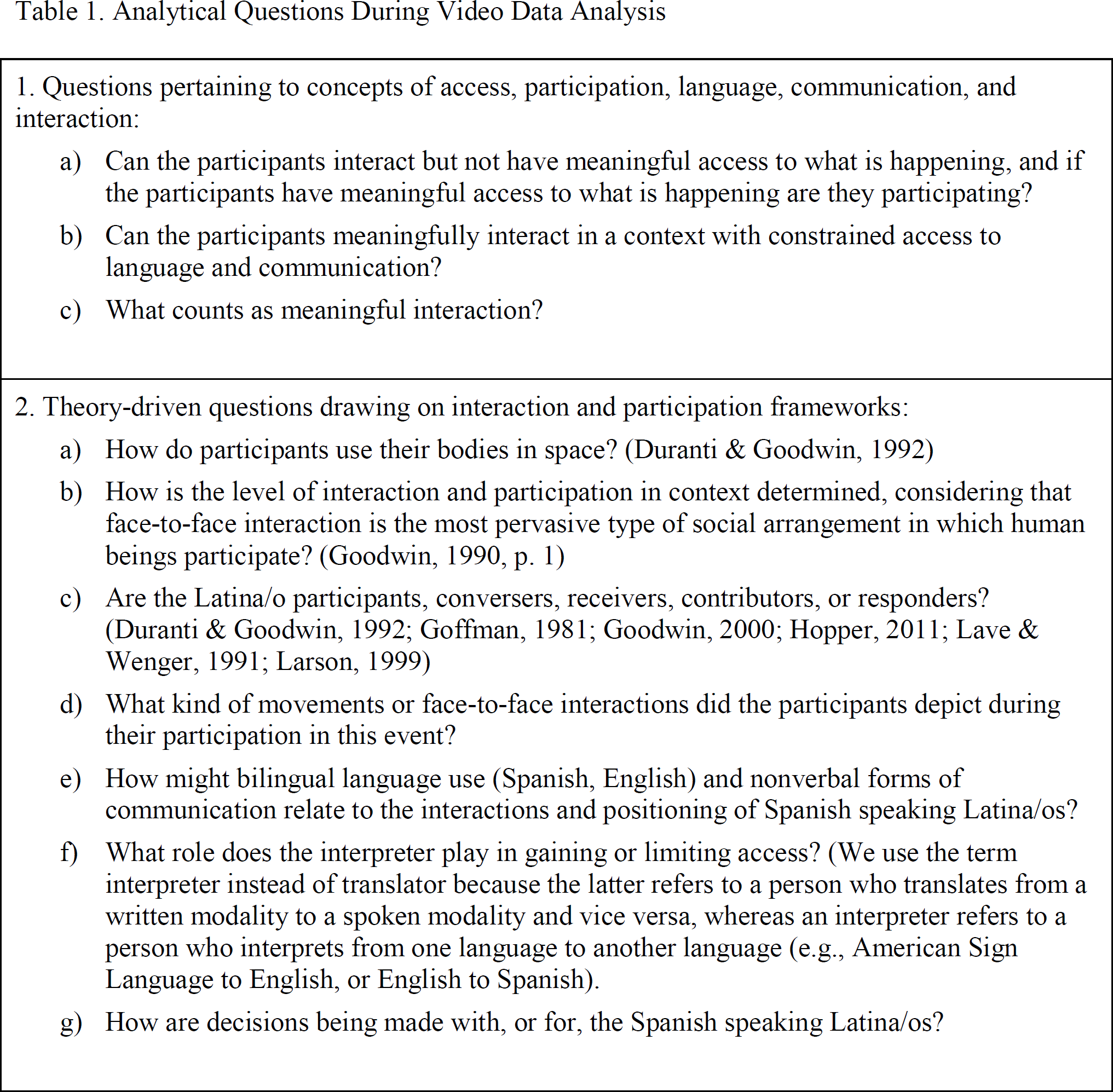
The preliminary analysis of the first set of questions (1a–1c) revealed troubling concepts of what might count as participation. Lave and Wenger (1991) theoretically have discussed concepts of legitimate peripheral participation, which means individuals change their position in the community, engage to an extent, and construct their understanding of what is taking place in their environment. Upon accessing information and moving in and out of conversation roles, members learn what it takes to become more active participants in their community. Legitimate peripheral participation could lead to either negative or positive results. Particular communities, however, might value participation that produces only authentic results, while other communities might value any type of participation—peripheral or active (Hopper & Ares, 2010). In other words, particular communities might have different ideas about what constitutes participation. Some participants might be marginalized and relegated on the periphery because they are unable to move in and out of conversation roles. Others become central participants because they have access to moving in and out of conversation roles (Hopper, 2010). An example of participation might be just attending, while another example would be attending and actively engaging, for example contributing input. The former might indicate the individual is a bystander, while the latter might indicate the individual is a converser or contributor (Goffman, 1981; Hopper, 2011). I continued to describe my visual analysis in the next passage taken from my researcher log, which indexed the chair and the corner as potential signifiers for access:
Then a chair was placed between the Latina/os. It was placed by one of the CCL leaders. A female came in the room, apparently, from the “corner” and sat in the “chair.” She began to converse with the Latinos/as. When she sat down, the Latina/os moved or leaned toward her. My instincts were telling me she was an “interpreter.” What did the Latina/os' movements toward the interpreter signify? Gathering information? Chiming in with their input? Feelings of being excluded or marginalized or being anxious to catch up? Denotations (representational meanings) of the “corner” and “chair” may be connotations of “access.” (Research Memo, Mindy Hopper)
As this memo reveals, I was struck with the placement of a chair and the corner as a destination for the Latina/os. This memo depicts my curiosity about the Latina/os' struggling for access to the information being presented and discussed during the CCL celebration event.
“Aha” Moment: Mindy's Hunch Without a Sound
During the first video viewing of the CCL celebration event, I went on to recall how, drawing from my own feelings and experiences as a Deaf researcher, I developed a “hunch” that something worthy of further analysis might be represented in this video:
To my excitement, I saw particular actions that reminded me of how we, Deaf people, act in a space where spoken language is privileged. For example, my eyes were drawn to the interactional phenomena when the interpreter arrived and the Latina/o members moved more in space. I started doing a context analysis moving from the whole video to parts, using an inductive approach (Erickson, 2006). The clip focused on the table the Latina/os chose to sit at during the celebration event. From this video watching, I developed a “hunch” about an unexpected phenomenon, a potentially critical incident had unfolded and surfaced. (Research memo, Mindy Hopper)
Switching from watching all the participants' movements within the whole event space, including the White male, to watching the parts that included Latina/o participants aligns with Erickson (2006), who suggests using a “whole to part, or inductive’ (pp.183-184) approach to video watching and focusing on nonverbal and verbal phenomena. I also recorded my feelings and questions about the need to add verbal analysis to capture a more complete account of the video data source:
The visual analysis is not complete without doing the audio analysis. The audio captures their talk and/or use of spoken language. For instance, there were times when the Latina/os did not clap, while others did. Why? Are they not understanding or do they not agree? (Research Memo, Mindy Hopper)
Thus far in this paper, I have described how I began, from a Deaf epistemological stance, to select video sources and analyze nonverbal data. With the hunch and questions in mind, my next step was to present my initial analysis to the research team and seek multiple perspectives of what I had found.
Processing Point 2: Collaborative Video Data Analysis Practices, Exploring Nonverbal and Verbal Interactions From a Video Segment
How Does the Nonverbal Data Relate to the Verbal Data in This Video? Seeking Collaboration
In an effort to consider multiple interpretations of the data, I shared this video segment, without the sounds, with my colleagues during a biweekly research team meeting. I discussed my initial thoughts about what I saw from viewing the nonverbal data:
Drawing on my Deaf epistemology, I suspected language issues might be impacting the quality and quantity of the Spanish participant's access to what was happening at the event, and subsequently impacting their interaction and participation with people at the table and at the larger event. I shared my hunch with the ethnography team, and Sandra, a bilingual colleague, validated my hunch since she heard enough of the Spanish dialogues (during the initial viewing at the meeting) to support my preliminary visual analysis findings. (Research Memo, Mindy Hopper)
After our discussion regarding my interpretations, I showed the video again, but with the sounds. During this second viewing, Sandra was struck by the verbal contents (i.e. what was being said by the participants). She responded with some presumptions about what might be transpiring, and I reminded her that it was likely, but we could not assume until we explored further by collaboratively viewing the video. Jordan and Henderson (1995) have argued that “Collaborative viewing is particularly powerful for neutralizing preconceived thoughts on the part of researchers and discourages the tendency to see in the interaction what one is conditioned to see or even wants to see” (p. 44). As Sandra listened to my initial visual analysis and the questions I was raising, she was intrigued by how the Latina/o participants in the video interacted (or not) with other individuals at the event. Since she was able to understand the Spanish spoken in the video, she corroborated my preliminary hunch that the contents of this particular video segment provided evidence for use in our larger project related to the positioning of Latina/os in the margins of the initiative (see Quiñones et al., 2011). Hence, she immediately expressed her desire to work with me.
Could We Be Onto Something? Revisiting the Video
Motivated by the idea that “we might be onto something here,” the ethnography research team encouraged us to revisit the video source in order to consider how our nonverbal and verbal analyses might be combined to co-construct meaning and generate further interpretations and theory-building through our lenses. At that point, we began our collaborative inquiry with the following research question: What does the video data source suggest about interaction and participation of Spanish speaking Latina/os in the CCL celebration event?
The combination of the critical incident and Sandra joining me motivated my interest to explore and make sense of the physical and symbolic positioning of the Spanish-speaking participants. In the literature, Deaf individuals often referred to missed opportunities to access information when they were physically positioned in an area where spoken English was prioritized (Foster, 1989; 1998; Hopper, 2011; Jankowski, 1997; Ramsey, 1997, Sacks, 1989; Sheridan, 2001, 2008).
Meanwhile, Sandra drew from Latina/o critical race (LatCrit) theory and Chicana/Latina feminist theory (Delgado Bernal, 1998, 2002; Villenas & Deyhle, 1999; Yosso, 2005) to explore and make sense of how the larger community might have missed out on potential contributions the Latina/os might have made during the celebration event. These observations entailed combining the video data with other sources of evidence, such as interviews, field notes, and documents generated during the planning process of the CCL initiative (Barron & Engle, 2007).
Together, we became interested in exploring the Spanish-speaking participants' reactions to accessing information and to being physically positioned in a different area of the room during the celebration event. At this point of the research project, we were conscious of revisiting the video, guided by the research question, and drawing from different theoretical lenses to get to the answers.
Did I Really Hear That? Video Watching and Memoing
Following Erickson's (2006) inductive procedures for video data analysis, Sandra watched the entire recorded interactional event and reviewed the video segment various times to transcribe all the verbal interactions throughout the entire video. She wrote a brief memo in her researcher log about her video watching task:
It was challenging to transcribe all of the Spanish language since the microphone had not yet been set up at the table where the three Spanish-speaking participants were sitting. However, I was able to transcribe most of what was said (as well as take notes about nonverbal interactions), only to find that what I saw and heard was shockingly in line with what Mindy had suspected—issues of marginalization, agency, positioning, and power. (Research Memo, Sandra Quiñones)
Sandra paid close attention to the interactions between the Spanish-speaking and English-speaking participants in the video. The following passage was taken from a set of field notes and memos where she recorded a brief description of the video segment, before meeting with me:
Generally speaking, there seemed to be a separation between the Spanish speakers and non-Spanish speakers at the table. The Latina translator came about 20 minutes into the event and sat in a chair between the three Latina/os … the translator was looking around in a confused manner and she said, “no entiendo” [I don't understand]. Then she left the table for a few minutes. At this point, the Latina/o participants referred to a document at the table and spoke in Spanish to each other about what was going on. When the translator came back to the table, she spoke with a tone of urgency and told the three Latino Spanish speakers that they will be moving to the corner. One of the Latinos repeated the command, saying “pa’ alla, a la esquina, a la esquina,” which means “over there, to the corner, to the corner.” Consequently … they were leaving the table, one of the Latinos said in a resentful tone “Nos sacaron, nos botaron” which meant “they have removed us, they have dumped/trashed us.” (Research Memo, Sandra Quiñones)
The description in the passage above corroborated the hunch that there might be a kind of critical incident taking place in this video segment.
Affirmation of the Hunch: A Critical Incident Discovered
Critical incident is defined as a moment of “aha,” “oooh,” “oh,” “oops,” “ouch,” or when something “amused” or “annoyed,” was “typical” or “atypical,” or was a “felt difficulty” or a “felt success” (Calandra, Brantley-Dias, & Fox, 2007, p. 35). For me, it was an “aha” moment, which was illuminated by the placement of the chair and body movements, such as gazes to the corner, the arrival of the interpreter, and Spanish-speaking Latina/o participants' body and face orientations in relation to the interpreter. The “aha” moment came from my personal Deaf ontological and epistemological orientations, which include experiencing interactions, to an extent, through the use of an interpreter. Drawing from my own experiences of being positioned on the margins of communities as a Deaf woman, I came to suspect how this Latina/o group might have become inadvertently marginalized. Realities, however, are multiple, fluid, interactive, and context dependent—”People construct individual or personal epistemologies through their experiences, and develop or receive group or socially constructed epistemologies through their interactions with others with shared or similar experiences” (Miller, 2010, p. 479). Furthermore, epistemological reflections of partial, situated experiences generate the understanding and knowledge of intersectionality, and thus stimulate shared experiences. Situating Deaf epistemologies by producing theories, knowledge, and approaches would be sensitive to, and inclusive of, marginalized/colonized groups (De Clerk, 2010).
For Sandra, it was an “ouch” moment, when she experienced feelings of pain and anger at what she saw and heard in the video. She was struck by the “nos botaron” remark that signified the Spanish-speaking Latina/o participants' feelings of being moved and disposed. The remark symbolized the interplay of place and space as conceptualized by Chicana/Latina feminist scholars (see Elenes & Delgado Bernal, 2010).
After taking some time to step away from her initial emotional reaction, Sandra scheduled a time to meet with me to discuss the first round of transcriptions, field notes, and analytical memos. What follows is another segment of her analytical memos recorded after her own verbal analysis (before meeting with me):
Who is “they”—Who is dumping them/trashing them (the interpreter, the event organizers, the organization, society)? Is this evidence that they feel subjugated or “kicked to the curb?” What is going on here? (Research Memo, Sandra Quiñones)
The word “they” ties in with the broader layered meanings of denotations and connotations that I suggested earlier. For instance, the term “they” might denote the dominant groups who are likely to relegate or marginalize the subjugated members to the periphery of the celebration event. The fact that this particular member felt like the Spanish speakers were being dumped was a connotation of societal patterns of linguistic marginalization. Thus far, the data analysis and probing of the data revealed the interplay of complex power dynamics and nonverbal interactions that warranted further analysis.
So, What Did We Find? Co-Constructing Meanings During Video Watching
One of the most powerful features of using video data sources is that the video can be revisited an infinite number of times as a necessary part of developing social practices for our video watching (Derry et al., 2010; Erickson, 2006). Together, we combined the nonverbal and verbal data and delved into my observations using this single video data source. Indeed, we were grateful that the videos could be revisited because merging our visual and verbal analyses gave us the opportunity to share interpretations and raise more questions. Many meetings later, we reviewed the video together and explored not only the video data but also other sources in the data corpus that could be used for triangulation purposes. Data source triangulation involves looking for patterns and themes across multiple data sources (Charmaz, 2006; Creswell, 2009; Stake, 1995).
When we came together to discuss our interpretations, it became evident that Sandra did not notice some of the visual patterns I had noticed in my visual analysis. I highlighted this observation and we revisited the video collaboratively to explore and clarify the work done independently. Overall, revisiting the video data numerous times, both independently and collectively, made salient the idea that video data analysis is a “recursive cyclical process” (Angelillo, Rogoff, & Chavajay, 2007, p. 193; Engle, Conant, & Greeno, 2007, p. 239), particularly as part of a collaborative endeavor. We engaged in collaborative practices by iterative video watching, processing our thoughts, and analyzing our multiple interpretations of the nonverbal and verbal interactions from this video segment.
Have We Let the Data Inform Us? Recoding and Reconceptualizing the Emergent Themes
After aligning our individual transcriptions using time stamps, we were excited to discover common codes, as well as some distinctive codes. In light of the realization that “we might be onto something” in this collaborative project, we pondered on whether or not to let the data inform or complement our epistemological stances. In other words, we made a conscientious effort to let the data inform us (Charmaz, 2006). We decided to delve into our collaborative and iterative coding process to reconceptualize themes that emerged in the data.
Reflecting and writing about our own dialogical process in the form of memos (Charmaz, 2006) and concept mapping (Marshall & Rossman, 2010) deepened our own understanding of methodology in video data analysis. During our ongoing analysis, we created diagrams to cluster our codes in order to explore and experiment with relationships between codes. The concept maps represented our collaborative interpretive progress. Figure 1 represents one of our concept maps.

An Example of One Conceptual Map.
We felt concept maps helped us visualize, document, and organize our clustered sub-themes and themes. For example, Figure 1 shows our themes of language, access, body orientation, gestures, roles, invisibility, spaces, and artifacts. In stepping back and looking at the concept map as a whole, the themes and sub-themes strongly reveal nonverbal actions and body language. Thus, the themes drew on the Deaf epistemology used during the recursive and iterative analysis process. The themes and sub-themes revealed a larger picture of structured participation and how the Spanish-speaking participants were positioned on the periphery of their immediate community during the celebration event.
How Do We Explain the Complex Phenomena of Marginalization? Participation Framework Grounded in Deaf Epistemology
As our dual lenses evolved—through the Deaf epistemological lens—we became interested in exploring the Spanish-speaking participants' reactions to accessing information and to being physically positioned in a different area of the room during the celebration event. Drawing from interaction and participation frameworks (Goffman, 1981; Larson, 1999) I developed the following subset of theory-driven questions, which are highlighted above in Table 1.
Rather than attempt to discover a single truth, our aim was to open up a more complex, in-depth, although still partial, understanding of the marginalization issue (Tracy, 2010). Furthermore, we aimed to continue performing progressive refinement of our questions (Engle et al., 2007) (see Table 1). So, with these questions in mind, we returned again to video watching. We realized how complex the phenomenon of marginalization was, and that we could not claim one single truth. Furthermore, intersectionality is concerned with how forces from different angles shape phenomena of marginalization.
How Do We Best Represent Evidence for Collaborative Interpretations? Reconceptualizing Transcriptions
In order to best represent evidence for collaborative interpretations, we reconsidered our transcribing work. This significant part of the methodology was to conceptualize the practical nature of the transcription (Erickson, 2006, 2007; Lapadat & Lindsay, 1999; Ochs, 1979). The practical nature of transcription often goes unrecognized; therefore, we made an effort to be consciously selective in the transcription process. Our goal was to make our transcripts explicit for our readers in terms of illustrating both nonverbal and verbal elements. We were inspired by Ochs' (1979) description of the ideal transcript:
Ideally, we want our transcript to meet practical needs as well as theoretical considerations. We want our transcript to express the relation between non-verbal and verbal behavior as accurately as possible: We want it to encode not only prior and subsequent behaviors, but concurrent and interconcurrent behaviors as well. We do not want a transcript that discourages the reader from integrating verbal and non-verbal acts. On the other hand, we want a readable transcript, one that displays clearly and systematically utterances and contexts. (p. 59)
At this point, we wanted to delve further into what the video data suggested about the interaction and participation of Spanish-speaking Latina/os at the celebration event. Keeping what Ochs (1979) suggested in mind, we wanted to determine what type of transcription best matched our practical needs and theoretical stances. Moreover, Erickson's (2007) work challenged us to ponder how we saw and heard what was transpiring in the video source, and how we made sense of the underlying meanings of these interactions. Since we wanted to represent both nonverbal and verbal forms of interaction, we decided to follow a transcription style that had two columns side-by-side. We both recorded nonverbal interactions on the left side and verbal interactions on the right side (see Appendix A). Appendix A represents 17 seconds of the video source.
Lapadat and Lindsay (1999) argued, “Transcription is inherently theory-laden” (p. 22). The reasons for revealing nonverbal interactions and verbal interactions separately is to be able to “see the trees rather than the forest” (Erickson, 2006, p. 185). We acknowledged that transcription is representational because verbal transcribing often overlooks what might be found in nonverbal transcribing. In our collaboration, we made a strategic and deliberate effort to avoid the mistake of privileging and representing only the verbal conversations (Lapadat & Lindsay, 1999). This choice “opens the transcription process for examination of its trustworthiness as an interpretive act” (p. 21). Therefore, the transcription process we used reveals our differing theoretical standpoints, which also complement each other. As shown in Appendix A, this visual format for the transcription allowed us to see the relationship between nonverbal and verbal references to the chair and the corner more explicitly. The references to the corner signified issues of access and displacement, which aligned with our merged codes.
As part of the effort to address these additional questions in the analysis, we had to determine which segments of the video to target for more detailed transcription and coding. In doing so, we identified which parts of the video to focus on as potential data sources in a more “systematic rather than arbitrary and capricious” (Goldman et al., 2007, p. 15) manner. We independently recorded our rationales for choosing four short segments of video, and when we convened to negotiate final selections based on our main research question, we found that we had chosen the same episodes. Moreover, we selected our segments for similar pragmatic and theoretical reasons. Reaching agreement with our segment selection further substantiated reliability and validity in our collaborative video data analysis process (Charmaz, 2006; Creswell, 2009; Derry et al., 2010). In a discussion of how to analyze data derived from video records, Derry et al. (2010) note the importance of attending to issues of reliability and validity:
Reliability and validity issues of all kinds (internal, convergent, external, descriptive, interpretive, and theoretical) apply to video-based data just as they apply for any other kind of quantitative or qualitative data analysis. Potential criticisms from the research community about the generalizability of findings from video research can be countered by paying explicit attention to the logic of one's inquiry, including one's approach to selecting or collecting records, and by articulating the processes used to create explanations and generate claims. (p.15)
With potential criticisms in mind, we wanted to model our merged transcription that represented this particular segment (see Appendix B). Reconceptualizing our transcriptions in this manner illustrated our collaborative findings more explicitly.
Exploring and scrutinizing the dimensions of the video resulted in multiple analyses and impacted how we came to segment selection agreement and to decide on the format of our final (merged) transcription (Ochs, 1979). Moreover, the individual and co-constructed interpretations helped us transcend and resist dichotomous thought processes (Ellingson, 2009). Generally speaking, our transcribing, coding, and analytical work helped us tease out the distinctions and relationships between two constructs: interaction and participation. Sandra realized that these two constructs (interaction and participation) were not mutually exclusive phenomena. Table 1 highlights our inquiries, which pertained to concepts of access, participation, language, communication, and interaction. At that moment, we realized scrutinizing and exploring such dimensions resulted in multiple interpretations.
To conclude processing point 2, we revisited the video (both independently and as a team) in a conscientious effort to examine the nonverbal and verbal data and co-construct our interpretations of a critical incident. In doing so, we recoded and reconceptualized emergent themes, explored complex phenomena using participation framework grounded in Deaf epistemology, and strategically merged our transcriptions to illustrate our collaborative video data analysis process.
Processing Point 3: Researcher Reflexivity and Epistemological Grounding of Video Watching as Part of the Interpretive Process
What Makes You Say That? Reflecting on Assumptions and Recognizing Limitations
Throughout the analysis and interpretative work that we engaged in (as described in processing point 2), we were mindful of how assumptions, presuppositions, beliefs/values, and dispositions came into play. We continuously challenged each other to consider assumptions by asking each other questions, such as “What makes you say this?” “What evidence do you have?” and “Are you making an assumption?” In doing so, we recognized how underlying and overt assumptions may impact our questions and interpretations. To this extent we both agreed with Goldman et al. (2007) that “the ability to decompose a complex event and select specific parts to pay further attention to is influenced both by a researcher's perception and by what actually occurs” (p.16). We also realized that, at times, we raised certain questions that were quite difficult to answer, given particular limitations (i.e., we were not at the event, there was only one camera and it was stationary, and we could not interview the participants). During these moments of researcher reflexivity, we engaged in memoing, which potentially highlighted our assumptions and limitations, as well as our overall line of inquiry.
Dealing with Multiple Tensions Related to What We “Uncover” and “Discover”
In the journey to explore various collaborative practices in video data analysis, what we uncovered and unveiled led us to a place where our multiple roles and identities combined to produce conflicting emotions. These roles and identities emerged from our own knowledge and experiences, in other words, epistemologies. For example, I drew from my Deaf epistemology of participating in events where the dominant language is English, and non-dominant language users are positioned at the periphery (both physically and symbolically). I argued that non-dominant language users in this position interacted within the environment but were not authentic or full participants during the celebration event. During our analysis, I recognized the parallels between the experiences of Deaf people and those of Spanish-dominant Latino/as. Similarly, Sandra drew from experiences of ethnic and linguistic discrimination. The next memo illustrates her realization:
On the one hand, I was excited to find supporting verbal details for Mindy's preliminary visual analysis. On the other hand, I was also saddened with the realization that the “discovery” of what I saw and heard in this video data source speaks to the perpetuation of oppressive structural and discursive practices that impact our Latino community. However, I am hopeful (in a Freireian sense) that my difficulties within this project will continue to challenge me, but not paralyze me (Freire, 1970, 1998). (Research Memo, Sandra Quiñones)
This hope served as a source of resilience to continue with this kind of unfinished and ongoing work (Freire & Araujo Freire, 2007). While Sandra drew from a Freireian notion of oppression, I drew from Foucauldian notions of power-knowledge to make sense of these social interactions (Foucault, 1978; Gore, 1998). In Foucault's famed power-knowledge axiom, he asserted that power is multidirectional, everywhere and not necessarily evil. Furthermore, “Power and knowledge directly imply one another” (Dreyfus & Rabinow, 1982, p. 115). The passage below is from an email I sent to Sandra in an attempt to synthesize how both Freireian and Foucauldian perspectives have informed our research journeys:
Yes, we all have been there and it is important that we keep learning and understanding how complex and embedded the perpetuation of institutional, structural and discursive discriminatory and oppressive practices have been and are. This is what Foucault was trying to point out. It is the role of resistance and education that we have to take on in battling those discriminatory and oppressive forces. With our epistemologies and ontologies, we can reveal these notions by working with our study participants. It is our hope that our research findings will encourage our readers to form authentic dialogues about how some people or students may be positioned or marginalized instead of how their unique funds of knowledge or resources could be capitalized. I guess you said it “in a Freireian sense.” I realize I basically said what you just said. It's simple—our hearts are invested in this research simply because of our experiences and epistemologies—we cannot avoid it and must acknowledge it! We all are socially constructed and situated in power relations. (Research Memo, Mindy Hopper)
Overall, it should be clear to the reader that our decision making and video watching processes were not isolated events that could be separated from our epistemologies and ontologies. In fact, as critical qualitative researchers, we did not seek to remain neutral or objective about the phenomena being observed (Gall, Borg, & Gall, 1996; Peshkin, 2000). For this reason, we chose to share with our audiences our feelings and experiences related to our critical and reflexive approach in video watching and analyses.
Complementing Deaf Epistemology with Chicana/Latina Feminist Epistemology
In Sandra's initial field notes and reflective/critical memos, she raised several questions that may be perceived as biased or politically charged. She acknowledged this potential critique, yet agreed with Delgado-Bernal's (1998, 2002) notion of using cultural intuition to inform her work as a researcher. Delgado-Bernal has employed cultural intuition to justify the need to “ground one's research within the experiences” of one's own ethnic communities in a deliberate and strategic effort to counteract epistemological racism (Scheurich & Young, 1997). Drawing from Chicana/Latina feminist epistemology, Sandra incorporated her personal and professional experiences as a female, bilingual Puerto Rican educational researcher in the United States context as she questioned the role of racism in the positioning of Latina/o participants in this study. That is, she wanted to consider what this critical incident might reveal about the positioning of Spanish-speaking participants in the context of the community celebration event. According to Rodriquez, Schwartz, Lahman, and Geist (2011), “[Chicana/Latina] epistemology challenges traditional paradigms by relocating Latinas' lived experience to a central position in the research and by viewing this experience at the intersection of the social identities of race/ethnicity, class, gender, and sexual identity” (p. 402).
Given both of our orientations to critical and social constructivist perspectives about knowledge production and learning, it became increasingly important to continue writing individual analytical memos and then discussing them together as part of the data analysis process. The analytical memos were vital steps in the development of interpretations. That is, the use of memos was helpful for understanding that we were coming to the data analysis from multiple theoretical orientations rooted in social constructivist and critical approaches to knowledge production.
“What's Going On Here?” Rethinking Our Research Analyses and Interpretations
While contemplating our research analyses and interpretations, we drew on Wenger's definition of participation. Wenger (1998) has defined participation as the process of people engaging, reflecting, and negotiating meaning within a community of practice. Applying this definition, we viewed the Community for Children of Lakeview (CCL) as the larger community of practice. The members of CCL might participate in practices that are more or less central to the practices of the larger community. Active engagement and membership are also two important notions in Wenger's definition of participation. Active engagement and membership includes language socialization in interactions or activities, and facilitates community members in negotiating and reconstructing knowledge (Bruner, 1990; Garrett & Baquedano-López, 2002; Wertsch, 1991). Participation allows people to experience collective or social learning and acquire ways of making sense of and understanding the world. Using a participation framework grounded in Deaf epistemology (Hopper, 2011), I have argued that participation is not possible without shared language, communication, and understanding. As a result of our data analysis, we felt the Spanish-speaking Latinos participated less in the practices of the larger community because the language was not shared between all the members. What we mean by shared language is that the language is fully accessible and intelligible to both parties. “Accessing and sharing language” phenomena are dynamic, fluid, and ongoing processes. Wenger's (1998) notion of participation influenced how we conceptualized participation and interaction. We returned to the data several times both independently and collaboratively with different tasks in order to explore various methods that might inform this refined research question.
In sum, processing point 3 focused on researcher reflexivity, and the epistemological and theoretical grounding of video watching as part of the interpretative process. We reflected on our assumptions, dealt with multiple tensions that arose, complemented our epistemological stances, and reconsidered our research analyses and interpretations using participation framework grounded in Deaf epistemology.
Discussion
Co-Constructing Meanings by Drawing From Our Respective Epistemologies and Joint Researcher Subjectivities
Inspired by Erickson (2006), we engaged collaboratively in a critical, reflexive phenomenological and epistemological grounding of video watching. Erickson has posited, “It is not a realist matter of disembodied objectivity – a view from nowhere and no when by no one in particular” (p. 179). We interpreted this particularly as a collaborative process and could not detach ourselves from the video analysis. In this paper, we revealed the personal and subjective nature of video analysis. Rather than disembodied and objective, we viewed video data from particular epistemological and theoretical stances.
After writing drafts of this journal manuscript, we were pleased to discover how Paulas et al.'s (2010) claims support our own understanding of how collaborative meaning making increases the richness of qualitative inquiry. These authors posited:
In collaborative research, meaning making is the dynamic and iterative process of connecting researchers, empirical materials, interpretations, and theory to better understand the phenomenon under study, all within one or more institutions and the wider research community. (p. 860)
These scholars emphasized the importance of iterative, dialogic, and emergent processes of co-constructing meaning. In a similar vein, we believe the interplay of epistemologies, theoretical frameworks, and methodology increased the rigor, soundness, and trustworthiness of our video data analyses.
Essentially, our individual and joint journeys of interpretation resulted in unmasking and “coming out” of our relationships to the chair/silla and the corner/esquina. The chair/silla and the corner/esquina became symbolic in our individual and joint interpretive journeys. As non-dominant researchers, we came to a consensus that the chair and the corner represented multifaceted and multidimensional forms of marginalizing and exclusionary practices. Ultimately, we realized the use of dominant language as a means of subjugating and marginalizing linguistic groups prompted a sense of advocacy and a political push for a transformation and equal access in participation structures and practices. We began with individual researcher positionality. Then, as we went through our interpretive journey (Peshkin, 2000), we gained greater access to understanding and co-constructing meanings and how those meanings interact (Goldman, 2007). This “sense-making” emerged from our joint researcher epistemologies. In so doing, we (Mindy Hopper and Sandra Quiñones) centred our interactive and collaborative video data analysis processes to gain a more complex and nuanced interpretation of video data.
Ethical Considerations in Video Data Analysis
In line with our critical and reflexive approach to video watching, ethical considerations need to be addressed when using video data for research in community settings, in the reporting of the data analysis process, and in the dissemination of the findings (both in conferences and in publications).
During the Strategy Team meetings, the co-principal investigators introduced the purpose of the study and the data collection methods, including videotaping, and discussed how to ensure confidentiality and anonymity by using assigned codes or pseudonyms for each participant. During the community meetings, including the celebration event, the researchers posted Institutional Review Board (IRB) approved posters, in both Spanish and English, indicating that the participants were being filmed as part of an ethnographic study of the Community for the Children of Lakeview (CCL) organization. For video data analysis purposes, only the members of the ethnography team viewed the data.
During the celebration event, the camcorder was placed toward the back of the room and the viewing was set on a wide-angle focus. The participants were aware that we were filming the event, and yet they sat at a table in front of the camcorder (see Appendix C). Although the participants knew they were being audio-visually recorded as part of data collection for our ethnographic study, the participants might not have realized the extent to which their words and actions would be analyzed and distributed to other researchers.
Ethical concerns arise, for instance, in making the words and actions in the video data accessible to external audiences. If we had shared the video data with viewers, we would have had to obscure the participants' faces in an effort to protect their identities. For this particular paper, this type of obscuring would remove much of the nonverbal data, and there would be no reason to insert still frames (single-captured frames within a video file) from the video data. Furthermore, sharing a still frame would not capture the dynamics between nonverbal and verbal data interactions. Hence, we did not include a still frame of the critical incident as discussed in our narrative account of the collaborative research process. Aside from reading this paper, accessing and reviewing the Appendices (A, B, and C) should provide readers with a visualization of how we interpreted the actions and words in the video data. Ultimately, our intention in this paper was to share our methodological approaches in collaborative video data analysis, while still protecting the identities of the participants in the video data source.
Conclusion
Overall, our purpose was to give the reader insight into our thinking and decision-making process as a Deaf, White, bilingual female researcher and a bilingual, Latina researcher team co-constructing meanings from the nonverbal and verbal interactions that emerged in the chosen video data source. We did not allow our differing linguistic or cultural practices to inhibit our research interest and process, but, rather, utilized our respective epistemologies, including cultural and linguistic repertoires, to guide and frame our methodological process. If researchers wish to conduct a more in-depth study of videos, we encourage the vital step of taking advantage of Deaf researchers who see the world primarily through visual cues, expressions, body language, gestures, and movements. This is a critical approach to scrutinize the nonverbal interactions that are often overlooked. Co-constructing meanings through video analyses with a Deaf researcher promotes a more in-depth analysis of possible underlying layers of what might be going on in the data.
Overall, this research process has allowed us to engage collaboratively in a more carefully thought out process of “data mining” (Engle et al., 2007). Moreover, we engaged in practices that not only generated multiple interpretive analyses but also accounted for reflexivity. The interaction between our data and ourselves as co-researchers strengthened our qualitative inquiry. We encourage others not only to develop collaborative social practices for video data analysis but also to consider sharing their reflexive thinking about using video research in education (Derry, 2007). We welcome readers to join us in raising consciousness of embodied accounts of agency, and pushing for more fruitful qualitative inquiry processes through video data analysis of nonverbal and verbal interactions.
Footnotes
Acknowledgements:
The authors equally contributed to the development of this article. We acknowledge Dr. Nancy Ares, for her valuable guidance and support toward our collaborative research process. Professor Ares, Professor Joanne Larson, and Professor Kevin O'Connor were the co-principal investigators leading the larger ethnography study. Furthermore, we thank Dr. Scot Atkins for his feedback on this article.
Appendix A: Transcription that Reveals Nonverbal Interactions in Column 2 and Verbal Interactions in Column 3

| Time | Nonverbal | Verbal |
| 29:43 | – MARIE, already standing, picks up her papers; holds several papers in her left hand and a paper in her right hand; her head orientation shifts toward LIZ; pushes her chair in. – JUAN's head orientation faces across the table; holds his papers in his left hand and collects more papers from the table on his left. – JULIO's head orientation briefly shifts to his left then to right; gets up. – RED's shoulders are concaved inward and his head orientation is at his papers; scans his papers with is right hand (these are repeated and consecutive movements). |
|
| 29:46 | – MARIE walks to her left toward the corner. |
|
| 29:53 | – JUAN picks up his plastic cup with his right hand; gets up; his head and body orientation shift toward the corner | – JUAN says, “Pa alla’ pa’ la esquina pa’ la esquina … Nos sacaron, nos botaron.” |
| 30:00 | – LIZ walks to her left toward the corner. |
Appendix B: Merged Transcription that Records Each Participant's Interaction in a 17-second Segment
– JUAN picks up his plastic cup with his right hand; gets up and his head and body orientation shift toward the corner. – JUAN says, “Pa alla’ pa’ la esquina, pa’ la esquina…Nos sacaron, nos botaron.”
Critical Incident: “The Corner”
29:43-30:10
MARIE
JUAN
LIZ
JULIO
RED
29:43:00
– MARIE, already standing, picks up her papers; holds several papers in her left hand and a paper in her right hand; her head orientation shifts toward LIZ; pushes her chair in.
– JUAN's head orientation faces across the table; holds his papers with his left hand and collects more papers from the table on his left.
– LIZ picks up her coat; starts to pick up her water bottle but does not and instead picks up her papers in front of her on the table; then tucks her bottled water in her left arm; picks up her pop and plastic cup.
– JULIO's head orientation briefly shifts to his left then to right; gets up.
– RED's shoulders are concaved inward and his head orientation is at his papers; scans his papers with his right hand (these are repeated and consecutive movements).
29:46:00
– MARIE walks to her left toward the corner.
– JULIO's head orientation shifts to the corner then back to his table; picks up a plate of stuff and walks away.
29:53:00
30:00:00
– LIZ walks to her left toward the corner.
– RED's head orientation shifts from his papers toward the corner; his head orientation remains for 24 seconds.