




Abstract
In this article the authors describe the use of time line drawings in sensitive-topic narrative interviews. They present time line drawings as a means of inviting participants to enter into a reflective space and engage their stories with a depth that might not happen without such a representational activity. The authors discuss three examples of research participant drawings.
Sketching the outline: Setting the scene
Challenges abound when researchers invite participants to tell stories that go beyond a mere shopping list of facts, distracted ramblings, or disjointed vignettes to enter a space of deeper reflection. When the stories we ask for involve sensitive topics, the challenges increase. We become concerned that our invitations to enter into deeper reflection might be unnecessarily painful, that the participant might feel overly exposed or vulnerable, that there seems no way to move past a scripted telling of painful events and into more reflective engagement. Participants experience their own challenges when we not only ask for difficult stories to be told but expect that participants will also engage in a meaning-making process.
In this article we describe the use of time line drawings as a means of addressing researcher concerns and providing participants with a way to engage their stories with depth and create new meanings and understandings.
Narrative interviewing
We live and make meaning of our lives through stories (King, 2003). A narrative interview format is an excellent method for having participants talk and describe their experiences in the form of a story. An open-ended question employed to begin the interview is helpful in putting the participants into a narrative frame of mind. As Chase (2005) has written, the participant must be willing to take up the invitation to become a narrator of his or her life experience.
Enosh and Buchbinder (2005) contended that the narrative interview is both relational and interactional. The what (the context) and the how (the way in which the meaning of the context is constructed) are intertwined, and both are crucial elements of the process. As qualitative researchers we often worked to achieve what these authors describe as narrative as self-observation, in which participants move to a position of interest in remembering and telling their stories in a self-reflective manner. This approach to research interviewing was echoed when Clinchy (2003) encouraged researchers to explore ways to encourage participants to engage in an “epistolary voice,” one that does not assert or announce but explores and engages.
The sensitive-topic interview
When research involves asking participants to tell their stories of potentially sensitive and emotionally charged topics, we face particular challenges in trying to tap into a participant voice that will explore and engage. Telling one's story has the potential to carry a tremendous psychological implication for the storyteller (Rosenthal, 2003). When participants are asked to relate stories that possibly contain traumatic events, various issues can arise: Participants can become lost in the telling of this story, they might not find a voice for this particular story, they might react by quickly related a shopping list of details with little engagement or emotion, they might forget or avoid important aspects of the story, or they might fall into a rote telling of a story they have possibly spoken of many times. Narrative storytelling has a widespread application in the ethnographies of health care for the very reason that it can lead to an integration and understanding of life experience, but first we have to access a space with the participant that will encourage self-reflection. In sensitive topic interviews, the authors have found that participants often need alternative means by which they can tell their stories of suffering before they can enter a more reflective state to engage the story, making connections and creating deeper meanings.
Time line drawings
Time line drawings can provide a representational anchor in sensitive topic, narrative interviews. They can facilitate participants' process of telling their stories in the epistolary voice that Clinchy (2003) has described. The researcher can probe for many details and examples of storied experience while the participant works on the time line or after. The time line is useful as a finished product, on the table between researcher and participant, as a touch point for further and deeper reflection. It is helpful for some participants when trying to gather and express their thoughts to have the opportunity to switch from a purely verbal way of expressing oneself to a more creative form. It can also provide valuable distance from what has been experienced; a “break” from a more intense verbal process.
Research context
As part of the first author's thesis she employed the use of time line drawings with women, who were asked: Do you have a story to tell about how your past experiences of abuse have affected your ability to find and maintain work? Many research studies have examined quantitative aspects related to women's experiences of abuse; what are less prevalent are the actual stories women tell about the effects of abuse on work life. The time line drawing was introduced at various times, depending on the narrative flow of the participant's story. Participants were asked to create some type of visual representation of their work history, including important life events along the way. They were shown two examples: a simple line drawing with peaks and valleys and written notations, and a more winding path type of drawing. Five women were interviewed for this research. The following three examples have been chosen because they illustrate the ways in which the time line drawings enhanced the narrative interview process as well as demonstrate three possible points within the interview when this type of representational activity can be introduced.
Becky's time line drawing
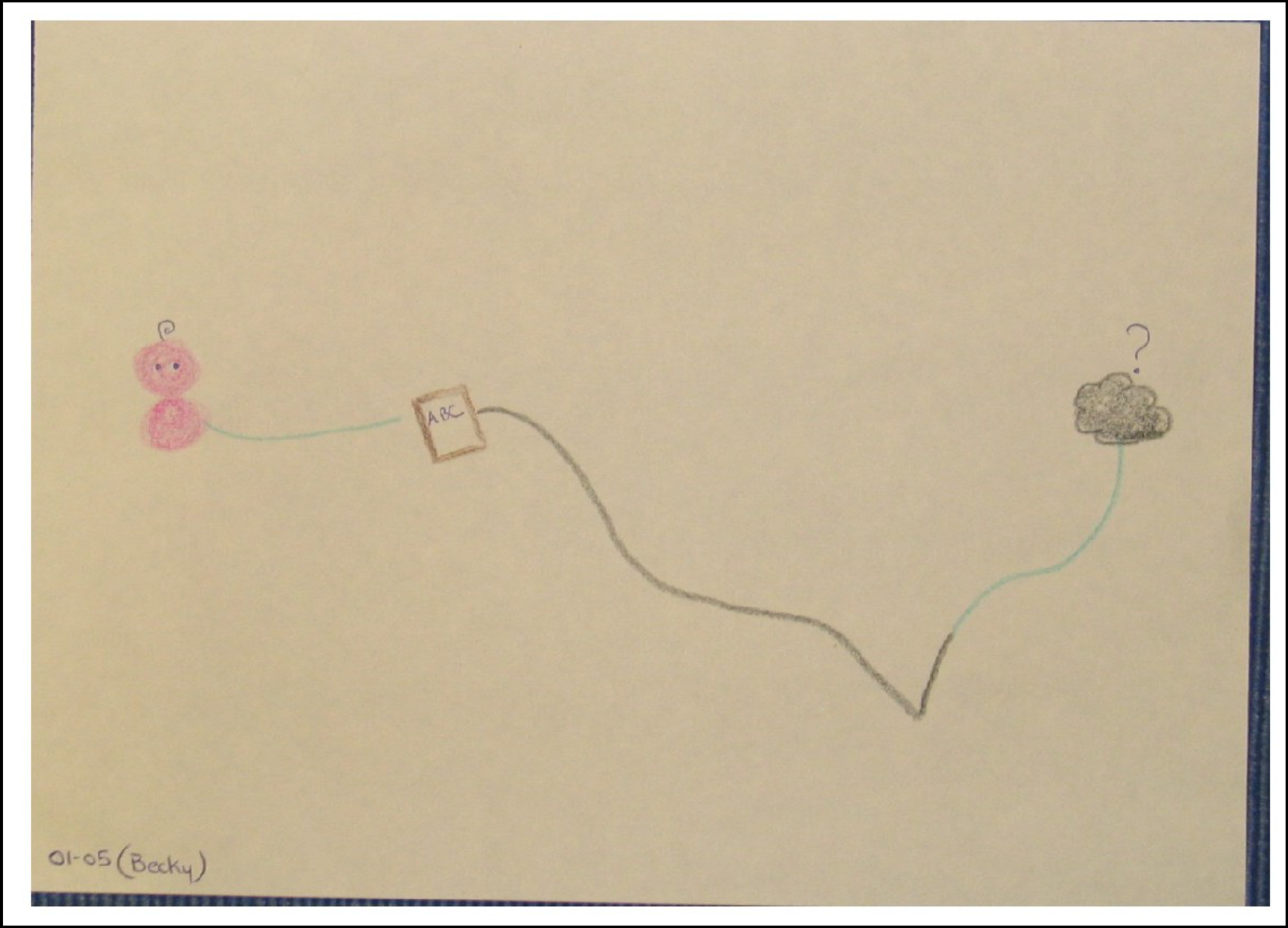
The time line drawing came late in Becky's interview (Figure 1). She told her story in a clear narrative fashion with few slowdowns or stops. After moving through the drawing quite quickly, almost as if the activity was somewhat juvenile, Becky sat in silent contemplation for several moments.
Becky's time line drawing
At first glance her drawing seemed simplistic. It begins with a pink baby figure and then moves along a light green line for a short distance to a small book labeled “ABC.” Becky describes this as, “Well, baby pinky, that's me, all sweet and innocent, and everything seemed kind of hopeful but school happened, and I didn't do well with school.” The doubling action of metaphor, in this case Becky's identification with “baby pinky” as an innocent figure, increases and provokes reconsiderations and deeper meanings (Springgay, Irwin, & Wilson-Kind, 2005). In the moment of recognizing herself as baby pinky, the ways in which her innocence had been stolen at a very young age were revealed and felt in a different way than previously when Becky had described events in her childhood quite matter-of-factly. From the “ABC” book a black line leads steadily down. “From school, everything just sort of got, you know, it was just confusing and then back to no dreams and just barely getting through.” Eventually the line climbs up again, though still black. Becky points to the lowest point, “This part—it really stripped me of everything, you know, or everything I had left.” The line then turns green and climbs slightly higher than the pink baby figure and ends in a small black cloud with a question mark over it. “Well, I've come through this employment program and things are better but there is still this black cloud of unknowing and I'm still just not sure of things.”
Coming at the end of the interview, the time line drawing activity allowed Becky a valuable opportunity to consolidate and expand on much of what she had already shared. The quality of her reflections took on a greater depth. She ended the interview pointing to her drawing of the black cloud and saying,
Coming through this cloud, I will be able to make a difference and I think people's life experiences drive you toward what you feel you need to do and I feel like I need to make at least one person's life a little easier than mine was.
Cinnamon's time line drawing
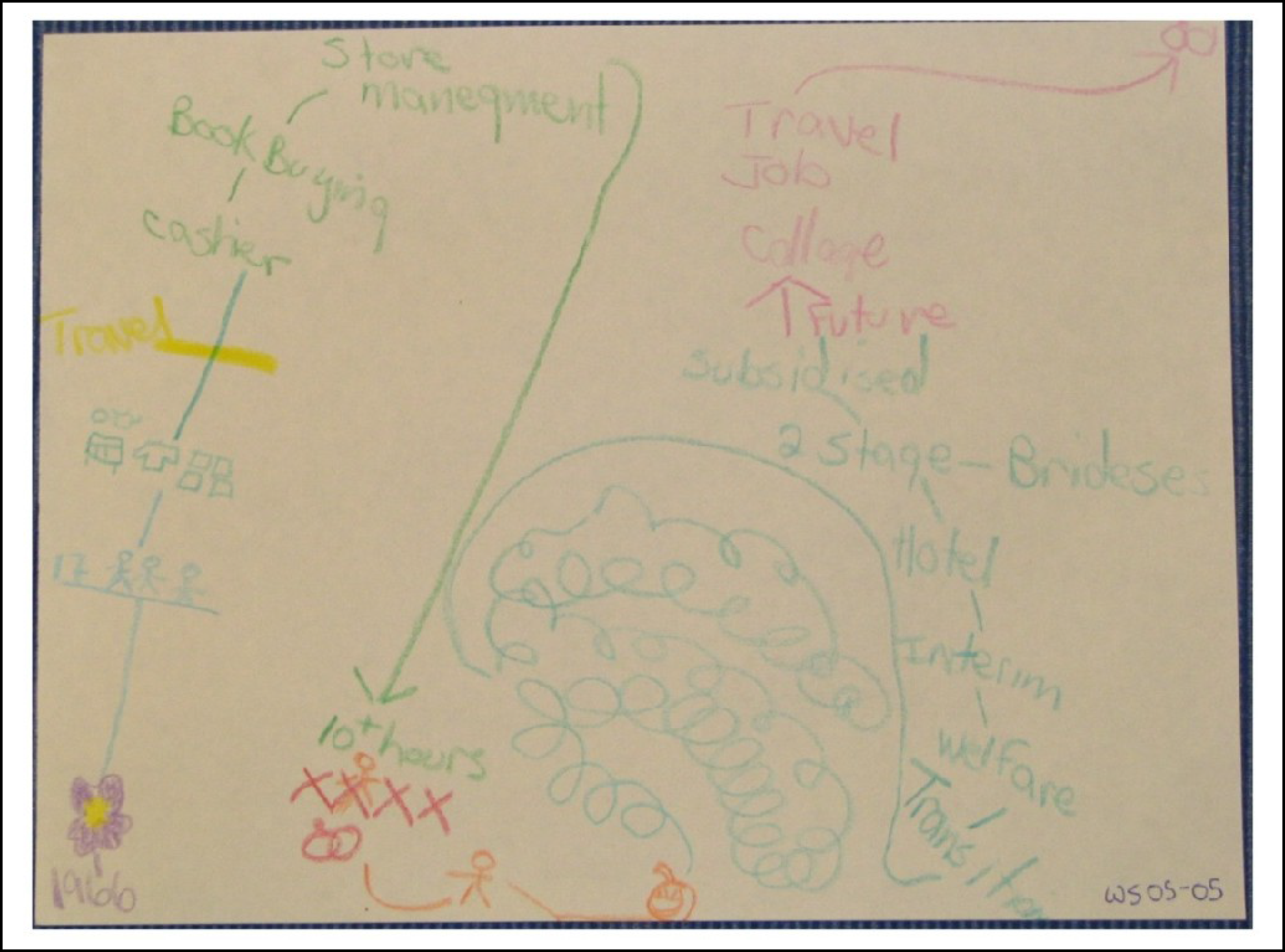
Cinnamon created her time line drawing (Figure 2) about halfway through the interview. She had seemed to wind down in her ability to verbalize her experience, and her transcript reveals several long pauses and one-word replies to the various ways the interviewer attempted to draw her out and have her elaborate on her story. It seemed to be a natural place in the interview when Cinnamon would benefit by shifting away from talking to accessing another means of depicting her experiences. Field notes taken at the conclusion of the interview reflect this process: “Through the first part of the interview she seemed so intent, never taking her eyes off me as she spoke. I think she really relaxed into the process somewhat as she did the drawing.”
Cinnamon's time line drawing
Cinnamon's drawing shows her moving in an upward direction from her early home life as she embarks on the world of work. She then reaches a peak and seems to plunge down into a very deep valley. This represents her breakdown from overwork and her subsequent marriage. The marriage experience is depicted by a series of spiral lines. She begins to climb back up again as she leaves the marriage, finds housing, accesses an employment program for women, and looks to the future.
The time line drawing allowed Cinnamon to share details of her actual work experiences and how these related to her abuse. In the first half of the interview, she dwelled almost exclusively on her separation from her abusive husband and her struggle to find housing. These were issues that were close in time and very important before she could move on with any other aspect of her life, including work. The drawing triggered a movement into reflection related to her earlier life, experiences with her family of origin, and earlier work history.
As the second half of the interview progresses, Cinnamon makes many allusions to the drawing by saying things like, “Now here, this is when … and right here, that is when …” The image of the spiral becomes significant as she describes moments of spiraling down in past work experiences and in her marriage. Her visual depiction becomes what Denzin and Lincoln (2005) described as the creation of an emotional gestalt, where images and understandings blend together and form something new. The tone is much more reflective than in the first half of the interview. She ends the interview saying,
Looking at this time line I see that I am still in such a process of trying to get past my family stuff—my mom making me into such a people pleaser—that just really follows me all the way through.
Melanie's time line
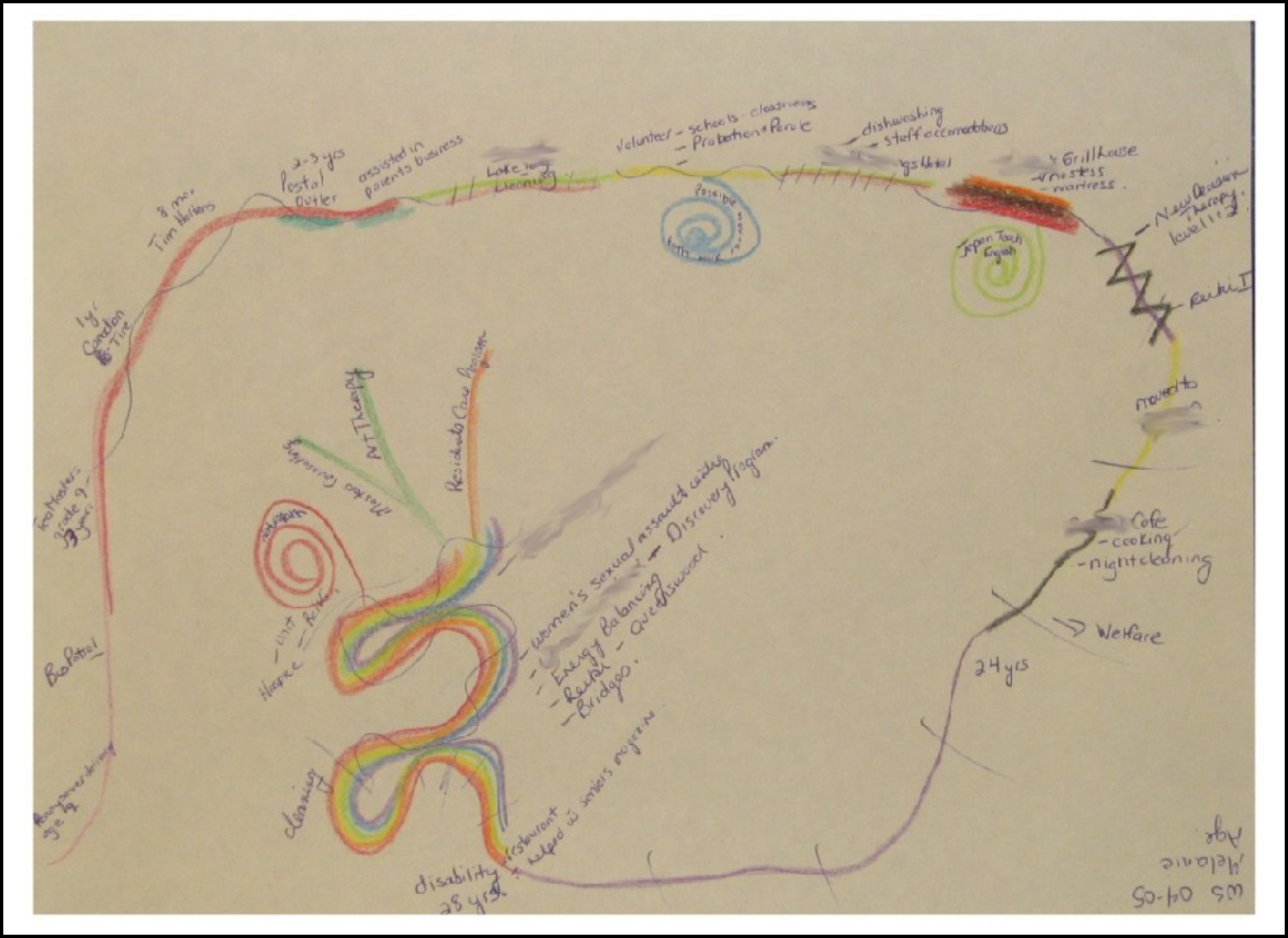
Melanie's began her time line drawing (Figure 3) at the start of the interview. She shared that she often struggled to find words when speaking of her experiences. The drawing activity was introduced as a possibility to help her organize her thoughts and words. She readily accepted. Melanie drew and spoke for the first half of the interview, and during the last half the drawing was prominent for both participant and interviewer to refer to. For Melanie, the reality of her story is as much in her drawing as it is in her words. Springgay et al. (2005) described the creation of an arts-based visual, in which the words included within the visual or used to describe it are not separate or merely illustrative but are interconnected and woven through to create additional meanings. The spiral shapes, the colors, and the symbols used to depict certain times of her life add a richness and depth to her spoken words. It is doubtful that Melanie could have told her story at all without this type of activity to guide and organize her experiences. The incorporation of a visual arts–based aspect to her interview allowed what has been described as the exploration of marginalized, controversial, and disruptive perspectives that might have been lost using only traditional research methodologies (Estrella & Forinash, 2007).
Melanie's time line drawing
Melanie provides a commentary as she draws and after to describe the lines, symbols, and colors she has used in her drawing.
So, I put the red along here, well it is still pink here – but turning to red, because that is when the feeling of anger really started for me.
At another point she says,
Now, here is where I made the connection between the work I was choosing and my history of abuse.
She returns to the theme of the red line, saying,
I've kept the red line going here because there is still the anger coming
She describes the green spiral off to the side of her path as,
I put this colour green here because there was so much excitement about leaving home and going somewhere new.
As she comes to drawing the many-colored rainbow spiral, she reflects on how so much of her healing has been her work for many years,
I want to draw it like a rainbow because so much of it has been a blessing.
Melanie's story winds back and forth over the paths and spirals of her drawing as the second half of the interview unfolds. She looks back to the small blue spiral and reflects,
There is something there for sure, still there, I wonder what my life would have been like if I had followed that path.
At one point she asks me, “Do you want to know about this part?” as she points to the jagged black line intersecting her path. Later she goes back to the drawing and inks in a line that extends all the way back to her teenage years.
This is Corey, he's been along with me in one way or another through all of this.
Final thoughts
When women in this research were asked to tell their stories about past abuse and work experiences, they invariably related traumatic events from their lives. Personal narratives of traumatic experiences abound in our society. Chase (2005) has named this phenomenon as our trauma/interview culture. Participants, like all of us, are being shaped by the outpourings of trauma stories heard daily in the media. They come to the interview situation already formed in what this dynamic should entail. For Becky, the use of the time line drawing seemed to be a means of moving beyond a scripted telling of her story. Her simple drawing shifted her out of the words of a story she had spoken many times to a deeper sense of what her early loss of innocence had meant for her and what she now wanted her future to look like.
The time line drawing was also useful in moving Cinnamon from her immediate concerns related to finding housing to a deeper reflection on patterns she had taken on at an early age in her relationship with her mother and how these had followed her through work situations and into her marriage. In a sense, the recovery of a part of her very self that Mattingly and Lawlor (2000) wrote about seemed to happen. Introduced at a time in the interview when she was running out of words, the chance to step back from her current concerns and view her life as it unfolded on the page, allowed Cinnamon to relax and gain a necessary distance from her story to find Clinchy's (2003) epistolary voice, which is able to explore and engage.
For Melanie, the time line drawing became a means of finding a voice that she felt was all too often lost to her. In her circular journey of spiraling colors she finds her way to describing and reflecting on many painful aspects of her past while projecting herself into a rainbow of options for the future. As Enosh and Buchbinder (2005) contended, the content of a story is intertwined with how the story is constructed and both are important parts of the narrative process.
The use of time line drawings, in this research, allowed these three participants to enter into a reflective space as they told their stories and to engage the story with a depth that may not have happened without this activity. A representational activity like time line drawing can lead to richer data in sensitive topic, narrative interviews. It also provides the participant with a concrete reflective product to take with them as they leave the research interview. Time line drawings can become an important tool in the narrative researcher's repertoire.