




Abstract
Abstract: In the early stages of her master's thesis the author became increasingly concerned about how she would analyze the data for her planned critical interpretive study. She felt that she needed clear direction about the process of qualitative analysis but found the “how to” of theory development within qualitative data analysis poorly described and vague. A book chapter by qualitative researcher Janice Morse (1994) provided guidance. In it Morse outlined four cognitive and essentially sequential processes, which the author adapted to guide the analysis of data for her study.
Introduction
In the preparatory stages of my master's thesis I read widely about the various methods of qualitative analysis but became increasingly concerned about how I would analyze the data for my planned critical interpretive study. The aim of the study was to reveal the meaningful experiences of registered nurse (RN) buddies involved in undergraduate nursing clinical education. Mandated by Australia's regulating nursing body (Australian Nursing and Midwifery Council, 2005), the RN buddy role has some similarities to mentorship although the role has neither formal preparation nor qualification to directly assess student performance. Thus, the challenge was to truthfully interpret and make meaning of the uncovered experiences of RN Buddies. I found the how-to of qualitative data analysis, particularly theory development, to be poorly described and vague. As a novice I felt that I needed clear direction about the process of qualitative analysis. Expert qualitative researcher Janice Morse (1994) provided guidance in her chapter titled “Emerging from the Data: The Cognitive Processes of Analysis in Qualitative Inquiry.” In it Morse described data analysis as a creative and logical process of gathering and arranging data so that the analytic scheme appears obvious. More important, however, she outlined four cognitive and essentially sequential processes—comprehending, synthesizing, theorizing and recontextualizing—which offered a structured way of thinking about qualitative analysis. I adapted these processes to guide the analysis of data for my study. In this article I describe my qualitative analysis.
Background
The aim in qualitative research, as with all other research traditions, is the acquisition of knowledge and understanding. Qualitative researchers seek to discover, describe, and understand the complex nature of human experience in a detailed, naturalistic, and contextualized way (Bear-Lehman, 2002; Damico & Simmons-Mackie, 2003; Donalek & Soldwisch, 2004; Shields & Twycross, 2003). The data that are collected, ideally, are exhaustive, rich, and descriptive, and are analyzed and understood holistically (Damico & Simmons-Mackie, 2003). In this way, the qualitative research process is not a reductionist approach; that is, qualitative researchers do not aim to isolate a phenomenon under study, simplifying it so that it can be measured. Rather, they seek to understand it as it is situated within its context (Cheek, Onslow, & Cream, 2004).
Fundamental to any research process, and in the pursuit of understanding more generally, is the researcher's conceptualization of the nature of reality and knowledge, or their ontological and epistemological beliefs. This is particularly true within the qualitative research tradition, where several ontological and epistemological perspectives can be found (Donalek, 2004). Ontology is the examination of the nature of reality and how we as humans come to know that reality, whereas in epistemology the focus is on the nature of knowledge and how such knowledge is formed (Ellett & Beausang, 2001).
Early scientific and quantitative research approaches are underpinned by the positivist ontological perspective (Cheek et al., 2004; Donalek, 2004). In this perspective reality is viewed as concrete and tangible, something that can be observed, measured, and understood in an objective way. In qualitative research approaches, on the other hand, reality is viewed as less tangible and more subjective. Postpositivists, for instance, acknowledge that reality can never be measured in a completely accurate and objective way (Ellett & Beausang, 2001). Another example is hermeneutic phenomenology, in which reality is conceptualized as socially and mentally constructed and thus fundamentally subjective (Ellett & Beausang, 2001). Within this perspective there are multiple realities that are specific to the individual or groups that create them. This justifies a focus on the lived experience of the research participants. Another view, critical social theory, posits that reality is essentially constructed, shaped, distorted, and unequal because of dominating social, political, and cultural forces (Ellett & Beausang, 2001). The reality of ever-present tendencies for injustice has thus led to feminist research, queer theory, and emancipatory methods that focus on the silent and silenced to achieve freedom and change. In all of these epistemologies analytic or interpretive measures are ultimately incomplete or flawed, and at best can only approximate reality. Hence, the qualitative ontological paradigm has led to various methods of analysis, including narrative analysis, content analysis, and discourse analysis, as qualitative analytic tools (Ellett & Beausang, 2001). Each of the perspectives has a different emphasis in the pursuit of understanding; therefore, it is fundamental that researchers be clear about how the approach they are using informs the kind of reality they are exploring (Cheek et al., 2004; Donalek, 2004; Thorne, 2006).
Further to this, the role that the researcher takes will likewise be driven by his or her ontological and epistemological perspective. A researcher, for instance, who believes in a concrete and tangible reality will be most likely to take the epistemological position of an objective observer (Ellett & Beausang, 2001). On the other hand, one who believes in a socially and mentally constructed reality will take a more subjective approach and will acknowledge his or her perceptions and experiences as a part of the reality under study (Ellett & Beausang, 2001). In this way, the meaning of researcher bias is significantly different in qualitative research approaches than it is in positivist and quantitative ones (Cheek et al., 2004; Koch, 1994). Within qualitative research the researcher's perspective, or “bias,” is a necessary and unavoidable component of the research process, but this is not considered problematic. Rather, the researcher is viewed as a kind of interpretive lens through which the qualitative data are given meaning and significance.
In other words prejudices are not necessarily erroneous or necessarily distortions of truth. Our situatedness as interpreters, our own historicity, do not constitute an obstacle. Prejudices are the conditions by which we encounter the world as we experience something. We take value positions with us into the research process. These values rather than getting in the way of research, make research meaningful. (Koch, 1994, p. 977)
Alternatively, a subjective understanding of reality risks being a personal and possibly private research process. Within qualitative research the researcher becomes the instrument of data collection and analysis (Jacelon & O'Dell, 2005; Morse, 1994; Ullman, 2005), and this is why special measures need to be taken to avoid research findings that are narcissistic and insignificant. Measures to increase the research's credibility and the transferability of the study must be paramount (Peshkin, 1993). There are no rules or formulas to determine how much data to collect, who to collect it from, and what kind of data should be collected, nor are there any computer packages or mathematical formulas to tell researchers what their data mean. Researchers must make these decisions based on their experience, knowledge, and strategy of inquiry from within the philosophical and theoretical framework they have chosen. In presenting the results of their study, they must also demonstrate the veracity and relevance of their interpretations and of the meaning of their work.
Good qualitative research … is that which produces coherent accounts of experience from the viewpoints of people being investigated, along with trustworthy and relevant interpretations that demonstrate a commitment to multiple realities. These intentions require skills, knowledge and a stance from which researchers can see possibilities, see familiar things in a strange way, or render the strange familiar. (Rowe & McAllister, 2002, p. 10)
The merit of qualitative research is largely dependent on the skills and knowledge of the researcher. The method and the analytical and data collection techniques are rendered useless if the researcher is not able to provide appropriate meanings (believable, trustworthy conclusions) for the findings. As argued by Cheek et al. (2004), “simply interviewing someone is not qualitative research” (p. 148). For qualitative research methods to take on meaning and utility, the findings must be situated within their context. Part of this context must constitute the researcher's philosophical and theoretical perspective, his or her experiences and biases, and “a means to knowing what the participants actually meant by their answers and why they gave them” (p. 149). In this way, much of the difference between qualitative practice and meaningful research lies within the researcher.
The consequences of this subjectivity are twofold. First, the qualitative research process can be a powerful and deeply meaningful experience for the researcher, the participants, and the consumers of the research findings (Donalek, 2005; Ullman, 2005). The phenomenon under investigation is explored in great detail and might even be experienced by the researchers. If the findings are communicated skillfully, some of the power of this experience can be shared with the readers. “The expert qualitative researcher is also an excellent writer who creatively but faithfully conveys an aspect of human life that was not previously expressed or appreciated” (Kearney, 2005, p. 147). The richness and depth of understanding that can be achieved through good qualitative research is the result of this subjectivity and contributes much to the research and wider community.
On the other hand, this subjectivity also creates a research process that is somewhat ill defined and difficult to master. Although the literature is heavily weighted with instruction explaining how to break the data into manageable, logical, and judicious bites (Creswell, 2003; Polit & Beck, 2006; Ritchie, Spencer, & O'Connor, 2003; Ryan & Bernard, 2000; Taylor, 2007), there is less description about the next step: the process of transforming bites into theory. With no clear-cut and concrete guidance about this translation, much of the decision making arises from the expertise of the researcher. Compounding this problem, the complex and sophisticated way in which researchers come to understand their data is often difficult for them to access consciously. In fact, Smith (2004) has argued that an effective strategy for making meaning of qualitative data is to be as unconscious as possible; this allows researchers to engage more effectively with their data and to see things they might not see otherwise. This also makes the process of data interpretation unconscious and lost to the researcher, however. Although this might not pose a problem within the research process, it does make the art of qualitative research more difficult to teach and less accessible to the neophyte researcher. By default, qualitative research becomes something that can be learned only through experience and trial and error. This predicament is not new; in 1994 Morse argued that the process of data analysis was not described adequately, with most researchers learning by doing and under the guidance of a mentor.
Neophyte researchers can benefit by using some kind of cognitive framework or a different way of thinking to develop their understanding of qualitative research processes. By making the unconscious conscious and gaining access to the steps beginners take to understand their data, new researchers should be better able to articulate this process. This, in turn, should enable them to promote the art of qualitative research and ensure its future by developing effective skills. Further to this, the integrity and veracity of research can only be improved by a deeper understanding of the role of our cognitive processes and subjectivity within research.
Applying Morse's cognitive processes for qualitative analysis to a critical study
When working on my proposal, I tentatively allowed the structure for analysis to emerge and evolve from the methodology. The research was based was critical interpretive theory, which aimed to embrace the subjective in an attempt to uncover the silenced or invisible thus avoiding formula-based analysis (Kincheloe & McLaren, 2000; Pease, Allan, & Briskman, 2003). Specifically, I wanted to explore the experiences of RN buddies involved in undergraduate clinical education. These RNs make a significant contribution to undergraduate nursing education; thus, the role carries important responsibilities and challenges. Unfortunately within the Australian context of interest, the RN buddy role seems to be characterized by poor preparation, support, and acknowledgement. The apparent invisibility of this important aspect of the RN role suggested that the data analysis style needed to be uninhibited rather then linear; however, I felt quite insecure about this approach. I required some sort of a structure to enable me to be clear about the steps I needed to take to afford me some control over the process but also, more important, to draw believable, trustworthy conclusions and provide a clear audit trail. In my search for suitable analysis guidance that managed to straddle this methodological contradiction, I discovered Morse's (1994) cognitive processes. These signposts for thinking about the process of qualitative analysis allowed me to move from raw data to meaning making and (albeit unsophisticated and rudimentary) theory development. The following describes this journey of comprehending, synthesizing, theorizing, and recontextualizing (Morse, 1994).
In the early stages of the study I adhered closely to the comprehending process described by Morse (1994). I reviewed the literature, which confirmed the gap in knowledge about the role of the RN buddy. Although a frequent visitor to the setting in which I was interested, I was suitably distant from it, which enabled me to be nonjudgmental and receptive to seeing everything “remotely relevant to the topic of interest” (p. 28). I was conscientious in establishing and maintaining a relaxed and unintrusive manner when recruiting and interviewing the participants. Prior to and during the data collection phases, I concentrated on my interview technique and created a prompt sheet, to which I would refer to before meeting the participant. It reminded me to use “wh” questions to clarify connections or exceptions, to remain nonjudgmental, and to listen. During the interviews I took descriptive notes, which were reviewed following the interview and added to the overall audit trail. I was mindful of the need to remain open to new ideas and to reflect on personal biases; this self-awareness provided a space through which alternative meanings could emerge (Northway, 2000). In addition, this period of consideration allowed me to play around with different ideas, and as I gathered more data, I was able to see parallels and distinctions. This review process enabled me to become more and more familiar with the data and represented the basic starting point for the analytic process. I described this approach as Level 1 analysis: description (refer to Table 1).
Level 1 analysis: description

This first descriptive step involved an adaptation of Emden's (1998) strategy to elicit the core information of participant interviews. This was performed in close consultation with the field notes and over time, so I was able to reflect on my influences and biases and how these might influence the choice of appropriate content. Following this initial process, common speech data were identified. The interviewer's questions and comments were deleted as well as sounds and words that detracted from identified key content (refer to Appendix A for an example of this process). This step was repeated and refined until what I perceived as core information from each participant's interview was created without significant loss of meaning(s). This core story was then presented in a de-identified format to the respective RN buddy participant to check that the summary represented a fair interpretation of his or her perspective (Holloway & Wheeler, 2002), which conformed to the requirements set out in the Participant Information Sheet and Consent Form.
The second of Morse's (1994) cognitive processes represented the point at which I analyzed participants' core information to generate themes (Table 2). Morse described synthesizing as extracting or weeding out the raw data to describe typical patterns of response. Synthesizing represented the second level of my analysis: analysis between participants to generate themes. To counter the ambiguity surrounding theme definition and formation (DeSantis & Ugarriza, 2000, p. 352), I embedded a microanalytic tool within Step 3 of the analysis and used it to extract themes from each participant's core information. This divided the generation of themes into three subprocesses. In Appendix B I have provided a brief excerpt example of the first and second microanalysis subprocesses from one participant's core information. The first subprocess broadly extracts relevant paraphrased bites from the participant's core information using a critical theory lens. The weeding out of relevant bites included any good or bad experiences the RN buddy described regarding undergraduate nursing students, facilitators, management, and so on. The second subprocess then generated rudimentary themes specific to the RN buddy from the broadly extracted bites. The third and final microanalysis step (presented as Appendix C) illustrates the summary of these rudimentary themes synthesized from all of the participant interviews from which patterns of response and points of tension were identified.
Level 2: Analysis between participants to generate themes

The processes of data management and organization described in Steps 1 to 3 of analysis were relatively straightforward as they are well described in the literature (Creswell, 2003; Polit & Beck, 2004; Ritchie et al., 2003; Ryan & Bernard, 2000; Taylor, 2007). It was the fourth step of analysis, meaning making from the abstract and development of theory, that presented the greatest challenge and for which Morse (1994) provided the greatest direction. The themes generated in Steps 1 to 3 were collected in summary form, and from them I identified contradictions. Identifying these points of tension constituted the most important and intangible aspect of the first two levels of analysis and represents Morse's fourth cognitive process of analysis: theorizing. Morse encouraged researchers to take risks in the creation of theory: to play around with different ideas and to, essentially, make the “best guess.” During this phase of analysis I met frequently with my supervisors in a series of informal conversations about the themes generated by discussing their connection to each other as well as their link to the study's method. Morse described this process as one “of speculation and conjecture, of falsification and verification, of selecting, revising and discarding” (p. 33).
The four points of tension that finally emerged from my analysis illuminated new angles on the issue of clinical teaching from an RN buddy's perspective and provided a starting point in the emancipatory process for these nurses, the intent of critical theory (Fontana, 2004). In particular, the tensions highlighted the push-and-pull conflicts of the participants' perception and experience of being an RN buddy and were labeled acknowledgement, experience, balance, and interruption. These labels were intentionally neutral so as to highlight the equality of tensions revealed in the RN buddy role. The labels provided a platform for the next stage of the analysis process, in which I sought to explore the deeper meaning of experience.
In Step 5 and the final level of the data analysis process (Table 3), acknowledgement, experience, balance, and interruption were further deconstructed by means of an adaptation of McAllister's (2001) guidelines for reflection.
Level 3: Findings—Critical and cultural analysis
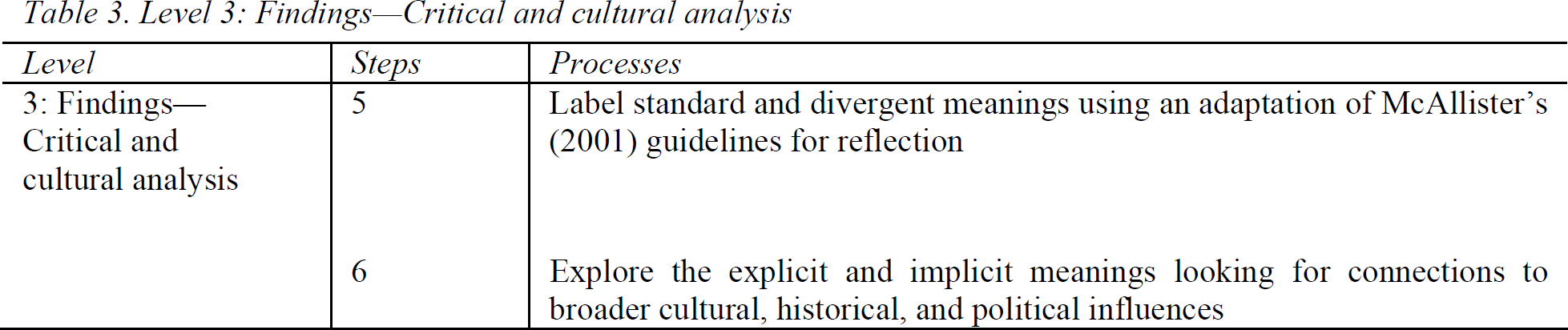
Questions asked during this identification and labeling process included What standard meanings were produced? That is, what uncovered meanings were familiar? What truisms were sustained? What divergent (or nonstandard meanings) were produced? What resistances were concealed or obscured by participants? What did the gaps and silences mean (Emden, 1998; McAllister, 2001)? This postmodern deconstruction, therefore, acknowledged the multilayered nature of personal experience and adhered to the notion of the transience of human experience recognized by critical interpretive theory (McAllister, 2001).
In combination with this deconstruction and illumination process, the final step of Level 3 analysis involved an attempt to critically uncover the possible sociocultural, political, and historical dynamics that influenced and collided with the experience of each participant RN buddy (Kohler Riessman, 2002; Sandelowski, 1991). The objective of this final step in the analysis process was to achieve the overall aim of the critical interpretive method used in this study; that is, to critique and inform previously unexplored sectors of society, particularly marginalized or oppressed populations, about actions necessary to promote their emancipation (Fontana, 2004). This recontextualizing of emerging theory into different settings represents Morse's (1994) final cognitive process of analysis: where research findings “support established knowledge/theory, and to claim clearly new contributions” (p. 34).
Reflections on the process
As a neophyte researcher I found the process of qualitative analysis, particularly the development of theory, to be daunting. Descriptions of the analysis processes in the literature were often vague or cryptic, suggesting an assumed knowledge of a seemingly mysterious process. Even though the method I was using promoted the avoidance of structured, formula-based analysis, I needed clear direction to plan for and then make sense of the data, and qualitative researcher Morse (1994) provided guidance. In the chapter she outlined four cognitive and ordered processes, which I adapted and used for my study. I used these processes—comprehending, synthesizing, theorizing, and recontextualizing—to create a six-step analytic process that enabled me to link the aims of critical social theory with those of qualitative analysis. By providing this explanation of the approach I took to a critical study, I hope that other researchers new to change-focused projects feel better informed and equipped and ready for a method that is not only relevant to nursing work but crucial in revising and correcting the power imbalances that persist in that profession.
Footnotes
Appendix A: Data analysis: Step 1 Participant E: Dana (pseudonym)
Participant came to interview with prepared notes. She exhibited good eye contact, crossing her arms intermittently. She was forthright and assertive in the way she spoke. Participant didn't seem at all concerned about being recorded. Participant submitted her completed consent form to the researcher prior to the interview. Participant has been an RN for 33 years. She has worked on the same ward for three years.
Appendix B: Generation of themes excerpt: Step 3 (Microanalysis 1–2) Participant E: Dana (pseudonym)

|
Confirmed by participant as capturing the essence of experience |
Broad extraction of core information via a critical theory lens; to include paraphrased bites of RN buddy experience as well as their relationship with students, facilitators, etc. |
From broad extraction, generation of themes specific to RN buddy |
| You're setting a standard … you show them one way of doing something. An example: the other day, I showed this girl … to wear a plastic apron when she does her dressing. Well it wouldn't be half an hour later, she did another dressing, she didn't have a plastic apron on. She wasn't listening to what I was saying about it and I've drawn the curtains for the privacy factor … and put a light on so it would help her better … but they don't sort of take that all in. | You're setting a standard … She wasn't listening to what I was saying about it and I've drawn the curtains for the privacy factor … and put a light on so it would help her better … but they don't sort of take that all in. | RN becomes irritated when student doesn't do as she does. RN expects that certain standards are met by the student. Modelling goes unnoticed and unheeded because the student doesn't listen to the RN. By not listening is the student resisting the authority of the RN? |
| I suppose … they're not used to doing dressings, so it's just all new to them really … they're all novices … I mean they know how to do the sterile part, you know the technique's not so bad but to get the environment ready or get a light so you can see the wound better and have a better … look at it and … wear an apron … I don't know whether they're not taught that … I find they don't listen, that's their biggest problem. | … they're all novices … I mean they know how to do the sterile part, you know the technique's not so bad but to get the environment ready or get a light so you can see the wound better and have a better … look at it and … wear an apron … I don't know whether they're not taught that … I find they don't listen, that's their biggest problem. | The students know the principals but the practical, tacit or experiential knowledge has not yet been learned. |
| Well it's quite frustrating … | The RN is frustrated. There is a tension between the complexity of skills to be performed and naivety to the culture. | |
| Well it's quite frustrating … because … I'm put in that position to get the standards … high … they need to get the basic things … right |
Appendix C: Summary of themes generated from all participant interviews: Step 3 (Microanalysis 3)
RN becomes irritated when student doesn't do as she does
RN demands students listen to her; she has expectations that the students do not meet
Modeling goes unnoticed and unheeded because the student doesn't listen to the RN
There is a tension between the complexity of skills to be performed and naivety to the culture Students who are running late create tension and stress for the RN buddy, who is organized
Adolescent characteristics are in contrast with nursing characteristics; students do not conform to hospital cultural norm of punctuality
RN concerned that students aren't passionate and conscientious about nursing
Is there a lack of moral development in students or a consumer mentality?
A lack of moral development in students
RN frustrated that students don't consider what she teaches them as important
RN feels that she is wasting her time sharing skills with students who do not share the passion
The buddy has a wide view and can see the complexity and many issues, whereas the student has a narrow view
Buddy and student have a different point of view regarding standard of dress
A point of tension between what kind of knowledge counts within the care context; body care skills are considered to have a greater priority than psychosocial knowledge
Nursing is hard work
Buddy's attention to the client's dignity and the student's disregard
Buddy's commitment to the team ethos and the student's disregard
Buddy's concerns for body care and the student's inattention to these
The students know the principles, but the practical, tacit or experiential knowledge has not yet been learned
Students are beginners and are therefore disjointed in their practice (that is, learning to walk and talk like an RN) and do get side-tracked very easily; perhaps greater repetition is required
Students openly admit they are using nursing as a stepping-stone for another career option
Students overawed/shocked by the nature of illness/disease
Students not attached to the ward community
Students may feel detached: of not belonging or of not wanting to belong
Nursing is hard work
RN takes for granted her “expert” knowledge in being able to “do everything”
No preparation for the RN buddy role
Experience with students is leading to negativity/bitterness
Biggest frustration for RN is that students disregard her passion for nursing
RN disheartened that students aren't passionate and conscientious about nursing
RN thinks students don't have a good general knowledge because there is too much early specialization
Nursing is hard work