




Abstract
The article develops a categorization scheme for collective activities facilitated by social media. I introduce a six-part scheme consisting of two distinct dimensions: the character of the activity (deliberative or participatory) and the platform where the activity unfolds—within social media platforms; outside social media platforms but still online; or in offline settings. While existing models provide a foundation for understanding collective actions on social media, they often overlook the nuanced interactions between online and offline activities, and the transition between different characters of collective activities. The proposed model addresses these gaps by incorporating a more granular analysis of activity types and platforms, enhancing our ability to understand and leverage these dynamics for more effective mobilization and advocacy. This categorization is justified and substantiated through a netnographic study of the social media campaign advocating for justice for Roman Zadorov, in Israel.
Enhanced Framework for Categorization: The article provides a refined classification scheme for understanding collective actions facilitated by social media. This can help public managers and policy analysts better monitor and evaluate the dynamics of online and offline mobilization. Integration of Online and Offline Activities: The research emphasizes the transition between online participation and offline actions, demonstrating how social media campaigns can lead to offline outcomes. Practitioners can use this insight to bridge their digital engagement strategies with physical community initiatives, fostering a comprehensive approach to public involvement. Deliberative and Participatory Dynamics: The distinction between deliberative and participatory activities offers IT architects and policy analysts a nuanced lens for designing and supporting digital platforms that encourage either deep discussion or broad public engagement, based on specific goals and community needs.
1 Introduction
Despite the acknowledged role of social media in facilitating activism, a comprehensive understanding of how such activities should be categorized remains elusive. This gap in our knowledge presents a critical problem: without a clear method for categorization, analyzing and understanding the full impact of social media-based collective actions is challenging. Existing frameworks, such as Zuckerman's (2014) model of “thin” and “thick” participation, which emphasizes the level of engagement, and Segesten and Bossetta's (2017) typology, which distinguishes between content originality and the existence of a call to action (Segesten & Bossetta, 2017; see also George & Leidner, 2018), offer initial insights into how activism on these platforms operates. But, aruguably, these models often overlook the complexity of how online actions transition into offline activities and the various types of participation that occur on different platforms (Wiggins & Crowston, 2012).
This article seeks to address this gap by proposing a novel method for categorizing social media-based collective actions. The central question guiding this inquiry is: How can social media-based collective actions be effectively categorized? To answer this question, the article begins by reviewing existing methods for categorizing collective actions facilitated through social media (Segesten & Bossetta, 2017; Zuckerman, 2014). By refining these frameworks and incorporating both the character of the activity (deliberative or participatory) and the platform where it unfolds (online and inside or outside social media platforms, or offline), this article offers a more nuanced understanding of social media-based activism.
By incorporating both the character of the activity (deliberative or participatory) and the platform where the activity unfolds (inside social media platforms, outside social media platforms but still online, or offline), the proposed scheme offers a more nuanced understanding of social media-based collective actions. This dual-dimensional approach allows for a more granular analysis of how individuals and groups engage in collective action through social media platforms, addressing the shortcomings of previous categorization methods.
The significance of this new classification method is demonstrated through its application to a netnographic study of the social media campaign advocating for justice for Roman Zadorov in Israel. This case study not only exemplifies the application of the proposed categorization scheme but also underscores its utility in providing deeper insights into the strategies and impacts of online collective actions.
By offering a method that more accurately reflects the diversity and complexity of social media-based collective action, this article contributes to a more profound understanding of digital activism. This categorization scheme is designed not only to describe the forms and forums of collective action enabled by social media but to function primarily as an analytical tool that elucidates the underlying dynamics and potential impact of these actions.
2 Collective Action on Online Social Media
In the recent decade, online social media has gained prominence in the discourse on the social impact of new media (Castillo-Esparcia et al., 2023; Gorostiza-Cerviño et al., 2023). The “turning point year” in which Facebook became a main stage for organizing social protests was 2011, when many protests took place around the world, such as the Wall Street protests in the US, the Arab Spring events, and more. In these events, the place of Facebook, according to spectators and commentators, was significant (Bastos et al., 2015; Greijdanus et al., 2020; Hussain & Howard, 2013). Time Magazine chose “The Demonstrator” as the Person of the Year in 2011. The usage of online social media to help organize protests was highlighted in the article that accompanied the selection (Anderson, 2011).
In time, social media turned into the preferred site for activists and social movements and a major communication channel for “low-exposure” social players in the mainstream media (Cammaerts, 2012; Castillo-Esparcia et al., 2023; Harlow & Harp, 2012). The literature focuses on various aspects of the contribution of the Internet, especially social media, to social movements. First, social media creates an “address” and a meeting place for causes and individuals who otherwise would find it very difficult, if not impossible, to locate each other to initiate activities for the benefit of their common interest (Gorostiza-Cerviño et al., 2023; Johansson & Scaramuzzino, 2019). Second, social media makes it possible to send information from top to bottom; that is, from the leadership to activists “on the ground”, bypassing the filter of mainstream media. This avoids distortions to the messages and enables significant dissemination of non-consensual messages that cannot always penetrate central media channels. Online social media also makes it possible to send “bottom-up” information from the activists to the organizers to keep them up-to-date about the advance of their causes on the ground minute by minute (Lev-On & Hardin, 2007; Sandoval-Almazan & Gil-Garcia, 2014; Valenzuela, 2013).
In addition, social media complements traditional sources for mobilizing resources, supporters and activists (Laer & Aelst, 2010; Vissers & Stolle, 2014). In addition to reducing traditional protest practices costs, social media also enables new protest practices, such as profile picture swapping (Lev-On & Hardin, 2007).
Studies of collective action and protest on social media focus on issues such as the political background that proceeds and enables the protest and within which it takes place (Wolfsfeld et al., 2013), the stories and content created by the protesters (Papacharissi & de Fatima Oliveira, 2012), the motivations of participants to contribute to the protest, and the ability to relatively easily recruit the “critical mass” of activists (Deseriis, 2021; Margetts et al., 2015).
Researchers also ask why social media contributes to motivating collective action. To answer this question, some focus on the fact that social media reduces the costs required from protest organizers and participants and consequently make it easier for the protest to take shape (Benkler, 2006; Lupia & Sin, 2003). Others focus on the fact that activities once perceived as private are now carried out in public, allowing people to participate in activities they would have previously avoided (Bimber et al., 2005). Others focus on the fact that social media allows for collective activity to succeed even if there are only loose ties between participants (Bennett et al., 2014; Deseriis, 2021; Haythornthwaite, 2009; 2012; Lev-On, 2013; Tufekci, 2017).
Following such lines of research, scholars have also asked: how can the different types of collective activities facilitated through online social media be mapped? Below, I present several categorizations and suggest that they are not sensitive enough to the fact that even when online social media platforms function as hubs of group activity, a significant part of the activity is often carried out online but outside the platform, and some activities are even carried out offline (Theocharis, 2015). Following this and other justifications, I propose a categorization scheme based on two dimensions: The character of the activity (deliberative or participatory), and the platform where the activity unfolds: online/inside social media platforms; online/outside social media platforms; or offline.
3 Deliberative vs Participatory Public Processes
Scholars identify two primary perspectives regarding engagement in public processes. One perspective encourages the involvement of a broad spectrum of stakeholders, aiming for inclusivity. Conversely, an alternative viewpoint supports in-depthdeliberation, weighing the pros and cons of proposed courses of action before arriving at a decision. Consistent with existing literature, I will term these two approaches as participative and deliberative, respectively (Chambers, 2009; Floridia, 2017; Lev-On, 2022).
Engagement, whether manifested online or offline, comes in diverse forms, encompassing public articulation of opinions, persuasive endeavors, public demonstrations expressing affiliation or dissent, and participation in elections for various decision-making institutions (Arnstein, 1969; Nabatchi & Mergel, 2010). The theories emphasizing and endorsing participation in democratic settings address intrinsic elements like the benefits individuals derive from engagement, alongside extrinsic factors such as the caliber of decision-making and the legitimacy of the governing system (Mansbridge, 1983).
Advocates of deliberative democratic principles assert that the realization of democracy should extend beyond mere reliance on representation and voting mechanisms. It should encompass processes involving the active search for information, thorough examination of arguments, and a balanced consideration of various opinions and values until well-informed decisions are reached (Chambers, 2003; Fishkin, 2009; Gutmann & Thompson, 2004; Mendelberg, 2002). Fishkin (2009) contends that the quality of deliberation hinges on factors such as access to pertinent and accurate information, participants’ capability to engage with encountered arguments, representation of the predominant public stance during deliberation, genuine weighing of arguments by participants, and impartial consideration of arguments, irrespective of their source. These conditions are applicable across diverse arenas, ranging from small-scale committees and think tanks to traditional newspapers and, notably, certain online social media platforms, which have increasingly become hubs for significant portions of public discourse in recent years (Black, 2011; Roberts, 2004).
Comprehensive understanding of facts and arguments is imperative for deliberative processes, making them seemingly better suited for smaller groups. With an expansion in the number of participants involved in decision-making, the process tends to inherently shift away from a deliberation-centric focus. Consequently, the more emphasis there is on deliberative elements within the processes, the less inherently participatory they become, and conversely, an increase in participatory elements often correlates with a decrease in the depth of deliberation (Gastil & Felicetti, 2024).
There was optimism that the rise of online social media would serve as a framework for decision-making processes that blend both participation and deliberation. However, as highlighted by certain authors, a distinct phenomenon frequently unfolds spontaneously in the online realm—clustering into two distinct groups: those inclined toward participation and those favoring deliberation (Buozis, 2019; Gaines & Mondak, 2009; Hedrick et al., 2018; Lev-On, 2022; Nekmat & Lee, 2018).
4 The Proposed Categorizing Scheme of Collective Activities Facilitated by Social Media
There are many types of social media-based collective activities, and a few researchers have created schemes to categorize them (see Table 1). For example, Segesten and Bossetta (2017) offered a scheme to catalog political activity on Twitter, where one dimension addresses the originality of the content being distributed (was it written by the activists, or by someone else and only shared by the activists?), and a second dimension refers to the existence of a call to action. However, this scheme only applies to posts written on social media and not to a variety of other activities like those that are carried out “on the ground” based on the content that appears on social media.
Categorization Schemes of Collective Activity on Social Media.

George and Leidner (2018) proposed a scheme for the classification of online political activism, where the first dimension refers to the resources required from the activists—whether they need to perform costly actions (such as financing or participating in a consumer boycott) or whether they can be satisfied with activities that do not require leaving the computer (such as writing or liking a post). The second dimension addresses the question of whether the activity has the potential to be exposed to many people (such as certain hacker activities) or whether it is exposed to just a few. Similarly, Wiggins and Crowston (2012) categorized online collaborative projects according to project objectives and the tasks that participants were asked to perform.
A highly valuable classification system is presented by Zuckerman (2014). This system introduces a categorization structured along two dimensions, creating a spectrum that represents “a continuum, not a binary [distinction].” The first dimension, labeled as “Thin” vs. “Thick,” delves into the character of participants’ involvement in the civic endeavor. This dimension raises the question of whether individuals are primarily contributing through their physical presence or their intellectual capacities: “What is expected of you as a participant in a civic act: your feet or your head?” According to Zuckerman, “in thin engagement, someone else, presumably, has done the thinking and concluded that what's needed to persuade or to make a point is mass participation. In thick engagement, your job is to figure out what needs to be done.”
The second dimension introduced by Zuckerman is the “Voice” versus “Instrumental” axis. The concept of “Voice” encompasses forms of participation that prioritize self-expression, raise awareness, and provide people with a platform to share their perspectives. In contrast, instrumental engagement signifies actions guided by a clear and direct theory of change.
The significance of thoroughly establishing Ethan Zuckerman's 2014 framework as a paradigmatic contribution within the literature on collective action through social media cannot be overstated. Zuckerman's work is cited, much more than the other schemes presented above, as a foundational framework for understanding the dynamics of digital activism. His categorization of collective actions into 'thick' and 'thin' engagement offers a valuable lens through which to assess the depth and character of participant involvement in online movements.
Still, although this categorization scheme has gained popularity, there are some concerns associated with it. First, the Overlap Between “Thin” and “Voice,” “Thick” and “Instrumental”: Arguably, significant overlap can exist between the “thin” dimension and the “voice” axis, as well as between the “thick” dimension and the “instrumental” axis. This overlap is rooted in their emphasis of “embeddedness,” whether within the physical or cognitive realm. For instance, actions demanding participation in actions planned by someone else (“thin”) could also exhibit a strong element of self-expression (“voice”), as seen in attending a protest while vocally expressing one's opinions. Similarly, activities oriented toward intellectual engagement (“thick”) often align with the “instrumental” approach, driven by a specific theory of change.
Second, Neglecting the Multidimensional Character of Online-Only Actions: Arguably, Zuckerman's categorization of “thin” vs. “thick” doesn't sufficiently account for the distinction between actions confined to the online realm and those extending into physical spaces. As mentioned earlier, the online realm, for better or worse, has become the “first choice” for many activists, and actions that remain exclusively online are far more common than those occurring solely offline (Lev-On & Hardin, 2007). From interviews, it also seems that a significant difference exists between actions that occur via social media and those that require them to take an “extra” step online. Nonetheless, while online collective actions might not always translate into physical manifestations, they can still have a significant impact in their own right. A more comprehensive framework could include a dimension that recognizes whether actions remain exclusively on social media where activists “bumped inro them”, extend to other online spaces, or are strictly physical.
While Zuckerman's framework serves as a valuable starting point, one should crucial to critically assess its limitations and contemplate refinements that can accommodate the evolving character of social media-based activism.
Taking into account the highlighted considerations, an alternative categorization for analyzing online collective action should adopt a more comprehensive approach. Drawing from interviews with administrators and prominent activists, as well as observations of social media activity (see exact details in the method section below) arguably this refined categorization addresses the concerns raised by the existing frameworks. It does so by recognizing the potential overlap between types of engagement and by acknowledging the varying stages of involvement, ranging from online to offline.
Through the incorporation of insights garnered from interviews with social media administrators and a thorough consideration of the ever-evolving landscape of digital activism, this alternative framework provides a more nuanced perspective for analyzing the intricate dynamics of collective action in online spaces.
Participatory vs. Deliberative: This dimension arguably refers to the character of engagement within online collective actions. “Participatory” actions encompass forms of involvement that revolve around joining, sharing, and contributing to a cause, often with minimal discussion or discourse. Such activities could include signing petitions, retweeting messages, or employing hashtags. Conversely, “deliberative” actions focus on more profound conversations, debates, and discussions with the goal of collectively shaping opinions, strategies, and solutions. This could involve platforms like online forums, live chats, and spaces where participants engage in thoughtful discourse regarding the pertinent issues. This categorization distinguishes itself from Zuckerman's by attributing “Participatory” to what Zuckerman terms as “Voice” and “Deliberative” to what he calls “Instrumental,” which can be argued as a more refined approach. Social Media vs. On the Internet vs. Offline: Acknowledging the diverse contexts in which collective actions unfold, this dimension classifies actions based on their primary location. “Social Media” actions encompass initiatives primarily contained within platforms like Facebook, Twitter, or Instagram, often capitalizing on the influence and dynamics of these networks. “On the Internet” actions encompass broader online engagement, spanning petition and crowdfunding websites, forums, and other online platforms that extend beyond the initial locations where users stumbled upon the call for action. “Offline” actions encompass activities that transition from the digital realm to physical spaces, such as protests, rallies, and events that materialize in the tangible world. This trichotomy of social media, online, and offline arguably better captures the spectrum of effort required compared to Zuckerman's “thin (feet)” to “thick (head)” terminology. For most individuals, activities demanding physical presence (“feet”), involving real-world actions away from screens at home, typically entail more effort than those primarily requiring cognitive engagement (“heads”), such as interacting through screens. Thus, the categories of “Social Media” and “On the Internet” should be complemented with the category of “Offline” engagement.
While existing models provide a foundation for understanding collective actions on social media, they often overlook the nuanced interactions between online and offline activities and the transition between different forms of participation. The proposed model addresses these gaps by incorporating a more granular analysis of activity types and platforms, significantly enhancing our ability to understand and leverage these dynamics for more effective mobilization and advocacy.
Similar to Zuckerman's categories, mine are also non-dichotomous and instead exist along a continuum. The initial differentiation involves classifying activities into two primary categories: “deliberative,” which encompasses actions focused on revealing information and conducting fact-based discussions, and “participatory,” which involves activities aimed at capturing public attention and encouraging engagement. Argumentation, involving the presentation of factual or interpretive claims through written communication and/or endorsing such claims, can fall within both the participatory and deliberative realms. Regarding the second distinction based on the platform (social media/Internet/offline), these activities can also span multiple venues. For instance, people could donate money online and subsequently promote their contribution on social media. While certain activities are distinctively confined to platforms like Facebook, the broader Internet, or offline spaces (such as attending a rally at a specific location and time), a significant number of activities transcend the strict online/offline boundary. As a result, the six-cell framework presents an “ideal type,” and in practice, the boundaries between cells may become somewhat blurred.
5 Research Environment: Activism for Justice for Roman Zadorov on Social Media
This research introduces an enhanced method for classifying social media-based collective actions, focusing on the social media-based advocacy for Roman Zadorov as a key example. Zadorov, found guilty of murdering a young girl, received a life sentence in 2010. Despite this, a significant portion of the Israeli population believed he was unjustly convicted. This belief has sparked extensive and unprecedented social media campaigns, particularly on Facebook, demanding justice for him. Simultaneously, the bulk of the investigative documents have been made available to the public through a dedicated website and on YouTube (Lev-On, 2023b).
On the 6th of December, 2006, Tair Rada, a 13-year-old, was discovered deceased in her school in Katzrin, Israel. Roman Zadorov, employed at the school as a flooring installer, was apprehended on December 12th and admitted to the crime a week thereafter. However, following a reconstruction of the event two days later, Zadorov reasserted his guilt but quickly retracted his confession, maintaining his innocence ever since. In 2010, Zadorov received a life sentence for the murder, with the court's decision citing a 'robust, comprehensive, and convincing set of evidence' against him (Nazareth District Court, 2010, pp. 251–252). His subsequent appeal was dismissed by the Supreme Court in 2015.
Contrastingly, the certainty of the court's decision stands in stark opposition to the opinion of the general public. Numerous surveys have consistently indicated that a vast majority believe Zadorov to be not guilty. In a pivotal move in 2021, a Supreme Court judge sanctioned a retrial for Zadorov (Lev-On, 2023b), leading to his exoneration in 2023.
Initially, the case garnered widespread public interest, particularly because the victim was a young girl tragically killed during daytime at her school. Doubts about Zadorov's involvement were further fueled by statements from Tair Rada's mother. Following Zadorov's detailed account of the crime, she expressed skepticism about his guilt. Over time, inconsistencies in Zadorov's confession and the crime's reconstruction, coupled with emerging alternative theories regarding the identity of the real perpetrator(s), the method of the murder, and the underlying motives, intensified these doubts.
The notable surge in public interest in this case can be attributed significantly to a robust social media campaign advocating for Zadorov's innocence. It is essential to acknowledge that 2011 marked a pivotal year for Facebook, playing a crucial role in organizing social movements globally, exemplified by significant protests like the Arab Spring and the Occupy Wall Street movement in the USA. Antecedent to these major events, starting in 2009, numerous Facebook groups dedicated to this case began to surface. The Supreme Court's rejection of Zadorov's appeal in 2015 further catalyzed an increase in the membership of these groups. Notably, the group 'The Whole Truth about the Murder of the Late Tair Rada' emerged as one of Israel's largest, as reported by Ben-Israel in 2016. Subsequently, from 2016 onward, investigative documents became accessible on the 'Truth Today' website. Additionally, various YouTube channels contributed related content, featuring investigative videos, discussions with the police informant, and re-enactments of the crime.
The social media activities advocating for Zadorov stand out in several ways, not only in their scale but also in their unique characteristics (Grossman & Lev-On, 2023; Lev-On, 2023b).
Contextual Distinction: This campaign is set against the backdrop of a murder trial and the pursuit of justice for an alleged wrongful conviction. This is in sharp contrast to the typical scenario where the details and outcomes of police investigations and judicial proceedings are not readily accessible to the public. Diversity of Discourse Participants: In most legal and justice-related public discussions, the primary voices are 'insiders’ like judges, lawyers, police officers, journalists, and legal analysts. The discourse around the Zadorov case, however, has seen a notable participation of 'outsiders’, including activists deeply involved in both minor and major aspects of the case. Impact of the Activities: The efforts have had significant implications, notably influencing public perceptions regarding the efficacy of relevant state bodies and the question of Zadorov's guilt or innocence (Lev-On, 2023b; Lev-On & Steinfeld, 2024).
Furthermore, this form of activism is distinctive in its outcomes, particularly due to the numerous findings uncovered by activists diligently examining the investigation documents. These discoveries were instrumental in the decision to initiate a retrial for Zadorov (Lev-On, 2023a). Given these factors, the advocacy for Zadorov presents an intriguing subject for analyzing the attributes and impacts of activism on social media platforms.
The selection of the Roman Zadorov case study as the focal point for this research is predicated on its unique and illustrative qualities that exemplify the dynamics of modern collective action facilitated through social media. This case is particularly representative of a successful online collective action due to several key factors. First, the Zadorov campaign demonstrated significant mobilization of public support through social media platforms, primarily Facebook. The ability of this campaign to engage a large number of individuals over an extended period highlights the potent role social media plays in sustaining and amplifying social movements.
Furthermore, the Zadorov case is a poignant example of how social media-based collective actions can influence real-world outcomes. The sustained online advocacy contributed to significant developments in the case, including the reopening of legal proceedings and the eventual exoneration of Roman Zadorov. This impact highlights the transformative potential of online collective actions, not just in shaping public opinion but in effecting tangible changes in the legal and social realms.
In alignment with Bent Flyvbjerg's (2001) phronetic approach to social science, the selection of the Roman Zadorov case study for this research is particularly poignant. Flyvbjerg (2001) emphasizes the importance of context, power dynamics, and the social complexities inherent in case studies to produce knowledge that is both scientifically robust and practically relevant. This approach is instrumental in understanding how social phenomena operate in real-world settings and how they can be addressed effectively.
The Zadorov case encapsulates a complex interplay of social media dynamics, public mobilization, and judicial processes, making it an ideal subject for examining the efficacy of collective action through digital platforms. This case study allows for a deep dive into the contextual and power-related aspects of social media activism. It showcases how digital platforms can be leveraged to challenge established power structures, thus bringing to light issues of justice and fairness in a highly public and accessible manner. The activism surrounding this case involved significant mobilization of public opinion, direct impacts on legal proceedings, and a substantial challenge to institutional authority, highlighting the power dynamics at play between state mechanisms and citizen-led movements.
Furthermore, by using this case, the research adheres to Flyvbjerg's (2001) call for social science to engage with the real-world complexities that influence human behavior and societal outcomes. Thus, the case study serves not merely as an example of the proposed categorization scheme but as a critical analysis tool that reflects on the practical implications of collective action theories in tangible settings.
Incorporating Flyvbjerg's (2001) approach, the case study transcends descriptive analysis and contributes to a nuanced understanding of how collective action through social media can influence and is influenced by larger societal structures. This aligns with the goals of phronetic social science by producing knowledge that is deeply contextual, rigorously analyzed, and directly applicable to real-world problems, thereby fulfilling both theoretical advancements and practical applications in the field of social media activism.
6 Research Method
This research employs netnographic methods for its investigation. Netnography is an interpretative, qualitative research technique focused on examining online communities and their communicative and behavioral dynamics (Kozinets, 2010; Rageh & Melewar, 2013).
The process of netnography includes gathering data from a variety of digital platforms such as social media, online forums, and petition websites. It allows researchers to identify and join online communities, observe their interactions, and conduct interviews with participants. A comprehensive understanding of the activism surrounding the justice for Zadorov case was attained through the amalgamation of participant observation, interviews, and content analysis. This netnographic study unfolded over a four-year period, commencing in December 2015, coinciding with the intensification of activism subsequent to the Supreme Court's rejection of Zadorov's appeal. The study persisted until December 2022, involving the continuous monitoring of activist movements, thorough analysis of posts within social media groups, and interviews with the administrators of these groups.
6.1 Observations of Activism
Persistent engagement was maintained with both group administrators and prominent activists. Discussions with these administrators often revolved around various topics and challenges related to the content and activities within these groups. The netnographic approach proved especially valuable in uncovering insights about divisions within the groups and breakthroughs made by the activists.
6.2 Analysis of Content from Social Media Groups
Within this study, fifteen vibrant Facebook groups were identified, boasting a cumulative membership exceeding 300,000 individuals. A meticulous record was maintained of the posts and the ensuing reactions in real-time. Groups exhibiting heightened levels of activity underwent daily sampling, while those with comparatively lower activity were sampled on a weekly basis.
6.3 Interviews with Administrators of Social Media Groups
This study involved conducting twenty-five interviews with administrators from various groups. These interviews covered a range of topics, including the administrators’ backgrounds, their views on the objectives and influence of the activism, aspects of group management, and other subjects. Each interview lasted between one to one-and-a-half hours and took place in casual settings like cafes, conducive to open conversations. A team of four interviewers carried out these interviews under the guidance of the principal researcher. All interviews were recorded, transcribed, and thoroughly analyzed. The findings are primarily presented through insights from these interviews, supplemented by selected excerpts from the group content.
By applying this netnographic approach to the case study of Roman Zadorov's advocacy campaign, I demonstrate the model's utility in capturing the complex interplay of actions across different platforms, providing clear evidence of its added value in analyzing real-world scenarios and offering actionable insights for activists and organizers.
7 Findings
This article presents a categorization scheme for collective activities facilitated by social media, based on the collective activities that take place on the basis of social media in the context of the justice for Zadorov activism. Consequently, a novel scheme for categorizing social media-based activities is herein offered, composed of two dimensions:
The type of activity (deliberative or participatory). Following up on the literature review above, I found that the collective activities can be divided into those aimed at exposing information and conducting fact-based discussions (i.e., “deliberative”) and those aimed at attracting public awareness and engagement (i.e., “participatory”). The arena in which the activity takes place (online/inside social media platforms; online/outside social media platforms; or offline). The second dimension of the scheme pertains to the context within which the activity is conducted. This dimension encompasses three distinct possibilities: (1) activities that transpire within the realm of social media. This includes engagements like partaking in surveys or swapping profile pictures. (2) activities occurring on the broader Internet landscape. Examples encompass activities like endorsing petitions or engaging in online surveys. Notably, in our case, these activities manifest beyond the realm of Facebook, which serves as the prominent platform for advocating justice for Zadorov. These endeavors necessitate a more substantial investment of time and effort from participants, and are typically conducted using a computer or similar device. (3) activities transpiring in the physical world. This entails actions such as attending demonstrations or affixing stickers to vehicles. These activities can achieve heightened visibility among individuals present in the immediate physical environment. However, they often demand a significantly greater level of effort from those involved.
Table 2 displays the categories employed subsequently to classify the collective activities within the activity for justice for Zadorov.
Six-part Scheme for Categorizing Social Media-absed Collective Action.

The following table presents a categorization of collective actions based on both the platform where the activity takes place (online or offline) and the character of the activity (deliberative or participatory). It is important to note that these categories are not strictly dichotomous; many activities span both the online and offline realms. For example, physical demonstrations may be preceded by extensive online discussions, and online campaigns may have significant offline components. The categories in this table aim to provide a structured understanding of how collective actions manifest in different contexts, while recognizing the fluid interaction between digital and physical spaces.
8 Category 1: Participatory Activity on the Social Media Platform
Let us begin with participatory activities carried out on the social media platform, specifically Facebook, aimed at generating awareness about the Zadorov case. These actions do not mandate participants to engage with intricate materials or undertake arduous tasks. Given their execution on Facebook, there's no necessity for participants to undertake supplementary actions that might cause inconvenience in alternative online domains or even the physical realm.
For instance, the customization of individual profile images on Facebook, which encompasses actions like incorporating a frame onto a profile picture or altering the cover image, serves as a prime example. This activity transcends mere sympathy and support for the justice for Zadorov activism; it also amplifies the public visibility of the cause itself. Figure 1 showcases frames adorned with images of Tair, as devised by Yanir Dvir, the administrator of the group “The Truth Today - In Memory of the Late Tair Rada,” during the 11th commemoration of the tragedy. According to Dvir, hundreds of activists embraced this practice by appending a frame to their profile pictures.
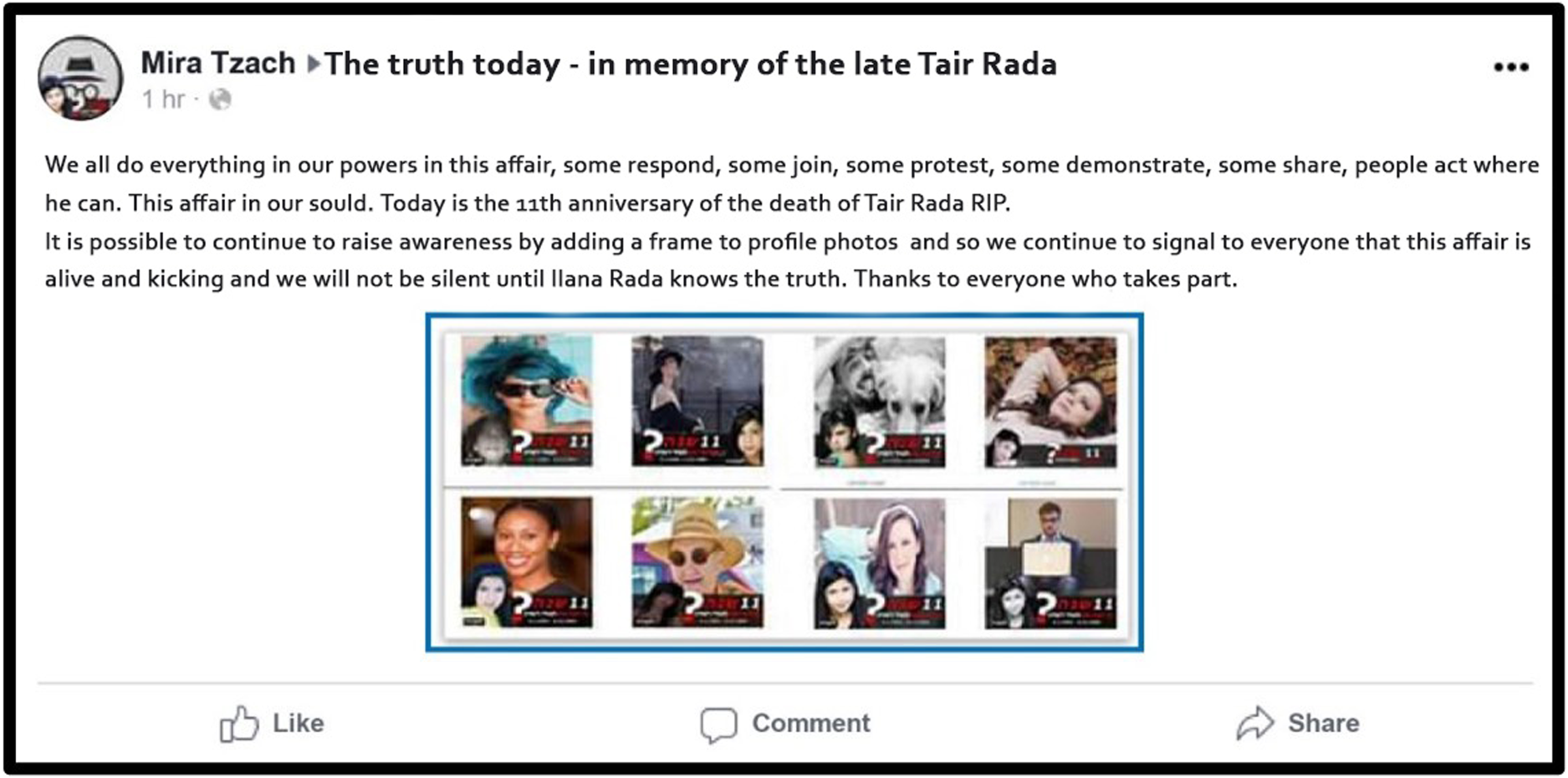
Frames for Facebook profile pictures.
This example of profile picture customization on Facebook exemplifies a participatory activity, as it allows individuals to express support and raise awareness with minimal effort, without requiring deeper engagement or significant offline action, thus aligning with the low-barrier nature of social media participation.
9 Category 2: Deliberative Activity on the Social Media Platform
The objective of the second category of collective action on social media is to divulge information and foster knowledge dissemination. An instance of this activity involves the examination of the recording discovered on the MP4 device lent to Tair by her close friend on the day of her tragic demise. Notably, this device was located in Tair's possession subsequent to her murder.
The police's investigation unveiled that among the tracks on the MP4 device, there existed a 43-s segment in which predominantly children's screams could be discerned. This recording's origin remained unidentified, and it was transmitted by the police to the legal representatives representing Zadorov. In 2017, it was publicly disseminated online. Regrettably, the recording suffers from subpar quality, characterized by greatly noise that greatly hindered comprehension of its content. Following its online release, activists undertook endeavors to decipher its meaning. In one such dialogue, the author illustrates that discernible voices of a boy and a girl emerge, with the girl inquiring, “Are you scared?” and the boy responding, “No.” Consequently, through collaborative efforts, numerous Facebook users might have succeeded in elucidating the recording's significance.
This example of collectively analyzing and interpreting the recording demonstrates a deliberative activity, as it required participants to engage in thoughtful discussion and knowledge-sharing, aiming to uncover the meaning behind the recording, thus fostering deeper cognitive involvement and collaboration typical of deliberation on social media.
10 Category 3: Online Participatory Activities (Outside the Realm of the Social Media Platform)
The third classification of collective activities rooted in social media discourse pertains to the elevation of awareness regarding the matter. In contrast to the initial category, participants are compelled to undertake an “additional stride” to engage in the activity. This transpires online, albeit within a distinct virtual arena separate from the Facebook groups they are engaged with.
One such endeavor encompasses affixing signatures to petitions, exemplified by Ilana Rada's (the victim's mother) plea to activists to contribute their signatures to advocate for the reopening of the investigation dossier. At the time of composing, the petition had garnered over 300,000 signatures. Another engagement involves participation in surveys situated on online platforms beyond the confines of Facebook. When activists come across a survey related to the Zadorov case on any other internet platform, they disseminate a post regarding it, prompting fellow activists to partake in the survey. Consequently, the survey's opinion distribution becomes skewed, deviating from a representation of the broader public sentiment. Nonetheless, engagement in the survey continues to fulfill the activists’ explanatory objectives and demonstrates the extent of their backing to the wider populace. In such scenarios, the social media activity functions as a launching pad for other online undertakings.
Another variant of online outreach activities encompasses engagement in fundraising initiatives. In recent times, the utilization of crowdfunding platforms has become a prevalent creation of practice. As an illustration, crowdfunding was employed to financially support the Olga Grishiev's (Zadorov's wife) book titled “The Man Who Was Not There.” In actuality, screenshots consistently found their way onto justice for Zadorov activism groups, providing updates on the fundraising campaign's advancement. Figure 2 includes a screenshot indicating the accomplishment of the fundraising objective, amassing NIS 80,000 from 569 contributors. 1
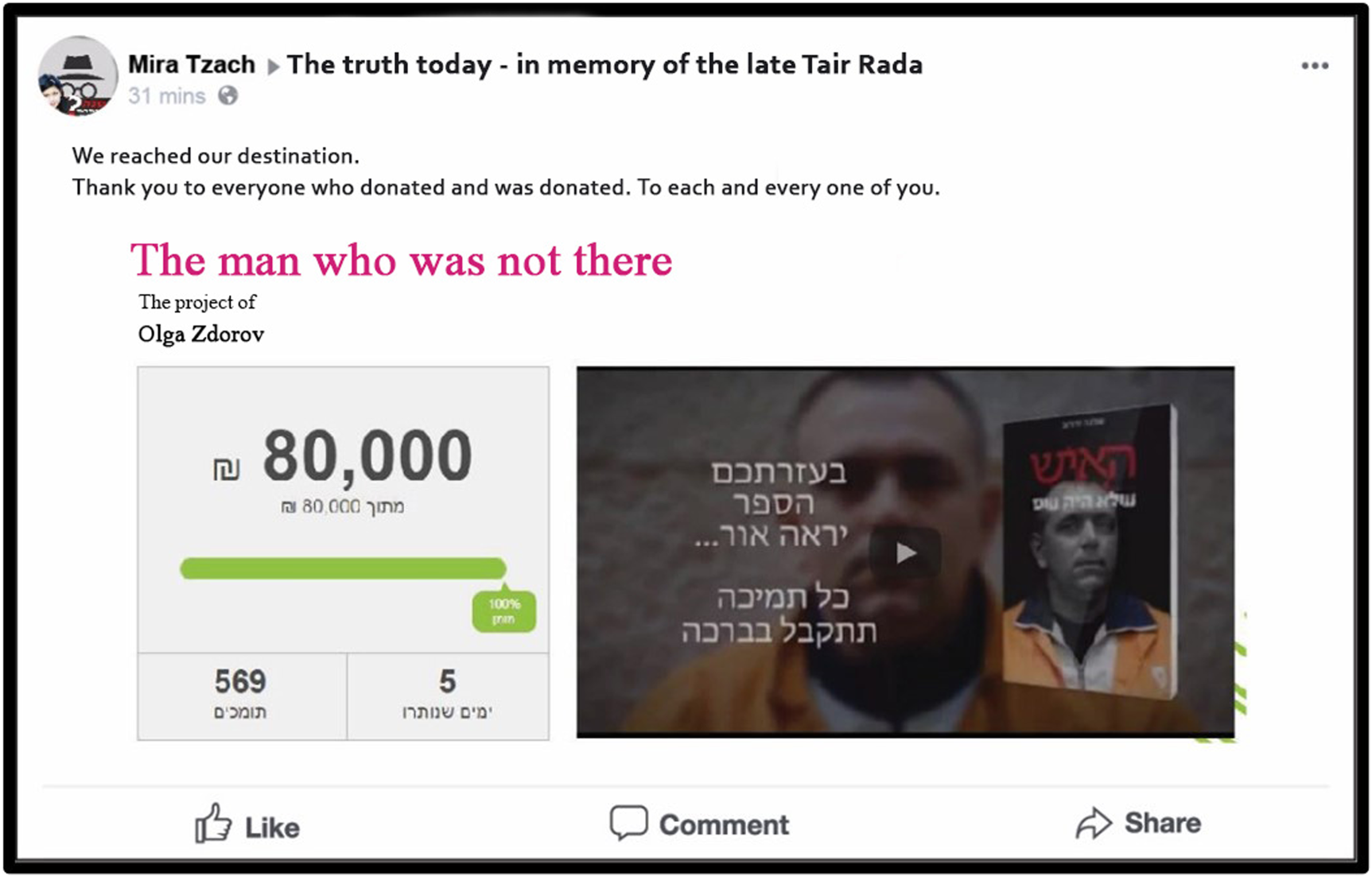
Meeting the fundraising goal for the publication of the book “The Man Who Was Not There”.
These examples of petition signing, survey participation, and crowdfunding demonstrate online participatory activities beyond social media platforms. Although initiated through social media, they require an additional step of engagement in other virtual arenas, showcasing how activism can extend its reach while still maintaining strong ties to the original social media discourse.
11 Category 4: Online Deliberative Activity (Outside the Social Media Platform)
The fourth classification pertains to the revelation of information and the presentation of arguments online, distinct from the Facebook platform. Unlike the second category, participants in this instance are called upon to embark on an additional stage to engage in the activity. An instance of this is the transcription of segments from the investigative materials within the “Truth Today” group. In response to an appeal from the group's administrator, a multitude of documents were transcribed within a brief timeframe, involving the active participation of numerous people.
Another illustrative instance of such collective activity involves the retranslation of investigative videos, discussions with a police informant, and the reconstruction of the murder, all of which were supplemented with subtitles for videos uploaded onto YouTube. This expansive undertaking—comprising slightly over 100 h of video content—was spearheaded by Edik Feinstein, an activist, with support from a limited number of collaborators who aided in the review and enhancement of the translations’ precision. Differing from the transcription of investigative materials (an example of category 2), the translation of these videos necessitates a considerable degree of technical acumen and a grasp of the Russian language.
These examples of transcribing investigative materials and retranslating videos illustrate online deliberative activities outside the social media platform, requiring participants to engage in more complex, skill-based tasks. By facilitating in-depth analysis and information sharing, these activities embody the deliberative nature of collective action while extending beyond the initial social media discourse.
12 Category 5: Participatory Activities Offline
This category pertains to heightening awareness of matters through activities occurring in the physical world. These endeavors entail a higher level of demand compared to those explored in the preceding categories.
Certainly, the creation of physical informational materials serves the purpose of widespread dissemination. For instance, the design, printing, and distribution of car stickers were orchestrated, with volunteers receiving these materials (financed by prominent activists) to ensure the visibility of justice for Zadorov activism on the streets and roads. As conveyed by the individual overseeing this initiative, around one thousand stickers were dispatched to interested parties. 2
Another illustrative instance is depicted in Figure 3, featuring a post authored by an admin of a “secret charity group.” The objective of this engagement is to raise awareness that “she is still among us”.
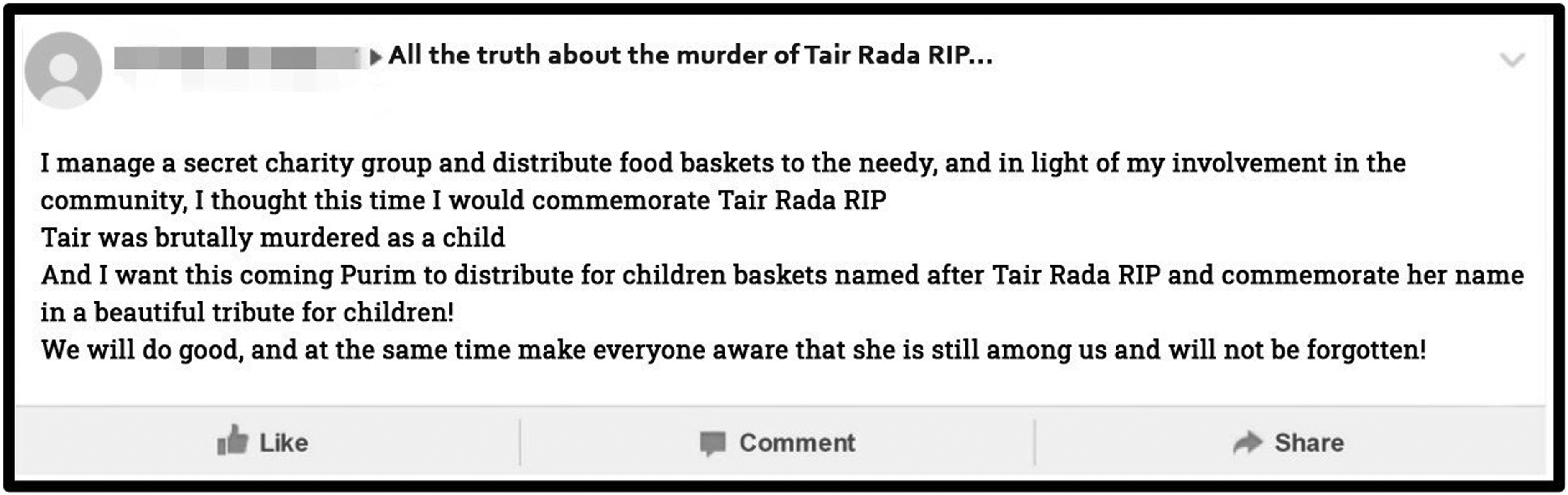
Delivery of gift baskets in memory of Tair Rada.
Another variant of activities taking place in the physical world, albeit with a portion of its organization occurring through social media, involves the orchestration of demonstrations and protests. Activists convened demonstrations in front of the residences of the attorney general and the state attorney. Additionally, three substantial demonstrations took place in Rabin Square— one in 2013 and two in 2016. Each of these events witnessed the contributions of individuals who wished to provide support in various ways, such as offering transportation, handling amplification, or extending design services. These actions underscore that activists not only arrange these demonstrations but also manage logistical aspects independently, bypassing the need for external entities like production companies.
The final demonstration advocating for justice in the Zadorov case occurred in May 2016. Some activists anticipated a turnout in the thousands, driven by a significant count of supposedly confirmed attendees and the prevalence of a “bubble illusion” within the realm of social media. This illusion often leads individuals to believe that a particular topic, which garners interest within a specific online group, possesses an extensive offline following.
As per a pre-demonstration survey, a majority of respondents held the belief that the attendance would range from 50,000 to 100,000 people (refer to Figure 4). Nevertheless, the actual turnout amounted to only a few hundred individauals. Subsequently, a sentiment of disappointment and resentment emerged among certain ctivists towards those who failed to participate: “Cease being mere keyboard warriors, confined to your living rooms, and counting on others to carry out the task. A genuinely disheartening shame and dishonor.”
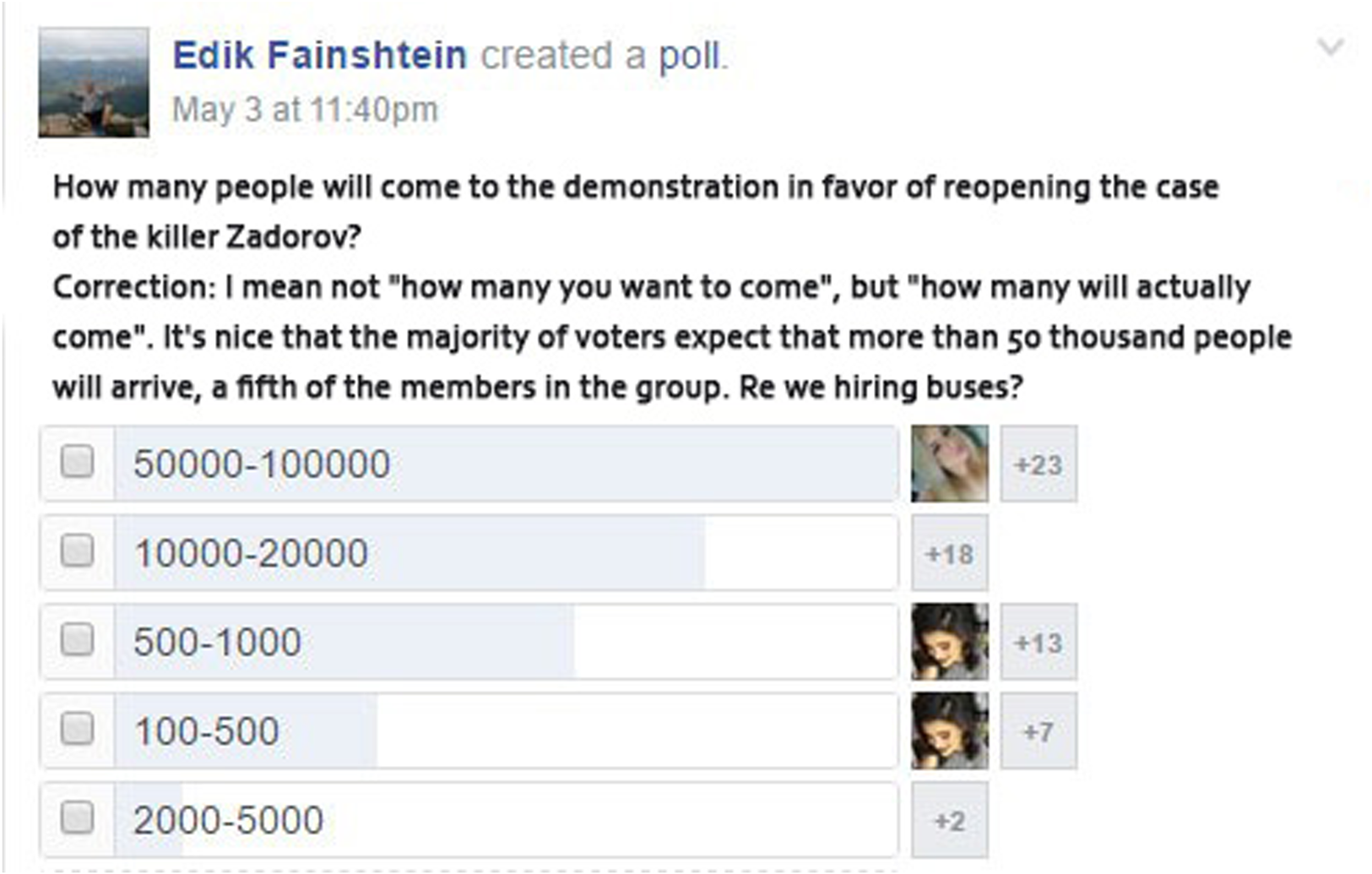
Poll: How many people will come?
These examples of distributing physical materials, organizing demonstrations, and protests showcase participatory activities in the offline realm, requiring higher levels of effort and engagement compared to online actions. While social media often facilitates the organization of these events, the execution of these activities in physical spaces demonstrates a tangible commitment to the cause.
13 Category 6: Deliberative Activities Offline
The sixth and ultimate category pertains to the revelation of information and the presentation of arguments through activities that occur offline, in a physical space.
Activists frequently undertook “home visits” and unexpected phone calls to individuals whose names surfaced in the legal proceedings. Numerous interviews and informal discussions were conducted with teenagers who resided in Katzrin during the time of the murder or attended the school there. Instances of grievances about being harassed by activists keen on extracting information were widespread. Moreover, activists reached out to stores, companies, and media establishments in their pursuit of information.
The most “challenging” instances of such collective endeavors are encapsulated in the “quests” undertaken by certain activists, such as the pursuit of objects that could potentially be linked to the murder case. An illustrative scenario involves Adir Habani's assertion in 2012 that his then-girlfriend, Ola Kravchenko, was the actual perpetrator. He furnished particulars about the potential murder weapon—a specific type of knife—and the shoes she purportedly wore during the crime. In response, a collective initiative was launched by activists to track down the exact model of the knife and the shoes, as depicted in Figure 5.
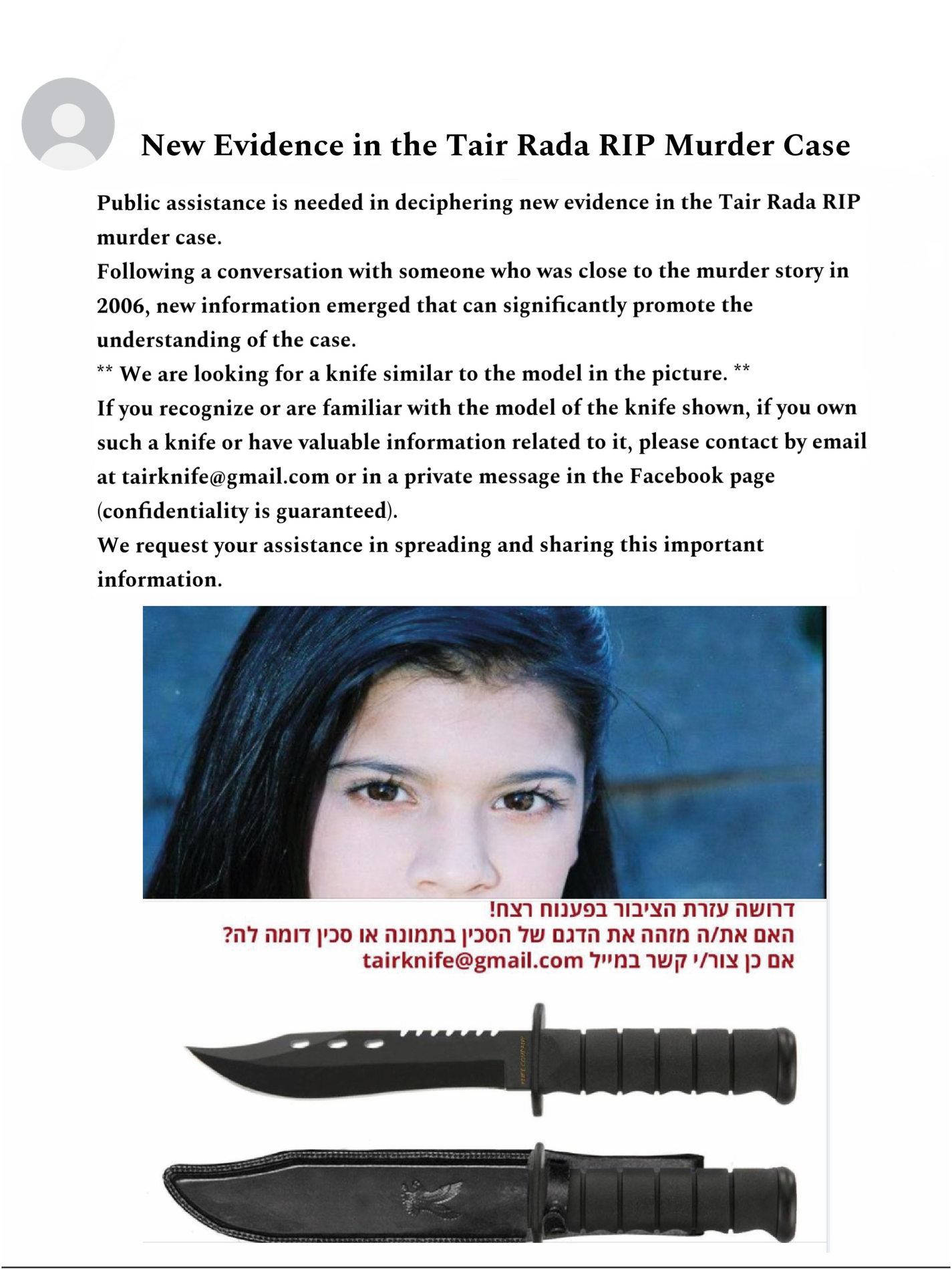
Help in locating a knife similar to the murder knife.
The findings from this study highlight the added value of the new categorization scheme by showing how different types of collective actions interact to produce sustained engagement and significant social impact. This enhanced understanding facilitates more strategic planning and execution of collective actions, underlining the practical implications of adopting this model
These examples of “home visits,” investigative interviews, and the pursuit of physical evidence illustrate offline deliberative activities. By engaging in extensive information gathering and analysis in the physical world, activists participated in actions requiring deep thought, investigation, and argument construction, aligning with the deliberative nature of offline collective action.
14 Discussion and Conclusions
This paper introduces a comprehensive classification framework for collective activities facilitated by social media. This categorization consists of two key dimensions: the nature of the activity, which can be either deliberative or participatory, and the platform where it unfolds. The latter dimension includes three distinct hubs: online/within social media platforms, online/beyond social media platforms, and offline.
Social media has emerged as the favored platform for activists and social movements, serving as a prominent communication channel for individuals and groups with limited visibility within mainstream media (Cammaerts, 2012; Harlow & Harp, 2012). Various forms of collective actions unfold online, prompting researchers to construct frameworks designed to categorize these actions (e.g., George & Leidner, 2018; Segesten & Bossetta, 2017; Zuckerman, 2014).
The proposed framework for categorizing collective activities facilitated by social media consists of two primary dimensions: (1) Activities oriented towards disclosing information and conducting objective discussions (“deliberative”), as well as activities aimed at garnering public attention and involvement (“participatory”). (2) The context within which these activities occur. This dimension encompasses three distinct categories: activities conducted within social media platforms, such as altering profile pictures; activities transpiring online but not within social media platforms, like signing petitions outside of Facebook; and activities taking place in the physical realm, such as participating in demonstrations or affixing stickers to vehicles. The latter activities might enjoy heightened visibility among individuals present locally but typically demand more substantial commitment from participants.
The proposed scheme offers a more nuanced classification of collective activities facilitated by social media due to its dual-dimensional approach encompassing both deliberative and participatory actions, while also considering the contextual setting. This sets it apart from other frameworks, notably Zuckerman's (2014), by providing a more comprehensive and adaptable structure for categorizing activities that acknowledges the diverse nature and varying levels of engagement across online and offline spaces.
The findings from applying the newly proposed categorization scheme to the social media-based activism for Roman Zadorov highlight several key insights. First, the distinction between deliberative and participatory activities facilitated through distinct platforms offers a more nuanced understanding of how collective actions coalesce and operate within and beyond the realm of social media. This nuanced analysis enables activists and scholars to tailor strategies that are better aligned with the desired outcomes of their campaigns, enhancing both reach and impact.
Moreover, the application of this scheme reveals the dynamic interplay between online and offline actions, demonstrating that movements often transition between these spaces to maximize effectiveness. For example, the case study of the justice campaign for Roman Zadorov shows that while much of the initial mobilization occurred through participatory activities on social media, the more sustained and impactful deliberative actions often took place offline or through extended online platforms. This shift from online mobilization to deeper engagement underscores the added value of recognizing different activity types and platforms in strategizing collective actions.
While the proposed categorization scheme offers significant insights into the dynamics of social media-based collective action, it is not without its theoretical and methodological limitations. Theoretically, the framework assumes a level of homogeneity in the character of collective actions across different social media platforms, which may not fully capture the unique affordances and user dynamics of each platform. Methodologically, the reliance on a single case study, while illustrative, may limit the generalizability of the findings. The case of the Roman Zadorov advocacy campaign, though profound, represents a specific socio-political context and type of collective action that may not be directly applicable to other cases or environments.
Further research endeavors can persist in substantiating and honing the suggested framework in diverse contexts and scenarios where collective activities transpire. Additionally, the assessment of perceived significance and associated costs linked to the various categories within this scheme can be undertaken to gain a more comprehensive comprehension of which actions are more effective at eliciting online support and under which circumstances.
Footnotes
Acknowledgments
I thank Inbal Laks-Freund, Tslil Rahamim and Inbar Malka for their assistance in preparing the manuscript for publication.

Funding
The author received no financial support for the research, authorship, and/or publication of this article.
Declaration of conflicting interests
The author declared no potential conflicts of interest with respect to the research, authorship, and/or publication of this article.