



Abstract
Background/Objectives
During the COVID-19 pandemic, workforce across the globe had experienced an unprecedent change in work mode under the quarantine and social distancing policies. Shift work workers, who were at higher risk of burnout, upheld their roles and kept the essential operation of society maintained amidst the pandemic time. The objectives of this study are to evaluate the association between impact of COVID-19 and burnout among shift workers in Hong Kong, and to investigate if there is any association between the infection history and burnout among shift workers.
Methods
Five hundred and thirty eight shift workers (297 males and 241 females of age 33+9) were recruited in this cross-sectional study. Self-administered questionnaire addressing respondents’ demographic information, shift characteristic, anxiety level, perception towards COVID-19 and the burnout situation of the respondent were distributed.
Results
The prevalence of burnout among shift workers during pandemic was 39.4%. Engagement in more shifts (aOR = 2.608), 9 to 15-night shift/month (aOR = 1.654), history of frequent infection of COVID-19 (aOR = 2.076), high anxiety level (aOR = 8.599) was associated with higher probability of burnout. Increase in anxiety level correlated to increase in exhaustion (β 0 = 0.042) and decrease in personal efficacy. ( β 0 = -0.081).
Conclusion
Impacts by COVID-19 were associated with burnout of shift workers in terms of older age, single status, long shift pattern, night shift, anxiety level as well as infection history. Although World Health Organization has declared the end of COVID-19 pandemic, the post-pandemic burnout situation emerged as an alarming occupational hazard.
Keywords
Introduction
Burnout is an occupational phenomenon that has been on list of the International Classification of Disease (ICD-11) by the World Health Organization (WHO). People with burnout generally felt a lack of energy, emotionally drained and were pessimistic about their potential to change their performance status (Boyd & Bee, 2019). Burnout results from chronic stress at workplace that has not been successfully managed, and it is characterized by three dimensions, i.e., feeling of exhaustion, cynicism towards his/her job and a sense of reduced professional efficacy (World Health Organization [WHO], 2019). It can be exhibited in terms of impacts to physiological health, psychological condition as well as job performance. Higher risk in musculoskeletal disorder, insomnia, depression, development of suboptimal health condition (Salvagioni et al., 2017) and increased susceptibility to COVID-19 infection were reported (Fatima et al., 2021). Also, burnout was linked to deteriorated occupational performance, more days of sick leave and lower motivation towards work. Compassion fatigue among healthcare workers during COVID-19 has brought the public to worry about the quality of medical service provided (Lluch et al., 2022).
'Shift workers' in this study refer to the workforce who are required to work in patterns that can support the operation of establishment longer than the working hour of an individual (International Agency for Research on Cancer of World Health Organization [IARC], 2010). To support the round the clock local societal needs, shift work is common in Hong Kong, ranging from medical sectors who are supporting the life-saving service to transport sectors who are maintaining mobility of the population round the clock. Before the COVID-19, prevalence of burnout of around 25%–31% was reported amongst nurses and doctors (Lau et al., 2022; Peterson et al., 2019). Shift working nurse was at higher risk of burnout than the non-shift worker [aOR = 1.4,95%CI: 1.0/1.9] (Wisetborisut et al., 2014) due to the disruption of circadian rhythm and sleep problem (Hulsegge et al., 2020; Peterson et al., 2019).
Hong Kong had the first confirmed COVID-19 case on 23rd January 2020 which marked the start of the over 3-year COVID-19 pandemic. “Dynamic zero-COVID policy”, one of the world’s strictest quarantine measures, had brought the society into gloomy atmosphere, where people were worried about their health and also their job security. The quarantine and social distancing measures were also found linked to deteriorated mental health of the general public, where incidence rate of anxiety, depression or even suicidal ideation were worrying. (Ganesan et al., 2021; Lau et al., 2022). Shift workers upheld their duty at the stressful frontline during the pandemic. It was thus worth society’s attention to their burnout situation amidst the pandemic time. This is a cross-sectional study with the primary objective of evaluating the association between impact of COVID-19 and burnout among shift workers in Hong Kong. The secondary objective is to investigate the association between infection history and the situation of burnout of shift workers. If a positive association could be found, suggesting ‘post-infection condition’ might have an effect on burnout, further studies are warranted.
Methods
Participants
Shift workers from medical sector, disciplinary forces, and transport sector were invited to be the representative of shift workers in this study because these industries were supporting essential services in Hong Kong during the COVID-19 time. Eligible participants of the study should have joined the workforce in Hong Kong before the onset of COVID-19 and have been working in shift for at least 90 days before taking the questionnaire. Participants were invited through snowball sampling via their work associations and invitation posted on the social media platforms of the targeted groups. Online questionnaires on ‘Microsoft Form’ and in PDF format were sent to potential respondents through messaging or email, they returned the responses through online platform or in paper form between 20th December 2022 and 16th April 2023. All participants provided informed consent.
Sample size calculation and data collection
By using formula N = [(z-score)2 (
Measurement tool
Self-administered questionnaire was set to collect information on five domains, including demographics, shift characteristics, general anxiety level, infection history and COVID-19 risk perception, taking ‘COVID-19 Population Survey Tool by School of Public Health of CUHK’ as reference. Level of burnout was measured by Maslach Burnout Inventory – General Survey (MBI-GS), which was a modified version of MBI for general workforce despite their professions and it measured the level of burnout in three dimensions, exhaustion (Ex), cynicism (Cy) and professional efficacy (PE). MBI was the gold standard for assessing burnout (Williamson et al., 2018) which was tested with good internal reliability, i.e. Cronbach alpha values was 0.88 for Ex, 0.76 for Cy and 0.76 for PE, and good performance for validity (Maslach et al., 2018).
Statistical data analysis was conducted using SPSS 28.0.1.0. Having demographic factors with significant odd ratio (p < .05) adjusted, odd ratio (aOR) was calculated for variables of interest.
This study was approved by the Survey and Behavioural Research Ethics Committee of the Chinese University of Hong Kong. (SBRE Ref. No.: 043-22).
Results
Descriptive Data Analysis for Demographics Information, Shift Characteristic, Infection History, Perceived Change in Mental Health, Anxiety Level, Perceived Susceptibility and Perceived Severity of Sample. Categorical/Ordinal Data is Presented in Frequency. Mean of Mean Score of 16 Questions was Calculated for Perceived Susceptibility, Mean of Mean Score of 3 Questions was Calculated for Perceived Severity. Descriptive Data Analysis for Ex, Cy and PE of MBI-GS.
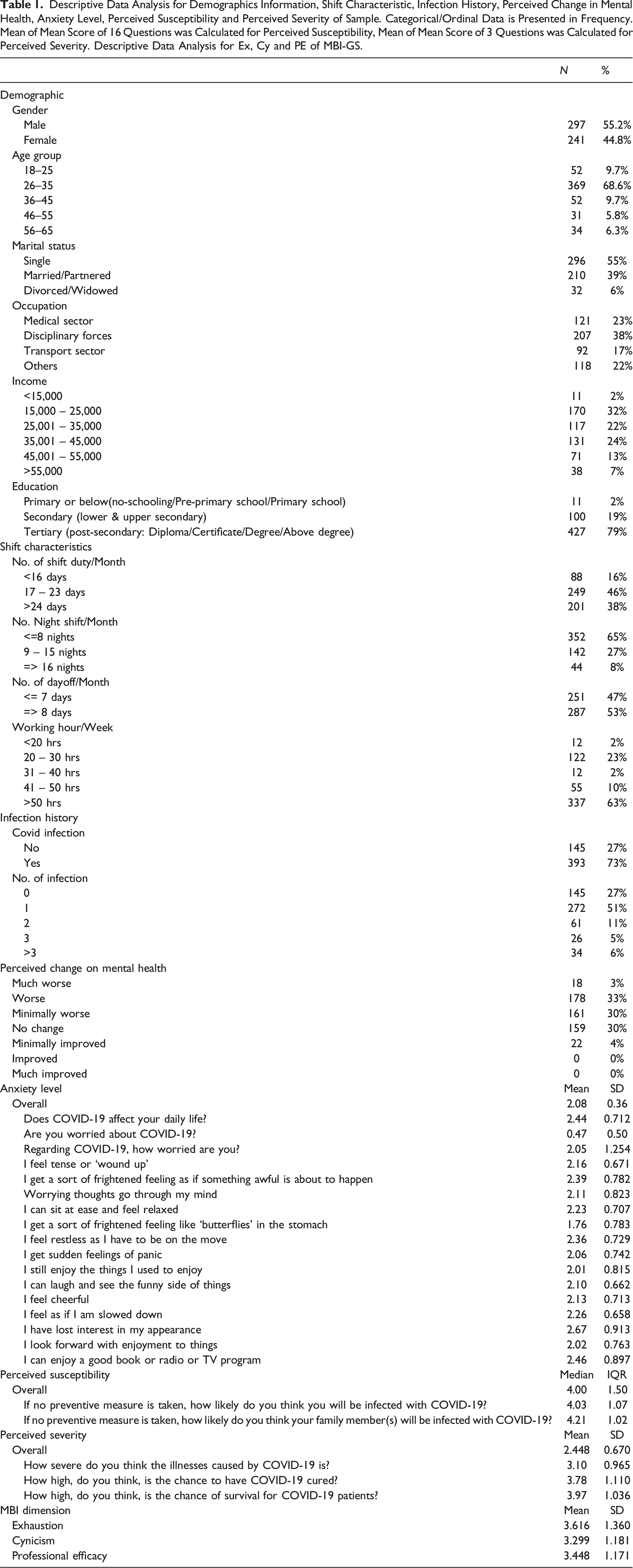
Demographics: Ratio of male (55.2%) to female (44.8%) is 1: 0.8. 369 (69%) of respondents aged between 26 and 35. 121 (22%) were from the medical sector, 207 (38%) were from the disciplinary forces, 92 (17%) were from transport sector and the remaining 118 (22%) were from other occupations, including media, customer service and property management.
Shift Characteristics: 84% of the respondents worked for over 17 shifts/month. 8% of respondents worked for over 16 night shifts/month while majority (65%) worked for less than 9 night shifts/month. 62% of respondents worked for over 50 hours per week, which is far exceeding Hong Kong workforce’s weekly average working hour, 42 hours. (The Legislative Council Commission, 2019).
COVID-19 Infection History: 145 (27%) respondents had never been infected while 272 (50%) had been infected once, 61 (11%) had been infected twice and the 11% had been infected three or more than three times.
Anxiety level: Mean of anxiety mean score is 2.08+0.36. That meant, respondents were in average more anxious during the pandemic time when compared to 2009 influenza pandemic (mean score = 1.8) (Cowling et al., 2010).
Risk Perception of COVID-19: The median of perceived susceptibility mean score was 4.00 (IQR: 1.5), respondents in average perceived themselves as susceptible to COVID-19 infection. At the same time, they in average perceived COVID-19 is not that severe (μ = 2.44
MBI-GS: 62.6% rated themselves at high exhaustion level (>3.2) (Figure 1(a)). 83% rated themselves at a high level of cynicism (>2.2) and only 3% rated ‘low’ (<1.00) level of cynicism) (Figure 1(b)). Over half of respondents (66.9%) rated low level of professional efficacy (<4.00) (Figure 1(c)). In MBI-GS, ‘Burnout’ refer to a typical profile of high exhaustion, high cynicism and moderate/low professional efficacy. Prevalence of burnout was 212 (39.4%) in this study. Referring to Figures 2(a)–2(c), among the burnout groups in the medical sector, disciplinary forces and transport sector, disciplinary forces rated the highest in exhaustion (μex = 4.58+0.81) and cynicism (μcy = 4.28+0.68) while transport sector rated the highest mean score for professional efficacy (μpe = 2.98+0.51). The medical sector rated a relatively high score in Ex (μex = 4.41+0.76), which was in line to findings in other studies on medical professionals (Wisetborisut et al., 2014; Wu et al., 2007). (a–c) : Distribution of level of mean Exhaustion Score, mean Cynicism score and mean Professional Efficacy Score. Cut-off for exhaustion level is <2.00 as ‘low’, 2.01–3.19 as ‘moderate’ and >3.20 as ‘high’. Cut-off for cynicism level is <1.00 as ‘low’, 1.01–2.19 as ‘moderate’ and >2.20 as ‘high’. Cut-off for professional efficacy level is <4.00 as ‘low’, 4.01–4.99 as ‘moderate’ and >5.00 as ‘high’. (a). Comparison of mean Ex score in burnout and non-burnout groups between occupations. (b). Comparison of mean Cy score in burnout and non-burnout groups between occupations. (c). Comparison of mean PE score in burnout and non-burnout groups between occupations.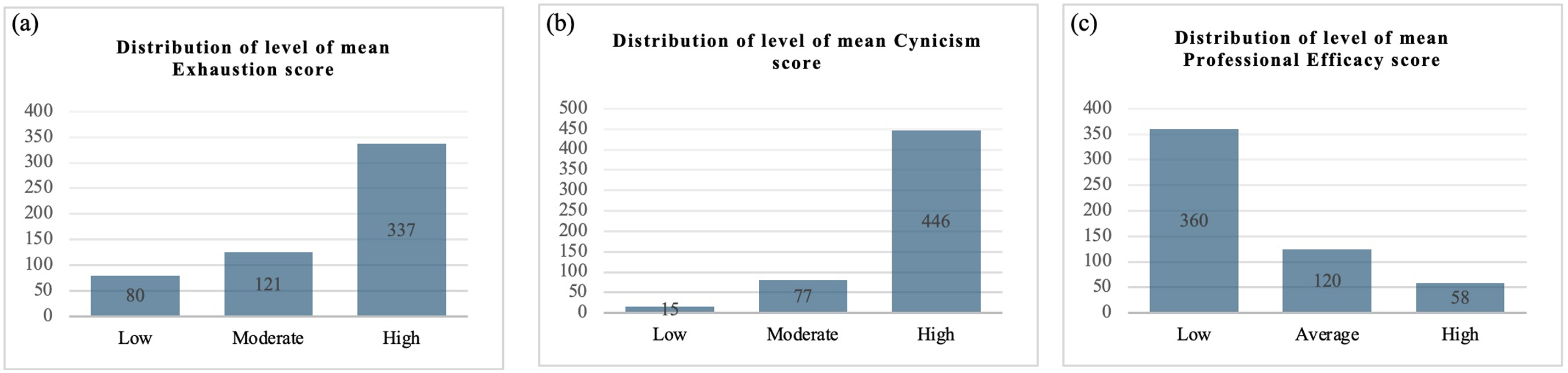
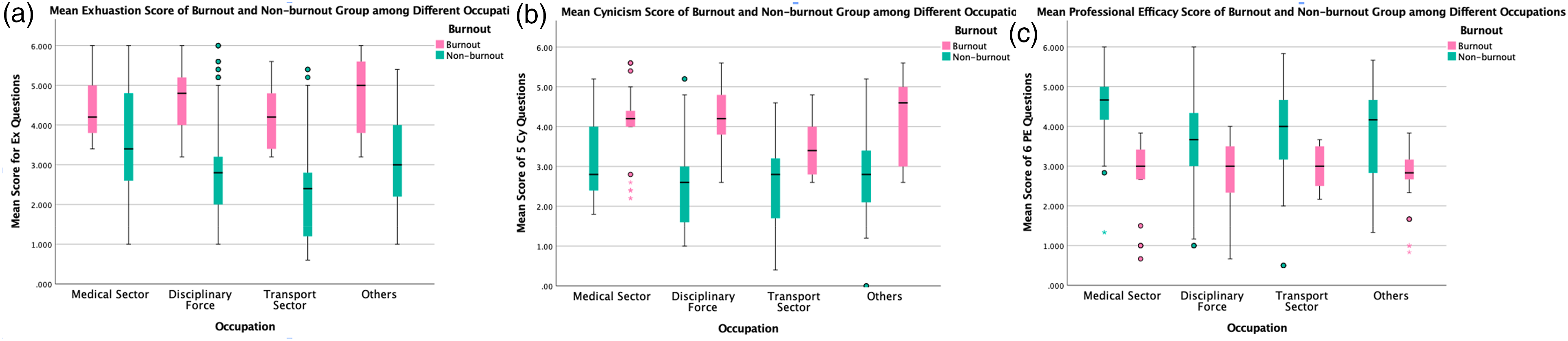
Exhaustion (Ex), cynicism (Cy) & professional efficacy (PE)
Correlation Coefficient (r) Between Independent Factors and Mean Score of Ex, Cy and PE.
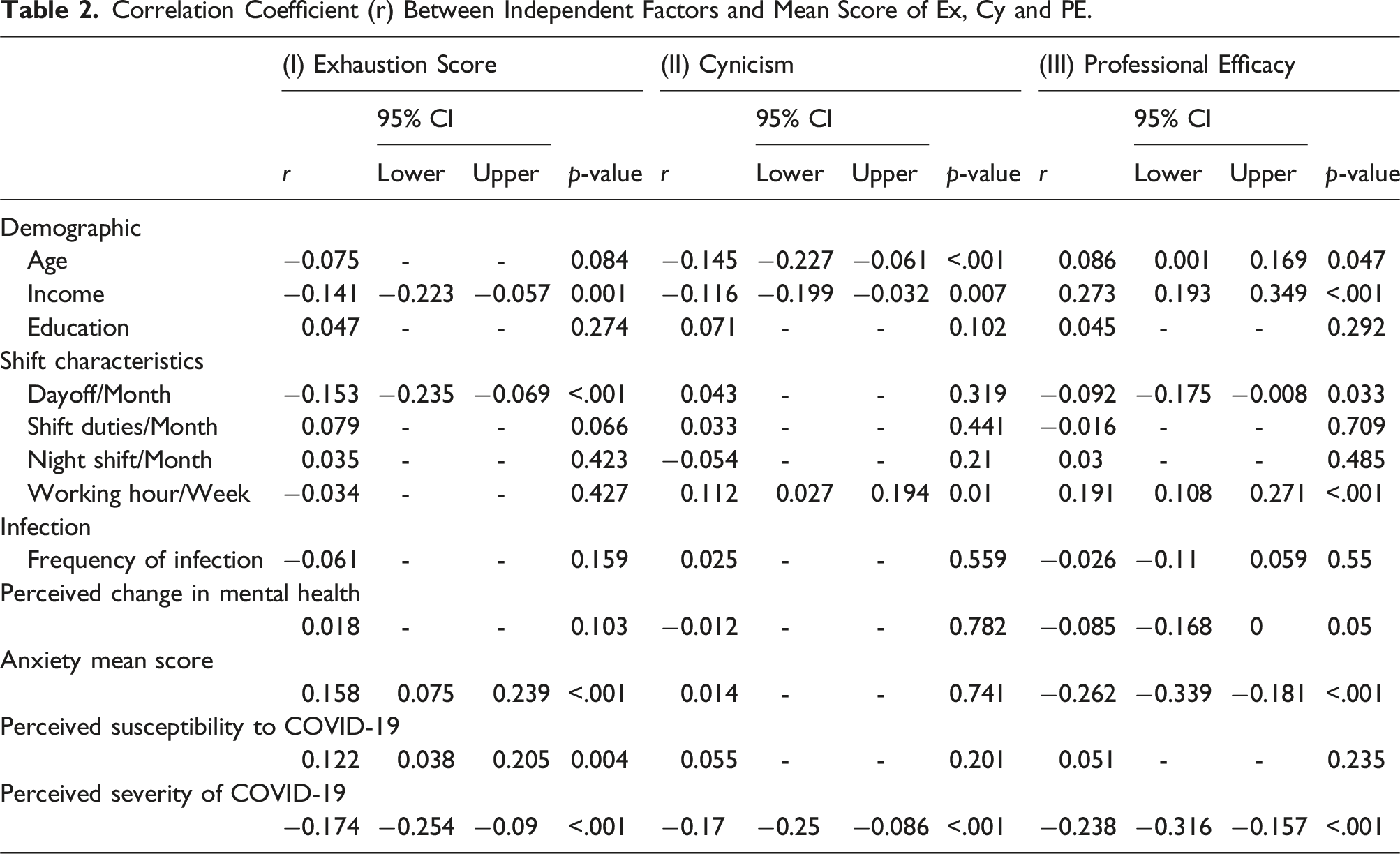
Cynicism level was positively correlated with working hour/week (r = 0.112, 95% CI: 0.027/0.194) while negatively correlated with age (r = -0.145, 95% CI:-0.227/-0.061), income (r = -0.116, 95% CI:-0.199/-0.032) and perceived severity (r = -0.17, 95% CI: -0.25/-0.086).
Level of professional efficacy was positively correlated with age (r = 0.086, 95% CI:0.001/0.169), income (r = 0.273, 95% CI:0.193/0.349) and working hour/week (r = 0.191, 95% CI:0.108/ 0.271) while negatively correlated with day off/month (r = -0.092, 95% CI:-0.175/-0.008), perceived change in mental health (r = -0.085, 95% CI: -0.168/0), anxiety score (r = -0.262, 95% CI:-0.339/-0.181) and perceived severity (r = -0.238, 95%CI: -0.316/-0.157).
Associated factors to burnout
Association Between Prevalence of Burnout and Predictor Variables by Binary Logistic Regression. Age, Marital Status, Income and Education Level Were Adjusted for Adjusted Odd Ratio for Shift Characteristics, Infection History, Anxiety Level, Perceived Susceptibility, Perceived Severity and Perceived Change in Mental Health and Mean Score for Exhaustion, Cynicism and Personal Efficacy of MBI-GS. Crude Odd Ratio and Adjusted Odd Ratio Were Calculated for (I) Overall Sample Group, (II) Non-Infected Group and (III) Infected Group.
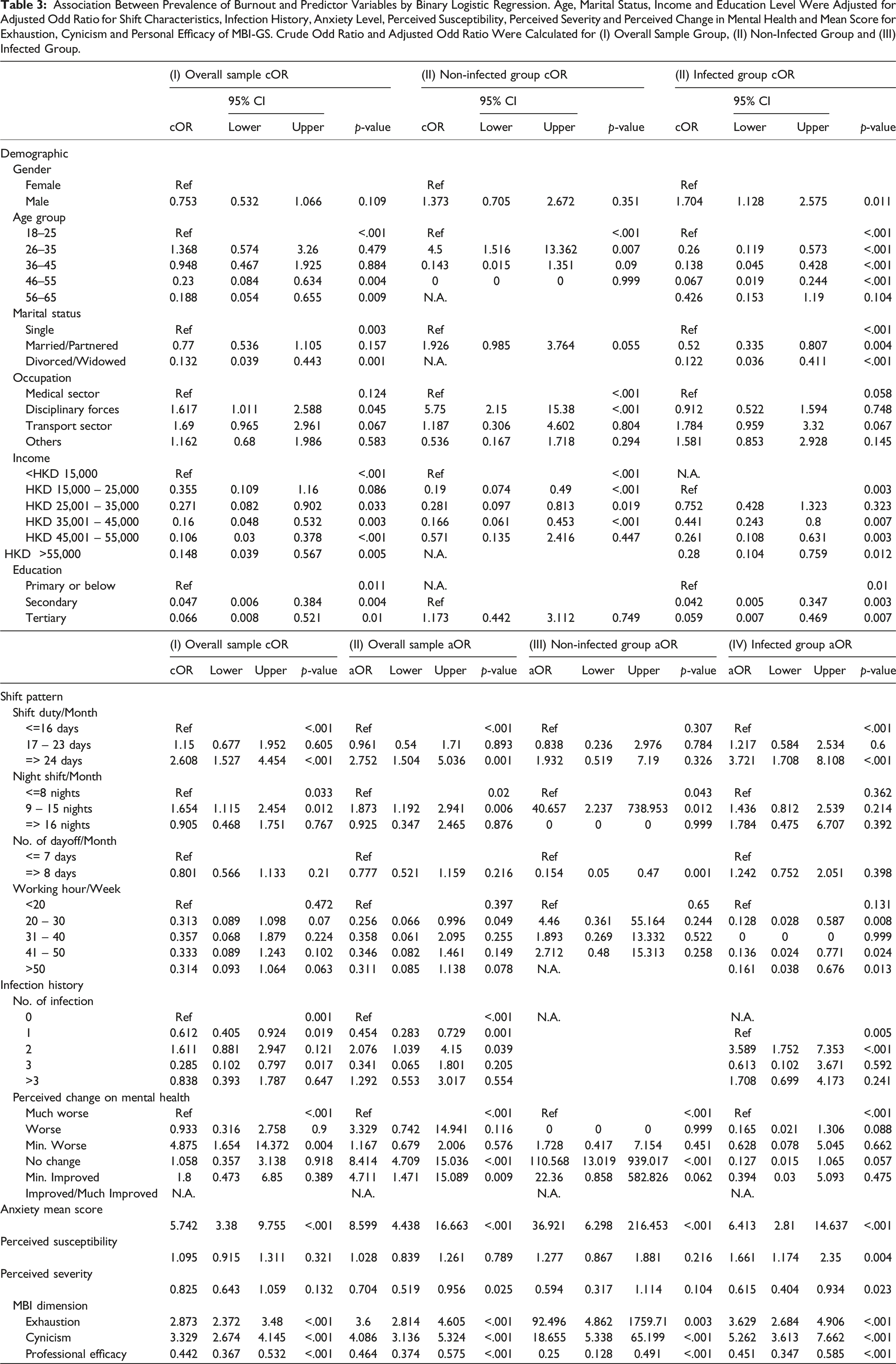
By adjusting the above significant demographic factors, adjusted odd ratio (aOR) of factors related to shift characteristics and other risk perception were calculated. Workers who engaged
Discussion
The prevalence of burnout among Hong Kong shift workers during the COVID-19 time was 39.4% (212) in this study. The more stringent definition of ‘Burnout’ adopted from the MBI-GS manual made the prevalence seemingly being lower than 55% found among French public (Mion et al., 2021) and 60% for general workers in Corporates of Hong Kong (Lam et al., 2022) during COVID-19.
For demographic factors, older age was significantly associated with lower level in Cy(r = -0.145), but higher level in PE (r = 0.086) which echoed to other studies (Khodadoost et al., 2023; Lau et al., 2022). ‘Survivor population’ explained that those who had experienced severe level of burnout syndrome may have already left their job position (Ahmadi & Maleki, 2022; Dall’Ora et al., 2015), and those who stayed in workplace at older age could have attained higher position in the career and not necessary to extensively engage in demanding hands-on duties. Also, extensive experience of the older age workforce equipped them with better adaptability to changes brought by COVID-19.
Shift workers in single status, were in general 1.29 times the odds of burnout. In sub-group with infection history, single workers were 1.92 times at the risk of burnout than the married/partnered group. During the COVID-19, single individuals lacked an intimate partner to share the mental and practical burdens, including care, support on daily necessities and medicine when they were infected. Switching from face-to-face interaction to online interaction on social media did not alleviate the impact (Pandya & Lodha, 2021). Instead, excessive use of social media was proven bringing negative impact to physical and psychological health, such as increased risk of anxiety and depression (Lee et al., 2022).
Lower income was associated with higher odds of burnout, explained by higher level in exhaustion and cynicism, and lower level of professional efficacy. Workers engaging in low-income jobs were vulnerable to frequent policy changes during the pandemic, such as the Target Group Testing Scheme (Hong Kong Special Administrative Region Government [HKSARG], 2020). Besides high unemployment rate and job insecurity of the low-income workers under the gloomy economy during COVID (Hong Kong Monetary Authority [HKMA], 2021) imposed negative burden to mental and physical health (Caroli & Godard, 2014; Hao et al., 2024). The deteriorated health signs might be interpreted as nerve-racking signs of infection.
In the infected group, lower the education level, the higher the odds of burnout. Misinterpretation of COVID-19 situation could occur in people with low education and thus resulted in their over-/under-reaction towards exigencies, such as raging for mask stocking.
For shift characteristics, negative correlations between day off/month and Ex score (r = -0.153) and PE score (r = -0.092). Meanwhile, significant association between frequent shifts and decreased level of PE was suggested in previous studies (Peterson et al., 2019).
Workers performing 9–15 night shift/month were having the highest odds of burnout (aOR = 1.873, 95%CI: 1.192/2.941) when compared to groups that worked less (<8 night shift) or worked more (>16 night shifts). ‘9–15 night shift/month’ was the pattern causing highest degree of disturbance to circadian rhythm (Pilcher et al., 2000), i.e. ‘<8 night’ offered longer buffering time for recovery and ‘>16 nights’ offered a relatively regular pattern of resting than ‘9–15 night shifts’ as it usually consisted of a consistent or permanent night shift.
Shift workers infected with COVID-19 twice were at the highest odds of burnout, which was two times of the non-infected group and around four times of those infected once. Those who infected twice was a minority group (11%) at the time of study. This group might be relatively worried about the uncertainties in health consequence brought by repeated infection, such as long covid syndrome and weakened immunity susceptible to other infectious disease, or underlying to other disease, such as shingles (Bhavsar et al., 2022). The non-infected group experienced mental burden from uncertainty of when they would eventually be infected and they were uncertain about the symptom to develop if they got infected.
Anxiety level has been proven an important predictor to burnout (Lluch et al., 2022). It had a significant positive correlations with Ex and Cy with correlation coefficient ranged 0.15 to 0.44. In this study, linear regression coefficient between anxiety level and Ex (β 0 = 0.042, 95%CI 0.02/0.064) echoed to the past study. Anxiety was negatively associated to level of PE (β 0 = -0.081, 95%CI -0.106/-0.055). For shift workers who maintained the essential services during the pandemic bore additional source of anxiety as they were not guaranteed for any work-from-home arrangement and were exposed to higher infection risk. Anxiety not only caused negative psychological impact, but also physiological impact in terms of weakened immunity & gastrointestinal function. It also increased the risk of turning to unhealthy behaviours, such as substance abuse and passive suicidal ideation. These behavioural changes reciprocally negatively affected people’s mental condition, especially those who already had mental illness (Ganesan et al., 2021).
Despite the end of the COVID-19 pandemic, concern still cast shade to the public in the post-pandemic recovery phase (Hao et al., 2024). Follow-up serial cross-sectional studies on burnout situations of shift workers can identify unknown issues, such as if the relating burnout situation is persistent or transient. This helps to meet the mental and occupational needs of shift workers at the post-pandemic time. The government may introduce public health policies, and enterprises may review the stress coping management to their staff accordingly.
Limitations
This study is subject to potential selection bias as shift workers who perceived themselves as ‘Burnout’ tended to be more willing to participate. Potential sampling bias from channel of distribution and targeted groups. Online questionnaire as the main channel of data collection skewed the samples to younger age while the whole shift worker population in Hong Kong might be underrepresented by samples from only three sectors. Since only 94% of effective sample size was achieved, association was statistically weakened. Generalization of result to other regions might be limited as the working culture and quarantine measures differed in a significant extent across regions.
Conclusion
The 3-year COVID-19 pandemic has doubtlessly brought great changes to every person’s mode of living. Meanwhile, significant prevalence of burnout amongst shift workers in Hong Kong was identified during the pandemic, and that shift characteristics, anxiety level, COVID-19 infection history were found to be associated with burnout.
Footnotes
Acknowledgements
I sincerely thank Prof. Kin On KWOK, Ms. Wan In WEI, and Prof. Samuel Yeung Shan WONG in the Division of Infectious Diseases of JC School of Public Health and Primary Care, The Chinese University of Hong Kong, Hong Kong Special Administrative Region, China for permission to use their survey instrument and translating it into English ( ). Section C to Section F of this questionnaire are adopted from the Population Survey Tool.
Author contributions
(1) Concept or design: All authors, (2) Acquisition of data: SW Wong, (3) Analysis or interpretation of data: SW Wong, (4) Drafting of the article: All authors, (5) Critical revision for important intellectual content: All authors. The following statement should also be included: “All authors had full access to the data, contributed to the study, approved the final version for publication, and take responsibility for its accuracy and integrity.”
Declaration of conflicting interests
The author(s) declared no potential conflicts of interest with respect to the research, authorship, and/or publication of this article.
Funding
The author(s) received no financial support for the research, authorship, and/or publication of this article.
Declaration
Presented in Capstone Project Presentation Session for 2022/23 Master of Public Health of The Chinese University of Hong Kong.