



Abstract
Keywords
Introduction
One of the main tasks at school is writing: classwork such as copying from the board to a notebook, writing answers in a book or on paper when doing homework, composing essays, taking tests and more (Barnett et al., 2018; Rosenblum & Gafni-Lachter, 2015). By the time children reach 8–10 years, their handwriting usually becomes automatic, organised and available as a tool to facilitate the development of ideas (Julius et al., 2016). To achieve this, handwriting must be legible to the readers and to the writers themselves, for example, to allow writers to re-read their scripts later.
Copying a text and free-writing tasks are two of the most common writing tasks in school. Both involve lower-level processes as described by Berninger et al. (2011) and earlier by Kellogg’s (1996) model of writing. These lower-level processes, such as graphomotor execution, need to be mastered first in handwriting acquisition because they demand conscious attention to the writing process and close sensory guidance of the pen during writing (Grabowski, 2010). However, self-generated writing tasks also require recursive, strategic and challenging high-level processes, such as described in the fundamental literature of handwriting: (a) planning what to say and how to say it, (b) translating ideas into written text and (c) revising what has been written (e.g. Hayes & Flower, 1980; Zimmerman & Risemberg, 1997). Van Galen’s (1991) psychomotor model of handwriting, which refers to higher-level cognitive processes and includes attention (activation of the intention to write) and language (semantic retrieval and syntactical construction) support these high-level processes. More recently, these processes were defined as executive functions (Graham et al., 2007; Rosenblum, 2018).
Legibility of handwritten tasks is important for determining what the writer is attempting to convey in terms of knowledge or understanding of a topic (Collette et al., 2017), and poorly formed handwriting often leads to lower academic marks (Sweedler-Brown, 1992). Poor legibility reflects lack of automaticity and therefore fewer resources to attend to composition, which may lead to poor writing content. Previous studies indicated that handwriting difficulties, specifically the inability to produce legible letters automatically and effortlessly at an appropriate speed, may be an initial indication that a child is at risk for developing inadequate composition skills (Berninger & Amtmann, 2003), underachievement and low self-esteem (Feder & Majnemer, 2007).
Additionally, poor legibility may cause assessors to mark the work more harshly, leading to lower grades for the same content as more legible work (Connelly et al., 2005). In school, papers with clearer and more legible handwriting are more apt to receive higher grades than are papers with poor penmanship, regardless of content (Santangelo & Graham, 2016). Hammerschmidt and Sudsawad (2004) indicated that while evaluating students’ handwriting, teachers judge whether the writing is legible and quick by comparing with the students’ peers.
Although handwriting difficulties often cause concern for parents, teachers and the children themselves (Hammerschmidt & Sudsawad, 2004; Marquardt et al., 2016) and are a major reason for referral for occupational therapy assessment and treatment, there is a lack of robust practical tools to assess legibility of the written product across tasks. The literature describes two main approaches to measure legibility: global evaluation scales and analytically based evaluations (Rosenblum et al., 2003). The Handwriting Legibility Scale (HLS) is a recently developed evaluation scale that combines both global and analytic approaches in a quick and easy-to-administer format and has been found useful for identifying poor handwriting legibility (Barnett et al., 2018; Prunty & Barnett, 2017). However, the HLS has previously been applied only to free-writing text.
The aim of the current study was therefore to examine how handwriting legibility is reflected in other writing tasks. The handwriting legibility of school-aged children (9–14 years) was compared across three handwriting tasks: copying in best writing (‘copy-best’), copying-quickly (‘copy-fast’) and generating their own text in a ‘free-writing’ task. Additionally, legibility components were examined to understand their contributions to the total legibility score on each task.
The research hypotheses were:
Method
Participants
This was a secondary analysis sample of data on 148 children aged 9–14 years (M = 11.45 years, SD = 1.7) who formed part of a previous UK standardization sample: 72 (48.6%) boys (M = 11.42 years, SD = 1.7) and 76 (51.4%) girls (M = 11.49 years, SD = 1.71). There were no significant differences between boys and girls in age, t(146) = −.25, p = .8.
Procedure
The sample, described in (Barnett et al., 2018), was drawn from the U.K. stratified sample of 546 children described in the Detailed Assessment of Speed of Handwriting (DASH) manual (Barnett et al., 2007). Ethical approval for the U.K. standardization project was granted by the (Oxford Brookes University Research Ethics Committee on 29 July 2005. No: 050158) Ethics Committee on 29 July 2005 (No. 050,158). The handwriting scripts were taken from the original U.K. Detailed Assessment of Speed of Handwriting standardization sample. As for the DASH normative sample described in the manual, the smaller sample used in the current study was representative of the U.K. population in terms of gender, level of parental education and race/ethnicity according to 2001 U.K. census data. The children were selected from a range of schools across the United Kingdom, including England, Scotland, Wales and Northern Ireland. The parent/guardian of each child participating in the U.K. standardization of the DASH provided written informed consent, and each child gave verbal assent prior to commencement of testing on the DASH.
Instruments
Detailed Assessment of Speed of Handwriting: The DASH provides a broad assessment of handwriting speed across a range of writing tasks. It has U.K. norms for children aged 9–16 years. The internal reliability of the total DASH score is between .83 and .89, and the interrater reliability for the four tasks is .99, as reported in the test manual (Barnett et al., 2007). For the current study, three of the four primary DASH tasks were used:
• A 10-minute free-writing task: In this task, the students composed a text on the topic, ‘My Life’. Before starting to write, the students were presented with a spider diagram containing different facets and topics of life as writing prompts and instructed that the prompts were only suggestions – they could write about one or several topics but should aim to write continuous text rather than a list. They were instructed to use their ‘everyday’ handwriting and first given 1 minute to generate ideas and make notes if they wished.
• Copy-best task: This 2-minute task required the students to repeatedly copy the short sentence, ‘The quick brown fox jumps over the lazy dog’, in their ‘best’ handwriting.
• Copy-fast task: This 2-minute task required the students to repeatedly copy the same short sentence, ‘The quick brown fox jumps over the lazy dog’, using ‘fast’ handwriting but ensuring the tester could read it.
Handwriting Legibility Scale: The HLS was originally developed using scripts from the DASH free-writing task. It was designed to examine performance on five legibility components: global legibility (overall readability on first reading), overall effort required to read the script, layout on the page, letter formation and alterations to writing (attempts to rectify letters and words). Each component is scored on a scale of 1 (good performance) to 5 (poor performance) and then summed to give a total legibility score ranging from 5 to 25. Higher scores reflect poorer legibility. Interrater reliability and internal consistency have been reported as high (0.92 in each case), with all components loading on just one factor (Barnett et al., 2018). In the current study, the HLS was applied to the three tasks from the DASH and rated by an occupational therapist with specific expertise in handwriting.
Data analysis
A multivariate analysis of variance (MANOVA) was used to examine differences in the HLS total score across the three tasks, and Friedman tests to examine differences among the HLS components between the handwriting tasks. Effect sizes were calculated from the Wilcoxon post-hoc test by dividing the absolute (positive) standardised test z statistic by the square root of the number of pairs, and Cohen’s classification of effect sizes was used (0.1 = small effect, 0.3 = moderate effect and 0.5 and above = large effect; Rosenthal, 1996). Spearman correlation analyses were conducted to examine relationships between the total HLS score in each task and the component scores. Finally, a series of forward stepwise linear regression analyses were performed to determine which specific HLS components would best predict the total score in each task. We included participant age and gender in each regression analysis in light of the significant negative and low correlations found between them and the total HLS score in the free-writing task (age: r = −.19, p = .02; gender: r = −.16, p = .05) and of existing knowledge about the possible effects of age and gender on legibility. A significance level of p < .05 was applied.
Results
Task differences: Handwriting legibility scale total and component scores
Comparison among the three tasks: Mean (M), standard deviation (SD), median (Mdn), X2 and p values.
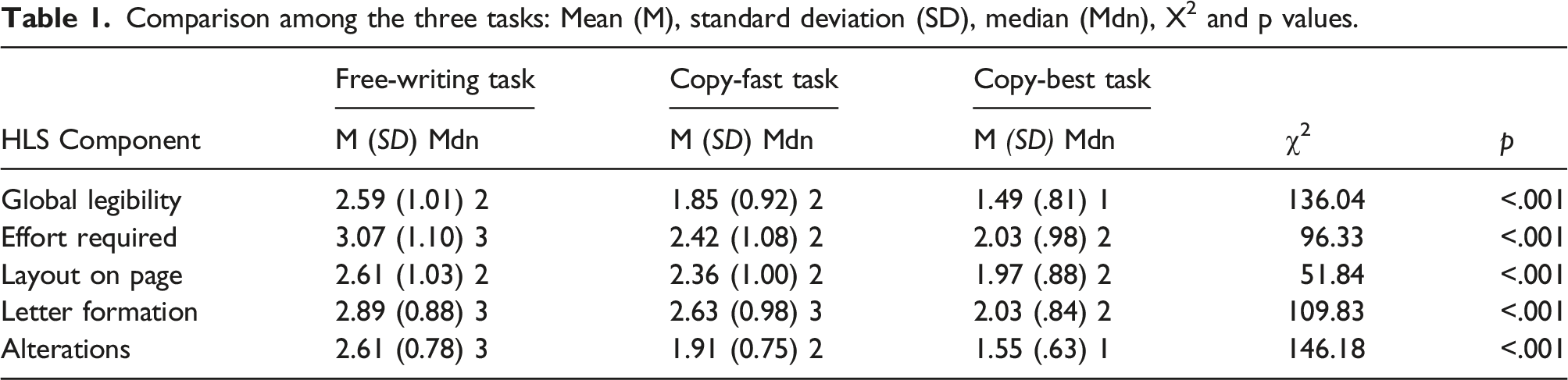
In all HLS components, the free-writing score was higher than the copy-fast and copy-best scores, and the copy-fast scores were higher than the copy-best scores. Effect sizes calculated for each component according to the Wilcoxon z values were medium-to-strong for legibility (r = .39–.77), effort (r = .40–.69) and alterations (r = .41–.77); medium for layout on the page (r = .36–.50); and small for letter formation (r = .26–.27).
Correlations between total handwriting legibility scale scores and handwriting legibility scale components
High correlations were found between the total HLS score and HLS components in all three tasks. Free-writing task: layout on the page (r = .77, p < .001), letter formation (r = .85, p < .001) and alterations (r = .70, p < .001). Copy-best task: layout on the page (r = .65, p < .001), letter formation (r = .84, p < .001) and alterations (r = .56, p < .001). Copy-fast task: layout on the page (r = .73, p < .001), letter formation (r = 88, p < .001) and alterations (r = .55, p < .001).
Significantly high correlations were found between the HLS total score and components in all three tasks. For the free-writing task, correlations ranged from .49 (alterations) to .87 (effort); For copy-best, correlations ranged from .26 (alterations) to .80 (effort), and for copy-fast, correlations ranged from .24 (alterations) to .84 (effort). All correlations were significant (p < .001).
Predicting total handwriting legibility scale score by handwriting legibility scale components
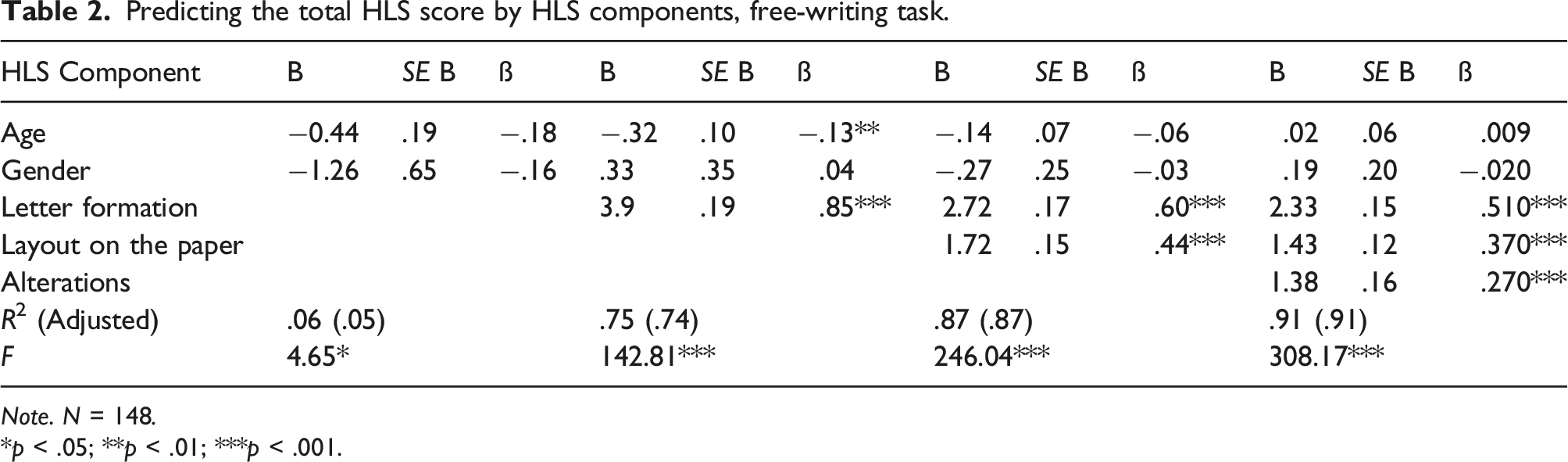
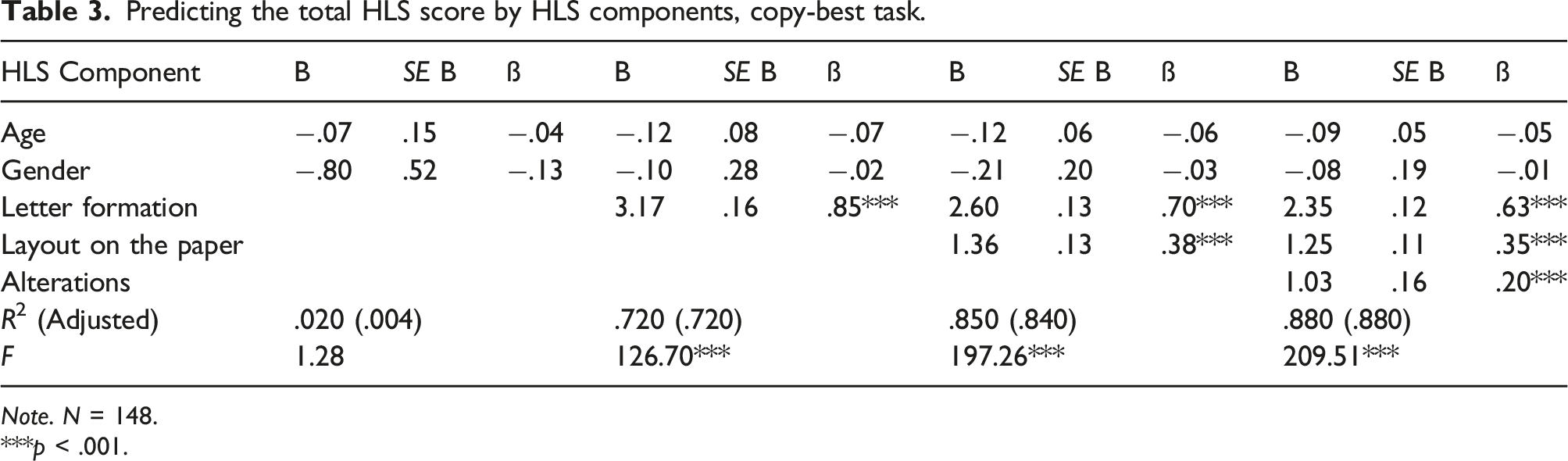
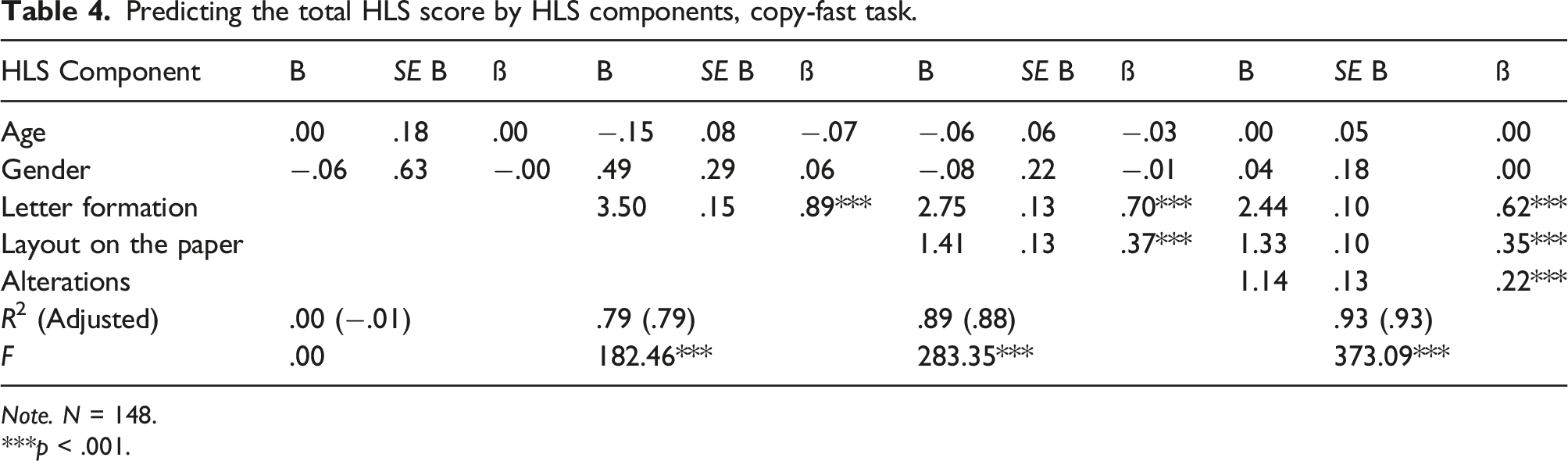
A series of forward stepwise regression analyses was conducted to determine which specific HLS component (layout, letter formation or alterations) best predicted the total HLS score in each task. To minimise multicollinearity, only three HLS components were entered into the regression analysis: layout on the page, letter formation and alterations. For the free-writing task, the correlation between layout on the page and letter formation was r = .53, p < .001; layout on the page and alterations r = .50, p < .001; and letter formation and alterations r = .49, p < .001. For the copy-best task, the correlation between layout on the page and letter formation was r = .38, p < .001; layout on the page and alterations r = .30, p < .001; and letter formation and alterations r = .37, p < .001. For the copy-fast task, the correlation between layout on the page and letter formation was r = .51, p < .001; layout on the page and alterations r = .25, p < .001; and letter formation and alterations r = .38, p < .001.
Predicting the total HLS score by HLS components, free-writing task.
Note. N = 148.
*p < .05; **p < .01; ***p < .001.
Predicting the total HLS score by HLS components, copy-best task.
Note. N = 148.
***p < .001.
Predicting the total HLS score by HLS components, copy-fast task.
Note. N = 148.
***p < .001.
Discussion
The aim of this study was to examine the handwriting legibility of school-aged children across different writing tasks required at school by applying the HLS and to explore which legibility components predict overall handwriting legibility. The first research hypothesis was supported, with significant differences in legibility found across the three handwriting tasks. Of the three tasks, copy-best had the lowest and free-writing had the highest total HLS and component scores, with higher scores indicating poorer legibility.
These results reflect the greater complexity of the free-writing task, in which the children need to rely on their abilities to generate text and, at the same time, produce writing that is legible (Gilboa et al., 2014). Hayes and Flower’s (1980) model of skilled writing can help to explain this complexity. According to their model, a free-writing task requires text-generation abilities, which correspond with generating ideas and then translating them into language representations in working memory (Berninger et al., 1992; De Vita et al., 2021; Hebert et al., 2018). Copy tasks, by comparison, require mainly transcription skills, which enable the writer to translate the language representations into orthographic symbols using pencil, pen or keyboard; these skills are presented as the ‘lower levels’ of writing production (Hebert et al., 2018). In the current study, the HLS scores were also sufficiently sensitive to reflect the different task demands for the copy-best and copy-fast tasks, with poorer legibility scores found for copy-fast. Here, the instructions focus more on the production of fast handwriting, which seems to result in a classic trade-off with accuracy, affecting the legibility components and overall legibility of the text (Prunty & Barnett, 2017).
These significant task differences reflect the sensitivity of the HLS across different writing tasks and therefore the potential value of this tool to assess classroom handwriting. Understanding the characteristics of different writing tasks may help occupational therapists to appreciate the impact of increasing cognitive loads on the legibility of written assignments (i.e. copying from the board, dictation and composition). This should be considered when choosing which task(s) to use to identify children with poor handwriting legibility. Those with severe difficulties may be identified even when task demands are low (e.g. copying with no time pressure). For others, their difficulties may become apparent only when task demands increase, such as in text-generation tasks. Assessment across a range of writing tasks may thus provide useful information for the classroom teacher and may refine the reason for referral to occupational therapy. In this way, the occupational therapist can be more precise in choosing appropriate assessment tools and adapt the treatment to the needs of the individual child and the educational setting (American Occupational Therapy Association, 2020).
Additionally, the positive and strong correlations found between the HLS total score and the three specific components highlight the importance of focussing on the handwriting legibility components. The results indicate that a copying or self-generated script with clear letter formation, organised layout on the page and few alterations will be more legible and easier to read, and vice versa. The HLS provides the rater with a structured way to focus on and evaluate these separate components in addition to judging the overall legibility of the text (Prunty & Barnett, 2017). We suggest that application of the HLS helps highlight for an occupational therapist which aspects of the handwriting could be the focus for further teaching and practise, thus promoting handwriting instruction in school. In their meta-analysis, Santangelo and Graham (2016) found that explicitly teaching handwriting not only improved students’ handwriting legibility and fluency but also enhanced the quality of their written compositions.
Based on the high correlation between handwriting legibility components, the third research hypothesis of this study concerned understanding the contribution of the three legibility components to the total HLS score of each task. The results reflect high percentages of prediction in all three writing tasks, indicating that the handwriting legibility components have significant and high contributions to total legibility. In addition, the contributions were similar in the three writing tasks: letter formation was the highest predictive component, followed by layout on the page, with alterations the least predictive.
This result is consistent with findings of previous studies that investigated legibility components and their impact on overall legibility. Letter formation has consistently been found to contribute more than any other component to the legibility of writing samples (Caravolas et al., 2020; Prunty & Barnett, 2017; Weintraub et al., 2007). From the legibility components of 9- to 13-year-old children with learning disabilities, Graham and Harris (1989) found letter formation had the most substantial impact on overall legibility, explaining 44% of the variance in a writing task (writing argumentative essays). When teachers and therapists were asked for their views on important aspects of legibility, they concluded that letter formation, size (Daniel & Froude, 1998) and ‘proper’ spacing (Hammerschmidt & Sudsawad, 2004) were most important for overall handwriting legibility in children. Similarly, in their sample of 134 Israeli students aged 12–16 years, Weintraub et al. (2007) reported that letter formation was the only significant component that contributed to handwriting legibility in a copying-and-dictation writing task. The importance of letter formation seen in the current study and its consistency with previous findings across different tasks emphasises the need to focus teaching specifically on this aspect of handwriting to improve overall legibility.
Limitations
Assessment of legibility inevitably involves some element of subjectivity, and one limitation of the current study was the use of only one rater for the HLS. Although good interrater reliability was previously reported for the HLS (Barnett et al., 2018), this may differ among individuals. In the current study, the rater was an occupational therapist with specific expertise in handwriting. However, because the HLS is a subjective rating – rated by only one rater – there may be bias. Another potential study limitation is that the sample did not specifically include children with difficulties, and in the current study, the age of participants ranged from 9 to 14 years. Additionally, another limitation may relate to the possible multicollinearity in the third aim that examine which components of the HLS would predict the total HLS score through the use of regression analysis. A final possible limitation relates to the date of production of the original handwriting scripts for this study and generalisation to current handwriting of school children. Although handwriting is still commonly used in UK classrooms, increasing use of computers since 2006 may have led to changes in handwriting legibility.
Recommendations for future studies
Future research could examine whether other raters and other professionals (e.g. teachers) would produce different scores. It would be interesting to examine whether there are differences in the ways professionals ‘see’ legibility across the tasks. Future research could include children with handwriting difficulties to see whether the findings remain the same across the tasks, and examine a wider age range (e.g. children and adults) to examine the consistency of the findings across age.
Conclusions
Handwriting legibility in copying and free-writing tasks is required from school-aged children. Increasing task complexity and the need for higher-level processes can be reflected in decreased text legibility. The HLS was found to be a sensitive tool to assess handwriting legibility across different tasks.
Implications for occupational therapy
Occupational therapists can benefit from using the HLS to assess handwriting legibility across writing tasks among school-aged children and draw attention to the different components of handwriting legibility. Task analysis may help them understand the child’s personal needs and focus on the relevant handwriting legibility components in evaluation and intervention processes.
Footnotes
Acknowledgements
We thank Dr. Olivia Afonso for her valuable comments on the manuscript.
Declaration of conflicting interest
The authors declared no potential conflicts of interest with respect to the research, authorship, and/or publication of this article.
Funding
The author(s) disclosed receipt of the following financial support for the research, authorship, and/or publication of this article: The first author received financial support for scholarship from Oxford Brookes University for postdoctoral research in the Department of Psychology, Health and Professional Development with Professor Anna Barnett.
Research Ethics
This study was based on data collected as part of the DASH standardisation project. The research was approved by the University Research Ethics Committee at Oxford Brookes University (No. 050,158). Parents/guardians gave written consent for their child to participate.
