



Abstract
“With economic advances and transnational trade of processed foods, school-based programs are an important service to promote long-term health of the population.”
Introduction
Childhood obesity and overweight is a serious public health problem in Mexico.1,2 The World Health Organization reports that Mexico has a high prevalence of childhood obesity and overweight with an estimated nearly 39% of children classified as either overweight or obese.3-5 Mexican children are doubly burdened with undernutrition (low caloric intake and/or nutrient-poor intake) in some socioeconomic subgroups and overnutrition (excessive caloric intake, with or without appropriate nutrients) in others.6,7 The double burden is increasing rates of childhood overweight and obesity alongside persistent problems associated with undernutrition, such as stunting and underweight.8-11 Childhood nutrition is a critical aspect of overall health and development, playing a pivotal role in shaping the future health outcomes and well-being of individuals.9,12
Mexico is classified by the World Bank as an upper-middle-income country. 13 As countries move towards an improved level of income, nutritional choices increase, including more processed and calorie-dense foods. This dietary transition moves these populations from near-famine conditions to more Western-style diets high in calories and fat but low in fiber and nutrient density.4,14,15 The increased consumption of nutrition-poor, calorie-dense foods contribute to rising obesity and overweight.14,15
School-based nutrition is an important component of childhood nutrition in many countries, 16 as children may spend up to a third of their waking hours in school-based activities. 17 Latin American countries are globally recognized for efforts made to build effective school food programs, providing important nutritional support for schoolchildren in Latin American countries, including Mexico.12,18 In an effort to combat the rising consumption of highly processed foods, Latin American countries, including Mexico, were among the first to embrace an environmental/ecological approach to using labeling and taxes to communicate nutrition information to the consumer in an easy-to-read way, including mandating front-of-package labels indicating foods high in sugar, fats, salt, or calories. Mexico also implemented warnings 19 and was the first Latin American country to impose taxes on sugary beverages and ultra-processed foods. 12
However, Mexico is not among the top Latin American countries that offer school food programs. While Mexico has developed national guidelines and directives aimed at improving school nutrition programs, it ranks behind Chile, Ecuador, and Honduras in terms of covering all schools across the country. 20 A variety of factors drive uneven implementation of national school nutrition policy, including geography (remote and rural), access to healthy foods, the logistics of transporting food supplies, the diversity of socioeconomic status within Mexican populations, school policies among Mexican states and regions, and the lack of national oversight and supervision of school nutrition programs.3,21,22
The benefits of school nutrition programs are well established. 16 These programs offer food to children who might otherwise go without a meal at school. School-based food programs offer economic opportunities for local food suppliers and farmers. 23 Parents and community members express satisfaction with well-developed school food programs. 20 Yet, school nutrition research in Mexico identifies characteristics of school systems across the country that hinder the development of comprehensive and consistent school feeding programs. 24 Some of Mexico's schools are in rural or remote areas where there is limited access to clean drinkable water. 22 Some schools have dedicated on-site kitchens, while others depend on catered food from outside vendors. Many schools have available refrigeration and electricity, but some do not, instead depending on charcoal or wood stoves for food preparation. 20
Many Mexican school systems feature established school food programs, but the food offered is not always consistent with national directives. 25 Many participants in school breakfast programs are overweight and consume more sugary drinks and snacks and less dietary fiber as a part of school nutrition programs.3,26 Other research studies have found the outcomes of government-supported nutrition programs are affected by student access to food vendors selling unhealthy foods near schools, a lack of knowledge among school authorities about national school food programs, and a lack of nutrition education targeted to school children and their parents. 22
The WHO has published evidence about effective school nutrition programs. 16 Specific recommendations from this report include promoting participation by parents and community members in the development of school feeding programs, using locally sourced foods, and providing nutrition education to school children and their families. 16 These recommendations are consistent with research reported from Latin America and Mexico. The aim of this scoping review seeks to bridge existing knowledge gaps in this body of research evidence to examine, organize, and characterize information from the literature currently available about school-based nutrition and physical activity interventions in Mexico.
Methods
Selection Criteria
PICOS Criteria for Inclusion and Exclusion of Studies.
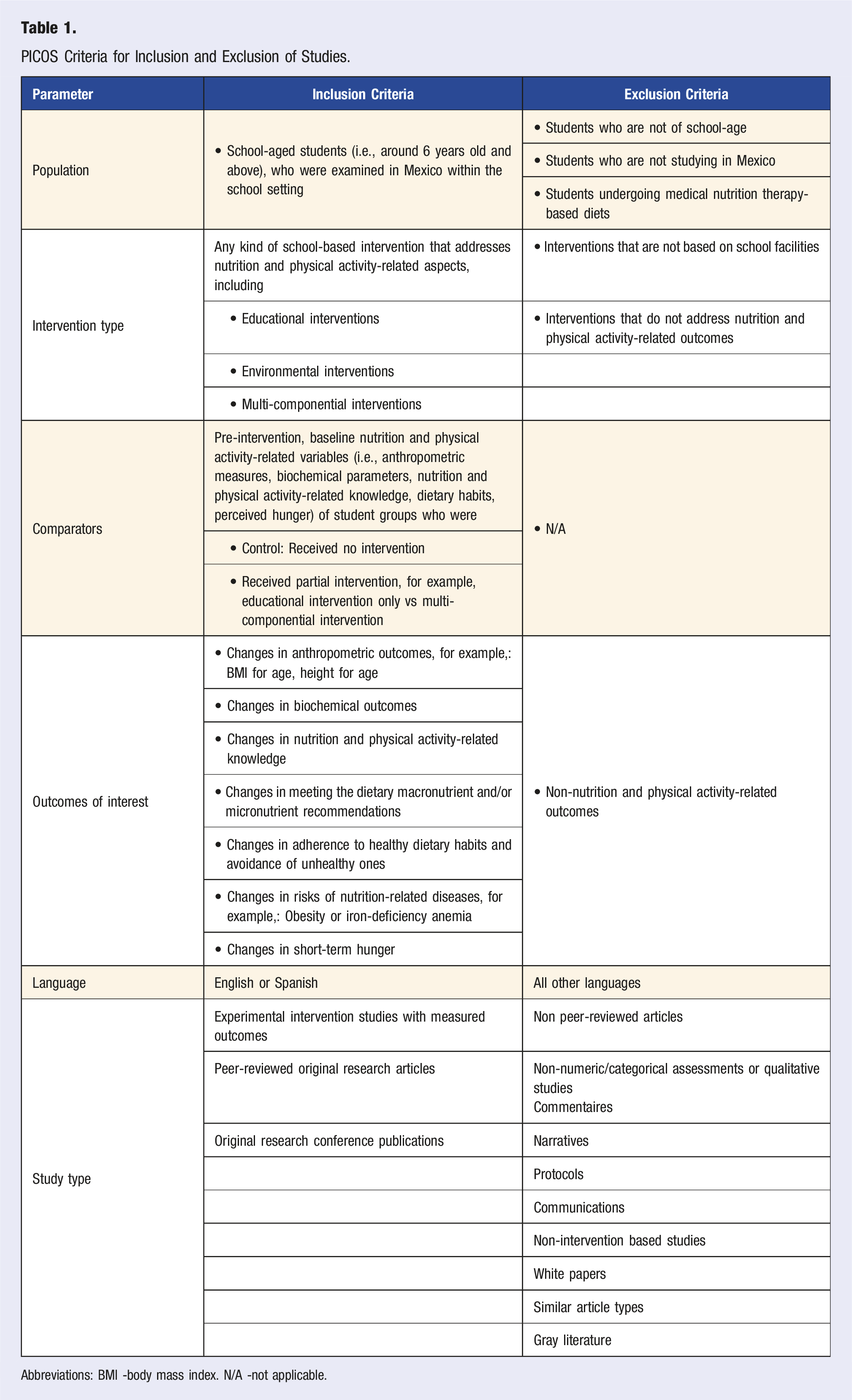
Abbreviations: BMI -body mass index. N/A -not applicable.
Search Procedure
For this scoping review, we followed the PRISMA Extension for Scoping Reviews 28 and began a comprehensive search within biomedical bibliographic databases using a combination strategy of medical subject heading keywords, terms, phrases, and Boolean operators (see Supplemental Material). The following 14 databases were searched: EBSCOHost; BIOSIS; CINAHL; ScienceDirect; ArticleFirst; Biomed Central; BioOne; ProQuest; SAGE Reference Online; Scopus; SpringerLink; PubMed; Taylor & Francis; and Wiley Online. The search strategies were adapted according to the indexing systems of each respective database.
Study Selection and Data Extraction
Two of the authors [BAE and ED] conducted the searches for relevant articles and one author utilized Rayyan QCRI software
29
to assist in the screening process. All retrieved articles were screened for relevance to the topic (see Figure 1). In addition, reference lists from retrieved articles were also hand reviewed to identify any additional relevant publications. Titles and abstracts were screened for relevancy, and potentially relevant journal abstracts were reviewed by four of the authors [SB, ED, TK and NR]. Potential articles for inclusion in this review were evaluated independently for relevance, merit, and inclusion/exclusion criteria (see Table 1). Articles accepted for inclusion were individually reviewed by each author. Additionally, each study was assessed by an independent reviewer and the reference list of each included article was screened for potentially eligible articles. Once the list of selected studies was finalized, SB and BAE extracted and cross-checked each study. NR updated the search, reviewed the articles, and wrote first draft of the results and discussion sections of the review. Differences in opinion in data extracted were discussed to reach consensus and tabulated (Tables 2 and 3). A total of 17 articles were included in this review. Given that methodological quality assessment is not a prerequisite for scoping reviews, we did not appraise the included studies.
30
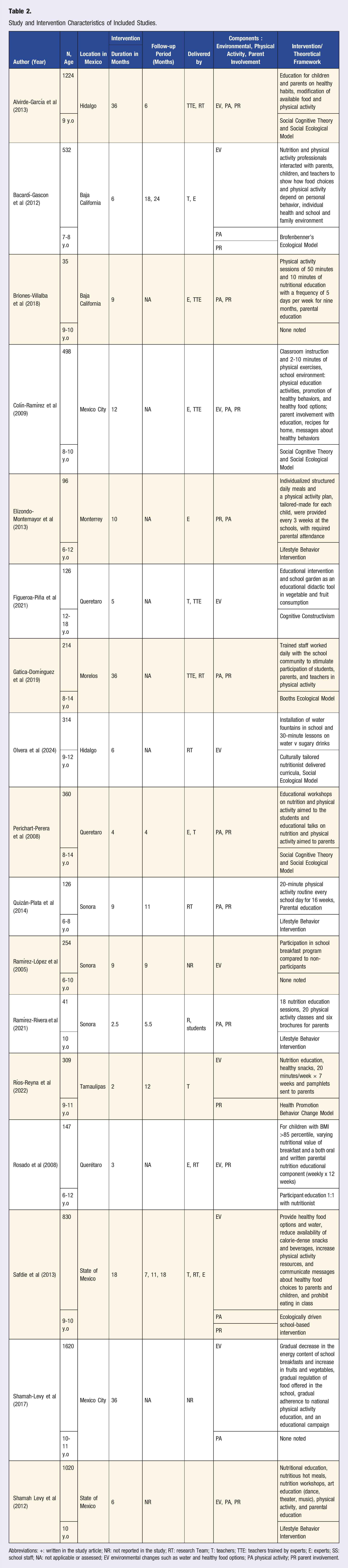
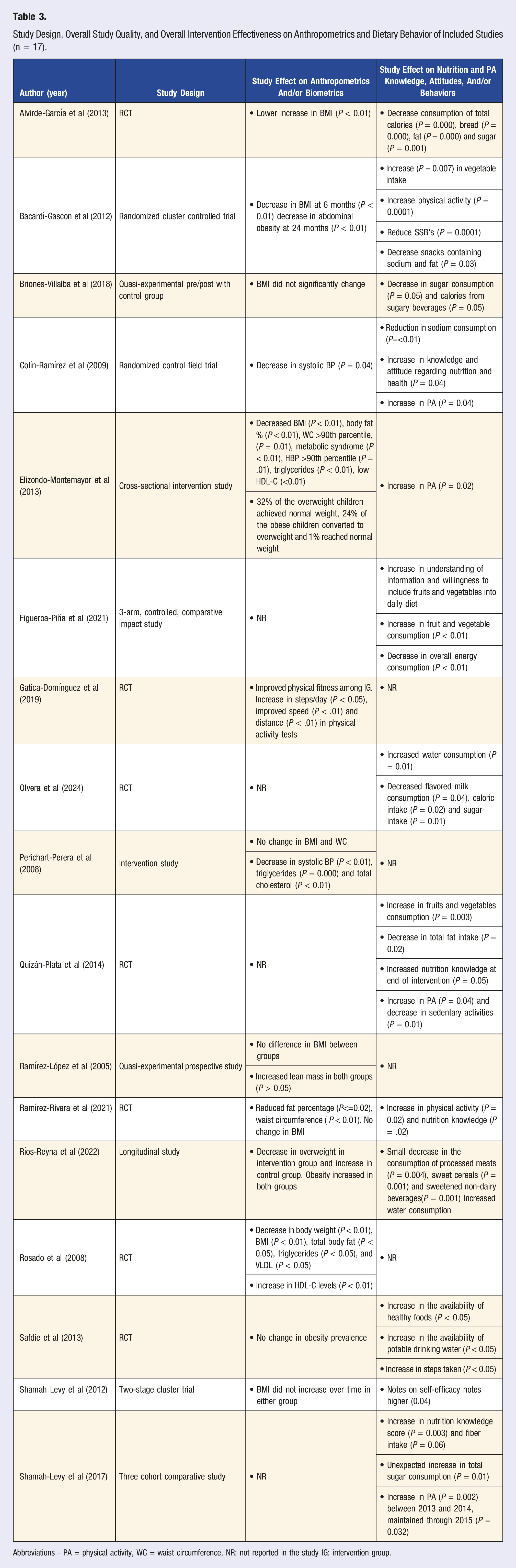
Search flow diagram following PRISMA 2020 guidelines. Study and Intervention Characteristics of Included Studies. Abbreviations: +: written in the study article; NR: not reported in the study; RT: research Team; T: teachers; TTE: teachers trained by experts; E: experts; SS: school staff; NA: not applicable or assessed; EV environmental changes such as water and healthy food options; PA physical activity; PR parent involvement. Study Design, Overall Study Quality, and Overall Intervention Effectiveness on Anthropometrics and Dietary Behavior of Included Studies (n = 17). Abbreviations - PA = physical activity, WC = waist circumference, NR: not reported in the study IG: intervention group.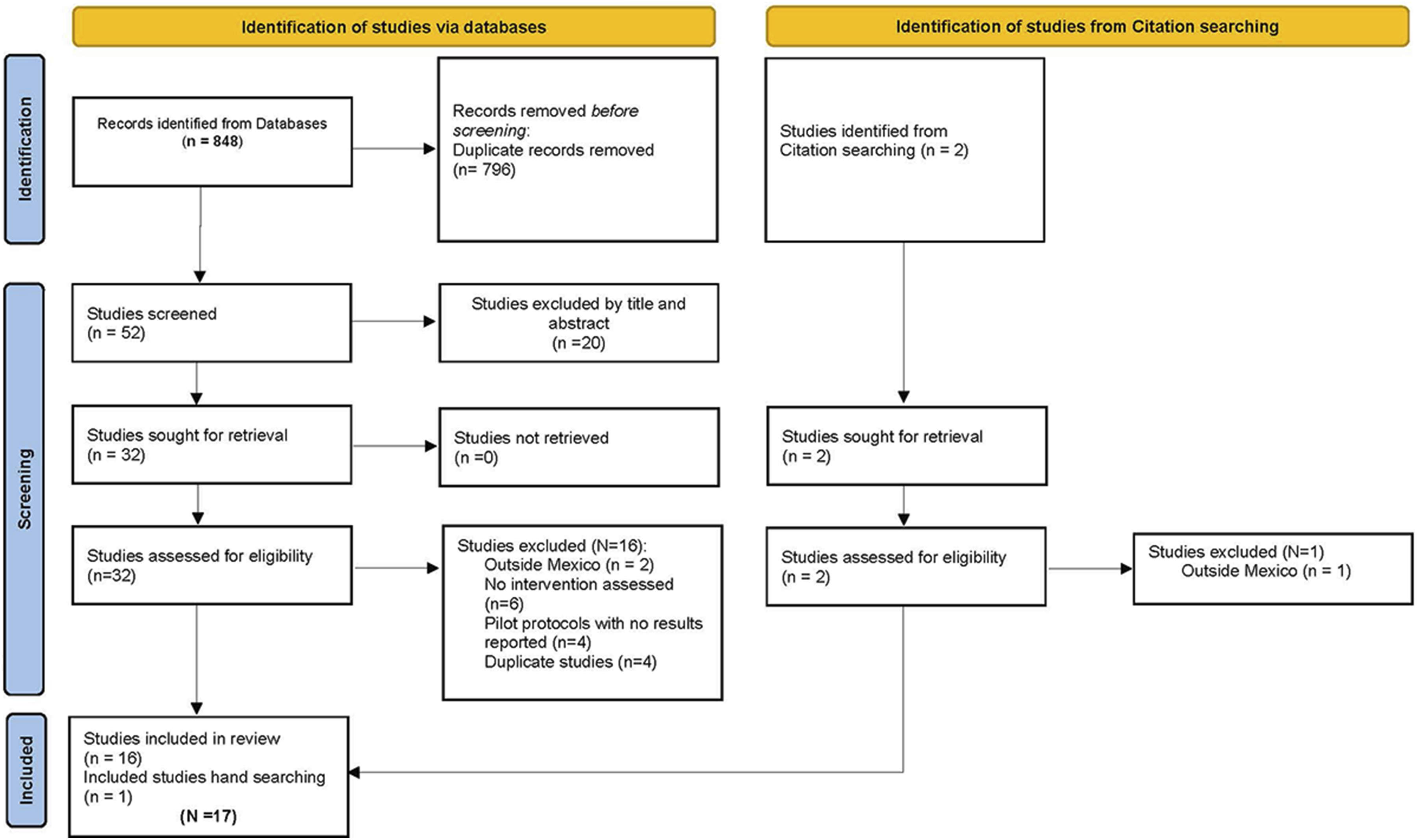
Results
Target Ages, Locations, and Duration of Interventions
The interventions targeted 6–18-year-olds. The majority (14/17, 82%) included 10-year-olds. Only three (18%) addressed adolescents. Studies examined interventions in nine different states of Mexico. The majority of studies (13/17) reported interventions of six months or more. Slightly more than a third (6 out of 17) of the interventions were a year in duration or longer.
Intervention Components
The studies incorporated components for school nutrition programs recommended by WHO 16 (Table 2). All had an educational component. All but four31-34 of the 17 incorporated parents into the program. Nine of the interventions included physical activity incorporated into the school routines. Twelve included environmental changes.
Intensity of the interventions varied. Physical activities (PA) ranged from 50 minutes a day five days a week for nine months 35 to individualized food and exercise plans and support every three weeks. 36 Colín-Ramírez, Castillo-Martínez, Orea-Tejeda, Vergara and Villa 37 reported on an intervention that included 10 weeks of weekly classroom education on nutrition and PA, including 20-30 minutes of activity, as well as daily classroom breaks of 2-10 minutes of physical activity, and a school wide requirement for 2 times a week PE classes of 30 minutes/session for a year. One study 38 looked at nutrition education 20 minutes per week for seven weeks.
Environmental interventions included increasing the availability of healthier food options, limiting unhealthy options, increasing water consumption, and creating a school culture of physical activity and healthy eating. One study 39 modified available food options. One study 31 implemented a school garden to teach students 12-18 years old and provide nutritious options. One study 33 examined the impact of school breakfasts. Four studies34,40-42 provided healthier food options and water while reducing availability of calorie-dense snacks and beverages. Four studies reduced the availability and/or intake of sweetened beverages.32,35,38,41
Theoretical Frameworks and Behavior Change Models
Fourteen of the 17 (82%) included articles utilized a theoretical framework or behavior change model to inform the education component of their interventions, while the remaining 3 did not note the use of a theoretical framework.33-35 The majority of the articles utilizing a theoretical framework or educational or behavioral change model noted that the intervention was designed based on a variety of social-ecological models (n = 7),32,37,39,41,43-45 including three that use a combination of Social Cognitive Theory and Social Ecological Model,37,39,45 one based on Brofenbenner’s Ecological Model, 43 one on Booth’s Ecological Model, 44 one that is culturally tailored and based on the Social Ecological Model, 32 and one described as an Ecologically driven school-based intervention. 41 Another article noted the use of Cognitive Constructivism as the basis for the intervention. 31 Four more interventions relied on Lifestyle Behavior Interventions,36,42,46,47 while one study 38 based their intervention on the Health Promotion and Behavior Change Model. Finally, one intervention noted one on one education sessions with a nutritionist.
Outcomes
All of the reported school-based nutrition programs had positive effects in knowledge, attitudes and/or behaviors, or had improved anthropometric or biometric results (Table 3). Decreases in sugars occurred in four programs.32,35,38,39 However, one study 34 found an unexpected increase in total sugar consumption, although fiber intake and nutritional knowledge scores increased. Salt intake was reduced in two studies.37,43 Fruit and vegetable consumption increased in three initiatives.31,43,46 Physical activity, integrated into nine of the studies, increased in eight studies.34,36,37,41,43,44,46,47 Interventions were associated with a lower increase in BMI or a decrease in BMI or weight in five studies. Other findings from the interventions include increased physical fitness, decreased systolic blood pressure, decreased waist circumference. Only two of the interventions studied measured outcomes longer than a year after the intervention. One study 43 found vegetable intake and physical activity had increased at 24 months. One study 41 found a sustained increase in physical activity (steps taken) and in the availability of drinking water and healthy snacks.
Discussion
Each of the programs cited in the literature occurred with the backdrop of the Mexican government’s emphasis on the problem of childhood overweight and obesity, as well as national guidelines for school nutrition efforts and policies. The diversity of strategies to address the need for healthy nutrition and physical activity and the potential impact are evident in this scoping review. While many of the studies impacted knowledge, attitudes, and behaviors, only five yielded a decrease in BMI or a decrease in the rate of increase in BMI. The process of changing behaviors sufficiently to change biometric indicators occurs over time. These studies show that interventions can change nutrition intake and physical activity, the precursors to reducing overweight and obesity over time.
Program duration may also impact the extent to which a certain behavior is changed. The shortest intervention ran only 2 months, with a 12-month follow-up and found that an education intervention based on the Health Promotion and Behavior Change model resulted in significant decreases in the consumption of processed meats, sweetened cereals, and sugar sweetened beverages (SSB’s). However, while overweight decreased in the intervention group, obesity increased in both groups. 38 In contrast, the longest studies (n = 3)34,39,44 ran for 36 months and found significant increases in nutrition knowledge, 34 improved physical fitness, 44 and a significant decrease in total kcal, bread, fat and sugar consumption. 39 Interestingly, one study 34 also found an unexpected and significant increase in total sugar consumption in the intervention group. The majority of studies (13/17) reported interventions of six months or more, and for nutrition and health related outcomes those interventions that were offered over 6 months or more found significant reductions in processed foods and SSB’s, as well as fat, sugar, sodium,32,35,37-39,43,46 increased vegetable, fruit, and/or water intake.32,34,43,46 It is important to note that while conducted over 5 months, one study 31 also found an increase in fruit and vegetable consumption and a decrease in overall kcal consumption.
For those interventions that were 6 months or more and included intervention components on physical activity and assessed physical activity participation and/or anthropometric outcomes, three demonstrated a reduction in weight and/or BMI,36,39,43 and 7 studies found an increase or improvement in PA.34,36,37,41,43,44,46 One additional study also found a significant (P = 0.02) increase in physical activity, but was offered over a shorter duration of 2.5 months with a 5.5 month follow-up. 47 It is interesting to note that of the interventions without a stated theoretical framework, the findings related to BMI were non-significant.33,35
Only one study specifically noted cultural tailoring of the intervention. 32 This study found a significant increases in water consumption (P = 0.01) in the intervention schools compared to the control school, as well decreased flavored milk consumption (P = 0.04), caloric intake (P = 0.02) and sugar intake (P = 0.01). As cultural tailoring can increase the success of nutrition education interventions,48-50 future research could investigate whether including cultural tailoring of the intervention can further impact intervention efficacy.
It is noteworthy that the majority of programs, 12, addressed environmental issues, such as increasing the availability of healthy foods, limiting access to unhealthy foods and drinks, and incorporating physical activity into daily school activities. Each of these initiatives with environmental components impacted behaviors. It is worth noting, however, that the reporting of successful outcomes may be a result of publication bias; unsuccessful interventions are less likely to be published. 51
Limitations and Opportunities for Further Research
This review identified several limitations in the existing literature on school-based nutrition interventions in Mexico. Heterogeneity across studies limits the ability for direct comparisons and generalizability about intervention effectiveness. Because the majority of interventions included a variety of different approaches to effecting change in nutrition and physical activity behaviors, it is difficult to determine the impact of individual intervention components. Finally, potential selection bias due to study locations and potential publication bias due to studies with neutral or negative findings not being published may skew the available data.
Future research would benefit from standardized intervention protocols and outcome measures, based on clearly defined theoretical frameworks and measures associated with the relevant constructs. Further, developing interventions that have similar intensity levels and durations would facilitate comparison and produce data that can assess individual component effectiveness. Longitudinal studies are needed to assess the long-term impact of such interventions on dietary and physical activity behaviors and related health outcomes. Additionally, we found a paucity of investigations targeting adolescents in the school-setting, and recommend further studies on cost-effectiveness analyses, and implementation strategies to strengthen the evidence base regarding school-based nutrition interventions in Mexico.
Conclusion
The evidence reviewed to date shows positive trends for school-based nutrition and physical activity interventions in Mexico and the ability to impact health and physical activity outcomes can improve knowledge, attitudes, and behaviors. The national policy focus on these issues most likely added additional support to the initiatives and their impacts. With economic advances and transnational trade of processed foods, school-based programs are an important service to promote long-term health of the population.
Supplemental Material
Supplemental Material - A Scoping Review of School-Based Nutrition and Physical Activity Interventions Conducted in Mexico
Supplemental Material for A Scoping Review of School-Based Nutrition and Physical Activity Interventions Conducted in Mexico by Nancy Rudner, Basil H. Aboul-Enein, Silvana Blanco, Teresa Keller, and Elizabeth Dodge in American Journal of Lifestyle Medicine.
Footnotes
Author Contributions
Nancy Rudner: Data curation; Formal analysis; Investigation; Methodology; Project administration; Supervision; Writing—original draft. Basil H. Aboul-Enein: Conceptualization; Data curation; Formal analysis; Investigation; Methodology; Project administration; Supervision; Writing—original draft. Silvana Blanco: Writing—original draft. Teresa Keller: Writing—original draft. Elizabeth Dodge: Formal analysis; Investigation; Methodology; Writing—original draft.
Declaration of Conflicting Interests
The author(s) declared no potential conflicts of interest with respect to the research, authorship, and/or publication of this article.
Funding
The author(s) received no financial support for the research, authorship, and/or publication of this article.
Ethical Statement

Supplemental Material
Supplemental material for this article is available online.
References
Supplementary Material
Please find the following supplemental material available below.
For Open Access articles published under a Creative Commons License, all supplemental material carries the same license as the article it is associated with.
For non-Open Access articles published, all supplemental material carries a non-exclusive license, and permission requests for re-use of supplemental material or any part of supplemental material shall be sent directly to the copyright owner as specified in the copyright notice associated with the article.
