



Abstract
The Need of the LM content in Medical undergraduate curriculum was imperative based on the mortality and morbidity statistics in Pakistan along with lack of LM training and unhealthy lifestyle of physicians themselves. Aims and Objectives for integrating LM content were designed including cognitive, affective and psychomotor domains of learning. while embedding LM content in an integrated modular system, every step was technically monitored and matched with the academic year, teaching methodology and importance of the topic. LM content was integrated in every educational activity from first to final year by adding or modifying LM learning objectives. The alignment of learning domains was in accordance with the teaching and assessment strategies. Teaching methods chosen were according to the designed learning objectives and phase of curriculum. LM content was assessed in formative and summative assessment through, single best and case cluster MCQs, reflections, OSPE. LM curriculum was communicated to teaching faculty and medical students through academic calendar, module guides and timetables. It was shared on Moodle and Teams. Educational environment incorporated both physical and virtual learning and has been supportive of lifestyle practices among medical students. The entire process of embedding LM content in medical education has been multifaceted. Different committees were formed including Steering, Core, implementation, and Evaluation Committees. Students were part of each committee. This write-up describes the evidence-based approach used to embed LM content in Undergraduate Medical Education and offers guidance to other undergraduate medical colleges that may wish to implement lifestyle medicine content.
Keywords
Worldwide scientific evidence associates unhealthy lifestyle practices with morbidity and mortality related to non-communicable chronic diseases. Globally, there is insufficient lifestyle medicine training of physicians at undergraduate and postgraduate level. Chancellor Riphah International University Mr Hassan Muhammad Khan took the lead in Pakistan by establishing Riphah Institute of Lifestyle Medicine (RILM) in 2019 under the directorship of Dr Shagufta Feroz. Along with the other goals, integration of lifestyle medicine content in undergraduate medical curriculum was one of the prime objectives of RILM. The first step was to train the medical teaching faculty by offering them a 6 month certificate course named “lifestyle medicine postgraduate course.” This motivated them to appear for the International Board of Lifestyle Medicine (IBLM) and obtain certification.
A team of medical doctors who were certified in IBLM and holding master’s Degree in medical education designed, developed, and implemented lifestyle medicine curriculum in undergraduate teachings. At the medical college, based on World Federation of medical education standards, an internationally accredited system based spiral integrated modular curriculum has been utilized. Harden’s 10 rules of curriculum design were used as a theoretical framework for integrating LM content in undergraduate medical education in the following manner. 1. What are the 2. What are the 3. What 4. How should the 5. What 6. What 7. How should 8. How should details of the 9. What 10. How should the
1. LM content covering knowledge part of curriculum was addressed by emphasizing the primary role of lifestyle medicine in chronic disease. 2. LM content covering change in attitude part of curriculum was addressed by applying the principle of LM in the management of chronic disease. 3. LM content covering practical part of curriculum was addressed by implementing lifestyle medicine practices for self-care.
Curriculum Objectives were further translated into modular objectives and followed by learning objectives at the mode of lesson plan.
The 1. Improving health through exercise 2. The nutrition health connection 3. Sleep matters 4. Stress and resilience 5. Substance abuse 6. The power of connection
Along with this content, Behavior change, Positive Psychology, and Empowering self and others, was added in behavioral science module which is vertically integrated from first to third year.
For
One of the most important steps was to align the content with
Holistic model of LM integration along with the teaching and assessment strategies is shown in Diagram 1. LM Integration model along with teaching and assessment strategies.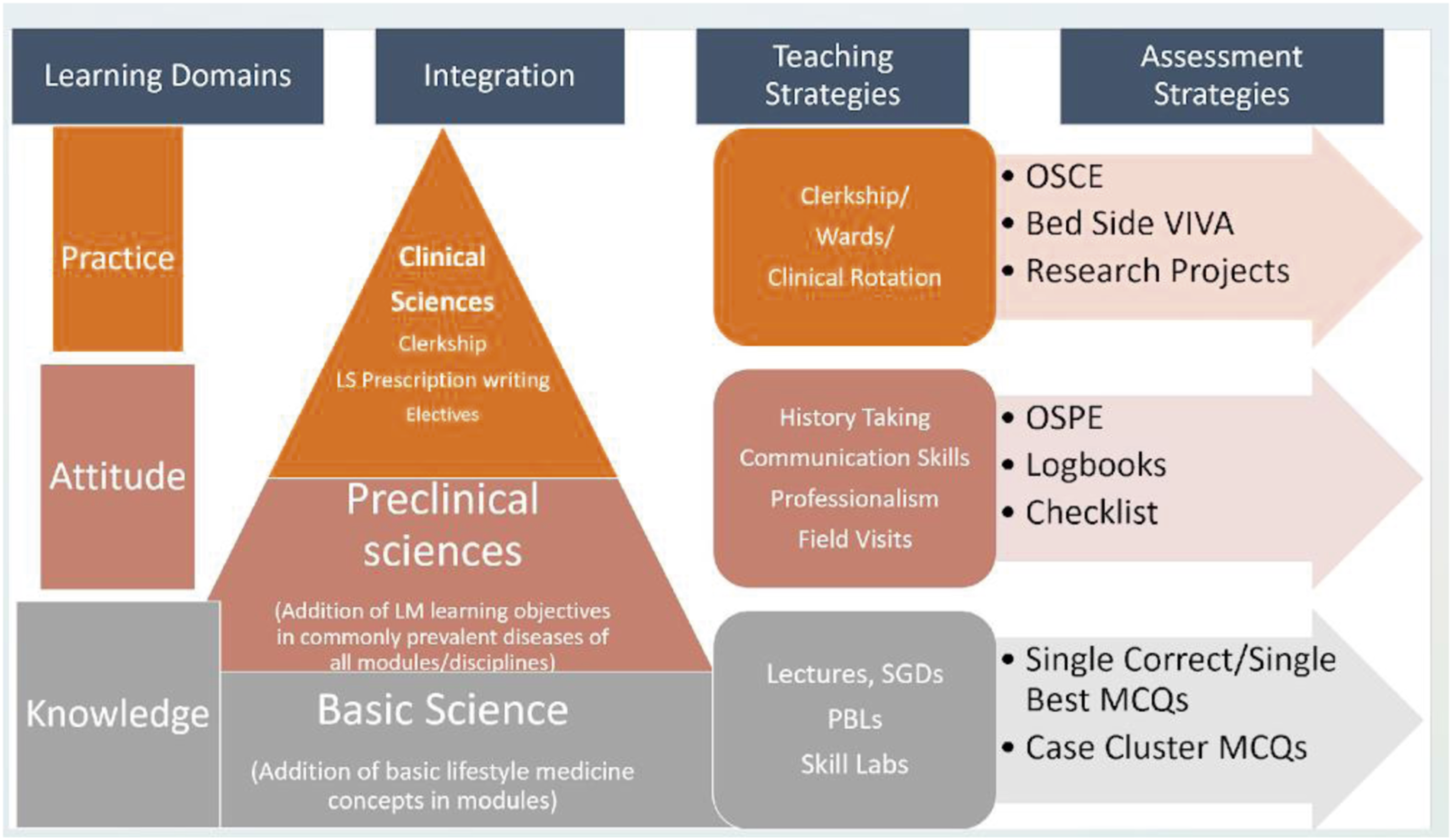
Operational layout of the complete process is shown in Diagram 2. Operational layout of embedding LM content in Medical Education.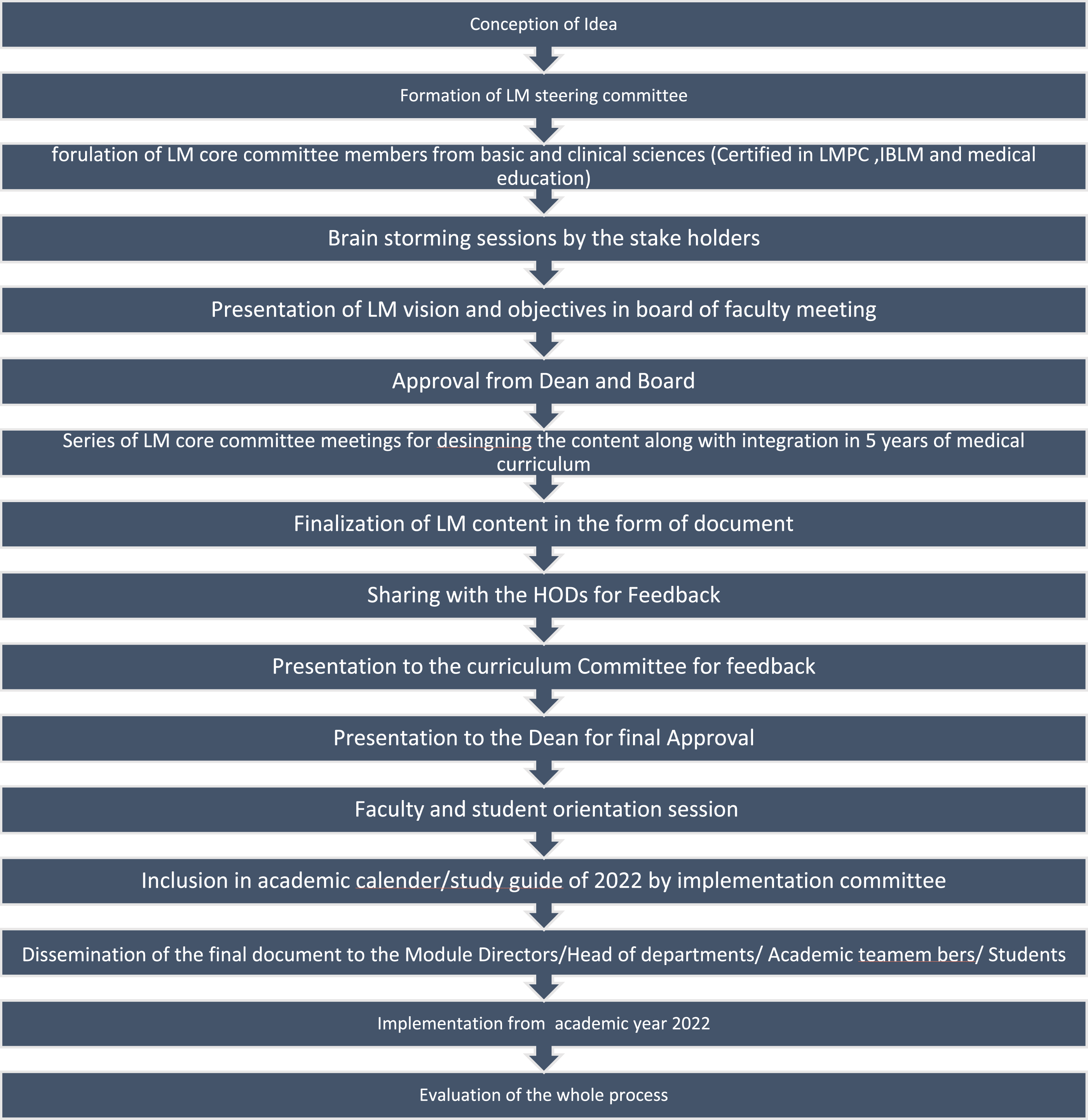
At this moment, we are in the phase of assessing the LM content at end of year exams. We are planning to hold a 360-degree evaluation involving internal and external evaluators to refine the process and improve the outcome. This write-up describes the evidence-based approach used to embed LM content in Undergraduate Medical Education and offers guidance to other undergraduate medical colleges that may wish to implement lifestyle medicine content to improve LM knowledge and practices of future doctors to not only reduce disease burden but also optimize health.
Footnotes
Declaration of Conflicting Interests
The author(s) declared no potential conflicts of interest with respect to the research, authorship, and/or publication of this article.
Funding
The author(s) received no financial support for the research, authorship, and/or publication of this article.