



Abstract
Given the ongoing COVID-19 pandemic, it is important to identify lifestyle factors associated with infection outcomes. Physical activity is a lifestyle factor which measurably decreased during the pandemic. Purpose: To examine the relationship between physical activity and COVID-19 infection outcomes. Method: College students owning an iPhone with the Health app calculated their average daily steps for the 6-month period immediately before the pandemic and 2 years later. At the second time point, students provided levels of mild, moderate, and vigorous physical activity, hours/week of weightlifting, whether they had ever tested positive for COVID-19, and if so, the infection outcome. Results: Objectively measured pre-pandemic steps were significantly and positively correlated with steps 2 years later (P ≤ .001) as well as weightlifting, and mild and vigorous physical activity (P ≤ .033) suggesting that present physical activity participation may be returning to pre-pandemic levels. There were no differences between those who tested positive for COVID-19 and those who did not for any physical activity variable (P ≥ .275). However, among those infected, outcomes were negatively associated with weightlifting (P = .026) and vigorous physical activity (P = .055) suggesting that greater participation in these activities was associated with less severe outcomes.
“Because COVID-19 is still a public health emergency, it is important to examine lifestyle variables which might be associated with the infection.”
Introduction
More than 3 years after its emergence, COVID-19 is still a global pandemic with over 200,000 new cases per week worldwide. COVID-19 infection outcomes vary widely from no symptoms at all to severe respiratory illness and even death. To date, over 6.8 million people have died from COVID-19 infection.1,2 Because COVID-19 is still a public health emergency, it is important to examine lifestyle variables which might be associated with the infection. Of particular interest is research suggesting that moderate to vigorous physical activity is associated with reduced risk of acquiring community spread infections and heightened immune system responses. 3 Because of the public’s familiarity and comfort with many forms of widely available physical activity, it may prove important for community-wide interventions aimed at mitigating the impacts of the COVID-19 pandemic. Thus, the purpose of the research presented here was to examine the relationship between physical activity intensity, COVID-19 infection, and COVID-19 infection outcomes.
Immediately after COVID-19 was declared a global pandemic in 2020, shutdowns of public spaces including gymnasiums, health and fitness clubs, and even outdoor parks became common. While this was done to curtail the spread of the virus, it also limited opportunities for physical activity. Indeed, research suggests that people became more sedentary and less physically active immediately after the shutdowns were imposed.4,5 In hindsight, efforts to maintain pre-pandemic levels of physical activity might have been helpful. A recent, albeit pre-COVID-19, meta-analysis of 55 studies concluded that moderate to vigorous physical activity is associated with a reduced risk of acquiring community spread infections, reduced risk of infectious disease mortality, and heightened immune system responses. 3 Furthermore, a review of 38 studies found that regular vigorous physical activity was associated with increased influenza antibodies after vaccination compared to vaccinated individuals with moderate, low, or no physical activity. 6 More generally, multi-year cohort studies have found that individuals who meet moderate to vigorous physical activity guidelines significantly reduce their risk for all-cause mortality compared to those who are physically inactive.7,8 Reflecting on such studies has led some public health experts to advocate for regular moderate and vigorous physical activity as an affordable and accessible protective measure against severe respiratory infections such as the common cold, influenza, and even COVID-19. 9
Research is now emerging from the pandemic suggesting that regular physical activity may offer some protection against COVID-19 infection and mitigate infection outcomes. For example, a large Brazilian cohort study utilizing self-reported data found that among individuals who consistently practiced handwashing and mask wearing, maintaining regular physical activity throughout the pandemic reduced the risk of becoming infected by COVID-19 compared to individuals who were never physically active or who stopped physical activity with the onset of the pandemic. 10 Beyond this, most of the emerging research focuses on the relationship between physical activity and the severity of COVID-19 infections. Many of these first studies utilized a large United Kingdom Biobank cohort (n ≤ 500,000) and are summarized in a recent review. 11 The Biobank studies demonstrate an increased risk for severe COVID-19 symptoms, hospitalization, and mortality among physically inactive individuals. These risks were significantly reduced among individuals who met activity guidelines for moderate and vigorous exercise. Similarly, a study based upon a large national database in Sweden found a significant inverse relationship between severe COVID-19 outcomes and cardiorespiratory fitness. 12 Published studies from a large Kaiser Permanente database of Californians found that, after controlling for demographics and comorbidities, physically inactive individuals were at greatest risk for severe COVID-19 outcomes (e.g., hospitalization, death) while highly active individuals (i.e., regular moderate and vigorous exercise) were less likely to experience those same severe outcomes.13,14 To further summarize this emerging work, a review of ten additional studies by Castoldi and colleagues (2023) again found evidence that regular moderate to vigorous physical activity protects against the most severe effects of COVID-19. 15
As our contribution to this emerging line of research, we offer a study utilizing objectively measured physical activity data recorded before and after the onset of the pandemic in combination with self-reported physical activity data in order to explore the relationship between physical activity and COVID-19. Because physical activity behavior is inversely related to age, 16 and the severity of COVID-19 infection outcomes are positively related to age, 17 we controlled for this variable by using a sample of young adults aged 18-28 years. As such, we investigated 3 timely research questions: First, is there a relationship between physical activity immediately preceding the pandemic and current levels of physical activity? This is important as research indicated a decrease in physical activity with the onset of the pandemic.4,5 Second, is there a relationship between physical activity and COVID-19 infection? And third, is there a relationship between physical activity and the outcome of a COVID-19 infection?
Methods
Data Collection
A random sample of college students (N = 150, n = 81 female, 69 male; mean age = 20.91 ± 1.62 years, age range 18-28 years) owning an iPhone with Apple’s Health app (i.e., www.apple.com/ios/health/) were surveyed during the month of March, 2022. Apple’s Health app provides valid estimates of physical activity data in the form of steps. 18 The survey instructed students to use the Health app to obtain their average daily steps for the 6-month period immediately preceding pandemic restrictions in the US (March 11, 2020). Students then used the app to calculate their average daily steps for the 6-month period immediately preceding the survey. In this way, the survey recorded objective physical activity data from 2 time periods roughly 2 years apart. Students then provided current levels of mild, moderate, and vigorous physical activity using the valid and reliable Godin Leisure Time Physical Activity Questionnaire.19,20 Additionally, the survey assessed hours per week of weightlifting. Next, the survey assessed whether they had ever tested positive for COVID-19 (Yes/No); and if so, the outcome of the infection using a five-point scale (1 = no symptoms, 2 = symptoms lasted 1-6 days, 3 = symptoms lasted 7-14 days, 4 = symptoms lasted 15-28 days, 5 = symptoms lasted 29 or more days). Finally, participants self-reported their age and sex.
Data Analysis
To address research question number 1, a Pearson’s correlation (r) was used to examine the relationship between pre-pandemic average daily steps and all other physical activity variables. To address research question number 2, independent samples t-tests compared all physical activity variables between students who tested positive (n = 89) for COVID-19 with those who did not (n = 61). To address research question number 3, only those who tested positive for COVID-19 were included in the analysis to determine if any physical activity variables were associated with infection outcomes. Because our assessment of infection outcomes was an ordinal variable, Spearman’s correlation (ρ) was used rather than Pearson’s.
Results
In examining question number 1, pre-pandemic average daily steps as assessed by the iPhone Health app were significantly and positively correlated with current average daily steps as assessed by the iPhone Health app (r = .587, P ≤ .001) as well as current levels of self-reported mild (r = .176, P = .032) and vigorous physical activity (r = .246, P = .003) and weightlifting hours per week (r = .175, P = .033). There was no relationship with moderate physical activity (r = .112, P = .174). These results suggest that physical activity behavior at the time of the survey was similar to that of pre-pandemic activity (i.e., 2 years prior).
Description of Exercise Variables.
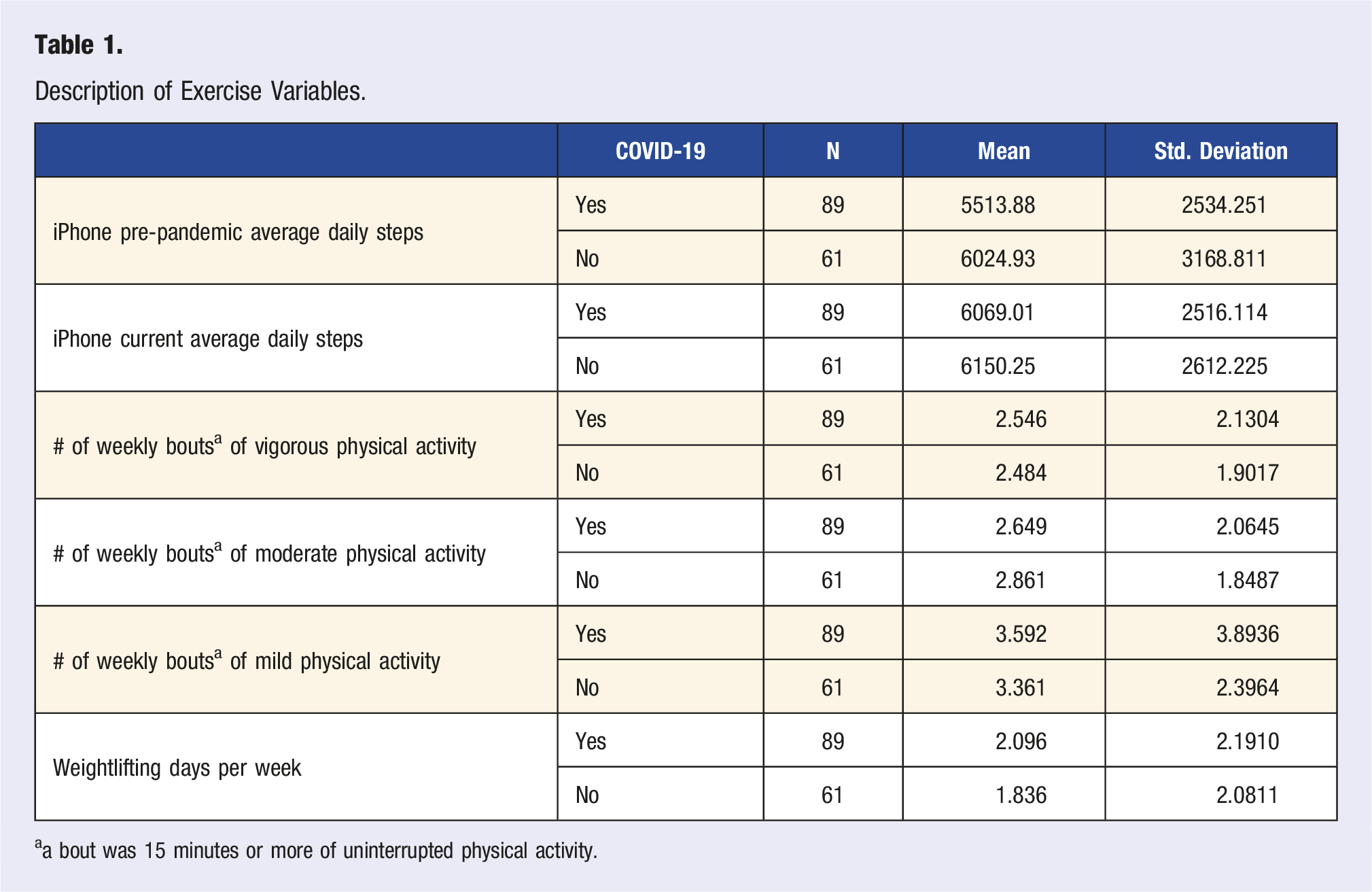
aa bout was 15 minutes or more of uninterrupted physical activity.
In examining question number 3, only data from those who tested positive for COVID-19 were analyzed. Of those, 10 experienced no symptoms, 27 experienced symptoms for 1-6 days, 30 experienced symptoms for 7-14 days, 11 experienced symptoms for 15-28 days, and 11 experienced symptoms for 29 or more days. Because of the significant relationship between pre-pandemic physical activity and physical activity at the time of the survey, all exercise variables were examined in relation to infection outcome. Infection outcome was significantly and negatively associated with weightlifting (ρ = −.235, P = .026) and trending towards a negative association with vigorous physical activity (ρ = −.206, P = .055). No other correlations were significant (ρ ≤ .166, P ≥ .124).
Discussion
Prior to the global COVID-19 pandemic, physical activity was in decline across the United States. Like other industrial nations, the US was becoming increasingly sedentary and physically inactive. 21 This trend may have been accentuated by the pandemic which led to the temporary closure of health clubs, gymnasiums, and even public parks. Indeed, evidence suggests that physical activity decreased in the early stages of the pandemic.4,5 This led some health researchers to declare a twin pandemic, meaning COVID-19 and accompanying physical inactivity. 22 Considered together, it now appears that physical inactivity is associated with more severe outcomes of COVID-19 infection.11-14 Furthermore, this twin pandemic interacted with age, as declines in physical activity increased with age, as did the likelihood of a severe COVID-19 infection.16,17 Within this context, we examined a sample of college students (mean age = 20.91 ± 1.62 years) which controlled for the impact of age. The results of our study should be seen as encouraging. First, we identified a strong positive relationship between objectively measured physical activity immediately preceding the pandemic and objectively measured physical activity 2 years after the start of the pandemic. This suggests that the pandemic induced decline in physical activity may be coming to an end. This is encouraging as regular physical activity, particularly of moderate and vigorous intensity, enhances the body’s ability to identify and respond to pathogens while quickening recovery time from infection and limiting the most severe infection outcomes.3,9 While we did not see any differences in physical activity in participants that indicated they had been infected with COVID-19 vs those that were not, our results suggest that regular physical activity may attenuate the more severe outcomes of a COVID-19 infection. Specifically, we examined mild, moderate, and vigorous intensity physical activity and weightlifting in relation to the outcome of a COVID-19 infection. We found a significant negative relationship between weightlifting and infection outcome, as well as a notable trend towards a negative relationship between vigorous physical activity and infection outcome. In other words, individuals in our sample who reported greater participation in vigorous exercise and weightlifting reported a shorter duration of symptoms after COVID-19 infection. These findings support emerging epidemiological research which also suggests that moderate to vigorous physical activity is associated with less severe COVID-19 infection outcomes.11-14 Physical activity may even prove beneficial in the fight against “long COVID.” 23
Taken together this highlights the importance of regular physical activity as a type of lifestyle medicine. To this end, the World Health Organization recommends “150 minutes of moderate-intensity or 75 minutes of vigorous-intensity physical activity per week, or an equivalent combination of both.” 24 When calculating an equivalent combination of both, it is important to understand that moderate-intensity activities utilize 3 to 6 times as much energy as sitting still, while vigorous-intensity activities utilize more than 6 times the energy as sitting still. Thus, vigorous activities are roughly double the intensity of moderate. Examples of moderate-intensity activity include brisk walking, riding a bike with light effort, dancing, and yard work; examples of vigorous-intensity activity include jogging, hiking, swimming, and sports like basketball. In the face of pandemic related constraints to physical activity such as quarantines and lockdowns, it is important to recognize that moderate and vigorous physical activity can be achieved at home and experts have provided simple guidance for doing so. 25 Thus, community-wide interventions aimed at increasing physical activity across populations can be achieved with familiar activities, accomplished from home and neighborhood parks, and mounting evidence suggests such a lifestyle change may help to lessen the burden of the current COVID-19 pandemic while preparing us all to better resist the next. 26
Footnotes
Declaration of Conflicting Interests
The author(s) declared no potential conflicts of interest with respect to the research, authorship, and/or publication of this article.
Funding
The author(s) received no financial support for the research, authorship, and/or publication of this article.
Ethical Approval
All procedures were approved by the university institutional review board.
