



Abstract

“The students who are part of ACLM’s LMIGs represent the bright future of health care, dedicated to treating root causes of disease.”
In 2008, the American College of Lifestyle Medicine (ACLM) had been in existence for 4 years. I had learned about the field of lifestyle medicine in 2006, after co-authoring a book on preventing a second stroke titled, “Life After Stroke: The Guide to Recovering Your Health and Preventing Another Stroke.” 1 For this book, I researched the power of exercise, nutrition, and stress to help prevent cardiovascular disease. Shortly after the publication of the book, I learned about lifestyle medicine and then devoted the rest of my career to advancing education, research, and clinical practice in this field.
While serving as a tutorial facilitator teaching in the medical school core curriculum courses in the 2000s including in courses such as Human Central Nervous System and Behavior, Nutrition, and Rheumatology, I was able to connect with bright, curious students, like Dr Michelle Hauser who now practices lifestyle medicine at Stanford. It was clear to me that these students were interested in how to use the 6 pillars of lifestyle medicine including routine physical activity, a whole food plant predominant eating pattern, stress resilience, restorative sleep, positive social connections and avoidance of risky substances to help patients prevent, treat and in some cases reverse chronic conditions. They asked me questions about this when covering their core material. Since the core curriculum was full, the chances of getting a course approved were slim.
When there are obstacles, we find ways around them. Holding lectures at lunch time and offering healthy meals was a way to teach about the 6 pillars of lifestyle medicine, connect with the students and bring lifestyle medicine into the medical school in an informal way. So, in fall 2008, we started the first Lifestyle Medicine Interest Group (LMIG). Students were excited and engaged with the pillars of lifestyle medicine. Since that time, we have run a LMIG at Harvard Medical School with new student leaders each year.
In 2015, I connected with the ACLM Professionals-in-Training (PiT) group and met Drs Ingrid Edshteyn, Jon Bonnet, Beth Motley, Deepa Sannidhi, and Regan Steigmann. All were trainees at that time, and all have become important lifestyle medicine leaders. Back in 2015, we worked on ways to empower schools to create LMIGs. Together, we developed a Roadmap for LMIG development that was shared with the ACLM community. In addition, I shared my PowerPoints that I used during my LMIG presentations with the ACLM community to help faculty and students teach the evidence-based information on the pillars. With the help of Jon Bonnet and continuous updates from the Professionals in Training, we were able to provide these for years. Later, I shared the Lifestyle Medicine 101 Curriculum from my course work at Harvard Extension School, and in collaboration with ACLM these PowerPoint slides were made available for free through ACLM and have been used with LMIGs as well as a multitude of other teaching endeavors from bachelor level courses to medical school electives to CME courses.
The goal was to help spread these LMIGs across the country throughout medical schools and other healthcare professional schools. To make the case for this type of learning, it was important to demonstrate impact. In 2016, I conducted a research study that looked at the knowledge and confidence levels of medical students before and after one of the LMIG presentations on behavior change techniques, specifically about the Transtheoretical Model of Change. The results showed that after a one-hour lecture, students increased their knowledge and also increased their confidence in counseling patients about lifestyle related behaviors. 2 This helped to share the power of this type of teaching and to bring an academic foundation to the work of LMIGs.
In 2017, I co-authored an academic article in Clinical Teacher titled “A Parallel Curriculum in Lifestyle Medicine.” This article shared a step-by-step approach to starting a LMIG and described why it was important. 3 By publishing in the medical literature, it was possible to share this concept and strategy of teaching medical information outside the core curriculum through an LMIG. In this way, a wider audience including readers who had not yet heard of lifestyle medicine could be exposed to LMIGs and the parallel curriculum.
The creation of the Donald A Pegg Student Leadership Award in 2017 helped to highlight the importance of this work and to encourage more students to create LMIGs. The award supports students who are creating, leading, and sustaining LMIGs in medical schools and other healthcare professional schools by providing them with funds to hold events as well as funds to attend the ACLM annual conference where they can meet other students and attendings passionate about lifestyle medicine. Dr Sami Beg was the Chair of the Awards Committee when the Pegg Award was established, and, without him, the award would never have come to fruition.
ACLM has supported the creation of LMIGs for years. As ACLM’s staff has grown, its capacity to support LMIG expansion has increased. In recent years, Kaitlyn Pauly, Shannon Worthman, and Grace Gama have made significant contributions to the growth of LMIGs. The figure below reveals the incredible expansion of LMIGs. To date, there are 123 LMIGs, 81 of which are affiliated with medical schools. ACLM Director of Medical Education Shannon Worthman put a procedure in place that allows for an orientation to LMIGs and a support system for LMIGs as they grow in their own schools. This powered the LMIG engine, yielding remarkable results in establishing LMIGs and allowing them to flourish.
As is evident from Figure 1 below created by ACLM, LMIGs are in Bachelor’s programs and Masters/Doctoral programs. These have grown and developed since 2015. In 2022, health systems started creating LMIGs, as well. In 2022, two high schools created their own LMIGs for their student bodies and used the Teen Lifestyle Medicine Handbook and free downloadable Teen Curriculum available through ACLM’s Connect platform. The growth of lifestyle medicine interest groups from 2009-2023. **Graph by Shannon Worthman, ACLM Director of Medical Education.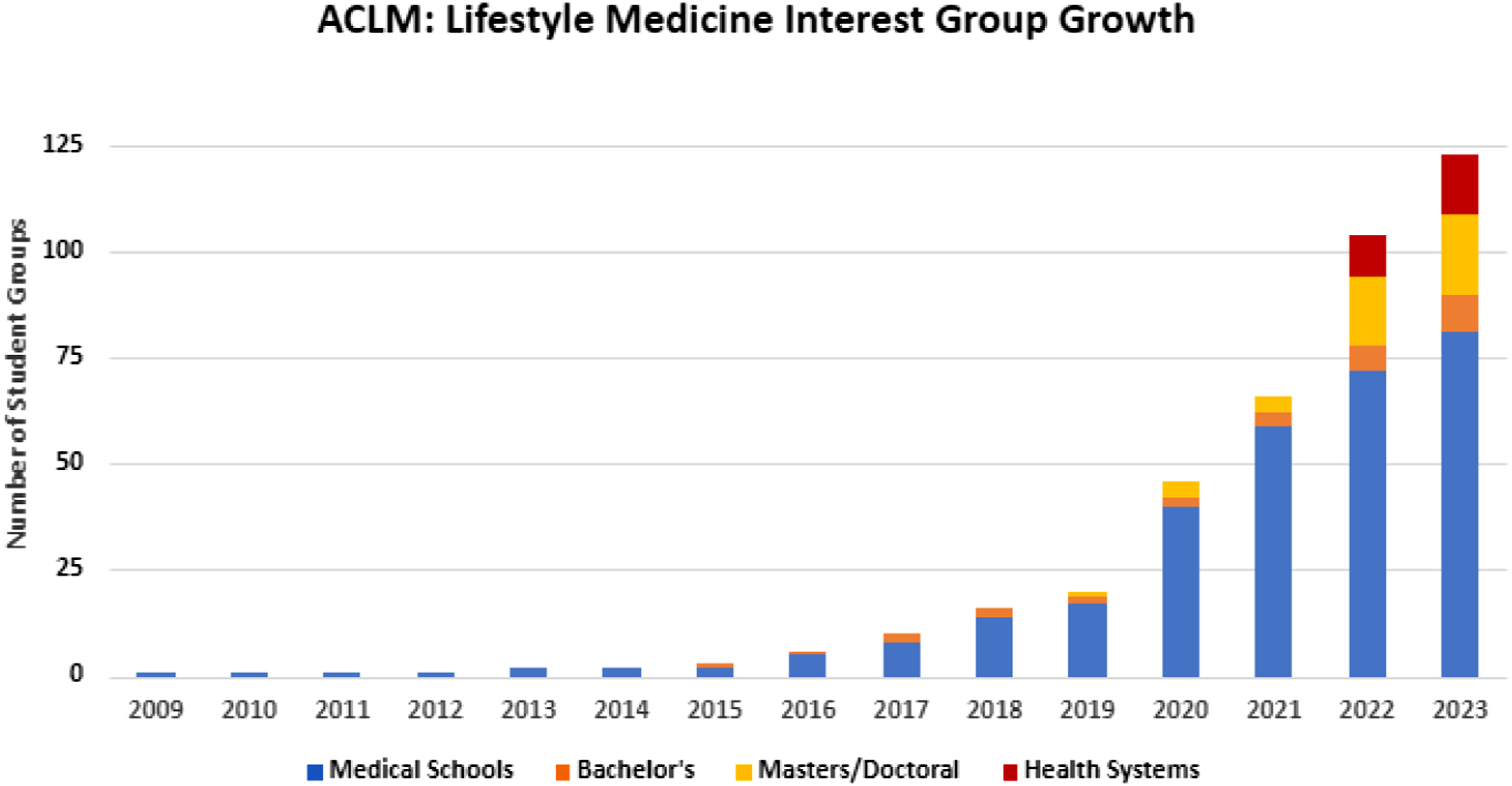
In 2022, in an effort to connect LMIGs from across the country, our LMIG invited Dr John LaPuma to speak about nature as medicine, and we held the event on zoom. COVID 19 taught us that zoom meetings were easy to conduct, convenient, and allowed for easy recording. The first virtual LMIG was a success. After that, Dr Meagan Grega and I decided to formalize the process and hold 6 virtual lectures on the 6 pillars each year. They were recorded and are now part of a curated library of excellent LMIG videos from national experts like Walter Willett, MD, Dr PH. This is another step in the evolution of lifestyle medicine education and creating community among learners across the country. ACLM is supporting this effort with virtual nationwide LMIG presentations.
In 2023, Shannon Worthman, Grace Gama, ACLM Trainee President Dr Justin Charles and I are collaborating to contact each and every medical school that does not already have an official LMIG. Our goal is to facilitate the establishment and on-going support of LMIGs across the U.S.—with efforts also underway to support global LMIG expansion.
LMIGs have been a team effort from the beginning. It starts with an interested faculty member and student who create a team of two, and then it expands to involve more students and faculty. Combined, we are a huge force of LMIGs around the nation, connected, supported, and facilitated by ACLM.
By planting these seeds of change in the form of LMIGs on campuses across the country, we are making way for the power and beauty of lifestyle medicine to fully blossom, and it will continue to blossom with the investment of time, energy, and resources. The students who are part of ACLM’s LMIGs represent the bright future of health care, dedicated to treating root causes of disease.