



Abstract
Montverde Academy is home to our country’s first Lifestyle Medicine Club, a novel approach to Lifestyle Medicine outreach amongst teenagers. A high-school student-driven initiative, the club successfully completed its first year in existence by focusing on growing its membership and teaching high school students about the 6 pillars of Lifestyle Medicine. This article describes the inception of the club, its first events, and its future directions.
“The data speak clearly: our youth need lifestyle medicine now more than ever.”
Introduction
Adolescents today face a globalized and digitized world wherein they are simultaneously coming of age while constantly facing comparison brought on by digital media. According to the Pew Research Center, approximately 70% of teens see anxiety and depression as a major problem among their peers and another 51% and 45% see drug addiction and drinking alcohol as prominent issues. 1 During the COVID-19 pandemic, the prevalence of depression and anxiety symptoms doubled amongst children and adolescents when compared with pre-pandemic estimates. A meta-analysis of 80,879 youth globally estimated the rates of children and adolescents with depression and anxiety were 25.2% and 20.5%, respectively. 2 And yet, only two states (Vermont and New Hampshire) have met the American School Counselor Association recommendation of one school counselor per 250 students as of the 2020–2021 school year. 3
Outside of mental health problems, we know that the prevalence of both diabetes mellitus and prediabetes are rising among adolescents. 4 This is corroborated by data from the National Health and Nutrition Examination Survey which demonstrated an 87.1% increase in the prevalence of impaired glucose regulation among adolescents from 1999 to 2006.5,6 More recently, JAMA reiterated this observation in a 2014 study that found an increasing rate of type II diabetes in the pediatric and in a 2021 study that found that the estimated prevalence of type 2 diabetes (amongst adolescents aged 10–19) increased from .34 per 1000 youths in 2001 to .67 per 1000 youths in 2017 population.7,8
In terms of addressing these metabolic and mental health issues, the Diabetes Prevention Program studies showed that lifestyle behaviors (such as physical activity) were superior to drugs in the prevention of type 2 diabetes. 9 Years later, we continue to find efficacy in lifestyle changes for the treatment of type 2 diabetes, as elaborated in the American College of Lifestyle Medicine’s Expert Consensus Statement on the use of diet for the remission of type 2 diabetes. 10 A meta-analysis of 50 randomized controlled trials showed that lifestyle medicine interventions appeared to be effective in mitigating depressive symptoms. 11 The data speak clearly: our youth need lifestyle medicine now more than ever.
As a community of Lifestyle Medicine practitioners, how can we promote the adoption of lifestyle medicine pillars at a younger age? Through the inauguration of the first High School-level Lifestyle Medicine club, we have done just that. We have reached high school students in a fun, peer-supported manner in the hopes that these lifestyle principles will help them combat the rising rates of metabolic disease and mental health disorders.
In this article, we will outline the methods by which the first Lifestyle Medicine Club was created, the club’s events and programming, and the resources utilized by the club members in the hopes that other communities will be inspired to create similar Lifestyle Medicine Clubs.
Founding the Club
Anabella Munoz, founder of the high school Lifestyle Medicine club, recognized the importance of adapting a healthy lifestyle for herself and her peers. As a freshman at Montverde Academy, she witnessed the inner workings of high school and the cry for help among her classmates lost in a cycle of constant depression or anxiety. She was in a unique position: her father had just worked on a project to open the Lake Nona Performance Club, a local fitness club and hub for lifestyle medicine. She accompanied him to one of the club’s guest lecture series and learned of the concept of lifestyle medicine and saw her opportunity: she would answer her classmates’ call for help by establishing the nation’s first Lifestyle Medicine Club. She penned the club’s mission as follows: The Lifestyle Medicine Club’s mission is to influence not only adolescents, but all generations, to recognize and employ the pillars of Lifestyle Medicine. To create the club, she employed the following steps (also outlined in Figure 1). Checklist with steps for founding a lifestyle medicine club.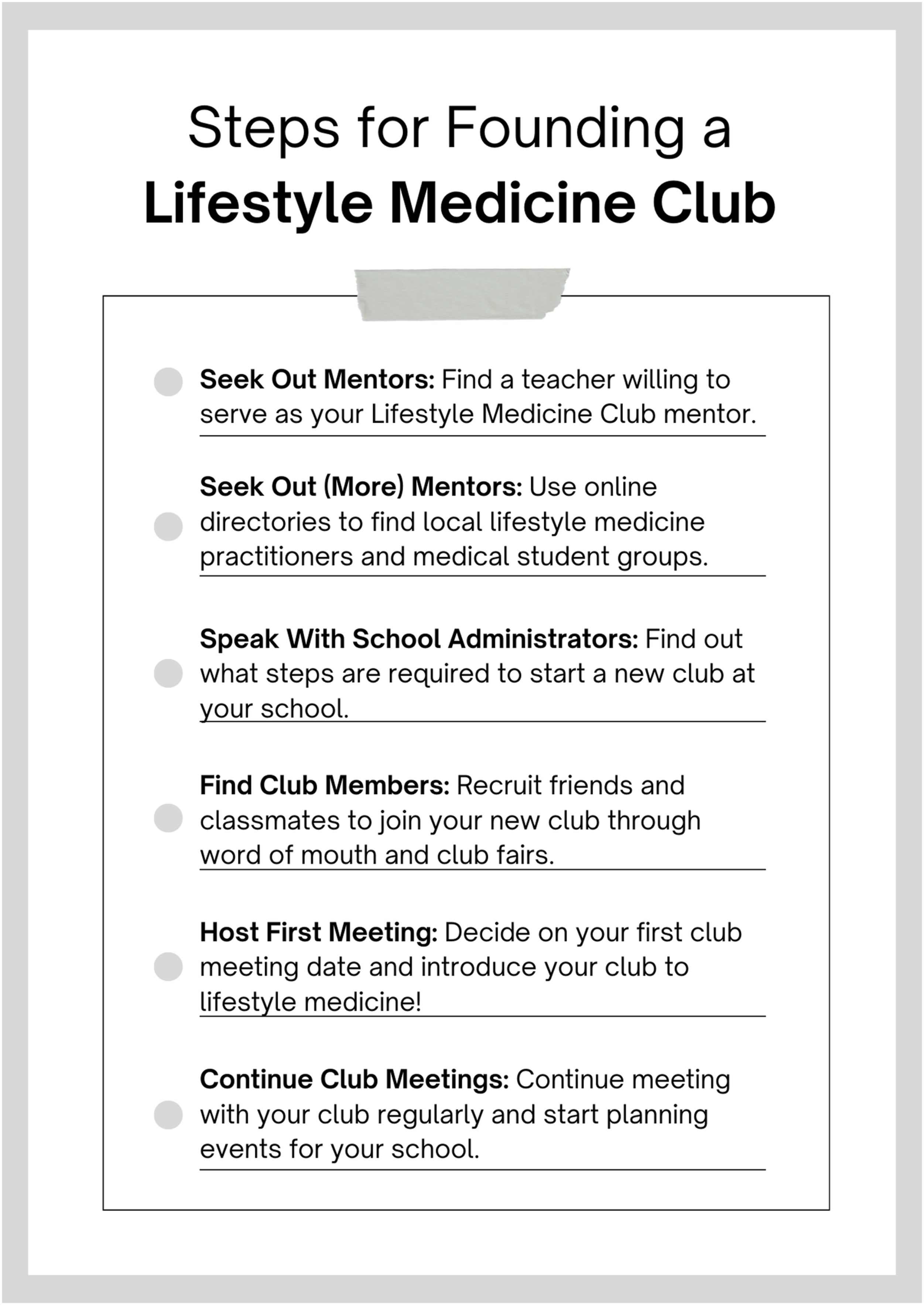
Seek Out Mentors
Anabella first surrounded herself with key mentors. She connected with: Mrs. Schlussel at her school who would serve as the club’s mentor, Dr. Wasserstrom from the University of Central Florida (UCF) College of Medicine who is a practicing Internal Medicine and Lifestyle Medicine specialist, and Léonie Dupuis who founded the UCF College of Medicine Lifestyle Medicine Interest Group (LMIG).
In other words, she found: 1) a schoolteacher to serve as the club’s mentor, 2) a local lifestyle medicine practitioner to help guide the content, and 3) a leader from the local LMIG to help support and mentor the club’s students. To find a local lifestyle medicine practitioner or LMIG, we recommend utilizing the American College of Lifestyle Medicine’s directories. For lifestyle medicine clinicians, visit lifestylemedpros.org. To connect with an LMIG, visit lifestylemedicine.org/student-interest-groups-lmig/.
Speak With School Administrators
Anabella spoke with her school’s administrators to learn of the steps needed to start a new club at her school. She had already identified a club mentor through Mrs. Schlussel, filled out the necessary paperwork, and began to recruit club members.
Find Club Members
Students signed up to join the club during Montverde Academy’s club fair where the Lifestyle Medicine club had a booth set up. The club fair turned out to be a success, with approximately 30 students signing up to become club members.
Host First Meeting
She hosted the club’s first meeting at the beginning of the school year where she invited Beth Frates, MD (with whom she connected virtually via Sharon Wasserstrom), Sharon Wasserstrom, MD, and Léonie Dupuis to present on an overview of the 6 pillars of lifestyle medicine to the group. Dr. Frates was very generous and gifted the inaugural cohort of members each a copy of the Lifestyle Medicine Teen Handbook.
From Kickoff to End of Year: Covering the Six Pillars of Lifestyle Medicine
After the first club meeting, the Montverde Lifestyle Medicine Club continued to grow and gain recognition by both the student body and the school’s administration. A cohort of 25 students attended each club meeting and over the course of the year, all 6 pillars of lifestyle medicine were individually addressed.
Members learned about the Lifestyle Medicine pillars, brainstormed ideas on how to build events to educate the student body about the pillars and executed some of these events. After executing each event or club activity, club members would reflect on their experience in The Lifestyle Medicine Teen Handbook. Members found that the Teen Handbook allowed them to learn more about the pillars of lifestyle medicine in a way that was interesting and approachable as teenagers. Although The Lifestyle Medicine Teen Handbook was utilized as the primary resource for the Montverde Academy Lifestyle Medicine Club, information about each pillar of Lifestyle Medicine is available for free at lifestylemedicine.org.
Summary of the Montverde Academy Lifestyle Medicine Club’s Coverage of the Lifestyle Medicine Pillars.
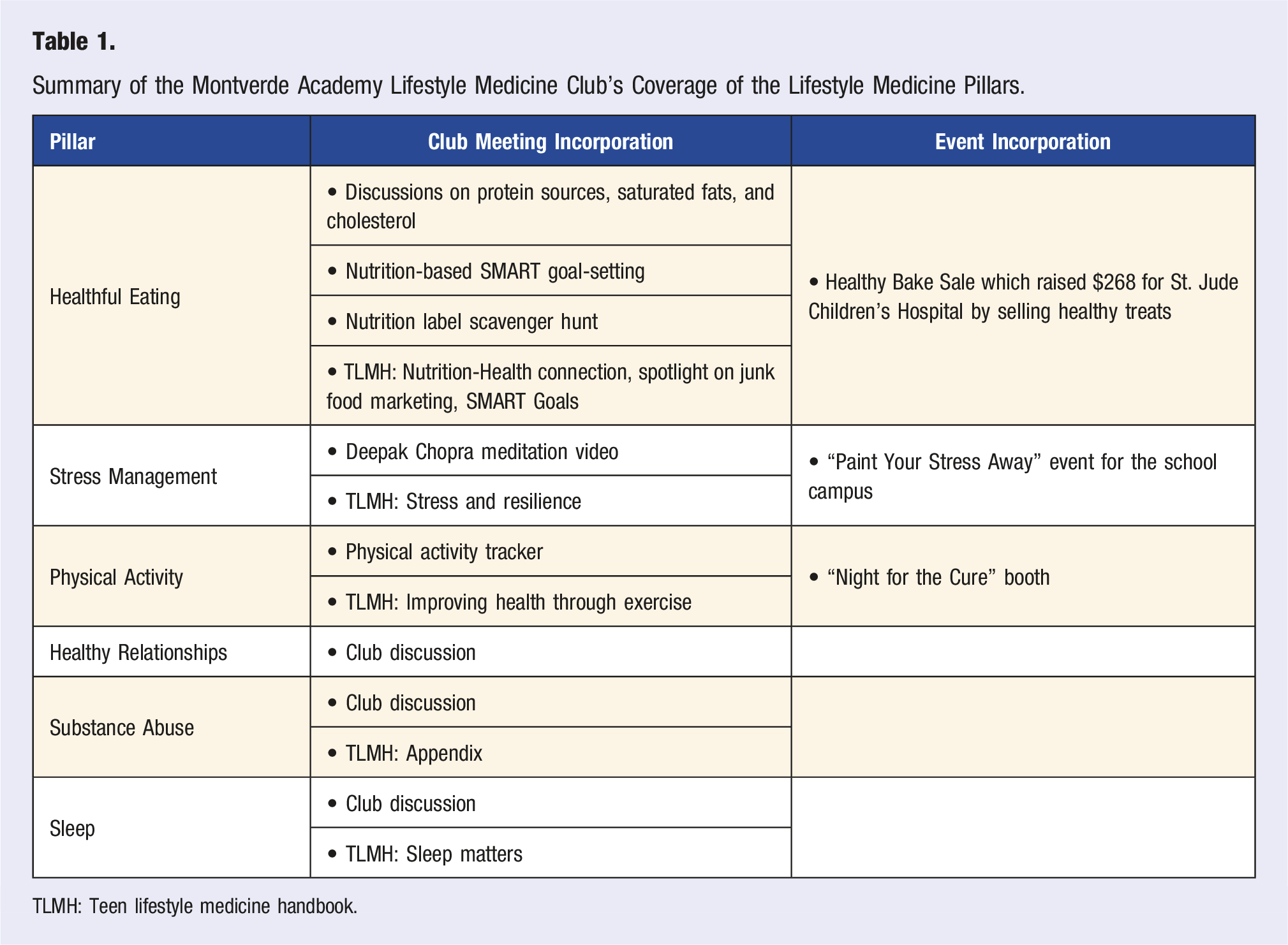
TLMH: Teen lifestyle medicine handbook.
Healthful Eating
The club held a healthy bake sale for St. Jude Children’s Hospital featuring homemade goods. Not only did they raise $268 for St. Jude, but they also educated fellow students about the importance of healthful eating. The fundraising booth was located outside of the school’s dining hall, which is accessible to all grades. Prior to hosting this fundraiser, the club held a nutrition discussion where they covered the importance of choosing healthy plant-based proteins and the difference between processed and unprocessed foods. They also discussed the presence of saturated fats and cholesterol in animal foods and the ways these micronutrients can harm our body over time. The club then rounded out the session with a SMART goal-setting session, where students self-assessed their diet and set goals regarding what foods they should consume more of or less of.
At another club meeting, the members learned how to read nutrition labels through a treasure hunt activity. This activity required calculating serving sizes and nutritional values and comparing them to each other to find the healthier snack options on the school campus. This club meeting activity was paired with the Nutrition-Health Connection chapter of the Teen Handbook. The members referred to the nutrition label diagram throughout the activity and read the “Spotlight on Junk Food Marketing” to learn of marketing tactics they may be exposed to such as ads using influencers or celebrities to target the attention of adolescents.
Stress Management
The club held a “Paint Your Stress Away” activity where students were welcomed to paint and release their stress, while also learning about techniques to manage stress. The activity was held in the campus’s courtyard, outside of the high school. The club set up a booth that was available to the entire student body wherein students were welcome to paint with acrylic paint and paintbrushes provided by the club. Each student painted something unique and valuable to them. There were many students who opted for themes related to nature, such as oceans or sunsets, but others also leaned into their comedic side with renditions of popular cartoon characters such as SpongeBob and Patrick. The club made sure to make this booth a day-long activity so that every student had the opportunity to participate during their free period that day. Anabella credits this event as increasing awareness of and participation in the Lifestyle Medicine Club.
In a club meeting, members watched Deepak Chopra’s “Go-To 3 Minute Meditation to Stay Focused” video on breathing techniques that can help relieve stress or tension. They discussed the application of this technique before exams or big life events. Anecdotally, club members expressed gratitude for this new practice and found that the breathing techniques did enhance their test-day experience. At this same meeting, the club reviewed the Stress and Resilience chapter of the Teen Handbook and reviewed the impact of stress on the mind and body such as acne breakouts, anxiety, headaches, high blood pressure, and more. They also reviewed the way that stress can affect performance such as in “fight or flight” responses and how this system is necessary for survival but may impair performance when too high.
Physical Activity
The Lifestyle Medicine Club sponsored a booth at “Night for the Cure”. Night for the Cure is an annual event held at Montverde Academy that serves as a fundraiser for cancer research centers. At the event, students and parents walked laps around the track to recognize and celebrate cancer survivors. At Night for the Cure, the Lifestyle Medicine Club walked around the track with a baton decorated to represent the 6 pillars and sponsored a temporary tattoo station, which helped encourage attendees to make donations towards the event’s charity.
During a club meeting, members also reviewed the “Improving Health Through Exercise” chapter of the Teen Handbook. Throughout this club meeting, club members discussed the physical activities they participate in. Members shared the ways that they stay active (such as sharing the sports they play) and individually filled out a weekly schedule about the intensity of their physical activity.
Healthy Relationships, Substance Abuse, and Sleep
These three pillars are grouped together because the club did not host specific events relating to these pillars. Instead, club members discussed the pillar as a group in their biweekly meetings, using the Teen Lifestyle Medicine Handbook as their primary source of information and conversation starter.
The club discussed Healthy Relationships at a club meeting, visiting the key points of communication, establishing boundaries, showing respect, and being an active listener. Club members discussed how healthy relationships can increase self-esteem and empathy and described examples of valuable relationships in their personal lives. The club utilized the Appendix in the Teen Lifestyle Medicine Handbook to learn about how different substances affect health. They reviewed the effects of tobacco, alcohol, cannabis, stimulants, and caffeine using the Appendix as a guide. They followed a similar structure for their discussion on sleep. Club members read the “Sleep Matters” chapter of the Teen Lifestyle Medicine Handbook to discuss the various benefits of sleep and its impact on academics, athletics, and mental health.
Member Survey and Future Directions
At the conclusion of the school year, Anabella surveyed her members and asked them two questions: What was your favorite part about the club this year? And what activities would you like to see the club do next year? Members’ answers varied, but the feedback clearly showed that the students valued events where they were able to educate their peers on lifestyle medicine and serve their community. For the following year, students hoped for “more interaction with experts,” more “community service,” and “presentations to spread knowledge about [lifestyle medicine].”
In the next school year, the club members will be divided into 6 committees, each representing a pillar of lifestyle medicine, with the hope that more students will gain leadership skills through the Lifestyle Medicine Club and that all 6 pillars will be incorporated into events for the school or the community.
The club plans to incorporate UCF Lifestyle Medicine Interest Group students into its programming by inviting them to come to Montverde Academy and represent the pillars of Lifestyle Medicine. The club also plans to participate in the Lake Nona/Orlando Lifestyle Medicine week festivities and share tips with other students about how they can create this club at their own high school. Long-term visions include incorporating Lifestyle Medicine clubs in high schools at a national level and continuing to promote awareness and knowledge of the pillars of lifestyle medicine.
Footnotes
Acknowledgments
Thank you to all the individuals who have helped the Montverde students succeed in establishing the first Lifestyle Medicine Club. Your support and dedication have allowed Lifestyle Medicine to enter new spaces and inspire our next generation.
Declaration of Conflicting Interests
The author(s) declared no potential conflicts of interest with respect to the research, authorship, and/or publication of this article.
Funding
The author(s) received no financial support for the research, authorship, and/or publication of this article.
