



Abstract
The disruption of school operations and routines caused by the COVID-19 pandemic affected students’ physical and emotional well-being. Providing physical activity opportunities in schools can encourage students to positively engage with each other. Using a nationally representative sample of U.S. high school students from the Adolescent Behaviors and Experiences Survey (January to June 2021), we examined the association between physical activity behaviors and feeling close to people at school using sex-stratified and race/ethnicity-stratified multiple linear regressions models. Participating in team sports, being more physically active, and attending physical education (PE) during an average week were all associated with higher levels of feeling close to people at school, with variation by sex and race/ethnicity. These associations were also significant when the physical activity behavior variables were categorized to reflect national recommendations. Daily physical activity (i.e., ≥60 minutes all 7 days), daily PE (i.e., attended all 5 days), and the number of Comprehensive School Physical Activity Program (CSPAP) components implemented were associated with higher levels of feeling close to people at school. These findings suggest that opportunities for physical activity before, during, and after school are associated with increased levels of feeling close to people at school during crises like COVID-19.
“Our findings show positive associations between physical activity and feeling close to people at school during the COVID-19 pandemic.”
Introduction
During the COVID-19 pandemic, 1 in 3 U.S. high school students experienced poor mental health, including stress, anxiety, and depression, which could negatively affect their emotional well-being and readiness to learn. 1 Schools and families are grappling with how to help adolescents buffer these negative effects from the pandemic. A consistently proposed solution is to strengthen adolescents’ connection with their families and schools because feeling close to people, especially during adolescence, is an important protective factor that can reduce the effects of stressful life events and promote key skills for social and emotional development.2–6
Specifically, school connectedness reflects students’ belief that adults and peers in the school care about their individual well-being as well as their academic progress. 7 An important strategy to promote school connectedness is helping students feel close with people with in the school environment (e.g., administrators, teachers, staff, students, families, and community members). 7 Students who feel more connected to school are less likely to engage in risky behaviors such as tobacco use and alcohol and other drug use in adolescence and adulthood.8,9 School connectedness is also associated with more positive academic markers, including higher grades and test scores, better school attendance, and staying in school longer.10,11
Physical activity also has been identified as a protective factor for adolescents, and its positive effects on self-esteem, relationships, academic achievement, and physical and mental health are well documented in the literature.12,13 However, despite its benefits, levels of physical activity are declining for adolescents with only 23% of U.S. high school students meeting the nationally recommended 60 minutes of daily physical activity. 14 Students can accumulate minutes of physical activity throughout the day by participating in physical activity opportunities supported by schools including physical education (PE), physical activity breaks, and before and after school sports.
Although both physical activity and school connectedness are protective factors for a variety of adolescent health behaviors, there is a gap in our understanding about how these two constructs affect each other to benefit the health, academic achievement, and emotional well-being of adolescents. From a theoretical perspective, it can be argued that levels of physical activity can affect levels of feeling close to people at school and vice versa. For example, PE, classroom physical activity, recess, and team sports offer students time to practice skills needed for resolving conflicts, respecting others, cooperating, helping others, and being a role model, which have been known to enhance feeling close connectedness. 15 Some studies have examined the effect of school connectedness on physical activity and have found a significant association between feeling more connected to their school and having higher levels of physical activity.9,16 However, the reverse has been rarely examined with only 1 study showing that students who regularly participated in extracurricular sports and physical activity, regardless of ethnicity, had greater levels of school connectedness. 17
We chose to examine the association between physical activity behaviors and feeling close to people at school to identify possible physical activity strategies schools could implement to help improve students’ connection with others at school during the COVID-19 pandemic. First, there is a well-established association between physical activity and mental health, and mental health and quality of relationships.1,3,4 Schools can create opportunities within PE and team sports for adolescents to improve social skills, which can help adolescents have better relationships with their teachers and peers.18,19 Second, social learning theory suggests school environments can provide adolescents with experiences to connect with and learn from peers and adults. These experiences for connection and learning can happen through physical activity opportunities such as PE, classroom physical activity, recess, and team sports.19,20 Teachers and other adults in the school can provide adolescents with activities or tasks during these physical activity opportunities to help practice how to respond in certain situations, such as demonstrating teamwork, resolving conflict, and managing emotions during games, which can encourage desirable social interactions and facilitate feeling close with others at school. During these various physical activity opportunities, adolescents observe and adopt the behaviors and attitudes of peers and adults they value. These physical activity opportunities also can help adolescents develop supportive relationships that will enhance their connections within schools and, ultimately, lead to better health and educational outcomes.
Building more evidence to explain the association between physical activity behaviors and feeling close to people at school among adolescents is particularly important given the current national concern for the mental health and emotional well-being of adolescents as a result of the COVID-19 pandemic. Understanding ways to bolster feeling close with people at school might give school staff options for supporting the mental health and emotional well-being of all students, which was declining even prior to the pandemic and further deteriorated during the pandemic. 21 Because of this, we examined whether adolescents who engage in more physical activity behaviors have higher levels of feeling close to people at school. This is the first study to our knowledge to examine these associations with a nationally representative sample of U.S. high school students during the COVID-19 pandemic. Given documented disparities in feeling close to people at school 1 and physical activity levels,13,14 we examined associations by sex and race/ethnicity. Findings from this study could help describe how PA opportunities in school may help address declines in physical activity and feeling close to people at school during the COVID-19 pandemic.
Methods
Data Source
This study includes data from the Adolescent Behaviors and Experiences Survey (ABES), which was conducted by the Centers for Disease Control and Prevention (CDC) during January to June 2021 to assess student behaviors and experiences during the COVID-19 pandemic. ABES was a 1-time, probability-based online survey of U.S. high school students and used a stratified, 3-stage cluster sampling approach to obtain a nationally representative sample of public and private school students in grades 9–12 in the 50 states and the District of Columbia (N = 7705). Participation in ABES was voluntary, and each school and teacher decided whether students completed the survey during instructional time or on their own time. Additional information about ABES sampling, data collection, response rates, and processing is available elsewhere. 22 The ABES questionnaire, datasets, and documentation are available at https://www.cdc.gov/healthyyouth/data/abes.htm. ABES was reviewed and approved by an institutional review board at CDC.
Measures
Question and Analytic Coding for Variables Included in the Analysis—Adolescent Behaviors and Experiences Survey, United States, January–June 2021.
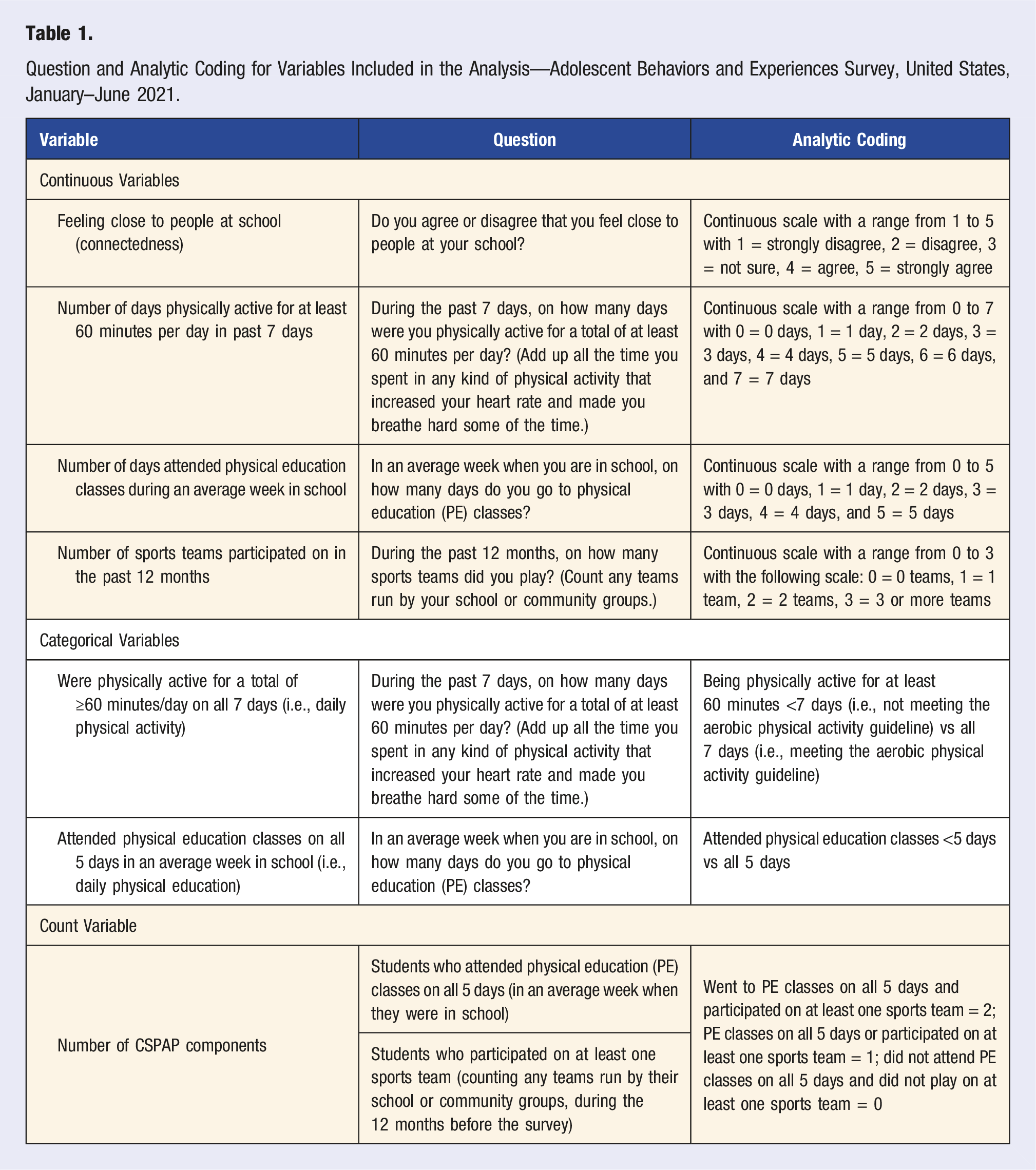
We analyzed the following demographic characteristics: sex, race/ethnicity (non-Hispanic White, non-Hispanic Black, Hispanic, non-Hispanic other), grade in school (9th-12th), and region (Northeast, Midwest, South, West). Body weight status was based on body mass index (BMI) calculated from self-reported height and weight. 24 Based on reference data from growth charts produced by CDC, students with BMI ≥ 95th percentile for sex and age were considered to have obesity; students with 85th ≤ BMI <95th percentile were considered to be overweight; students with 5th ≤ BMI<85th percentile were considered to be normal weight; and students with BMI<5th percentile were considered to be underweight.
Data Analysis
We conducted all analyses using SUDAAN v11.0.3 to account for the survey’s complex cluster sampling design and to be able to calculate sampling variance appropriately. Analyses were stratified by sex and race/ethnicity because previous research shows differences for feeling close to people at school and physical activity behaviors by sex and race/ethnic groups for adolescents.1,14 First, we used bivariate analyses to assess significant differences (P < .05) in feeling close to people at school and physical activity behaviors by sex (t tests or Chi-squared tests) and race/ethnicity (ANOVA or Chi-squared tests). Then, we used sex-stratified and race/ethnicity-stratified multiple linear regressions to model the feeling close to people at school outcome variable on continuous independent variables for 3 physical activity behaviors (all 3 included in model), while controlling for grade, body weight status, region, and sex or race/ethnicity. We also ran similar sex-stratified and race/ethnicity-stratified multiple linear regression models replacing the continuous independent variables for number of days physically active and PE attendance with dichotomous variables to align with the national recommendations—daily physical activity (i.e., ≥60 all 7 days) and daily PE (i.e., attended all 5 days). Lastly, we ran similar sex-stratified and race/ethnicity-stratified multiple linear regression models with students feeling close to people at school as the dependent variable, number of CSPAP components (count variable) and number of days physically active as the independent variables, and all control variables.
Results
Sample Description
The overall sample was 7705 U.S. high school students with approximately half female (52.1%). A total of 45.3% were non-Hispanic White, 15.6% were non-Hispanic Black, 26.7% were Hispanic, and 12.4% were non-Hispanic other. The sample was evenly distributed across the grades in school: 26.7% were in 9th grade, 25.4% in 10th, 24.4% in 11th, and 23.6% in 12th. Most U.S. high school students had a normal body weight (61.9%), 15.2% were overweight, 20.0% had obesity, and 3.0% were underweight. Most lived in the South (44.7%), 21.7% lived in the West, 19.9% in the Midwest, and 13.8% in the Northeast.
Feeling Close to People at School and Physical Activity Behaviors by Sex and Race/Ethnicity Among U.S. High School Students—Adolescent Behaviors and Experiences Survey, United States, January–June 2021.
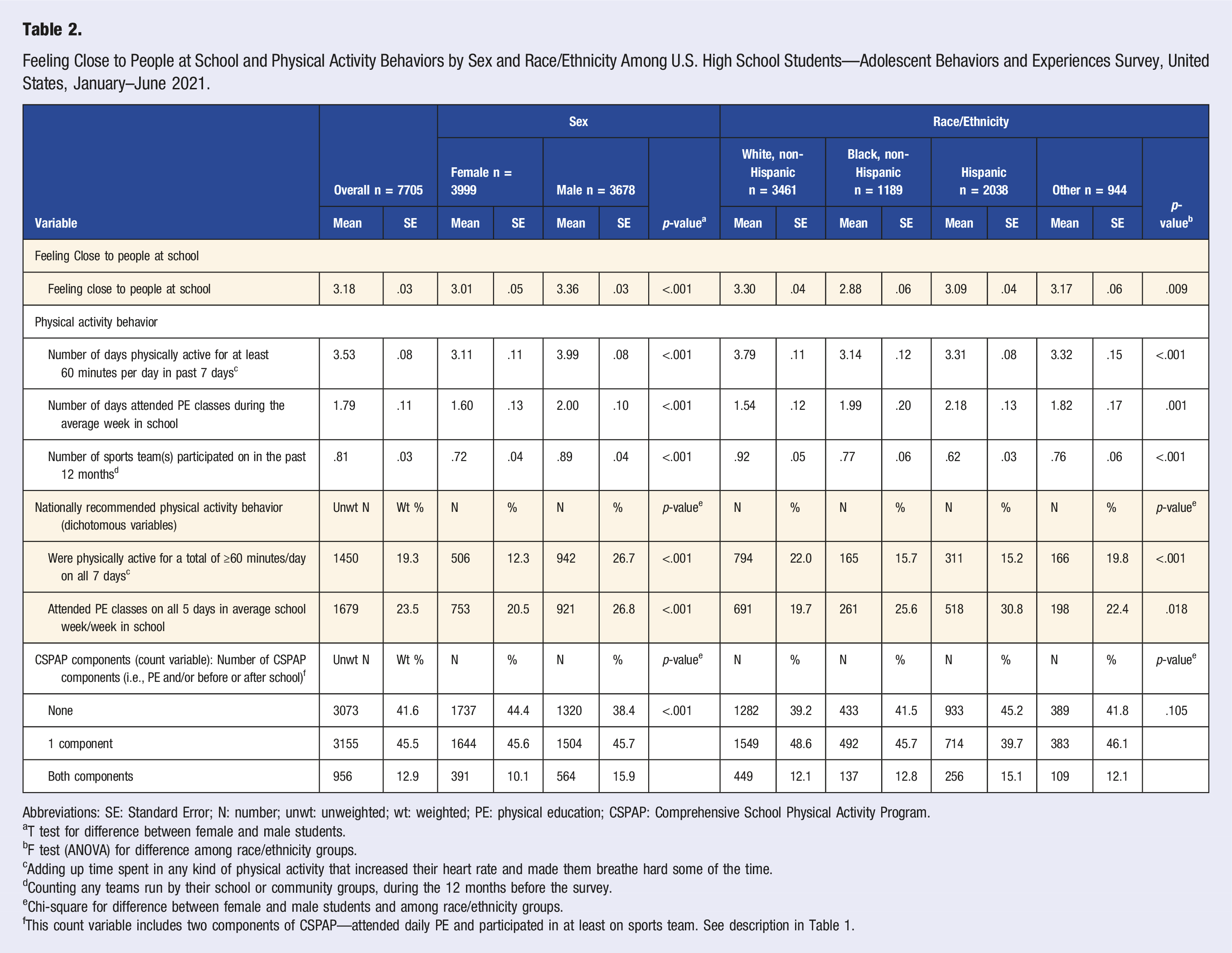
Abbreviations: SE: Standard Error; N: number; unwt: unweighted; wt: weighted; PE: physical education; CSPAP: Comprehensive School Physical Activity Program.
aT test for difference between female and male students.
bF test (ANOVA) for difference among race/ethnicity groups.
cAdding up time spent in any kind of physical activity that increased their heart rate and made them breathe hard some of the time.
dCounting any teams run by their school or community groups, during the 12 months before the survey.
eChi-square for difference between female and male students and among race/ethnicity groups.
fThis count variable includes two components of CSPAP—attended daily PE and participated in at least on sports team. See description in Table 1.
Associations Between Physical Activity Behaviors and Feeling Close With People at School
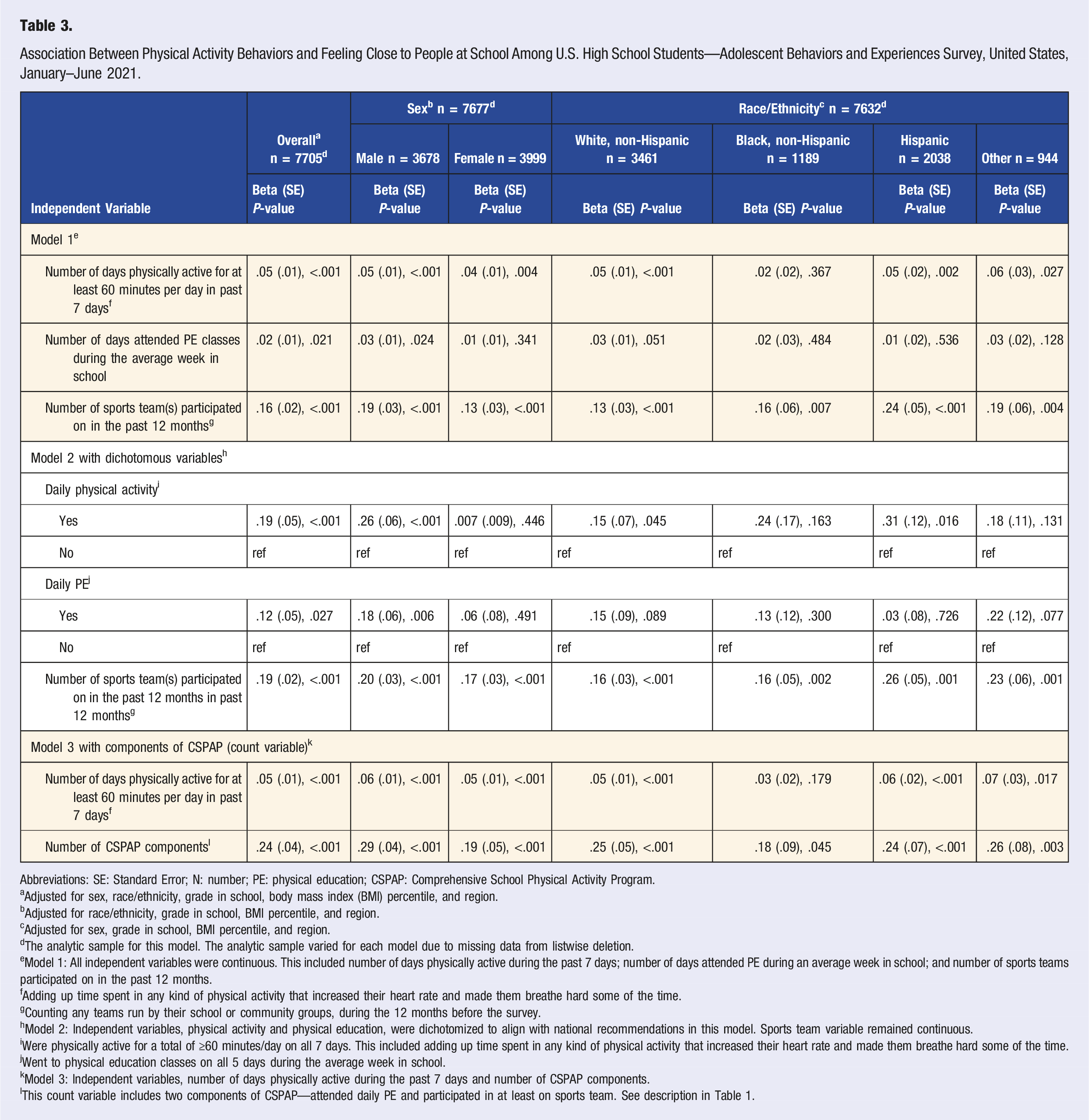
Association Between Physical Activity Behaviors and Feeling Close to People at School Among U.S. High School Students—Adolescent Behaviors and Experiences Survey, United States, January–June 2021.
Abbreviations: SE: Standard Error; N: number; PE: physical education; CSPAP: Comprehensive School Physical Activity Program.
aAdjusted for sex, race/ethnicity, grade in school, body mass index (BMI) percentile, and region.
bAdjusted for race/ethnicity, grade in school, BMI percentile, and region.
cAdjusted for sex, grade in school, BMI percentile, and region.
dThe analytic sample for this model. The analytic sample varied for each model due to missing data from listwise deletion.
eModel 1: All independent variables were continuous. This included number of days physically active during the past 7 days; number of days attended PE during an average week in school; and number of sports teams participated on in the past 12 months.
fAdding up time spent in any kind of physical activity that increased their heart rate and made them breathe hard some of the time.
gCounting any teams run by their school or community groups, during the 12 months before the survey.
hModel 2: Independent variables, physical activity and physical education, were dichotomized to align with national recommendations in this model. Sports team variable remained continuous.
iWere physically active for a total of ≥60 minutes/day on all 7 days. This included adding up time spent in any kind of physical activity that increased their heart rate and made them breathe hard some of the time.
jWent to physical education classes on all 5 days during the average week in school.
kModel 3: Independent variables, number of days physically active during the past 7 days and number of CSPAP components.
lThis count variable includes two components of CSPAP—attended daily PE and participated in at least on sports team. See description in Table 1.
Associations Between Nationally Recommended Physical Activity Behaviors and Feeling Close With People at School
Daily physical activity (i.e., ≥60 minutes all 7 days) was associated with higher levels of feeling close to people at school overall (B (SE) = .19 (.05), P < .001) (Table 3). This association was also significant for male students, White students, and Hispanic students. Daily PE (i.e., attended all 5 days) was associated with higher levels of feeling close to people at school overall (B (SE) = .12 (.05), P = .03) but only among male students in stratified analyses. In this model, the number of sports teams on which students participated remained consistent, showing a positive association with higher levels of feeling close to people at school overall and for both sexes and all race/ethnicity groups.
Associations Between Comprehensive School Physical Activity Program Components and Feeling Close With People at School
Engagement with more CSPAP components was associated with higher levels of feeling close to people at school overall (B (SE) = .24 (.04), P < .001) and for both sexes and all race/ethnicity groups (Table 3). In this model, being more physically active throughout the week remained consistent, showing a positive association with higher levels of feeling close to people at school overall and for both sexes and all race/ethnicity groups.
Discussion
The COVID-19 pandemic has disrupted the rhythm of the school day and adolescents’ routines in ways that have affected both their physical and emotional well-being.6,25,26 Recent studies have highlighted that alarming proportions of adolescents experienced adverse mental health during the COVID-19 pandemic. 1 Several have also noted signs of learning loss.27,28 Schools face the daunting task of addressing numerous academic, social-emotional, and physical health issues with finite resources and staffing. Therefore, this study investigated the link between two known protective factors—physical activity and connectedness—and examined whether this association varied by sex or race/ethnicity among adolescents.
Our findings show positive associations between physical activity and feeling close to people at school during the COVID-19 pandemic. We also found that attending PE during an average week in school, being physically active, and participating in team sports were each associated with higher levels of feeling close to people at school. Although these data did not permit us to examine the influence of school instruction modality on these outcomes, we know from prior research that students who attended school virtually during the pandemic demonstrated poorer mental health and lower levels of feeling close to people at school. 6 The results from this paper show that physical activity is related to students’ feeling close to people at school. This suggests that schools can support the physical and emotional well-being of students during and after the COVID-19 pandemic as well as during any subsequent emergencies, by leveraging existing physical activity opportunities (i.e., offering team sports, PE recess, and classroom physical activity) to enhance an important aspect of school connectedness.
However, prior to and even more so during the COVID-19 pandemic, there has been a lack of availability of and support for PE and physical activity in schools despite the beneficial effects of both physical activity and school connectedness.29–31 Limited access to school physical activity opportunities could exacerbate disparities among students in under-resourced schools and specific geographic locations 32,33; these existing disparities have already been significantly affected by the pandemic. For example, in a recent scoping review, Rossi, Behme, and Breuer found that the COVID-19 pandemic and the subsequent distancing guidance, which limited indoor activities, have further increased disparities between families with safe and open outdoor spaces and families living in dense environments. 31 They also found adolescents with a lower socioeconomic background were situated in built environments that provide little to no opportunities for physical activity.
In addition, we stratified by sex and race/ethnicity to better understand how our findings contribute additional insights about what types of physical activity opportunities might strengthen feelings of closeness with people at school and for whom, especially during the COVID-19 pandemic. For example, greater participation in team sports was associated with feeling close to people at school among male and female students and across racial and ethnic groups in this survey. This is encouraging because, as of 2018, most schools in each state offered interscholastic sports (72.0%–95.6% of schools in states, median 84.7), and many offered intramural or club sports as well (35.3%–86.7%, median 63.7%). 29 Students participating in team sports tend to form positive relationships with their coaches, which might also affect how they perceive their connection to school. 34 Although team sports are widely available, there are still disparities in participation by sex and race/ethnicity, and this could be due to participation barriers (e.g., cost, transportation, grades), perceived ability and confidence, personal health goals, and expectations for social interactions and enjoyment. 35 By better understanding these potential barriers to team sports and identifying specific actions to increase participation among female and racial and ethnic minority students, schools can help address existing gaps in both physical activity and feeling close to people at school.
Although PE attendance was positively associated with feeling close to people at school overall, stratified analyses revealed that this association may be driven by male students’ experiences, as the association was not significant for any other demographic group. These findings also held for students who attended PE every school day (i.e., all 5 days). Male students tend to report higher perceptions of physical and athletic competence than female students, which can affect students’ perceptions of competence and motivation to engage in physical education.36,37 In addition, other studies have documented racial stereotyping in physical education.38,39 For example, Black students are perceived by teachers as more physically competent whereas White students are perceived to have greater cognitive capacities. This elevates the need to prepare physical education teachers to be aware of these differences and perceptions, so they can create positive learning experiences for all students that meet students’ movement, fitness, and health needs while also helping them maintain a sense of identity and connection to the class.23,35,39
Lastly, the association between physical activity (both number of days and daily) and feeling close to people at school was statistically significant for all sex and race/ethnicity categories except for Black students. This study showed that Black students reported the lowest feeling close to people at school score, which might mean that even the potential benefit of physical activity will not compensate for other societal issues affecting their feeling close to people at school. We also know that Black students were more likely to attend school virtually during COVID and virtual school attendance was associated with lower rates of feeling close to people at school. 6 Another possibility might be that Black students are participating in physical activity during out-of-school time programs (e.g., YMCA, team sports), in the community, or on the weekend rather than during school, which might affect their connection to peers and adults within the school building.
Overall, these findings underscore the importance of meeting the national guidance set for youth aerobic physical activity in the Physical Activity Guidelines for Americans, 2nd Edition, which recommends that children and adolescents ages 6–17 years engage in ≥60 minutes of moderate to vigorous physical activity every day. 13 Unfortunately, data from the 2019 Youth Risk Behavior Survey showed for the first time a significant decline in daily physical activity among U.S. high school students (from 28.7% in 2011 to 23.2% in 2019), 14 and during the COVID-19 pandemic, only 19.3% of students met the aerobic physical activity guideline (shown in Table 2). In this study, we were able to show that overall, students who were physically active at least 60 minutes every day of the week had higher levels of feeling close to people at school. Similarly, a study with longitudinal data from 9th–12th graders in Canada found that students who reported an increase in school connectedness scores had higher odds of meeting physical activity recommendations across 4 years. 9
To help address this trend, schools can strive to offer opportunities for all students to be physically active and enhance their peer and adult relationships by implementing a Comprehensive School Physical Activity Plan. 40 This framework promotes physical activity for students before, during, and after school, which can be incredibly important to implement for students’ health and emotional well-being following the COVID-19 pandemic. This study shows the positive association between students engaging in more physical opportunities (i.e., CSPAP components) and increased levels of feeling close to people at school for all students. Despite the important benefits of both physical activity and an important aspect of school connectedness, few, if any, school-based interventions have been designed to study and evaluate these constructs for collective impact. An important future step is to continue to examine what types of physical activity strategies can most effectively bolster students feeling close to people at school as well as to develop and evaluate school-based and out-of-school time interventions that incorporate these constructs. Future studies also can help reinforce strategic programmatic implementation for physical activity and enhancing peer and adult relationships in school that can improve both health and educational outcomes while attenuating the burden of health inequities.
Limitations
Several limitations should be noted. First, because of the cross-sectional nature of this survey, we cannot infer causality in the relationship between physical activity and connectedness. Although we hypothesized that PE and participation in team sports influenced students feeling close to people at school via peer interactions and teamwork, it is also possible that individuals who already felt more connected to their school and classmates were more inclined to pursue extracurricular sports and attend PE more frequently, which may have contributed to their meeting physical activity recommendations on more days of the week. Second, the recall periods for our main variables of interest vary from the present (feeling close to people at school; physical activity in past 7 days), to the average school week (PE), to the past year (sports teams), which may have introduced potential for measurement bias. In addition, the recall period for PE is not clear; specifically, students could have interpreted “average school week” to mean when they attended PE in-person before COVID or attended PE during COVID (in-person or remote). The consistent and positive relationship between the physical activity variables and feeling close to people at school, however, is encouraging. Third, while two of the physical activity measures, daily physical activity and participation in team sports, may account for some physical activity outside of the school day, these measures would also account for physical activity before, during, and after the school day and align with the conceptual application and expected implementation of a CSPAP.
Fourth, ABES includes only a single item to address the multi-dimensional construct of connectedness at school. Not using a more comprehensive measure of connectedness at school limits the interpretation of the results to the association between physical activity behaviors and feeling close to people at school. However, it has been cognitively tested to confirm that students understood the intent of the question. In addition, previous studies with a more comprehensive measure of school connectedness have found similar findings.9,16 There are several factors that affect students’ feelings of connectedness within the school that we were not able to account for in our models including support from school staff (e.g., time, interest, attention); stability and positivity of their peer network; commitment to their education; and the physical environment and psychosocial climate of their school. 7
A fifth limitation is that ABES had higher levels of nonresponse among minority races than the typical national Youth Risk Behavior Survey, which potentially reflects selection bias. ABES weights take nonresponse into consideration and use post-stratification adjustments to compensate for potential biases. Lastly, the survey did not ask students to indicate whether, at the time of the survey or in weeks or months preceding the survey, they attended school in person, remotely, or both in person and remotely, which prevents us from exploring the role of school instruction modality. When schools were recruited for participation in this study (during October 2020 and November 2020), most schools were hybrid (65.1%), remote (24.4%), in person (2.4%), and other (8.1%); 41 however, school instruction modality fluctuated throughout the 2020–2021 school year.
We also were unable to examine potential differences between public and private schools, which might have influenced school instruction modality, given that students in this study predominantly attended public high schools (96.1%). Further, we cannot explain how PE was conducted for students who were remote or hybrid or the availability and structure of team sports during the time of the survey. This would likely vary depending on local contextual factors, including weather, the prevalence of COVID-19, local guidance, and staff availability. While exclusively remote learning was one reason for students to have a loss of feeling close to people at school, 6 these findings indicate the potential importance of promoting physical activity opportunities to help keep students connected to their schools. Additional research would be helpful to determine how school modality affects the association between physical activity behaviors and feeling close to people at school. Schools might want to concurrently develop a strategy to keep students more connected to sports, physical activity, and trusted adults at school in case of short-term pivots to remote learning.
Conclusion
This study demonstrates the association between existing physical activity school offerings, namely, PE and team sports, and increased levels of feeling close to people at school. It also demonstrates the link between adolescents being more physically active and feeling more connected to people at their school. Evidence shows that making time for physical activity in the school day does not have any known academic drawbacks, 42 thus offering physical activity opportunities in schools, as part of a Comprehensive School Physical Activity Plan, may provide an even wider variety of benefits, including increased ability to focus, strengthened interpersonal skills, and improved relationships with peers and trusted adults. These benefits may enhance students’ connection to school while also improving their health and educational outcomes, regardless of crises like COVID-19.
Footnotes
Declaration of Conflicting Interests
The author(s) declared no potential conflicts of interest with respect to the research, authorship, and/or publication of this article.
Funding
The author(s) received no financial support for the research, authorship, and/or publication of this article.
Disclaimer
The findings and conclusions in this manuscript are those of the authors and do not necessarily represent the official position of the Centers for Disease Control and Prevention.
