




Abstract
Physical activity (PA) is beneficial for both the physical and psychological health of prostate cancer (PCa) survivors. This study identified and examined motives for PA in a cross-section of PCa survivors, including both men in remission and those receiving treatment in the form of androgen deprivation therapy (ADT). Sixteen PCa survivors from Auckland, New Zealand were individually interviewed. Data were analyzed using an inductive thematic approach. Both groups of men were motivated to engage in PA post-diagnosis to obtain and experience the physical, mental, and cognitive health-related benefits associated with regular PA engagement. Past history of PA was also identified as a motive for current PA for men in remission. These findings provide important insight into how PCa survivors perceive the benefits of PA as a part of their cancer survivorship. Healthcare practitioners, exercise physiologists, and cancer support organizations can use this information to further improve PCa survivors’ quality of life and overall cancer survivorship by better promoting PA to these individuals.
“Regular PA is also beneficial for men receiving PCa treatments, such as ADT, as certain types of PA can help counteract adverse treatment-related side effects.”
Prostate cancer (PCa) is one of the most commonly diagnosed cancers among men in developed countries. 1 With early detection and advancements in treatment options, men are living longer post-diagnosis. 2 With an increase in both the 5- and 10-year survival rates for men with localized PCa, a growing focus is now being placed on PCa survivorship in relation to modifiable factors that can help maintain and improve the health-related outcomes of PCa survivors.2-4 The term “survivor” and “survivorship” in the context of PCa takes into consideration the prolonged disease course and ongoing treatment associated with PCa. 5 Therefore, these terms refer to both men who are in remission and are treatment free and men who have incurable PCa and are receiving intermittent or ongoing treatment for their PCa. 5
Physical activity (PA) is a modifiable behavior that has been found to benefit both the physical and mental health-related outcomes of PCa survivors.2,3,6,7 Physical activity is beneficial throughout the PCa continuum, from diagnosis and treatment, through to remission and survivorship.2,3,6,8 The American College of Sports Medicine (ACSM) roundtable on exercise guidelines for cancer survivors recommends either150 minutes of moderate-intensity PA or 75 minutes of vigorous PA per week. 8 An ACSM systematic review pertaining to PA in cancer prevention and survival reported moderate-to-vigorous PA was related to reduced risk of PCa specific mortality. 9 Regular PA has been associated with a lower risk for PCa progression and recurrence, a delay in the use of hormone suppression therapy, and lower prostate-specific antigen (PSA) levels.2,3,7,10,11 Aerobic and resistance exercise undertaken over a 6-month period has been found to improve health-related quality of life (HRQoL) in older PCa survivors. 12 Regular PA is an important component of PCa survivorship, as PA can provide many protective benefits for PCa survivors, who as a group are at increased risk for PCa recurrence, secondary cancers, cardiovascular disease, and poor quality of life.2,7,11,13
Regular PA can also help counteract some of the negative treatment-related side effects associated with PCa treatments, especially for men undergoing hormone suppression therapy in the form of androgen deprivation therapy (ADT).2,3,6 Adverse side effects of ADT include an increase in body fat, predominantly in the abdominal region, and loss in muscle and bone mass.2,3,6 Regular engagement in PA, particularly aerobic and resistance exercise can counteract some of these negative ADT-related side effects, which in turn are risk factors for type 2 diabetes, metabolic syndrome, osteoporosis, as well as cancer-related fatigue and depression.2,3,6
Even though the potential for PA-related health benefits are perhaps most important during or in close proximity to the treatment stages due to the wide-ranging potential side effects and symptoms associated with these treatments, men who are in remission and are no longer undergoing treatment, such as ADT, are still quite likely to experience a range of negative outcomes associated with their PCa diagnosis and past PCa treatments.2,7,14,15 Physical activity has been identified as a non-pharmacological intervention that can benefit both men undergoing treatment, as well as those in remission.2,8,15 Despite the protective benefits that regular PA can provide, the majority of PCa survivors are not engaging in sufficient PA to achieve health-related gain.6,16,17
A number of studies have identified and examined barriers, facilitators, and motives for PA in PCa survivors.14,15,17-20 Previous studies that examined motivators for PA in PCa survivors, reported that men were motivated to engage in PA to obtain physical, psychological, and social benefits associated with PA engagement.17-20 More research is required to identify and understand the motives for PA that PCa survivors may experience at different stages of the PCa continuum, from their diagnosis and treatment through to remission and survivorship.20-22 Such findings can provide useful insights that can help contribute to the development of strategies, interventions, and programs that help increase and maintain regular PA in this population.19,22 Therefore, the aim of the present study is to qualitatively identify and examine motives for PA in a cross-section of PCa survivors, including both men in remission and those receiving active treatment in the form of ADT.
Methods
Participants
Participant demography and prostate cancer treatments that participants have undergone or are undergoing.
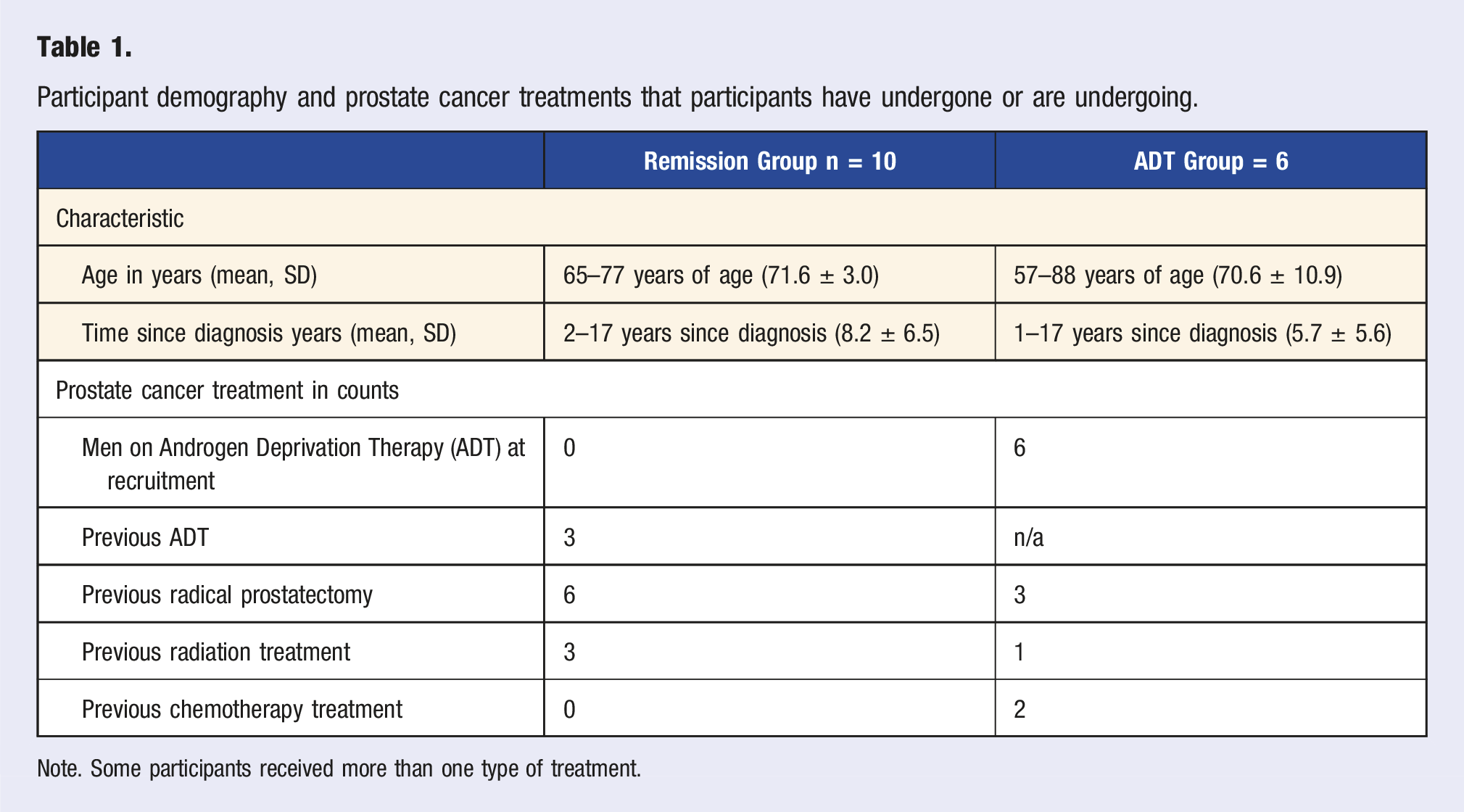
Note. Some participants received more than one type of treatment.
Measure
The present study is a sub-study of a broader qualitative study that was designed to identify and examine post-diagnosis changes in perceived quality of life, PA, and dietary factors in a sample of 16 PCa survivors.14,23 An interview schedule was developed for the broader parent study by members of the research team. Questionnaire construction was guided in part by an interview schedule we had developed for an earlier PCa focus group study that was designed to examine perceived quality of life and barriers and facilitators to PA post-diagnosis in older PCa survivors.15,24 The broader parent study questionnaire comprised of 4 main sections. The first section contained 4 questions relating to perceived quality life post-diagnosis. The second section contained 14 questions pertaining to PA, comprising the bulk of the questionnaire. Physical activity questions were designed to identify if the men were physically active pre PCa diagnosis, and to ascertain if the men were currently engaging in regular PA. This included obtaining information on the types of regular PA the men were engaging in post-diagnosis, including frequency (i.e., times per week) and duration (i.e., length of each PA session) of the activities for those who were physically active. Physical activity questions were also designed to identify if the men perceived any benefits from engaging in regular PA, as well as identifying motives and/or barriers to PA. Participants were also asked if they had received PA advice from a healthcare practitioner. The third section contained 9 questions relating to dietary factors. Dietary questions were designed to identify and examine the types of dietary changes men made post-diagnosis, including whether they had received dietary advice from a healthcare practitioner post-diagnosis. The final section contained questions pertaining to participant demography. The broader parent study questionnaire comprised of open-ended questions that were designed to facilitate discussion and to allow for participants to elaborate on their responses. Data presented in this paper reports the findings of the PA section that focused on motives for PA post-diagnosis, with a specific focus on the following questions: 1. Have you experienced any benefits from engaging in regular physical activity or exercise since your diagnosis? 2. What motivates you to continue being physically active?
Procedure
Recruitment was predominately through the New Zealand Prostate Cancer Foundation. A copy of the Participant Information Sheet pertaining to the broader parent study was included in a number of the monthly newsletters that the Prostate Cancer Foundation email to their members. The remaining 2 participants were recruited via word of mouth by members of the research team. Men who were interested in taking part in the study, either emailed or called the first author, and an interview time and location were arranged. All participants were individually interviewed once by the first author. Interviews either took place at the participant’s home, place of work, or at the university. Informed written consent was obtained from each participant prior to the commencement of each interview. All interviews were audiotaped and ranged in length from 15 to 61 minutes. This study received ethical approval from the New Zealand Ministry of Health Northern A Health and Disability Ethics Committee (Reference number: 13/NTA/241/AM01).
Data Analysis
All interviews were transcribed verbatim. Data were analyzed using an inductive thematic approach based on Auerbach and Silverstein’s 25 4-step approach to thematic analysis. The first step in the analysis process involved reading and re-reading each transcript for each specific question within a topic area. The second step involved identifying repeating ideas. This involved identifying text within a specific question where participants had used similar words or experiences to answer the same question. The third step involved naming the repeating ideas, which resulted in the emergence of themes and sub-themes. A theme is an organization of repeating ideas that is given a name which is designed to communicate what participants are trying to convey in their response to a specific question. 25 For the data reported in the present study, each theme or sub-theme had a minimum of 3 participant quotes. The fourth step was designed to verify the trustworthiness of the findings and reduce individual researcher bias. 25 The first author analyzed the data and identified themes. The co-authors then independently read the transcripts to ensure that participant quotes matched the themes identified. This resulted in verifying or disqualifying themes. All authors hold a doctorate and have extensive experience in carrying out qualitative research.
Results
Data were examined under the main topic area designed to identify motives for PA post-diagnosis. Four main themes and five sub-themes were identified. The four main themes are listed below: 1. Physical health-related motivators 2. Mental health-related motivators 3. Cognitive health-related motivators 4. Past history of physical activity
Themes and sub-themes are outlined and discussed below and representative quotes that illustrate participants’ views and experiences are provided.
Theme 1: Physical Health-Related Motivators
This theme comprised of three related sub-themes in which participants provided accounts that conveyed that they were motivated to engage in regular PA for a number of physical health-related reasons. Such reasons related to a perception that regular PA engagement could slow the progression of their PCa. For those in remission, PA was perceived to be an important component in keeping oneself alive. Participants were also motivated to engage in PA to help manage pre-existing conditions, for weight management purposes, as well as to maintain their general fitness.
Sub-theme: Physical Activity, Prostate Cancer, and Mortality
The following quotes convey that participants were motivated to engage in PA, as it was perceived to be an important behavior in keeping them alive. A participant receiving ADT discussed how PA could slow the progression of his PCa. Two participants in remission provided accounts that conveyed that they engaged in PA as it was perceived to be a beneficial activity that helped keep them healthy and alive.
“Doing some exercise retards the cancer. It doesn’t absolutely stop it, but it stops it growing so fast.” (Participant 4, currently receiving ADT)
“It’s just very good for you. It keeps you alive. You stay well. I wouldn’t even want to think about not regularly exercising. It’s important, and it’s probably the most important thing I do for me.” (Participant 2, in remission)
“Not wanting to die.” (Participant 6, in remission)
Sub-theme: General Health-Related Reasons
The following quotes convey that participants were motivated to be physically active for general health-related reasons, such as for the purposes of weight management, for the management of chronic health conditions, as well as to aid their sleep:
“Not wanting to turn into a blob and put on excessive amounts of weight. I eat the right things. You can still put on weight if you don’t balance exercise into it. What motivates me? I don’t wish to be a blob.” (Participant 3, currently receiving ADT)
“I think it’s good for me. It helps my health. It keeps my weight down.” (Participant 12, in remission)
“I had back problems for about the last 10 years and then I started going to the gym, and the back problems have all but gone away.” (Participant 14, in remission)
“You sleep better.” (Participant 7, in remission)
Sub-theme: Physical Fitness and General Benefits of Physical Activity
This sub-theme illustrated how participants had an awareness of the general fitness related benefits associated with regular PA engagement. The following quotes convey that participants were motivated to engage in PA to keep fit so they could engage in certain activities and tasks. One participant also discussed that he was motivated to engage in PA, because it equated to better quality of life for him:
“I want to keep reasonably fit, so we (his wife) can do stuff together. So that motivates me too.” (Participant 3, currently receiving ADT)
“It’s the most important thing I can do. My whole quality of life depends on being fit.” (Participant 2, in remission)
“It keeps me going. I see people who are of similar age, but we have different abilities because of our activity levels.” (Participant 12, in remission)
“I feel the benefits of the fitness coming back. All the normal things you do when you are an exercise person, climbing the stairs is easier and not having to huff, and being able to do physical activity around the home without tiring.” (Participant 3, currently receiving ADT)
“You’re able to move better. If you don’t do it, it’s a lot harder when you go back to it. There are benefits, but you don’t realise it till you don’t do it and go back to it.” (Participant 7, in remission)
Theme 2: Mental Health-Related Motivators
This theme comprised of two related sub-themes in which participants provided accounts that demonstrated how they were motivated to engage in regular PA to obtain mental health-related benefits associated with PA engagement, such as for stress management and relaxation, eliciting a sense of well-being, and achieving mental happiness.
Sub-theme: Stress Relief, Relaxation, and Mental Happiness
Some participants were motivated to engage in PA as it was perceived to be a form of stress relief and relaxation. One participant gave an account of how being physically active made him feel mentally happy, as being active provided him with a sense of achievement. Another participant (also on ADT) discussed how PA engagement through gym activity made him feel strong, which was a feeling he valued:
“I find it’s a great stress reliever. When my wife was really sick, I would go out on my bike for two or three hours, and it would just clear the head of all the problems that were going on in life. I find that I feel mentally and physically so much better when I exercise.” (Participant 14, in remission)
“I’ve always felt better after a run. It’s a feeling of well-being and relaxation afterward.” (Participant 5, currently receiving ADT)
“Keeping a level of fitness that keeps me mentally happy, so I feel I’m achieving something that way.” (Participant 3, currently receiving ADT)
“I just like to have physical activity. I go to the gym. It makes me feel physically strong. I feel strong and I appreciate that.” (Participant 1, currently receiving ADT)
Sub-theme: A Feeling of Well-Being
The following quotes convey that some participants were motivated to engage in PA as it elicited a feeling of well-being. One participant also discussed that he was able to do more when he felt mentally better through being physically active:
“I would miss it if I didn’t do it. It makes me feel better.” (Participant 15, in remission)
“There is an acceptance by me that I am better to do it than not to do it. I do feel better if I do it.” (Participant 1, currently receiving ADT)
“The benefit of regular exercise is that you also feel better, and you do more things because you feel better.” (Participant 2, in remission)
Theme 3: Cognitive Health-Related Motivators
In the following quotes, participants gave accounts of how they were motivated to engage in PA as it was perceived to be beneficial for their cognitive health. Physical activity was perceived as a means of providing mental stimulation, and in some cases a break from certain situations:
“You’ve got to keep the brain working.” (Participant 16, in remission)
“It’s good for the brain.” (Participant 3, currently receiving ADT)
“I find that the fresh air outside and that break away from home mentally recharges my battery. It’s mentally stimulating.” (Participant 11, in remission)
Theme 4: Past History of Physical Activity
Participants who were in remission gave accounts that highlighted how previous experience of regular PA, especially that which began in childhood or in adolescence was a motivating factor in relation to continuing with their current PA engagement:
“I think it’s just inbred in me. I was always active. So, it’s just a habit for me.” (Participant 15, in remission)
“You’ve got to keep going, I think it’s a family trait. I’ve always been quite sporty, and I think it’s just an ongoing thing.” (Participant 12, in remission)
“I’ve always been physically active, so I keep on going.” (Participant 11, in remission)
Discussion
The present study identified a number of motives for PA that PCa survivors can experience post-diagnosis. A participant currently receiving ADT was motivated to engage in PA to slow the progression of his PCa. Two men in remission were motivated to engage in PA, as it was perceived to be an important component in helping maintain their health, and essentially in helping keep them alive. There is emerging evidence that PA can slow the progression of PCa and lower the risk of PCa mortality.9-11,26 A study involving 1455 men with localized PCa reported a 57% lower rate of PCa progression for men who walked briskly for 3 or more hours per week compared to men who engaged in less walking activity. 26 Also, a study carried out with 2705 men with nonmetastatic PCa found 3 or more hours per week of vigorous PA was associated with reduced risk of PCa morality. 11
Participants in the present study were also motivated to engage in PA for their overall general health and physical fitness. Participants discussed how they were motivated to engage in regular PA to aid their weight management, to help manage pre-existing conditions, such as chronic back problems, and to improve their physical fitness. Through engaging in regular PA, the participants in our study became aware of the benefits associated with PA, such as the realization that regular PA aided their ability to carry out daily tasks and other activities with relative ease. Earlier qualitative studies that examined facilitators and motives for PA in PCa survivors, including both men in remission and those receiving treatment in the form of ADT, also reported that men were motivated to engage in PA for physical health-related reasons, such as for the maintenance of their general physical health, to help manage pre-existing chronic health conditions, for weight management purposes, and to increase their energy levels.18-20,24
Participants in the present study were motivated to engage in PA to obtain mental health-related benefits associated with PA, such as stress relief and relaxation, a feeling of well-being, and mental happiness. Previous studies that examined facilitators and motives for PA in PCa survivors also reported that PA helped to relieve stress, promoted relaxation, and provided a sense of well-being and improved mood, and in some cases, provided a sense of achievement.17-20,24,27 Maintaining a certain level of fitness equated to a participant on ADT in the present study feeling a sense of achievement, which in turn elicited a feeling of mental happiness within him. The role of PA in providing a sense of achievement was also identified in a study that examined body image and exercise in men undergoing ADT. 28 It has been argued that PA can have a salient role in helping PCa survivors focus on what they can still physically achieve, as well as helping them regain some control over their bodies. 28 There was also discussion in relation to how certain physical activities, such as gym attendance helped another participant who was also on ADT, feel physically strong and how this was a pleasant feeling.
Physical activity for cognitive brain health was also identified as a motive for PA in the present study. This motive has not specifically been identified in previous research that has examined facilitators and motives for PA in PCa survivors. Physical activity can improve cognitive function by changing brain structure, such as hippocampal volume, which positively influences memory. 29 A recent meta-analysis 30 found PA to be beneficial for the cognitive health of men undergoing PCa treatments. Supervised PA in the form of resistance and aerobic activity was found to improve self-reported cognitive functioning in three randomized controlled trials carried out with PCa survivors both during and after cancer treatments. 30
The role of PA in maintaining and improving cognitive function is imperative for men with PCa as there is evidence that cancer treatments, such as chemotherapy, radiation, and hormone suppression treatment can negatively affect various aspects of cognitive functioning.31-33 Changes in cognitive functioning are affected by changes in structural and neurophysiological alterations of the central nervous system, including impaired cell function. 33 For men on ADT, changes in testosterone levels have been associated with impairments in cognitive functioning.31,32 Long-term use of ADT may be a risk factor for the development of Alzheimer’s disease. 34
Past history of PA was a motive for current PA engagement for men in remission. Some participants discussed how they have always been physically active and how this had continued into adulthood, becoming a part of their daily lives. In line with our findings, an electronic survey designed to identify barriers, facilitators, and exercise preferences in 103 Canadian PCa survivors, found exercise routine or habit to be one of the most reported facilitators for PA. 17 Such results are consistent with the wider literature, whereby longitudinal studies of the general population have found adolescent PA to be a predictor of adult PA.35,36
Strengths, Limitations, and Application of Study Findings
A qualitative interview-based methodology strengthened the present study, as it allowed participants, both men in remission and those receiving active treatment for PCa, to discuss in detail the factors they perceived as influencing their post-diagnosis PA engagement. While the present study had a relatively small sample size, previous qualitative studies that have examined PA engagement in PCa survivors have also had similar sample size.18,19,24 Our study had a representative sample of PCa survivors, with the inclusion of men in remission and those receiving PCa treatment in the form of ADT. It must be noted that none of our participants were undergoing chemotherapy or radiation treatment in the 12 months prior to recruitment. These are more severe types of PCa treatments that can affect PA levels and may also affect the men’s attitudes toward PA. The results from the present study are primarily from PCa survivors who were physically active before and after treatment. Therefore, more investigation is needed on attitudes toward PA in men who were inactive before and/or after treatment. The data collected on pre and post-diagnosis PA was self-reported and subjective. No measure was used to objectively measure pre or post PA. There is strong potential for a self-selecting sample, as the majority of participants were motivated to approach the researchers. It is possible that our participants were more likely to be motivated to engage in PA compared to the general PCa survivor population, as reflected by the data obtained.
The findings from this study would be of interest to healthcare practitioners, exercise physiologists, PCa support group staff and researchers. Specifically, healthcare practitioners are ideally positioned to gauge their PCa patient’s PA levels, as they see PCa patients and survivors on a regular basis and can therefore provide some degree of PA advice even if such advice is verbal in nature relating to the general benefits of PA and/or referral for PA programs for men who are low-active or sedentary.14,37 Prostate cancer survivors are receptive to receiving PA advice from their healthcare practitioners.15,23,37
It must be noted that healthcare practitioners (i.e., oncologists, urologists, general practitioners/primary care physicians) are not trained to provide PA advice or prescription.37,38 A study carried out by Spellman and colleagues 38 designed to examine the knowledge, attitudes, and practices of 31 practitioners (predominately radiation oncologists and urologists) in relation to their promotion of PA with PCa survivors, found practitioners infrequently provided their PCa patients with PA advice. When PA advice was provided, it tended to be verbal and non-specific. 38 It must be acknowledged that practitioners may have a lack of knowledge, resources, formal training, and confidence in providing PA advice, and hence, why only general verbal advice is imparted. 38 General PA advice lacks detailed information pertaining to type of PA (i.e., aerobic resistance, restorative) to engage in, including intensity and frequency of activity. 38 The majority of practitioners in the Spellman study 38 reported that provision of PA advice was not part of their role. Similar findings were reported amongst a small sample of New Zealand-based medical oncologists, who viewed their role as providing their PCa patients with specialized medical knowledge and information and not PA advice. 38 Other pertinent barriers to PA promotion of healthcare practitioners to their cancer patients, include time constraints within the consultation and lack of clear exercise guidelines to impart to their cancer patients.37,39
It has been suggested that practitioners would benefit from an education program that provides information pertaining to how PA can safely benefit PCa patients, in terms of helping alleviate treatment-related side effects, as well as the provision of training in how to promote PA to their patients. 38 Despite the pertinent issues discussed above, healthcare practitioners can have a salient role in either providing their PCa patients with some degree of PA advice and/or referral for PA programs, which can include patient consultation with an exercise physiologist or physiotherapist (such as in a New Zealand context). 37 It has been suggested that collaborative practice between healthcare practitioners and exercise physiologists and physiotherapists would benefit the health and well-being of low-active and sedentary PCa survivors.37,40
Conclusions
The men in the present study were motivated to engage in PA to obtain physical, mental, and cognitive health-related benefits associated with regular PA engagement. Regular PA is an important component of PCa survivorship, as PA can provide many protective benefits for PCa survivors, who as a group are at increased risk for PCa recurrence, secondary cancers, cardiovascular disease, and poor quality of life. Regular PA is also beneficial for men receiving PCa treatments, such as ADT, as certain types of PA can help counteract adverse treatment-related side effects. The findings from the present study provide useful insights that can add to the emerging literature in this area, especially in relation to why physically active men continue being physically active after receiving a PCa diagnosis.
Footnotes
Acknowledgments
We would like to thank the men who took part in this study. We would also like to thank the New Zealand Prostate Cancer Foundation for their support with participant recruitment.
Declaration of Conflicting Interests
The author(s) declared no potential conflicts of interest with respect to the research, authorship, and/or publication of this article.
Funding
The author(s) disclosed receipt of the following financial support for the research, authorship, and/or publication of this article: This work was supported by the Cancer Society of New Zealand through a 3-year Prostate Cancer Young Investigator Scholarship for the first author.
Ethical Approval
Ethical approval was obtained from the New Zealand Ministry of Health Northern A Health and Disability Ethics Committee (Reference number: 13/NTA/241/AM01).
Informed Consent
Written informed consent was obtained from each participant prior to their interview.
Trial Registration
Not applicable as this was a qualitative interview-based study.
