



Abstract
In many low- and middle-income countries, chronic or noncommunicable disease is rising exponentially leading to high rates of death and disability. Many low-resource countries also still have high rates of infectious disease, leading to a double burden. As demographics shift and people are able to afford higher calorie convenience foods there can be concomitant obesity and malnutrition. Lifestyle medicine can prevent and reverse these diseases, but the concepts of lifestyle medicine are not reaching the people who need them the most. Lifestyle medicine’s unique contribution to the fight against noncommunicable disease is well trained providers who can reach people, really hear their stories, and provide tools for them on their journey, which can affect individuals, communities, and the planet. Providers all over the world are realizing this and joining together in the Lifestyle Medicine Global Alliance (LMGA) to build a network of providers; share best practices, educational resources, and research initiatives; and to advocate on the global stage. The contribution lifestyle medicine has to offer in synergy with public health efforts has been recognized by the World Health Organization, and the Lifestyle Medicine Global Alliance has been invited to partner with them to reduce noncommunicable disease by 30% by 2030.
As people we may improve our standard of living but decrease our quality of life, and as we move from less to more affluent circumstances too often our health suffers.
Mr B was born in Syria and spent most of his formative years in refugee camps. He worked his way out of poverty through his intelligence, a talent for boxing, and a lot of grit. He made a name for himself, and 10 years later he was in the United States of America, working as a professor at a prestigious university.
With his new life, and new opportunities, he enjoyed the comforts of life and wanted nothing but the best for his family. Decades later I met Mr B in my office where he came to see me as his family physician. He came because of a fracture in his hand, but as we talked more about his story he had become completely sedentary, eating on the run while teaching and working on his next book for publication. He was diabetic with known cardiovascular disease, and he had had a recent scare with chest pain. We discussed where he was and where he would like to be. His aspirations included spending more time with his grandchildren, regaining fitness, taking time for his own health and well-being, and reconnecting with his wife.
Lifestyle medicine offered him all the answers he needed, and 2 years later, 63 pounds lighter and much fitter, he has been able to stop 12 of his 15 medications. His grandchildren are living with him, he and his wife have a renewed relationship, his book is completed, and he consistently expresses a deep joy in his life.
His story highlights the power of lifestyle medicine, and also the challenge. As people we may improve our standard of living but decrease our quality of life, and as we move from less to more affluent circumstances too often our health suffers. Now Mr. B. has started an initiative in lifestyle medicine for his own friends, family, and community in the Middle East where they are beginning to face the same chronic diseases that he faced.
The Global Pandemic of Noncommunicable (Chronic) Disease
Every year 41 million people die from noncommunicable disease (NCD). Eighty-five percent of those people live in low-income and middle-income countries.
Ischemic heart disease and stroke are the world’s biggest killers, accounting for a combined 15.2 million deaths in 2016. Cardiovascular diseases account for 17.9 million deaths, or 44% of all NCD deaths. Cancers account for 9.0 million, or 22% of all NCD deaths. Respiratory diseases—asthma and chronic obstructive pulmonary disease—account for 3.8 million, 9% of all NCD deaths. Diabetes accounts for 1.6 million deaths. 1
These diseases have remained the leading causes of death globally in the past 15 years. What is changing is where they are occurring (Figure 1).
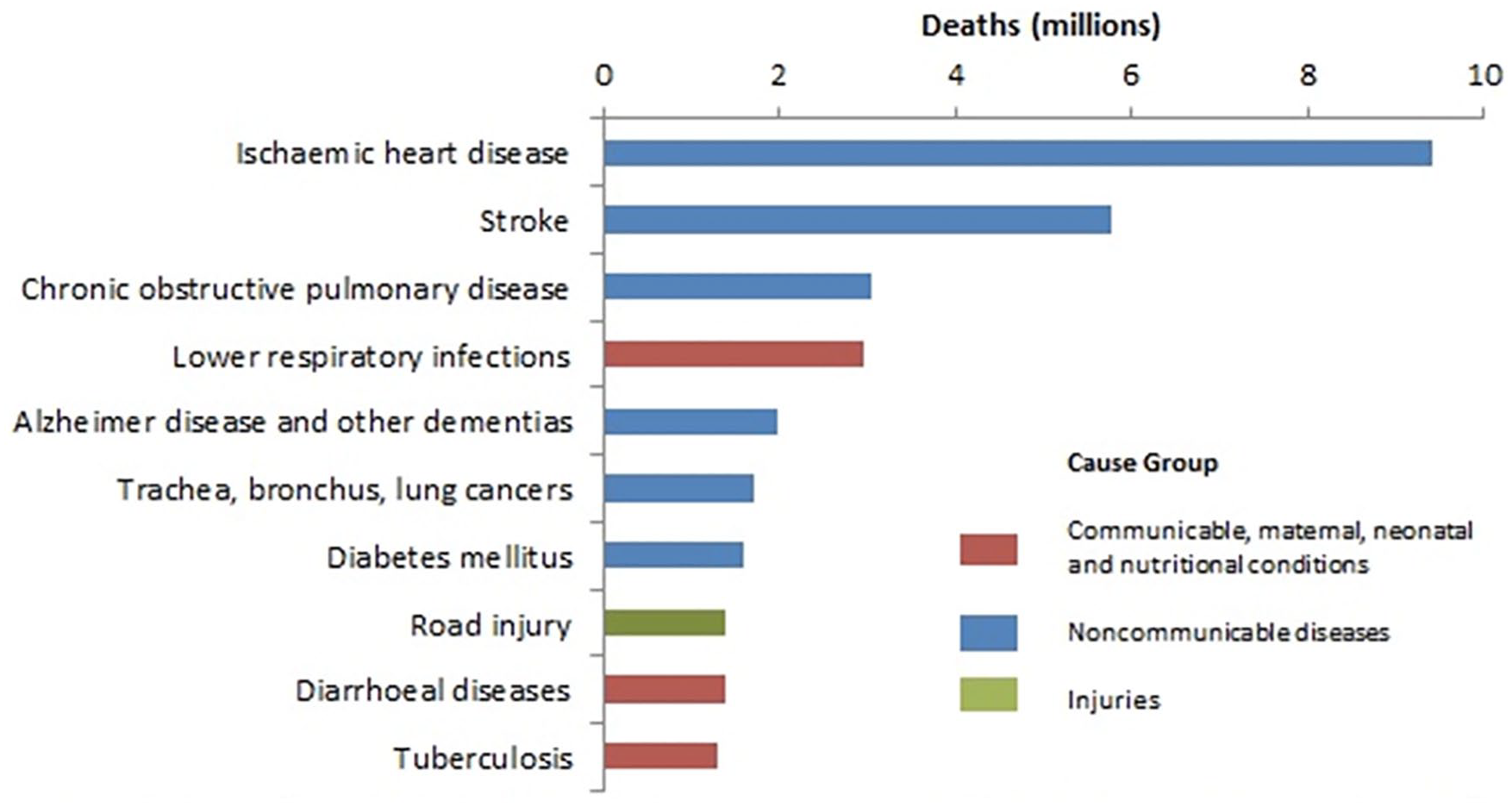
Top 10 global causes of deaths, 2016.
The globalized marketing of unhealthy products opened wide the entry point for the rise of lifestyle-related chronic conditions.
This is a unique time in history, where economic progress, improved living conditions, and greater purchasing power are actually increasing diseases instead of reducing them. (Margaret Chan, MD, WHO Director-General; February 8, 2017)
The Double Burdens of Disease
A total of 7.6 billion people live on earth; 6.2 billion live in low- and middle-income countries. That is 81.5% of the world’s population. It is predicted that by 2030 cardiovascular disease will be the main cause of death everywhere, but all diseases will be disproportionately high in poorer countries.
The main burden of infectious disease falls on low- and middle-income countries. As many countries increase in wealth they continue to face infectious disease, but with the change in lifestyle, which often accompanies wealth, they add to that an epidemic of stroke, high blood pressure, and heart disease (Figure 2).
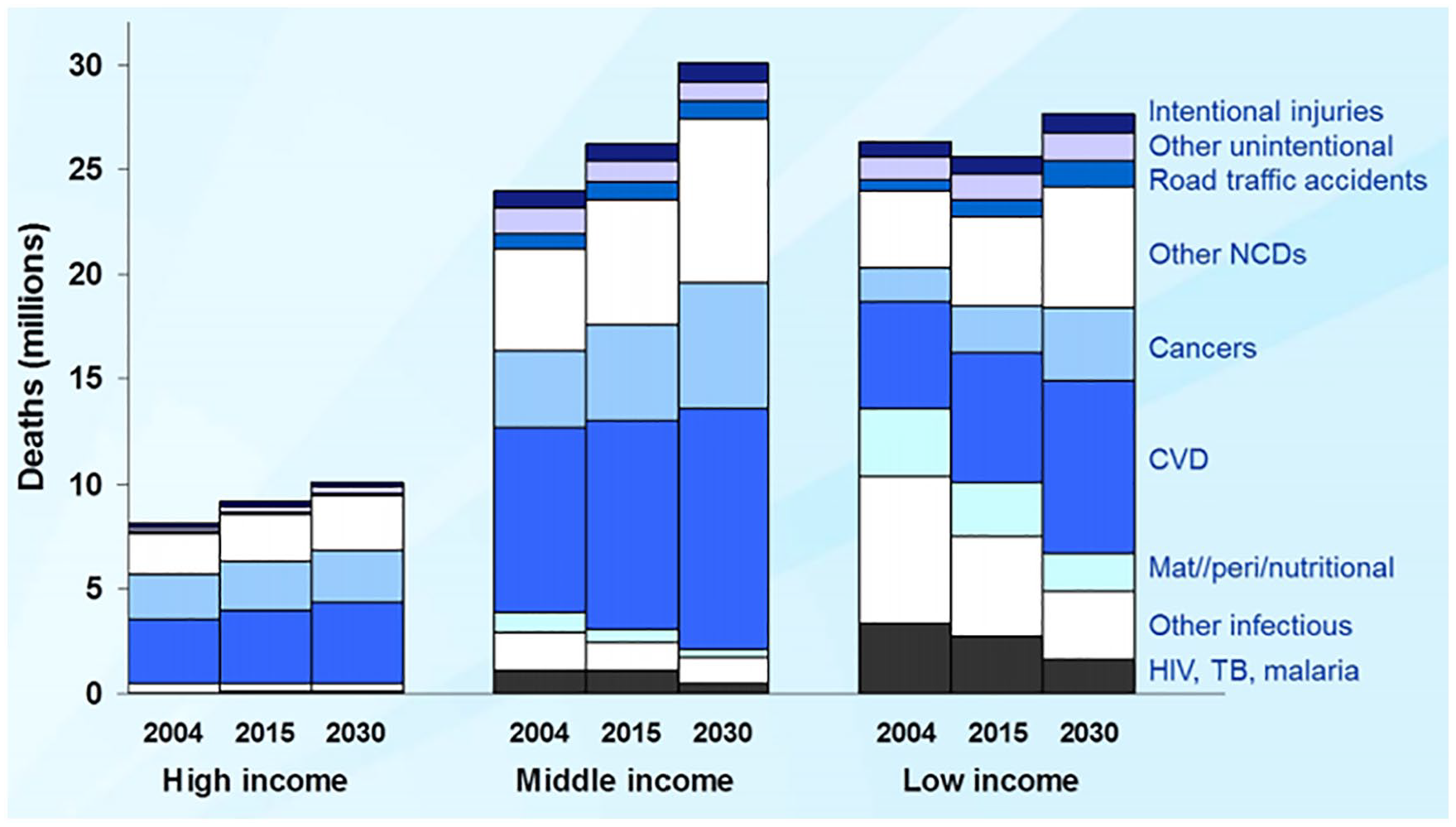
Projected NCD deaths in low-, medium-, and high-income countries.
There is another kind of double burden we are facing: 795 million people on earth are hungry, and 1.9 billion people are overweight or obese.
Undernutrition leaves children and adults vulnerable to infectious disease, and there is a growing number of people who are “calorie rich but micronutrient poor,” that is, their diet gives them calories and energy, but not the vitamins, nutrients, and minerals needed for healthy physiology and immunity.
This is the basis of the growing pandemic.
A Global Syndemic
A new term has been coined—a global syndemic: This is the combined catastrophic impact of obesity, undernutrition, and climate change. 2
The interdependence of our health with that of our planet is increasingly recognized as illustrated by the United Nations Standing Committee on Nutrition’s statement, “It is critical to promote . . . changes in dietary patters toward less greenhouse gas-intensive, healthier, more plant-based diets containing more fruit, vegetables, whole grains and pulses.” 3 And here in the United States the food system is responsible for more than a quarter of all greenhouse gas emissions, while unhealthy diets and high body weight are among the greatest contributors to premature mortality. 4
This highlights the global reality that our lifestyles are increasingly threatening our own health, our community’s health, and the health of the planet on which we reside. It also demonstrates the opportunity and necessity of lifestyle medicine to change the status quo; slowing and reversing the impending tsunami of NCD and environmental degradation.
Lifestyle Medicine’s Offering on the Global Stage
Lifestyle medicine operates in a unique niche, offering a leverage point to health that is complementary to and synergistic with the current public health initiatives on the global stage.
Lifestyle medicine leverages the provider-patient relationship to put the person at the center of their own health and health care. As providers we have the opportunity to really listen to the person’s story, to meet them where they are, and to empower them with economical, sustainable solutions to improve their health, with far-reaching consequences. Those solutions will look different in different cultures and countries, but the basic tools are universal, and as practitioners are realizing the power of lifestyle medicine, and the need in their communities, many reached out to individuals involved in the American College of Lifestyle Medicine, and we recognized the need to develop a global alliance of lifestyle medicine practitioners.
Lifestyle Medicine Global Alliance (LMGA)
Origin
The LMGA arose in response to the increasing need for lifestyle medicine solutions in low- and middle-income countries and for communication and coordination between lifestyle medicine professional organizations around the world.
In 2015, three people started discussions as to how to unite and support colleagues in other countries, to answer questions from fellow clinicians such as how to get trained in lifestyle medicine, how to find and unite other practitioners, how to set up a national organization, and how to find out about and collaborate with practitioners in other countries. In 2016, LMGA was born.
The initial vision of LMGA was, “A world without noncommunicable disease.” With a mission to “unite national lifestyle medicine medical professional associations from around the world, with the goal of reining in the alarming rise in global obesity and lifestyle-related chronic disease trends. Identifying and eradicating the cause of disease.” 5
Objectives
LMGA is uniting national lifestyle medicine professional organizations, with 5 main objectives:
Creating cohesiveness
Enabling global sharing of best practices
Enabling global sharing of educational resources
Leveraging public relations efforts
Developing opportunities for synergistic collaboration
Development
The need and the response have been overwhelming. Clinicians in more than 45 countries have approached and registered interest, and 17 countries have reached formal Sister Organization status, which requires a pledge to practice evidence-based lifestyle medicine, democratically elected leadership, certain levels of national membership, nonprofit status, and financial transparency.
At time of writing, countries who have achieved Sister Organization status include the following: Albania, Australasia, Britain, China, India, Iran, Italy, Japan, Korea, Malaysia, Nigeria, Pakistan, Philippines, Poland, Portugal, Romania, and the United States of America.
Current Initiatives and Next Steps
Leadership Diversification
A board of directors is being developed with representatives of all level 4 and 5 Sister Organizations. This will replace our board of advisors. The board of directors will then elect a Chairperson to take over directorship of LMGA.
During the transition phase, our Director of Operations will continue to lead the day-to-day operations of LMGA. A Steering Committee will guide and oversee the changes needed to our strategic plan, financial plan, and governing documents to ensure institutional memory and momentum are maintained.
International Advocacy
LMGA has been invited and formally accepted as a World Health Organization partner in the Global Coordination Mechanism for Noncommunicable Disease.
LMGA has been invited to speak as a keynote at the General Meeting in Geneva, participate in ongoing international meetings, and dialogue on how to facilitate progress to the Sustainable Development Goal 3.4: to decrease non-communicable disease by 30% by 2030.
LMGA has also been involved in shared communication and advocacy with International Health Federation, the World Diabetes Foundation, and the nutritional campaign of Greenpeace.
Network Building
Lifestyle Medicine Sister Organizations are now present on virtually every continent, each with diverse cultures, needs, and stories, yet united in the common cause, and in the fundamental practices of lifestyle medicine.
Some, such as the Australasian Society of Lifestyle Medicine, are well established and have been in operation for almost as long as the American College of Lifestyle Medicine, while others, such as the Polish Society of Lifestyle Medicine, have only just been founded, and started from the initiative and enthusiasm of medical students. Some are struggling to change the health care system they operate in, to value focusing on lifestyle medicine solutions, while others are working without a coordinated health care system at all.
Many practitioners struggle with the double burdens of disease: noncommunicable disease and infectious disease, undernutrition and calorie-rich, macronutrient poor nutrition. Many national organizations struggle as their population is going through the demographic shift, and some such as Lithuania are aiming to integrate lifestyle medicine core principles into the political and social fabric of the country to make it accessible to all and sustainable.
To read more about the stories of individual countries, subscribe to the LMGA newsletter, and also read the “Around the World” column in the American Journal of Lifestyle Medicine.
Educational Resource and Research Sharing
LMGA has created a Starter Pack to assist in developing national organizations, which is freely available on the website. On the website educational and research resources are also detailed, and informal sharing and collaboration is facilitated by email and quarterly network calls. We are also in the process of establishing a systematic research database and network to foster collaboration.
Lifestyle Medicine Global Alliance Workshop, Orlando 2019
The annual American College of Lifestyle Medicine conference in Orlando was deemed to be the perfect event to organize the first ever workshop for international conference attendees, to share best practices in the establishment and efficient running of professional medical associations. The Australasian Society of Lifestyle Medicine, during the 2018 Brisbane, Australia, conference, had highlighted the need for such a measure and offered their cooperation and support.
Presenters from Great Britain, Poland, Lithuania, Philippines, Australia, Qatar, and the United States spoke on various topics, from “how to get a lifestyle medicine society started” and “how to organize a conference and certification exam” to website management, social media, marketing, finance, fund raising, corporate sponsorship, education, and government and university liaison. The need for a compliance framework was discussed as well as the need to recruit people with the right skill set, passion for the cause and ability to get results, to help build the societies, and to ensure that solid foundations are established. Presenters would use 15 to 20 minutes to talk about their experience and learnings and then conduct a question and answer session, to stimulate lively discussion around the topics.
The feedback from workshop participants was overwhelmingly positive and it is envisaged that these workshops will become a regular feature going forward. The LMGA expects that as a direct result of this workshop lifestyle medicine societies in Portugal, Spain, Chile, Peru, and Argentina will be established.
Communications Optimization
A comprehensive communications plan including a website revamp, increased compelling visual content and stories, media engagements, and social media amplification is underway.
Conclusion
Lifestyle medicine is greatly needed in low- and middle-income countries where the largest burden of lifestyle-mediated disease is and where infectious disease rates are also still high. Practitioners in many countries are recognizing the power of lifestyle medicine to help their patients, communities, and countries, and are coming together under the banner of the Lifestyle Medicine Global Alliance, sharing educational and best practice resources, building a network for research collaboration and connection, and providing a platform to globally advocate for lifestyle medicine.
Footnotes
Acknowledgements
LMGA Steering Committee: Stephan Herzog, Steven Penman, Rob Lawson, MBChB, and Agnese Lapsa-Lešinske.
Declaration of Conflicting Interests
The author(s) declared no potential conflicts of interest with respect to the research, authorship, and/or publication of this article.
Funding
The author(s) received no financial support for the research, authorship, and/or publication of this article.
Ethical Approval
Not applicable, because this article does not contain any studies with human or animal subjects.
Informed Consent
Not applicable, because this article does not contain any studies with human or animal subjects.
Trial Registration
Not applicable, because this article does not contain any clinical trials.