




Abstract
The current study aimed to determine the effect of fasting during Ramadan on the metabolic profile, anthropometry, and serum leptin and adiponectin concentrations. Anthropometry and blood samples were examined at 2 phases: baseline (within 3 days of the start of the Ramadan fast) and end-line (in the last 3 days before the end of the Ramadan fast) in 27 healthy Muslim male participants who completed Ramadan fasting. Results demonstrate reductions in body weight (P < .001), body mass index (P < .001), fat mass (P = .003), muscle mass (P = .004), and waist circumference (P < .001) following reductions in energy intake (P = .003). Insulin sensitivity was improved. Serum insulin concentration and homeostatic model assessment of insulin resistance decreased significantly (P = .005 and P = .009). No significant change in fasting plasma glucose was observed. Correlation coefficients showed a significant correlation between the percentage changes in body weight and percentage changes in serum leptin concentration (r = 0.412; P = .037). These results demonstrate that intermittent fasting during Ramadan leads to beneficial effects by improving insulin sensitivity. It also resulted in a beneficial effect on weight and fat loss.
‘ . . . there are profound impacts on the circadian patterns of various hormones, including insulin, leptin, and adiponectin levels.’
Introduction
Muslims restrict consumption of food and beverages from sunrise until sunset during the month of Ramadan annually. This daytime fasting process provides a unique metabolic model for an intermittent fasting regime because it is associated with a profound alteration in lifestyle, including meal frequency and timing, and physical activity. Intermittent fasting is known to have substantial effects on metabolic homeostasis.1-5 Significant metabolic benefits, including lower fasting plasma glucose levels, blood lipid profiles, and serum insulin sensitivity, have been reported in several studies.6-12 However, other studies have shown conflicting results.1,13-15 The effects of intermittent fasting during Ramadan on energy intake, weight regulation, and other indices of body composition have been studied with conflicting conclusions.16-18 In addition, it is well documented that there are profound impacts on the circadian patterns of various hormones, including insulin, leptin, and adiponectin levels.
Insulin resistance is a major risk factor for metabolic syndrome and may lead to noncommunicable diseases. Improving insulin sensitivity by weight reduction, particularly abdominal obesity, is the main therapeutic goal in patients with metabolic syndrome. 19 Inconsistent data have been reported regarding the effect of Ramadan fasting on adiponectin and leptin concentration. Ramadan fasting dramatically decreases concentrations of circulating leptin and adiponectin.20-22 Meanwhile, a study by Vardarli et al 23 found that Ramadan fasting was associated with a significant increment in adiponectin (16%, P = .003), whereas leptin concentration was not significantly changed. Adiponectin and leptin have been known to regulate appetite and food intake. Shifts in their concentrations may cause changes in food intake, body composition, and other metabolic parameters.
Therefore, the current study was designed to determine the effect of intermittent fasting during Ramadan on body weight, body composition, fasting plasma glucose, serum lipid profiles, serum insulin, and leptin and adiponectin concentrations at baseline (in the first 3 days of the start of the Ramadan fast) and end-line (in the last 3 days before the end of the Ramadan fast) in healthy Muslim men.
Materials and Methods
A total of 34 participants were recruited into the study protocol by an advertisement at Chulalongkorn University and nearby mosques in Bangkok, Thailand. Among them, 29 fulfilled the inclusion criteria: male, age 19 to 40 years old, fasted completely during Ramadan, and had no known metabolic-related diseases. Participants who smoked, drank alcohol, had diseases and/or took any medication and dietary supplement were excluded. A total of 27 participants completed the study (1 participant was excluded for personal reasons, and another was excluded for taking a supplement for weight reduction).
The study was conducted during 29 days of Ramadan fasting in June to July 2015. The study protocol comprised 2 phases: baseline (in the first 3 days of the start of the Ramadan fasting period) and end-line (in the last 3 days before the end of the Ramadan fasting period). On the day of the baseline clinic visit and end-line phase, 8 hours after the beginning of the fast, the outcome measurements, including anthropometric parameters, body composition, metabolic parameters, and leptin and adiponectin were recorded for each participant.
Body weight, fat mass, and total body water were measured using a bioelectrical impedance analyzer (MC-980 MA body composition analyzer, TANITA Corporation, Tokyo, Japan). Participants were requested to dress in light attire and had bare feet. Eight polar electrodes were positioned, so that electric current was supplied from the electrodes on the tips of the toes of both feet and the fingertips of both hands. Voltage was then measured on the heels of both feet and the near sides of both hands. Body mass index (BMI) was calculated as weight/height 2 (in kilograms per square meter). Waist circumference was measured to the nearest 1.0 cm using a standard measuring tape at a point right above the iliac crest on the midaxillary line at minimal respiration (waist measure).
Fasting blood samples were taken from a vein puncture 8 hours after the beginning of the fast in both phases by a nurse. After they were drawn, blood samples were collected to determine the metabolic profile, including plasma glucose, total cholesterol, high-density lipoprotein cholesterol (HDL-c), and triglycerides (TGs), using the enzymatic method, whereas serum insulin levels were analyzed using chemiluminescence. Low-density lipoprotein cholesterol (LDL-c) was estimated using the Friedewald equation: LDL-c = ([Total cholesterol] − [HDL-c] − [TG]/5). 24 Additionally, the homeostatic model assessment of insulin resistance (HOMA-IR) was calculated as Fasting serum insulin (µIU/mL) × Fasting plasma glucose (mmol/L)/22.5. A quantitative insulin sensitivity check index (QUICKI) was calculated as a log transform of the insulin glucose product. 25
Serum leptin was measured using a commercial human leptin standard ABTS enzyme-linked immunosorbent assay (ELISA) development kit (Peprotech, Inc, Rocky Hill, NJ; Cat No: 900-K90) at a wavelength of 405 nm with correction set at 650 nm, whereas serum adiponectin was measured using an adiponectin (human) ELISA kit (Enzo Life Sciences, Farmingdale, NY; Cat. No: ALX-850-377) at a wavelength of 450 nm with correction set at 630 nm. Both serum leptin and adiponectin were measured with ELISA, which was performed according to the manufacturer’s recommended procedure.
Participants were requested to record their dietary intake and type of daily physical activity (2 weekdays and 1 weekend day) each week during Ramadan. Self-reported energy and intake of macronutrients, including carbohydrates, protein, and fat, were analyzed by a registered dietitian. Also, participants were requested to maintain their physical activity habits throughout the study.
All procedures were approved by the Ethical Review Committee for Research Involving Human Research Subjects, Health Science Group, Chulalongkorn University, Bangkok, Thailand. Written informed consent was obtained from all participants prior to enrolment in the study. The anonymity of the participants was preserved. The Clinical Trial number is NCT03098381 (http://www.clinicaltrials.gov).
Data are expressed as means with SDs for continuous, normally distributed data. Normality was tested using a Shapiro-Wilk test. The paired Student t-tests and 2 related sample (Wilcoxon) tests were used to observe the differences for normally distributed data at baseline and end-line phases. A Wilcoxon signed-rank test was used to analyze nonnormally distributed data. A simple linear regression analysis was performed for analysis of association between leptin and adiponectin as dependent variables with body weight as the independent variable. For each variable, a significance level of .05 was considered statistically significant. All analyses were performed using SPSS, version 16.0 (IBM, Chicago, IL).
Results
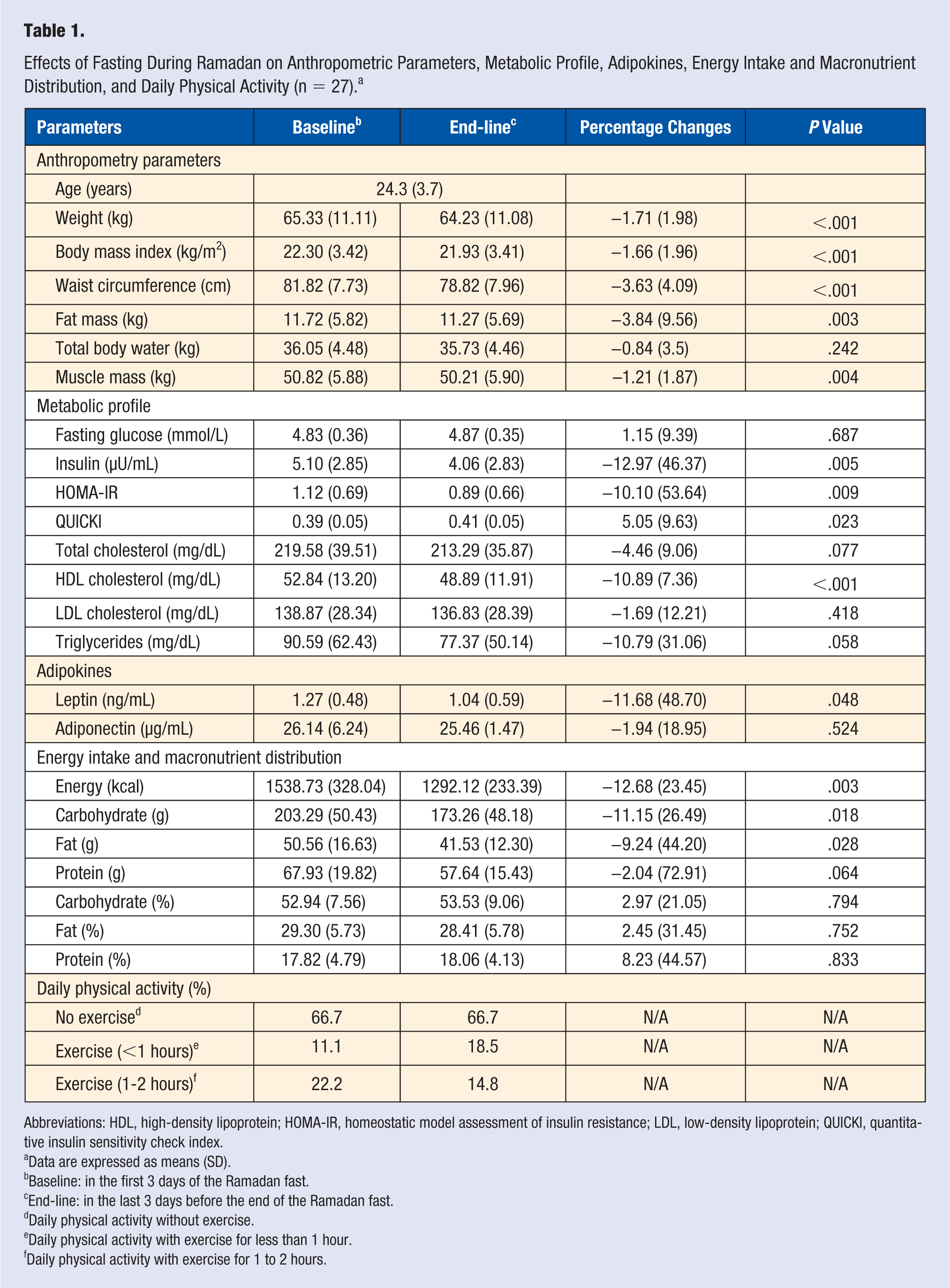
A total of 27 male Muslim participants 24.3 (3.7) years old, on average, were included in the study. Results show that intermittent fasting during Ramadan resulted in a significant weight loss from 65.33 (11.11) kg at baseline to 64.23 (11.08) kg at the end-line (P < .001) accompanied by a reduction in BMI (kg/m2) from 22.30 (3.42) at baseline to 21.93 (3.41) at end-line (P < .001). The percentage values for waist circumference, fat mass, and muscle mass also decreased significantly by −3.63 (4.09), −3.84 (9.56), and −1.21 (1.87), respectively. However, total body water did not change significantly during intermittent fasting. The mean daily energy intake (kcal) during the fasting period reduced significantly from 1538.73 (328.04) at baseline to 1292.12 (233.39) at end-line (P = .003). The majority of participants maintained their physical activity level throughout the fasting month.
No significant change in fasting plasma glucose levels was found. However, alterations in participants’ insulin status were detected because insulin and HOMA-IR were significantly lower from Ramadan fasting. Also, QUICKI increased significantly by the end-line phase. Total cholesterol, LDL-c, and TGs did not change significantly during Ramadan fasting. However, the results showed a significant decrease in percentage of HDL-c of −10.90 (7.36) that was 52.84 (13.20) mg/dL at baseline versus 48.89 (11.91) mg/dL at end-line.
At the end-line phase, serum leptin had declined significantly, whereas serum adiponectin decreased by an insignificant amount compared with the level at baseline. The mean concentrations of serum leptin at baseline and end-line were 1.27 (0.48) ng/mL and 1.04 (0.59) ng/mL, respectively, whereas serum adiponectin levels decreased insignificantly from 26.14 (6.24) µg/mL at baseline to 25.46 (1.47) µg/mL at end-line (Table 1).
Effects of Fasting During Ramadan on Anthropometric Parameters, Metabolic Profile, Adipokines, Energy Intake and Macronutrient Distribution, and Daily Physical Activity (n = 27). a
Abbreviations: HDL, high-density lipoprotein; HOMA-IR, homeostatic model assessment of insulin resistance; LDL, low-density lipoprotein; QUICKI, quantitative insulin sensitivity check index.
Data are expressed as means (SD).
Baseline: in the first 3 days of the Ramadan fast.
End-line: in the last 3 days before the end of the Ramadan fast.
Daily physical activity without exercise.
Daily physical activity with exercise for less than 1 hour.
Daily physical activity with exercise for 1 to 2 hours.
Correlation coefficients show a significant correlation between the percentage change in body weight and percentage change in serum leptin concentration (r = 0.412; P = .037) as shown in Figure 1. With decreasing body weight, serum leptin concentration decreased linearly. However, there was no correlation between change of body weight and change in serum adiponectin concentration.
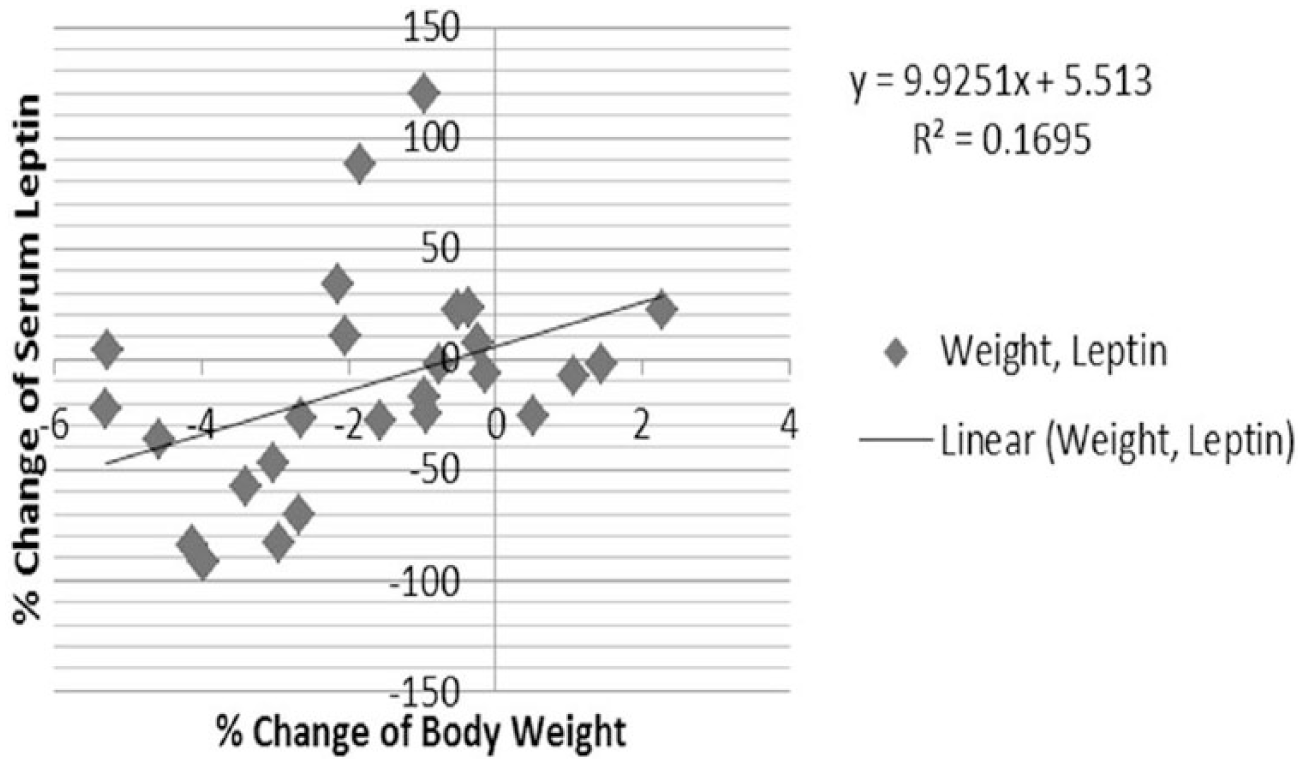
Correlation of body weight and serum leptin concentration.
Most of the participants recorded their daily physical activity without exercise during Ramadan fasting. A few participants continued being active with exercise for less than 1 hour and 1 to 2 hours during Ramadan (Table 1).
Discussion
The results of this investigation show that a significant decrease in body weight as well as BMI, fat mass, and waist circumference resulted from 4 weeks of intermittent fasting by young Muslim men during Ramadan. Although a few studies have found no change in body weight after intermittent fasting,26,27 the finding of weight and fat mass loss of the current study is consistent with previous studies.1,13 Loss of body weight and fat mass usually are the result of several factors, including negative energy balance, physical activity, and dehydration. In this study, participants reported no significant changes in physical activity during Ramadan fasting. In addition, study participants were able to maintain hydration status during Ramadan as shown by the constant level of total body water. Therefore, it is suggested that a negative energy balance might be the cause of body weight and fat loss demonstrated in the current study. In addition, weight loss correlated well with the lower caloric intake during Ramadan fasting demonstrated in this study. Heterogeneous findings were noted to determine the effect of Ramadan fasting on energy and macronutrient intake. A systematic review and meta-analysis reported that the number of studies with increased total daily energy intake was almost equal to the number of studies with decreased total daily energy intake during Ramadan. In Western and Asian populations, a reduction in daily energy intake (by 600-900 kJ/d or 143.4-215.1 kcal) was found as a result of a decline in carbohydrate consumption. 5
No significant reduction in fasting plasma glucose level after intermittent fasting was found in this study. Although a few studies have shown a reduction in plasma glucose concentrations after Ramadan fasting,28,29 our finding is in line with another study that has shown no significant effect of fasting on plasma glucose levels. 30 The differences in findings between studies on plasma glucose concentration after intermittent fasting could be attributed to individual variation in glycogen storage ability. 21 In addition, it is believed that glucose homeostasis, via gluconeogenesis of healthy young adults, might overcome the effects of this short-term intermittent fasting. In early starvation, the adaptive response to maintain energy homeostasis involves several endocrine alterations. Thus, although insulin secretion may decrease in response to reduction in the concentrations of plasma glucose and free amino acids, the homeostatic mechanisms of healthy young adults might overcome this effect of intermittent starvation.
Our results demonstrate that fasting during Ramadan decreases the concentration of HDL-c without any significant changes in total cholesterol, TG, and LDL-c levels. Studies on the effect of Ramadan fasting on blood lipids are not consistent. Some have reported no change in serum cholesterol during fasting, 14 whereas others have found raised concentrations of total cholesterol.13,31 One study has reported that alterations in blood lipids seem to be inconstant and might depend on the quality and quantity of food consumption and the degree of weight change. 32 Therefore, it might be inferred that the weight loss of participants in this study is not sufficient to lead to significant changes in blood lipid values. Moreover, HDL-c might be affected by physical activity,33-35 stress hormones,3,36 sleep cycles,37-39 and quality of lipid consumption.40,41 Even though physical activity levels were kept constant by participants throughout the study, hours of sleep, stress levels, and quality of lipids consumed were not examined. In addition, preserving hydration status also rules out the possibility of hydration causing the variations in blood parameters observed.
The results of the present study also demonstrate that intermittent fasting during Ramadan may lead to concomitant beneficial effects by improving insulin sensitivity and reducing insulin resistance. A number of studies have demonstrated that insulin sensitivity can be improved by many factors, including weight loss, 42 and a reduction in fat mass and waist circumference. 2 Therefore, the significant reduction in body weight, fat mass, and waist circumference demonstrated in this study might be the factors that increased insulin sensitivity in participants during Ramadan fasting.
It has long been established that leptin secretion may decrease in response to weight and fat loss and a negative energy balance.43,44 Therefore, it is suggested that the reduction in weight and fat mass loss found in this study might be the cause of the reduction in serum leptin concentration. The negative energy balance in participants reported in this study also supports the reduction in serum leptin concentration as the source. In addition, serum leptin has been found to have a positive correlation with serum insulin. 45 Our results similarly indicate a positive correlation between serum leptin and serum insulin concentrations. However, the present study shows that serum adiponectin levels remained constant, reflecting a stable energy reservoir in the adipose tissue. It is possible that the release of adiponectin into circulation is regulated by long-term metabolic changes, and its circulating diurnal variation is much less than that observed in leptin.46,47
A few studies have estimated circulating adiponectin levels during Ramadan fasting, and yet the available studies have shown conflicting results of either no change or a decrease in its levels, with or without changes in body mass or body fat, in healthy individuals during Ramadan.20,21,48 Studies conducted in trained young men showed that Ramadan fasting was associated with a reduction in body mass and body fat without a significant change in leptin or adiponectin levels. 48
A limitation of the present study is that only young male participants were included; thus, the impact of intermittent fasting in women could not be evaluated. In addition, there is no control group to compare the results. Moreover, sleep patterns, energy expenditure, and quality of nutrient intake profile during intermittent fasting were not examined. These factors might possibly act as confounding factors to the outcomes. Therefore, further study is recommended to determine whether these factors might influence the results.
Conclusions
The results of this observational experiment on the effects of fasting on metabolic markers in young Muslim men demonstrate that intermittent fasting during Ramadan leads to beneficial effects, improving insulin sensitivity and reducing insulin resistance. Other beneficial effects include a reduction in body weight, BMI, and waist circumference and an increase in fat loss. However, HDL-c was found to decrease after intermittent fasting.
Footnotes
Acknowledgements
The author acknowledges the contributions of all participants for their enthusiasm and cooperation.
Declaration of Conflicting Interests
The author(s) declared no potential conflicts of interest with respect to the research, authorship, and/or publication of this article.
Funding
The author(s) disclosed receipt of the following financial support for the research, authorship, and/or publication of this article: This work was supported by the 90th Anniversary of Chulalongkorn University Ratchadaphiseksomphot Endowment Fund.
Ethical Approval
The study protocol was approved by the Ethical Review Committee for Research Involving Human Research Participants, Health Science Group, Chulalongkorn University, Bangkok, Thailand (COA no. 136/2558).
Informed Consent
Written informed consent was obtained from all subjects prior to enrolling to the study. Subject’s anonymity was preserved.
